Heritage · Country
Abkhazia Culture and Heritage
Under the water of Sukhumi bay lie the walls of a Greek city founded from Miletus, and in the hills above the coast priestly families still keep seven open-air sanctuaries. This guide follows Abkhaz heritage: a language of fifty-eight consonants, the muhajir exile, and the customs of the funeral feast.Written to last.
By Confinity Heritage Editorial · Updated 2026-08-17 · 8-minute readQuiet tools, kept out of the way.
Abkhaz has fifty-eight consonants in its literary dialect and two vowels. Linguists still argue about how to describe those two, because their colour comes almost entirely from the consonants around them, and the Bzyp dialect northwest of Sukhumi keeps a handful of consonants the standard lost. It belongs to the Northwest Caucasian family, a group with no demonstrated relatives anywhere else on earth, and one of its sisters went silent in October 1992 when Tevfik Esenç, the last fluent speaker of Ubykh, died on a farm in northwestern Turkey.
Abkhazia is a strip of subtropical coast and high mountain between the Black Sea and the main Caucasus ridge, called Apsny by its own people, a name usually glossed as land of the soul, though that reading is folk etymology rather than settled scholarship. It holds Greek and Roman ruins, Byzantine and Georgian churches, a Russian monastery of the 1880s, and open-air sanctuaries where a religion older than any of them is still served. It carries two large displacements as well, one in the 1860s and 1870s and one in the 1990s, and both are heritage questions as much as political ones, because they separated people from their churches, graves and villages.
Abkhazia covers about 8,665 square kilometres between the Psou river and the Inguri on the northeastern shore of the Black Sea. The coastal strip is subtropical, planted with tangerine, tea and eucalyptus, and the land climbs fast behind it to the main Caucasus ridge, where several summits pass 4,000 metres and the limestone of the Arabika massif holds Veryovkina and Krubera, the two deepest caves yet surveyed anywhere. Local counts put the population at roughly 245,000 (Britannica).
The status of the territory is disputed and this page takes no position on it. Abkhazia took de facto control of most of the region at the end of the 1992 to 1993 war and formally declared independence in October 1999.
Russia recognised it on 26 August 2008, days after the war of that month, and three other United Nations members do so: Nicaragua from 2008, Venezuela from 2009 and Syria from 2018, while Nauru, Tuvalu and Vanuatu each recognised it and later withdrew (Wikipedia). Georgia regards Abkhazia as its own territory under Russian occupation, a position its parliament formalised on 23 October 2008, and the great majority of states and international organisations treat it the same way. The United Nations General Assembly has adopted a resolution on the status of internally displaced persons and refugees from Abkhazia and the Tskhinvali region/South Ossetia in almost every year since 2008, affirming their right to return home in safety and dignity regardless of ethnicity (UN Meetings Coverage).
On 21 January 2021, in Georgia v. Russia (II), the Grand Chamber of the European Court of Human Rights held that Russia had exercised effective control over Abkhazia, South Ossetia and the adjacent buffer zone from 12 August 2008, that this control continued after Russian troops withdrew that October, and that violations followed including of the right to life, the prohibition of ill-treatment and the freedom of movement of displaced Georgians who wished to return (HUDOC). Those are the positions of the bodies that hold them. The rest of this page is about heritage.
Sukhumi (Aqua, Sokhumi). The capital sits on a wide bay under wooded hills, on ground settled since the Greek colony of Dioscurias. Its promenade of plane trees and Italianate facades comes from the Russian imperial and Soviet resort periods, the botanical garden dates from 1840, and the Abkhazian State Museum holds the classical and medieval collections.
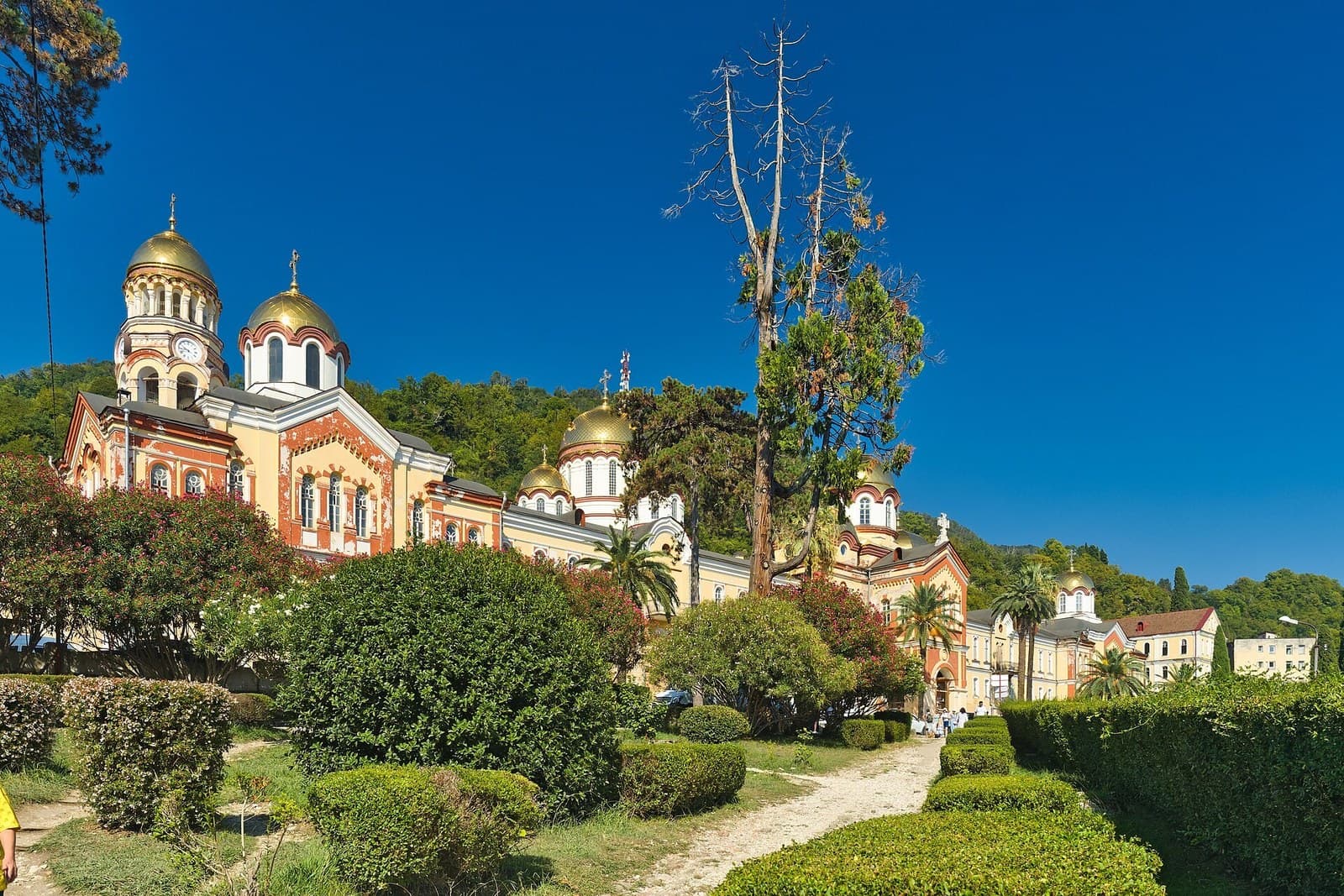
New Athos (Akhali Atoni, Anakopia). A town under Iverian Mountain, with the monastery of St Panteleimon founded in 1875 by monks from Mount Athos, the fortress of Anacopia on the summit above, and the New Athos Cave, opened in 1975 and reached by an underground railway.
Pitsunda (Bichvinta). A pine-covered cape north of Sukhumi, built over the Greek colony and Roman fort of Pityus. The tenth-century cathedral at its centre was the seat of the Abkhazian Catholicos and now serves mainly as a concert hall, an organ having been installed in 1975.
Gali and Ochamchira. The southeastern districts, historically the most heavily Mingrelian and Georgian part of Abkhazia, and home to most of those who returned after the war. Mokvi and Bedia lie within reach.
Greek traders from Miletus founded Dioscurias on the site of Sukhumi in the sixth century BC, the most distant of that city's colonies. Pliny the Elder wrote that Roman business there once required 130 interpreters, a remark quoted ever since as a measure of how many peoples came down to trade. Rome refounded the port as Sebastopolis and the sea has since taken part of it: towers and walls have been recorded underwater, and in 1953 a marble funerary stele of the fifth century BC, showing a woman and a girl in Attic style, was lifted from the seabed at the mouth of the Basla (Wikipedia).
The interior belonged to Colchis and then to small kingdoms named in Byzantine sources as Abasgia, Apsilia and Misimiania. Christianity arrived through Byzantium in the sixth century under Justinian. In 736 an Arab army under Marwan ibn Muhammad was held at the fortress of Anacopia, a siege that appears in Abkhaz and Georgian national histories alike, with different weight given to the roles of the Abasgian ruler Leon and his Kartvelian allies. Around 780 Leon II declared a kingdom independent of Byzantium, and in 1008 Bagrat III, whose mother was the sister of the last Abkhazian king, joined that crown to the eastern Georgian one and titled himself king of the Abkhazians and the Kartvelians. He built the cathedral at Bedia, consecrated around 999, and was buried there in 1014; the gold chalice he and his mother gave to that church is now in the Georgian National Museum in Tbilisi (Wikipedia). After the Mongol invasions the region passed to the Chachba princes, known in Georgian as Shervashidze, who ruled under Ottoman influence from the sixteenth century, when Islam spread along the coast. Russia took the principality as a protectorate in 1810 and abolished it in 1864.
What followed is the founding trauma of Abkhaz identity. After the Caucasian War, and again after risings at Lykhny in 1866 and across the country in 1877, the imperial authorities pushed large parts of the Abkhaz population out to the Ottoman Empire in the deportations known as muhajir, emptying central districts including Dal and Tsabal. From 1880 the Abkhaz were designated a guilty population and barred from resettling much of the coast, a restriction lifted only in 1907. Estimates vary widely and no reliable count exists, but the outcome is not in doubt: more Abkhaz now live in Turkey than in Abkhazia. The Abkhaz parliament called the deportations genocide in 1997, and 21 May is a day of mourning across the Northwest Caucasian peoples (Wikipedia).
Soviet Abkhazia was a union republic from 1921 and was reduced to an autonomous republic within Georgia in 1931; Abkhaz schools closed and the alphabet changed in the late 1930s. The war of August 1992 to September 1993 ended with Abkhaz control of the territory and with the flight or expulsion of most of the ethnic Georgian population, between 200,000 and 250,000 people out of a pre-war total of about 525,000, along with heavy losses among Abkhaz, Armenians, Greeks and Russians. The OSCE summit documents agreed at Budapest in 1994, Lisbon in 1996 and Istanbul in 1999 condemned what those documents call ethnic cleansing of the predominantly Georgian population of Abkhazia (OSCE). Perhaps 45,000 people have since returned, almost all to the Gali district.
The consonant inventory deserves an explanation rather than a headline. Abkhaz distinguishes voiced, voiceless and ejective series, then multiplies them by secondary articulations, so one basic sound can be plain, palatalised or labialised, and Bzyp adds pharyngealised uvulars on top. That is how a language reaches fifty-eight consonants. The vowel side is the mirror image: most analysts describe two vowels, one open and one close, whose actual quality is supplied by the neighbouring consonants, so what an English speaker hears as several different vowels is one phoneme wearing different coats (Wikipedia).
The alphabet has been a political instrument for a century and a half. Peter von Uslar devised a 37-letter Cyrillic script in 1862, a 55-letter version was in use by 1909, Nikolai Marr's Latin analytical alphabet was imposed briefly in the 1920s, and the Georgian script was adopted in 1938 and used until 1954, when Cyrillic returned. Each change cut a generation off from what the one before it had written. Abkhaz is official in the territory and taught in schools, its closest relative Abaza is written separately in Karachay-Cherkessia, and UNESCO lists Abkhaz among vulnerable languages.
Place names carry the layers. Aqua, Sokhumi and Sukhumi name one harbour in Abkhaz, Georgian and Russian usage, and Bichvinta and Pitsunda both descend from the Latin and Greek word for pine, after the trees on the cape. In the southeast, Abkhaz names sit alongside Mingrelian and Georgian ones, and people usually use a village's older name when saying where a family came from.
Apsuara, roughly the Abkhaz way, is the unwritten code that organises behaviour: hospitality that cannot be refused, deference to elders, restraint in speech, and above all alamys, a word covering conscience, honour and shame at once. Councils of elders still settle disputes at village level and are consulted on national questions, and fosterage, in which a child was raised for years in another household, tied families across clans and sometimes across ethnic lines.
The table is formal. A meal has a tamada who directs the toasts, and abysta, the unsalted maize porridge eaten with smoked cheese, walnut sauces and the pepper paste called adjika, is served at every level of society. Music runs to polyphony, two upper voices over a drone, sung by men in a line with arms linked, and the two-string apkhyartsa fiddle carries the heroic songs, including the one sung over a wounded man to keep him from sleeping.
Longevity is the claim the outside world knows. Soviet publicity in the 1960s and 1970s presented Abkhazia as a land of working centenarians, complete with choirs of very old men. Demographers who examined the documents found the ages unverifiable, and Zhores Medvedev's 1974 paper concluded that the record was a social phenomenon built on missing birth registration rather than a biological one (The Gerontologist). The choirs were real. The numbers were not.
Three religious systems occupy the same population, and many people belong to more than one: Orthodox Christianity, present since the sixth century and the nominal faith of most Abkhaz; Sunni Islam, which arrived with Ottoman influence and is professed by a minority; and the Abkhaz traditional religion, served at open-air sanctuaries that were never fully abandoned.
 New Athos was founded in 1875 by monks from Mount Athos, closed under Soviet rule and used as a warehouse and a hospital, and reopened in the 1990s. Photograph by Hons084, CC BY-SA 4.0, via Wikimedia Commons.
Those sanctuaries are the unusual part. Seven principal shrines, called the anykha, are recognised: Dydrypsh, Lashkendar, Ldzaa, Lykhny, Elyr, Inal-Kuba and Bytkha, most of them again in use since the 1990s. Each has a priest who must come from a particular family, so the office passes by descent within lineages such as Chichba at Dydrypsh above Achandara, Gochua at Ldzaa and Shakryl at Lykhny. Prayers are said in the open, a bull is sacrificed and its meat shared, and oaths sworn at Dydrypsh are treated as binding in ways a court document is not. Scholars describe the system both as a survival, since priestly families passed their knowledge on quietly under Christianity, Islam and Soviet atheism, and as a revival, since public practice resumed only in the 1980s and 1990s (Wikipedia). A council uniting the seven priests was constituted in Sukhumi on 3 August 2012. A survey with the 2003 census put explicit adherence at around 8 per cent, which understates practice, since going to a sanctuary is not thought to conflict with being baptised.
Burial usually happens in family ground, often within sight of the house, and the graves stay in the household's care rather than a municipal cemetery's. The body is kept at home while relatives and neighbours come to see it, women keening in the room and men receiving condolences in the yard. Mourning is loud at the start and long afterwards: the funeral feast on the day of burial, another on the fortieth day, and an annual commemoration at which the dead are addressed directly in the toasts. Hosting it properly is an obligation families borrow to meet.
Older practice runs alongside the church. The hearth chain over the fire was the object families swore on and the thing a bride was led around when she entered the household, which made the fire itself the continuing line rather than a building or a document, and sanctuary prayers name the lineage's dead.
Two griefs sit behind all of this. The muhajir deportations left villages whose descendants are now in Turkey, Jordan and Syria, and the day of mourning on 21 May draws people to the shore to throw flowers into the sea for those who died on the crossings. The war of 1992 and 1993 left memorials in every town and a Gali district split by a ceasefire line: people displaced south of the Inguri have relatives, houses and family graves north of it, and reaching a grave has depended on the state of the crossings in any given year.
Abkhazia's records were burned during the war that made it de facto independent, and the fire was the point.
In October 1992, during the conflict with Georgia, the Abkhazian State Archives and the Institute of Language, Literature and History in Sukhum were burned. The institute held the manuscript collections, the folklore recordings and the historical documentation of the Abkhaz people, and the archive held the civil records of the republic. The destruction was widely understood as deliberate, and it removed both the state's paperwork and the scholarly record of a small nation in one night.
The older absence is the muhajir exile. After the Russian conquest of the Caucasus, a very large share of the Abkhaz population was expelled or left for the Ottoman Empire in the 1860s and 1870s, and their descendants in Turkey now outnumber the Abkhaz in Abkhazia by a wide margin. The Ottoman settlement records document where they went, and the Turkish diaspora keeps its own genealogy.
Abkhaz descent runs through the abipara, the patrilineal clan, and clan names are recognisable and placed.
Since 1993 Abkhazia has issued its own documents, recognised by Russia and a handful of others and not by Ukraine, Georgia or the wider world. The Georgians displaced from Abkhazia, over two hundred thousand people, have their records on the other side, and their property claims remain unresolved.
The Abkhazian State Museum in Sukhumi, founded in 1915, holds material from Dioscurias and Sebastopolis, medieval metalwork and an ethnographic collection, and it reopened after the war with very limited resources. The written record is harder to repair. On 22 October 1992, while Sukhumi was held by Georgian forces, the state archive and the Abkhazian institute of history, language and literature were set alight; the fire was started twice by armed men who drove off neighbours trying to put it out, and no authority ever claimed responsibility. Estimates of the loss run to about 95 per cent of the holdings, including nineteenth-century collections held nowhere else (openDemocracy).
Monuments face a subtler problem. No site in Abkhazia is on the World Heritage List, and none can easily be, because the territory is not a state party to the 1972 convention and Georgia, which is, cannot get in to do the monitoring or nomination work the convention requires. UNESCO missions do not go there, and that gap has consequences. Repairs at the eleventh-century church of Ilori around 2010 and 2011 replaced the roof with a dome of Russian type and removed exterior inscriptions, and Georgian heritage bodies, among them ICOMOS Georgia and campaigners who appealed to the Blue Shield network under the 1954 Hague Convention, protested that original fabric had been destroyed (Wikipedia). Abkhaz church authorities defended it as necessary conservation, and similar arguments have followed work at Bedia and Mokvi.
Interpretation is contested in its own right. The Great Abkhazian Wall, which runs inland from the Kelasuri river for roughly 160 kilometres with hundreds of towers, has been dated by Georgian scholarship to the seventeenth century and the Mingrelian ruler Levan II Dadiani, and by Soviet, Russian and Abkhaz archaeologists, including Yuri Voronov and the survey teams of 2013 to 2015, to late antiquity or the early medieval period (Wikipedia). The identity of the medieval kingdom's population is argued along the same lines, and this page describes the readings rather than choosing one.
Copies have become the safeguard. After the 1992 fire, archivists began reassembling what they could from duplicates in Tbilisi, Moscow and St Petersburg, since much imperial and Soviet paperwork existed in more than one place. Apsnyteka, an online Abkhaz library, has published several thousand scanned books, journals and documents in Abkhaz and Russian, and it is the most accessible single collection for anyone working on the region (Apsnyteka).
Language work has gone the same way, with a Wikipedia edition, a digital corpus, and dictionaries and school materials circulating online in a way a small print run never could. The recordings made of Tevfik Esenç by Georges Dumézil and Hans Vogt remain the basis of everything known about Ubykh.
Fazil Iskander, born in Sukhumi in 1929, wrote in Russian and made an Abkhaz mountain village into one of the enduring settings of twentieth-century Russian prose in his Sandro of Chegem cycle. Bagrat Shinkuba, writing in Abkhaz, produced The Last of the Departed, a novel about the extinction of the Ubykh and their language and the most direct literary treatment of the muhajir period by anyone.
The Abkhaz State Drama Theatre performs in Abkhaz, and a repatriation programme has brought several thousand people back from the Turkish and Syrian diaspora, some speaking a nineteenth-century dialect.
The alphabet came back. Cyrillic was restored in 1954 after sixteen years in which Abkhaz was written in Georgian script, and the language is now taught, published and broadcast in its own letters.
An archive partly reassembled. Duplicate holdings in Tbilisi, Moscow and St Petersburg have let archivists recover part of what burned in October 1992, and the state museum reopened after the war with the collections that survived it.
A dead language kept on tape. The Ubykh recordings made with Tevfik Esenç preserved a full Northwest Caucasian language after its last speaker died, and they underpin the grammars Abkhaz and Circassian linguists use today.
New Athos was founded in 1875 by monks from Mount Athos, closed under Soviet rule and used as a warehouse and a hospital, and reopened in the 1990s. Photograph by Hons084, CC BY-SA 4.0, via Wikimedia Commons.
Those sanctuaries are the unusual part. Seven principal shrines, called the anykha, are recognised: Dydrypsh, Lashkendar, Ldzaa, Lykhny, Elyr, Inal-Kuba and Bytkha, most of them again in use since the 1990s. Each has a priest who must come from a particular family, so the office passes by descent within lineages such as Chichba at Dydrypsh above Achandara, Gochua at Ldzaa and Shakryl at Lykhny. Prayers are said in the open, a bull is sacrificed and its meat shared, and oaths sworn at Dydrypsh are treated as binding in ways a court document is not. Scholars describe the system both as a survival, since priestly families passed their knowledge on quietly under Christianity, Islam and Soviet atheism, and as a revival, since public practice resumed only in the 1980s and 1990s (Wikipedia). A council uniting the seven priests was constituted in Sukhumi on 3 August 2012. A survey with the 2003 census put explicit adherence at around 8 per cent, which understates practice, since going to a sanctuary is not thought to conflict with being baptised.
Burial usually happens in family ground, often within sight of the house, and the graves stay in the household's care rather than a municipal cemetery's. The body is kept at home while relatives and neighbours come to see it, women keening in the room and men receiving condolences in the yard. Mourning is loud at the start and long afterwards: the funeral feast on the day of burial, another on the fortieth day, and an annual commemoration at which the dead are addressed directly in the toasts. Hosting it properly is an obligation families borrow to meet.
Older practice runs alongside the church. The hearth chain over the fire was the object families swore on and the thing a bride was led around when she entered the household, which made the fire itself the continuing line rather than a building or a document, and sanctuary prayers name the lineage's dead.
Two griefs sit behind all of this. The muhajir deportations left villages whose descendants are now in Turkey, Jordan and Syria, and the day of mourning on 21 May draws people to the shore to throw flowers into the sea for those who died on the crossings. The war of 1992 and 1993 left memorials in every town and a Gali district split by a ceasefire line: people displaced south of the Inguri have relatives, houses and family graves north of it, and reaching a grave has depended on the state of the crossings in any given year.
Abkhazia's records were burned during the war that made it de facto independent, and the fire was the point.
In October 1992, during the conflict with Georgia, the Abkhazian State Archives and the Institute of Language, Literature and History in Sukhum were burned. The institute held the manuscript collections, the folklore recordings and the historical documentation of the Abkhaz people, and the archive held the civil records of the republic. The destruction was widely understood as deliberate, and it removed both the state's paperwork and the scholarly record of a small nation in one night.
The older absence is the muhajir exile. After the Russian conquest of the Caucasus, a very large share of the Abkhaz population was expelled or left for the Ottoman Empire in the 1860s and 1870s, and their descendants in Turkey now outnumber the Abkhaz in Abkhazia by a wide margin. The Ottoman settlement records document where they went, and the Turkish diaspora keeps its own genealogy.
Abkhaz descent runs through the abipara, the patrilineal clan, and clan names are recognisable and placed.
Since 1993 Abkhazia has issued its own documents, recognised by Russia and a handful of others and not by Ukraine, Georgia or the wider world. The Georgians displaced from Abkhazia, over two hundred thousand people, have their records on the other side, and their property claims remain unresolved.
The Abkhazian State Museum in Sukhumi, founded in 1915, holds material from Dioscurias and Sebastopolis, medieval metalwork and an ethnographic collection, and it reopened after the war with very limited resources. The written record is harder to repair. On 22 October 1992, while Sukhumi was held by Georgian forces, the state archive and the Abkhazian institute of history, language and literature were set alight; the fire was started twice by armed men who drove off neighbours trying to put it out, and no authority ever claimed responsibility. Estimates of the loss run to about 95 per cent of the holdings, including nineteenth-century collections held nowhere else (openDemocracy).
Monuments face a subtler problem. No site in Abkhazia is on the World Heritage List, and none can easily be, because the territory is not a state party to the 1972 convention and Georgia, which is, cannot get in to do the monitoring or nomination work the convention requires. UNESCO missions do not go there, and that gap has consequences. Repairs at the eleventh-century church of Ilori around 2010 and 2011 replaced the roof with a dome of Russian type and removed exterior inscriptions, and Georgian heritage bodies, among them ICOMOS Georgia and campaigners who appealed to the Blue Shield network under the 1954 Hague Convention, protested that original fabric had been destroyed (Wikipedia). Abkhaz church authorities defended it as necessary conservation, and similar arguments have followed work at Bedia and Mokvi.
Interpretation is contested in its own right. The Great Abkhazian Wall, which runs inland from the Kelasuri river for roughly 160 kilometres with hundreds of towers, has been dated by Georgian scholarship to the seventeenth century and the Mingrelian ruler Levan II Dadiani, and by Soviet, Russian and Abkhaz archaeologists, including Yuri Voronov and the survey teams of 2013 to 2015, to late antiquity or the early medieval period (Wikipedia). The identity of the medieval kingdom's population is argued along the same lines, and this page describes the readings rather than choosing one.
Copies have become the safeguard. After the 1992 fire, archivists began reassembling what they could from duplicates in Tbilisi, Moscow and St Petersburg, since much imperial and Soviet paperwork existed in more than one place. Apsnyteka, an online Abkhaz library, has published several thousand scanned books, journals and documents in Abkhaz and Russian, and it is the most accessible single collection for anyone working on the region (Apsnyteka).
Language work has gone the same way, with a Wikipedia edition, a digital corpus, and dictionaries and school materials circulating online in a way a small print run never could. The recordings made of Tevfik Esenç by Georges Dumézil and Hans Vogt remain the basis of everything known about Ubykh.
Fazil Iskander, born in Sukhumi in 1929, wrote in Russian and made an Abkhaz mountain village into one of the enduring settings of twentieth-century Russian prose in his Sandro of Chegem cycle. Bagrat Shinkuba, writing in Abkhaz, produced The Last of the Departed, a novel about the extinction of the Ubykh and their language and the most direct literary treatment of the muhajir period by anyone.
The Abkhaz State Drama Theatre performs in Abkhaz, and a repatriation programme has brought several thousand people back from the Turkish and Syrian diaspora, some speaking a nineteenth-century dialect.
The alphabet came back. Cyrillic was restored in 1954 after sixteen years in which Abkhaz was written in Georgian script, and the language is now taught, published and broadcast in its own letters.
An archive partly reassembled. Duplicate holdings in Tbilisi, Moscow and St Petersburg have let archivists recover part of what burned in October 1992, and the state museum reopened after the war with the collections that survived it.
A dead language kept on tape. The Ubykh recordings made with Tevfik Esenç preserved a full Northwest Caucasian language after its last speaker died, and they underpin the grammars Abkhaz and Circassian linguists use today.
National Overview
Notable Cities
Historical Foundations
Linguistic and Etymological Roots
Cultural Identity
Religion and Spirituality
Remembrance and Mourning Traditions
Tracing a Family in Abkhazia
Heritage Preservation Efforts
Digital Heritage
Contemporary Cultural Influences
Success Stories
References and resources
- Encyclopaedia Britannica, Abkhazia: geography and population.
- International recognition of Abkhazia and South Ossetia, Wikipedia: who recognises, and who withdrew.
- UN Meetings Coverage, resolution on Georgia's displaced: the annual right of return text.
- European Court of Human Rights, Georgia v. Russia (II): judgment of 21 January 2021.
- OSCE, Istanbul Summit Document 1999: the summit language on displacement.
- Abkhaz language, Wikipedia: phonology, dialects, alphabet.
- Muhajir (Caucasus), Wikipedia: the deportations and the diaspora.
- Council of Priests of Abkhazia, Wikipedia: the sanctuaries and priestly families.
- Zhores Medvedev, Caucasus and Altay longevity: the centenarian claims examined.
- Thomas de Waal, Abkhazia's archive: fire of war, ashes of history: 22 October 1992.
- Kelasuri Wall, Wikipedia: the competing datings.