Heritage · Museum
Kunsthistorisches Museum: Vienna's Imperial Art Treasury
Opened in 1891 to display the art amassed by the Habsburg dynasty, the Kunsthistorisches Museum in Vienna holds the world's largest Bruegel collection and Vermeer's Art of Painting. Its galleries, imperial Kunstkammer and antiquities occupy a domed Ringstrasse palace facing its twin, the Natural History Museum.Written to last.
By Confinity Heritage Editorial · Updated 2026-07-31 · 7-minute readQuiet tools, kept out of the way.
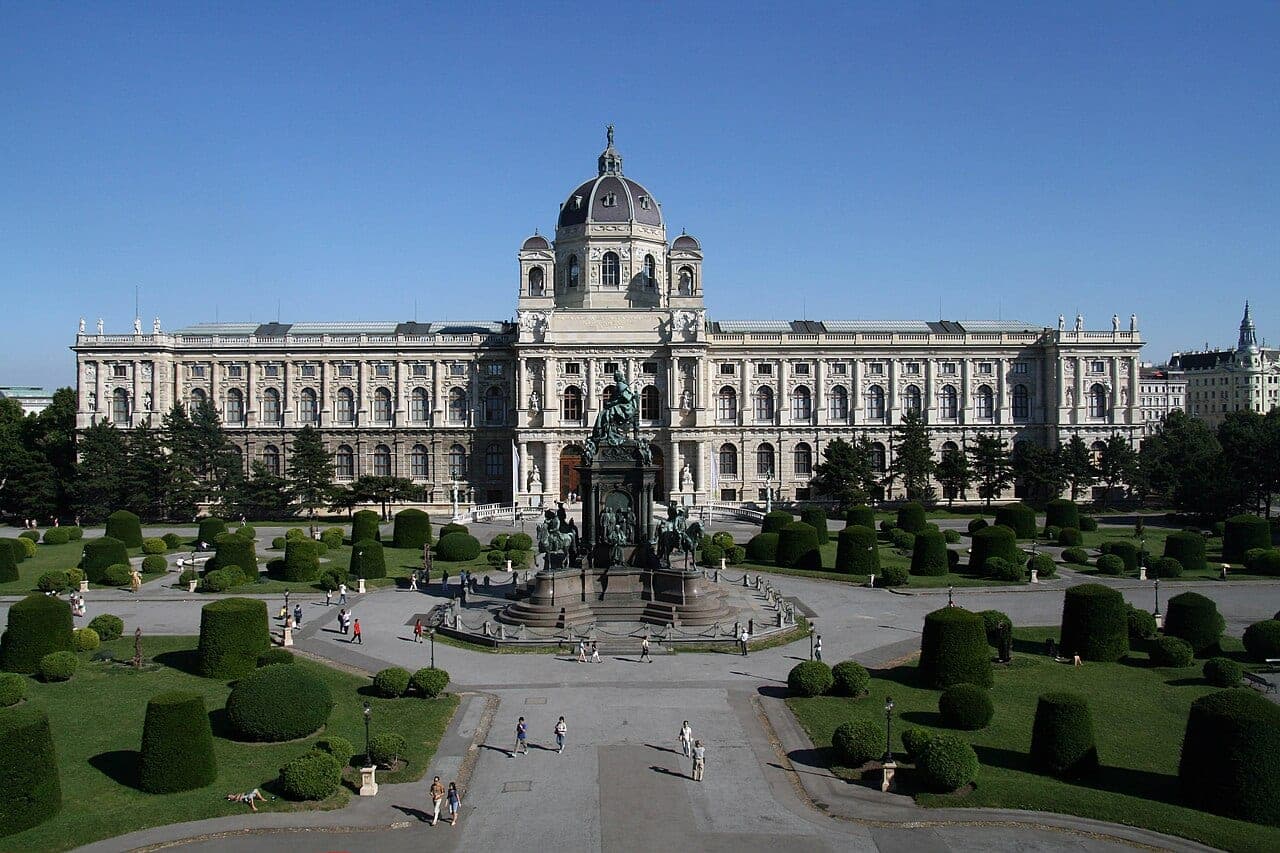
The Kunsthistorisches Museum, whose name translates as the Museum of Art History, is the largest art museum in Austria and one of the principal galleries of Europe. It occupies a domed palace on the Ringstrasse in central Vienna, facing an almost identical building, the Natural History Museum, across the formal square of Maria-Theresien-Platz. The museum opened in 1891 and was built for a single purpose: to gather under one roof the art that the House of Habsburg had accumulated over more than three centuries of rule. Its departments run from a picture gallery of the first rank to an imperial collection of decorative treasures, ancient Egyptian and Near Eastern antiquities, Greek and Roman sculpture, and one of the largest coin collections anywhere.
What sets the collection apart is its origin. It was not assembled by a modern state buying on the open market but inherited from a dynasty, the record of what generations of emperors, archdukes and governors chose to own. That inheritance produced concentrations found nowhere else, among them twelve panels by Pieter Bruegel the Elder, the largest holding of his work in the world, Johannes Vermeer's The Art of Painting, and the only surviving gold sculpture securely given to the Florentine goldsmith Benvenuto Cellini. To walk the galleries is to read the taste of the Habsburgs across the centuries in which they were among the wealthiest patrons in Europe.
The holdings are far older than the building. Several Habsburg rulers were serious collectors, and their separate hoards form the foundation of the modern departments. In Prague, Emperor Rudolf II assembled one of the most famous cabinets of art and curiosities in Renaissance Europe. At Ambras Castle in the Tyrol, Archduke Ferdinand II built a collection of armour, portraits and rarities that survives as one of the oldest museum collections in existence. In the seventeenth century Archduke Leopold Wilhelm, governor of the Spanish Netherlands, brought together several hundred paintings, many of them Venetian and Flemish, that still form the core of the picture gallery.
For most of their history these collections were dispersed among imperial palaces, hunting lodges and the Belvedere, where part of the picture gallery had been shown to the public since the eighteenth century. By the middle of the nineteenth century the case for a single modern museum had become clear. When Emperor Franz Joseph I ordered the old city walls demolished and the grand boulevard of the Ringstrasse laid out in their place, the plan set aside a site for a pair of imperial museums. The Kunsthistorisches Museum opened to the public on 17 October 1891, its collections drawn together from across the Habsburg residences into the purpose-built galleries where they remain.
The building and its twin were designed by the German architect Gottfried Semper together with the Viennese architect Karl von Hasenauer, and raised between 1871 and 1891. They are matched Renaissance Revival palaces of sandstone, each crowned by an octagonal dome rising about sixty metres, set as mirror images on either side of Maria-Theresien-Platz. Between them stands a large monument to Empress Maria Theresa, so that the two museums, art history on one side and natural history on the other, frame the square as a single composition. The Natural History Museum holds the imperial scientific collections; the Kunsthistorisches Museum holds the art.
 The staircase is part of the exhibit. Klimt was in his twenties when he painted the spandrels above it, before the style he is remembered for. Photograph by Petar Milosevic, CC BY-SA 4.0, via Wikimedia Commons.
The interior was conceived as a setting worthy of the collection. The grand staircase, faced in marble, climbs toward Antonio Canova's sculptural group of Theseus defeating a centaur on the landing above. Its ceiling carries a large painting by the Hungarian artist Mihály Munkácsy, and the lunettes were painted by Hans Makart, the most celebrated decorative painter of Vienna's late imperial years. The paintings in the spandrels and the narrow bays between the columns were the work of a young partnership that included Gustav Klimt, his brother Ernst Klimt and Franz Matsch. These early panels, made before Klimt broke toward the style that would make him famous, are among the most sought-out details in the museum, and the domed hall at the head of the stairs now holds a café beneath its cupola.
The Picture Gallery is the department most visitors come for. Its collection of Pieter Bruegel the Elder is the largest in the world, twelve panels that amount to roughly a third of his surviving output, including The Hunters in the Snow (1565), The Tower of Babel (1563) and The Peasant Wedding. Nearby hangs Vermeer's The Art of Painting, an oil of about 1666 to 1668 that is often called his most ambitious composition. The Italian and Spanish rooms hold Raphael's Madonna of the Meadow, works by Caravaggio and Titian, and a celebrated series of portraits by Diego Velázquez of the Infanta Margarita Teresa. Those portraits reached Vienna as a family matter: they were sent from the Spanish court so that the child's Austrian relatives could follow her likeness as she grew toward her marriage to Emperor Leopold I, a union typical of the ties between the Spanish and Austrian branches of the dynasty. The northern rooms add Peter Paul Rubens, Rembrandt and Albrecht Dürer.
The Kunstkammer, the chamber of art and marvels, gathers the decorative treasures of the imperial collections: goldsmiths' work, carved ivory and rock crystal, bronzes, clocks and automata, and objects worked from exotic materials. Closed for renovation for more than a decade, it reopened in 2013. Its best-known object is the Saliera, or salt cellar, a small sculpture in gold and enamel made by Benvenuto Cellini between about 1540 and 1543 for King Francis I of France, and the only surviving gold work securely attributed to him. The Saliera was stolen from the museum in 2003 and recovered in 2006, buried in a lead box in the Austrian countryside, after which it returned to display.
Three further departments carry the collection back into antiquity and outward across cultures. The Egyptian and Near Eastern Collection holds sarcophagi, statuary, papyri and everyday objects, some of the oldest pieces in the museum. The Collection of Greek and Roman Antiquities ranges from Cypriot and Greek sculpture to Roman cameos, among them the famous Gemma Augustea. The Coin Cabinet, or Münzkabinett, is one of the largest and most important collections of its kind in the world, its holdings of coins, medals and related objects numbering in the hundreds of thousands and spanning nearly the whole recorded history of money.
The museum is, in effect, the visible record of the Habsburgs as collectors, and its holdings document not only European painting and sculpture but the tastes, marriages and reach of a dynasty that ruled across much of Europe for centuries. That same history has given the museum a serious responsibility for the origins of its objects. Like the other Austrian federal museums, it carries out provenance research into how works entered its collections, with particular attention to the years of National Socialist rule and the Second World War, when many artworks in Austria changed hands under duress or were seized outright.
Austria addressed this question through the Art Restitution Act of 1998, which provides for the return of objects that entered the federal collections improperly during the Nazi period, and through the Commission for Provenance Research established in the same year to examine museum inventories. The Kunsthistorisches Museum publishes the findings of this continuing research and has returned works where the evidence supported a claim. One much-discussed case concerns Vermeer's The Art of Painting, which the Austrian state acquired in 1940 from the Czernin family during the German annexation; a later restitution claim by the family's heirs was examined and not upheld under the Act. The museum presents this work as an ongoing obligation rather than a closed chapter.
The Kunsthistorisches Museum stands on Maria-Theresien-Platz between the Ringstrasse and the MuseumsQuartier, in the centre of Vienna and within easy walking distance of the Hofburg and the Ringstrasse trams. The nearest underground stations are Volkstheater and Museumsquartier, and several tram and bus routes stop close by. A single ticket admits visitors to the main departments, while a combined ticket links the main building with the museum's other sites, among them the Imperial Armoury and the collection of historical musical instruments in the Hofburg and the Ambras collections near Innsbruck.
The galleries are large and densely hung, so it helps to decide in advance whether to concentrate on the Picture Gallery, the Kunstkammer or the antiquities rather than attempt everything in one visit. The café beneath the cupola is a destination in its own right. Opening hours and prices change with the season, and some departments keep different schedules, so it is worth checking the official website for current times, ticket options and any temporary closures before travelling rather than relying on figures quoted elsewhere.
The staircase is part of the exhibit. Klimt was in his twenties when he painted the spandrels above it, before the style he is remembered for. Photograph by Petar Milosevic, CC BY-SA 4.0, via Wikimedia Commons.
The interior was conceived as a setting worthy of the collection. The grand staircase, faced in marble, climbs toward Antonio Canova's sculptural group of Theseus defeating a centaur on the landing above. Its ceiling carries a large painting by the Hungarian artist Mihály Munkácsy, and the lunettes were painted by Hans Makart, the most celebrated decorative painter of Vienna's late imperial years. The paintings in the spandrels and the narrow bays between the columns were the work of a young partnership that included Gustav Klimt, his brother Ernst Klimt and Franz Matsch. These early panels, made before Klimt broke toward the style that would make him famous, are among the most sought-out details in the museum, and the domed hall at the head of the stairs now holds a café beneath its cupola.
The Picture Gallery is the department most visitors come for. Its collection of Pieter Bruegel the Elder is the largest in the world, twelve panels that amount to roughly a third of his surviving output, including The Hunters in the Snow (1565), The Tower of Babel (1563) and The Peasant Wedding. Nearby hangs Vermeer's The Art of Painting, an oil of about 1666 to 1668 that is often called his most ambitious composition. The Italian and Spanish rooms hold Raphael's Madonna of the Meadow, works by Caravaggio and Titian, and a celebrated series of portraits by Diego Velázquez of the Infanta Margarita Teresa. Those portraits reached Vienna as a family matter: they were sent from the Spanish court so that the child's Austrian relatives could follow her likeness as she grew toward her marriage to Emperor Leopold I, a union typical of the ties between the Spanish and Austrian branches of the dynasty. The northern rooms add Peter Paul Rubens, Rembrandt and Albrecht Dürer.
The Kunstkammer, the chamber of art and marvels, gathers the decorative treasures of the imperial collections: goldsmiths' work, carved ivory and rock crystal, bronzes, clocks and automata, and objects worked from exotic materials. Closed for renovation for more than a decade, it reopened in 2013. Its best-known object is the Saliera, or salt cellar, a small sculpture in gold and enamel made by Benvenuto Cellini between about 1540 and 1543 for King Francis I of France, and the only surviving gold work securely attributed to him. The Saliera was stolen from the museum in 2003 and recovered in 2006, buried in a lead box in the Austrian countryside, after which it returned to display.
Three further departments carry the collection back into antiquity and outward across cultures. The Egyptian and Near Eastern Collection holds sarcophagi, statuary, papyri and everyday objects, some of the oldest pieces in the museum. The Collection of Greek and Roman Antiquities ranges from Cypriot and Greek sculpture to Roman cameos, among them the famous Gemma Augustea. The Coin Cabinet, or Münzkabinett, is one of the largest and most important collections of its kind in the world, its holdings of coins, medals and related objects numbering in the hundreds of thousands and spanning nearly the whole recorded history of money.
The museum is, in effect, the visible record of the Habsburgs as collectors, and its holdings document not only European painting and sculpture but the tastes, marriages and reach of a dynasty that ruled across much of Europe for centuries. That same history has given the museum a serious responsibility for the origins of its objects. Like the other Austrian federal museums, it carries out provenance research into how works entered its collections, with particular attention to the years of National Socialist rule and the Second World War, when many artworks in Austria changed hands under duress or were seized outright.
Austria addressed this question through the Art Restitution Act of 1998, which provides for the return of objects that entered the federal collections improperly during the Nazi period, and through the Commission for Provenance Research established in the same year to examine museum inventories. The Kunsthistorisches Museum publishes the findings of this continuing research and has returned works where the evidence supported a claim. One much-discussed case concerns Vermeer's The Art of Painting, which the Austrian state acquired in 1940 from the Czernin family during the German annexation; a later restitution claim by the family's heirs was examined and not upheld under the Act. The museum presents this work as an ongoing obligation rather than a closed chapter.
The Kunsthistorisches Museum stands on Maria-Theresien-Platz between the Ringstrasse and the MuseumsQuartier, in the centre of Vienna and within easy walking distance of the Hofburg and the Ringstrasse trams. The nearest underground stations are Volkstheater and Museumsquartier, and several tram and bus routes stop close by. A single ticket admits visitors to the main departments, while a combined ticket links the main building with the museum's other sites, among them the Imperial Armoury and the collection of historical musical instruments in the Hofburg and the Ambras collections near Innsbruck.
The galleries are large and densely hung, so it helps to decide in advance whether to concentrate on the Picture Gallery, the Kunstkammer or the antiquities rather than attempt everything in one visit. The café beneath the cupola is a destination in its own right. Opening hours and prices change with the season, and some departments keep different schedules, so it is worth checking the official website for current times, ticket options and any temporary closures before travelling rather than relying on figures quoted elsewhere.
History and founding
The building