Heritage · Country
United States Virgin Islands Culture and Heritage
Three small islands held by Denmark for nearly 250 years and sold to the United States in 1917, where enslaved Africans mounted one of the earliest sustained revolts in the Americas and won their freedom by marching on a fort. This is a guide to Virgin Islands heritage, its Creole speech, its quelbe bands and the nine nights by which families sit with their dead.Written to last.
By Confinity Heritage Editorial · Updated 2026-08-17 · 8-minute readQuiet tools, kept out of the way.
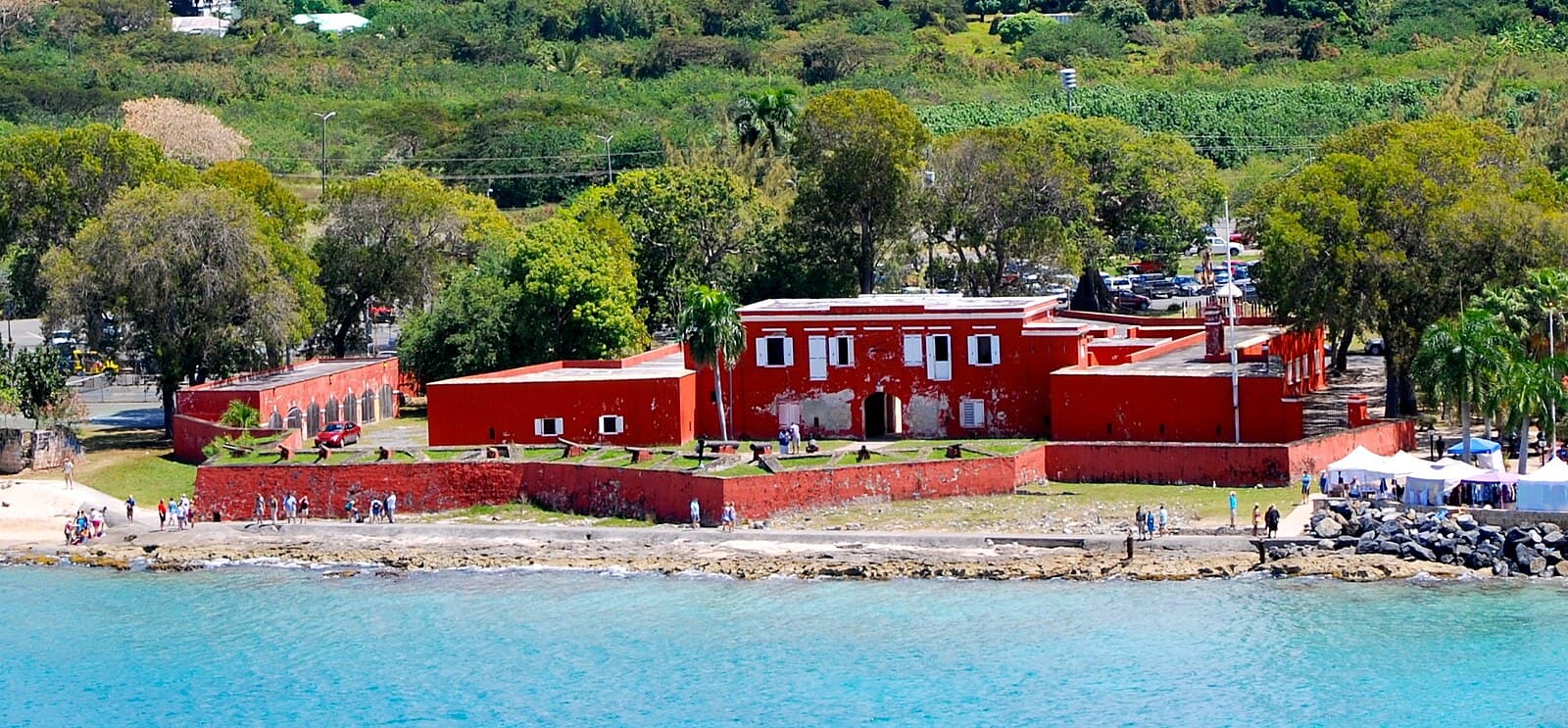
On the morning of 3 July 1848, several thousand enslaved people from the estates of western St Croix walked into Frederiksted and stood in front of the red walls of Fort Frederik. They had come to demand their freedom, and by the afternoon the Danish governor-general had granted it, over the heads of his own government and of every planter on the island. Danish rule lasted another sixty-nine years, but the date on which Virgin Islanders mark their emancipation is the one they took for themselves.
That is the shape of the territory's history in miniature. Almost everything here was built by people who were brought against their will and who then made the place their own: the grid of Christiansted and the sugar works at Whim were raised by enslaved labour, the Creole language grew in the slave quarters and the mission schools, and the music now recognised as the islands' own was assembled from a banjo, a washboard and a length of car exhaust pipe.
The United States Virgin Islands are a group of three main islands and about fifty islets and cays at the eastern end of the Greater Antilles, covering roughly 346 square kilometres with a population of 87,146 at the 2020 census. St Croix, the largest and the flattest, lies about 65 kilometres south of the other two and carries the sugar landscape; St Thomas holds the capital, Charlotte Amalie, and one of the busiest cruise harbours in the Caribbean; St John, the smallest of the three, is about sixty per cent national park. The territory is an unincorporated, organised territory of the United States governed under the Revised Organic Act of 1954, with a legislature of fifteen senators and, since 1970, a governor elected by the islands rather than appointed from Washington. Residents are United States citizens who send a non-voting delegate to the House and who cannot vote in presidential elections while they live in the territory, an arrangement that shapes much of local political argument. English is official, and roughly three-quarters of residents identify as Black or African American.
Charlotte Amalie. The capital on St Thomas grew from a Danish settlement of the 1670s known first as Taphus, "beer houses", and was renamed for the queen consort of Christian V. Its street names are still Danish, Dronningens Gade and Kongens Gade among them, and its hillside is climbed by stepped alleys including the 99 Steps, built from the brick that Danish ships carried as ballast. The St Thomas Synagogue, rebuilt in 1833 after fire and floored with sand in the Sephardic manner, is the second-oldest synagogue building in continuous use in the western hemisphere and a National Historic Landmark (Wikipedia).
 Christiansted was laid out by the Danish West India Company on a grid with arcaded walkways, and the buildings around the wharf are where the sugar and the people who cut it were both traded. Photograph by Fritz Henle for the Historic American Buildings Survey, public domain, via Wikimedia Commons.
Christiansted. Laid out on a Danish grid from 1735 and built in yellow ballast brick with arcaded walkways, Christiansted was the capital of the Danish West Indies. Its waterfront is now a National Historic Site holding Fort Christiansvaern, the Danish West India and Guinea Company warehouse where enslaved people were sold, the Scale House and the Steeple Building of 1753. Alexander Hamilton clerked on this waterfront as a teenager before leaving for New York.
Frederiksted. Founded on the western end of St Croix in 1751, Frederiksted is the emancipation town. Fort Frederik, whose walls are painted the same red as when they were built, is where freedom was proclaimed in 1848 and where the Fireburn of 1878 began; much of the surrounding district was rebuilt after that fire in a Victorian style set on older Danish foundations.
Cruz Bay and Coral Bay. St John's two settlements sit at either end of an island whose interior is national park. Coral Bay is where the 1733 insurrection began.
The islands were settled first by archaic peoples, then by Saladoid and Taíno migrants from South America, with Kalinago groups present in the wider region at contact. Columbus reached St Croix on 14 November 1493 at Salt River Bay, the only place under the United States flag today where he is known to have landed, and his party fought a brief skirmish with the inhabitants. Spanish raids and disease emptied the islands over the following century, and Dutch, English and French settlers came and went before the Danish West India Company took St Thomas in 1672, occupied St John in 1718 and bought St Croix from France in 1733.
Sugar and enslavement are the central story of the Danish period, and everything else in the territory's heritage runs back to them. Estates covered St Croix, tens of thousands of Africans were shipped in to work the cane, and St Thomas became a free port and a transit market where captives were sold on. On 23 November 1733, enslaved people from the Akwamu, a people of what is now Ghana, seized the fort at Coral Bay on St John and took control of most of the island; they held it through the winter and spring, and the colonial government only broke the revolt after several hundred French and Swiss troops were brought from Martinique, with the last maroons hunted down and the rebellion declared over in August 1734. It was among the earliest and longest sustained revolts in the Americas (Wikipedia).
Denmark banned its transatlantic slave trade with an edict of 1792 that took effect in 1803, but slavery itself continued for another forty-five years. It ended in a single day. On 2 and 3 July 1848 an organised body of enslaved people led by Moses Gottlieb, remembered as General Buddhoe, marched on Frederiksted and confronted Governor-General Peter von Scholten, who proclaimed from the fort that all unfree people in the Danish West Indies were from that day free (National Museum of Denmark). Von Scholten was recalled and court-martialled; Buddhoe was deported.
Freedom without land or wages produced the Labor Act of 1849, which fixed pay, tied workers to annual contracts and allowed them to change estates only on one day of the year. Thirty years of that regime ended on 1 October 1878, when a confrontation with police in Frederiksted turned into the Fireburn, a labour revolt in which some fifty estates and most of the town were burned. It was led by women remembered as the Queens, Mary Thomas, Agnes Salomon, Mathilda McBean and Susanna Abramson; Danish forces, reinforced by United States troops sent from Puerto Rico, put it down, and the leaders were imprisoned in Copenhagen before eventually returning to St Croix (nordics.info). The labour law was repealed the following year.
Sugar prices collapsed under European beet competition, the colony ran at a loss, and on 31 March 1917 Denmark sold the islands to the United States for 25 million dollars in gold, a transfer driven by American concern about German submarine bases in the Caribbean. Transfer Day is still marked each year. The islands were run by the Navy until 1931, citizenship came in stages through acts of 1927 and 1932, and the economy shifted from cane to tourism, an oil refinery on St Croix and financial services.
English is official, but the language of home and street is Virgin Islands Creole, an English-lexicon Creole with distinct island varieties, of which Crucian is the most marked. Before it there was Negerhollands, a Dutch-based Creole that formed on St Thomas within a decade or so of the 1672 settlement and became the everyday speech of the enslaved population on St Thomas and St John. Moravian and Lutheran missionaries wrote it down, printing a catechism in 1770 and a translation of the New Testament in 1781, which makes Negerhollands one of the earliest Creole languages with a substantial written literature. English displaced it through the trading port of Charlotte Amalie during the nineteenth century, and the language died in 1987 with its last speaker, Alice Stevens (Wikipedia).
The map is Danish and the people are not. Christiansted and Frederiksted carry the names of Danish kings, Charlotte Amalie that of a Danish queen, and the streets of both towns are still gade. The island names came from Columbus, who called the archipelago after Saint Ursula and her eleven thousand virgins and named St Croix Santa Cruz, which the French turned into Sainte Croix and the Danes kept. Later migration added further layers: substantial communities from Puerto Rico settled on St Croix, so Spanish is widely spoken there, and arrivals from St Lucia, Dominica and the eastern Caribbean brought French Creole and their own family names.
Quelbe is the territory's own music, played by scratch bands, sometimes called fungi bands, and made official by the legislature in 2004 (St John Source). It is topical folk song, sung to comment on local events and personalities, with lyrics that carry a good deal of double meaning, and its instruments are a record of improvisation under scarcity: banjo, washboard, gourd, triangle, saxophone or flute, and a length of car exhaust pipe blown as a bass. Stanley and the Ten Sleepless Knights and the late Jamesie Brewster are the names most cited in its lineage.
Alongside quelbe runs the quadrille, a set dance of European origin reworked in the islands and led by a floor manager who calls the figures aloud. Moko jumbies, stilt dancers whose form comes from West Africa, walk in every parade on stilts of three metres and more, and are understood in the islands as guardians rather than entertainers, walking high enough to see trouble before it arrives. Carnival is the calendar's spine, with the St Thomas Carnival in April and May, the St John Festival ending on 4 July and the Crucian Christmas Festival running from December into January. The kitchen keeps its own record: fungi and fish, kallaloo, johnnycake, souse, maubi brewed from bark, and the storytelling tradition of Anansi, the West African spider, still told here as Bru Nansi.
The Danish crown established the Lutheran church, but the deepest religious mark on the islands was made by the Moravian Brethren, who arrived on St Thomas in 1732 with the explicit aim of preaching to the enslaved and who built schools and congregations across all three islands. Their mission produced the Creole literacy described above and gave the territory a Moravian presence that remains strong. Anglican and Methodist congregations followed, and Roman Catholicism grew substantially through Puerto Rican and eastern Caribbean migration to become the largest single denomination. The Hebrew Congregation of St Thomas was founded in 1796 by Sephardic families trading through the free port, and still holds services on the sand floor of its 1833 building.
Beneath the churches sits a body of belief carried from West Africa and rarely discussed with outsiders. Jumbies, the spirits of the dead who have not settled, are treated seriously in stories told to children and in habits of speech; bush medicine, the use of local plants for healing, is still practised and increasingly documented; and older people will describe precautions taken around a house after a death. Rastafari has a visible community, particularly on St Croix.
A Virgin Islands funeral is a public event, prepared over days. The wake is held in the home or the yard, and in the older practice it continued for nine nights, a Caribbean custom with roots in Akan funerary rites in which family, neighbours and church members gather each evening to sing, eat, tell stories about the dead and keep the household company through the period when the spirit is thought to be still nearby (Wikipedia). The ninth night is the largest and the last, and it closes the period in which the dead person is still, in some sense, at home.
Music carries the body out. Funerals are announced on the radio and in the newspaper, congregations turn out in numbers that would surprise a visitor, and the procession from the church to the graveyard walks behind a band, hymns from the Sankey collection giving way to brass and, in some processions, to quelbe. Graves are boxed above ground in concrete, painted and repainted by relatives, and in many families a second gathering follows months or a year later when the permanent headstone is set in place, a practice found across the eastern Caribbean and known here as setting the tombstone.
The territory also remembers collectively, and its public memory is organised around slavery and its ending. Emancipation Day on 3 July is a public holiday marked at Fort Frederik in Frederiksted, where the proclamation was read, and the freedom march that ends there is walked each year by schoolchildren as well as officials. The Fireburn Queens are named in songs still sung, particularly the folk song about Queen Mary, and in 2018 the artists La Vaughn Belle and Jeannette Ehlers unveiled I Am Queen Mary on the Copenhagen waterfront, a seven-metre statue of Mary Thomas seated with a cane bill and a torch, described at the time as Denmark's first public monument to a Black woman (Smithsonian Magazine).
The Virgin Islands were Danish for nearly 250 years, so the records are in Copenhagen.
The Danish National Archives hold the West Indies collections, and they are extraordinary: plantation ledgers, church books, censuses taken almost every year in some periods, and above all the slave lists. In 2017, marking the centenary of the transfer to the United States, Denmark digitised and published the entire West Indian archive free online, several million pages. For families in the Virgin Islands, and for the wider Afro-Caribbean diaspora, it is one of the most complete slavery-era archives anywhere, and it is fully open.
The 1841 to 1846 slave lists and the 1857 census name individuals across successive years, so a person can be followed. Lutheran, Moravian and Anglican church registers carry baptisms and marriages, and the Moravians in particular baptised and recorded enslaved people from the eighteenth century.
Emancipation came in 1848, and it came because the enslaved population of St Croix marched on the fort at Frederiksted and demanded it, forcing the governor to declare it on the spot. The records of that day, and of the labour revolt of 1878, are in the same archive.
After 1917 the record becomes American: territorial civil registration, federal censuses, and the migration to New York that took a substantial part of the population.
Three units of the National Park Service hold much of the territory's built and archaeological heritage. Virgin Islands National Park, established in 1956 after Laurance Rockefeller donated land, covers most of St John and includes the Annaberg sugar works, the ruins of dozens of estates and the carved petroglyphs above Reef Bay. Christiansted National Historic Site protects the Danish town centre and its fort. Salt River Bay National Historical Park and Ecological Preserve, established in 1992, covers the 1493 landing site, a Taíno ceremonial ball court and the surrounding mangrove estuary (National Park Service).
Local institutions carry the rest. The St Croix Landmarks Society maintains the Whim Museum, an eighteenth-century estate house with its sugar factory, windmill and research library, and Estate Little Princess; the St Thomas Historical Trust runs a museum and walking tours in Charlotte Amalie; and the territorial preservation office oversees the Frederiksted and Charlotte Amalie historic districts. All of it was tested in September 2017, when Hurricanes Irma and Maria struck two weeks apart, tearing roofs from historic buildings on all three islands and forcing a programme of stabilisation and repair still running through parts of the district housing stock.
The territory's most consequential archive is not in the territory. Denmark holds the administrative records of the Danish West Indies from 1672 to 1917, and for the 2017 centenary of the transfer the Danish National Archives digitised almost the whole of that holding, more than eight million pages, and published it free of charge from 1 March 2017 (Rigsarkivet). The material includes census returns, church books, court records, plantation ledgers and the slave registers, which means a Virgin Islander can now sit at a screen and find an enslaved ancestor recorded by name, age and estate, in documents that were physically unavailable for a century.
Others have extended that work. Retired Danish archivists have transcribed and indexed series that the bulk scanning left hard to search, genealogy workshops on St Croix and St Thomas teach residents to use the records, and the Enslaved.org project links Danish West Indian records to data from other colonies so individuals can be traced across archives. The St Croix Landmarks Society research library and the Digital Library of the Caribbean add local newspapers, photographs and estate papers.
Virgin Islands culture reaches well beyond its population. Carnival draws the diaspora home from the mainland each year; quelbe and quadrille are taught in schools and by cultural troupes rather than left to survive on their own; and children's moko jumbie schools on St Croix and St Thomas have produced a generation of stilt dancers who perform internationally. Musicians working in soca, reggae and dancehall, among them Pressure Buspipe and Verse Simmonds, carry island identity into Caribbean and American markets. The 2017 centenary set off a public argument in Denmark about colonial responsibility and apology that continues, with Virgin Islands artists and historians central to it. Locally, the pressures named most often are the cost of living, the loss of young people to the mainland, hurricane risk and the difficulty of keeping historic buildings standing on a small tax base.
The archive came back to the people it is about. More than eight million pages of Danish West Indian records, including the registers naming enslaved people, were digitised and published free for the 2017 centenary, putting an archive held in Copenhagen within reach of the descendants of those recorded in it.
A music saved by naming it. Quelbe, once dismissed as country music for old men, was made the territory's official music in 2004 and is now taught to schoolchildren by the bands that kept it going.
Queen Mary in Copenhagen. I Am Queen Mary, unveiled on the Copenhagen waterfront in 2018, put a leader of the 1878 Fireburn on the quay in front of the building where colonial records were once kept.
St John kept whole. Sixty per cent of St John, with the Annaberg sugar works, the estate ruins and the Reef Bay petroglyphs, is held as national park, preserving an unusually complete plantation landscape.
Christiansted was laid out by the Danish West India Company on a grid with arcaded walkways, and the buildings around the wharf are where the sugar and the people who cut it were both traded. Photograph by Fritz Henle for the Historic American Buildings Survey, public domain, via Wikimedia Commons.
Christiansted. Laid out on a Danish grid from 1735 and built in yellow ballast brick with arcaded walkways, Christiansted was the capital of the Danish West Indies. Its waterfront is now a National Historic Site holding Fort Christiansvaern, the Danish West India and Guinea Company warehouse where enslaved people were sold, the Scale House and the Steeple Building of 1753. Alexander Hamilton clerked on this waterfront as a teenager before leaving for New York.
Frederiksted. Founded on the western end of St Croix in 1751, Frederiksted is the emancipation town. Fort Frederik, whose walls are painted the same red as when they were built, is where freedom was proclaimed in 1848 and where the Fireburn of 1878 began; much of the surrounding district was rebuilt after that fire in a Victorian style set on older Danish foundations.
Cruz Bay and Coral Bay. St John's two settlements sit at either end of an island whose interior is national park. Coral Bay is where the 1733 insurrection began.
The islands were settled first by archaic peoples, then by Saladoid and Taíno migrants from South America, with Kalinago groups present in the wider region at contact. Columbus reached St Croix on 14 November 1493 at Salt River Bay, the only place under the United States flag today where he is known to have landed, and his party fought a brief skirmish with the inhabitants. Spanish raids and disease emptied the islands over the following century, and Dutch, English and French settlers came and went before the Danish West India Company took St Thomas in 1672, occupied St John in 1718 and bought St Croix from France in 1733.
Sugar and enslavement are the central story of the Danish period, and everything else in the territory's heritage runs back to them. Estates covered St Croix, tens of thousands of Africans were shipped in to work the cane, and St Thomas became a free port and a transit market where captives were sold on. On 23 November 1733, enslaved people from the Akwamu, a people of what is now Ghana, seized the fort at Coral Bay on St John and took control of most of the island; they held it through the winter and spring, and the colonial government only broke the revolt after several hundred French and Swiss troops were brought from Martinique, with the last maroons hunted down and the rebellion declared over in August 1734. It was among the earliest and longest sustained revolts in the Americas (Wikipedia).
Denmark banned its transatlantic slave trade with an edict of 1792 that took effect in 1803, but slavery itself continued for another forty-five years. It ended in a single day. On 2 and 3 July 1848 an organised body of enslaved people led by Moses Gottlieb, remembered as General Buddhoe, marched on Frederiksted and confronted Governor-General Peter von Scholten, who proclaimed from the fort that all unfree people in the Danish West Indies were from that day free (National Museum of Denmark). Von Scholten was recalled and court-martialled; Buddhoe was deported.
Freedom without land or wages produced the Labor Act of 1849, which fixed pay, tied workers to annual contracts and allowed them to change estates only on one day of the year. Thirty years of that regime ended on 1 October 1878, when a confrontation with police in Frederiksted turned into the Fireburn, a labour revolt in which some fifty estates and most of the town were burned. It was led by women remembered as the Queens, Mary Thomas, Agnes Salomon, Mathilda McBean and Susanna Abramson; Danish forces, reinforced by United States troops sent from Puerto Rico, put it down, and the leaders were imprisoned in Copenhagen before eventually returning to St Croix (nordics.info). The labour law was repealed the following year.
Sugar prices collapsed under European beet competition, the colony ran at a loss, and on 31 March 1917 Denmark sold the islands to the United States for 25 million dollars in gold, a transfer driven by American concern about German submarine bases in the Caribbean. Transfer Day is still marked each year. The islands were run by the Navy until 1931, citizenship came in stages through acts of 1927 and 1932, and the economy shifted from cane to tourism, an oil refinery on St Croix and financial services.
English is official, but the language of home and street is Virgin Islands Creole, an English-lexicon Creole with distinct island varieties, of which Crucian is the most marked. Before it there was Negerhollands, a Dutch-based Creole that formed on St Thomas within a decade or so of the 1672 settlement and became the everyday speech of the enslaved population on St Thomas and St John. Moravian and Lutheran missionaries wrote it down, printing a catechism in 1770 and a translation of the New Testament in 1781, which makes Negerhollands one of the earliest Creole languages with a substantial written literature. English displaced it through the trading port of Charlotte Amalie during the nineteenth century, and the language died in 1987 with its last speaker, Alice Stevens (Wikipedia).
The map is Danish and the people are not. Christiansted and Frederiksted carry the names of Danish kings, Charlotte Amalie that of a Danish queen, and the streets of both towns are still gade. The island names came from Columbus, who called the archipelago after Saint Ursula and her eleven thousand virgins and named St Croix Santa Cruz, which the French turned into Sainte Croix and the Danes kept. Later migration added further layers: substantial communities from Puerto Rico settled on St Croix, so Spanish is widely spoken there, and arrivals from St Lucia, Dominica and the eastern Caribbean brought French Creole and their own family names.
Quelbe is the territory's own music, played by scratch bands, sometimes called fungi bands, and made official by the legislature in 2004 (St John Source). It is topical folk song, sung to comment on local events and personalities, with lyrics that carry a good deal of double meaning, and its instruments are a record of improvisation under scarcity: banjo, washboard, gourd, triangle, saxophone or flute, and a length of car exhaust pipe blown as a bass. Stanley and the Ten Sleepless Knights and the late Jamesie Brewster are the names most cited in its lineage.
Alongside quelbe runs the quadrille, a set dance of European origin reworked in the islands and led by a floor manager who calls the figures aloud. Moko jumbies, stilt dancers whose form comes from West Africa, walk in every parade on stilts of three metres and more, and are understood in the islands as guardians rather than entertainers, walking high enough to see trouble before it arrives. Carnival is the calendar's spine, with the St Thomas Carnival in April and May, the St John Festival ending on 4 July and the Crucian Christmas Festival running from December into January. The kitchen keeps its own record: fungi and fish, kallaloo, johnnycake, souse, maubi brewed from bark, and the storytelling tradition of Anansi, the West African spider, still told here as Bru Nansi.
The Danish crown established the Lutheran church, but the deepest religious mark on the islands was made by the Moravian Brethren, who arrived on St Thomas in 1732 with the explicit aim of preaching to the enslaved and who built schools and congregations across all three islands. Their mission produced the Creole literacy described above and gave the territory a Moravian presence that remains strong. Anglican and Methodist congregations followed, and Roman Catholicism grew substantially through Puerto Rican and eastern Caribbean migration to become the largest single denomination. The Hebrew Congregation of St Thomas was founded in 1796 by Sephardic families trading through the free port, and still holds services on the sand floor of its 1833 building.
Beneath the churches sits a body of belief carried from West Africa and rarely discussed with outsiders. Jumbies, the spirits of the dead who have not settled, are treated seriously in stories told to children and in habits of speech; bush medicine, the use of local plants for healing, is still practised and increasingly documented; and older people will describe precautions taken around a house after a death. Rastafari has a visible community, particularly on St Croix.
A Virgin Islands funeral is a public event, prepared over days. The wake is held in the home or the yard, and in the older practice it continued for nine nights, a Caribbean custom with roots in Akan funerary rites in which family, neighbours and church members gather each evening to sing, eat, tell stories about the dead and keep the household company through the period when the spirit is thought to be still nearby (Wikipedia). The ninth night is the largest and the last, and it closes the period in which the dead person is still, in some sense, at home.
Music carries the body out. Funerals are announced on the radio and in the newspaper, congregations turn out in numbers that would surprise a visitor, and the procession from the church to the graveyard walks behind a band, hymns from the Sankey collection giving way to brass and, in some processions, to quelbe. Graves are boxed above ground in concrete, painted and repainted by relatives, and in many families a second gathering follows months or a year later when the permanent headstone is set in place, a practice found across the eastern Caribbean and known here as setting the tombstone.
The territory also remembers collectively, and its public memory is organised around slavery and its ending. Emancipation Day on 3 July is a public holiday marked at Fort Frederik in Frederiksted, where the proclamation was read, and the freedom march that ends there is walked each year by schoolchildren as well as officials. The Fireburn Queens are named in songs still sung, particularly the folk song about Queen Mary, and in 2018 the artists La Vaughn Belle and Jeannette Ehlers unveiled I Am Queen Mary on the Copenhagen waterfront, a seven-metre statue of Mary Thomas seated with a cane bill and a torch, described at the time as Denmark's first public monument to a Black woman (Smithsonian Magazine).
The Virgin Islands were Danish for nearly 250 years, so the records are in Copenhagen.
The Danish National Archives hold the West Indies collections, and they are extraordinary: plantation ledgers, church books, censuses taken almost every year in some periods, and above all the slave lists. In 2017, marking the centenary of the transfer to the United States, Denmark digitised and published the entire West Indian archive free online, several million pages. For families in the Virgin Islands, and for the wider Afro-Caribbean diaspora, it is one of the most complete slavery-era archives anywhere, and it is fully open.
The 1841 to 1846 slave lists and the 1857 census name individuals across successive years, so a person can be followed. Lutheran, Moravian and Anglican church registers carry baptisms and marriages, and the Moravians in particular baptised and recorded enslaved people from the eighteenth century.
Emancipation came in 1848, and it came because the enslaved population of St Croix marched on the fort at Frederiksted and demanded it, forcing the governor to declare it on the spot. The records of that day, and of the labour revolt of 1878, are in the same archive.
After 1917 the record becomes American: territorial civil registration, federal censuses, and the migration to New York that took a substantial part of the population.
Three units of the National Park Service hold much of the territory's built and archaeological heritage. Virgin Islands National Park, established in 1956 after Laurance Rockefeller donated land, covers most of St John and includes the Annaberg sugar works, the ruins of dozens of estates and the carved petroglyphs above Reef Bay. Christiansted National Historic Site protects the Danish town centre and its fort. Salt River Bay National Historical Park and Ecological Preserve, established in 1992, covers the 1493 landing site, a Taíno ceremonial ball court and the surrounding mangrove estuary (National Park Service).
Local institutions carry the rest. The St Croix Landmarks Society maintains the Whim Museum, an eighteenth-century estate house with its sugar factory, windmill and research library, and Estate Little Princess; the St Thomas Historical Trust runs a museum and walking tours in Charlotte Amalie; and the territorial preservation office oversees the Frederiksted and Charlotte Amalie historic districts. All of it was tested in September 2017, when Hurricanes Irma and Maria struck two weeks apart, tearing roofs from historic buildings on all three islands and forcing a programme of stabilisation and repair still running through parts of the district housing stock.
The territory's most consequential archive is not in the territory. Denmark holds the administrative records of the Danish West Indies from 1672 to 1917, and for the 2017 centenary of the transfer the Danish National Archives digitised almost the whole of that holding, more than eight million pages, and published it free of charge from 1 March 2017 (Rigsarkivet). The material includes census returns, church books, court records, plantation ledgers and the slave registers, which means a Virgin Islander can now sit at a screen and find an enslaved ancestor recorded by name, age and estate, in documents that were physically unavailable for a century.
Others have extended that work. Retired Danish archivists have transcribed and indexed series that the bulk scanning left hard to search, genealogy workshops on St Croix and St Thomas teach residents to use the records, and the Enslaved.org project links Danish West Indian records to data from other colonies so individuals can be traced across archives. The St Croix Landmarks Society research library and the Digital Library of the Caribbean add local newspapers, photographs and estate papers.
Virgin Islands culture reaches well beyond its population. Carnival draws the diaspora home from the mainland each year; quelbe and quadrille are taught in schools and by cultural troupes rather than left to survive on their own; and children's moko jumbie schools on St Croix and St Thomas have produced a generation of stilt dancers who perform internationally. Musicians working in soca, reggae and dancehall, among them Pressure Buspipe and Verse Simmonds, carry island identity into Caribbean and American markets. The 2017 centenary set off a public argument in Denmark about colonial responsibility and apology that continues, with Virgin Islands artists and historians central to it. Locally, the pressures named most often are the cost of living, the loss of young people to the mainland, hurricane risk and the difficulty of keeping historic buildings standing on a small tax base.
The archive came back to the people it is about. More than eight million pages of Danish West Indian records, including the registers naming enslaved people, were digitised and published free for the 2017 centenary, putting an archive held in Copenhagen within reach of the descendants of those recorded in it.
A music saved by naming it. Quelbe, once dismissed as country music for old men, was made the territory's official music in 2004 and is now taught to schoolchildren by the bands that kept it going.
Queen Mary in Copenhagen. I Am Queen Mary, unveiled on the Copenhagen waterfront in 2018, put a leader of the 1878 Fireburn on the quay in front of the building where colonial records were once kept.
St John kept whole. Sixty per cent of St John, with the Annaberg sugar works, the estate ruins and the Reef Bay petroglyphs, is held as national park, preserving an unusually complete plantation landscape.
National Overview
Notable Cities
Historical Foundations
Linguistic and Etymological Roots
Cultural Identity
Religion and Spirituality
Remembrance and Mourning Traditions
Tracing a Family in United States Virgin Islands
Heritage Preservation Efforts
Digital Heritage
Contemporary Cultural Influences
Success Stories
References and resources
- National Park Service, Christiansted National Historic Site: the Danish town centre and Fort Christiansvaern.
- National Park Service, Salt River Bay: the 1493 landing site and the Taíno ball court.
- National Park Service, Virgin Islands National Park: Annaberg and the Reef Bay petroglyphs.
- 1733 Slave Insurrection on St. John, Wikipedia: the Akwamu revolt and its suppression in 1734.
- National Museum of Denmark, Emancipation: the march on Frederiksted and the 1848 proclamation.
- nordics.info, The 1878 Fireburn Uprising: the labour revolt and the Queens.
- Rigsarkivet, The Danish West Indies: the digitised colonial archive, 1672 to 1917.
- Negerhollands, Wikipedia: the Dutch Creole of St Thomas and its last speaker.
- St John Source, Quelbe Made Official: the 2004 designation of the territory's music.
- Smithsonian Magazine, I Am Queen Mary: the 2018 Copenhagen monument to Mary Thomas.
- St Croix Landmarks Society: the Whim Museum and the research library.
- Encyclopaedia Britannica, United States Virgin Islands: geography, history and government.