Heritage · Country
Greenland Culture and Heritage
Kalaallit Nunaat has been settled at least four times in four and a half thousand years, and the Norse who farmed its southern fjords stopped sending word around 1450. A guide to Greenland's museums, landscapes and languages, and to the naming and burial customs that keep its dead present.Written to last.
By Confinity Heritage Editorial · Updated 2026-08-17 · 8-minute readQuiet tools, kept out of the way.
Greenland is Kalaallit Nunaat to the people who live there, the land of the Kalaallit. Human beings have crossed the frozen strait from Arctic Canada to this coast at least four separate times in about four and a half thousand years: the Saqqaq, the Independence cultures, the Dorset, and finally the Thule, whose descendants are the Greenlanders of today. Between the last two arrivals a Norse farming colony held the fjords of the far south for roughly five centuries and then stopped sending word.
Almost every question about Greenlandic heritage turns out to be a question about what was kept, what was carried away, and what has come back. The country's archaeological collections spent most of the twentieth century in Copenhagen and came home across two decades of patient negotiation. Kalaallisut became the sole official language in 2009. The state that governed here as a colony until 1953 is still, in the mid-2020s, apologising for what it did to Greenlandic children and women.
Greenland is the largest island on earth, about 2,166,000 square kilometres, of which roughly four fifths lies under an ice sheet up to three kilometres thick. Around 56,000 people live on the ice-free coastal rim, most on the west side facing Davis Strait, and no road connects one town to the next: travel between settlements means a boat, a helicopter, a plane or, in winter, a dog sledge. It is a self-governing nation within the Kingdom of Denmark, with its own parliament, the Inatsisartut, and since the Self-Government Act of 2009 a single official language, Kalaallisut (Britannica). Fishing supplies the bulk of exports, halibut and cold-water prawns above all, and hunting still shapes the calendar in the north and east. About 89 per cent of the population is Greenlandic Inuit.
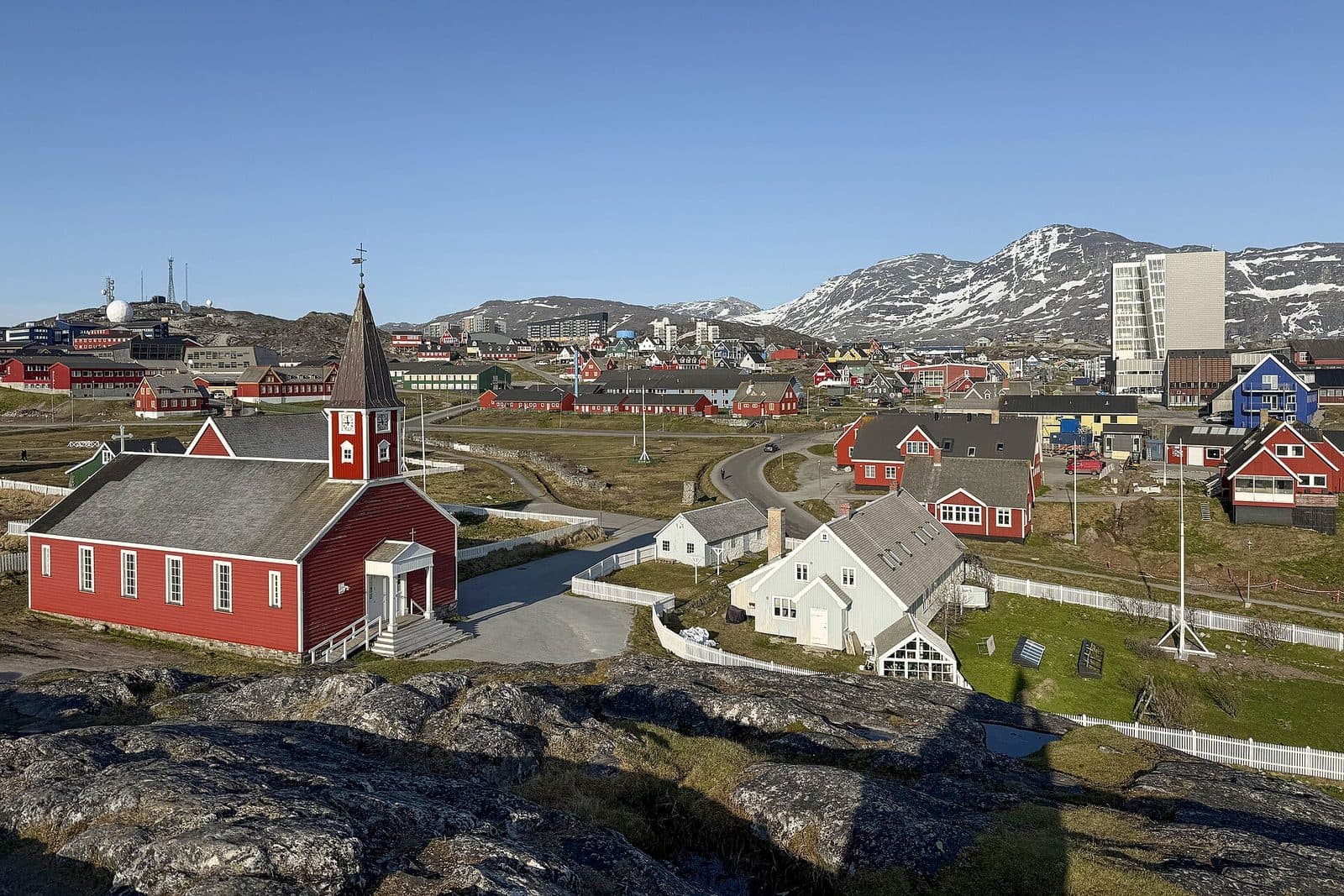
Nuuk. The capital sits on a headland at the mouth of one of the largest fjord systems in the world, and it holds close to a third of the country's people. The Danish-Norwegian missionary Hans Egede founded the settlement in 1728 as Godthåb, "good hope", a few kilometres from a much older Inuit site, and the colonial harbour quarter around the red timber Church of Our Saviour of 1849 is still the oldest part of town. Nuuk holds the Greenland National Museum and Archives, which cares for the Qilakitsoq mummies and the collections returned from Denmark, and Katuaq, the cultural centre of 1997 whose undulating larch facade was designed to recall the northern lights. The name Nuuk means the cape, and it replaced Godthåb officially in 1979.
Sisimiut. The second town, about 5,500 people, lies just north of the Arctic Circle on a coast of low granite domes. Its Bethel church of 1775 is the oldest surviving building in Greenland, a blue and white timber box shipped in pieces from Denmark, and the town museum keeps reconstructed peat-and-stone houses of the kind Greenlanders lived in until the twentieth century.
Ilulissat. The third town takes its name from the Kalaallisut word for icebergs, and it earns it: Sermeq Kujalleq, the glacier at the head of the fjord beside the town, is among the fastest-moving in the world and calves the ice that drifts down the west coast. The Ilulissat Icefjord became a World Heritage Site in 2004, and the polar ethnographer Knud Rasmussen was born in the vicarage here in 1879 to a Danish father and a Greenlandic mother. Far to the south, where sheep still graze slopes the Norse cleared, Qaqortoq looks out over the ruins of Hvalsey church.
The first people reached northern Greenland around 2500 BC. Archaeologists distinguish several waves: the Saqqaq of the west coast, known in extraordinary detail from the waterlogged site of Qeqertasussuk, where wood, feathers and hair survived in the permafrost; the Independence cultures of the far north; and the Dorset, remembered in Inuit oral tradition as the Tuniit, a strong and shy people already there when the ancestors arrived. Around AD 1200 the Thule culture spread east from Alaska with dog sledges, skin boats and the toggling harpoon, which made open-water hunting of large sea mammals reliable. Every Greenlander today descends from that migration.
The Norse arrived at almost the same moment from the other direction. Erik the Red, outlawed from Iceland, sailed west around 985 and returned with a name calculated to attract settlers (World History Encyclopedia). Two colonies grew in the southwest, with a bishop's seat at Gardar and an economy built on walrus ivory sold into Europe. The last written record from the colony is a marriage at Hvalsey church in 1408, and by the middle of the fifteenth century the Norse were gone. The reasons argued over ever since include a cooling climate, soil exhaustion and the collapse of the ivory market.
Danish-Norwegian rule dates from 1721, when Hans Egede sailed to find the lost Norse Christians and found Inuit instead. A royal trading monopoly followed, closed to outsiders and run from Copenhagen for two centuries. In 1953 a constitutional change turned the colony into a Danish county, and the modernisation that followed emptied small settlements into a handful of towns and apartment blocks. Two episodes from those decades are now formally acknowledged. In 1951, 22 Greenlandic children aged between four and nine were taken to Denmark to be raised as model Greenlanders; most never rejoined their families, and Denmark apologised in writing in 2020 and in person, with compensation, in 2022 (BBC). In 1953 the Inughuit of Uummannaq were moved at a few days' notice to make room for the American air base at Thule, now Pituffik, and resettled at Qaanaaq more than 100 kilometres north. Home Rule followed a referendum in 1979, and the Self-Government Act of 2009 transferred further powers and set out a route to independence.
Kalaallisut belongs to the Inuit branch of the Eskimo-Aleut family and is close kin to the Inuktitut of Arctic Canada. It is polysynthetic, which means that much of what English spreads across a clause is built into a single Greenlandic word by stacking suffixes onto a root, so that one word can carry a subject, an object, a mood and several qualifications at once. Three dialects are usually distinguished: West Greenlandic, the standard; Tunumiit oraasiat in the east, spoken by a few thousand people and hard for westerners to follow; and Inuktun in the Thule district.
The written language owes much to the missionary Samuel Kleinschmidt, whose grammar and orthography of 1851 gave Greenlandic a consistent spelling for the first time. A reform in 1973 replaced his diacritics with a system closer to modern pronunciation, and it is that spelling in use today. The Language Secretariat, Oqaasileriffik, coins new terminology and manages personal and place names. When Home Rule arrived the map was rewritten accordingly: Godthåb became Nuuk, Jakobshavn became Ilulissat, "the icebergs", Holsteinsborg became Sisimiut, "the people at the fox dens". The English name Greenland preserves Erik the Red's sales pitch. The Greenlandic name records who lives there.
The oldest performing tradition is the drum. The qilaat is a wide, shallow frame drum struck on the rim with a short stick rather than on the skin, and the dancer sings while turning it in the hand, so that beat and body move together. Drum songs carry hunting stories, longing, jokes and satire, and in the pre-Christian legal order a drum duel between two men, each mocking the other in verse before the assembled community, could settle a dispute outright. Missionaries suppressed it for the best part of two centuries. It survived in the east and far north, was revived from the 1970s, and entered the UNESCO Representative List in 2021 (UNESCO). East Greenland also keeps uaajeerneq, the mask dance, in which a performer with a blackened and painted face plays fear, sex and death before an audience meant to laugh and flinch at once.
 The Ilulissat Icefjord is a World Heritage site, and the Inuit settlement record around it goes back some four thousand years. Photograph by Christoph Strassler, CC BY-SA 2.0, via Wikimedia Commons.
Everyday culture centres on the kaffemik, the open house held for a birthday, a confirmation, a first seal or a funeral, at which anyone may come, eat cake and dried fish, sit a while and leave. The national dress, the kalaallisuut, pairs sealskin kamik boots with a collar of many thousand glass beads in geometric bands. Carvers make tupilaks in bone and antler, small twisted figures whose originals were secret objects meant to harm an enemy. The watercolours of Aron of Kangeq, a nineteenth-century seal hunter who painted the oral traditions he had been told, are among the country's most valued works on paper.
Greenland is overwhelmingly Lutheran. The Church of Greenland, Kalaallit Ilagiit, was part of the Church of Denmark until 1993, when it became a diocese in its own right with a Greenlandic bishop and services in Kalaallisut. Alongside the state mission of 1721, the Moravian Brethren ran their own stations from 1733, and their hymn-singing marked Greenlandic church music long after the mission closed in 1900.
Underneath sits the older order. Before conversion, the world was regulated by sila, a word meaning at once the weather, the air and a kind of consciousness in things, and by a system of observances governing how sea and land animals could be hunted and eaten. Sassuma Arnaa, the woman at the bottom of the sea, held the animals in her hair when people broke those rules, and the angakkoq, the shaman, travelled down in trance to comb her hair and release them. The mission suppressed the angakkut hard, though belief in the qivittoq, the person who walks out of a settlement after a shame or a quarrel and takes on strange powers alone in the mountains, is still current enough that people report sightings and children are warned.
Greenlandic burial is shaped by the ground. Much of the country is bare rock or permafrost, and in many places a grave cannot be dug deep, so graves are shallow, mounded and built up with stones. Cemeteries sit on the rock above the town, ranked with white-painted wooden crosses, and because almost nothing will grow in them the graves are dressed with plastic and silk flowers, replaced when the weather takes them, so that a Greenlandic churchyard is bright against grey stone and snow for most of the year. Families visit at Christmas, when candles are set out, and on the birthdays of the dead. A funeral is followed by a kaffemik like any other turning point in a life, and the whole settlement is welcome.
The deeper custom is naming. In Inuit tradition a person's name carries something of the person, an ateq that does not end at death, and a child born after a death is commonly given the name of the one who died. Relatives then address the child with the kin terms that belonged to the dead person, so that a grandmother's name in a small girl makes her, in speech and in a real sense in family life, the grandmother returned. The practice survived Christianisation by fitting comfortably beside it, and it means that in a Greenlandic family the dead are continually spoken to.
Older practice placed the dead on the surface under a cairn of stones with their belongings beside them, and it is that practice which produced the country's most affecting archaeological find. In 1972 two brothers out hunting near the abandoned settlement of Qilakitsoq came on eight bodies under a rock overhang, six women and two children, mummified by the dry cold around 1475, still dressed in sealskin and caribou and still tattooed. The Greenland National Museum in Nuuk cares for them now, displays some with their clothing, and treats them explicitly as ancestors of the living rather than as specimens (Greenland National Museum).
Public remembrance has lately taken a harder form. Greenland and Denmark have spent the 2020s establishing an official record of what was done under Danish administration, and in September 2025 a joint commission reported on the contraception campaign of 1966 onward, in which thousands of Greenlandic women and girls, some of them thirteen or fourteen, were fitted with intrauterine devices, in many cases without their knowledge or consent and without their parents being told. Danish and Greenlandic prime ministers apologised together after the report, with court cases brought by the women still running (BBC). Greenlanders describe the process itself, the gathering of files and testimony into a document a country can hold, as a form of remembrance owed to people who were not believed at the time.
Greenlandic records are Danish in form and Kalaallit in substance, and the join between them is where the difficult history sits.
The Lutheran mission arrived in 1721 and the church kept registers of baptism, marriage and burial from early in the eighteenth century. Those books, together with the census returns taken from the same period and the accounts of the Royal Greenland Trading Company, which had a monopoly for two centuries and recorded everybody it dealt with, are held by the Danish National Archives and by Greenland's own archives in Nuuk. Coverage is genuinely good, because the population was small and the administration was interested in it.
Names are the obstacle. Greenlanders carried Kalaallisut names, then were baptised with Danish ones, then in many cases had both, and spelling followed whoever was holding the pen. Following a family means following the settlement.
Two twentieth-century policies are documented and are still being reckoned with. In 1951 twenty-two Greenlandic children were taken to Denmark to be re-educated as model Danish-speaking Greenlanders; most never recovered their families or their language, and Denmark apologised in 2020. And between 1966 and 1975 Danish doctors fitted intrauterine devices to thousands of Greenlandic women and girls, in many cases without consent, in a programme whose files are only now being examined.
The older record is the settlement and the name itself: a Greenlandic child is often given the name of a recently dead relative, so the name carries the person forward.
Greenland has three World Heritage Sites, and each is a landscape rather than a monument. The Ilulissat Icefjord was inscribed in 2004 for the glacier and its ice stream (UNESCO). Kujataa, inscribed in 2017, covers the fields and ruins of Norse and later Inuit farming at the southern tip of the island (UNESCO). Aasivissuit-Nipisat, inscribed in 2018, protects a corridor from coast to ice cap used for 4,200 years of seasonal hunting, with the caribou drives, tent rings and winter houses still legible on the ground (UNESCO).
The country's central preservation achievement is Utimut, a Greenlandic word meaning return. Greenland's archaeology had gone almost entirely to the National Museum of Denmark. From 1982, beginning with 204 watercolours by Aron of Kangeq and Jens Kreutzmann, and under a formal agreement in force from 1984, the two museums worked region by region until roughly 35,000 objects had been transferred to the Greenland National Museum and Archives by 2001 (Art-Law Centre, University of Geneva). It was framed throughout as a shared professional judgement about where a collection is best held, and it is now cited internationally as a model of negotiated restitution.
Human remains have been slower. Five mummified Greenlanders of the sixteenth century, kept in a Harvard basement since 1929, were sent back toward Greenland in 2024 and are held for now in Copenhagen, because Greenland lacks a facility able to store them properly. The larger physical threat is the climate: the permafrost that preserved wood, skin and hair at sites like Qeqertasussuk for four thousand years is warming, and archaeology that survived because it was frozen is decaying in the ground faster than it can be excavated.
The Greenland National Museum and Archives publishes collection material online and doubles as the country's archive, holding the administrative record of the colonial and Home Rule periods. Oqaasileriffik has done the quiet work that keeps a small language usable on a screen: a Greenlandic spellchecker and morphological analyser, digital dictionaries, and public registers of personal names and place names, which matter in a country where the official map was rewritten within living memory. Trap Grønland, the reference encyclopaedia published from 2021, is online in full, town by town.
Two resources carry particular weight. Long runs of Atuagagdliutit, the Greenlandic-language newspaper founded in 1861, have been digitised, giving a continuous public record of the country in its own language over more than a century and a half. And the inquiry into the contraception campaign turned on records in the Danish National Archives: the story could be established because the paperwork survived, was located, and could be read against the women's own testimony. That is an unglamorous form of digital heritage with immediate consequences for living people.
Modern Greenlandic culture has an unusually direct line to its politics. The band Sume released Sumut in 1973, the first rock album in Kalaallisut, and its sleeve art and songs became a rallying point for the generation that won Home Rule six years later. Nanook and a stream of younger artists have carried Greenlandic-language pop since. Niviaq Korneliussen won the Nordic Council Literature Prize in 2021, the first Greenlandic writer to take it, and Nuummioq of 2009 was the first feature film made in Greenland by Greenlanders.
The wider pressures are visible. New international airports at Nuuk and Ilulissat put the country within direct reach of North America and Europe, with tourism and the questions that follow it. Greenland's minerals and its position have drawn heavy geopolitical attention, and independence remains the central argument of domestic politics, weighed against the Danish block grant. The apologies of 2022 and 2025 are widely read in Greenland as the beginning of an accounting rather than its end.
A national collection came home. Between 1984 and 2001, roughly 35,000 archaeological and ethnographic objects moved from the National Museum of Denmark to the Greenland National Museum and Archives, and the process is studied elsewhere as a workable model for restitution.
A language became the only official one. The Self-Government Act of 2009 made Kalaallisut the sole official language, and the Language Secretariat has kept it working in schools, administration and software rather than letting it turn ceremonial.
The drum came back. Suppressed by missionaries for close to two hundred years and reduced to a few communities in the east and north, Inuit drum dancing and singing was revived from the 1970s and inscribed by UNESCO in 2021.
Ancestors are cared for as ancestors. The eight people found at Qilakitsoq in 1972 are held and interpreted by Greenland's own national museum, in Greenland, as the forebears of those who visit them.
The Ilulissat Icefjord is a World Heritage site, and the Inuit settlement record around it goes back some four thousand years. Photograph by Christoph Strassler, CC BY-SA 2.0, via Wikimedia Commons.
Everyday culture centres on the kaffemik, the open house held for a birthday, a confirmation, a first seal or a funeral, at which anyone may come, eat cake and dried fish, sit a while and leave. The national dress, the kalaallisuut, pairs sealskin kamik boots with a collar of many thousand glass beads in geometric bands. Carvers make tupilaks in bone and antler, small twisted figures whose originals were secret objects meant to harm an enemy. The watercolours of Aron of Kangeq, a nineteenth-century seal hunter who painted the oral traditions he had been told, are among the country's most valued works on paper.
Greenland is overwhelmingly Lutheran. The Church of Greenland, Kalaallit Ilagiit, was part of the Church of Denmark until 1993, when it became a diocese in its own right with a Greenlandic bishop and services in Kalaallisut. Alongside the state mission of 1721, the Moravian Brethren ran their own stations from 1733, and their hymn-singing marked Greenlandic church music long after the mission closed in 1900.
Underneath sits the older order. Before conversion, the world was regulated by sila, a word meaning at once the weather, the air and a kind of consciousness in things, and by a system of observances governing how sea and land animals could be hunted and eaten. Sassuma Arnaa, the woman at the bottom of the sea, held the animals in her hair when people broke those rules, and the angakkoq, the shaman, travelled down in trance to comb her hair and release them. The mission suppressed the angakkut hard, though belief in the qivittoq, the person who walks out of a settlement after a shame or a quarrel and takes on strange powers alone in the mountains, is still current enough that people report sightings and children are warned.
Greenlandic burial is shaped by the ground. Much of the country is bare rock or permafrost, and in many places a grave cannot be dug deep, so graves are shallow, mounded and built up with stones. Cemeteries sit on the rock above the town, ranked with white-painted wooden crosses, and because almost nothing will grow in them the graves are dressed with plastic and silk flowers, replaced when the weather takes them, so that a Greenlandic churchyard is bright against grey stone and snow for most of the year. Families visit at Christmas, when candles are set out, and on the birthdays of the dead. A funeral is followed by a kaffemik like any other turning point in a life, and the whole settlement is welcome.
The deeper custom is naming. In Inuit tradition a person's name carries something of the person, an ateq that does not end at death, and a child born after a death is commonly given the name of the one who died. Relatives then address the child with the kin terms that belonged to the dead person, so that a grandmother's name in a small girl makes her, in speech and in a real sense in family life, the grandmother returned. The practice survived Christianisation by fitting comfortably beside it, and it means that in a Greenlandic family the dead are continually spoken to.
Older practice placed the dead on the surface under a cairn of stones with their belongings beside them, and it is that practice which produced the country's most affecting archaeological find. In 1972 two brothers out hunting near the abandoned settlement of Qilakitsoq came on eight bodies under a rock overhang, six women and two children, mummified by the dry cold around 1475, still dressed in sealskin and caribou and still tattooed. The Greenland National Museum in Nuuk cares for them now, displays some with their clothing, and treats them explicitly as ancestors of the living rather than as specimens (Greenland National Museum).
Public remembrance has lately taken a harder form. Greenland and Denmark have spent the 2020s establishing an official record of what was done under Danish administration, and in September 2025 a joint commission reported on the contraception campaign of 1966 onward, in which thousands of Greenlandic women and girls, some of them thirteen or fourteen, were fitted with intrauterine devices, in many cases without their knowledge or consent and without their parents being told. Danish and Greenlandic prime ministers apologised together after the report, with court cases brought by the women still running (BBC). Greenlanders describe the process itself, the gathering of files and testimony into a document a country can hold, as a form of remembrance owed to people who were not believed at the time.
Greenlandic records are Danish in form and Kalaallit in substance, and the join between them is where the difficult history sits.
The Lutheran mission arrived in 1721 and the church kept registers of baptism, marriage and burial from early in the eighteenth century. Those books, together with the census returns taken from the same period and the accounts of the Royal Greenland Trading Company, which had a monopoly for two centuries and recorded everybody it dealt with, are held by the Danish National Archives and by Greenland's own archives in Nuuk. Coverage is genuinely good, because the population was small and the administration was interested in it.
Names are the obstacle. Greenlanders carried Kalaallisut names, then were baptised with Danish ones, then in many cases had both, and spelling followed whoever was holding the pen. Following a family means following the settlement.
Two twentieth-century policies are documented and are still being reckoned with. In 1951 twenty-two Greenlandic children were taken to Denmark to be re-educated as model Danish-speaking Greenlanders; most never recovered their families or their language, and Denmark apologised in 2020. And between 1966 and 1975 Danish doctors fitted intrauterine devices to thousands of Greenlandic women and girls, in many cases without consent, in a programme whose files are only now being examined.
The older record is the settlement and the name itself: a Greenlandic child is often given the name of a recently dead relative, so the name carries the person forward.
Greenland has three World Heritage Sites, and each is a landscape rather than a monument. The Ilulissat Icefjord was inscribed in 2004 for the glacier and its ice stream (UNESCO). Kujataa, inscribed in 2017, covers the fields and ruins of Norse and later Inuit farming at the southern tip of the island (UNESCO). Aasivissuit-Nipisat, inscribed in 2018, protects a corridor from coast to ice cap used for 4,200 years of seasonal hunting, with the caribou drives, tent rings and winter houses still legible on the ground (UNESCO).
The country's central preservation achievement is Utimut, a Greenlandic word meaning return. Greenland's archaeology had gone almost entirely to the National Museum of Denmark. From 1982, beginning with 204 watercolours by Aron of Kangeq and Jens Kreutzmann, and under a formal agreement in force from 1984, the two museums worked region by region until roughly 35,000 objects had been transferred to the Greenland National Museum and Archives by 2001 (Art-Law Centre, University of Geneva). It was framed throughout as a shared professional judgement about where a collection is best held, and it is now cited internationally as a model of negotiated restitution.
Human remains have been slower. Five mummified Greenlanders of the sixteenth century, kept in a Harvard basement since 1929, were sent back toward Greenland in 2024 and are held for now in Copenhagen, because Greenland lacks a facility able to store them properly. The larger physical threat is the climate: the permafrost that preserved wood, skin and hair at sites like Qeqertasussuk for four thousand years is warming, and archaeology that survived because it was frozen is decaying in the ground faster than it can be excavated.
The Greenland National Museum and Archives publishes collection material online and doubles as the country's archive, holding the administrative record of the colonial and Home Rule periods. Oqaasileriffik has done the quiet work that keeps a small language usable on a screen: a Greenlandic spellchecker and morphological analyser, digital dictionaries, and public registers of personal names and place names, which matter in a country where the official map was rewritten within living memory. Trap Grønland, the reference encyclopaedia published from 2021, is online in full, town by town.
Two resources carry particular weight. Long runs of Atuagagdliutit, the Greenlandic-language newspaper founded in 1861, have been digitised, giving a continuous public record of the country in its own language over more than a century and a half. And the inquiry into the contraception campaign turned on records in the Danish National Archives: the story could be established because the paperwork survived, was located, and could be read against the women's own testimony. That is an unglamorous form of digital heritage with immediate consequences for living people.
Modern Greenlandic culture has an unusually direct line to its politics. The band Sume released Sumut in 1973, the first rock album in Kalaallisut, and its sleeve art and songs became a rallying point for the generation that won Home Rule six years later. Nanook and a stream of younger artists have carried Greenlandic-language pop since. Niviaq Korneliussen won the Nordic Council Literature Prize in 2021, the first Greenlandic writer to take it, and Nuummioq of 2009 was the first feature film made in Greenland by Greenlanders.
The wider pressures are visible. New international airports at Nuuk and Ilulissat put the country within direct reach of North America and Europe, with tourism and the questions that follow it. Greenland's minerals and its position have drawn heavy geopolitical attention, and independence remains the central argument of domestic politics, weighed against the Danish block grant. The apologies of 2022 and 2025 are widely read in Greenland as the beginning of an accounting rather than its end.
A national collection came home. Between 1984 and 2001, roughly 35,000 archaeological and ethnographic objects moved from the National Museum of Denmark to the Greenland National Museum and Archives, and the process is studied elsewhere as a workable model for restitution.
A language became the only official one. The Self-Government Act of 2009 made Kalaallisut the sole official language, and the Language Secretariat has kept it working in schools, administration and software rather than letting it turn ceremonial.
The drum came back. Suppressed by missionaries for close to two hundred years and reduced to a few communities in the east and north, Inuit drum dancing and singing was revived from the 1970s and inscribed by UNESCO in 2021.
Ancestors are cared for as ancestors. The eight people found at Qilakitsoq in 1972 are held and interpreted by Greenland's own national museum, in Greenland, as the forebears of those who visit them.
National Overview
Notable Cities
Historical Foundations
Linguistic and Etymological Roots
Cultural Identity
Religion and Spirituality
Remembrance and Mourning Traditions
Tracing a Family in Greenland
Heritage Preservation Efforts
Digital Heritage
Contemporary Cultural Influences
Success Stories
References and resources
- Encyclopaedia Britannica, Greenland: geography, population and the road to self-government.
- Greenland National Museum and Archives: the Qilakitsoq mummies and the returned collections.
- UNESCO, Ilulissat Icefjord: the glacier and ice stream, inscribed 2004.
- UNESCO, Kujataa Greenland: Norse and Inuit farming at the edge of the ice, inscribed 2017.
- UNESCO, Aasivissuit-Nipisat: 4,200 years of Inuit hunting between ice and sea, inscribed 2018.
- UNESCO, Inuit drum dancing and singing: the qilaat tradition and its 2021 inscription.
- Art-Law Centre, University of Geneva, the Utimut process: the agreement and the 35,000 objects returned.
- World History Encyclopedia, Greenland: Erik the Red and the end of the Norse colony.
- BBC News, Denmark apologises to children taken from Greenland: the 1951 experiment and the 2022 ceremony.
- BBC News, Denmark apologises to Greenland's forced contraception victims: the 2025 commission report and the joint apology.
- Naalakkersuisut, the Government of Greenland: self-government and language policy.
- Oqaasileriffik, the Greenland Language Secretariat: orthography, terminology and place names.