Heritage · Country
British Virgin Islands Culture and Heritage
On a Sunday in November 1949 about 1,500 people walked into Road Town behind an Anegada fisherman and demanded the legislature Britain had abolished in 1902. This guide covers Virgin Islands heritage, from the sloops built on the beach at Carrot Bay to the nine nights kept for the dead.Written to last.
By Confinity Heritage Editorial · Updated 2026-08-17 · 8-minute readQuiet tools, kept out of the way.
On Sunday 24 November 1949, a fisherman from Anegada named Theodolph Faulkner led about 1,500 people through the streets of Road Town to the commissioner's office. They came by boat from Virgin Gorda, Anegada and the other islands, carrying placards, and they handed over a petition asking for the return of a legislature the imperial government had abolished in 1902. Within a year the Legislative Council was back.
Nothing else in these islands is quite so decisive, and almost everything else here was made at sea. Around sixty islands and cays lie scattered across a shallow bank at the eastern end of the Greater Antilles, and for two centuries the people who lived on them built sloops on the beach, sailed cargo through the whole Caribbean, salvaged wrecks off the reef at Anegada and ran contraband past whichever empire was collecting duty that year. This is a guide to that inheritance across Tortola, Virgin Gorda, Anegada and Jost Van Dyke, and to the customs by which Virgin Islanders sit with their dead.
The British Virgin Islands are a British Overseas Territory of roughly sixty islands, islets and cays covering about 150 square kilometres, of which some sixteen are inhabited. Tortola is the largest and holds the capital, Road Town, along with most of the population; Virgin Gorda lies to the east, Jost Van Dyke to the northwest, and Anegada, alone among them a flat coral island rather than a volcanic peak, lies twenty kilometres north behind the eighteen-mile Horseshoe Reef. The 2010 census counted 28,054 residents, a figure that fell after Hurricane Irma in 2017 and has since recovered. Around three-quarters of the population is Afro-Caribbean, and the currency has been the United States dollar since 1959, an unusual arrangement for a British territory and a reminder of how closely these islands are tied to the American Virgin Islands next door (Britannica).
Road Town. The capital sits at the head of a deep bay on Tortola's south coast and has been the administrative centre since the eighteenth century. Main Street keeps the older fabric: St George's Anglican Church, Britannic Hall, the Old Government House on its rise above the town, and the Sunday Morning Well, where the emancipation proclamation is remembered as having been read in August 1834.
 Tortola's sugar economy collapsed after emancipation and the planters left, so the land passed to the people who had worked it, which is unusual in the Caribbean. Photograph by Thomas Liptak, CC BY-SA 4.0, via Wikimedia Commons.
Spanish Town. The main settlement of Virgin Gorda sits below the granite boulders of The Baths, along the road the Cornish miners cut to bring copper ore down to the harbour.
The Settlement and Great Harbour. Anegada's single village keeps a few hundred people, a rock iguana breeding programme and a lobster fishery that outlasted the salvage economy. Great Harbour is the anchorage of Jost Van Dyke, an island of a few hundred residents and the claimed birthplace of the physician and abolitionist John Coakley Lettsom.
Arawak-speaking people from South America settled these islands from around the first centuries of the common era, and Kalinago groups were present across the wider region by the time Europeans arrived. Columbus sighted the archipelago on his second voyage in 1493 and named it Santa Ursula y las Once Mil Vírgenes, for the legend of Saint Ursula and her eleven thousand virgin companions, shortened in use to Las Vírgenes. Spain never settled here. Dutch traders and privateers did, with Joost van Dyk established at Soper's Hole on Tortola by the 1610s and recognised as patron of the island in 1625; English forces took Tortola in July 1672 during the Third Anglo-Dutch War and kept it (History of the British Virgin Islands).
Sugar and cotton followed, and with them enslavement on a scale that transformed the islands: the enslaved population rose from 547 in 1717 to 1,430 by 1724 and 6,121 by 1756. Two things made these islands unusual. The first was the Quaker community that flourished on Tortola between 1727 and about 1768, which condemned slavery and produced a series of large manumissions; John Coakley Lettsom freed the roughly one thousand people he inherited on coming into his estate. The second was Arthur Hodge, a Tortola planter and member of the island's council, tried in Road Town in April 1811 and hanged for the murder of an enslaved man, one of very few slave owners in the British Caribbean ever executed for such a killing.
Resistance ran through the whole period. The first significant rising came in 1790 on the estates of Isaac Pickering, set off by a rumour that freedom had been granted in England and was being withheld by the planters; it was put down quickly and the leaders were executed. In 1831 the authorities uncovered a far larger conspiracy, a plan to kill the white men of the territory and sail for Haiti, then the only Black republic in the world; the plot caused general panic, troops were brought in from St Thomas, and a number of those accused were executed (Slavery in the British Virgin Islands). By the time slavery ended on 1 August 1834, freeing 5,792 people into a further four to six years of unpaid apprenticeship, there were already around two thousand free black residents in the islands, while the white population, some 1,300 at the start of the century, was falling steadily toward the few dozen who remained by the 1890s.
What followed was a long collapse. Hurricanes, drought through the 1840s, the equalisation of sugar duties in 1846 and the failure of the merchant house financing the trade left the estates worthless, planters abandoned their land, and the freed population took it over as smallholders and seafarers. The imperial answer to a colony with no revenue was to remove its politics: the Legislative Council was dissolved in 1901 and the islands were run by a commissioner answering to the Governor of the Leeward Islands in Antigua, an arrangement that lasted almost fifty years.
The Great March ended it. Theodolph Faulkner, an Anegadian fisherman and trader, had begun speaking every evening in the Road Town market about the state of the hospital, the roads and the absence of any elected voice, and with Isaac Glanville Fonseca and Carlton de Castro he organised the demonstration of 24 November 1949; about 1,500 people, a substantial fraction of the whole population, marched and presented their petition (Virgin Islands News Online). The Legislative Council was restored in 1950 with four elected members, universal adult suffrage came with the constitution of 1954, and ministerial government arrived in 1967 with Lavity Stoutt as first chief minister. Faulkner, Fonseca and de Castro are national heroes, and 24 November is marked as Great March and Restoration Day.
English is official, and the everyday speech is Virgin Islands Creole, an English-lexicon Creole shared with the neighbouring United States Virgin Islands and marked here by its own vocabulary and intonation. Older speakers on Anegada and Jost Van Dyke keep forms that have thinned out in Road Town, where a migrant workforce from Guyana, the Dominican Republic, the eastern Caribbean and the Philippines has made other languages common alongside it.
The map is a European reading of a landscape. Columbus's saint gave the archipelago its name; Virgin Gorda, the "fat virgin", is said to describe the island's profile from the sea; Anegada is Spanish for drowned land, which is what a low coral island looks like from a ship's deck and why it wrecked so many of them; Jost Van Dyke carries the name of the Dutchman who settled it; and Tortola is usually derived from the Spanish tórtola, turtle dove. Beneath these lie the names given by the people who stayed: Carrot Bay, Cane Garden Bay, Sea Cows Bay, Fat Hogs Bay, Long Look.
The sloop is the central object of Virgin Islands heritage. From the eighteenth century local builders developed the Tortola boat, a trading sloop with a raking mast, long overhangs fore and aft, a pronounced sheer and a boom running well past the transom, built of native white cedar on the beach without plans and ballasted with rocks from the shore. Carrot Bay and Cane Garden Bay on Tortola's north coast, with Jost Van Dyke and Anegada, produced boats and crews that traded across the eastern Caribbean, and the design was copied well beyond these islands (All at Sea). Fibreglass ended the trade within a generation, and the sailing that survives is sport: the BVI Spring Regatta, first sailed in 1972 with about twenty boats, is now one of the larger Caribbean regattas, and preservation groups build replica sloops with schoolchildren to keep the knowledge in circulation.
Anegada's reef made a different economy. More than three hundred ships are recorded wrecked on Horseshoe Reef, and salvaging what came ashore supplied Anegadians with timber, metal, cloth and provisions an island with no forest and no manufacture could not otherwise get. The most famous of those wrecks lies to the south. On 29 October 1867 the Royal Mail steamer Rhone, caught by the San Narciso hurricane off Peter Island, tried to run for open sea, struck Black Rock Point off Salt Island and broke in two when cold water reached her boilers; of roughly 145 people aboard, about 25 survived. Salt Islanders pulled survivors from the water and buried the bodies that came ashore, and Queen Victoria is said to have remitted the island's salt rent in return. That rent was a single pound bag of salt paid to the Crown each year, a tradition revived in 2015 when the governor presented a pouch of Salt Island salt to Queen Elizabeth II (Salt Island).
Ashore, the music is fungi, played by scratch bands and known as quelbe in the American islands: a four-string ukulele banjo, a gourd squash scraped with a comb, a triangle, a drum and often a flute cut from pipe or a papaya stem, playing topical songs and driving the quadrille, the figure dance that came through the European planters and was reworked into something local (Fungi music). The calendar's centre is the Emancipation Festival, running from late July into the first week of August around August Monday, with a food fair, calypso, a village of stalls in Road Town and the pre-dawn street tramp known as Rise and Shine (Office Holidays).
Methodism is the largest denomination here, which sets the British Virgin Islands apart from most of the Caribbean. Wesleyan missionaries arrived in the 1780s, preached to enslaved and free people together and built chapels across Tortola and the outer islands; the Anglican establishment, the Church of God, Seventh-day Adventists, Baptists and Roman Catholics follow, the last strengthened by migration from Hispaniola. The Quaker meeting of 1727 to 1768 left no congregation but a long shadow, since its members' manumissions helped produce the large free black population that existed before emancipation.
Alongside the churches sits a body of belief carried from West Africa. Jumbies, the unquiet dead, are treated seriously in stories told to children and in habits around a house after a death; bush medicine is still practised and increasingly written down; and older people keep readings of weather, birds and dreams they will discuss with family more readily than with visitors. Rastafari has a visible presence among younger Virgin Islanders.
A death here is announced quickly, on the radio and by word of mouth, and the household fills the same evening. The wake, called sitting up, keeps the family company through the night with hymns, coffee, food brought by neighbours and stories about the person who has died. In the older practice it ran for nine nights, a custom found across the anglophone Caribbean with roots in Akan funerary rites, in which the spirit is understood to remain near the house until the ninth night, when the gathering is largest and the household is rearranged to let it go (Nine nights). Full nine nights are now rarer, but the phrase and the shape of the observance remain in ordinary use.
Burial keeps people close to where they lived. Family plots on family land are common outside the main settlements, so graves sit beside the house, along the road or above the bay, and relatives tend them; where public cemeteries are used, plots are still held by family and visited on anniversaries. The funeral itself is a large public event, with the church full, the procession walking, and a printed order of service carrying the obituary and photographs.
Public memory has two anchors. On Salt Island lie the dead of the Rhone, buried by islanders in 1867 where they came ashore, and the wreck is treated as a grave site as much as a dive. The other is the Emancipation Festival, a commemoration before it is a carnival: the services and the ceremony at the Sunday Morning Well, where the proclamation of 1834 was read, come before the parades.
The British Virgin Islands' family records are Quaker, Anglican and Methodist, and the Quaker part is unexpected.
A substantial Quaker community existed on Tortola in the eighteenth century, and its meeting records survive; some of those families freed the people they held before the law required it, and the Quaker testimony against slavery had a practical effect here earlier than in most of the Caribbean. The Anglican and Methodist registers, the latter from the 1780s, carry most vital events.
The slave registers of 1818 to 1834 name individuals with age, colour and origin, and the compensation records of 1834 name the owners. The 1831 Tortola revolt and the 1853 riot both generated official inquiries that name people.
Civil registration is held by the Registrar in Road Town, and the BVI Archives hold the administrative series, with the substantial older material at Kew.
The islands' population fell for much of the nineteenth and early twentieth centuries as the plantation economy collapsed, and people left for St Thomas, Santo Domingo and later New York, so a great many BVI families are documented in the American and Dominican records for that period.
Anegada is a separate story: a low coral island ringed by reefs where hundreds of ships have wrecked, and the salvage records name the islanders who went out to them.
The modern financial services economy has brought a population from elsewhere, documented in immigration and belonger-status files.
The National Parks Trust of the Virgin Islands was established by ordinance in 1961 and now manages some twenty-eight protected areas. Its first was Sage Mountain on Tortola, bought from farmers with a donation from Laurance Rockefeller and given to the government in 1964, protecting the last stand of moist forest in a territory otherwise cleared for cane. The Trust also holds the Wreck of the Rhone Marine Park, designated in 1980, and Mount Healthy, where an eighteenth-century sugar windmill stands intact.
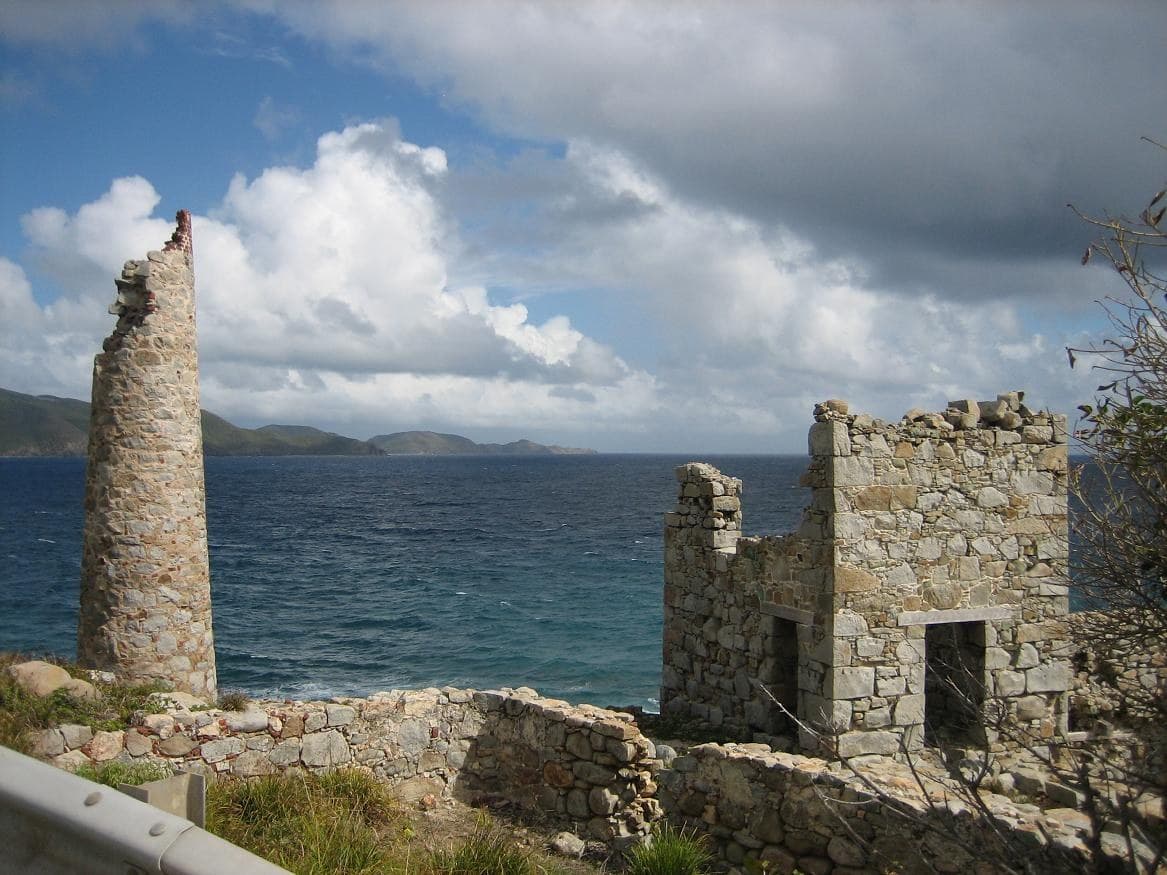
Copper Mine Point on Virgin Gorda became a national park in 2003. The mine was built in 1837 and its first shaft sunk in 1838; over roughly twenty-four years in two working periods, thirty-six Cornish miners and around 140 Virgin Islands labourers raised ore that went by cart down a road the miners cut to Spanish Town and then by ship to Wales, with coal for the steam engine coming back the other way. Work stopped in 1862 and never resumed. The stack, the roofless engine house and the cistern survive on the cliff edge, the beam engine associated with the site is described as the oldest surviving Cornish beam engine anywhere, and several miners started families whose descendants are still here (Copper Mine, Virgin Gorda). In Road Town, the Old Government House Museum occupies the former residence of the governors, built in 1926 on the site of an earlier house and opened to the public after the governors moved out in 1996.
Hurricane Irma tested all of it. The storm crossed the territory on 6 September 2017 with sustained winds around 185 miles an hour, damaging or destroying about 85 per cent of the buildings on Tortola, stripping Sage Mountain, wrecking roofs on historic structures, and cutting power for months. The population fell by roughly a tenth in the years that followed.
The territory's documentary record is largely held elsewhere, in the United Kingdom National Archives, in Antigua from the Leeward Islands administration, and in repositories covering the neighbouring islands, so the local work has been to find it and copy it back. The Virgin Islands Studies Institute, founded as a project in 1997 and based at H. Lavity Stoutt Community College at Paraquita Bay, gathers research, oral history and teaching materials, and local historians have argued for a coordinated digitisation programme with the British repositories rather than a claim on the originals (Virgin Islands Studies Institute).
Alongside it, the government's Archives and Records Management Unit catalogues public records, the compensation claims made by Virgin Islands slave owners in 1834 are searchable through the Legacies of British Slavery database at University College London, and the National Parks Trust publishes survey material on the Rhone and the other protected sites.
The modern economy rests on two things. Tourism, mostly bareboat chartering out of Tortola and Virgin Gorda, is the visible half. The other is the company registry: after a United States tax treaty was revoked in 1981, the territory passed the International Business Companies Act of 1984, and hundreds of thousands of companies were incorporated here over the following decades, with licence fees supplying around half of government revenue. That has made a territory of fewer than thirty thousand people a fixture in international financial reporting and drawn sustained scrutiny.
The most consequential recent episode should be set out plainly. On 18 January 2021 Governor Augustus Jaspert commissioned an inquiry into possible corruption in public administration, with Sir Gary Hickinbottom, a former English Court of Appeal judge, as commissioner. His 946-page report was delivered on 4 April 2022 and published on 29 April; it found the principles of good governance widely ignored, described governance as appallingly bad, and recommended a temporary partial suspension of the constitution with the governor assuming direct rule (Commission of Inquiry report). It appeared the day after Premier Andrew Fahie was arrested in Miami on drug and money-laundering charges; he was convicted by a United States jury in February 2024, sentenced to more than eleven years, and has appealed. On 8 June 2022 the British government declined to suspend the constitution, keeping the power in reserve while the new premier, Natalio Wheatley, committed to a programme of governance reforms (2021 Commission of Inquiry). Elected government has continued throughout.
A legislature won back by walking. The 1949 Great March restored representative government abolished in 1902, and its leaders are national heroes with a holiday on the anniversary.
A wreck turned into a park. The Rhone, lost with most of those aboard in 1867, became a marine park in 1980, protecting a grave site picked over for a century.
A forest kept. Sage Mountain, bought from farmers and given to the territory in 1964, preserved the last moist forest on Tortola and was the first of some twenty-eight protected areas.
A boat rebuilt with children. The Tortola sloop, obsolete once fibreglass arrived, is being built again by preservation groups working with schools, so the design is learned rather than only recorded.
Tortola's sugar economy collapsed after emancipation and the planters left, so the land passed to the people who had worked it, which is unusual in the Caribbean. Photograph by Thomas Liptak, CC BY-SA 4.0, via Wikimedia Commons.
Spanish Town. The main settlement of Virgin Gorda sits below the granite boulders of The Baths, along the road the Cornish miners cut to bring copper ore down to the harbour.
The Settlement and Great Harbour. Anegada's single village keeps a few hundred people, a rock iguana breeding programme and a lobster fishery that outlasted the salvage economy. Great Harbour is the anchorage of Jost Van Dyke, an island of a few hundred residents and the claimed birthplace of the physician and abolitionist John Coakley Lettsom.
Arawak-speaking people from South America settled these islands from around the first centuries of the common era, and Kalinago groups were present across the wider region by the time Europeans arrived. Columbus sighted the archipelago on his second voyage in 1493 and named it Santa Ursula y las Once Mil Vírgenes, for the legend of Saint Ursula and her eleven thousand virgin companions, shortened in use to Las Vírgenes. Spain never settled here. Dutch traders and privateers did, with Joost van Dyk established at Soper's Hole on Tortola by the 1610s and recognised as patron of the island in 1625; English forces took Tortola in July 1672 during the Third Anglo-Dutch War and kept it (History of the British Virgin Islands).
Sugar and cotton followed, and with them enslavement on a scale that transformed the islands: the enslaved population rose from 547 in 1717 to 1,430 by 1724 and 6,121 by 1756. Two things made these islands unusual. The first was the Quaker community that flourished on Tortola between 1727 and about 1768, which condemned slavery and produced a series of large manumissions; John Coakley Lettsom freed the roughly one thousand people he inherited on coming into his estate. The second was Arthur Hodge, a Tortola planter and member of the island's council, tried in Road Town in April 1811 and hanged for the murder of an enslaved man, one of very few slave owners in the British Caribbean ever executed for such a killing.
Resistance ran through the whole period. The first significant rising came in 1790 on the estates of Isaac Pickering, set off by a rumour that freedom had been granted in England and was being withheld by the planters; it was put down quickly and the leaders were executed. In 1831 the authorities uncovered a far larger conspiracy, a plan to kill the white men of the territory and sail for Haiti, then the only Black republic in the world; the plot caused general panic, troops were brought in from St Thomas, and a number of those accused were executed (Slavery in the British Virgin Islands). By the time slavery ended on 1 August 1834, freeing 5,792 people into a further four to six years of unpaid apprenticeship, there were already around two thousand free black residents in the islands, while the white population, some 1,300 at the start of the century, was falling steadily toward the few dozen who remained by the 1890s.
What followed was a long collapse. Hurricanes, drought through the 1840s, the equalisation of sugar duties in 1846 and the failure of the merchant house financing the trade left the estates worthless, planters abandoned their land, and the freed population took it over as smallholders and seafarers. The imperial answer to a colony with no revenue was to remove its politics: the Legislative Council was dissolved in 1901 and the islands were run by a commissioner answering to the Governor of the Leeward Islands in Antigua, an arrangement that lasted almost fifty years.
The Great March ended it. Theodolph Faulkner, an Anegadian fisherman and trader, had begun speaking every evening in the Road Town market about the state of the hospital, the roads and the absence of any elected voice, and with Isaac Glanville Fonseca and Carlton de Castro he organised the demonstration of 24 November 1949; about 1,500 people, a substantial fraction of the whole population, marched and presented their petition (Virgin Islands News Online). The Legislative Council was restored in 1950 with four elected members, universal adult suffrage came with the constitution of 1954, and ministerial government arrived in 1967 with Lavity Stoutt as first chief minister. Faulkner, Fonseca and de Castro are national heroes, and 24 November is marked as Great March and Restoration Day.
English is official, and the everyday speech is Virgin Islands Creole, an English-lexicon Creole shared with the neighbouring United States Virgin Islands and marked here by its own vocabulary and intonation. Older speakers on Anegada and Jost Van Dyke keep forms that have thinned out in Road Town, where a migrant workforce from Guyana, the Dominican Republic, the eastern Caribbean and the Philippines has made other languages common alongside it.
The map is a European reading of a landscape. Columbus's saint gave the archipelago its name; Virgin Gorda, the "fat virgin", is said to describe the island's profile from the sea; Anegada is Spanish for drowned land, which is what a low coral island looks like from a ship's deck and why it wrecked so many of them; Jost Van Dyke carries the name of the Dutchman who settled it; and Tortola is usually derived from the Spanish tórtola, turtle dove. Beneath these lie the names given by the people who stayed: Carrot Bay, Cane Garden Bay, Sea Cows Bay, Fat Hogs Bay, Long Look.
The sloop is the central object of Virgin Islands heritage. From the eighteenth century local builders developed the Tortola boat, a trading sloop with a raking mast, long overhangs fore and aft, a pronounced sheer and a boom running well past the transom, built of native white cedar on the beach without plans and ballasted with rocks from the shore. Carrot Bay and Cane Garden Bay on Tortola's north coast, with Jost Van Dyke and Anegada, produced boats and crews that traded across the eastern Caribbean, and the design was copied well beyond these islands (All at Sea). Fibreglass ended the trade within a generation, and the sailing that survives is sport: the BVI Spring Regatta, first sailed in 1972 with about twenty boats, is now one of the larger Caribbean regattas, and preservation groups build replica sloops with schoolchildren to keep the knowledge in circulation.
Anegada's reef made a different economy. More than three hundred ships are recorded wrecked on Horseshoe Reef, and salvaging what came ashore supplied Anegadians with timber, metal, cloth and provisions an island with no forest and no manufacture could not otherwise get. The most famous of those wrecks lies to the south. On 29 October 1867 the Royal Mail steamer Rhone, caught by the San Narciso hurricane off Peter Island, tried to run for open sea, struck Black Rock Point off Salt Island and broke in two when cold water reached her boilers; of roughly 145 people aboard, about 25 survived. Salt Islanders pulled survivors from the water and buried the bodies that came ashore, and Queen Victoria is said to have remitted the island's salt rent in return. That rent was a single pound bag of salt paid to the Crown each year, a tradition revived in 2015 when the governor presented a pouch of Salt Island salt to Queen Elizabeth II (Salt Island).
Ashore, the music is fungi, played by scratch bands and known as quelbe in the American islands: a four-string ukulele banjo, a gourd squash scraped with a comb, a triangle, a drum and often a flute cut from pipe or a papaya stem, playing topical songs and driving the quadrille, the figure dance that came through the European planters and was reworked into something local (Fungi music). The calendar's centre is the Emancipation Festival, running from late July into the first week of August around August Monday, with a food fair, calypso, a village of stalls in Road Town and the pre-dawn street tramp known as Rise and Shine (Office Holidays).
Methodism is the largest denomination here, which sets the British Virgin Islands apart from most of the Caribbean. Wesleyan missionaries arrived in the 1780s, preached to enslaved and free people together and built chapels across Tortola and the outer islands; the Anglican establishment, the Church of God, Seventh-day Adventists, Baptists and Roman Catholics follow, the last strengthened by migration from Hispaniola. The Quaker meeting of 1727 to 1768 left no congregation but a long shadow, since its members' manumissions helped produce the large free black population that existed before emancipation.
Alongside the churches sits a body of belief carried from West Africa. Jumbies, the unquiet dead, are treated seriously in stories told to children and in habits around a house after a death; bush medicine is still practised and increasingly written down; and older people keep readings of weather, birds and dreams they will discuss with family more readily than with visitors. Rastafari has a visible presence among younger Virgin Islanders.
A death here is announced quickly, on the radio and by word of mouth, and the household fills the same evening. The wake, called sitting up, keeps the family company through the night with hymns, coffee, food brought by neighbours and stories about the person who has died. In the older practice it ran for nine nights, a custom found across the anglophone Caribbean with roots in Akan funerary rites, in which the spirit is understood to remain near the house until the ninth night, when the gathering is largest and the household is rearranged to let it go (Nine nights). Full nine nights are now rarer, but the phrase and the shape of the observance remain in ordinary use.
Burial keeps people close to where they lived. Family plots on family land are common outside the main settlements, so graves sit beside the house, along the road or above the bay, and relatives tend them; where public cemeteries are used, plots are still held by family and visited on anniversaries. The funeral itself is a large public event, with the church full, the procession walking, and a printed order of service carrying the obituary and photographs.
Public memory has two anchors. On Salt Island lie the dead of the Rhone, buried by islanders in 1867 where they came ashore, and the wreck is treated as a grave site as much as a dive. The other is the Emancipation Festival, a commemoration before it is a carnival: the services and the ceremony at the Sunday Morning Well, where the proclamation of 1834 was read, come before the parades.
The British Virgin Islands' family records are Quaker, Anglican and Methodist, and the Quaker part is unexpected.
A substantial Quaker community existed on Tortola in the eighteenth century, and its meeting records survive; some of those families freed the people they held before the law required it, and the Quaker testimony against slavery had a practical effect here earlier than in most of the Caribbean. The Anglican and Methodist registers, the latter from the 1780s, carry most vital events.
The slave registers of 1818 to 1834 name individuals with age, colour and origin, and the compensation records of 1834 name the owners. The 1831 Tortola revolt and the 1853 riot both generated official inquiries that name people.
Civil registration is held by the Registrar in Road Town, and the BVI Archives hold the administrative series, with the substantial older material at Kew.
The islands' population fell for much of the nineteenth and early twentieth centuries as the plantation economy collapsed, and people left for St Thomas, Santo Domingo and later New York, so a great many BVI families are documented in the American and Dominican records for that period.
Anegada is a separate story: a low coral island ringed by reefs where hundreds of ships have wrecked, and the salvage records name the islanders who went out to them.
The modern financial services economy has brought a population from elsewhere, documented in immigration and belonger-status files.
The National Parks Trust of the Virgin Islands was established by ordinance in 1961 and now manages some twenty-eight protected areas. Its first was Sage Mountain on Tortola, bought from farmers with a donation from Laurance Rockefeller and given to the government in 1964, protecting the last stand of moist forest in a territory otherwise cleared for cane. The Trust also holds the Wreck of the Rhone Marine Park, designated in 1980, and Mount Healthy, where an eighteenth-century sugar windmill stands intact.
Copper Mine Point on Virgin Gorda became a national park in 2003. The mine was built in 1837 and its first shaft sunk in 1838; over roughly twenty-four years in two working periods, thirty-six Cornish miners and around 140 Virgin Islands labourers raised ore that went by cart down a road the miners cut to Spanish Town and then by ship to Wales, with coal for the steam engine coming back the other way. Work stopped in 1862 and never resumed. The stack, the roofless engine house and the cistern survive on the cliff edge, the beam engine associated with the site is described as the oldest surviving Cornish beam engine anywhere, and several miners started families whose descendants are still here (Copper Mine, Virgin Gorda). In Road Town, the Old Government House Museum occupies the former residence of the governors, built in 1926 on the site of an earlier house and opened to the public after the governors moved out in 1996.
Hurricane Irma tested all of it. The storm crossed the territory on 6 September 2017 with sustained winds around 185 miles an hour, damaging or destroying about 85 per cent of the buildings on Tortola, stripping Sage Mountain, wrecking roofs on historic structures, and cutting power for months. The population fell by roughly a tenth in the years that followed.
The territory's documentary record is largely held elsewhere, in the United Kingdom National Archives, in Antigua from the Leeward Islands administration, and in repositories covering the neighbouring islands, so the local work has been to find it and copy it back. The Virgin Islands Studies Institute, founded as a project in 1997 and based at H. Lavity Stoutt Community College at Paraquita Bay, gathers research, oral history and teaching materials, and local historians have argued for a coordinated digitisation programme with the British repositories rather than a claim on the originals (Virgin Islands Studies Institute).
Alongside it, the government's Archives and Records Management Unit catalogues public records, the compensation claims made by Virgin Islands slave owners in 1834 are searchable through the Legacies of British Slavery database at University College London, and the National Parks Trust publishes survey material on the Rhone and the other protected sites.
The modern economy rests on two things. Tourism, mostly bareboat chartering out of Tortola and Virgin Gorda, is the visible half. The other is the company registry: after a United States tax treaty was revoked in 1981, the territory passed the International Business Companies Act of 1984, and hundreds of thousands of companies were incorporated here over the following decades, with licence fees supplying around half of government revenue. That has made a territory of fewer than thirty thousand people a fixture in international financial reporting and drawn sustained scrutiny.
The most consequential recent episode should be set out plainly. On 18 January 2021 Governor Augustus Jaspert commissioned an inquiry into possible corruption in public administration, with Sir Gary Hickinbottom, a former English Court of Appeal judge, as commissioner. His 946-page report was delivered on 4 April 2022 and published on 29 April; it found the principles of good governance widely ignored, described governance as appallingly bad, and recommended a temporary partial suspension of the constitution with the governor assuming direct rule (Commission of Inquiry report). It appeared the day after Premier Andrew Fahie was arrested in Miami on drug and money-laundering charges; he was convicted by a United States jury in February 2024, sentenced to more than eleven years, and has appealed. On 8 June 2022 the British government declined to suspend the constitution, keeping the power in reserve while the new premier, Natalio Wheatley, committed to a programme of governance reforms (2021 Commission of Inquiry). Elected government has continued throughout.
A legislature won back by walking. The 1949 Great March restored representative government abolished in 1902, and its leaders are national heroes with a holiday on the anniversary.
A wreck turned into a park. The Rhone, lost with most of those aboard in 1867, became a marine park in 1980, protecting a grave site picked over for a century.
A forest kept. Sage Mountain, bought from farmers and given to the territory in 1964, preserved the last moist forest on Tortola and was the first of some twenty-eight protected areas.
A boat rebuilt with children. The Tortola sloop, obsolete once fibreglass arrived, is being built again by preservation groups working with schools, so the design is learned rather than only recorded.
National Overview
Notable Cities
Historical Foundations
Linguistic and Etymological Roots
Cultural Identity
Religion and Spirituality
Remembrance and Mourning Traditions
Tracing a Family in British Virgin Islands
Heritage Preservation Efforts
Digital Heritage
Contemporary Cultural Influences
Success Stories
References and resources
- History of the British Virgin Islands, Wikipedia: settlement and constitution.
- Slavery in the British Virgin Islands, Wikipedia: revolts and emancipation.
- Virgin Islands News Online, Theodolph Faulkner: the Great March.
- RMS Rhone, Wikipedia: the 1867 hurricane and the wreck.
- Salt Island, Wikipedia: the salt ponds and the annual rent.
- Copper Mine, Virgin Gorda, Wikipedia: the Cornish miners.
- All at Sea, Tortola Sloops: the design and builders.
- National Parks Trust of the Virgin Islands: the protected areas.
- Virgin Islands Studies Institute: research and oral history.
- Commission of Inquiry Report, 2022: the full report.
- Britannica, British Virgin Islands: geography and government.