Heritage · Country
Svalbard Culture and Heritage
A high Arctic archipelago governed by Norway under a 1920 treaty that gives every signatory nation equal access and keeps the islands unarmed. A guide to Svalbard's whalers' graves in the permafrost, its coal towns and Soviet ruins, and the vaults it keeps for everyone else.Written to last.
By Confinity Heritage Editorial · Updated 2026-08-17 · 8-minute readQuiet tools, kept out of the way.
Svalbard is the only inhabited part of Europe that nobody comes from. There is no indigenous population and never has been: the archipelago sat empty of people until whalers, hunters and then miners arrived, and everyone living on it today, or their parents, came by ship or plane. That shapes everything about how the islands hold their past. Heritage here is found in the ground, protected by statute, and increasingly kept on behalf of people who will never visit.
Two things make Svalbard unusual in international law and in the practice of remembrance. The first is the treaty of 1920, which gave Norway sovereignty while granting the nationals of every signatory state an equal right to live and work there, and which forbids warlike use of the islands. The second is the permafrost, which preserved seventeenth-century whalers in their coffins, held the tissue of people who died in the influenza pandemic of 1918, and now, as it thaws, is destroying the graves it once kept.
Svalbard is a Norwegian archipelago of roughly 61,000 square kilometres between the mainland and the North Pole, its southernmost point near 74 degrees north and its northernmost above 80. Spitsbergen is the largest island and the only one with permanent settlement. Around 60 per cent of the land is glaciated, and the population is about 2,500, most of it in Longyearbyen, with a few hundred in the Russian settlement of Barentsburg and a research staff at Ny-Ålesund. Governance runs through the Governor of Svalbard, the Sysselmesteren, at once police chief, environmental authority and civil administrator. Svalbard is Norwegian territory, but it sits outside the Schengen area and the European Economic Area, and the terms of settlement, taxation and commerce there follow the treaty signed at Paris in 1920 rather than ordinary Norwegian practice.
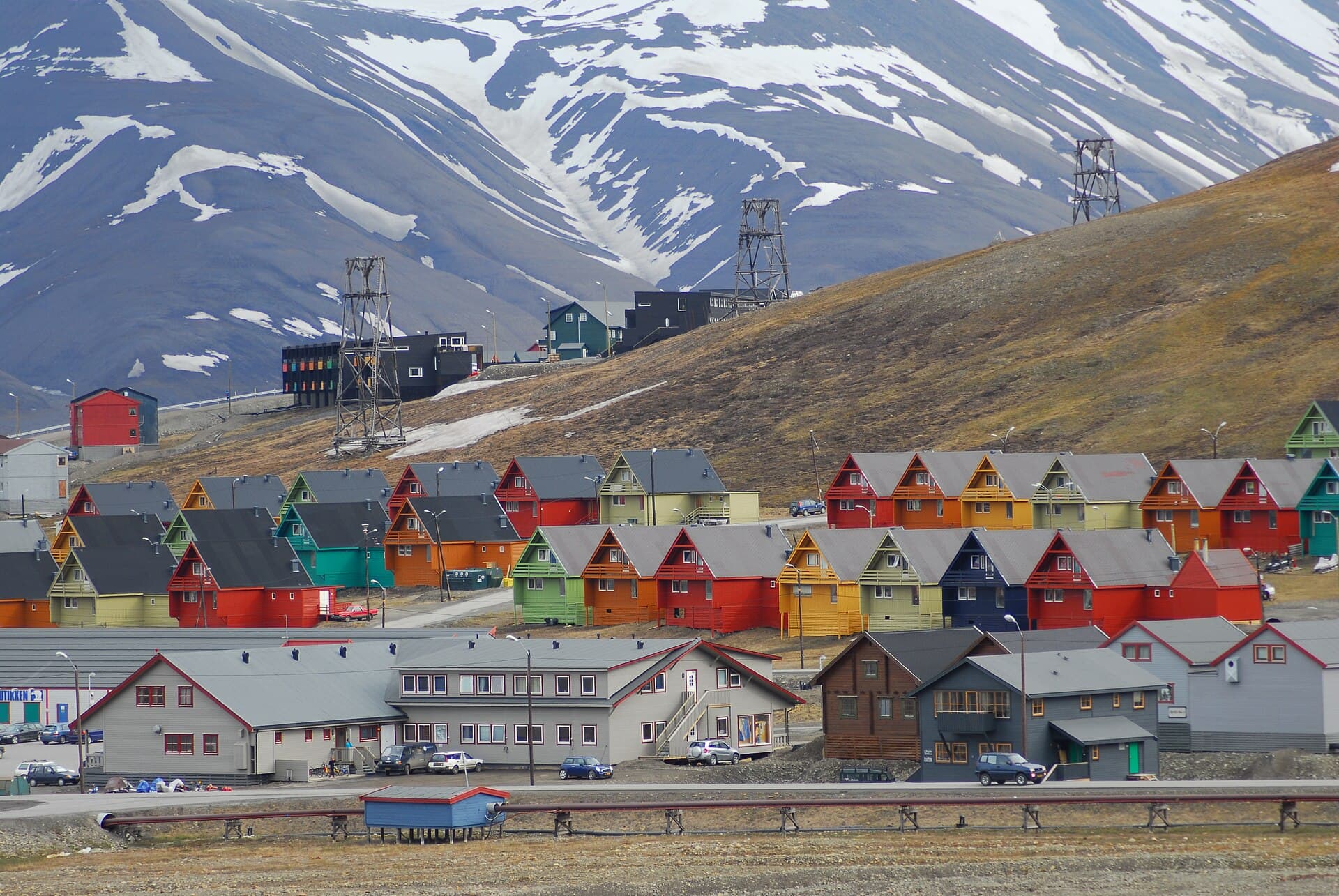
Longyearbyen. The administrative centre grew from a mining camp founded in 1906 by the Arctic Coal Company of the American industrialist John Munro Longyear, who had visited as a tourist in 1901 and bought Norwegian claims on Adventfjorden (Wikipedia). Store Norske Spitsbergen Kulkompani bought the operation in 1916, and the town it built strings along a valley below the old cableway trestles, its houses painted in strong colours against nine months of snow. It has a hospital, a school, a church, a university centre and around fifty nationalities, and it holds the graveyard on the hillside, the Svalbard Museum, the North Pole Expedition Museum and, in the mountain above the airport, the Global Seed Vault.
Barentsburg. The Russian settlement on Grønfjorden, run by the state company Trust Arktikugol, keeps a few hundred residents, mostly from Russia and Ukraine. It still mines coal, and its street plan, murals, statue of Lenin and Soviet-era cultural buildings make it a working example of a company town almost gone elsewhere.
Pyramiden. Founded by Swedish interests in 1910 and sold to the Soviet Union in 1927, Pyramiden was built as a model settlement with a cultural palace, a swimming pool, a hothouse and the world's northernmost grand piano and Lenin bust. After the Operafjellet air disaster of 1996 killed many of the mining community's people, Arktikugol consolidated at Barentsburg and abandoned Pyramiden in 1998, leaving plants on windowsills and folded sheets on beds (Wikipedia). The cold air has preserved it, and it is now among the most complete Soviet townscapes standing anywhere.
Ny-Ålesund. A former mining settlement turned international research village at 79 degrees north, and the departure point for the airship flights of Amundsen and Nobile in 1926 and 1928.
Icelandic annals for 1194 record that a place called Svalbarð was found, and Norway later took the name from that entry, though whether the reference means this archipelago, Jan Mayen or a stretch of east Greenland has never been settled. The certain history begins on 17 June 1596, when the Dutch navigator Willem Barentsz, searching for a north east passage to Asia, sighted a coast of sharp peaks and called it Spitsbergen.
 Pyramiden was emptied in 1998 and left standing. The cold preserves almost everything, so the town survives as a Soviet settlement frozen at the moment its people left. Photograph by Buiobuione, CC BY-SA 4.0, via Wikimedia Commons.
What followed was an industry. Bowhead whales gathered in the fjords in numbers that made shore processing worthwhile, and from about 1612 English, Dutch, Danish, Basque and other crews came north each summer to kill them and boil the blubber. The best known station was Smeerenburg, blubber town, on Amsterdam Island in the north west, occupied by the Dutch from 1614 and formally established with Danish partners in 1619. Later writers turned it into a polar city of thousands with shops and churches; archaeology has cut it down to sixteen or seventeen buildings at its peak in the 1630s, perhaps fifteen ships and four hundred men in a season, abandoned around 1660 once the whales near shore were gone (Wikipedia). Russian Pomor hunters from the White Sea worked a different pattern, overwintering at stations across the archipelago through the eighteenth century to take walrus, seal, fox and bear, and leaving log houses and Orthodox crosses behind.
Coal changed everything. Norwegian shipments began in 1899, American and then Norwegian companies opened Longyearbyen from 1906, and Russian, Swedish, Dutch and British interests staked ground across Spitsbergen. Because the archipelago belonged to no one, the claims were unresolvable, and the matter went to the Paris peace conference. The Svalbard Treaty, signed on 9 February 1920 and in force from 14 August 1925, gave Norway sovereignty on unusual conditions: the ships and nationals of every party enjoy equal rights of access, residence, fishing, hunting and commerce; taxes raised there may only be spent there; and the islands may not be used for warlike purposes or hold naval bases and fortifications (Wikipedia). Fourteen states signed at first, and the treaty now has more than forty parties.
The Second World War emptied the islands. The Allies evacuated the settlements in 1941 and burned the coal stocks; German forces shelled Barentsburg and Longyearbyen in 1943 and ran clandestine weather stations. The last of those garrisons, on Nordaustlandet, surrendered in September 1945, days after the war formally ended, having been forgotten by everyone with the authority to collect them.
Two names sit on the same islands. Barentsz called them Spitsbergen for their pointed mountains, and that name held in most European languages for three centuries; Norway adopted Svalbard, the cold coast or cold edge of the Old Norse annal, when it took sovereignty in the 1920s, reserving Spitsbergen for the main island. Both are still current, and Russian usage prefers Shpitsbergen, which is not merely a linguistic preference but a small marker of the treaty's shared character.
Norwegian is the official language and the language of administration and schooling, Russian is the working language of Barentsburg, and English is the common tongue of the university centre and the tourist industry. The map itself records who came: Dutch names in the north west from the whaling era, Russian names where the Pomors hunted, English names from the seventeenth-century fleets, Swedish and German names from the scientific expeditions of the nineteenth century, and Norwegian names layered over all of them. The Norwegian Polar Institute maintains the official place-name register and rules on new proposals, which in a territory with no continuous local naming tradition is a substantive act of heritage management.
Longyearbyen's defining feature is that almost nobody stays. The average residence is measured in a few years, the community is unusually young, and it is normal for a person's closest friends to leave every summer. What has grown up in place of continuity is a culture of practical mutual dependence: you learn to read avalanche risk, you carry a rifle outside the settlement, you take your boots off indoors, a habit that began as a way of keeping coal dust out of houses.
The old culture was industrial. Coal shaped the calendar, the housing and the accents, and the cableway trestles still standing above the town are protected relics of it. Around that grew the tradition of the hunting cabin, the dog yard and the snowmobile trip, now as much a part of local identity as the mine ever was. The return of the sun in early March, after four months of polar night, is marked by a week of celebration, with people gathering on the old hospital steps to watch the light strike the town again.
Svalbard Church, built in 1958 above Longyearbyen, is the northernmost parish church in the world and works on a model most parishes would not recognise. It is open around the clock, lends out boots and blankets, serves coffee and waffles on Sunday evenings to anyone who comes, and its congregation is short-term, mixed in nationality and largely secular. In a town without extended families, the church functions as the place where crisis is handled, and its pastor is a member of the emergency response system rather than an adjunct to it.
Barentsburg keeps a small Russian Orthodox chapel, built in the late 1990s in memory of the people killed in the air crash of 1996 and the mine explosion that followed. Beyond formal religion, the archipelago has accumulated a shared caution that functions a little like observance: rules about not disturbing graves, not moving old timber, not going out unarmed, and not treating the landscape as forgiving.
Svalbard's most striking heritage is a burial ground. At Likneset, corpse point, on Amsterdam Island, and at Gravneset in Magdalenefjorden, the whaling crews of the seventeenth and eighteenth centuries buried their dead in wooden coffins in shallow graves marked by stone cairns and wooden crosses, because the frozen ground would not take them deeper. The cold kept them. Coffins, textiles, hair and bone survive at Likneset in a state almost unknown in European archaeology, and at least 225 graves were recorded there in the early 1980s, with an unknown number already lost to the sea before anyone counted (PLOS One). Analysis of the remains has put faces to the trade: young men with the vertebral damage of heavy repeated lifting, and signs of scurvy in those who overwintered. As the permafrost warms, coffins are collapsing, water and oxygen are reaching what they held, and the coast is eroding under the graves (NIKU). Norwegian archaeologists are now excavating and recording at Likneset as a rescue operation rather than a research programme.
The Longyearbyen graveyard is a smaller version of the same problem. Its rows of white crosses on the hillside include seven young miners who arrived in the autumn of 1918 and died within days of the influenza then circling the world. In 1998 an international team led by the Canadian scientist Kirsty Duncan exhumed them, hoping the permafrost had preserved a live sample of the 1918 virus. It had not: the coffins lay only about 30 centimetres down, inside the layer that thaws and refreezes each year, and although tissue yielded fragments of viral RNA that fed later genetic work, no live virus was recovered.
That graveyard is also the source of a story worth stating precisely. It is not illegal to die on Svalbard, and no law obliges the sick or the old to leave. What is true is narrower. The Longyearbyen cemetery has taken no coffin burials since about 1950, because the permafrost stops bodies from decomposing, ground movement can push remains back toward the surface, and animals can reach them. People who die on the archipelago are normally flown to the mainland to be buried or cremated, and cremated ashes may be interred in Longyearbyen with the Governor's permission (Polar Journal). Separately, and this is what feeds the myth, Longyearbyen has a hospital but no nursing home or long-term care, so people facing serious illness or great age generally move south. Local clergy have spent years correcting the tabloid version, noting the obvious difficulty of punishing the offence.
Modern loss is remembered on the same hillside and across the fjord. On 29 August 1996 a chartered Tupolev carrying Russian and Ukrainian miners and their families to Barentsburg struck the mountain Operafjellet on approach, killing all 141 aboard, still the deadliest air accident in Norwegian history. Memorials stand at Barentsburg and near the site. The avalanche that destroyed houses in Longyearbyen in December 2015 and killed two people, one a child, is marked in the town and changed where people may live.
Svalbard has no indigenous population, nobody is born and nobody is buried there, and that is what makes its records unusual.
The archipelago was used seasonally by whalers from the seventeenth century, then by trappers and from 1906 by coal miners. Under the Svalbard Treaty of 1920 Norway has sovereignty and citizens of all signatory states may live and work there without a visa, so the population of around three thousand includes Norwegians, Russians and Ukrainians in the mining settlements, and people from more than fifty countries in Longyearbyen.
Nobody has a right to remain if they cannot support themselves, and there is no local citizenship, so the register of residents is a snapshot rather than a lineage. Births are not registered on the island: expectant mothers travel to the mainland. Burial in Longyearbyen has been effectively prohibited since 1950 because permafrost preserves rather than decomposes; the graves from the 1918 influenza still hold viable tissue, which researchers have sampled.
The records that exist are the mining companies' employment books, Store Norske's and the Soviet and Russian Arktikugol's at Barentsburg and Pyramiden, and the Norwegian administrative series at the Governor's office.
The whaling and trapping graves at Smeerenburg and elsewhere are the oldest human record, and they are archaeological sites protected by law.
The seed vault is the newest: a record of the world's crops rather than of anybody's family.
Svalbard protects its past with an unusually blunt instrument. Under the Svalbard Environmental Protection Act, every trace of human activity dating from before 1946 is automatically protected, with no listing process and no case-by-case decision; graves, crosses, grave markers and human bone are protected regardless of age, as are the bone deposits at walrus and whale slaughtering sites and around polar bear self-shooting traps. Each protected monument carries a 100-metre buffer in all directions (Governor of Svalbard). The rule means a piece of driftwood shaped by a Pomor hunter and a mining installation from 1945 have the same legal standing, and visitors are simply told to leave everything where it lies.
The Svalbard Museum in Longyearbyen holds the archaeology, the natural history and the mining record, and shares the Svalbard Science Centre with the university and the Norwegian Polar Institute. The Governor's office monitors the coastal sites most exposed to erosion, and Pyramiden is managed under Norwegian heritage rules as a settlement kept in arrested decay rather than restored. The pressure everywhere is the same: warming is undermining what cold preserved, and the protection regime is now a race between recording and loss.
Two vaults inside Svalbard mountains hold material that belongs to the rest of the world. The Global Seed Vault, opened on 26 February 2008, sits 130 metres inside a sandstone mountain above Longyearbyen airport, owned by Norway, operated with the Nordic Genetic Resource Centre and funded in part by the Crop Trust. It holds more than 1.3 million seed samples deposited by gene banks worldwide and held in trust rather than owned by Norway, and it has already been used for its purpose: the agricultural research centre ICARDA, forced out of Aleppo by the Syrian war, withdrew samples in 2015 and 2017, regenerated them in Lebanon and Morocco, and sent replacements back (Wikipedia). Meltwater reached the entrance tunnel in October 2016, and the approach was rebuilt and waterproofed by 2019.
The Arctic World Archive, opened in 2017 in a decommissioned coal mine, does the same job for digital material. Data is written by the Norwegian company Piql onto photosensitive film designed to stay readable for centuries without a working computer to interpret it. Depositors include the Vatican Library, the national archives of Brazil, Mexico and Norway, the European Space Agency, and GitHub, whose Arctic Code Vault placed 21 terabytes of open source software on 186 reels of film in 2020 (GitHub Archive Program). Alongside these, the Norwegian Polar Institute publishes its place-name database online, and the newspaper Svalbardposten, published since 1948, is the running record of the community.
Svalbard's economy has changed under everyone's feet. Store Norske ended production at Mine 7 in 2025, closing more than a century of Norwegian coal mining on the archipelago, and Longyearbyen now lives on research, tourism and public administration. UNIS, the University Centre in Svalbard, founded in 1993, teaches Arctic biology, geology, geophysics and technology in English to several hundred students a year, and its field courses double as a training ground for Arctic safety.
The polar bear rule remains the sharpest expression of what the place is. Anyone leaving the settlements is expected to carry a rifle of adequate calibre and know how to use it, while carrying a loaded weapon inside Longyearbyen is forbidden and firearms are handled so anyone can see they are unloaded (Governor of Svalbard). Bears have been protected since 1973, and every shot fired at one is investigated. Meanwhile the treaty is under more scrutiny than at any time since the Cold War, as Russia and Norway read its provisions on equal access and military use differently.
A treaty that has held for a century. The 1920 settlement resolved a genuinely intractable problem, an unclaimed territory with competing industrial claims from a dozen countries, by combining sovereignty with universal access and a ban on warlike use. It has survived a world war, the Cold War and the current deterioration of Arctic relations.
Protection without paperwork. Making every pre-1946 trace automatically protected, and every grave protected regardless of age, removed the delay and discretion that lose sites elsewhere. It is heritage law simple enough to explain to a tourist in one sentence.
Ordinary lives recovered from an eroding cemetery. Excavation and analysis at Likneset has turned an eroding cemetery into evidence about the working lives of ordinary seventeenth-century labourers, their diet, injuries and illnesses, recovering the people behind an industry usually described only in tonnages.
A vault that was actually needed. The Seed Vault was built against a hypothetical disaster and then met a real one, returning to ICARDA the crop diversity that the war in Syria had put out of reach.
Pyramiden was emptied in 1998 and left standing. The cold preserves almost everything, so the town survives as a Soviet settlement frozen at the moment its people left. Photograph by Buiobuione, CC BY-SA 4.0, via Wikimedia Commons.
What followed was an industry. Bowhead whales gathered in the fjords in numbers that made shore processing worthwhile, and from about 1612 English, Dutch, Danish, Basque and other crews came north each summer to kill them and boil the blubber. The best known station was Smeerenburg, blubber town, on Amsterdam Island in the north west, occupied by the Dutch from 1614 and formally established with Danish partners in 1619. Later writers turned it into a polar city of thousands with shops and churches; archaeology has cut it down to sixteen or seventeen buildings at its peak in the 1630s, perhaps fifteen ships and four hundred men in a season, abandoned around 1660 once the whales near shore were gone (Wikipedia). Russian Pomor hunters from the White Sea worked a different pattern, overwintering at stations across the archipelago through the eighteenth century to take walrus, seal, fox and bear, and leaving log houses and Orthodox crosses behind.
Coal changed everything. Norwegian shipments began in 1899, American and then Norwegian companies opened Longyearbyen from 1906, and Russian, Swedish, Dutch and British interests staked ground across Spitsbergen. Because the archipelago belonged to no one, the claims were unresolvable, and the matter went to the Paris peace conference. The Svalbard Treaty, signed on 9 February 1920 and in force from 14 August 1925, gave Norway sovereignty on unusual conditions: the ships and nationals of every party enjoy equal rights of access, residence, fishing, hunting and commerce; taxes raised there may only be spent there; and the islands may not be used for warlike purposes or hold naval bases and fortifications (Wikipedia). Fourteen states signed at first, and the treaty now has more than forty parties.
The Second World War emptied the islands. The Allies evacuated the settlements in 1941 and burned the coal stocks; German forces shelled Barentsburg and Longyearbyen in 1943 and ran clandestine weather stations. The last of those garrisons, on Nordaustlandet, surrendered in September 1945, days after the war formally ended, having been forgotten by everyone with the authority to collect them.
Two names sit on the same islands. Barentsz called them Spitsbergen for their pointed mountains, and that name held in most European languages for three centuries; Norway adopted Svalbard, the cold coast or cold edge of the Old Norse annal, when it took sovereignty in the 1920s, reserving Spitsbergen for the main island. Both are still current, and Russian usage prefers Shpitsbergen, which is not merely a linguistic preference but a small marker of the treaty's shared character.
Norwegian is the official language and the language of administration and schooling, Russian is the working language of Barentsburg, and English is the common tongue of the university centre and the tourist industry. The map itself records who came: Dutch names in the north west from the whaling era, Russian names where the Pomors hunted, English names from the seventeenth-century fleets, Swedish and German names from the scientific expeditions of the nineteenth century, and Norwegian names layered over all of them. The Norwegian Polar Institute maintains the official place-name register and rules on new proposals, which in a territory with no continuous local naming tradition is a substantive act of heritage management.
Longyearbyen's defining feature is that almost nobody stays. The average residence is measured in a few years, the community is unusually young, and it is normal for a person's closest friends to leave every summer. What has grown up in place of continuity is a culture of practical mutual dependence: you learn to read avalanche risk, you carry a rifle outside the settlement, you take your boots off indoors, a habit that began as a way of keeping coal dust out of houses.
The old culture was industrial. Coal shaped the calendar, the housing and the accents, and the cableway trestles still standing above the town are protected relics of it. Around that grew the tradition of the hunting cabin, the dog yard and the snowmobile trip, now as much a part of local identity as the mine ever was. The return of the sun in early March, after four months of polar night, is marked by a week of celebration, with people gathering on the old hospital steps to watch the light strike the town again.
Svalbard Church, built in 1958 above Longyearbyen, is the northernmost parish church in the world and works on a model most parishes would not recognise. It is open around the clock, lends out boots and blankets, serves coffee and waffles on Sunday evenings to anyone who comes, and its congregation is short-term, mixed in nationality and largely secular. In a town without extended families, the church functions as the place where crisis is handled, and its pastor is a member of the emergency response system rather than an adjunct to it.
Barentsburg keeps a small Russian Orthodox chapel, built in the late 1990s in memory of the people killed in the air crash of 1996 and the mine explosion that followed. Beyond formal religion, the archipelago has accumulated a shared caution that functions a little like observance: rules about not disturbing graves, not moving old timber, not going out unarmed, and not treating the landscape as forgiving.
Svalbard's most striking heritage is a burial ground. At Likneset, corpse point, on Amsterdam Island, and at Gravneset in Magdalenefjorden, the whaling crews of the seventeenth and eighteenth centuries buried their dead in wooden coffins in shallow graves marked by stone cairns and wooden crosses, because the frozen ground would not take them deeper. The cold kept them. Coffins, textiles, hair and bone survive at Likneset in a state almost unknown in European archaeology, and at least 225 graves were recorded there in the early 1980s, with an unknown number already lost to the sea before anyone counted (PLOS One). Analysis of the remains has put faces to the trade: young men with the vertebral damage of heavy repeated lifting, and signs of scurvy in those who overwintered. As the permafrost warms, coffins are collapsing, water and oxygen are reaching what they held, and the coast is eroding under the graves (NIKU). Norwegian archaeologists are now excavating and recording at Likneset as a rescue operation rather than a research programme.
The Longyearbyen graveyard is a smaller version of the same problem. Its rows of white crosses on the hillside include seven young miners who arrived in the autumn of 1918 and died within days of the influenza then circling the world. In 1998 an international team led by the Canadian scientist Kirsty Duncan exhumed them, hoping the permafrost had preserved a live sample of the 1918 virus. It had not: the coffins lay only about 30 centimetres down, inside the layer that thaws and refreezes each year, and although tissue yielded fragments of viral RNA that fed later genetic work, no live virus was recovered.
That graveyard is also the source of a story worth stating precisely. It is not illegal to die on Svalbard, and no law obliges the sick or the old to leave. What is true is narrower. The Longyearbyen cemetery has taken no coffin burials since about 1950, because the permafrost stops bodies from decomposing, ground movement can push remains back toward the surface, and animals can reach them. People who die on the archipelago are normally flown to the mainland to be buried or cremated, and cremated ashes may be interred in Longyearbyen with the Governor's permission (Polar Journal). Separately, and this is what feeds the myth, Longyearbyen has a hospital but no nursing home or long-term care, so people facing serious illness or great age generally move south. Local clergy have spent years correcting the tabloid version, noting the obvious difficulty of punishing the offence.
Modern loss is remembered on the same hillside and across the fjord. On 29 August 1996 a chartered Tupolev carrying Russian and Ukrainian miners and their families to Barentsburg struck the mountain Operafjellet on approach, killing all 141 aboard, still the deadliest air accident in Norwegian history. Memorials stand at Barentsburg and near the site. The avalanche that destroyed houses in Longyearbyen in December 2015 and killed two people, one a child, is marked in the town and changed where people may live.
Svalbard has no indigenous population, nobody is born and nobody is buried there, and that is what makes its records unusual.
The archipelago was used seasonally by whalers from the seventeenth century, then by trappers and from 1906 by coal miners. Under the Svalbard Treaty of 1920 Norway has sovereignty and citizens of all signatory states may live and work there without a visa, so the population of around three thousand includes Norwegians, Russians and Ukrainians in the mining settlements, and people from more than fifty countries in Longyearbyen.
Nobody has a right to remain if they cannot support themselves, and there is no local citizenship, so the register of residents is a snapshot rather than a lineage. Births are not registered on the island: expectant mothers travel to the mainland. Burial in Longyearbyen has been effectively prohibited since 1950 because permafrost preserves rather than decomposes; the graves from the 1918 influenza still hold viable tissue, which researchers have sampled.
The records that exist are the mining companies' employment books, Store Norske's and the Soviet and Russian Arktikugol's at Barentsburg and Pyramiden, and the Norwegian administrative series at the Governor's office.
The whaling and trapping graves at Smeerenburg and elsewhere are the oldest human record, and they are archaeological sites protected by law.
The seed vault is the newest: a record of the world's crops rather than of anybody's family.
Svalbard protects its past with an unusually blunt instrument. Under the Svalbard Environmental Protection Act, every trace of human activity dating from before 1946 is automatically protected, with no listing process and no case-by-case decision; graves, crosses, grave markers and human bone are protected regardless of age, as are the bone deposits at walrus and whale slaughtering sites and around polar bear self-shooting traps. Each protected monument carries a 100-metre buffer in all directions (Governor of Svalbard). The rule means a piece of driftwood shaped by a Pomor hunter and a mining installation from 1945 have the same legal standing, and visitors are simply told to leave everything where it lies.
The Svalbard Museum in Longyearbyen holds the archaeology, the natural history and the mining record, and shares the Svalbard Science Centre with the university and the Norwegian Polar Institute. The Governor's office monitors the coastal sites most exposed to erosion, and Pyramiden is managed under Norwegian heritage rules as a settlement kept in arrested decay rather than restored. The pressure everywhere is the same: warming is undermining what cold preserved, and the protection regime is now a race between recording and loss.
Two vaults inside Svalbard mountains hold material that belongs to the rest of the world. The Global Seed Vault, opened on 26 February 2008, sits 130 metres inside a sandstone mountain above Longyearbyen airport, owned by Norway, operated with the Nordic Genetic Resource Centre and funded in part by the Crop Trust. It holds more than 1.3 million seed samples deposited by gene banks worldwide and held in trust rather than owned by Norway, and it has already been used for its purpose: the agricultural research centre ICARDA, forced out of Aleppo by the Syrian war, withdrew samples in 2015 and 2017, regenerated them in Lebanon and Morocco, and sent replacements back (Wikipedia). Meltwater reached the entrance tunnel in October 2016, and the approach was rebuilt and waterproofed by 2019.
The Arctic World Archive, opened in 2017 in a decommissioned coal mine, does the same job for digital material. Data is written by the Norwegian company Piql onto photosensitive film designed to stay readable for centuries without a working computer to interpret it. Depositors include the Vatican Library, the national archives of Brazil, Mexico and Norway, the European Space Agency, and GitHub, whose Arctic Code Vault placed 21 terabytes of open source software on 186 reels of film in 2020 (GitHub Archive Program). Alongside these, the Norwegian Polar Institute publishes its place-name database online, and the newspaper Svalbardposten, published since 1948, is the running record of the community.
Svalbard's economy has changed under everyone's feet. Store Norske ended production at Mine 7 in 2025, closing more than a century of Norwegian coal mining on the archipelago, and Longyearbyen now lives on research, tourism and public administration. UNIS, the University Centre in Svalbard, founded in 1993, teaches Arctic biology, geology, geophysics and technology in English to several hundred students a year, and its field courses double as a training ground for Arctic safety.
The polar bear rule remains the sharpest expression of what the place is. Anyone leaving the settlements is expected to carry a rifle of adequate calibre and know how to use it, while carrying a loaded weapon inside Longyearbyen is forbidden and firearms are handled so anyone can see they are unloaded (Governor of Svalbard). Bears have been protected since 1973, and every shot fired at one is investigated. Meanwhile the treaty is under more scrutiny than at any time since the Cold War, as Russia and Norway read its provisions on equal access and military use differently.
A treaty that has held for a century. The 1920 settlement resolved a genuinely intractable problem, an unclaimed territory with competing industrial claims from a dozen countries, by combining sovereignty with universal access and a ban on warlike use. It has survived a world war, the Cold War and the current deterioration of Arctic relations.
Protection without paperwork. Making every pre-1946 trace automatically protected, and every grave protected regardless of age, removed the delay and discretion that lose sites elsewhere. It is heritage law simple enough to explain to a tourist in one sentence.
Ordinary lives recovered from an eroding cemetery. Excavation and analysis at Likneset has turned an eroding cemetery into evidence about the working lives of ordinary seventeenth-century labourers, their diet, injuries and illnesses, recovering the people behind an industry usually described only in tonnages.
A vault that was actually needed. The Seed Vault was built against a hypothetical disaster and then met a real one, returning to ICARDA the crop diversity that the war in Syria had put out of reach.
National Overview
Notable Cities
Historical Foundations
Linguistic and Etymological Roots
Cultural Identity
Religion and Spirituality
Remembrance and Mourning Traditions
Tracing a Family in Svalbard
Heritage Preservation Efforts
Digital Heritage
Contemporary Cultural Influences
Success Stories
References and resources
- Svalbard Treaty, Wikipedia: the 1920 text, the equal-access and demilitarisation clauses, and the parties.
- Governor of Svalbard, Cultural Heritage Management: the automatic protection of pre-1946 remains, graves and the 100-metre zones.
- Governor of Svalbard, Firearms: the rules on carrying protection against polar bears.
- Longyearbyen, Wikipedia: the founding by John Munro Longyear and the burial rules.
- Smeerenburg, Wikipedia: the Dutch whaling station, its real scale and its abandonment.
- PLOS One, Skeletons in the Permafrost: Likneset: the whalers' cemetery, its 225 recorded graves and climate-driven loss.
- NIKU, Whalers' Graves on Svalbard: the Norwegian rescue excavations and what the bones show.
- Pyramiden, Wikipedia: the Soviet model settlement and its abandonment in 1998.
- Vnukovo Airlines Flight 2801, Wikipedia: the 1996 Operafjellet crash and its 141 dead.
- Svalbard Global Seed Vault, Wikipedia: the 2008 opening, the holdings and the ICARDA withdrawals.
- GitHub Archive Program, Arctic Vault: the 2020 deposit of open source code in the Arctic World Archive.
- Arctic World Archive, Wikipedia: the film-based archive in the decommissioned coal mine.
- Svalbard Museum: collections of archaeology, natural history and mining.