Heritage · Country
South Sudan Culture and Heritage
In the world's youngest nation, memory lives in cattle camps along the White Nile, in the praise-songs of the Dinka and Nuer, and in the great antelope migration that still crosses the Boma plains. This guide traces how South Sudan's many peoples honour their ancestors and hold a hard-won history close.Written to last.
By Confinity Heritage Editorial · Updated 2026-07-31 · 8-minute readQuiet tools, kept out of the way.
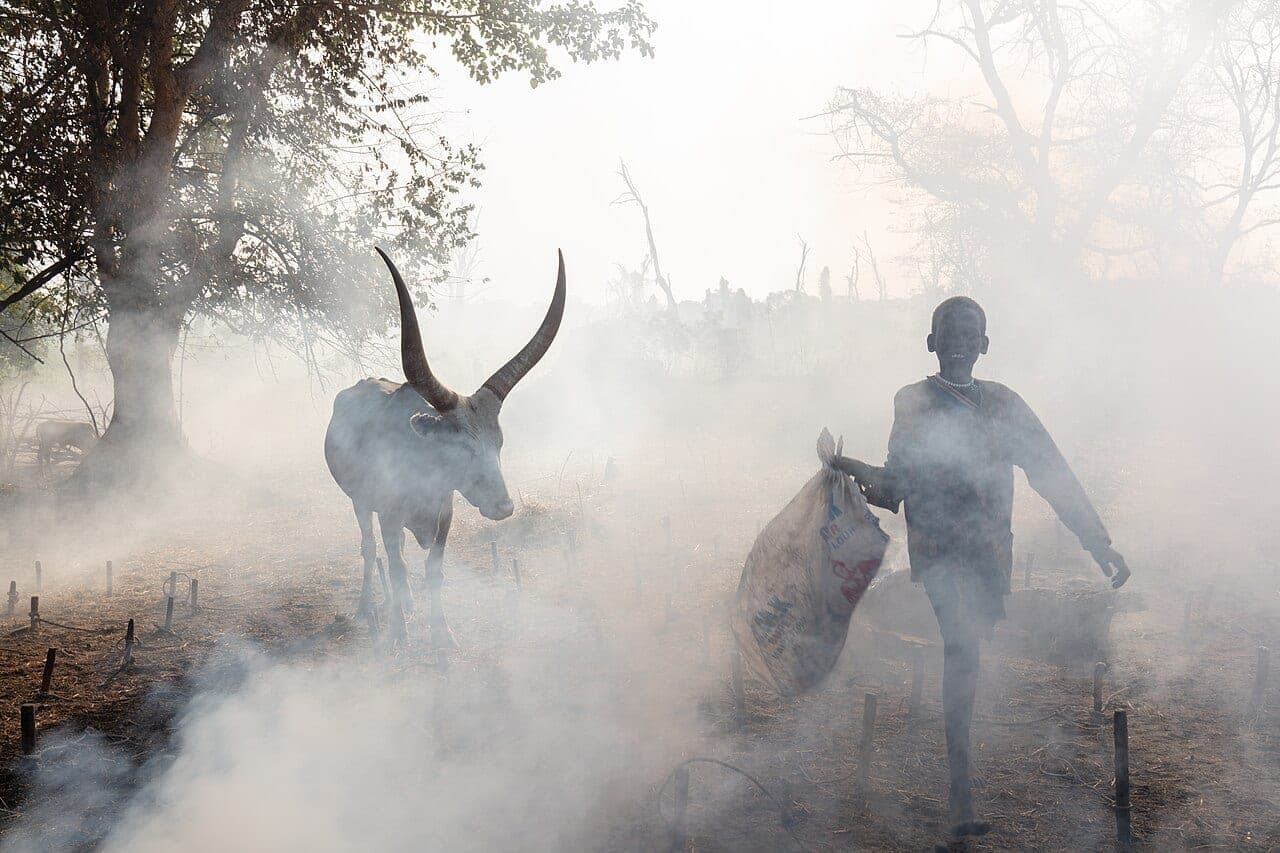
South Sudan became a sovereign state on 9 July 2011, the newest nation on earth, yet the memory it carries is very old. Along the White Nile, families still move with their herds between dry-season cattle camps and rainy-season villages, calling their favourite oxen by name. To the east, on the Boma and Bandingilo plains, one of the largest land-mammal movements on the planet crosses the savanna each year. Between the wetlands and the grasslands live more than sixty peoples, each with its own language, its own way of marking a life, and its own way of keeping the dead present among the living.
This page traces that inheritance: the Nilotic pastoral cultures of the Dinka, Nuer and Shilluk and the many communities beside them; the ancient Shilluk kingdom and its divine king; the long and painful road to independence; and the funerary and remembrance customs, traditional, Christian and Muslim, through which South Sudanese families honour those who came before. It is written in the spirit that guides Confinity's own work, which holds that memory kept with care is a form of belonging that outlasts hardship.
South Sudan is a landlocked country in east-central Africa, bordered by Sudan to the north, Ethiopia to the east, Kenya, Uganda and the Democratic Republic of the Congo to the south, and the Central African Republic to the west. The White Nile runs the length of the country from south to north, and at its heart lies the Sudd, an immense seasonal swamp of the Bahr el Jebel that is one of the largest wetlands in the world. Its waters spread across a low clay plain in flood season and shrink back in the dry months, shaping the movements of people, cattle and wildlife, while around this centre rise ironstone plateaus, open savanna and, near the borders, forested hills.
Estimates place the population at roughly eleven to twelve million, most of whom live in rural communities built around farming and cattle. The people are predominantly Nilotic, and society is young in every sense: a large majority is under thirty. Beyond the Nile plains, the Boma and Bandingilo landscapes host a migration of antelope that recent aerial surveys estimate at around six million animals, chiefly white-eared kob together with tiang and Mongalla gazelle, a movement now considered the largest of its kind on land.
What distinguishes South Sudan is how close its heritage sits to daily life: in a state still building its institutions, the deepest archives are held not in vaults but in memory, song and the customs of the cattle camp.
Juba, the capital and largest city, sits on the west bank of the White Nile in the country's south. Long a modest river port and mission station, it grew rapidly after 2005 into the seat of government and the hub of national life, home to ministries, the university, markets and a diverse population drawn from across the country and the diaspora.
 Juba became the capital of a country that did not exist until 2011, and most of what South Sudan holds as heritage is carried in song, cattle-naming and oral genealogy rather than in buildings. Photograph by MakurProTyler, CC BY-SA 4.0, via Wikimedia Commons.
Wau, in the north-west, is one of the country's oldest towns and the centre of Western Bahr el Ghazal. Set on the Jur River and long the terminus of the railway from the north, it is known for its cathedrals and mosques, its brick architecture from the condominium era, and a population that mixes Dinka, Luo, Fertit and other communities.
Malakal, on the White Nile in the north-east, is the historic gateway to Upper Nile and lies close to the heartland of the Shilluk kingdom and its old royal seat at Fashoda, now Kodok. A river town and trading centre, it suffered heavily during the recent conflict, and its recovery is bound up with that of the whole region.
Yei, in the far south near the borders with Uganda and the Democratic Republic of the Congo, sits in fertile Equatorian country. Known for coffee, teak and farming, and for a mix of peoples including the region's Bari-speaking communities, it has long been a crossroads of trade and a centre of church and educational life.
The plains of the upper White Nile have been home to Nilotic cattle-keeping peoples for many centuries. The Dinka, Nuer, Shilluk and their neighbours built societies in which herds meant survival, status and continuity, and in which movement between wet and dry season pastures set the rhythm of life. Among these peoples the Shilluk created the most centralised state, the Shilluk kingdom, traced to the semi-legendary founder Nyikang and ruled by a divine king, the reth, from a royal capital at Fashoda near present-day Malakal. To the south-west, the Azande built kingdoms of their own under the Avungara aristocracy, drawing many smaller groups into a shared political and cultural order.
The nineteenth century brought severe upheaval. Slave raids and ivory expeditions pushed up the Nile into these lands, and the turmoil of the Turco-Egyptian administration and the later Mahdist period fell hard on southern communities, who bore violence and displacement from powers based far to the north, leaving deep wounds and a lasting wariness of outside rule.
From 1899 the region was governed as part of Anglo-Egyptian Sudan, a condominium that administered the southern provinces separately from the north and invested little in them, widening a divide of religion, language and development. When Sudan approached independence in 1956, southern fears of domination were already acute, and a first long war ran from 1955 until the Addis Ababa Agreement of 1972. A second and larger war began in 1983, led on the southern side by the Sudan People's Liberation Movement and Army under John Garang, and continued until the Comprehensive Peace Agreement of 2005, which granted the south autonomy and the promise of a vote on its future.
In January 2011 that vote came. In the independence referendum, an overwhelming majority, reported at 98.83 per cent, chose separation, and on 9 July 2011 the Republic of South Sudan was born. The years that followed were difficult. A conflict that broke out in December 2013 and continued until 2018 caused immense suffering, with hundreds of thousands of deaths and millions displaced, and grave harm inflicted on civilians across communities. Successive peace efforts led to the Revitalised Agreement of September 2018 and a transitional unity government formed in February 2020. This account keeps that period brief and takes no side; the fuller reckoning belongs to South Sudanese themselves, and it is offered here in memory of victims from every community.
English is the official language of South Sudan, chosen at independence as a neutral medium for government, courts and schools. In practice the most widely shared spoken language is Juba Arabic, a distinct Arabic-based creole that grew in the nineteenth century among soldiers and traders and became the everyday lingua franca of the towns, especially in the Equatorian south. Alongside these, the country recognises the many indigenous tongues as national languages.
More than sixty languages are spoken across the country. The largest belong to the Nilotic family: Dinka, whose speakers call it Thuɔŋjäŋ and themselves Jieng or Muonyjang; Nuer, called Thok Naath by the Naath people; Shilluk; and Bari, spoken around Juba and Terekeka. Others, such as Zande in the south-west and Toposa in the south-east, belong to different families entirely, making South Sudan a meeting place of several African language groups.
The name Sudan comes from the Arabic bilad al-sudan, meaning the land of the black peoples, a geographic term once applied to the whole belt of Africa south of the Sahara. When the south voted for independence it kept the descriptive name and marked its place with a compass point, so that the country's name records both an old outsider's label and a new, chosen identity.
Cattle stand at the centre of life for the Nilotic peoples. In the dry season, families move their herds to riverside and swamp-edge pastures and gather in cattle camps, where young men tend the animals, cover themselves and the cattle in protective ash, and compose songs in honour of their favourite oxen. Among the Mundari near Terekeka, as among the Dinka and Nuer, a person's bond with a named ox can define identity itself. Cattle are wealth, kinship and poetry at once, given as bridewealth to seal marriages and offered in sacrifice at life's most important moments.
Body and bead traditions carry deep meaning. Many Dinka and Nuer communities have practised scarification, known among the Nuer as gaar, in which patterns of raised lines are marked on the forehead as a sign of adulthood and belonging; the classic Nuer pattern is a row of horizontal lines, and Dinka groups use distinctive forehead markings of their own. These customs, less common among the young today, are marks of identity and courage rather than curiosity. Beadwork corsets and jewellery signal age, status and marriageability, worn with pride at dances and ceremonies.
Culture here is expressive and communal. Wrestling matches between villages and cattle camps draw crowds and settle rivalries with honour rather than harm. Oral epic, genealogy and praise-song preserve the deeds of ancestors and the concerns of the living, from clan disputes to courtship to the constant matter of cattle. Cuisine is built around sorghum and millet, cooked as the stiff porridge asida or the thin bread kisra and eaten with stews, greens and, along the Nile, fish, while milk remains a staple of the pastoral diet.
South Sudan is today mostly Christian, with roughly six in ten people identifying as such according to recent estimates, a legacy of mission schools and of churches that stood by communities through decades of war. Roman Catholic, Anglican, Presbyterian and other denominations are woven into public life, and gospel song is widely loved.
Traditional Nilotic belief remains strong and often coexists with Christianity rather than being displaced by it. The Dinka know the supreme creator as Nhialic, the god of sky and rain who reigns above lesser divinities and the spirits of the ancestors; the Nuer speak of Kwoth, the spirit of the above. Prayer, sacrifice and the mediation of diviners connect the living with these powers, and every homestead may keep a shrine where offerings are made. A minority of South Sudanese, around six per cent, are Muslim, most numerous in the towns and in communities with older ties to the north. This page treats all three currents with equal respect, as living parts of a shared national life.
For the Nilotic peoples, death is a passage that binds a whole web of kin, and cattle lie at its heart. When a respected person dies, the family gathers for burial and mourning, and cattle may be slaughtered both to honour the dead and to feed those who come to grieve. The animal is not killed lightly; among the Dinka the ox is offered above all in sacrifice to God, the spirits and the ancestors. Mourning is observed over an extended period, and the departed are remembered as ancestors whose favour and guidance continue. The same cattle that pass as bridewealth to create a marriage also stand behind the continuity of the lineage, so that marriage, descent and remembrance are threads of a single cloth.
Christian and Muslim rites shape mourning across much of the country. Christian families hold a funeral service and graveside gathering, with prayers, hymns and a period of condolence in which relatives and neighbours sit with the bereaved. Muslim families follow the customs of Islam, washing and shrouding the body, praying the funeral prayer and burying the dead promptly and simply, with a recognised period of mourning afterward. In many communities these observances blend with older practices of feasting and remembrance, so that a burial is at once an act of faith and of kinship.
Above these particular customs lies a shared national memory. Almost every family carries the loss of relatives to the long struggle and to the more recent conflict, and the remembrance of those losses, across all communities and faiths, has become part of what it means to be South Sudanese.
South Sudan is the newest country in the world and it has, in effect, no historical civil register.
Registration under the Anglo-Egyptian condominium and then under Khartoum applied to a small part of the population and was administered from the north, so what exists of the colonial and Sudanese record for the southern provinces is in Khartoum, in London, and in scattered mission files. Two long civil wars, from 1955 to 1972 and from 1983 to 2005, destroyed or displaced most of what was here, and the fighting since 2013 has done more.
Church registers are the main written source. Anglican and Catholic missions have been in the south since the nineteenth century, and their baptism and marriage books, kept at parish level, are for many families the only paper record of a grandparent.
The substantive record is elsewhere. Dinka, Nuer, Shilluk, Azande, Bari and the other peoples of South Sudan keep genealogy orally and precisely, tied to cattle, to the age-set a man was initiated with, and to the section and clan that place a person in relation to everyone else. Cattle in particular are a ledger: bridewealth transfers are remembered in detail because they establish the legitimacy of children and the obligations between families.
The largest documentary archive of South Sudanese lives is a refugee archive, held by UNHCR and by the countries that received people: Uganda, Kenya, Ethiopia, Sudan, and the resettlement files of Australia, Canada and the United States.
South Sudan's greatest heritage assets include its landscapes. The Boma and Bandingilo national parks, together with the wider Jonglei plains, protect the corridors of the great antelope migration, and since 2022 the government has partnered with the conservation organisation African Parks to manage and safeguard them. A landmark aerial survey completed in 2024 confirmed the scale of the movement and drew international attention to a natural wonder long hidden by instability.
Cultural institutions are younger and more fragile. The South Sudan National Museum began as a mobile, community-based project supported by UNESCO from 2014, carrying photographs, recordings and objects to communities rather than waiting for them to come to a building, while efforts continue toward a permanent national museum and a functioning National Archives in Juba. Building such institutions in a state so young, and amid scarce resources, is slow and demanding work, and much of the country's heritage still rests with elders, singers and families, which gives added urgency to the task of recording living memory before it is lost.
For a country where so much knowledge is oral, digital tools offer a way to capture what might otherwise fade. Researchers and cultural organisations, among them the Rift Valley Institute, have recorded oral histories, praise-songs and language material, and archival projects have worked to copy fragile paper records held in Juba. Mobile phones, now widespread even in rural areas, allow families to photograph ceremonies, record elders and keep memories that once lived only in the telling.
The South Sudanese diaspora has taken up this work with energy, building online communities, uploading music and video, and documenting family and clan histories for children growing up far from home. Confinity's own remembrance mission speaks directly to this moment: a young nation with an ancient culture stands to gain enormously when families can gather names, voices and images into a lasting archive, safe from the disruptions of distance and time.
Decades of war scattered South Sudanese across the world, and the diaspora, in the United States, Canada, Australia, the United Kingdom and neighbouring African countries, has become a powerful cultural force. The generation known as the Lost Boys, who walked vast distances as children to reach safety, carried their languages and customs abroad. Diaspora artists and public figures have brought South Sudanese heritage to global audiences, from musicians who blend Nilotic themes with contemporary sound to writers and athletes who speak of their origins with pride.
At home, a young and connected generation is reworking tradition in music, fashion and film, setting praise-song rhythms against modern production and carrying beadwork and cattle-camp imagery into new forms, a culture that reaches outward without losing its roots.
The confirmation of the Boma and Bandingilo migration as the largest land-mammal movement on earth is a genuine achievement for a nation still finding its feet. It turned a fragile, little-known wilderness into a source of national pride and international partnership.
In culture, the reach of the South Sudanese diaspora offers its own success. Figures such as the model Alek Wek, born in Wau and later one of the most recognised faces in international fashion, have carried the name of their homeland with dignity, and musicians, writers and community leaders have done the same, transforming stories of hardship into works that honour where they came from.
Quietest and most important is the daily persistence of ordinary families who keep their customs alive: who name their cattle, sing their genealogies, bury their dead with honour and teach their children the language of their grandparents. In a nation this young, that unbroken transmission of memory is the surest heritage success of all.
Juba became the capital of a country that did not exist until 2011, and most of what South Sudan holds as heritage is carried in song, cattle-naming and oral genealogy rather than in buildings. Photograph by MakurProTyler, CC BY-SA 4.0, via Wikimedia Commons.
Wau, in the north-west, is one of the country's oldest towns and the centre of Western Bahr el Ghazal. Set on the Jur River and long the terminus of the railway from the north, it is known for its cathedrals and mosques, its brick architecture from the condominium era, and a population that mixes Dinka, Luo, Fertit and other communities.
Malakal, on the White Nile in the north-east, is the historic gateway to Upper Nile and lies close to the heartland of the Shilluk kingdom and its old royal seat at Fashoda, now Kodok. A river town and trading centre, it suffered heavily during the recent conflict, and its recovery is bound up with that of the whole region.
Yei, in the far south near the borders with Uganda and the Democratic Republic of the Congo, sits in fertile Equatorian country. Known for coffee, teak and farming, and for a mix of peoples including the region's Bari-speaking communities, it has long been a crossroads of trade and a centre of church and educational life.
The plains of the upper White Nile have been home to Nilotic cattle-keeping peoples for many centuries. The Dinka, Nuer, Shilluk and their neighbours built societies in which herds meant survival, status and continuity, and in which movement between wet and dry season pastures set the rhythm of life. Among these peoples the Shilluk created the most centralised state, the Shilluk kingdom, traced to the semi-legendary founder Nyikang and ruled by a divine king, the reth, from a royal capital at Fashoda near present-day Malakal. To the south-west, the Azande built kingdoms of their own under the Avungara aristocracy, drawing many smaller groups into a shared political and cultural order.
The nineteenth century brought severe upheaval. Slave raids and ivory expeditions pushed up the Nile into these lands, and the turmoil of the Turco-Egyptian administration and the later Mahdist period fell hard on southern communities, who bore violence and displacement from powers based far to the north, leaving deep wounds and a lasting wariness of outside rule.
From 1899 the region was governed as part of Anglo-Egyptian Sudan, a condominium that administered the southern provinces separately from the north and invested little in them, widening a divide of religion, language and development. When Sudan approached independence in 1956, southern fears of domination were already acute, and a first long war ran from 1955 until the Addis Ababa Agreement of 1972. A second and larger war began in 1983, led on the southern side by the Sudan People's Liberation Movement and Army under John Garang, and continued until the Comprehensive Peace Agreement of 2005, which granted the south autonomy and the promise of a vote on its future.
In January 2011 that vote came. In the independence referendum, an overwhelming majority, reported at 98.83 per cent, chose separation, and on 9 July 2011 the Republic of South Sudan was born. The years that followed were difficult. A conflict that broke out in December 2013 and continued until 2018 caused immense suffering, with hundreds of thousands of deaths and millions displaced, and grave harm inflicted on civilians across communities. Successive peace efforts led to the Revitalised Agreement of September 2018 and a transitional unity government formed in February 2020. This account keeps that period brief and takes no side; the fuller reckoning belongs to South Sudanese themselves, and it is offered here in memory of victims from every community.
English is the official language of South Sudan, chosen at independence as a neutral medium for government, courts and schools. In practice the most widely shared spoken language is Juba Arabic, a distinct Arabic-based creole that grew in the nineteenth century among soldiers and traders and became the everyday lingua franca of the towns, especially in the Equatorian south. Alongside these, the country recognises the many indigenous tongues as national languages.
More than sixty languages are spoken across the country. The largest belong to the Nilotic family: Dinka, whose speakers call it Thuɔŋjäŋ and themselves Jieng or Muonyjang; Nuer, called Thok Naath by the Naath people; Shilluk; and Bari, spoken around Juba and Terekeka. Others, such as Zande in the south-west and Toposa in the south-east, belong to different families entirely, making South Sudan a meeting place of several African language groups.
The name Sudan comes from the Arabic bilad al-sudan, meaning the land of the black peoples, a geographic term once applied to the whole belt of Africa south of the Sahara. When the south voted for independence it kept the descriptive name and marked its place with a compass point, so that the country's name records both an old outsider's label and a new, chosen identity.
Cattle stand at the centre of life for the Nilotic peoples. In the dry season, families move their herds to riverside and swamp-edge pastures and gather in cattle camps, where young men tend the animals, cover themselves and the cattle in protective ash, and compose songs in honour of their favourite oxen. Among the Mundari near Terekeka, as among the Dinka and Nuer, a person's bond with a named ox can define identity itself. Cattle are wealth, kinship and poetry at once, given as bridewealth to seal marriages and offered in sacrifice at life's most important moments.
Body and bead traditions carry deep meaning. Many Dinka and Nuer communities have practised scarification, known among the Nuer as gaar, in which patterns of raised lines are marked on the forehead as a sign of adulthood and belonging; the classic Nuer pattern is a row of horizontal lines, and Dinka groups use distinctive forehead markings of their own. These customs, less common among the young today, are marks of identity and courage rather than curiosity. Beadwork corsets and jewellery signal age, status and marriageability, worn with pride at dances and ceremonies.
Culture here is expressive and communal. Wrestling matches between villages and cattle camps draw crowds and settle rivalries with honour rather than harm. Oral epic, genealogy and praise-song preserve the deeds of ancestors and the concerns of the living, from clan disputes to courtship to the constant matter of cattle. Cuisine is built around sorghum and millet, cooked as the stiff porridge asida or the thin bread kisra and eaten with stews, greens and, along the Nile, fish, while milk remains a staple of the pastoral diet.
South Sudan is today mostly Christian, with roughly six in ten people identifying as such according to recent estimates, a legacy of mission schools and of churches that stood by communities through decades of war. Roman Catholic, Anglican, Presbyterian and other denominations are woven into public life, and gospel song is widely loved.
Traditional Nilotic belief remains strong and often coexists with Christianity rather than being displaced by it. The Dinka know the supreme creator as Nhialic, the god of sky and rain who reigns above lesser divinities and the spirits of the ancestors; the Nuer speak of Kwoth, the spirit of the above. Prayer, sacrifice and the mediation of diviners connect the living with these powers, and every homestead may keep a shrine where offerings are made. A minority of South Sudanese, around six per cent, are Muslim, most numerous in the towns and in communities with older ties to the north. This page treats all three currents with equal respect, as living parts of a shared national life.
For the Nilotic peoples, death is a passage that binds a whole web of kin, and cattle lie at its heart. When a respected person dies, the family gathers for burial and mourning, and cattle may be slaughtered both to honour the dead and to feed those who come to grieve. The animal is not killed lightly; among the Dinka the ox is offered above all in sacrifice to God, the spirits and the ancestors. Mourning is observed over an extended period, and the departed are remembered as ancestors whose favour and guidance continue. The same cattle that pass as bridewealth to create a marriage also stand behind the continuity of the lineage, so that marriage, descent and remembrance are threads of a single cloth.
Christian and Muslim rites shape mourning across much of the country. Christian families hold a funeral service and graveside gathering, with prayers, hymns and a period of condolence in which relatives and neighbours sit with the bereaved. Muslim families follow the customs of Islam, washing and shrouding the body, praying the funeral prayer and burying the dead promptly and simply, with a recognised period of mourning afterward. In many communities these observances blend with older practices of feasting and remembrance, so that a burial is at once an act of faith and of kinship.
Above these particular customs lies a shared national memory. Almost every family carries the loss of relatives to the long struggle and to the more recent conflict, and the remembrance of those losses, across all communities and faiths, has become part of what it means to be South Sudanese.
South Sudan is the newest country in the world and it has, in effect, no historical civil register.
Registration under the Anglo-Egyptian condominium and then under Khartoum applied to a small part of the population and was administered from the north, so what exists of the colonial and Sudanese record for the southern provinces is in Khartoum, in London, and in scattered mission files. Two long civil wars, from 1955 to 1972 and from 1983 to 2005, destroyed or displaced most of what was here, and the fighting since 2013 has done more.
Church registers are the main written source. Anglican and Catholic missions have been in the south since the nineteenth century, and their baptism and marriage books, kept at parish level, are for many families the only paper record of a grandparent.
The substantive record is elsewhere. Dinka, Nuer, Shilluk, Azande, Bari and the other peoples of South Sudan keep genealogy orally and precisely, tied to cattle, to the age-set a man was initiated with, and to the section and clan that place a person in relation to everyone else. Cattle in particular are a ledger: bridewealth transfers are remembered in detail because they establish the legitimacy of children and the obligations between families.
The largest documentary archive of South Sudanese lives is a refugee archive, held by UNHCR and by the countries that received people: Uganda, Kenya, Ethiopia, Sudan, and the resettlement files of Australia, Canada and the United States.
South Sudan's greatest heritage assets include its landscapes. The Boma and Bandingilo national parks, together with the wider Jonglei plains, protect the corridors of the great antelope migration, and since 2022 the government has partnered with the conservation organisation African Parks to manage and safeguard them. A landmark aerial survey completed in 2024 confirmed the scale of the movement and drew international attention to a natural wonder long hidden by instability.
Cultural institutions are younger and more fragile. The South Sudan National Museum began as a mobile, community-based project supported by UNESCO from 2014, carrying photographs, recordings and objects to communities rather than waiting for them to come to a building, while efforts continue toward a permanent national museum and a functioning National Archives in Juba. Building such institutions in a state so young, and amid scarce resources, is slow and demanding work, and much of the country's heritage still rests with elders, singers and families, which gives added urgency to the task of recording living memory before it is lost.
For a country where so much knowledge is oral, digital tools offer a way to capture what might otherwise fade. Researchers and cultural organisations, among them the Rift Valley Institute, have recorded oral histories, praise-songs and language material, and archival projects have worked to copy fragile paper records held in Juba. Mobile phones, now widespread even in rural areas, allow families to photograph ceremonies, record elders and keep memories that once lived only in the telling.
The South Sudanese diaspora has taken up this work with energy, building online communities, uploading music and video, and documenting family and clan histories for children growing up far from home. Confinity's own remembrance mission speaks directly to this moment: a young nation with an ancient culture stands to gain enormously when families can gather names, voices and images into a lasting archive, safe from the disruptions of distance and time.
Decades of war scattered South Sudanese across the world, and the diaspora, in the United States, Canada, Australia, the United Kingdom and neighbouring African countries, has become a powerful cultural force. The generation known as the Lost Boys, who walked vast distances as children to reach safety, carried their languages and customs abroad. Diaspora artists and public figures have brought South Sudanese heritage to global audiences, from musicians who blend Nilotic themes with contemporary sound to writers and athletes who speak of their origins with pride.
At home, a young and connected generation is reworking tradition in music, fashion and film, setting praise-song rhythms against modern production and carrying beadwork and cattle-camp imagery into new forms, a culture that reaches outward without losing its roots.
The confirmation of the Boma and Bandingilo migration as the largest land-mammal movement on earth is a genuine achievement for a nation still finding its feet. It turned a fragile, little-known wilderness into a source of national pride and international partnership.
In culture, the reach of the South Sudanese diaspora offers its own success. Figures such as the model Alek Wek, born in Wau and later one of the most recognised faces in international fashion, have carried the name of their homeland with dignity, and musicians, writers and community leaders have done the same, transforming stories of hardship into works that honour where they came from.
Quietest and most important is the daily persistence of ordinary families who keep their customs alive: who name their cattle, sing their genealogies, bury their dead with honour and teach their children the language of their grandparents. In a nation this young, that unbroken transmission of memory is the surest heritage success of all.
National Overview
Notable Cities
Historical Foundations
Linguistic and Etymological Roots
Cultural Identity
Religion and Spirituality
Remembrance and Mourning Traditions
Tracing a Family in South Sudan
Heritage Preservation Efforts
Digital Heritage
Contemporary Cultural Influences
Success Stories
References and resources
- Britannica: South Sudan
- Wikipedia: South Sudan
- Wikipedia: 2011 South Sudanese independence referendum
- Wikipedia: Shilluk Kingdom
- Wikipedia: Sudd
- Wikipedia: Boma-Badingilo Migratory Landscape
- African Parks: Badingilo and Boma
- Wikipedia: Juba Arabic
- Wikipedia: Nhialic
- Wikipedia: Religion in South Sudan
- Wikipedia: South Sudan National Museum
- Wikipedia: Comprehensive Peace Agreement