Heritage · Country
Central African Republic Culture and Heritage
In a forest clearing called Dzanga Bai, more than a hundred forest elephants gather in the open while the Aka sing their interwoven songs beneath the canopy. This is a guide to a country that keeps its memory in rainforest and savanna, in the Sango tongue, and in the founding vision of Barthélemy Boganda.Written to last.
By Confinity Heritage Editorial · Updated 2026-07-31 · 8-minute readQuiet tools, kept out of the way.
In the far south-west of the Central African Republic, deep in the Dzanga-Sangha forest, a broad clearing opens in the canopy where mineral-rich earth draws the animals of the rainforest into the light. This is Dzanga Bai, and on a single day more than a hundred forest elephants may gather to drink and dig at the salts, moving without fear across the open ground, sometimes joined by critically endangered western lowland gorillas and the spiral-horned bongo. The clearing lies inside the Sangha Trinational, a block of little-disturbed forest shared with Cameroon and the Republic of the Congo, among the last places on earth where the deep forest can be watched at its own scale.
Around that forest, and across the savanna to the north, live peoples whose memory is carried less in stone than in sound. The Aka, one of the forest's hunting and gathering communities, keep a tradition of interwoven, improvised polyphonic singing that UNESCO placed on its list of the intangible heritage of humanity, and their songs accompany the hunt, the founding of a camp and the mourning of the dead alike. This guide follows the country's inheritance across forest and grassland: its national parks and waterfalls, its peoples and the Sango tongue, the vision of Barthélemy Boganda, and the customs by which its communities remember their dead.
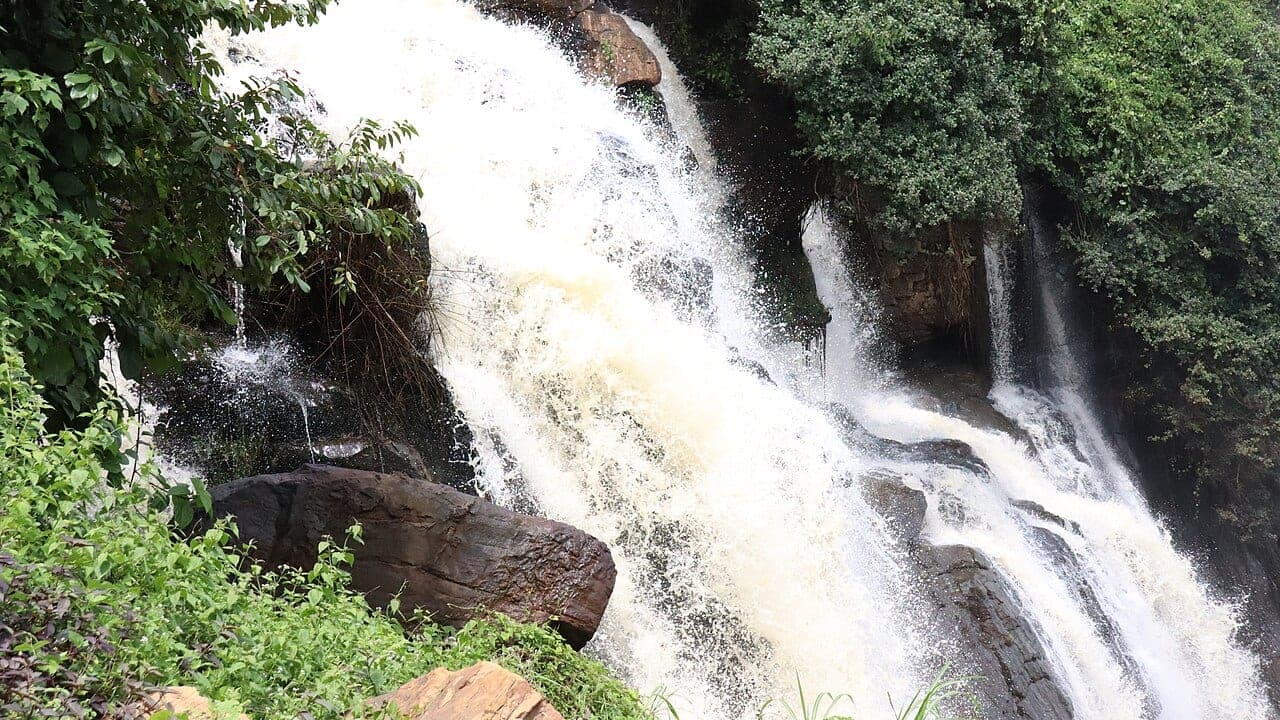
The Central African Republic is a landlocked country of roughly 623,000 square kilometres at the geographic heart of the continent, bordered by Chad to the north, Sudan and South Sudan to the east, the Democratic Republic of the Congo and the Republic of the Congo to the south, and Cameroon to the west. Much of it is a rolling plateau dividing the Lake Chad and Congo basins. Along the southern edge runs the Ubangi River, a major tributary of the Congo on which the capital, Bangui, stands. About 100 kilometres north-west of the capital, the Boali Falls drop some 50 metres over a front around 250 metres wide on the M'Bali River, a landmark that today also drives a hydroelectric station.
The population of around six million is drawn from many peoples. The Gbaya (also called Baya) and the Banda are the largest groups, joined by the Mandjia, the Sara, the Mboum, the riverine Yakoma and Sango, and, in the east, the Zande and Nzakara, whose ancestors built powerful states. In the south-western forest live the Aka, among the region's first inhabitants. Binding these communities is Sango, a shared national language understood by almost everyone, used alongside French in government and schooling. The land holds diamonds, gold, timber and farmland, though much of that wealth has been hard to turn to broad benefit.
Bangui. The capital sits on the north bank of the Ubangi, facing the Democratic Republic of the Congo across the water. Founded as a French river post in 1889, it grew into the country's political and cultural centre and is home to close to a million residents. Long known affectionately as "Bangui la Coquette", it holds the national university, the Notre-Dame Cathedral and the Boganda National Museum, and its riverside markets remain the meeting point of the country's regions.
Bimbo. The second-largest urban centre lies just south-west of the capital, of which it is effectively an extension, a residential and light-industrial district of several hundred thousand people on the road out of Bangui.
Berbérati. In the far south-west, near the forests of the Sangha basin, Berbérati is a principal town of the region and the seat of a Catholic diocese, in a zone of coffee and small-scale diamond mining near the Cameroonian border.
Bambari. On the Ouaka River in the central plateau, Bambari has long been a market and transport hub linking the west of the country to the east, a centre of trade in cotton and cattle and a point of contact between different communities.
Human presence here is ancient. Near the western town of Bouar stand the megaliths known as tazunu, arrangements of large upright stones, some tied to burials, that scholars date to the first millennium BC and earlier. Among the Gbaya the name means "standing stones", and the alignments are understood to mark ceremonial and funerary sites of early food-producing communities, one of the oldest monumental landscapes in Central Africa.
The centuries before colonial rule were shaped in part by the slave trade, and the record here is a sombre one. The corridor between the Ubangi River and the Sahara was drawn into raiding from two directions: captives were taken south and west down the Ubangi and Congo toward the Atlantic, and north across the desert toward North Africa and the Middle East, particularly from the seventeenth to nineteenth centuries. River traders such as the Bobangi and, later, the northern sultanate of Dar al-Kuti moved people out of the region in large numbers, and the resulting displacement left lasting marks on settlement patterns. Along the Ubangi itself, the Zande and Nzakara built kingdoms, and sultanates such as Bangassou, Rafaï and Zémio governed stretches of the river and its trade.
France took control of the region in the 1890s and administered it as the colony of Ubangi-Shari (Oubangui-Chari). From 1899 the colonial state granted large tracts to private concessionary companies, which held monopolies over trade and rubber harvesting. The methods used to compel labour were often severe, including forced work, punitive quotas and the taking of hostages; the abuses were recorded by outside observers, among them the writer André Gide in Voyage au Congo (1927). Resistance took organised form in the Kongo-Wara rebellion of 1928–1931, one of the largest risings against colonial rule in the region.
The path to independence was led by Barthélemy Boganda, a Catholic priest ordained in 1938 who became, in 1946, the first person from the territory elected to the French National Assembly. In 1949 he founded the party MESAN and preached the principle zo kwe zo, "every person is a person". Hoping to see a broad federation of Central African states, he proclaimed the Central African Republic on 1 December 1958 when neighbouring territories declined to join, and became its first premier. Boganda died in a plane crash near Bangui on 29 March 1959, before independence, which came on 13 August 1960 under his relative David Dacko. The decades that followed brought repeated changes of government, among them the rule of Jean-Bédel Bokassa from 1965, who proclaimed an empire in 1976 and was removed in 1979, a return to multiparty elections in 1993, and a period of armed conflict from 2013, after which efforts toward stabilisation have continued. This profile treats those events only in outline and takes no side.
The country's linguistic life turns on Sango. Originally a trade language that grew in the nineteenth century along the Ubangi River, Sango developed from Northern Ngbandi, a language of the Ubangian family, and absorbed French vocabulary during the colonial period while keeping its Ngbandi structure. It is spoken today by close to nine-tenths of the population as the national language, co-official with French. That reach is unusual: rather than one ethnic tongue prevailing, a shared second language grew up between peoples, and since the 1960s it has increasingly become a mother tongue in Bangui itself. Boganda's motto, zo kwe zo, is Sango, a plain statement of the equality he built his politics around.
The country's name is descriptive rather than ancestral. Boganda chose "Central African Republic" hoping that other territories would one day join a common state, a wider union he called a United States of Latin Africa. That federation never formed, but the name kept its outward sense, naming a place by its position on the map rather than by any single people. The colonial name it replaced, Ubangi-Shari, joined two rivers, the Ubangi and the Chari, whose basins the territory spanned.
The most widely known of the country's arts belong to the forest. Aka polyphony is collective, improvised singing in which each voice weaves an independent line, often using yodelling and rapid alternation of notes between singers, so that the whole seems to renew itself continuously; it belongs to the community. The songs are bound to forest life, sung at the making of a new camp, before and after the hunt, and in mourning. Instruments include the sanza, a plucked thumb piano, and the ngombi, a harp tied to ritual and storytelling, alongside drums, slit gongs and horn ensembles.
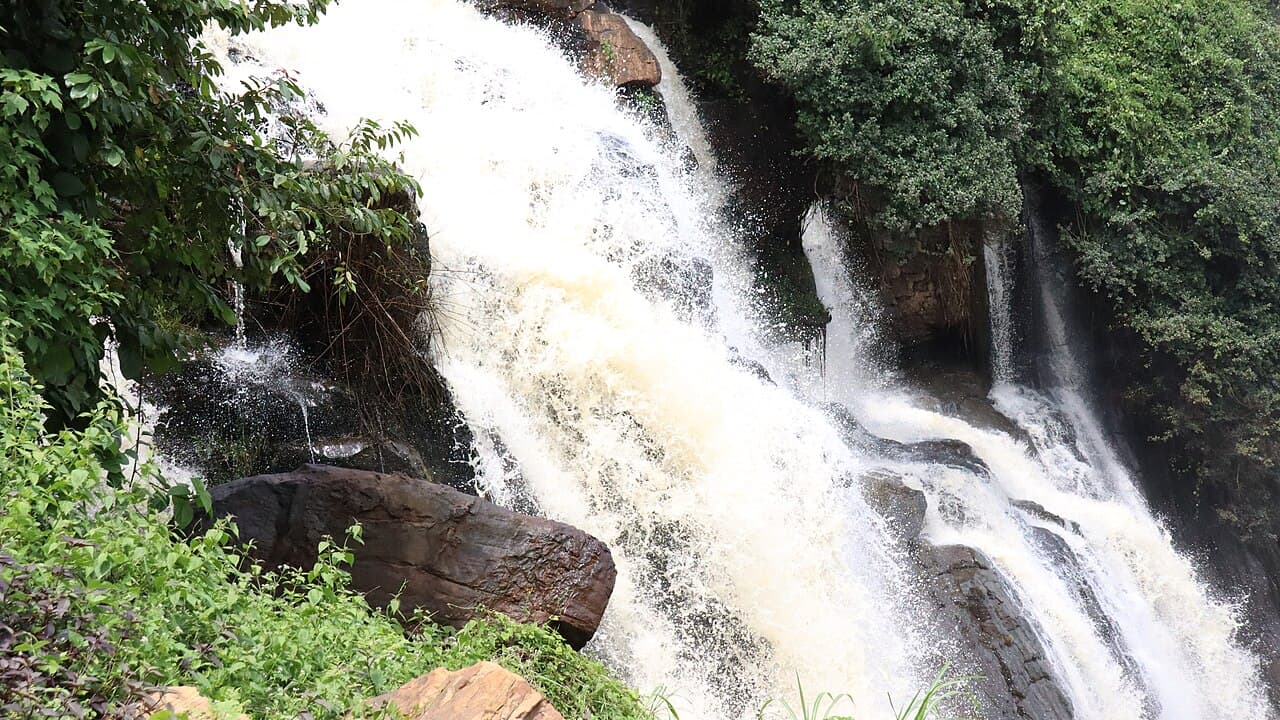 Boali is the country's best known natural site and the source of much of Bangui's electricity, and reaching it has been unsafe for long stretches of the past two decades. Photograph by Kondotikodro, CC BY-SA 4.0, via Wikimedia Commons.
Beyond the forest, the Gbaya, Banda and other savanna peoples keep traditions of music, dance and masking tied to initiation and the farming year. Banda musicians are known for ensembles of horizontal wooden trumpets, each player sounding a single note in interlocking patterns that build a melody together, an echo of the collective spirit of Aka song, while carved masks appear at communal ceremonies. Everyday culture rests on the land: cassava, pounded into the staple gozo, is eaten with sauces of koko (a wild forest leaf), groundnut and greens, with freshwater fish, palm oil and, in the forest, gathered honey and caterpillars as an important seasonal food.
The country is home to several faiths held side by side. A majority is Christian, divided between Roman Catholic and Protestant churches that run schools, clinics and parishes across the country. A significant minority follow Islam, with communities long established among northern peoples and among traders along the old routes. Traditional African beliefs remain present throughout, often practised alongside Christianity or Islam rather than in place of them, and many families move easily between a church or mosque and older observances at home.
Those older understandings commonly recognise a distant Creator together with a nearer world of ancestral and natural spirits who take an interest in the living. Among the Aka, the forest itself is held sacred and addressed through spirit figures central to hunting and healing rituals, in which music and dance are the means of contact. Across the savanna peoples, ancestors are honoured as continuing members of the family, consulted at births, marriages, sickness and death. The constitution provides for freedom of religion, and the country's communities have generally shared a landscape of overlapping devotion that citizens and religious leaders have worked to protect through periods of strain.
Death in the Central African Republic is met by the whole community. In traditional practice, the death of a family member draws relatives, neighbours and distant kin to the home for a wake that may last several days and nights, marked by singing, drumming and dancing that grieve and honour at once. Burial is usually near the family's home ground, and the dead are understood not to depart but to join the ancestors, who remain part of the family's affairs and may be addressed with words and small offerings in times of need. Among the Aka, funerals call for the community's polyphonic mourning songs, sung through the night so that the whole camp shares the passage.
For Christian families, these communal gatherings are joined to church rites: a vigil of prayer and hymns, a funeral Mass or service, and burial in consecrated ground, often followed by remembrance on later anniversaries. For Muslim families, custom follows Islamic practice, with the washing and shrouding of the body, funeral prayer and prompt burial, the grave oriented toward Mecca, and a period of condolence for the bereaved. Across all three traditions the underlying pattern is shared: the community assembles, the family is not left to mourn alone, and the dead are carried forward as a continuing bond rather than a closed chapter.
The Central African Republic's records are thin, dispersed and, since 2013, at further risk.
French administration from the 1890s governed Oubangui-Chari through concession companies whose treatment of the population was documented in a series of scandals, and the colonial record is divided between Bangui and the overseas archives at Aix-en-Provence. Catholic and Protestant mission registers from the same period are the practical vital records for most families.
Civil registration exists and has never been comprehensive, and the conflicts since 2013 have displaced a quarter of the population, damaged archives and made registration harder.
The country's founding figure is documented better than most of its people: Barthélemy Boganda, a Catholic priest turned politician who founded the movement that led to independence and died in a plane crash in 1959, months before it arrived, left speeches and correspondence that are the closest thing the republic has to a foundational archive.
For the Aka, the forest people of the south-west, the record is neither written nor genealogical in the usual sense. Their polyphonic singing, inscribed by UNESCO, is transmitted through the community rather than through specialists, and the forest itself, at Dzanga-Sangha, is the territory that identity attaches to.
Riverine and savanna peoples keep lineage systems that determine land and marriage, and the sango language that unites the country was a river trade pidgin before it was a national one.
The country holds two natural sites on the UNESCO World Heritage List. The Sangha Trinational, inscribed in 2012, protects a vast expanse of Congo Basin rainforest jointly with Cameroon and the Republic of the Congo; its Central African portion, the Dzanga-Ndoki park and the surrounding Dzanga-Sangha reserve, shelters forest elephants, lowland gorillas, chimpanzees and the bongo, and supports long-term monitoring at the Dzanga Bai clearing. In the northern savanna, the Manovo-Gounda St Floris National Park, inscribed in 1988, protects the largest savanna reserve in Central Africa, though poaching and other pressures led to its addition to the List of World Heritage in Danger in 1997.
Institutional heritage is anchored by the Boganda National Museum in Bangui, established in 1964, whose collections of masks, musical instruments, pottery, and ebony and ivory carving document the country's peoples; closed and damaged during the conflict of 2013 and after, it has kept much of its holdings crated for protection, and its reopening remains a goal of cultural workers. The Bouar megaliths stand on UNESCO's Tentative List, recognition of one of the region's oldest monumental landscapes.
Much of the preservation of the country's living culture has taken the form of sound recording. Over roughly three decades among the Aka, the American ethnomusicologist Louis Sarno recorded more than a thousand hours of their music and forest soundscape, now held in archival collections including the Pitt Rivers Museum in Oxford and studied as one of the fullest records ever made of a single community's musical life. UNESCO's intangible heritage programme has published documentary video of Aka polyphony, extending its reach far from the forest.
Conservation science has produced its own digital record: decades of monitoring at Dzanga-Sangha have generated data on individual elephants and gorillas, a scientific archive of the forest itself. Preservation of the country's documentary and museum heritage has been made harder by instability and by limited funding, and much remains to be catalogued and secured. Meanwhile, the Central African diaspora keeps music, language and ceremony in circulation through recordings shared between communities abroad and at home.
Aka music has travelled further than almost any other Central African art. Field recordings released internationally, among them the Music of the Bayaka albums and the soundtrack drawn from Sarno's archive for the 2013 documentary film Song from the Forest, brought the community's interwoven singing to listeners worldwide and influenced musicians in ambient, choral and electronic forms. The precise, overlapping structure of the songs has helped shape a wider appreciation of Central African polyphony.
Within the country, popular music blends Sango-language song with the guitar-driven dance styles of the wider Congo region, while church choirs sustain a strong choral culture. The image of the country that reaches the world through its music is, above all, one of voices sounding together.
The forest watched and defended. The Dzanga-Sangha protected area has become one of Central Africa's more hopeful conservation stories. Working with international partners, its teams have sustained decades of monitoring of forest elephants and habituated gorilla groups, supported anti-poaching patrols and involved local communities, including Aka trackers, keeping Dzanga Bai a place where large elephant gatherings can still be seen.
A savanna park brought back from the brink. In the northern Manovo-Gounda St Floris park, cooperation between the government, conservation organisations and UNESCO around a renewed management plan has recently begun to improve conditions after long decline, an encouraging turn for the largest protected savanna in Central Africa.
A community's music preserved in full. The thousand-plus hours of Aka recordings gathered by Louis Sarno amount to one of the most complete sound archives ever assembled for a single people, keeping the tradition available to scholars, to the wider world and to the Aka themselves.
Boali is the country's best known natural site and the source of much of Bangui's electricity, and reaching it has been unsafe for long stretches of the past two decades. Photograph by Kondotikodro, CC BY-SA 4.0, via Wikimedia Commons.
Beyond the forest, the Gbaya, Banda and other savanna peoples keep traditions of music, dance and masking tied to initiation and the farming year. Banda musicians are known for ensembles of horizontal wooden trumpets, each player sounding a single note in interlocking patterns that build a melody together, an echo of the collective spirit of Aka song, while carved masks appear at communal ceremonies. Everyday culture rests on the land: cassava, pounded into the staple gozo, is eaten with sauces of koko (a wild forest leaf), groundnut and greens, with freshwater fish, palm oil and, in the forest, gathered honey and caterpillars as an important seasonal food.
The country is home to several faiths held side by side. A majority is Christian, divided between Roman Catholic and Protestant churches that run schools, clinics and parishes across the country. A significant minority follow Islam, with communities long established among northern peoples and among traders along the old routes. Traditional African beliefs remain present throughout, often practised alongside Christianity or Islam rather than in place of them, and many families move easily between a church or mosque and older observances at home.
Those older understandings commonly recognise a distant Creator together with a nearer world of ancestral and natural spirits who take an interest in the living. Among the Aka, the forest itself is held sacred and addressed through spirit figures central to hunting and healing rituals, in which music and dance are the means of contact. Across the savanna peoples, ancestors are honoured as continuing members of the family, consulted at births, marriages, sickness and death. The constitution provides for freedom of religion, and the country's communities have generally shared a landscape of overlapping devotion that citizens and religious leaders have worked to protect through periods of strain.
Death in the Central African Republic is met by the whole community. In traditional practice, the death of a family member draws relatives, neighbours and distant kin to the home for a wake that may last several days and nights, marked by singing, drumming and dancing that grieve and honour at once. Burial is usually near the family's home ground, and the dead are understood not to depart but to join the ancestors, who remain part of the family's affairs and may be addressed with words and small offerings in times of need. Among the Aka, funerals call for the community's polyphonic mourning songs, sung through the night so that the whole camp shares the passage.
For Christian families, these communal gatherings are joined to church rites: a vigil of prayer and hymns, a funeral Mass or service, and burial in consecrated ground, often followed by remembrance on later anniversaries. For Muslim families, custom follows Islamic practice, with the washing and shrouding of the body, funeral prayer and prompt burial, the grave oriented toward Mecca, and a period of condolence for the bereaved. Across all three traditions the underlying pattern is shared: the community assembles, the family is not left to mourn alone, and the dead are carried forward as a continuing bond rather than a closed chapter.
The Central African Republic's records are thin, dispersed and, since 2013, at further risk.
French administration from the 1890s governed Oubangui-Chari through concession companies whose treatment of the population was documented in a series of scandals, and the colonial record is divided between Bangui and the overseas archives at Aix-en-Provence. Catholic and Protestant mission registers from the same period are the practical vital records for most families.
Civil registration exists and has never been comprehensive, and the conflicts since 2013 have displaced a quarter of the population, damaged archives and made registration harder.
The country's founding figure is documented better than most of its people: Barthélemy Boganda, a Catholic priest turned politician who founded the movement that led to independence and died in a plane crash in 1959, months before it arrived, left speeches and correspondence that are the closest thing the republic has to a foundational archive.
For the Aka, the forest people of the south-west, the record is neither written nor genealogical in the usual sense. Their polyphonic singing, inscribed by UNESCO, is transmitted through the community rather than through specialists, and the forest itself, at Dzanga-Sangha, is the territory that identity attaches to.
Riverine and savanna peoples keep lineage systems that determine land and marriage, and the sango language that unites the country was a river trade pidgin before it was a national one.
The country holds two natural sites on the UNESCO World Heritage List. The Sangha Trinational, inscribed in 2012, protects a vast expanse of Congo Basin rainforest jointly with Cameroon and the Republic of the Congo; its Central African portion, the Dzanga-Ndoki park and the surrounding Dzanga-Sangha reserve, shelters forest elephants, lowland gorillas, chimpanzees and the bongo, and supports long-term monitoring at the Dzanga Bai clearing. In the northern savanna, the Manovo-Gounda St Floris National Park, inscribed in 1988, protects the largest savanna reserve in Central Africa, though poaching and other pressures led to its addition to the List of World Heritage in Danger in 1997.
Institutional heritage is anchored by the Boganda National Museum in Bangui, established in 1964, whose collections of masks, musical instruments, pottery, and ebony and ivory carving document the country's peoples; closed and damaged during the conflict of 2013 and after, it has kept much of its holdings crated for protection, and its reopening remains a goal of cultural workers. The Bouar megaliths stand on UNESCO's Tentative List, recognition of one of the region's oldest monumental landscapes.
Much of the preservation of the country's living culture has taken the form of sound recording. Over roughly three decades among the Aka, the American ethnomusicologist Louis Sarno recorded more than a thousand hours of their music and forest soundscape, now held in archival collections including the Pitt Rivers Museum in Oxford and studied as one of the fullest records ever made of a single community's musical life. UNESCO's intangible heritage programme has published documentary video of Aka polyphony, extending its reach far from the forest.
Conservation science has produced its own digital record: decades of monitoring at Dzanga-Sangha have generated data on individual elephants and gorillas, a scientific archive of the forest itself. Preservation of the country's documentary and museum heritage has been made harder by instability and by limited funding, and much remains to be catalogued and secured. Meanwhile, the Central African diaspora keeps music, language and ceremony in circulation through recordings shared between communities abroad and at home.
Aka music has travelled further than almost any other Central African art. Field recordings released internationally, among them the Music of the Bayaka albums and the soundtrack drawn from Sarno's archive for the 2013 documentary film Song from the Forest, brought the community's interwoven singing to listeners worldwide and influenced musicians in ambient, choral and electronic forms. The precise, overlapping structure of the songs has helped shape a wider appreciation of Central African polyphony.
Within the country, popular music blends Sango-language song with the guitar-driven dance styles of the wider Congo region, while church choirs sustain a strong choral culture. The image of the country that reaches the world through its music is, above all, one of voices sounding together.
The forest watched and defended. The Dzanga-Sangha protected area has become one of Central Africa's more hopeful conservation stories. Working with international partners, its teams have sustained decades of monitoring of forest elephants and habituated gorilla groups, supported anti-poaching patrols and involved local communities, including Aka trackers, keeping Dzanga Bai a place where large elephant gatherings can still be seen.
A savanna park brought back from the brink. In the northern Manovo-Gounda St Floris park, cooperation between the government, conservation organisations and UNESCO around a renewed management plan has recently begun to improve conditions after long decline, an encouraging turn for the largest protected savanna in Central Africa.
A community's music preserved in full. The thousand-plus hours of Aka recordings gathered by Louis Sarno amount to one of the most complete sound archives ever assembled for a single people, keeping the tradition available to scholars, to the wider world and to the Aka themselves.
National Overview
Notable Cities
Historical Foundations
Linguistic and Etymological Roots
Cultural Identity
Religion and Spirituality
Remembrance and Mourning Traditions
Tracing a Family in Central African Republic
Heritage Preservation Efforts
Digital Heritage
Contemporary Cultural Influences
Success Stories
References and resources
- UNESCO World Heritage Centre: Sangha Trinational. The transboundary forest site shared with Cameroon and Congo, with its elephants and gorillas.
- UNESCO World Heritage Centre: Manovo-Gounda St Floris National Park. The northern savanna site and its World Heritage in Danger status.
- UNESCO Intangible Cultural Heritage: Polyphonic singing of the Aka Pygmies of Central Africa. Inscription record for the Aka vocal tradition.
- UNESCO World Heritage Centre: Megalithic site of Bouar (Tentative List). The tazunu standing stones.
- Encyclopaedia Britannica: Barthélemy Boganda. The founding leader and his vision.
- Wikipedia: Barthélemy Boganda. MESAN, zo kwe zo, and the proclamation of the republic.
- Encyclopaedia Britannica: Sango language. The Ngbandi-based national lingua franca.
- Wikipedia: Boganda National Museum. The national museum in Bangui and its collections.
- Dzanga-Sangha Protected Areas. Conservation work in the south-west forest and at Dzanga Bai.
- Mongabay: Conservation comeback in Manovo-Gounda St Floris National Park. The park's recent recovery.
- Wikipedia: Louis Sarno. The archive of Aka music and the film Song from the Forest.
- Encyclopaedia Britannica: Central African Republic. Geography, peoples and history.