Heritage · Country
Uganda Culture and Heritage
Uganda is where the White Nile begins its long walk to the Mediterranean, where four kings of Buganda lie beneath a single great dome of thatch, and where roughly half the world's mountain gorillas survive in one forest. A guide to how the country keeps its many peoples, kingdoms and dead close.Written to last.
By Confinity Heritage Editorial · Updated 2026-07-31 · 8-minute readQuiet tools, kept out of the way.
On a hill in a Kampala suburb stand the Kasubi Tombs, where four kings of Buganda lie beneath a dome of thatch and spear-grass, among the largest buildings raised from purely plant materials in sub-Saharan Africa. It is more than a mausoleum: behind a barkcloth curtain the descendants of the royal household keep watch over the resting kabakas, and the site is understood less as a grave than as a place where the kings remain present. When fire destroyed the great house in March 2010, the loss was felt as a national injury, and its reconstruction, completed in 2023, became a shared act of repair.
Uganda gathers memory in unusual density. It is where the White Nile leaves Lake Victoria near Jinja on a journey of some 6,600 kilometres to the sea; where the snow-topped Rwenzori, the range Ptolemy called the Mountains of the Moon, climb to 5,109 metres on the Congolese border; and where roughly half the world's surviving mountain gorillas live in the forest of Bwindi. It is a country of many languages and old interlacustrine kingdoms, and of remembrance customs, traditional, Christian and Muslim, that keep the dead among the living.
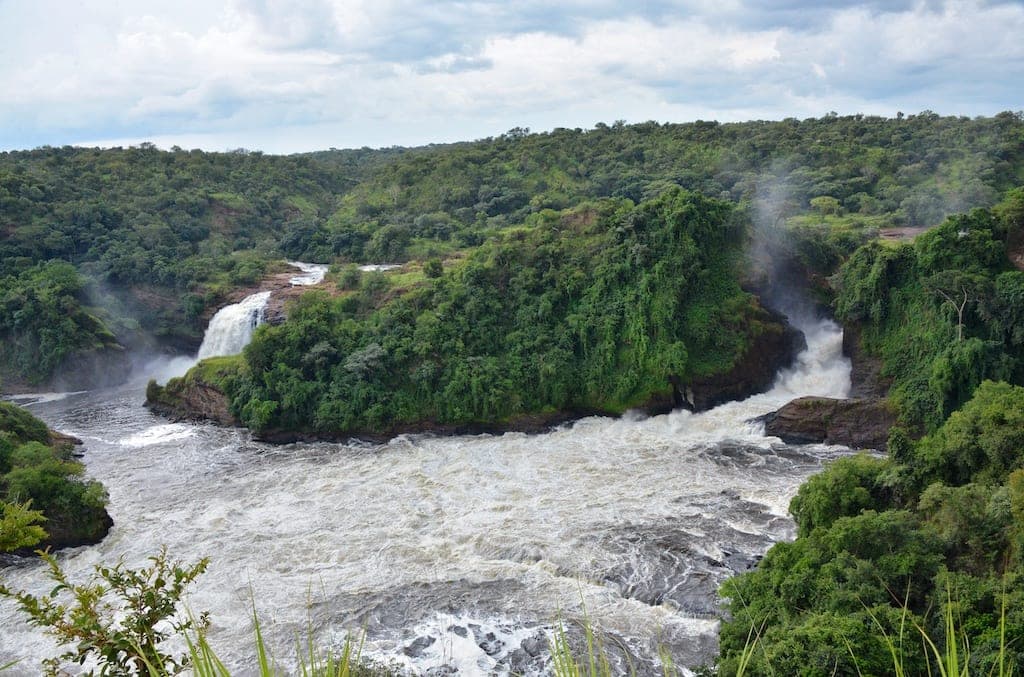
Uganda is a landlocked country of some 241,038 square kilometres straddling the equator, bordered by Kenya, South Sudan, the Democratic Republic of the Congo, Rwanda and Tanzania. Water defines it. Lake Victoria, the second-largest freshwater lake in the world by surface area, laps its southern shore; Lake Kyoga and Lake Albert lie inland; and the Victoria Nile links them before crashing through Murchison Falls, where the whole river is forced into a gorge about 7 metres wide and drops some 43 metres. Unlike the volcanoes of its neighbours, the Rwenzori range was thrust up along a fault, carrying glaciers almost on the equator. Winston Churchill, travelling through in 1908, called it "the Pearl of Africa".
The population, about 45.9 million in 2024, is among the world's youngest and belongs to dozens of peoples. The Baganda of the centre are the largest group, followed by the Banyankole, Basoga, Bakiga and others, spread across Bantu-speaking communities in the south and Nilotic communities in the north and east. Several still recognise cultural kingdoms, Buganda, Bunyoro, Toro, Busoga and others, revived as custodians of tradition rather than as governments. Kampala, built across a spread of hills, is the capital, while lakeside Entebbe holds the seat of administration and the main airport. Around four in five Ugandans are Christian and roughly one in eight Muslim, with older belief systems continuing beneath both.
Kampala. The capital grew from the hills around the kabaka's palace at Mengo, and its name traces to Kasozi k'Empala, the hill of the impala. It holds the Uganda Museum, the oldest in East Africa; the Lubiri royal enclosure and the Bulange, seat of the Buganda parliament; the Namirembe (Anglican) and Rubaga (Catholic) cathedrals facing each other across the city; and the Gadhafi National Mosque on Old Kampala hill.
 The Ssese Islands in Lake Victoria, long associated with Baganda shrines and spirits. Photograph by AmarinAfrica, CC BY-SA 4.0, via Wikimedia Commons.
Entebbe. On a peninsula reaching into Lake Victoria, Entebbe was the administrative capital of the protectorate and still houses State House and the principal international airport. Its National Botanical Gardens, laid out in 1898, hold a lakeside forest of old specimens, and the airport entered international memory through the 1976 rescue of hostages held there.
Jinja. Founded as a colonial trading post in 1901 beside the point where the Nile leaves Lake Victoria, Jinja became Uganda's industrial hub after the Owen Falls (Nalubaale) Dam was completed in 1954. The dam submerged Ripon Falls, the outflow that John Hanning Speke identified as the source of the Nile in 1862, but the "Source of the Nile" remains a place of pilgrimage, and the rapids downstream have made the town a centre for white-water rafting.
Gulu. The largest town of northern Uganda and the commercial and cultural heart of the Acholi people, Gulu carries the memory of the region's long conflict and its recovery. Once ringed by camps for the displaced, it is now a growing university and market city.
People have farmed and herded north of Lake Victoria for well over two thousand years. Bantu-speaking communities, arriving over the first millennium, brought iron-working, banana cultivation and settled villages to the south and west, while Nilotic and other peoples came down from the north with cattle and their own institutions, making Uganda a meeting ground of two broad worlds. Between the great lakes, powerful states took shape. Bunyoro-Kitara, remembered with the semi-legendary Bachwezi rulers and the earthworks at Bigo, dominated the west; Buganda rose beside Lake Victoria and, by the eighteenth and nineteenth centuries, had become a centralised kingdom under its kabaka, with a bureaucracy of chiefs. Toro broke away from Bunyoro in the 1830s, and the pastoral kingdom of Ankole held the grasslands of the south-west.
From the 1840s Arab and Swahili traders from the Indian Ocean coast reached Buganda in search of ivory and enslaved people, bringing Islam and a written script; European explorers followed, Speke above all. Protestant missionaries arrived in 1877 and Catholic White Fathers in 1879, and rivalry between Muslim, Protestant and Catholic factions at court erupted into religious wars in the late 1880s. Britain declared the Uganda Protectorate in 1894, and the 1900 Buganda Agreement bound the kingdom into colonial rule while confirming the kabaka's status. Independence came on 9 October 1962, with Milton Obote as prime minister and the kabaka, Edward Mutesa II, as first president.
The years that followed were turbulent. A constitutional crisis in 1966 set Obote against Buganda, and in 1967 he abolished the kingdoms and declared a republic. In January 1971 Idi Amin seized power in a military coup and ruled until 1979; the period brought severe repression, the expulsion of the Asian community in 1972 and an estimated 80,000 to 500,000 deaths, ending when a Tanzanian-led force removed him. Instability continued into the 1980s, and from 1987 to 2006 a war in the north between government forces and the Lord's Resistance Army killed tens of thousands and displaced much of the rural population before the Juba peace process largely ended it. The cultural kingdoms were restored in 1993, and the recovery since is the backdrop to Uganda's heritage work today.
The name Uganda is the Swahili form of Buganda, the kingdom that coastal traders and then the British encountered first; the "u-" prefix marks a place in Swahili, and the label for the central kingdom came to name the whole protectorate. Buganda's own language builds meaning through prefixes on the root -ganda: Buganda the land, Baganda the people, Muganda a single person, Luganda the language.
Uganda has more than forty living languages across two families. The Bantu languages of the south and west include Luganda, the most widely spoken and the common tongue of Kampala, along with Runyankore-Rukiga, Runyoro-Rutooro and Lusoga. The north and east speak Nilotic and related languages, among them Acholi, Lango, Alur, Ateso and Ngakarimojong. English, inherited from the protectorate, is the language of government and education, and Swahili, long used in the army and trade, is a second official language and a regional link. In the west, the Empaako tradition adds a further layer: among the Batooro, Banyoro and neighbouring peoples, a child receives, besides given and family names, one of twelve shared "pet" names such as Amooti, Abwoli or Akiiki, used as an affectionate and respectful address.
One of Uganda's oldest crafts is barkcloth, olubugo, made not by weaving but by beating the inner bark of the mutuba fig tree (Ficus natalensis) into a soft, terracotta-coloured cloth. Craftsmen of the Ngonge clan, led by a hereditary kaboggoza, have made it for the Buganda court for centuries; once everyday clothing, it now wraps shrines and the dead and appears in art and design, and UNESCO proclaimed the practice a Masterpiece of the Intangible Heritage of Humanity in 2005.
Music and dance carry regional identity. In Buganda the graceful bakisimba, danced to log xylophones and the ennanga royal harp, defines a courtly style; among the Bagisu of the east, energetic kadodi drumming accompanies the imbalu circumcision ceremonies; the Banyankore perform the ekitaguriro in imitation of their long-horned herds; and the Acholi dance the larakaraka courtship dance and the royal bwola. Royal regalia keep the kingdoms visible: the mujaguzo drums of Buganda, the revered Bagyendanwa drum of Ankole, and the great Ankole cattle whose sweeping horns are a living emblem of the south-west. Cuisine centres on matoke, steamed and mashed green banana, eaten with groundnut sauce, beans or meat; luwombo, a court dish steamed in banana leaves; millet, sorghum and cassava; and the tilapia and Nile perch of the lakes. The rolex, a chapati rolled around fried egg, is the best-known street food.
Christianity reaches about 82 per cent of Ugandans, split chiefly between Roman Catholics (around 42 per cent) and Anglicans and other Protestants (around 29 per cent), with Pentecostal churches growing quickly. Islam, present since the mid-nineteenth-century arrival of coastal traders, accounts for roughly 13 per cent. Older beliefs persist alongside both: the Baganda honour the creator Katonda and a pantheon of balubaale spirits such as Kibuka, the god of war, and revere the mizimu, the ancestral spirits, while the figure of Kintu appears in Buganda's origin story as the first man.
Uganda's most powerful religious memory is the story of the Uganda Martyrs. Between 1885 and 1887, amid tensions at Kabaka Mwanga II's court, dozens of young Christian converts, both Catholic and Anglican, were executed for refusing to renounce their faith; the best known, Charles Lwanga, was burned at Namugongo on 3 June 1886. The Catholic martyrs were canonised by Pope Paul VI in 1964, and their 3 June feast draws one of the largest annual pilgrimages in Africa to the Namugongo shrines, with hundreds of thousands walking, some for weeks.
Across Uganda's peoples, death calls the whole community together, and the dead are not thought to leave it. In traditional practice a person is buried on ancestral clan land, close to the living, and among the Baganda the funeral is only the beginning: months later the family gathers for okwabya olumbe, the "last funeral rites", a larger ceremony that ends mourning and installs an heir, the omusika, to carry the departed's name and duties forward. Ancestors, the mizimu, remain interested parties in the family's affairs, invoked at births, marriages and moments of trouble; to neglect them invites misfortune.
The Ssese Islands in Lake Victoria, long associated with Baganda shrines and spirits. Photograph by AmarinAfrica, CC BY-SA 4.0, via Wikimedia Commons.
Entebbe. On a peninsula reaching into Lake Victoria, Entebbe was the administrative capital of the protectorate and still houses State House and the principal international airport. Its National Botanical Gardens, laid out in 1898, hold a lakeside forest of old specimens, and the airport entered international memory through the 1976 rescue of hostages held there.
Jinja. Founded as a colonial trading post in 1901 beside the point where the Nile leaves Lake Victoria, Jinja became Uganda's industrial hub after the Owen Falls (Nalubaale) Dam was completed in 1954. The dam submerged Ripon Falls, the outflow that John Hanning Speke identified as the source of the Nile in 1862, but the "Source of the Nile" remains a place of pilgrimage, and the rapids downstream have made the town a centre for white-water rafting.
Gulu. The largest town of northern Uganda and the commercial and cultural heart of the Acholi people, Gulu carries the memory of the region's long conflict and its recovery. Once ringed by camps for the displaced, it is now a growing university and market city.
People have farmed and herded north of Lake Victoria for well over two thousand years. Bantu-speaking communities, arriving over the first millennium, brought iron-working, banana cultivation and settled villages to the south and west, while Nilotic and other peoples came down from the north with cattle and their own institutions, making Uganda a meeting ground of two broad worlds. Between the great lakes, powerful states took shape. Bunyoro-Kitara, remembered with the semi-legendary Bachwezi rulers and the earthworks at Bigo, dominated the west; Buganda rose beside Lake Victoria and, by the eighteenth and nineteenth centuries, had become a centralised kingdom under its kabaka, with a bureaucracy of chiefs. Toro broke away from Bunyoro in the 1830s, and the pastoral kingdom of Ankole held the grasslands of the south-west.
From the 1840s Arab and Swahili traders from the Indian Ocean coast reached Buganda in search of ivory and enslaved people, bringing Islam and a written script; European explorers followed, Speke above all. Protestant missionaries arrived in 1877 and Catholic White Fathers in 1879, and rivalry between Muslim, Protestant and Catholic factions at court erupted into religious wars in the late 1880s. Britain declared the Uganda Protectorate in 1894, and the 1900 Buganda Agreement bound the kingdom into colonial rule while confirming the kabaka's status. Independence came on 9 October 1962, with Milton Obote as prime minister and the kabaka, Edward Mutesa II, as first president.
The years that followed were turbulent. A constitutional crisis in 1966 set Obote against Buganda, and in 1967 he abolished the kingdoms and declared a republic. In January 1971 Idi Amin seized power in a military coup and ruled until 1979; the period brought severe repression, the expulsion of the Asian community in 1972 and an estimated 80,000 to 500,000 deaths, ending when a Tanzanian-led force removed him. Instability continued into the 1980s, and from 1987 to 2006 a war in the north between government forces and the Lord's Resistance Army killed tens of thousands and displaced much of the rural population before the Juba peace process largely ended it. The cultural kingdoms were restored in 1993, and the recovery since is the backdrop to Uganda's heritage work today.
The name Uganda is the Swahili form of Buganda, the kingdom that coastal traders and then the British encountered first; the "u-" prefix marks a place in Swahili, and the label for the central kingdom came to name the whole protectorate. Buganda's own language builds meaning through prefixes on the root -ganda: Buganda the land, Baganda the people, Muganda a single person, Luganda the language.
Uganda has more than forty living languages across two families. The Bantu languages of the south and west include Luganda, the most widely spoken and the common tongue of Kampala, along with Runyankore-Rukiga, Runyoro-Rutooro and Lusoga. The north and east speak Nilotic and related languages, among them Acholi, Lango, Alur, Ateso and Ngakarimojong. English, inherited from the protectorate, is the language of government and education, and Swahili, long used in the army and trade, is a second official language and a regional link. In the west, the Empaako tradition adds a further layer: among the Batooro, Banyoro and neighbouring peoples, a child receives, besides given and family names, one of twelve shared "pet" names such as Amooti, Abwoli or Akiiki, used as an affectionate and respectful address.
One of Uganda's oldest crafts is barkcloth, olubugo, made not by weaving but by beating the inner bark of the mutuba fig tree (Ficus natalensis) into a soft, terracotta-coloured cloth. Craftsmen of the Ngonge clan, led by a hereditary kaboggoza, have made it for the Buganda court for centuries; once everyday clothing, it now wraps shrines and the dead and appears in art and design, and UNESCO proclaimed the practice a Masterpiece of the Intangible Heritage of Humanity in 2005.
Music and dance carry regional identity. In Buganda the graceful bakisimba, danced to log xylophones and the ennanga royal harp, defines a courtly style; among the Bagisu of the east, energetic kadodi drumming accompanies the imbalu circumcision ceremonies; the Banyankore perform the ekitaguriro in imitation of their long-horned herds; and the Acholi dance the larakaraka courtship dance and the royal bwola. Royal regalia keep the kingdoms visible: the mujaguzo drums of Buganda, the revered Bagyendanwa drum of Ankole, and the great Ankole cattle whose sweeping horns are a living emblem of the south-west. Cuisine centres on matoke, steamed and mashed green banana, eaten with groundnut sauce, beans or meat; luwombo, a court dish steamed in banana leaves; millet, sorghum and cassava; and the tilapia and Nile perch of the lakes. The rolex, a chapati rolled around fried egg, is the best-known street food.
Christianity reaches about 82 per cent of Ugandans, split chiefly between Roman Catholics (around 42 per cent) and Anglicans and other Protestants (around 29 per cent), with Pentecostal churches growing quickly. Islam, present since the mid-nineteenth-century arrival of coastal traders, accounts for roughly 13 per cent. Older beliefs persist alongside both: the Baganda honour the creator Katonda and a pantheon of balubaale spirits such as Kibuka, the god of war, and revere the mizimu, the ancestral spirits, while the figure of Kintu appears in Buganda's origin story as the first man.
Uganda's most powerful religious memory is the story of the Uganda Martyrs. Between 1885 and 1887, amid tensions at Kabaka Mwanga II's court, dozens of young Christian converts, both Catholic and Anglican, were executed for refusing to renounce their faith; the best known, Charles Lwanga, was burned at Namugongo on 3 June 1886. The Catholic martyrs were canonised by Pope Paul VI in 1964, and their 3 June feast draws one of the largest annual pilgrimages in Africa to the Namugongo shrines, with hundreds of thousands walking, some for weeks.
Across Uganda's peoples, death calls the whole community together, and the dead are not thought to leave it. In traditional practice a person is buried on ancestral clan land, close to the living, and among the Baganda the funeral is only the beginning: months later the family gathers for okwabya olumbe, the "last funeral rites", a larger ceremony that ends mourning and installs an heir, the omusika, to carry the departed's name and duties forward. Ancestors, the mizimu, remain interested parties in the family's affairs, invoked at births, marriages and moments of trouble; to neglect them invites misfortune.
 Four kabakas of Buganda are buried under one thatched roof at Kasubi. The building burned in 2010 and was rebuilt by the same clans that hold the hereditary right to maintain it. Photograph by not not phil, CC BY-SA 2.0, via Wikimedia Commons.
The kingdoms preserve this continuity in monumental form. The Kasubi Tombs hold four kabakas of Buganda, and in older royal custom the spirit of a dead kabaka was tended at a separate jawbone shrine, the jawbone regarded as the seat of the soul. Bunyoro keeps the royal tombs at Mparo near Hoima, where the resistance king Cwa II Kabalega lies, and Toro maintains its own burial grounds. Christian Ugandans overlay these customs with church funerals, requiem services and the unveiling of a headstone, while Muslim Ugandans follow Islamic rites: the body washed and shrouded, buried before sundown after the janazah prayer, and mourned through several days of condolence. Burial societies and clan networks pool money and labour so that no family faces a death alone, at home or in the diaspora.
Ugandan records are kingdom records, mission records and, for one community, the records of an expulsion.
The Buganda kingdom kept a court and a documented succession of kabakas going back centuries, and the royal tombs at Kasubi are where four of them lie beneath a single great dome of thatch. The other kingdoms, Bunyoro, Toro, Ankole and Busoga, keep their own lines. Clan structure across Uganda is precise: a Muganda belongs to one of more than fifty clans, each with a totem and a hereditary head, and clan membership determines who a person may marry.
Church Missionary Society and Catholic White Fathers registers from the 1870s are the earliest written vital records, and the Uganda National Archives at Entebbe holds the protectorate and post-independence series.
The Asian expulsion of 1972 removed around 80,000 people, mostly Ugandan citizens of Indian descent, at ninety days' notice. Their property was seized and their documentation was largely abandoned, so the record of that community now sits in Britain, Canada and India, in the resettlement files of countries that took them in. Some returned after 1986 and had to prove title to property they had left.
The northern war and the Lord's Resistance Army abductions produced their own archive: the registers of reception centres for returning children, which recorded who came back, when, and from where, and are frequently the only document naming years of a person's life.
Uganda holds three UNESCO World Heritage sites. The Tombs of Buganda Kings at Kasubi were inscribed in 2001; after the 2010 fire the site joined the List of World Heritage in Danger, and its reconstruction, completed in 2023 with community labour, the Buganda kingdom's Etofaali fundraising drive and Japanese support, allowed its removal from that list. Rwenzori Mountains National Park (1994) protects the glaciers and Afro-alpine ecosystems of the range, and was itself in danger from 1999 to 2004 during the regional conflict. Bwindi Impenetrable National Park (1994), some 32,000 hectares of ancient forest in the south-west, shelters close to half of the world's mountain gorillas.
The country has also been active in safeguarding living heritage. Barkcloth making joined UNESCO's Representative List in 2008, and three practices sit on the List of Intangible Cultural Heritage in Need of Urgent Safeguarding: the Empaako naming tradition of the western kingdoms (2013), the Koogere oral tradition of the Batooro and Basongora (2015), and the Ma'di bowl-lyre music and dance of the north (2016). The Uganda Museum, founded in 1908, anchors the national collection, while the Cross-Cultural Foundation of Uganda supports community museums, and the cultural kingdoms run their own heritage bodies.
Some of the earliest recordings of Ugandan music were made around 1949 to 1950 by Klaus Wachsmann, then curator of the Uganda Museum, capturing court harpists and xylophone ensembles; those recordings are preserved and increasingly accessible through the British Library Sound Archive, a resource for musicians reconstructing older repertoire. Within the country, the Cross-Cultural Foundation of Uganda records intangible practices, naming ceremonies, crafts and oral histories as part of its inventory work.
The informal archive is larger still. Ugandans have made social media a folk museum of the present: introduction ceremonies (kwanjula) heavy with barkcloth and gomesi dress, kadodi processions, church and mosque celebrations and storytelling circulate daily, and diaspora associations stream ceremonies home. The Buganda kingdom and other institutions publish history, clan records and royal news on their own channels far beyond Uganda's borders, so that a Muganda in London or Boston can follow the affairs of the court.
Ugandan writing has carried the country's voice abroad since Okot p'Bitek's "Song of Lawino" (1966), a long poem in the Acholi idiom that answered colonial condescension with village wit. A newer generation has extended that reach: Jennifer Nansubuga Makumbi, whose "Kintu" (2014) is braided from Buganda myth and family history, won the Windham-Campbell Prize, and Moses Isegawa, Doreen Baingana and the women's collective FEMRITE have added to it. On screen, Mira Nair's "Queen of Katwe" (2016) told the true story of the Kampala chess prodigy Phiona Mutesi, while the studio Wakaliwood, run by Isaac Nabwana in the Wakaliga neighbourhood, turned tiny budgets and viral fame into an unlikely film movement.
In music, the singer Eddy Kenzo became the first Ugandan to win a BET Award, in 2015, and later earned a Grammy nomination, part of a fast-growing East African pop scene. Uganda's distance runners now lead the world: Joshua Cheptegei set world records at 5,000 and 10,000 metres in 2020 and took Olympic gold at both distances, following Stephen Kiprotich's marathon victory at London 2012 and John Akii-Bua's 400-metre-hurdles gold and world record in 1972, while Peruth Chemutai became the country's first female Olympic champion in the 3,000-metre steeplechase at Tokyo. Uganda's large diaspora, from Asian Ugandans who returned after 1992 to Baganda communities in Europe and North America, keeps these threads taut.
The kings' house rebuilt. After the 2010 fire, the great thatched tomb at Kasubi was raised again through the Buganda kingdom's Etofaali ("let us build") campaign, community labour and international support, and completed in 2023; UNESCO then removed the site from the List of World Heritage in Danger, a reversal achieved by the very people whose ancestors it holds.
The gorillas come back. Sustained protection in Bwindi and the neighbouring Virunga forests lifted the mountain gorilla population past 1,000, and in 2018 the IUCN moved the subspecies from Critically Endangered to Endangered, a recovery funded largely by the trekking permits that also support surrounding communities.
A name worth keeping. Faced with the fading of the Empaako naming tradition, the western kingdoms and the Cross-Cultural Foundation of Uganda won its 2013 UNESCO listing and revived the naming ceremonies, so that a custom of greeting one another by a name of affection and peace is again passed to children.
Running into history. From John Akii-Bua's barrier-breaking gold in 1972 to the world records of Stephen Kiprotich, Peruth Chemutai and Joshua Cheptegei, Uganda has built a distance-running dynasty that turns homecomings into national celebrations.
Four kabakas of Buganda are buried under one thatched roof at Kasubi. The building burned in 2010 and was rebuilt by the same clans that hold the hereditary right to maintain it. Photograph by not not phil, CC BY-SA 2.0, via Wikimedia Commons.
The kingdoms preserve this continuity in monumental form. The Kasubi Tombs hold four kabakas of Buganda, and in older royal custom the spirit of a dead kabaka was tended at a separate jawbone shrine, the jawbone regarded as the seat of the soul. Bunyoro keeps the royal tombs at Mparo near Hoima, where the resistance king Cwa II Kabalega lies, and Toro maintains its own burial grounds. Christian Ugandans overlay these customs with church funerals, requiem services and the unveiling of a headstone, while Muslim Ugandans follow Islamic rites: the body washed and shrouded, buried before sundown after the janazah prayer, and mourned through several days of condolence. Burial societies and clan networks pool money and labour so that no family faces a death alone, at home or in the diaspora.
Ugandan records are kingdom records, mission records and, for one community, the records of an expulsion.
The Buganda kingdom kept a court and a documented succession of kabakas going back centuries, and the royal tombs at Kasubi are where four of them lie beneath a single great dome of thatch. The other kingdoms, Bunyoro, Toro, Ankole and Busoga, keep their own lines. Clan structure across Uganda is precise: a Muganda belongs to one of more than fifty clans, each with a totem and a hereditary head, and clan membership determines who a person may marry.
Church Missionary Society and Catholic White Fathers registers from the 1870s are the earliest written vital records, and the Uganda National Archives at Entebbe holds the protectorate and post-independence series.
The Asian expulsion of 1972 removed around 80,000 people, mostly Ugandan citizens of Indian descent, at ninety days' notice. Their property was seized and their documentation was largely abandoned, so the record of that community now sits in Britain, Canada and India, in the resettlement files of countries that took them in. Some returned after 1986 and had to prove title to property they had left.
The northern war and the Lord's Resistance Army abductions produced their own archive: the registers of reception centres for returning children, which recorded who came back, when, and from where, and are frequently the only document naming years of a person's life.
Uganda holds three UNESCO World Heritage sites. The Tombs of Buganda Kings at Kasubi were inscribed in 2001; after the 2010 fire the site joined the List of World Heritage in Danger, and its reconstruction, completed in 2023 with community labour, the Buganda kingdom's Etofaali fundraising drive and Japanese support, allowed its removal from that list. Rwenzori Mountains National Park (1994) protects the glaciers and Afro-alpine ecosystems of the range, and was itself in danger from 1999 to 2004 during the regional conflict. Bwindi Impenetrable National Park (1994), some 32,000 hectares of ancient forest in the south-west, shelters close to half of the world's mountain gorillas.
The country has also been active in safeguarding living heritage. Barkcloth making joined UNESCO's Representative List in 2008, and three practices sit on the List of Intangible Cultural Heritage in Need of Urgent Safeguarding: the Empaako naming tradition of the western kingdoms (2013), the Koogere oral tradition of the Batooro and Basongora (2015), and the Ma'di bowl-lyre music and dance of the north (2016). The Uganda Museum, founded in 1908, anchors the national collection, while the Cross-Cultural Foundation of Uganda supports community museums, and the cultural kingdoms run their own heritage bodies.
Some of the earliest recordings of Ugandan music were made around 1949 to 1950 by Klaus Wachsmann, then curator of the Uganda Museum, capturing court harpists and xylophone ensembles; those recordings are preserved and increasingly accessible through the British Library Sound Archive, a resource for musicians reconstructing older repertoire. Within the country, the Cross-Cultural Foundation of Uganda records intangible practices, naming ceremonies, crafts and oral histories as part of its inventory work.
The informal archive is larger still. Ugandans have made social media a folk museum of the present: introduction ceremonies (kwanjula) heavy with barkcloth and gomesi dress, kadodi processions, church and mosque celebrations and storytelling circulate daily, and diaspora associations stream ceremonies home. The Buganda kingdom and other institutions publish history, clan records and royal news on their own channels far beyond Uganda's borders, so that a Muganda in London or Boston can follow the affairs of the court.
Ugandan writing has carried the country's voice abroad since Okot p'Bitek's "Song of Lawino" (1966), a long poem in the Acholi idiom that answered colonial condescension with village wit. A newer generation has extended that reach: Jennifer Nansubuga Makumbi, whose "Kintu" (2014) is braided from Buganda myth and family history, won the Windham-Campbell Prize, and Moses Isegawa, Doreen Baingana and the women's collective FEMRITE have added to it. On screen, Mira Nair's "Queen of Katwe" (2016) told the true story of the Kampala chess prodigy Phiona Mutesi, while the studio Wakaliwood, run by Isaac Nabwana in the Wakaliga neighbourhood, turned tiny budgets and viral fame into an unlikely film movement.
In music, the singer Eddy Kenzo became the first Ugandan to win a BET Award, in 2015, and later earned a Grammy nomination, part of a fast-growing East African pop scene. Uganda's distance runners now lead the world: Joshua Cheptegei set world records at 5,000 and 10,000 metres in 2020 and took Olympic gold at both distances, following Stephen Kiprotich's marathon victory at London 2012 and John Akii-Bua's 400-metre-hurdles gold and world record in 1972, while Peruth Chemutai became the country's first female Olympic champion in the 3,000-metre steeplechase at Tokyo. Uganda's large diaspora, from Asian Ugandans who returned after 1992 to Baganda communities in Europe and North America, keeps these threads taut.
The kings' house rebuilt. After the 2010 fire, the great thatched tomb at Kasubi was raised again through the Buganda kingdom's Etofaali ("let us build") campaign, community labour and international support, and completed in 2023; UNESCO then removed the site from the List of World Heritage in Danger, a reversal achieved by the very people whose ancestors it holds.
The gorillas come back. Sustained protection in Bwindi and the neighbouring Virunga forests lifted the mountain gorilla population past 1,000, and in 2018 the IUCN moved the subspecies from Critically Endangered to Endangered, a recovery funded largely by the trekking permits that also support surrounding communities.
A name worth keeping. Faced with the fading of the Empaako naming tradition, the western kingdoms and the Cross-Cultural Foundation of Uganda won its 2013 UNESCO listing and revived the naming ceremonies, so that a custom of greeting one another by a name of affection and peace is again passed to children.
Running into history. From John Akii-Bua's barrier-breaking gold in 1972 to the world records of Stephen Kiprotich, Peruth Chemutai and Joshua Cheptegei, Uganda has built a distance-running dynasty that turns homecomings into national celebrations.
National Overview
Notable Cities
Historical Foundations
Linguistic and Etymological Roots
Cultural Identity
Religion and Spirituality
Remembrance and Mourning Traditions
Tracing a Family in Uganda
Heritage Preservation Efforts
Digital Heritage
Contemporary Cultural Influences
Success Stories
References and resources
- UNESCO World Heritage Centre: Tombs of Buganda Kings at Kasubi. Inscription record, the 2010 fire and the reconstruction.
- UNESCO World Heritage Centre: Rwenzori Mountains National Park. The range's glaciers and Afro-alpine ecosystems.
- UNESCO World Heritage Centre: Bwindi Impenetrable National Park. The forest and its mountain gorillas.
- UNESCO Intangible Cultural Heritage: Barkcloth making in Uganda. The olubugo craft of the Ngonge clan.
- UNESCO Intangible Cultural Heritage: Empaako tradition of western Uganda. The naming custom and its 2013 listing.
- Encyclopaedia Britannica: Uganda. Geography, peoples, history and political background.
- Encyclopaedia Britannica: Murchison Falls. The falls on the Victoria Nile.
- IUCN: Mountain Gorilla recovering thanks to conservation action. The 2018 downlisting to Endangered.
- Buganda Kingdom: official site. The kabakaship, clans and cultural institutions of Buganda.
- Cross-Cultural Foundation of Uganda. Community museums and intangible heritage documentation.