Heritage · Country
Democratic Republic of the Congo Culture and Heritage
The only African nation with five natural World Heritage sites, from the mountain gorillas of Virunga to the okapi of the Ituri forest, and the cradle of the rumba that much of a continent learned to dance to. A guide to how the Congo River's peoples, from the Kuba weavers to the Kimbanguist faithful, keep their memory.Written to last.
By Confinity Heritage Editorial · Updated 2026-07-31 · 8-minute readQuiet tools, kept out of the way.
The Congo River draws a great arc across the heart of Africa, and along it lies the Democratic Republic of the Congo, the second-largest country on the continent. Second only to the Nile in length among African rivers and the deepest river on earth, the Congo gathers the waters of a basin that holds the world's second-largest tropical rainforest (Britannica). Its bends and cataracts have carried peoples, kingdoms, languages and songs for more than a thousand years, and its forests still shelter the mountain gorillas of Virunga and the okapi of the Ituri.
Memory here is layered and often hard-won. The country carries the inheritance of the Kingdom of Kongo and the savanna empires of the Luba, Lunda and Kuba; the grief of the Atlantic and Swahili-Arab slave trades and of the Congo Free State under Leopold II; the hope and heartbreak of independence in 1960; and the long ordeal of the wars that began in the 1990s. It also carries an unbroken practice of remembrance: ancestor veneration and masking among its many Bantu peoples, the funerary rites of a deeply Christian population, and the mourning customs of the Kimbanguist church, born on Congolese soil.
The Democratic Republic of the Congo sits astride the equator in central Africa, wrapped around the Congo River. Covering roughly 2.34 million square kilometres, it is the second-largest country in Africa after Algeria (Britannica). It borders nine nations and touches the Atlantic only through a narrow window of about 37 kilometres where the river reaches the sea. It should not be confused with its smaller western neighbour, the Republic of the Congo, or Congo-Brazzaville, whose capital faces Kinshasa across the water.
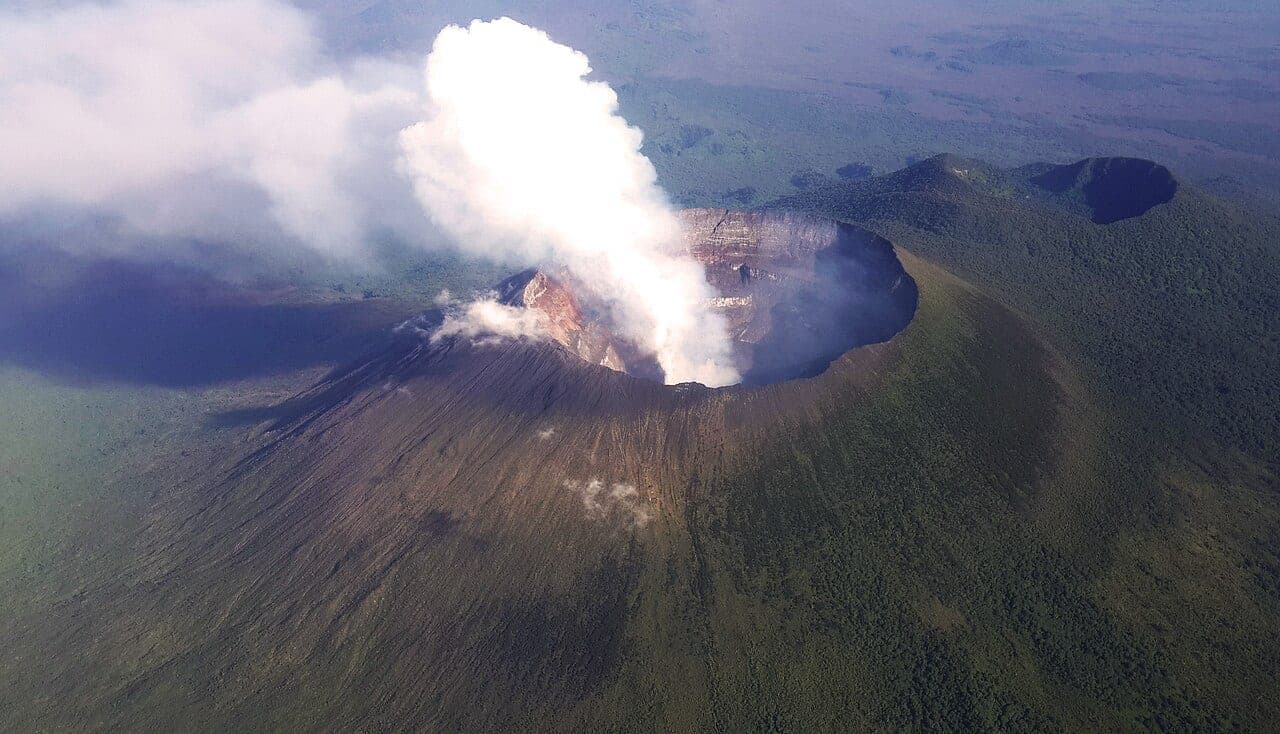
The land ranges from the rain-soaked heart of the Congo basin to the volcanic highlands of the east, where Nyiragongo smokes above the Great Rift and the deep lakes of Kivu, Tanganyika, Albert and Edward mark the country's edge. Beneath the soil lie some of the planet's greatest reserves of copper, cobalt, diamonds and coltan. The population, well over 100 million, makes the DRC the most populous officially French-speaking country in the world, home to more than 200 ethnic groups, most of them Bantu-speaking, alongside forest peoples such as the Mbuti and Ubangian and Nilotic groups in the north.
Kinshasa. The capital, known during colonial rule as Léopoldville, spreads along the south bank where the river widens into the Pool Malebo. It faces Brazzaville across the water, the only pair of national capitals on earth within sight of one another save for Rome and the Vatican. Now one of Africa's largest cities with some 17 million residents, and the largest French-speaking city in the world, Kinshasa is the engine of Congolese music, fashion and art, home to the Académie des Beaux-Arts and the National Museum.
Lubumbashi. The second city and capital of Haut-Katanga, founded as Élisabethville in 1910, is the heart of the mining south. It anchors the Copperbelt that runs into Zambia, and its copper and cobalt have shaped the country's economy and its conflicts alike.
Kisangani. Set on the great bend of the Congo, the city known in colonial times as Stanleyville is famous for the Wagenia fishermen, who for generations have set huge wooden tripod traps in the rapids of the Boyoma Falls to fish the racing current.
Goma. On the northern shore of Lake Kivu, at the foot of Nyiragongo, Goma is the capital of North Kivu and the gateway to Virunga's gorillas. It has twice been scarred by lava, in 2002 and again in 2021, and has become a centre of humanitarian work through the long insecurity of the east (National Geographic).
The forest and savanna were peopled over many centuries by Bantu-speaking farmers and ironworkers who spread across the basin from the first millennium BCE, absorbing the earlier forest foragers. Out of these communities grew sophisticated states. The Kingdom of Kongo, centred on Mbanza Kongo south of the river, arose by the fourteenth century and made contact with Portugal in 1483; its ruler was baptised and his son Afonso I built a Christian court that corresponded with Lisbon (Britannica). On the southern savanna, the Luba empire rose in the Upemba depression from the late sixteenth century on a doctrine of sacred kingship, and the Lunda empire, ruled by the Mwata Yamvo, spread Luba statecraft across a vast trading zone (Metropolitan Museum of Art). Between the Kasai and Sankuru rivers, the Kuba kingdom, consolidated by the founder-king Shyaam a-Mbul a-Ngwoong in the early seventeenth century, developed one of the most refined court cultures in central Africa.
 The river was the route by which the Congo Free State was administered and stripped, and Kinshasa and Brazzaville face each other across it, the closest pair of capital cities in the world. Photograph by EdwinAlden.1995, CC BY-SA 4.0, via Wikimedia Commons.
These worlds were battered by the trade in human beings. From the west, the Atlantic slave trade drew captives through the Kongo lands for centuries; from the east, in the nineteenth century, Swahili and Zanzibari traders such as Tippu Tip raided deep into the interior for ivory and slaves. Then came a darker chapter still. At the Berlin Conference of 1884–85 the powers of Europe recognised King Leopold II of Belgium as sovereign of the Congo Free State, his personal possession from 1885. Under a regime of forced labour for rubber and ivory, the population suffered grievously, and the atrocities, documented by reformers and denounced across the world, remain among the gravest crimes of the colonial age; the victims are honoured here without recounting the details of their ordeal. In 1908 Belgium annexed the territory as the Belgian Congo.
Independence came on 30 June 1960. Patrice Lumumba, the first prime minister, was removed within months and killed in January 1961, a loss still widely mourned (Britannica). Joseph-Désiré Mobutu seized power in 1965, renamed the country Zaïre in 1971 in a campaign of cultural authenticity, and ruled for over three decades until his overthrow in 1997 by Laurent-Désiré Kabila, who restored the name Democratic Republic of the Congo. The wars that followed between 1996 and 2003, drawing in armies from across the region, caused vast loss of life, and insecurity has persisted in the east since. Through it all, the older institutions of family, clan, church and chieftaincy have carried the country's memory forward.
French, inherited from Belgian rule, remains the official language of government, courts and schooling, one of the threads that binds a country of extraordinary linguistic diversity. Above roughly 200 languages, almost all of them Bantu, sit four national languages that serve as regional linguae francae: Lingala, the tongue of Kinshasa, the river and the army, and the language in which rumba is most often sung; Kiswahili in the east; Kikongo in the west; and Tshiluba in the Kasai. In the north, Ubangian and Central Sudanic languages are spoken, and small forest-forager languages survive at the margins.
The country's name comes from the Kingdom of Kongo and the Bakongo people who gave it, the river taking the kingdom's name; the word Kongo is linked to the Kikongo language and is often connected to a term for a public gathering or assembly. The colonial-era French spelling settled on Congo. The name Zaïre, used from 1971 to 1997, came through Portuguese from the Kikongo nzere or nzadi, meaning roughly "the river that swallows all rivers", a fitting description of a waterway that drains a basin the size of a subcontinent.
If one art defines the country abroad, it is its music. Congolese rumba grew in the port towns of Kinshasa and Brazzaville from the 1940s, when Cuban records, themselves descended from rhythms carried across the Atlantic during the slave trade, met local styles and an ancient Kikongo dance called nkumba, meaning "waist" (UNESCO). Pioneers such as Wendo Kolosoy gave way to Grand Kallé, whose 1960 anthem "Indépendance Cha Cha" became the sound of African liberation, and to Franco with his orchestra TPOK Jazz and Tabu Ley Rochereau. Its faster offshoot, soukous, with the ndombolo dance, became pan-African pop. In 2021 UNESCO inscribed Congolese rumba on the Representative List of the Intangible Cultural Heritage of Humanity, a listing shared with the Republic of the Congo, honouring a music used for both celebration and mourning (UNESCO ICH).
The country's visual traditions are equally renowned. The Kuba are celebrated for their raffia textiles, the plush "Kasai velvet" and the flat shoowa cloths whose geometric patterns so struck Klee and Matisse that both studied them, and for royal helmet masks such as the mwaash aMbooy (Britannica). The Luba left carved memory boards, caryatid stools and regalia that encoded the genealogy and law of sacred kingship. In modern painting, the Poto-Poto School, founded in 1951 in Brazzaville across the river, opened one early door for the wider basin's artists; on the Kinshasa side, the Académie des Beaux-Arts, renamed in 1957, and the self-taught popular painters of the 1970s, among them Chéri Samba, Moke and Bodo, built one of Africa's most influential painting movements, now shown in Paris and New York. On the streets, the sapeurs of La Sape, the Society of Ambience-Makers and Elegant People, turn tailoring into a philosophy of dignity, a movement shared with Brazzaville and embodied by the late Papa Wemba. At the table, cassava-based fufu and pondu accompany poulet à la moambe, chicken in a palm-nut sauce often called the national dish, along with liboke steamed in leaves, salted makayabu and river capitaine.
Most Congolese are Christian, the Roman Catholic Church the largest body, followed by many Protestant, Pentecostal and Revival congregations, with a Muslim minority concentrated in the east. The country is also the birthplace of one of Africa's great independent churches. In 1921, in the Lower Congo, a Baptist catechist named Simon Kimbangu began preaching and was reputed to heal the sick; within months the Belgian authorities, alarmed by the crowds, arrested him, and he spent the rest of his life in prison, dying in 1951 (Britannica). His followers built the Kimbanguist church, which gained recognition in 1959, joined the World Council of Churches in 1969, and centres its worship on the holy village of Nkamba, called the New Jerusalem.
Beneath and alongside these faiths runs an older stratum of belief. Across the country's Bantu peoples, a distant creator God, called Nzambi among the Kongo, presides over a world alive with ancestors and spirits; diviners and healers, the nganga, mediate between the living and the dead, and objects of power, the minkisi and the nail-studded nkondi figures of the Kongo, were made to bind oaths, heal and protect. For many Congolese these ways coexist with Christian practice rather than standing apart.
In the older Bantu understanding, death is not an ending but a passage into the community of ancestors, who remain present, are honoured at family shrines, and may be consulted in times of need. When a death occurs, the extended family and neighbours gather for the matanga, a wake that can last for days, filled with shared grief, food, song, drumming and dance; the bereaved household is expected to receive all who come, and a person's standing is measured by the length of the mourning. Among many peoples, including the Kuba, Pende, Yaka, Chokwe and Salampasu, masked dancers appear at funerals and second-burial rites, the mask embodying an ancestral presence that escorts the dead and reassures the living.
Christian funerals, Catholic and Protestant alike, weave the church liturgy through these communal wakes, and mourning is long: widows may keep to restrictions and mourning dress, and the community returns for commemorations weeks and months after the burial. Kimbanguist rites carry their own register, marked by hymn-singing, brass bands and choirs, and a firm hope of resurrection. Over all of this lies a collective memory of suffering that is itself a form of mourning: Patrice Lumumba is remembered as a martyr of independence, and the victims of the Free State era and of the wars in the east are kept present through commemoration and testimony, quietly and without spectacle.
The Congo has one of the largest populations in Africa and one of the least complete civil registers, and the reasons run back to the way the state was built.
The Congo Free State, held personally by Leopold II from 1885 to 1908, kept records of rubber quotas and labour rather than of families, and the demographic catastrophe of that period, in which millions died, is estimated rather than counted. When Belgium took over, the colonial administration produced a substantial archive, now divided between Kinshasa, Brussels and the Africa Museum at Tervuren, and Catholic and Protestant mission registers became the practical vital records for most Congolese families.
Civil registration exists and has never been comprehensive; a large share of Congolese children are unregistered, and the wars from 1996 onward destroyed provincial records and displaced millions.
The kingdom of Kongo's own record is older and better than any of this: its kings corresponded with Lisbon and Rome from the late fifteenth century, and those letters, in the Vatican and Portuguese archives, are an African royal archive in the ruler's own voice.
For the diaspora, Congolese ports were a major source of the transatlantic trade, particularly to Brazil and the Caribbean, and the voyage records document embarkation.
The lineage systems, Kongo, Luba, Mongo, Lunda and hundreds more, are the genealogy that works, held by families and elders, matrilineal in a large part of the country, which changes who a person's heirs are.
The Democratic Republic of the Congo is the only country in Africa with five natural sites on the World Heritage List, all inscribed for the biodiversity of the Congo basin (UNESCO). Virunga National Park (1979), the oldest national park in Africa, shelters mountain gorillas among its forests and the lava lake of Nyiragongo. Kahuzi-Biega (1980) protects the Grauer's, or eastern lowland, gorilla, the largest of all gorillas; Garamba (1980) was long the last refuge of the northern white rhinoceros; Salonga (1984), the largest protected rainforest in Africa, guards bonobos and forest elephants; and the Okapi Wildlife Reserve (1996) covers about a fifth of the Ituri forest, home to the okapi and to the Mbuti people. All five spent years on the List of World Heritage in Danger through conflict and poaching, and Virunga's rangers have paid for this heritage with hundreds of lives (UNESCO).
Cultural heritage is being rebuilt at home. The National Museum of the DRC opened in a new Kinshasa building in 2019, built with Korean cooperation, to house the national collection (BBC). The question of objects taken during colonial rule is also moving: Belgium and the DRC have agreed a framework for restitution, much of it concerning the roughly 120,000 Congolese items at the AfricaMuseum at Tervuren, with a first symbolic return, the Kakungu mask, loaned back ahead of fuller transfers (The Art Newspaper).
Because much documentation of Congolese heritage still sits abroad, digitisation has become part of how access is returned. The AfricaMuseum at Tervuren has digitised large parts of its Congolese holdings, its photographs, films, sound recordings and objects, and made them searchable online, a resource now shared with the National Museum in Kinshasa. Projects to preserve early rumba recordings and record oral histories and endangered languages are under way with local and international partners. Beyond the formal archive, Congolese heritage thrives on social and streaming platforms, where rumba and soukous, Lingala gospel and diaspora memorial services circulate daily among a young and connected population.
Few African cultures reach as far as Congolese music. The Lingala songs of Franco, Tabu Ley and Papa Wemba shaped popular music across the continent from the 1960s, and the soukous guitar sound and the ndombolo dance became genuinely pan-African; later stars such as Koffi Olomidé, Werrason and Fally Ipupa fill stadiums from Abidjan to Nairobi. In the diaspora, French-Congolese artists including Maître Gims and Damso carry the heritage into European pop. La Sape and its sharply dressed sapeurs have become an international emblem of Congolese self-respect, far beyond the two Congos where the movement was born.
The mountain gorillas recover. Cross-border protection linking Virunga with parks in Rwanda and Uganda helped the world's mountain gorilla population climb past 1,000, enough for the subspecies to be reclassified in 2018 from critically endangered to endangered, work secured by rangers under real danger (National Geographic).
The okapi returns to Epulu. After a 2012 armed attack on the reserve's Epulu headquarters killed people and the station's captive okapi, rangers and the Okapi Conservation Project spent more than a decade rebuilding. In 2025 an okapi was recorded at Epulu for the first time in over ten years, a sign of returning life in the Ituri forest (Mongabay).
Salonga leaves the danger list. In 2021 Salonga National Park, the largest rainforest reserve in Africa and a stronghold of the bonobo, was removed from the List of World Heritage in Danger after sustained anti-poaching and community work (UNESCO).
The river was the route by which the Congo Free State was administered and stripped, and Kinshasa and Brazzaville face each other across it, the closest pair of capital cities in the world. Photograph by EdwinAlden.1995, CC BY-SA 4.0, via Wikimedia Commons.
These worlds were battered by the trade in human beings. From the west, the Atlantic slave trade drew captives through the Kongo lands for centuries; from the east, in the nineteenth century, Swahili and Zanzibari traders such as Tippu Tip raided deep into the interior for ivory and slaves. Then came a darker chapter still. At the Berlin Conference of 1884–85 the powers of Europe recognised King Leopold II of Belgium as sovereign of the Congo Free State, his personal possession from 1885. Under a regime of forced labour for rubber and ivory, the population suffered grievously, and the atrocities, documented by reformers and denounced across the world, remain among the gravest crimes of the colonial age; the victims are honoured here without recounting the details of their ordeal. In 1908 Belgium annexed the territory as the Belgian Congo.
Independence came on 30 June 1960. Patrice Lumumba, the first prime minister, was removed within months and killed in January 1961, a loss still widely mourned (Britannica). Joseph-Désiré Mobutu seized power in 1965, renamed the country Zaïre in 1971 in a campaign of cultural authenticity, and ruled for over three decades until his overthrow in 1997 by Laurent-Désiré Kabila, who restored the name Democratic Republic of the Congo. The wars that followed between 1996 and 2003, drawing in armies from across the region, caused vast loss of life, and insecurity has persisted in the east since. Through it all, the older institutions of family, clan, church and chieftaincy have carried the country's memory forward.
French, inherited from Belgian rule, remains the official language of government, courts and schooling, one of the threads that binds a country of extraordinary linguistic diversity. Above roughly 200 languages, almost all of them Bantu, sit four national languages that serve as regional linguae francae: Lingala, the tongue of Kinshasa, the river and the army, and the language in which rumba is most often sung; Kiswahili in the east; Kikongo in the west; and Tshiluba in the Kasai. In the north, Ubangian and Central Sudanic languages are spoken, and small forest-forager languages survive at the margins.
The country's name comes from the Kingdom of Kongo and the Bakongo people who gave it, the river taking the kingdom's name; the word Kongo is linked to the Kikongo language and is often connected to a term for a public gathering or assembly. The colonial-era French spelling settled on Congo. The name Zaïre, used from 1971 to 1997, came through Portuguese from the Kikongo nzere or nzadi, meaning roughly "the river that swallows all rivers", a fitting description of a waterway that drains a basin the size of a subcontinent.
If one art defines the country abroad, it is its music. Congolese rumba grew in the port towns of Kinshasa and Brazzaville from the 1940s, when Cuban records, themselves descended from rhythms carried across the Atlantic during the slave trade, met local styles and an ancient Kikongo dance called nkumba, meaning "waist" (UNESCO). Pioneers such as Wendo Kolosoy gave way to Grand Kallé, whose 1960 anthem "Indépendance Cha Cha" became the sound of African liberation, and to Franco with his orchestra TPOK Jazz and Tabu Ley Rochereau. Its faster offshoot, soukous, with the ndombolo dance, became pan-African pop. In 2021 UNESCO inscribed Congolese rumba on the Representative List of the Intangible Cultural Heritage of Humanity, a listing shared with the Republic of the Congo, honouring a music used for both celebration and mourning (UNESCO ICH).
The country's visual traditions are equally renowned. The Kuba are celebrated for their raffia textiles, the plush "Kasai velvet" and the flat shoowa cloths whose geometric patterns so struck Klee and Matisse that both studied them, and for royal helmet masks such as the mwaash aMbooy (Britannica). The Luba left carved memory boards, caryatid stools and regalia that encoded the genealogy and law of sacred kingship. In modern painting, the Poto-Poto School, founded in 1951 in Brazzaville across the river, opened one early door for the wider basin's artists; on the Kinshasa side, the Académie des Beaux-Arts, renamed in 1957, and the self-taught popular painters of the 1970s, among them Chéri Samba, Moke and Bodo, built one of Africa's most influential painting movements, now shown in Paris and New York. On the streets, the sapeurs of La Sape, the Society of Ambience-Makers and Elegant People, turn tailoring into a philosophy of dignity, a movement shared with Brazzaville and embodied by the late Papa Wemba. At the table, cassava-based fufu and pondu accompany poulet à la moambe, chicken in a palm-nut sauce often called the national dish, along with liboke steamed in leaves, salted makayabu and river capitaine.
Most Congolese are Christian, the Roman Catholic Church the largest body, followed by many Protestant, Pentecostal and Revival congregations, with a Muslim minority concentrated in the east. The country is also the birthplace of one of Africa's great independent churches. In 1921, in the Lower Congo, a Baptist catechist named Simon Kimbangu began preaching and was reputed to heal the sick; within months the Belgian authorities, alarmed by the crowds, arrested him, and he spent the rest of his life in prison, dying in 1951 (Britannica). His followers built the Kimbanguist church, which gained recognition in 1959, joined the World Council of Churches in 1969, and centres its worship on the holy village of Nkamba, called the New Jerusalem.
Beneath and alongside these faiths runs an older stratum of belief. Across the country's Bantu peoples, a distant creator God, called Nzambi among the Kongo, presides over a world alive with ancestors and spirits; diviners and healers, the nganga, mediate between the living and the dead, and objects of power, the minkisi and the nail-studded nkondi figures of the Kongo, were made to bind oaths, heal and protect. For many Congolese these ways coexist with Christian practice rather than standing apart.
In the older Bantu understanding, death is not an ending but a passage into the community of ancestors, who remain present, are honoured at family shrines, and may be consulted in times of need. When a death occurs, the extended family and neighbours gather for the matanga, a wake that can last for days, filled with shared grief, food, song, drumming and dance; the bereaved household is expected to receive all who come, and a person's standing is measured by the length of the mourning. Among many peoples, including the Kuba, Pende, Yaka, Chokwe and Salampasu, masked dancers appear at funerals and second-burial rites, the mask embodying an ancestral presence that escorts the dead and reassures the living.
Christian funerals, Catholic and Protestant alike, weave the church liturgy through these communal wakes, and mourning is long: widows may keep to restrictions and mourning dress, and the community returns for commemorations weeks and months after the burial. Kimbanguist rites carry their own register, marked by hymn-singing, brass bands and choirs, and a firm hope of resurrection. Over all of this lies a collective memory of suffering that is itself a form of mourning: Patrice Lumumba is remembered as a martyr of independence, and the victims of the Free State era and of the wars in the east are kept present through commemoration and testimony, quietly and without spectacle.
The Congo has one of the largest populations in Africa and one of the least complete civil registers, and the reasons run back to the way the state was built.
The Congo Free State, held personally by Leopold II from 1885 to 1908, kept records of rubber quotas and labour rather than of families, and the demographic catastrophe of that period, in which millions died, is estimated rather than counted. When Belgium took over, the colonial administration produced a substantial archive, now divided between Kinshasa, Brussels and the Africa Museum at Tervuren, and Catholic and Protestant mission registers became the practical vital records for most Congolese families.
Civil registration exists and has never been comprehensive; a large share of Congolese children are unregistered, and the wars from 1996 onward destroyed provincial records and displaced millions.
The kingdom of Kongo's own record is older and better than any of this: its kings corresponded with Lisbon and Rome from the late fifteenth century, and those letters, in the Vatican and Portuguese archives, are an African royal archive in the ruler's own voice.
For the diaspora, Congolese ports were a major source of the transatlantic trade, particularly to Brazil and the Caribbean, and the voyage records document embarkation.
The lineage systems, Kongo, Luba, Mongo, Lunda and hundreds more, are the genealogy that works, held by families and elders, matrilineal in a large part of the country, which changes who a person's heirs are.
The Democratic Republic of the Congo is the only country in Africa with five natural sites on the World Heritage List, all inscribed for the biodiversity of the Congo basin (UNESCO). Virunga National Park (1979), the oldest national park in Africa, shelters mountain gorillas among its forests and the lava lake of Nyiragongo. Kahuzi-Biega (1980) protects the Grauer's, or eastern lowland, gorilla, the largest of all gorillas; Garamba (1980) was long the last refuge of the northern white rhinoceros; Salonga (1984), the largest protected rainforest in Africa, guards bonobos and forest elephants; and the Okapi Wildlife Reserve (1996) covers about a fifth of the Ituri forest, home to the okapi and to the Mbuti people. All five spent years on the List of World Heritage in Danger through conflict and poaching, and Virunga's rangers have paid for this heritage with hundreds of lives (UNESCO).
Cultural heritage is being rebuilt at home. The National Museum of the DRC opened in a new Kinshasa building in 2019, built with Korean cooperation, to house the national collection (BBC). The question of objects taken during colonial rule is also moving: Belgium and the DRC have agreed a framework for restitution, much of it concerning the roughly 120,000 Congolese items at the AfricaMuseum at Tervuren, with a first symbolic return, the Kakungu mask, loaned back ahead of fuller transfers (The Art Newspaper).
Because much documentation of Congolese heritage still sits abroad, digitisation has become part of how access is returned. The AfricaMuseum at Tervuren has digitised large parts of its Congolese holdings, its photographs, films, sound recordings and objects, and made them searchable online, a resource now shared with the National Museum in Kinshasa. Projects to preserve early rumba recordings and record oral histories and endangered languages are under way with local and international partners. Beyond the formal archive, Congolese heritage thrives on social and streaming platforms, where rumba and soukous, Lingala gospel and diaspora memorial services circulate daily among a young and connected population.
Few African cultures reach as far as Congolese music. The Lingala songs of Franco, Tabu Ley and Papa Wemba shaped popular music across the continent from the 1960s, and the soukous guitar sound and the ndombolo dance became genuinely pan-African; later stars such as Koffi Olomidé, Werrason and Fally Ipupa fill stadiums from Abidjan to Nairobi. In the diaspora, French-Congolese artists including Maître Gims and Damso carry the heritage into European pop. La Sape and its sharply dressed sapeurs have become an international emblem of Congolese self-respect, far beyond the two Congos where the movement was born.
The mountain gorillas recover. Cross-border protection linking Virunga with parks in Rwanda and Uganda helped the world's mountain gorilla population climb past 1,000, enough for the subspecies to be reclassified in 2018 from critically endangered to endangered, work secured by rangers under real danger (National Geographic).
The okapi returns to Epulu. After a 2012 armed attack on the reserve's Epulu headquarters killed people and the station's captive okapi, rangers and the Okapi Conservation Project spent more than a decade rebuilding. In 2025 an okapi was recorded at Epulu for the first time in over ten years, a sign of returning life in the Ituri forest (Mongabay).
Salonga leaves the danger list. In 2021 Salonga National Park, the largest rainforest reserve in Africa and a stronghold of the bonobo, was removed from the List of World Heritage in Danger after sustained anti-poaching and community work (UNESCO).
National Overview
Notable Cities
Historical Foundations
Linguistic and Etymological Roots
Cultural Identity
Religion and Spirituality
Remembrance and Mourning Traditions
Tracing a Family in Democratic Republic of the Congo
Heritage Preservation Efforts
Digital Heritage
Contemporary Cultural Influences
Success Stories
References and resources
- UNESCO World Heritage Centre: Democratic Republic of the Congo: state-party page listing the five natural World Heritage sites.
- UNESCO World Heritage Centre: Virunga National Park: inscription record for Africa's oldest national park and its gorillas.
- UNESCO World Heritage Centre: Okapi Wildlife Reserve: the Ituri forest reserve and its okapi population.
- UNESCO Intangible Cultural Heritage: Congolese rumba: the 2021 inscription shared with the Republic of the Congo.
- Encyclopaedia Britannica: Democratic Republic of the Congo: geography, history and political background.
- The Metropolitan Museum of Art: Kingdoms of the Savanna, the Luba and Lunda Empires: the savanna states and their art of statecraft.
- Encyclopaedia Britannica: Simon Kimbangu: the prophet and the founding of the Kimbanguist church.
- The Art Newspaper: Belgium plans to hand back colonial loot to DR Congo: the restitution framework with the AfricaMuseum at Tervuren.
- Mongabay: 13 years after deadly attack, an okapi returns to Epulu in DRC reserve: the recovery of the Okapi Wildlife Reserve.