Heritage · Country
Sudan Culture and Heritage
Sudan holds more ancient pyramids than Egypt, raised by the Nubian kings of Kush at Meroe, on the river where the Blue and White Niles become one. A guide to that deep heritage, from the Black Pharaohs to the Sufi lodges of Omdurman, and to how Sudanese families remember their dead.Written to last.
By Confinity Heritage Editorial · Updated 2026-07-31 · 8-minute readQuiet tools, kept out of the way.
Sudan holds one of the deepest and least-told records of civilisation in Africa. Along the middle Nile rose the kingdom of Kush, whose rulers governed Egypt as its 25th Dynasty and whose later capital at Meroe raised more pyramids than survive in all of Egypt (National Geographic). Before them the city of Kerma built one of the earliest urban centres south of the Sahara, and after them Christian Nubian kingdoms and Muslim sultanates each shaped the same river valley. At Khartoum the Blue Nile, born in the Ethiopian highlands, meets the White Nile that has travelled from the Great Lakes, and the two join to form the single river that carried water and grain northward for millennia.
Sudan is also a large modern nation of roughly 48 million people, overwhelmingly Muslim, drawn from Arab, Nubian, Beja, Fur, Nuba and many other communities (Britannica). Since April 2023 the country has been affected by armed conflict between rival military forces, which has displaced millions of people and put its museums and archaeological sites at risk. This profile notes that situation only briefly and keeps its focus on the heritage that long predates it: the ancient and medieval past of the middle Nile, the faiths and customs by which Sudanese remember their dead, and the institutions working to protect one of the great archaeological landscapes on Earth.
Sudan lies in north-eastern Africa, bordered by Egypt to the north, the Red Sea and Eritrea to the east, Ethiopia to the south-east, South Sudan to the south, the Central African Republic, Chad and Libya to the west. After the secession of South Sudan in 2011 it remains among the largest countries on the continent by area, most of it desert or semi-desert crossed from south to north by the Nile (Britannica). Nearly all settled life clusters along the river and its tributaries, above all around the capital.
The population of roughly 48 million is diverse. Arabic-speaking Muslim communities predominate across the centre and north, alongside Nubians of the far north, the Beja of the Red Sea hills, and the peoples of Darfur, Kordofan and the Nuba Mountains in the west and south (Britannica). Arabic and English are the official languages, Islam is the faith of the great majority, and the Sudanese pound is the currency. The three adjoining cities of Khartoum, Khartoum North (Bahri) and Omdurman form the country's largest urban area, gathered at the point where the two Niles meet.
Khartoum. The national capital grew from a military camp founded in 1821, at the confluence where the Blue and White Niles join, a meeting point Sudanese call al-Mogran (Britannica). It became the seat of Turco-Egyptian rule and, after 1898, of the Anglo-Egyptian administration, whose planners laid out its central streets. Today it holds the National Museum of Sudan, home to the country's greatest collection of Nubian and Kushite antiquities.
Omdurman. Across the river from Khartoum, Omdurman was chosen by Muhammad Ahmad, the Mahdi, as the capital of his Islamic state in 1885, and it grew rapidly into the largest city of the Mahdist period (Britannica). It remains the cultural heart of the country, with the Mahdi's domed tomb, the old souk and, at the Hamed al-Nil cemetery, the best-known Sufi gathering in Sudan.
Port Sudan. Founded by the British administration in 1905 as a modern harbour on the Red Sea, to replace the ancient coral-built port of Suakin, Port Sudan became and remains the country's main sea gateway. The nearby waters of Sanganeb and Dungonab Bay hold the coral reefs that make up Sudan's only natural World Heritage site.
Kerma. Now a modest town near the Third Cataract, Kerma was the capital of the earliest known Nubian kingdom, flourishing from around 2500 BC (Britannica). At its heart still rises the Western Deffufa, a huge mud-brick temple that is among the oldest and largest such structures anywhere, a monument older than much of what survives in Egypt.
Sudan's earliest cities grew at Kerma, where a powerful Nubian state controlled the middle Nile and its trade in gold, ivory and ebony from about 2500 BC, rivalling Old and Middle Kingdom Egypt to the north (Britannica). Egypt eventually conquered and colonised this stretch of Nubia during its New Kingdom, spreading its gods and building work as far south as the sacred mountain of Gebel Barkal.
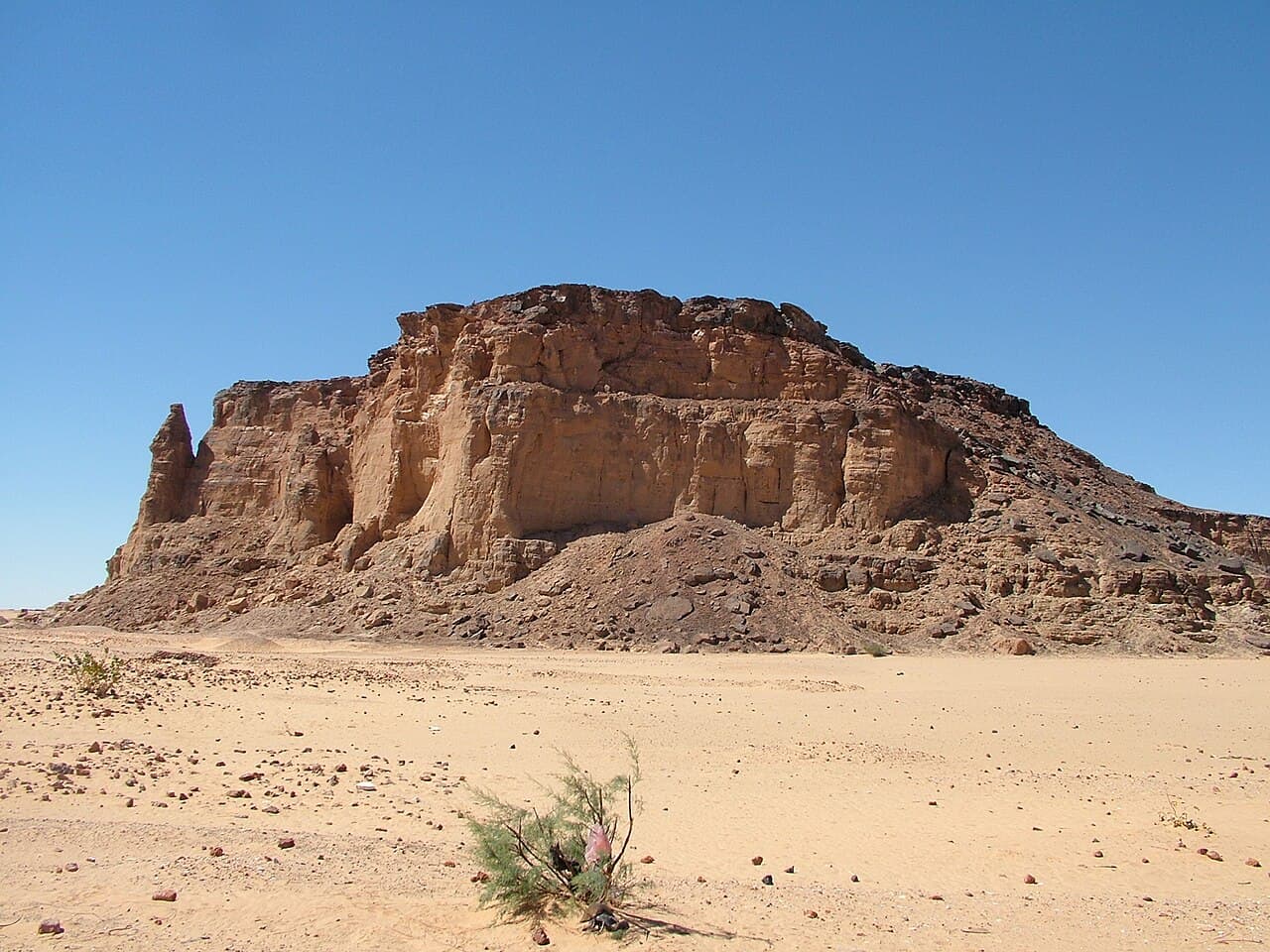 Jebel Barkal was held sacred by Egyptians and Kushites alike as the home of Amun, and the Kushite kings who later ruled Egypt as its twenty-fifth dynasty came from here. Photograph by LassiHU, CC BY-SA 4.0, via Wikimedia Commons.
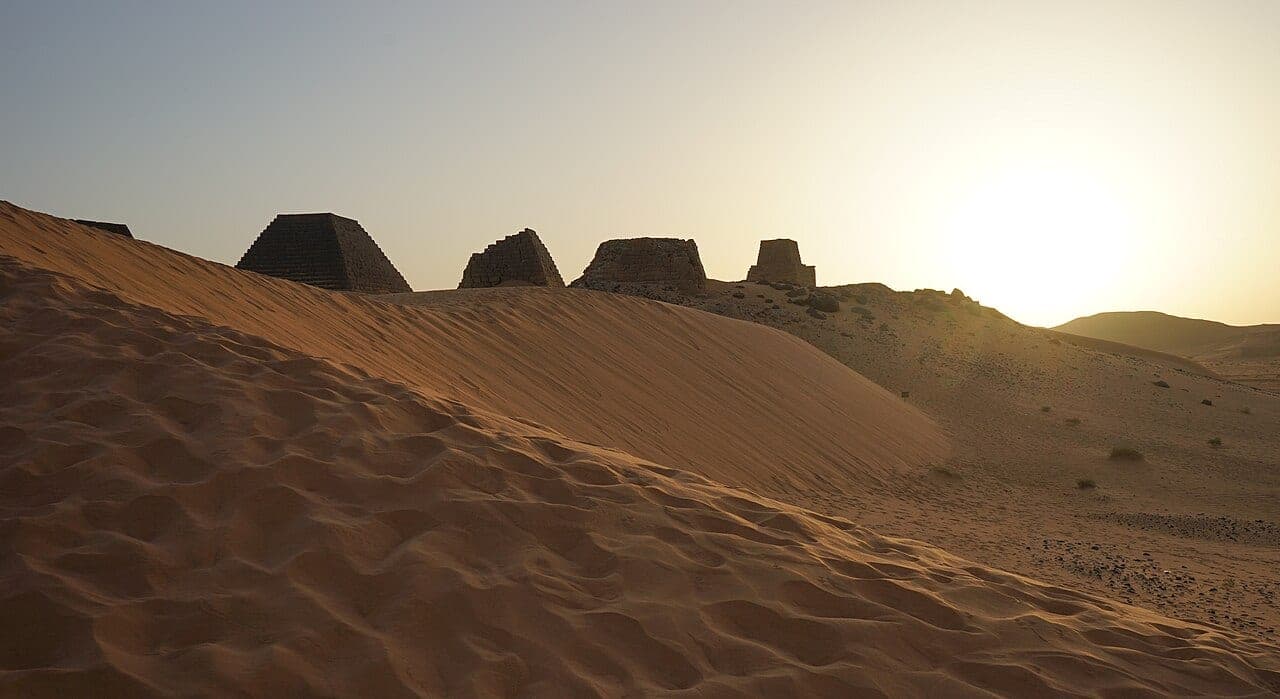
When Egyptian power receded, a new Nubian dynasty rose at Napata, near Gebel Barkal, and turned the tables. Its kings pushed north and, under Piye and then Taharqa, ruled Egypt itself as the 25th Dynasty between roughly 744 and 656 BC, the line often called the Black Pharaohs (National Geographic). Driven from Egypt by an Assyrian invasion, the kingdom of Kush endured in its homeland and, from about 300 BC, centred itself further south at Meroe. There its rulers were buried beneath steep-sided pyramids, and the fields of Meroe and its northern cemeteries together hold well over two hundred of them, more than in all of Egypt (National Geographic). Meroe also developed its own writing, the Meroitic script, one of the earliest alphabetic systems in Africa, which recorded a language that scholars can read phonetically but still cannot fully translate (Wikipedia).
Meroe declined and fell by around the fourth century AD. In the centuries that followed, three Christian kingdoms took shape along the Nubian Nile: Nobatia in the north, Makuria centred on Old Dongola, and Alodia (Alwa) in the south with its capital at Soba, near modern Khartoum. Byzantine missionaries brought Christianity to these states in the sixth century, and they held their faith for some seven hundred years, painting the walls of cathedrals such as the one at Faras (Smarthistory). Islam arrived gradually, carried less by armies than by traders and by Sufi holy men who settled among the people. As the Christian kingdoms weakened, the Funj, a people of the upper Blue Nile, took Soba in 1504 and founded the Islamic Sultanate of Sennar, which drew much of the region into a Muslim and Arabic-speaking world (Wikipedia).
In 1820 the armies of Muhammad Ali of Egypt invaded, opening the Turco-Egyptian period and founding Khartoum as a garrison town (Britannica). Resentment of that rule fed the movement of Muhammad Ahmad, who proclaimed himself the Mahdi and by 1885 had captured Khartoum and established an independent Islamic state with its capital at Omdurman. The Mahdist state lasted until 1898, when an Anglo-Egyptian force under Kitchener defeated it at the Battle of Omdurman. From 1899 Sudan was governed as an Anglo-Egyptian condominium, jointly in name but British in practice, until it gained full independence on 1 January 1956 (Britannica). The decades since brought long civil wars, the secession of South Sudan in 2011, and, from April 2023, the current armed conflict, described here only in outline so that the emphasis remains on the older heritage.
The name Sudan comes from the medieval Arabic phrase bilad al-sudan, "the land of the Blacks", used by Arab geographers for the African lands stretching south of the Sahara (Britannica). It once named a broad belt of the continent and narrowed over time to the country on the middle Nile.
Arabic is the dominant and official language, spoken in a distinctive Sudanese form, and its spread accompanied the coming of Islam and the Funj era. Yet Sudan remains linguistically layered. Nubian languages, direct descendants of the tongues of the medieval Christian kingdoms and ultimately linked to ancient Nubia, are still spoken in the far north and in Kordofan. The Beja of the eastern hills speak a Cushitic language, and the peoples of Darfur, the Nuba Mountains and the Blue Nile keep dozens of further languages alive. Beneath them all lies Meroitic, the script and language of ancient Kush, which used both a hieroglyphic and a cursive form and remains one of the last major writing systems of antiquity still awaiting full decipherment (Wikipedia).
Sudanese culture joins Nile Valley, Arab and wider African traditions. Hospitality is central, and the shared meal is its clearest expression. Everyday food includes ful medames, the slow-cooked fava beans eaten for breakfast, kisra, a thin fermented sorghum bread, and asida, a stiff porridge served with rich stews, alongside the ever-present rounds of sweet tea and spiced coffee poured from a long-necked pot, the jebena.
Music carries much of the national feeling. Sudanese song, built on the pentatonic scales of the Nile Valley and the sound of the oud, produced singers such as Mohammed Wardi and Abdel Karim al-Kabli, whose recordings are cherished across generations and among the diaspora. Craft traditions run deep as well: gold and silver jewellery, leatherwork, basketry and pottery, and the beadwork of the western and southern peoples. Women's dress often centres on the thobe, a long wrapped cloth in many colours, while ceremonies around weddings, births and religious feasts keep older forms of poetry, drumming and dance in daily use.
Islam is the faith of the large majority of Sudanese, most following the Sunni tradition, and it took root above all through Sufism, the mystical current of the religion. Sufi brotherhoods, among them the Qadiriyya and the Khatmiyya, have shaped Sudanese piety for centuries, spreading learning from village schools and lodges and binding communities to the tombs of revered teachers (Qantara). The most visible expression is the weekly gathering at the Hamed al-Nil tomb in Omdurman, where members of the Qadiriyya order sing, chant the names of God and turn in rhythmic devotion before sunset each Friday.
Behind this living faith lies an older religious record. The ancient Kushites worshipped Egyptian gods such as Amun at Gebel Barkal, together with their own deities, including the lion-headed war god Apedemak. For seven centuries the Nubian kingdoms were Christian, leaving cathedrals, monasteries and painted saints along the Nile before the faith gave way to Islam (Smarthistory). Small Christian communities remain, and these successive layers of belief, Kushite, Christian and Muslim, all belong to the country's heritage.
Sudanese mourning today follows Islamic practice, carried out quickly and as a shared duty of the whole community. The body is washed by relatives or attendants of the same sex, wrapped in a plain white shroud, and buried, usually on the day of death or the next morning, laid on its right side facing Mecca in a simple grave. The funeral prayer is offered at the mosque or graveside, and burial without a coffin follows without delay.
Jebel Barkal was held sacred by Egyptians and Kushites alike as the home of Amun, and the Kushite kings who later ruled Egypt as its twenty-fifth dynasty came from here. Photograph by LassiHU, CC BY-SA 4.0, via Wikimedia Commons.
When Egyptian power receded, a new Nubian dynasty rose at Napata, near Gebel Barkal, and turned the tables. Its kings pushed north and, under Piye and then Taharqa, ruled Egypt itself as the 25th Dynasty between roughly 744 and 656 BC, the line often called the Black Pharaohs (National Geographic). Driven from Egypt by an Assyrian invasion, the kingdom of Kush endured in its homeland and, from about 300 BC, centred itself further south at Meroe. There its rulers were buried beneath steep-sided pyramids, and the fields of Meroe and its northern cemeteries together hold well over two hundred of them, more than in all of Egypt (National Geographic). Meroe also developed its own writing, the Meroitic script, one of the earliest alphabetic systems in Africa, which recorded a language that scholars can read phonetically but still cannot fully translate (Wikipedia).
Meroe declined and fell by around the fourth century AD. In the centuries that followed, three Christian kingdoms took shape along the Nubian Nile: Nobatia in the north, Makuria centred on Old Dongola, and Alodia (Alwa) in the south with its capital at Soba, near modern Khartoum. Byzantine missionaries brought Christianity to these states in the sixth century, and they held their faith for some seven hundred years, painting the walls of cathedrals such as the one at Faras (Smarthistory). Islam arrived gradually, carried less by armies than by traders and by Sufi holy men who settled among the people. As the Christian kingdoms weakened, the Funj, a people of the upper Blue Nile, took Soba in 1504 and founded the Islamic Sultanate of Sennar, which drew much of the region into a Muslim and Arabic-speaking world (Wikipedia).
In 1820 the armies of Muhammad Ali of Egypt invaded, opening the Turco-Egyptian period and founding Khartoum as a garrison town (Britannica). Resentment of that rule fed the movement of Muhammad Ahmad, who proclaimed himself the Mahdi and by 1885 had captured Khartoum and established an independent Islamic state with its capital at Omdurman. The Mahdist state lasted until 1898, when an Anglo-Egyptian force under Kitchener defeated it at the Battle of Omdurman. From 1899 Sudan was governed as an Anglo-Egyptian condominium, jointly in name but British in practice, until it gained full independence on 1 January 1956 (Britannica). The decades since brought long civil wars, the secession of South Sudan in 2011, and, from April 2023, the current armed conflict, described here only in outline so that the emphasis remains on the older heritage.
The name Sudan comes from the medieval Arabic phrase bilad al-sudan, "the land of the Blacks", used by Arab geographers for the African lands stretching south of the Sahara (Britannica). It once named a broad belt of the continent and narrowed over time to the country on the middle Nile.
Arabic is the dominant and official language, spoken in a distinctive Sudanese form, and its spread accompanied the coming of Islam and the Funj era. Yet Sudan remains linguistically layered. Nubian languages, direct descendants of the tongues of the medieval Christian kingdoms and ultimately linked to ancient Nubia, are still spoken in the far north and in Kordofan. The Beja of the eastern hills speak a Cushitic language, and the peoples of Darfur, the Nuba Mountains and the Blue Nile keep dozens of further languages alive. Beneath them all lies Meroitic, the script and language of ancient Kush, which used both a hieroglyphic and a cursive form and remains one of the last major writing systems of antiquity still awaiting full decipherment (Wikipedia).
Sudanese culture joins Nile Valley, Arab and wider African traditions. Hospitality is central, and the shared meal is its clearest expression. Everyday food includes ful medames, the slow-cooked fava beans eaten for breakfast, kisra, a thin fermented sorghum bread, and asida, a stiff porridge served with rich stews, alongside the ever-present rounds of sweet tea and spiced coffee poured from a long-necked pot, the jebena.
Music carries much of the national feeling. Sudanese song, built on the pentatonic scales of the Nile Valley and the sound of the oud, produced singers such as Mohammed Wardi and Abdel Karim al-Kabli, whose recordings are cherished across generations and among the diaspora. Craft traditions run deep as well: gold and silver jewellery, leatherwork, basketry and pottery, and the beadwork of the western and southern peoples. Women's dress often centres on the thobe, a long wrapped cloth in many colours, while ceremonies around weddings, births and religious feasts keep older forms of poetry, drumming and dance in daily use.
Islam is the faith of the large majority of Sudanese, most following the Sunni tradition, and it took root above all through Sufism, the mystical current of the religion. Sufi brotherhoods, among them the Qadiriyya and the Khatmiyya, have shaped Sudanese piety for centuries, spreading learning from village schools and lodges and binding communities to the tombs of revered teachers (Qantara). The most visible expression is the weekly gathering at the Hamed al-Nil tomb in Omdurman, where members of the Qadiriyya order sing, chant the names of God and turn in rhythmic devotion before sunset each Friday.
Behind this living faith lies an older religious record. The ancient Kushites worshipped Egyptian gods such as Amun at Gebel Barkal, together with their own deities, including the lion-headed war god Apedemak. For seven centuries the Nubian kingdoms were Christian, leaving cathedrals, monasteries and painted saints along the Nile before the faith gave way to Islam (Smarthistory). Small Christian communities remain, and these successive layers of belief, Kushite, Christian and Muslim, all belong to the country's heritage.
Sudanese mourning today follows Islamic practice, carried out quickly and as a shared duty of the whole community. The body is washed by relatives or attendants of the same sex, wrapped in a plain white shroud, and buried, usually on the day of death or the next morning, laid on its right side facing Mecca in a simple grave. The funeral prayer is offered at the mosque or graveside, and burial without a coffin follows without delay.
 Sudan has more pyramids than Egypt. These are the tombs of Kushite kings and queens, and many were decapitated in the 1830s by a treasure hunter looking for gold. Photograph by Ahmed Amir, CC BY-SA 4.0, via Wikimedia Commons.
What comes after is the condolence gathering, one of the strongest institutions of Sudanese social life. For three days the bereaved family receives visitors, often under an awning raised near the house, with men and women in separate spaces; neighbours provide food so that a grieving household need not cook, and the Quran is recited for the departed. Mourners are received with unsweetened coffee, and the constant word of comfort is that all belong to God and to Him return. Charity given in the name of the dead, and further Quran readings on later days, extend the remembrance well beyond the first period of grief. In communities shaped by Sufi tradition, the anniversaries of saints are marked with recitation and shared meals at their tombs, so that memory of holy teachers binds whole towns.
The most striking remembrance customs of all lie in the ancient past. The kings and queens of Kush were buried beneath the pyramids of Napata and Meroe, their bodies laid in chambers cut below the tombs and provisioned, in the manner learned from Egypt, for a life beyond death (National Geographic). At Kerma, far older royal burials lay beneath enormous earthen mounds. These monuments, and the Christian tombs and inscribed grave markers of medieval Nubia, form a record of remembrance on the middle Nile reaching back more than four thousand years.
Sudan's national record was damaged before 2023 and has been comprehensively attacked since.
The Anglo-Egyptian condominium built an administrative archive that was, by regional standards, well kept, and the National Records Office in Khartoum held the Mahdist, condominium and post-independence series. Islamic court registers hold marriage and inheritance, and church registers cover the Christian communities. Civil registration existed and reached a minority of the population.
The war that began in April 2023 turned Khartoum into a battlefield. Archives, museums and government offices in the capital have been looted and burned, the National Museum's collections were plundered, and the state of the National Records Office is uncertain. Ten million people have been displaced. For a great many Sudanese families the documents that establish who they are were in a building in Khartoum.
Before that, the Aswan High Dam had already displaced the Nubians. In the 1960s around fifty thousand Sudanese Nubians were moved from the Nile valley to Khashm el-Girba, hundreds of kilometres away, and their villages and cemeteries were flooded. The resettlement records name the households moved, and for Nubian families they are the last document that connects a name to a place that no longer exists.
Tribal and lineage genealogy, recited across the Arab and Beja groups and the Nuba and Fur and Zaghawa communities, is what survives all of this, because it is not stored anywhere that can be burned.
Sudan has three sites on the UNESCO World Heritage List, two of them at the core of the ancient Kushite landscape. Gebel Barkal and the Sites of the Napatan Region, inscribed in 2003, protect the sacred mountain and the temples, palaces and pyramid cemeteries of the Napatan and Meroitic kingdoms across five locations along the Nile (UNESCO). The Archaeological Sites of the Island of Meroe, inscribed in 2011, cover the royal city of Meroe, its pyramid fields and the associated religious centres of Naqa and Musawwarat es-Sufra, the heartland of Kush for around nine centuries (UNESCO). Sanganeb Marine National Park and Dungonab Bay, added in 2016, protects a coral atoll and a Red Sea bay of exceptional marine life, the country's one natural World Heritage site (UNESCO).
Care of these places rests with the National Corporation for Antiquities and Museums, which licenses excavation and runs the National Museum in Khartoum, together with international missions working alongside Sudanese archaeologists. Preservation has always been difficult in a poor country with a vast desert terrain, and the conflict since 2023 has sharply raised the risk: reports of looting and of damage to museum collections have alarmed heritage bodies, and safeguarding the National Museum's holdings has become an urgent international concern.
Because Sudan's sites are remote and access has often been limited, digital documentation has become central to protecting them. Long-running archaeological projects, such as those associated with the Sudan Archaeological Research Society and the British Museum, have mapped and recorded sites along the middle Nile and published their findings for researchers worldwide (Britannica). Excavation archives, site photographs and object records held in institutions abroad increasingly appear in open databases, preserving a century of fieldwork in digital form.
Satellite imagery has proved especially valuable, letting threatened sites be monitored from a distance when ground missions cannot travel, while 3D imaging and virtual tours now let audiences far from Sudan explore the pyramids of Meroe and the temples of the Napatan region. During the current conflict, such remote tools have gained added weight as a way to watch for damage.
Modern Sudanese culture reaches well beyond the country's borders, carried by a large and active diaspora. Sudanese writers have gained international standing, above all Tayeb Salih, whose novel Season of Migration to the North is regarded as one of the finest works of modern Arabic fiction. Musicians and poets keep the older song traditions alive while a younger generation, at home and abroad, blends them with new forms.
The peaceful protest movement of 2018 and 2019 became a moment of cultural energy, producing striking street art, music and photography drawn from Sudanese and Nubian imagery, much of it now continuing in exile. Sudan's ancient heritage feeds a wider fascination too: the pyramids of Meroe and the story of the Nubian pharaohs increasingly feature in documentaries, exhibitions and scholarship that place the kingdom of Kush among the major civilisations of the ancient world.
The kings of Kush regain their place. Long overshadowed by Egypt, the Nubian kingdoms and their Black Pharaohs have been restored to prominence by decades of archaeology and by museum exhibitions around the world, so that Meroe and Napata are now recognised as centres of a great African civilisation (National Geographic).
A World Heritage landscape secured. The inscription of Gebel Barkal and the Napatan region in 2003 and of the Island of Meroe in 2011 brought international recognition and support to the pyramid fields of the middle Nile, anchoring conservation work at the heart of ancient Kush (UNESCO).
Saving the temples of Nubia. When the Aswan High Dam threatened to flood Lower Nubia in the 1960s, an international campaign recorded and rescued Sudanese and Egyptian monuments alike, and finds from the salvaged sites enriched the National Museum in Khartoum, where rescued temples now stand in its garden (Britannica).
Sudan has more pyramids than Egypt. These are the tombs of Kushite kings and queens, and many were decapitated in the 1830s by a treasure hunter looking for gold. Photograph by Ahmed Amir, CC BY-SA 4.0, via Wikimedia Commons.
What comes after is the condolence gathering, one of the strongest institutions of Sudanese social life. For three days the bereaved family receives visitors, often under an awning raised near the house, with men and women in separate spaces; neighbours provide food so that a grieving household need not cook, and the Quran is recited for the departed. Mourners are received with unsweetened coffee, and the constant word of comfort is that all belong to God and to Him return. Charity given in the name of the dead, and further Quran readings on later days, extend the remembrance well beyond the first period of grief. In communities shaped by Sufi tradition, the anniversaries of saints are marked with recitation and shared meals at their tombs, so that memory of holy teachers binds whole towns.
The most striking remembrance customs of all lie in the ancient past. The kings and queens of Kush were buried beneath the pyramids of Napata and Meroe, their bodies laid in chambers cut below the tombs and provisioned, in the manner learned from Egypt, for a life beyond death (National Geographic). At Kerma, far older royal burials lay beneath enormous earthen mounds. These monuments, and the Christian tombs and inscribed grave markers of medieval Nubia, form a record of remembrance on the middle Nile reaching back more than four thousand years.
Sudan's national record was damaged before 2023 and has been comprehensively attacked since.
The Anglo-Egyptian condominium built an administrative archive that was, by regional standards, well kept, and the National Records Office in Khartoum held the Mahdist, condominium and post-independence series. Islamic court registers hold marriage and inheritance, and church registers cover the Christian communities. Civil registration existed and reached a minority of the population.
The war that began in April 2023 turned Khartoum into a battlefield. Archives, museums and government offices in the capital have been looted and burned, the National Museum's collections were plundered, and the state of the National Records Office is uncertain. Ten million people have been displaced. For a great many Sudanese families the documents that establish who they are were in a building in Khartoum.
Before that, the Aswan High Dam had already displaced the Nubians. In the 1960s around fifty thousand Sudanese Nubians were moved from the Nile valley to Khashm el-Girba, hundreds of kilometres away, and their villages and cemeteries were flooded. The resettlement records name the households moved, and for Nubian families they are the last document that connects a name to a place that no longer exists.
Tribal and lineage genealogy, recited across the Arab and Beja groups and the Nuba and Fur and Zaghawa communities, is what survives all of this, because it is not stored anywhere that can be burned.
Sudan has three sites on the UNESCO World Heritage List, two of them at the core of the ancient Kushite landscape. Gebel Barkal and the Sites of the Napatan Region, inscribed in 2003, protect the sacred mountain and the temples, palaces and pyramid cemeteries of the Napatan and Meroitic kingdoms across five locations along the Nile (UNESCO). The Archaeological Sites of the Island of Meroe, inscribed in 2011, cover the royal city of Meroe, its pyramid fields and the associated religious centres of Naqa and Musawwarat es-Sufra, the heartland of Kush for around nine centuries (UNESCO). Sanganeb Marine National Park and Dungonab Bay, added in 2016, protects a coral atoll and a Red Sea bay of exceptional marine life, the country's one natural World Heritage site (UNESCO).
Care of these places rests with the National Corporation for Antiquities and Museums, which licenses excavation and runs the National Museum in Khartoum, together with international missions working alongside Sudanese archaeologists. Preservation has always been difficult in a poor country with a vast desert terrain, and the conflict since 2023 has sharply raised the risk: reports of looting and of damage to museum collections have alarmed heritage bodies, and safeguarding the National Museum's holdings has become an urgent international concern.
Because Sudan's sites are remote and access has often been limited, digital documentation has become central to protecting them. Long-running archaeological projects, such as those associated with the Sudan Archaeological Research Society and the British Museum, have mapped and recorded sites along the middle Nile and published their findings for researchers worldwide (Britannica). Excavation archives, site photographs and object records held in institutions abroad increasingly appear in open databases, preserving a century of fieldwork in digital form.
Satellite imagery has proved especially valuable, letting threatened sites be monitored from a distance when ground missions cannot travel, while 3D imaging and virtual tours now let audiences far from Sudan explore the pyramids of Meroe and the temples of the Napatan region. During the current conflict, such remote tools have gained added weight as a way to watch for damage.
Modern Sudanese culture reaches well beyond the country's borders, carried by a large and active diaspora. Sudanese writers have gained international standing, above all Tayeb Salih, whose novel Season of Migration to the North is regarded as one of the finest works of modern Arabic fiction. Musicians and poets keep the older song traditions alive while a younger generation, at home and abroad, blends them with new forms.
The peaceful protest movement of 2018 and 2019 became a moment of cultural energy, producing striking street art, music and photography drawn from Sudanese and Nubian imagery, much of it now continuing in exile. Sudan's ancient heritage feeds a wider fascination too: the pyramids of Meroe and the story of the Nubian pharaohs increasingly feature in documentaries, exhibitions and scholarship that place the kingdom of Kush among the major civilisations of the ancient world.
The kings of Kush regain their place. Long overshadowed by Egypt, the Nubian kingdoms and their Black Pharaohs have been restored to prominence by decades of archaeology and by museum exhibitions around the world, so that Meroe and Napata are now recognised as centres of a great African civilisation (National Geographic).
A World Heritage landscape secured. The inscription of Gebel Barkal and the Napatan region in 2003 and of the Island of Meroe in 2011 brought international recognition and support to the pyramid fields of the middle Nile, anchoring conservation work at the heart of ancient Kush (UNESCO).
Saving the temples of Nubia. When the Aswan High Dam threatened to flood Lower Nubia in the 1960s, an international campaign recorded and rescued Sudanese and Egyptian monuments alike, and finds from the salvaged sites enriched the National Museum in Khartoum, where rescued temples now stand in its garden (Britannica).
National Overview
Notable Cities
Historical Foundations
Linguistic and Etymological Roots
Cultural Identity
Religion and Spirituality
Remembrance and Mourning Traditions
Tracing a Family in Sudan
Heritage Preservation Efforts
Digital Heritage
Contemporary Cultural Influences
Success Stories
References and resources
- Encyclopaedia Britannica, Sudan, geography, peoples, languages and society.
- Encyclopaedia Britannica, History of Sudan, from ancient Nubia through the Funj, Mahdist and independence eras.
- National Geographic, The Nubian kingdom of Kush, the 25th Dynasty, Napata, Meroe and the pyramids.
- Smarthistory, Medieval Nubian Kingdoms, an introduction, Nobatia, Makuria and Alodia and Christian Nubia.
- Wikipedia, Meroitic language, the script and language of ancient Kush.
- Wikipedia, Funj Sultanate, the Islamic sultanate of Sennar founded in 1504.
- UNESCO World Heritage Centre, Gebel Barkal and the Sites of the Napatan Region, inscribed 2003.
- UNESCO World Heritage Centre, Archaeological Sites of the Island of Meroe, inscribed 2011.
- UNESCO World Heritage Centre, Sanganeb Marine National Park and Dungonab Bay, inscribed 2016.
- Encyclopaedia Britannica, Khartoum, the capital at the confluence of the Blue and White Niles.
- Encyclopaedia Britannica, Omdurman, the Mahdist capital and cultural centre.
- Qantara, The Sufis of Khartoum, the Qadiriyya order and the Hamed al-Nil gathering in Omdurman.