Heritage · Country
South Ossetia Culture and Heritage
At an Ossetian feast three pies go on the table for God, the sun and the earth, and at a funeral only two, because the dead will not see the sun again. This guide follows Ossetian heritage: a surviving Scythian language, the Nart sagas, and the shrines above the villages.Written to last.
By Confinity Heritage Editorial · Updated 2026-08-17 · 8-minute readQuiet tools, kept out of the way.
At an Ossetian table on a good day, three pies go down in a stack, and they are read from the top: God, the sun, the earth. At a funeral there are only two. The middle one, the sun, is left out, because the person being buried will not see it again. Nobody explains this at the table. Everyone present knows what the count means, and the bread does the saying.
South Ossetia is a small territory of high valleys on the southern slope of the Greater Caucasus, and the people who live in it speak a language that came off the Eurasian steppe with the Scythians and the Alans and has outlived every other one of them. Their epic cycle, the Nart sagas, is shared across the Caucasus and studied for what it may preserve of Scythian religion. Their shrines sit in groves above the villages, and their churches carry Georgian inscriptions from the twelfth century. Two wars in living memory drove people out of these valleys in both directions, and that displacement is a heritage question as much as a political one, because it separated families from their churches, their graves and their villages.
The territory covers about 3,900 square kilometres, almost all of it mountain. The main Caucasus ridge forms its northern edge, crossed since 1984 by the Roki tunnel, and the land falls southward through the Liakhvi, Ksani and Prone valleys to the plain of Shida Kartli. Alpine lakes sit on the Keli volcanic plateau at over 2,900 metres, beech and pine cover the middle slopes, and the settled valleys are narrow. Official figures put the population at just over 56,500, with around 33,000 in the capital, Tskhinvali. The authorities adopted State of Alania as an additional official name in 2017.
The status of the territory is disputed and this page takes no position on it. The South Ossetian Autonomous Oblast, created within Soviet Georgia in 1922, declared itself a republic in 1990, and independence was declared and confirmed by referendums in 1992 and 2006.
Russia recognised South Ossetia as a state on 26 August 2008, days after the war of that month, and three other United Nations members recognise it: Nicaragua from 2008, Venezuela from 2009 and Syria from 2018, while Nauru, Tuvalu and Vanuatu each recognised it and later withdrew (Wikipedia). Georgia calls the area the Tskhinvali region, regards it as its own territory under Russian occupation, and legislated to that effect in October 2008; the great majority of states and international organisations take the same view. The United Nations General Assembly has adopted a resolution on the status of internally displaced persons and refugees from Abkhazia and the Tskhinvali region/South Ossetia in almost every year since 2008, affirming their right to return home in safety and dignity regardless of ethnicity (UN Meetings Coverage).
On 21 January 2021, in Georgia v. Russia (II), the Grand Chamber of the European Court of Human Rights held that Russia had exercised effective control over South Ossetia, Abkhazia and the adjacent buffer zone from 12 August 2008, that this control continued after Russian troops withdrew that October, and that violations followed including of the right to life, the prohibition of ill-treatment and the freedom of movement of displaced Georgians who wished to return (HUDOC). Those are the positions of the bodies that hold them. The rest of this page is about heritage.
Tskhinvali. The capital sits where the Liakhvi leaves the mountains, first recorded in 1398 as a royal village of the Georgian crown. Its old town was a dense quarter of two-storey houses with wooden balconies, much of it the Jewish quarter: an 1886 count recorded 1,953 Jews among 3,832 residents, and Tskhinvali was for a long time one of the main centres of Georgian Jewry. That quarter was wrecked by shelling during the fighting of 1991 and 1992, its synagogue badly damaged then and again in 2008, and almost the whole community emigrated to Israel (JAMnews). What remains of the old streets is fragmentary.
Java (Dzau). A small town in the upper Liakhvi valley, close to the Roki road, badly damaged by the earthquake of 1991 and rebuilt since.
Akhalgori (Leningor). The eastern district town in the Ksani valley, historically mixed Georgian and Ossetian, which came under South Ossetian control in 2008 and has since been separated from Tbilisi by a closed crossing.
Kvaisa and Znauri. Western settlements in the mountains, Kvaisa built around a lead and zinc mine, Znauri on the road toward the Georgian plain.
The oldest layer belongs to the Koban culture of the late Bronze and early Iron Age, whose bronze axes, belt plates and animal figures come from sites on both sides of the range and remain the emblem of Caucasian metalwork. Scythian and then Sarmatian speakers moved across the north from the seventh century BC, and out of the Sarmatians came the Alans, who by the ninth century held a kingdom on the northern slope of the Caucasus. Alania accepted Christianity from Byzantium around 916, under the patriarch Nicholas Mystikos, and kept a metropolitan see for several centuries.
The Mongol campaigns of 1238 and 1239 ended that kingdom. Alans were killed, dispersed as far as Hungary and China, and pushed up into the gorges, and from there some crossed the watershed into the valleys that became South Ossetia. How early and how numerously they did so is argued. Georgian scholarship generally places substantial Ossetian settlement of the southern slope from the seventeenth century, while Ossetian scholarship traces continuous presence to the medieval period and earlier; both cite the same thin body of chronicles, place names and graves. The medieval churches in these valleys carry Georgian inscriptions and Georgian royal and ducal patronage, which is not in dispute as epigraphy, and the readings that get built on top of it are.
Russia annexed eastern Georgia in 1801 and the Ossetian districts with it. The Soviet authorities created a South Ossetian Autonomous Oblast within Georgia in 1922, and a North Ossetian autonomous unit within Russia, so that one people has been administered across an international frontier ever since.
The late Soviet collapse brought conflict. Georgia abolished the oblast's autonomy in December 1990, and fighting from January 1991 to June 1992 killed around a thousand people and displaced tens of thousands in both directions: Ossetians from Georgian-controlled areas moved north through the Roki tunnel, and Georgians left villages inside the region. The Sochi agreement of 24 June 1992 froze the line. In August 2008 a much larger war followed, after which South Ossetian and Russian forces held the whole of the former oblast. Human Rights Watch, in a report of January 2009 based on more than 460 interviews, documented indiscriminate attacks by Georgian and Russian forces and a deliberate campaign by South Ossetian forces to destroy ethnic Georgian villages in the Liakhvi valley, including Tamarasheni, Kekhvi, Kurta and Achabeti, and concluded that the burning and looting, together with the intent that nobody should return, amounted to attempted ethnic cleansing; it recorded roughly 22,000 people still displaced (Human Rights Watch). Those villages held churches, cemeteries and family houses, and the people who kept them have not been back.
Ossetian is an Eastern Iranian language, and it is the last one standing from the Scythian branch. Its ancestors are the speech of the Sarmatians and, immediately, of the medieval Alans, which makes an everyday conversation in a Tskhinvali kitchen the living end of a line that ran across the steppe from the Danube to the Aral. Two written traces of the older stage survive. The Zelenchuk inscription, cut in Greek letters and dated to the tenth to twelfth centuries, was found near the Bolshoy Zelenchuk river in the northern Caucasus, and two lines of Alanic phrases appear in the Theogony of the twelfth-century Byzantine grammarian John Tzetzes, who set down a greeting and a joke he had heard (Wikipedia). Modern Ossetian speakers can still read most of both.
The language has two dialects. Iron is spoken by roughly five sixths of Ossetians, including in South Ossetia, where the local variety is called Kudar; Digor, spoken in western North Ossetia, is the more archaic of the two and is written separately. Ossetian is easy to recognise on the page because it uses the Cyrillic letter Ӕӕ, which no other language does. The script has been through as many changes as the border. A Georgian-based primer appeared in 1820, the Cyrillic alphabet Andreas Sjögren devised in 1844 became standard, a Latin alphabet was made official in 1923, and then in the late 1930s the two halves of Ossetia were given different scripts: Georgian in the South Ossetian oblast, Cyrillic in the north. Southern Ossetians protested in 1951, and in 1954 a single Cyrillic orthography was restored for both. UNESCO has listed Ossetian as vulnerable since 2009.
The scholarly monument of the language is Vasily Abaev's historical and etymological dictionary, four volumes published between 1958 and 1989, which traces Ossetian words back through Alanic to Old Iranian and is still the reference for anything Scythian.
The feast, the kuvd, is the central institution. An elder opens it, the toasts run in a fixed order beginning with God, and nobody drinks out of turn. Three pies are stacked for the good occasions, made with cheese, potato, beet leaves or minced meat, and ualibakh, the cheese one, is the standard. Ossetian beer, brewed at home from barley and hops, is drunk at rituals rather than casually and is one of the few brewing traditions in the Caucasus that never gave way to wine.
The epic sits underneath all of it. The Nart sagas tell of Satana, the mother of the Narts, of Uryzmaeg and Soslan, of the steel-bodied Batraz and of Syrdon the troublemaker, and versions are told by Circassians, Abkhaz, Karachay-Balkars and Chechens, but the name itself is Ossetian, from a root meaning hero (Wikipedia). Georges Dumézil devoted much of his career to arguing that the cycle preserves Scythian religion and social structure, comparing Syrdon with Loki and reading Batraz against Herodotus, who described the Scythians worshipping a sword driven into a mound of brushwood. Dumézil also drew a line between the Alans who reached western Europe and the Arthurian legends, in particular the return of a sword to water, and later writers built that into a fuller theory. It is a hypothesis about transmission, argued from parallels, and it remains debated among specialists rather than settled.
Two systems overlap. Most Ossetians identify as Orthodox Christians, with a Muslim minority mainly in the north, and alongside that sits Uatsdin, the Ossetian traditional religion, sometimes called Assianism, which is organised around a supreme god and a set of intermediary figures venerated at open-air shrines called dzuar. A survey conducted in North Ossetia in 2012 found around 29 per cent identifying with the traditional faith, which is among the highest such figures anywhere in Europe, and in the southern valleys the practice is general even among the baptised (OC Media).
The shrines are groves, hilltops and single old trees, kept clear of cutting and grazing, with a low wall or a small stone building where offerings are left. The most important figure is Uastyrdzhi, patron of men and travellers, whose iconography merged with Saint George and whose feast, Jeorguyba, falls in November and is the largest festival of the year. Women do not use his name; they call him the men's dzuar instead. Church jurisdiction in the territory is itself contested, since the Georgian Orthodox Church regards the area as canonically its own and the local Orthodox community has been organised outside the recognised Orthodox communion for decades.
Ossetian mourning is elaborate and public. The body is kept at home, the family receives for days, and men and women mourn in separate rooms. The memorial meal, the hist, is repeated on the fortieth day and on the anniversary, and the funeral table is set with two pies rather than three. Families put up roadside memorials with a table and benches at the spot where someone died, so that travellers can stop, and graves are visited with food and drink on the commemorative days.
One rite has kept its shape since the steppe. In bæxfældisyn, the dedication of the horse, a speaker stands over the dead man's horse and consigns it to him for the journey to the next world, describing the road it will take. Where a horse was once buried with its owner, the surviving practice cuts the tip of an ear and leaves the animal alive. The Encyclopaedia Iranica records the rite as a direct continuation of Scytho-Sarmatian funeral custom, and it is still performed in rural districts (Encyclopaedia Iranica).
Two modern griefs are unavoidable. The wars of 1991 to 1992 and of 2008 left memorials on both sides of the line: Ossetians mark the killing of civilians on the Dzari road in May 1992, and displaced Georgians mark villages of the Liakhvi valley that no longer exist as communities. And the defining recent grief of Ossetians generally happened outside this territory. On 1 September 2004, in Beslan in North Ossetia, part of the Russian Federation, armed men seized School Number One at the start of the school year; the siege ended on the third day and 334 people were killed, 186 of them children. The European Court of Human Rights, in Tagayeva and Others v. Russia on 13 April 2017, found that Russia had failed in its duty to protect life and to plan the operation so as to minimise risk (HUDOC). The ruined gymnasium is kept as it was, and Ossetians travel there from both slopes of the mountains.
South Ossetia's family records are split between two states that disagree about which one they belong to.
Ossetian genealogy runs through the myggag, the patrilineal clan, and Ossetian surnames are clan names, so a person is placed immediately. The clans are shared across the Caucasus range: North Ossetia is in Russia, South Ossetia is not recognised as anything by most of the world, and families straddle the mountains.
Imperial Russian metrical books and revision lists cover the nineteenth century, and Soviet ZAGS registration the twentieth; the archives are in Tskhinval and in Vladikavkaz and Tbilisi. The conflicts of 1991 to 1992 and 2008 displaced tens of thousands in both directions and left records where the people were not, and the Georgian villages of the Liakhvi valley were destroyed in 2008.
Since 2008 South Ossetia has issued its own documents, recognised by Russia and four other states, and most residents hold Russian passports, so the practical record of a South Ossetian family is Russian.
The deep record is the Nart sagas, the epic cycle shared across the Caucasus and best preserved in Ossetian, which is the collective genealogy of a people descended from the Alans and speaking the last surviving Northeast Iranian language.
The dzuar shrines, the sacred groves where the community gathers, are where families still mark obligations that no register holds.
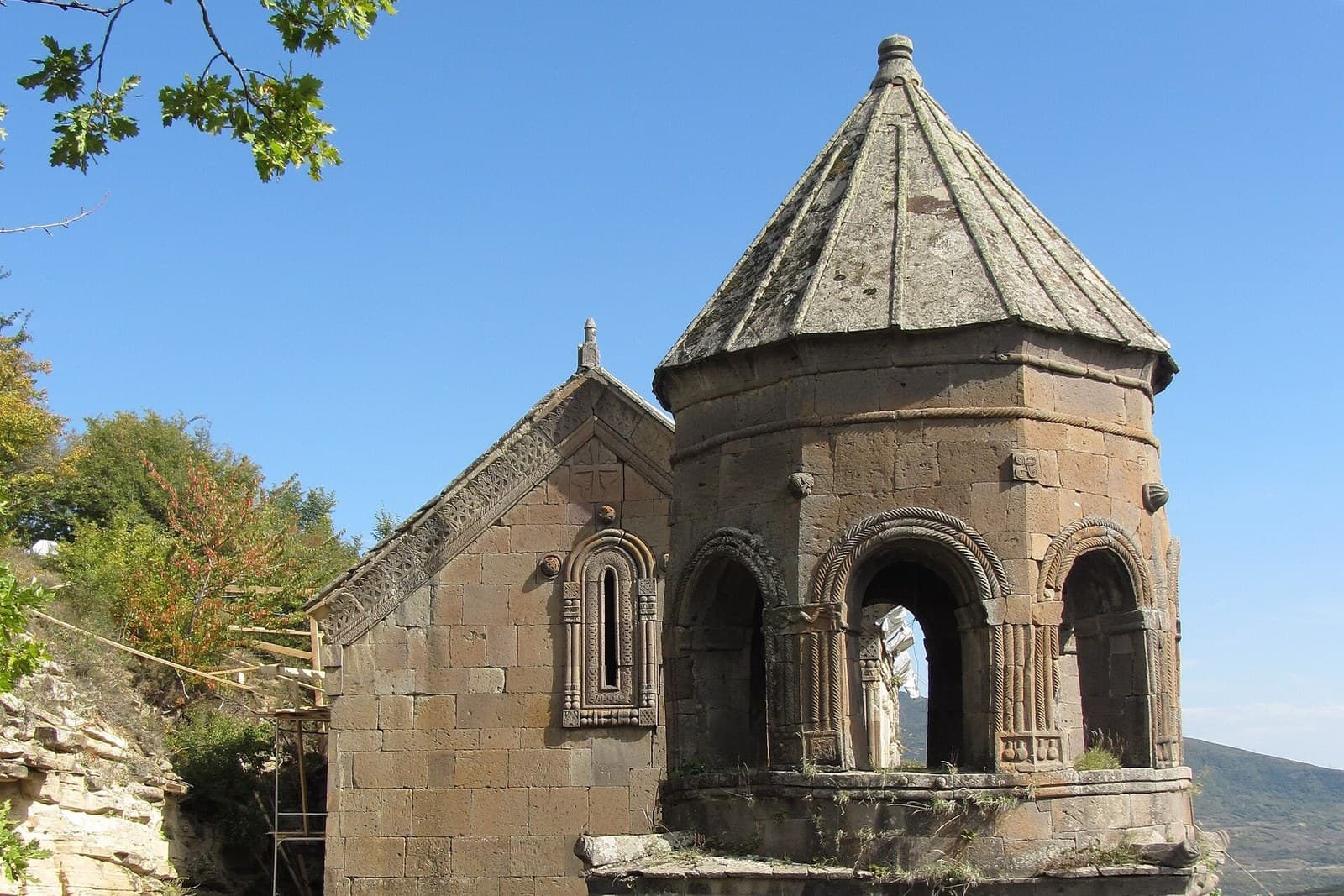
The monuments are mostly medieval and mostly in poor repair: the thirteenth-century Tiri monastery near Tskhinvali, the domed church at Tigva founded in 1152 by Tamar, daughter of King David IV, the basilica at Eredvi with its tenth-century inscription, and a scatter of tower houses and hill forts at Vanati, Beloti and Achabeti. Their care is caught in the status question. Georgia's heritage agency lists them and cannot reach them; South Ossetian and Russian bodies work on them without any external technical review; no site in the territory is on the World Heritage List, and none can easily be nominated, since the territory is not a state party to the 1972 convention and Georgia has no access. Work at Tiri in 2015 caused an argument on exactly these lines, with Georgian specialists saying the intervention damaged medieval frescoes and infringed the building's authenticity, and local authorities defending it as repair (Wikipedia).
The other structural problem is the border through the middle of a people. Ossetians live on both slopes, the north inside Russia and the south outside Georgian control, and the Roki tunnel is the only road link. Archives, institutes and specialists are concentrated in Vladikavkaz, while much of the documentary record for the southern districts sits in Tbilisi, and neither set of material is easy to consult from the other side.
Language work has moved online, which suits a small population spread across a frontier. The Ossetian National Corpus assembles millions of words of Iron and Digor text with morphological tagging, and it is the practical tool for anyone studying the language today (Ossetic Studies). Abaev's dictionary has been digitised, Ossetian has its own Wikipedia edition, and school materials and newspapers circulate as files rather than print runs.
The Nart sagas have travelled the same way. Translations into Russian, French and English, several of them now freely available, have put a cycle that was recited in mountain houses in front of readers who will never hear it performed.
Kosta Khetagurov, born in 1859 in a mountain village in the north, is the founder of written Ossetian literature and the figure both Ossetias claim without argument; his collection Iron Fandyr remains the book people quote. Tskhinvali keeps an Ossetian drama theatre and a state university, and the twelve-string harp and the fandyr accompany the old songs at festivals.
Ossetian pies have become the most portable part of the culture, sold in bakeries across Russia and among the diaspora, which is a small commercial fact with a straightforward heritage effect: the ritual count of three, and the two at funerals, travels with them.
One alphabet again. After sixteen years in which Ossetians north and south of the range were made to write their language in different scripts, a single Cyrillic orthography was restored in 1954.
A dictionary that outlasted its state. Abaev's four-volume historical and etymological dictionary, published between 1958 and 1989, remains the standard reference for Ossetian and for reconstructing Scythian vocabulary.
A steppe rite still performed. The dedication of the horse has been carried out at Ossetian funerals continuously enough to be recorded by ethnographers as a living survival of Scytho-Sarmatian practice.
The epic in print and online. The Nart sagas, once oral, now exist in scholarly editions and in translations that circulate freely, so the cycle survives the decline of the households that told it.
National Overview
Notable Cities
Historical Foundations
Linguistic and Etymological Roots
Cultural Identity
Religion and Spirituality
Remembrance and Mourning Traditions
Tracing a Family in South Ossetia
Heritage Preservation Efforts
Digital Heritage
Contemporary Cultural Influences
Success Stories
References and resources
- Encyclopaedia Britannica, South Ossetia: geography and administrative history.
- International recognition of Abkhazia and South Ossetia, Wikipedia: who recognises, and who withdrew.
- UN Meetings Coverage, resolution on Georgia's displaced: the annual right of return text.
- European Court of Human Rights, Georgia v. Russia (II): judgment of 21 January 2021.
- Human Rights Watch, Up in Flames: the 2008 conflict and the destroyed villages.
- Ossetian language, Wikipedia: classification, the Zelenchuk inscription, script history.
- Nart saga, Wikipedia: the cycle, its characters and its study.
- Encyclopaedia Iranica, Bäx fäldisin: the dedication of the horse.
- OC Media, How Ossetian Uatsdin became a living faith: the traditional religion and its shrines.
- JAMnews, South Ossetia: the Jewish quarter: Tskhinvali's old town and its loss.
- Tiri Monastery, Wikipedia: the thirteenth-century church and the 2015 works.
- European Court of Human Rights, Tagayeva and Others v. Russia: the Beslan judgment of 13 April 2017.