Heritage · Country
Nicaragua Culture and Heritage
Between two inland seas and a spine of volcanoes, Nicaragua raised the oldest Spanish cities on the American mainland and gave the Spanish language its great reformer in Rubén Darío. This guide follows the country's colonial ruins, its Indigenous and Caribbean inheritances, and the December nights when whole towns shout their joy to the Virgin.Written to last.
By Confinity Heritage Editorial · Updated 2026-07-31 · 8-minute readQuiet tools, kept out of the way.
Nicaragua is the largest country in Central America, and much of it is water and fire. Two inland seas, Lake Cocibolca (Lake Nicaragua) and Lake Xolotlán (Lake Managua), fill the Pacific lowlands, and a chain of volcanoes runs beside them toward the Costa Rican border. Out of Cocibolca, the largest lake in Central America, rises Ometepe, an island formed by two volcanoes whose Nahuatl name means simply "two mountains". The Caribbean side is another country in feel: a wide, rain-soaked coast of rivers, savannah and pine, home to peoples whose first language is not Spanish.
The country's built heritage is among the oldest in the hemisphere. Near the Momotombo volcano lie the Ruins of León Viejo, a Spanish city founded in 1524 and later buried by eruption and earthquake, inscribed by UNESCO in 2000 as one of the earliest colonial settlements in the Americas. The cathedral of the León that replaced it, the largest in Central America, followed onto the World Heritage List in 2011. Nicaragua also gave the Spanish language its great reformer, the poet Rubén Darío, and gave the wider world El Güegüense, a masked folk drama recognised by UNESCO as a masterpiece of intangible heritage.
Nicaragua covers about 130,000 square kilometres between Honduras and Costa Rica, with coasts on both the Pacific Ocean and the Caribbean Sea. The Pacific lowlands hold most of the population and nearly all of the volcanoes, among them Momotombo and the perpetually smoking Masaya in the Cordillera de los Maribios. Central Nicaragua rises into highlands of coffee and cattle, and the east falls to the largest expanse of rainforest north of the Amazon. The two great lakes, Xolotlán and Cocibolca, are the country's defining feature; Cocibolca shelters the bull sharks that swim up the San Juan River from the sea.
Around 6.7 million people live here. Spanish is the official language and the mother tongue of most Nicaraguans, but the Caribbean coast is home to Miskito, Mayangna, Rama, Creole and Garifuna communities, and since 1987 two autonomous regions have governed much of that coast. The capital, Managua, has anchored national life since 1852, chosen as a neutral compromise between the older rival cities of León and Granada. Nicaragua holds two UNESCO World Heritage sites, both colonial, and one element on UNESCO's Representative List of Intangible Cultural Heritage, the folk drama El Güegüense.
Managua. The capital sits on the southern shore of Lake Xolotlán and became the seat of government in 1852 to settle the long contest between León and Granada. Its lakeside holds one of the oldest human traces in the Americas, the Huellas de Acahualinca, footprints pressed into volcanic mud several thousand years ago. Earthquakes badly damaged Managua in 1931 and again in 1972, and the shell of its old cathedral still marks the former centre beside the National Palace, now the National Museum.
León. Founded on its present site in 1610 after the abandonment of León Viejo, colonial León became the country's intellectual and ecclesiastical capital and the home of its national university. Its cathedral, the Real Basílica de la Asunción, is the largest in Central America, built between 1747 and 1814 with thick stone walls meant to withstand earthquakes; a stone lion guards the tomb of Rubén Darío inside. Around it the city keeps a dense set of colonial churches and the museums that grew around the poet's memory.
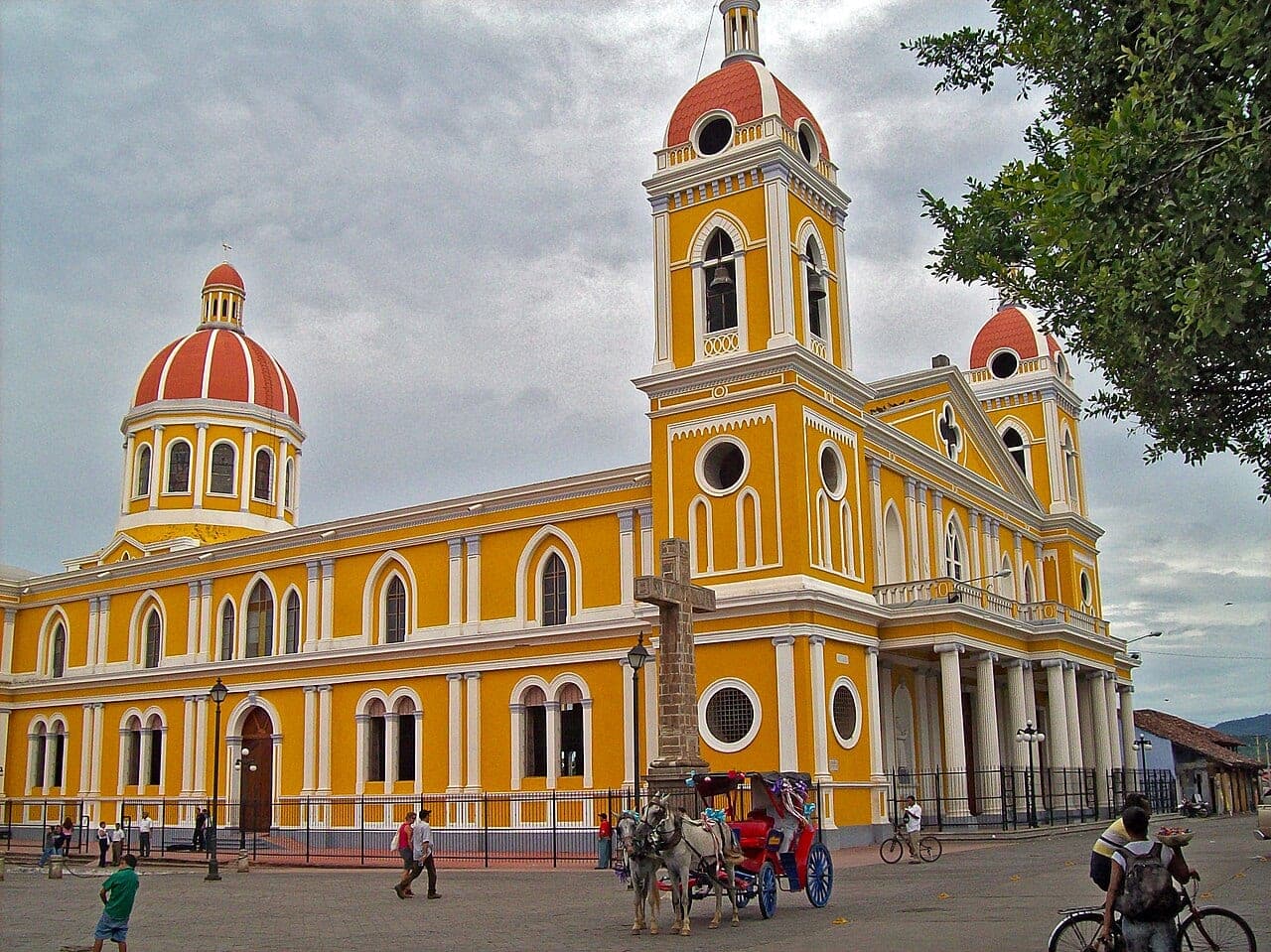
Granada. Founded in 1524 on the shore of Lake Cocibolca, Granada is often called one of the oldest continuously inhabited European-founded cities on the American mainland. Its grid of pastel houses, arcaded courtyards and yellow neoclassical cathedral looks out over the lake and the archipelago of Las Isletas. Grown wealthy on the lake-and-river trade to the Caribbean, it was repeatedly raided by pirates and remains the country's showcase of colonial architecture.
Masaya. Between Managua and Granada, Masaya is Nicaragua's craft capital, known for the marimba and for Monimbó, an Indigenous quarter that keeps its workshops, dances and festivals. Beside the city, Masaya Volcano National Park became Nicaragua's first national park in 1979; a road climbs to the rim of the Santiago crater, whose glowing lava lake so alarmed the Spanish that a friar planted a cross above what they called the mouth of hell.
Long before the Spanish, the Pacific strip was settled by peoples who had migrated south from Mesoamerica. The Chorotega arrived first, and the Nahua-speaking Nicarao followed, bringing a language and calendar related to those of central Mexico; the shores of Cocibolca became among the most densely peopled parts of the region. Ometepe preserves their memory in more than 1,700 petroglyphs carved into its volcanic slopes. The Caribbean side developed apart, home to Miskito, Mayangna, Rama and other peoples with ties toward the sea and South America.
 Leon Viejo was abandoned after an eruption in 1610 and buried in ash, which left the earliest Spanish town plan in the Americas legible at ground level. Photograph by pr47, CC BY-SA 3.0, via Wikimedia Commons.
European contact came in 1502, when Christopher Columbus, on his fourth voyage, reached the Caribbean coast near the cape he named Cabo Gracias a Dios. The Pacific chiefdoms were entered from Panama in 1522 and 1523 by Gil González Dávila, who named the land after a local ruler, Nicarao or Nicaragua. In 1524 Francisco Hernández de Córdoba founded the country's two enduring cities, Granada and León, the latter beside Momotombo at the site now called León Viejo. That first León, a colonial town of plaza, cathedral and fort, was abandoned after eruption and earthquake in 1610 and rebuilt on safer ground, and from this beginning grew the long rivalry of conservative Granada and liberal León that shaped Nicaraguan politics for centuries.
Nicaragua declared independence from Spain in 1821, joined the Mexican Empire briefly, and then entered the United Provinces of Central America before seceding as a separate republic in 1838. Its geography made it a coveted prize: the San Juan River and Lake Cocibolca offered a near-complete water route between the Atlantic and Pacific, used during the California gold rush and long studied as a possible interoceanic canal. In the mid-1850s the American adventurer William Walker exploited the León and Granada feud, seized power and briefly declared himself president before being driven out and executed in 1860. The twentieth century brought the long rule of the Somoza family, a revolution led by the Sandinista movement in 1979, and an armed conflict involving Contra insurgents through the 1980s. These events are recent and disputed, and this profile records them only as chronology, taking no side. The modern republic emerged from a peace process and elections at the end of that decade.
The name Nicaragua is usually traced to Gil González Dávila's meeting with the Nahua ruler the Spanish called Nicarao, joined by some accounts to the Spanish word agua, "water", a fitting ending for a land of lakes; other readings look instead to a Nahuatl phrase describing the country's position. Either way, the name marks the meeting of an Indigenous world with the Spanish tongue that came to dominate it.
Spanish is spoken by almost the whole population and gives Nicaraguan speech its own character, including the widespread use of vos in place of tú. But the country is legally multilingual. On the Caribbean coast, Miskito is the most widely spoken Indigenous language, while Mayangna (Sumu) survives in the interior forests and Rama has been reduced to a few elderly speakers now supported by revival efforts. Communities there also speak Nicaraguan Creole English, a legacy of the coast's links to the British Caribbean, and Garifuna. The 1987 Autonomy Statute recognised these languages within the two Caribbean autonomous regions, giving them a place in schooling and public life.
Nicaragua is proud to call itself a nation of poets, and the source of that pride is Rubén Darío. Born in 1867 in the town of Metapa, since renamed Ciudad Darío in his honour, he published Azul in 1888 and went on to lead modernismo, the movement that renewed Spanish-language verse on both sides of the Atlantic. Later admirers called him the Prince of Spanish Letters, and his influence on the poets who followed is hard to overstate.
The marimba, a wooden xylophone played especially in Masaya, gives the sound of festivals and courtship dances such as the baile de las inditas. The country's signal contribution to world theatre is El Güegüense, a masked drama first written down in the eighteenth century that mixes Spanish and Nahuatl and mocks colonial authority through the wiles of a clever old trader. Performed each January around the feast of San Sebastián in Diriamba, it was proclaimed by UNESCO in 2005 and later inscribed on the Representative List of Intangible Cultural Heritage. At the table, Nicaragua is defined by gallo pinto, the everyday dish of rice and beans fried together, joined by the nacatamal wrapped in plantain leaf, the vigorón of yuca and pork crackling, and quesillo, a soft cheese rolled in a tortilla.
Nicaragua is a mainly Christian country. Roman Catholicism, brought by the Spanish and long the majority faith, is now shared with a large and growing number of evangelical and Pentecostal Protestants, while the Caribbean coast keeps a strong Moravian tradition dating to nineteenth-century missions. Catholic practice here is deeply folk-inflected, wound around patron-saint fiestas and home devotion as much as the formal liturgy.
The most Nicaraguan of these devotions is La Purísima, a nine-day novena in honour of the Immaculate Conception of the Virgin Mary, the country's patron. Households and churches build elaborate altars to the Virgin through late November and early December, and the observance culminates on the night of 7 December in La Gritería, "the shouting". The custom, which began in León in 1857, turns on a call and response: a leader cries "¿Quién causa tanta alegría?", "Who causes so much joy?", and the crowd answers "¡La Concepción de María!". Families throw open their homes, sing to the Virgin and hand out sweets and small gifts to the crowds who move from altar to altar, binding faith tightly to neighbourhood and family.
Nicaraguan mourning follows the wider Catholic pattern of the region. When someone dies, family and neighbours gather for the velorio, a wake often held through the night at home with coffee, prayer and shared memory before a prompt burial. The days that follow bring the novenario or rezos, nine consecutive evenings of the rosary prayed in the house of the deceased, during which the household is not left alone; a further Mass commonly marks the first anniversary of the death, and these rhythms give grief a shared shape and keep the bereaved surrounded by kin.
Collective remembrance centres on the Day of the Dead. On 2 November, El Día de los Difuntos, Nicaraguan families go to the cemeteries to tend the graves of their dead, cleaning, repainting and adorning the tombs and laying fresh flowers, and many stay for hours or through the night. The day is quieter and more devotional than the costumed festivals of Mexico, but it rests on the same conviction: that the dead remain part of the family and are owed a visit. Set against these hushed November cemeteries, La Purísima and La Gritería are the year's great gathering of the living around a shared devotion, bracketing the Nicaraguan year with remembrance each December.
Nicaragua has two family histories that were written in different languages by different empires.
The Pacific side is Spanish. Catholic parish registers begin in the sixteenth century in León and Granada, civil registration dates from 1879, and the colonial material sits in Managua and in Seville. The 1972 earthquake destroyed much of central Managua, including archives, and the 1979 revolution and the war that followed displaced records and people.
The Caribbean side is British and then autonomous. The Mosquito Coast was a British protectorate, with a Miskito monarchy recognised by Britain, and the Moravian Church arrived in 1849 and has been the dominant institution there ever since. Moravian registers are the vital records for Miskito, Creole, Mayangna and Rama families, kept in Bluefields and Puerto Cabezas, and the Moravian archives in Bethlehem, Pennsylvania and Herrnhut hold copies and correspondence. The region was incorporated into Nicaragua in 1894 and has had autonomous status since 1987.
That autonomy statute gave the coastal peoples title to communal land, and demarcating it required documenting who belonged to which community, so the territorial titling process of the 2000s produced a genealogical record where none had existed.
The Sandinista period and the Contra war displaced tens of thousands, particularly Miskito communities forcibly relocated in the early 1980s, and their return and land claims are documented in the same files.
Nicaragua's two World Heritage inscriptions are both colonial and both centred on León. The Ruins of León Viejo, excavated in the twentieth century after long burial, were inscribed in 2000 as an exceptionally well-preserved early Spanish settlement whose original layout survives almost untouched. The Cathedral of León, inscribed in 2011, was recognised for its scale, its blend of baroque and neoclassical form, and the religious art it holds, among it Darío's tomb.
National stewardship runs through the Instituto Nicaragüense de Cultura, the state body responsible for museums, monuments and archaeology, together with the national museum in Managua's Palacio Nacional. The Convento de San Francisco museum in Granada preserves the basalt statues carved by the peoples of Zapatera island; the museums of Ometepe hold the island's ceramics and petroglyph record; and León and Ciudad Darío both keep house museums devoted to the poet. Conservation faces real pressures, from earthquakes and volcanic activity to limited funding, and much of the Indigenous and Caribbean heritage lives less in institutions than in community practice.
Nicaragua's digital heritage is at an earlier stage than that of larger neighbours, but the foundations are being laid. UNESCO's portals carry full documentation of the country's World Heritage and intangible-heritage listings, including video of El Güegüense, and the complete text of Rubén Darío's poetry circulates freely through digital libraries such as the Biblioteca Virtual Miguel de Cervantes. As connectivity spreads, the next task is the systematic digitisation of the national museum and archive collections that at present exist mainly on site.
Darío's legacy made Nicaragua a country that takes its writers seriously, and the twentieth century produced a notable line of them: the poet and priest Ernesto Cardenal; the poet and novelist Gioconda Belli; and Sergio Ramírez, who received the Cervantes Prize, Spanish literature's highest honour, in 2017. Their books keep Nicaraguan writing in the conversation Darío first opened.
Beyond letters, Nicaraguan culture travels with its people. Baseball is the national sport, and Nicaraguan players have reached the major leagues. The marimba and gallo pinto follow the large Nicaraguan communities in the United States and Costa Rica, where La Purísima altars now rise each December far from León, while on the Caribbean coast the May Day Palo de Mayo festival keeps Afro-Caribbean music at the centre of Creole identity. In all of these an old habit persists: the impulse to gather and remember together.
A buried city recovered and recognised. The Ruins of León Viejo, lost for centuries beneath volcanic debris, were excavated and inscribed by UNESCO in 2000, returning to Nicaragua a nearly intact plan of one of the first Spanish towns on the mainland.
A colonial cathedral joins the World Heritage List. The recognition of León's Basílica de la Asunción in 2011 secured international standing for the largest church in Central America and for the tomb of Rubén Darío it shelters.
A folk drama saved as living heritage. El Güegüense, once at risk of fading into a local curiosity, was inscribed by UNESCO in 2005, and its yearly performance in Diriamba keeps a three-hundred-year-old satire alive.
A devotion that unites a nation. From its beginning in León in 1857, La Gritería has grown into the country's most widely shared celebration, bringing whole towns into the streets each December.
Leon Viejo was abandoned after an eruption in 1610 and buried in ash, which left the earliest Spanish town plan in the Americas legible at ground level. Photograph by pr47, CC BY-SA 3.0, via Wikimedia Commons.
European contact came in 1502, when Christopher Columbus, on his fourth voyage, reached the Caribbean coast near the cape he named Cabo Gracias a Dios. The Pacific chiefdoms were entered from Panama in 1522 and 1523 by Gil González Dávila, who named the land after a local ruler, Nicarao or Nicaragua. In 1524 Francisco Hernández de Córdoba founded the country's two enduring cities, Granada and León, the latter beside Momotombo at the site now called León Viejo. That first León, a colonial town of plaza, cathedral and fort, was abandoned after eruption and earthquake in 1610 and rebuilt on safer ground, and from this beginning grew the long rivalry of conservative Granada and liberal León that shaped Nicaraguan politics for centuries.
Nicaragua declared independence from Spain in 1821, joined the Mexican Empire briefly, and then entered the United Provinces of Central America before seceding as a separate republic in 1838. Its geography made it a coveted prize: the San Juan River and Lake Cocibolca offered a near-complete water route between the Atlantic and Pacific, used during the California gold rush and long studied as a possible interoceanic canal. In the mid-1850s the American adventurer William Walker exploited the León and Granada feud, seized power and briefly declared himself president before being driven out and executed in 1860. The twentieth century brought the long rule of the Somoza family, a revolution led by the Sandinista movement in 1979, and an armed conflict involving Contra insurgents through the 1980s. These events are recent and disputed, and this profile records them only as chronology, taking no side. The modern republic emerged from a peace process and elections at the end of that decade.
The name Nicaragua is usually traced to Gil González Dávila's meeting with the Nahua ruler the Spanish called Nicarao, joined by some accounts to the Spanish word agua, "water", a fitting ending for a land of lakes; other readings look instead to a Nahuatl phrase describing the country's position. Either way, the name marks the meeting of an Indigenous world with the Spanish tongue that came to dominate it.
Spanish is spoken by almost the whole population and gives Nicaraguan speech its own character, including the widespread use of vos in place of tú. But the country is legally multilingual. On the Caribbean coast, Miskito is the most widely spoken Indigenous language, while Mayangna (Sumu) survives in the interior forests and Rama has been reduced to a few elderly speakers now supported by revival efforts. Communities there also speak Nicaraguan Creole English, a legacy of the coast's links to the British Caribbean, and Garifuna. The 1987 Autonomy Statute recognised these languages within the two Caribbean autonomous regions, giving them a place in schooling and public life.
Nicaragua is proud to call itself a nation of poets, and the source of that pride is Rubén Darío. Born in 1867 in the town of Metapa, since renamed Ciudad Darío in his honour, he published Azul in 1888 and went on to lead modernismo, the movement that renewed Spanish-language verse on both sides of the Atlantic. Later admirers called him the Prince of Spanish Letters, and his influence on the poets who followed is hard to overstate.
The marimba, a wooden xylophone played especially in Masaya, gives the sound of festivals and courtship dances such as the baile de las inditas. The country's signal contribution to world theatre is El Güegüense, a masked drama first written down in the eighteenth century that mixes Spanish and Nahuatl and mocks colonial authority through the wiles of a clever old trader. Performed each January around the feast of San Sebastián in Diriamba, it was proclaimed by UNESCO in 2005 and later inscribed on the Representative List of Intangible Cultural Heritage. At the table, Nicaragua is defined by gallo pinto, the everyday dish of rice and beans fried together, joined by the nacatamal wrapped in plantain leaf, the vigorón of yuca and pork crackling, and quesillo, a soft cheese rolled in a tortilla.
Nicaragua is a mainly Christian country. Roman Catholicism, brought by the Spanish and long the majority faith, is now shared with a large and growing number of evangelical and Pentecostal Protestants, while the Caribbean coast keeps a strong Moravian tradition dating to nineteenth-century missions. Catholic practice here is deeply folk-inflected, wound around patron-saint fiestas and home devotion as much as the formal liturgy.
The most Nicaraguan of these devotions is La Purísima, a nine-day novena in honour of the Immaculate Conception of the Virgin Mary, the country's patron. Households and churches build elaborate altars to the Virgin through late November and early December, and the observance culminates on the night of 7 December in La Gritería, "the shouting". The custom, which began in León in 1857, turns on a call and response: a leader cries "¿Quién causa tanta alegría?", "Who causes so much joy?", and the crowd answers "¡La Concepción de María!". Families throw open their homes, sing to the Virgin and hand out sweets and small gifts to the crowds who move from altar to altar, binding faith tightly to neighbourhood and family.
Nicaraguan mourning follows the wider Catholic pattern of the region. When someone dies, family and neighbours gather for the velorio, a wake often held through the night at home with coffee, prayer and shared memory before a prompt burial. The days that follow bring the novenario or rezos, nine consecutive evenings of the rosary prayed in the house of the deceased, during which the household is not left alone; a further Mass commonly marks the first anniversary of the death, and these rhythms give grief a shared shape and keep the bereaved surrounded by kin.
Collective remembrance centres on the Day of the Dead. On 2 November, El Día de los Difuntos, Nicaraguan families go to the cemeteries to tend the graves of their dead, cleaning, repainting and adorning the tombs and laying fresh flowers, and many stay for hours or through the night. The day is quieter and more devotional than the costumed festivals of Mexico, but it rests on the same conviction: that the dead remain part of the family and are owed a visit. Set against these hushed November cemeteries, La Purísima and La Gritería are the year's great gathering of the living around a shared devotion, bracketing the Nicaraguan year with remembrance each December.
Nicaragua has two family histories that were written in different languages by different empires.
The Pacific side is Spanish. Catholic parish registers begin in the sixteenth century in León and Granada, civil registration dates from 1879, and the colonial material sits in Managua and in Seville. The 1972 earthquake destroyed much of central Managua, including archives, and the 1979 revolution and the war that followed displaced records and people.
The Caribbean side is British and then autonomous. The Mosquito Coast was a British protectorate, with a Miskito monarchy recognised by Britain, and the Moravian Church arrived in 1849 and has been the dominant institution there ever since. Moravian registers are the vital records for Miskito, Creole, Mayangna and Rama families, kept in Bluefields and Puerto Cabezas, and the Moravian archives in Bethlehem, Pennsylvania and Herrnhut hold copies and correspondence. The region was incorporated into Nicaragua in 1894 and has had autonomous status since 1987.
That autonomy statute gave the coastal peoples title to communal land, and demarcating it required documenting who belonged to which community, so the territorial titling process of the 2000s produced a genealogical record where none had existed.
The Sandinista period and the Contra war displaced tens of thousands, particularly Miskito communities forcibly relocated in the early 1980s, and their return and land claims are documented in the same files.
Nicaragua's two World Heritage inscriptions are both colonial and both centred on León. The Ruins of León Viejo, excavated in the twentieth century after long burial, were inscribed in 2000 as an exceptionally well-preserved early Spanish settlement whose original layout survives almost untouched. The Cathedral of León, inscribed in 2011, was recognised for its scale, its blend of baroque and neoclassical form, and the religious art it holds, among it Darío's tomb.
National stewardship runs through the Instituto Nicaragüense de Cultura, the state body responsible for museums, monuments and archaeology, together with the national museum in Managua's Palacio Nacional. The Convento de San Francisco museum in Granada preserves the basalt statues carved by the peoples of Zapatera island; the museums of Ometepe hold the island's ceramics and petroglyph record; and León and Ciudad Darío both keep house museums devoted to the poet. Conservation faces real pressures, from earthquakes and volcanic activity to limited funding, and much of the Indigenous and Caribbean heritage lives less in institutions than in community practice.
Nicaragua's digital heritage is at an earlier stage than that of larger neighbours, but the foundations are being laid. UNESCO's portals carry full documentation of the country's World Heritage and intangible-heritage listings, including video of El Güegüense, and the complete text of Rubén Darío's poetry circulates freely through digital libraries such as the Biblioteca Virtual Miguel de Cervantes. As connectivity spreads, the next task is the systematic digitisation of the national museum and archive collections that at present exist mainly on site.
Darío's legacy made Nicaragua a country that takes its writers seriously, and the twentieth century produced a notable line of them: the poet and priest Ernesto Cardenal; the poet and novelist Gioconda Belli; and Sergio Ramírez, who received the Cervantes Prize, Spanish literature's highest honour, in 2017. Their books keep Nicaraguan writing in the conversation Darío first opened.
Beyond letters, Nicaraguan culture travels with its people. Baseball is the national sport, and Nicaraguan players have reached the major leagues. The marimba and gallo pinto follow the large Nicaraguan communities in the United States and Costa Rica, where La Purísima altars now rise each December far from León, while on the Caribbean coast the May Day Palo de Mayo festival keeps Afro-Caribbean music at the centre of Creole identity. In all of these an old habit persists: the impulse to gather and remember together.
A buried city recovered and recognised. The Ruins of León Viejo, lost for centuries beneath volcanic debris, were excavated and inscribed by UNESCO in 2000, returning to Nicaragua a nearly intact plan of one of the first Spanish towns on the mainland.
A colonial cathedral joins the World Heritage List. The recognition of León's Basílica de la Asunción in 2011 secured international standing for the largest church in Central America and for the tomb of Rubén Darío it shelters.
A folk drama saved as living heritage. El Güegüense, once at risk of fading into a local curiosity, was inscribed by UNESCO in 2005, and its yearly performance in Diriamba keeps a three-hundred-year-old satire alive.
A devotion that unites a nation. From its beginning in León in 1857, La Gritería has grown into the country's most widely shared celebration, bringing whole towns into the streets each December.
National Overview
Notable Cities
Historical Foundations
Linguistic and Etymological Roots
Cultural Identity
Religion and Spirituality
Remembrance and Mourning Traditions
Tracing a Family in Nicaragua
Heritage Preservation Efforts
Digital Heritage
Contemporary Cultural Influences
Success Stories
References and resources
- UNESCO World Heritage Centre: Ruins of León Viejo. Inscribed 2000.
- UNESCO World Heritage Centre: León Cathedral. Inscribed 2011.
- UNESCO Intangible Cultural Heritage: El Güegüense. The folk drama of Diriamba.
- Encyclopaedia Britannica: Nicaragua. Geography and history.
- Encyclopaedia Britannica: Rubén Darío. The poet and modernismo.
- Encyclopaedia Britannica: Lake Nicaragua. The lake and its wildlife.
- Wikipedia: Masaya Volcano. Volcano and national park.
- Quixote Center: La Purísima, A Nicaraguan Celebration. La Purísima and La Gritería.
- The Culture Trip: Nicaragua's Day of the Dead. Observances on 2 November.