Heritage · Country
Vanuatu Culture and Heritage
Vanuatu joins the world's densest linguistic diversity with sand drawing, land diving and a fieldworker network that has become a global model for indigenous preservation. A guide to kastom and to how ni-Vanuatu keep faith with their dead.Written to last.
By Confinity Heritage Editorial · 2026-07-10 · 8-minute readQuiet tools, kept out of the way.
Few countries hold as much culture in as little space as Vanuatu. Across its Y-shaped chain of some eighty islands live a little over 300,000 people speaking 138 indigenous languages, the highest linguistic density per capita on earth. On Pentecost, men dive from wooden towers with vines tied to their ankles to bless the yam harvest; on Ambrym, masked Rom dancers embody spirits during grade-taking rites; and across the northern and central islands, elders trace intricate geometric patterns in sand with a single unbroken line, a UNESCO-recognised writing of stories, maps and messages that crosses language boundaries.
The word that binds all of this together is kastom: the body of traditional knowledge, law, ceremony and obligation that ni-Vanuatu inherit from their ancestors and adapt to the present. Kastom has proved remarkably good at defending itself. The Vanuatu Cultural Centre's network of volunteer fieldworkers, the filwoka, has documented and revitalised island traditions for half a century and is studied worldwide as a model of indigenous-led preservation. And in July 2025, an idea born among Pacific law students in Port Vila became a unanimous advisory opinion of the International Court of Justice on states' climate obligations, a modern chapter in a very old story: the defence of the land, the vanua, from which the country takes its name.
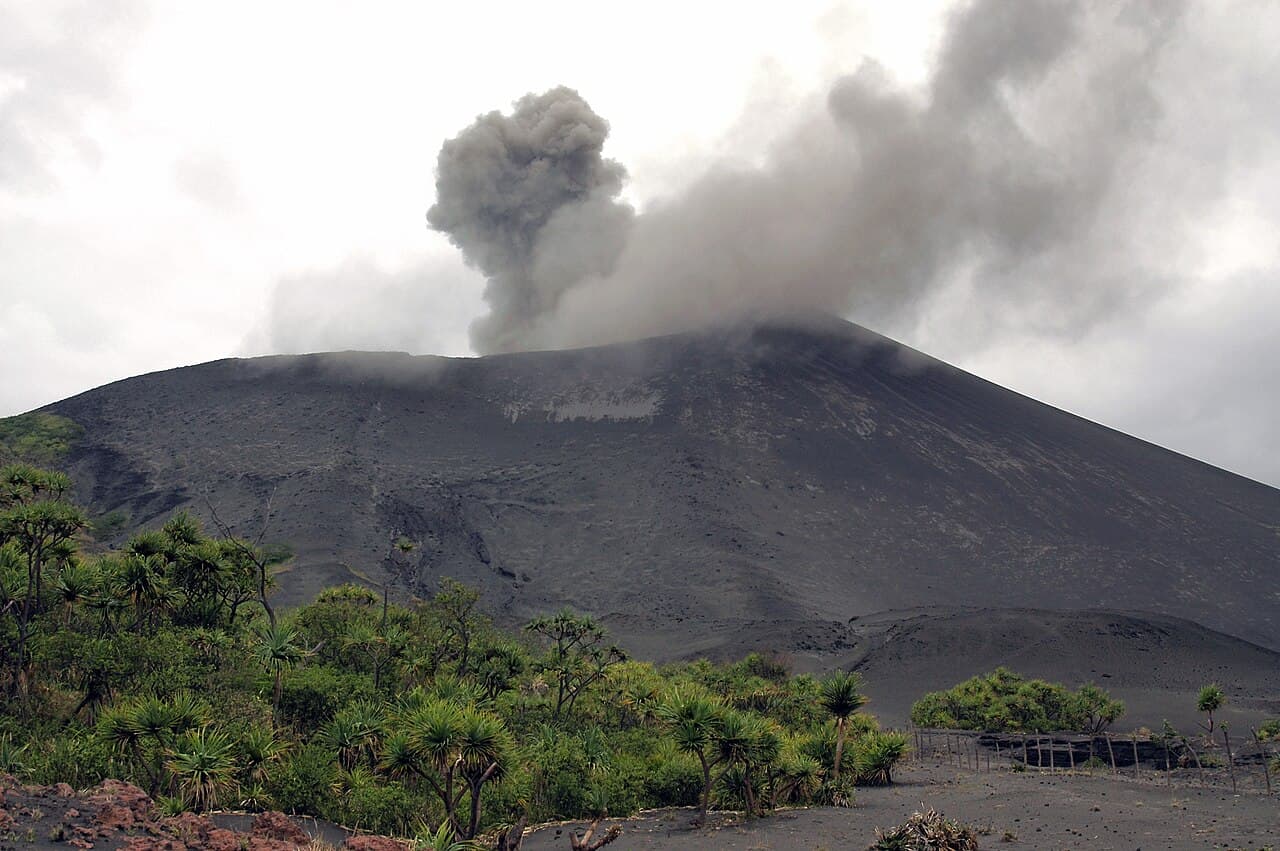
Vanuatu lies in the south-western Pacific, east of Australia, north-east of New Caledonia and west of Fiji. Its roughly eighty-three islands, of which about sixty-five are inhabited, stretch some 1,300 kilometres from the Torres and Banks groups in the north to Aneityum in the south. The archipelago is volcanic and restless: Mount Yasur on Tanna, glowing so reliably that Captain Cook used it as a beacon, is among the most accessible active volcanoes in the world, and the twin craters of Ambrym feed one of the planet's most persistent lava-lake systems. The same geology brings hazard. Cyclone Pam devastated the country in March 2015, twin cyclones struck within days of each other in 2023, and a strong earthquake hit Port Vila in December 2024.
The population is overwhelmingly Melanesian, the people calling themselves ni-Vanuatu, with small communities of other Pacific islanders, Europeans and Asians concentrated in the two towns, Port Vila on Efate and Luganville on Espiritu Santo. Most ni-Vanuatu live in villages and work the land, growing yams, taro and bananas and producing copra, kava and cocoa for sale. The national currency is the vatu, and the flag carries the country's self-image in miniature: a curved boar's tusk, the ancient symbol of wealth and rank, enclosing two crossed leaves of the namele cycad, the plant of peace and taboo. Chiefs retain a constitutional voice through the Malvatumauri National Council of Chiefs, which advises Parliament on matters of custom and language.
Port Vila. The capital, set around a deep natural harbour on Efate's south-west coast, is where Vanuatu's traditions and institutions meet. It is home to the Vanuatu Cultural Centre and National Museum, whose displays of slit drums, tree-fern figures and outrigger canoes are enlivened by daily sand-drawing demonstrations, and to the Malvatumauri's ceremonial nakamal. The town's markets, where women from across Efate sell island produce under one roof, are as much a cultural institution as any museum. Port Vila took the brunt of Cyclone Pam in 2015 and of the December 2024 earthquake, and its repeated rebuilding has become part of its character.
Luganville. Vanuatu's second town, on Espiritu Santo, is a child of the Second World War: the United States built one of the Pacific's largest forward bases here, and hundreds of thousands of service personnel passed through. The war left extraordinary heritage underwater, including the SS President Coolidge, a converted luxury liner sunk by mines in 1942 and now one of the world's great wreck dives, and Million Dollar Point, where the departing military dumped equipment into the sea in 1945. Luganville is also home to the Leweton cultural village, where families from Gaua and Merelava perform the mesmerising women's water music of the Banks Islands.
Lenakel and Isangel. The main settlement and the provincial capital of Tanna sit on the island's west coast, gateway to Yasur volcano, to strong kastom villages such as Yakel, and to the John Frum communities of the island's east.
Lakatoro. The administrative centre of Malampa province on Malakula, an island regarded as one of the most culturally and linguistically diverse places on earth, home of the Big Nambas and Small Nambas peoples and of some of the Pacific's most powerful funerary art traditions.
People of the Lapita culture, the great seafaring ancestors of much of the remote Pacific, reached Vanuatu a little over three thousand years ago. Their most eloquent remains were found in 2004 at Teouma, near Port Vila: one of the oldest cemeteries in the Pacific, whose careful burials, with skulls removed and repositioned according to mortuary custom, show that the elaborate care of the dead has been part of life on these islands from the very beginning. Over the following millennia, successive movements of people produced the archipelago's extraordinary cultural mosaic. Oral tradition remembers the paramount chief Roi Mata, who united the warring peoples of central Vanuatu around the start of the seventeenth century; when the French archaeologist José Garanger followed the oral accounts in 1967, he uncovered Roi Mata's mass burial on the island of Artok exactly where tradition placed it, a landmark vindication of Pacific oral history.
The Spanish navigator Pedro Fernández de Quirós sighted Espiritu Santo in 1606, and Captain James Cook charted the islands in 1774, naming them the New Hebrides. The nineteenth century brought sandalwood traders, missionaries and the labour trade known as blackbirding, which carried tens of thousands of ni-Vanuatu, by recruitment and by kidnap, to the plantations of Queensland and Fiji. In 1906 Britain and France established a joint Condominium, a cumbersome dual administration with two police forces, two currencies and two school systems that residents nicknamed the Pandemonium. The Second World War transformed the islands again, as American bases on Efate and Santo brought sudden wealth and new ideas. From the 1960s, disputes over land alienated to European planters fed a national movement; land, the vanua, became the rallying cause of independence. After a turbulent transition that included a brief secessionist rebellion on Santo, the Republic of Vanuatu was born on 30 July 1980, with the Anglican priest Father Walter Lini as its first prime minister and a constitution that vested all land in its customary owners.
The country's name was chosen at independence and is itself a statement of kastom: it joins vanua, land or home, with tu, to stand, and is usually rendered as "our land eternal" or "the land that stands". Replacing the colonial "New Hebrides" with an indigenous name declared that the new state belonged to its first peoples.
Vanuatu's 138 indigenous languages, all Oceanic members of the Austronesian family, give it the densest linguistic landscape per capita in the world, averaging fewer than two thousand speakers per language; linguists have counted dozens of languages on Malakula alone. Bridging them is Bislama, an English-based creole whose name derives from the bêche-de-mer trade and whose grammar carries the memory of the plantation labour lines on which it formed. Bislama is the national language and the everyday lingua franca, sharing official status with English and French, the twin inheritances of the Condominium's rival school systems. Many of the smaller vernaculars are endangered, and their documentation is a national priority, because in Vanuatu a language is never only a language: each one anchors its own songs, genealogies, place names and ritual knowledge. Sand drawing itself functions as a kind of shared graphic language, its patterns readable across communities that cannot understand one another's speech.
Kastom is the organising idea of ni-Vanuatu identity: the inherited ways of doing things, from land tenure and dispute settlement to dance, carving and ceremony, understood as a living inheritance rather than a museum piece. Its social heart is the nakamal, the meeting house or cleared ceremonial ground where men traditionally gather at dusk to drink kava, debate and settle affairs. Vanuatu is regarded as the homeland of kava, and the shells of the peppery root drunk quietly at nightfall remain the country's great social ritual, in villages and urban kava bars alike.
Rank and achievement are central. In the graded societies of the northern and central islands, men (and in some places women) rise through named grades by accumulating and ceremonially killing tusked pigs and by hosting feasts; each grade-taking brings new titles, insignia and obligations. The boar's curved tusk, produced by years of careful husbandry, is the supreme symbol of this wealth and stands at the centre of the national flag. The great spectacle traditions belong to this world of ceremony: the Rom dance of Ambrym, in which towering masked figures embody spirits during grade rituals, and the Nagol or land diving of south Pentecost, performed between April and June around the yam harvest, when men leap head-first from towers twenty metres and more in height, their fall broken only by liana vines lashed to their ankles, an act of courage, purification and blessing that later inspired the invention of bungee jumping.
Sand drawing, inscribed by UNESCO on the Representative List of the Intangible Cultural Heritage of Humanity in 2008 after its proclamation as a Masterpiece in 2003, is practised across some eighty language groups of northern and central Vanuatu. The drawer traces a continuous, self-crossing line over a grid in sand, ash or clay, producing a symmetrical figure that encodes a story, a ritual instruction, a map or a message. Women's arts are equally foundational: finely plaited and dyed pandanus mats and textiles serve as currency, ceremonial gifts and funerary wealth, and the women's water music of the Banks Islands turns the surface of rivers and the sea into a percussion instrument.
Christianity arrived in the nineteenth century, at times at great cost to its bearers, and is today professed by the great majority of ni-Vanuatu, with Presbyterian, Anglican, Roman Catholic and Seventh-day Adventist churches the largest among many. The national motto, "Long God yumi stanap" ("In God we stand"), and the naming of the independence-era anthem "Yumi, Yumi, Yumi" reflect a public culture in which church and kastom are interwoven rather than opposed. Most communities move easily between Sunday worship and customary ceremony, and church leaders were prominent in the independence movement.
Beneath and alongside Christianity runs the older spiritual order of kastom: a world of ancestors, place spirits and tabu, the sacred prohibition that protects sites, reefs, objects and knowledge. A namele leaf planted on a beach or garden closes it as effectively as any law. Certain knowledge, especially that of the graded societies, is restricted to initiates, and respecting those restrictions has become a principle of Vanuatu's heritage institutions. Tanna is home to two famous movements that reworked outside contact into indigenous religious forms: the John Frum movement, whose followers at Lamakara celebrate their prophesied American benefactor each 15 February, and the Yaohnanen villagers who revered Prince Philip, Duke of Edinburgh, as an ancestral figure and mourned him with customary rites when he died in 2021. Reconciliation is itself a spiritual practice: in 2009 the people of Erromango held a moving ceremony with descendants of the missionary John Williams, killed on their shore in 1839, to lift the weight of that old blood from both families.
In Vanuatu a death belongs to the whole community, and mourning is measured in days counted with great precision. News of a death brings kin from across the island and beyond; ritual wailing announces grief, and the household of the deceased fills with relatives who keep vigil, cook and receive mourners. Most funerals today centre on a church service and burial, but around that Christian core the customary economy of grief operates in full: woven pandanus mats, pigs, kava and food move between the mother's and father's lines of the deceased in exchanges that honour the dead and repair the web of relationships that each death tears.
 Roi Mata was buried on Eretoka with dozens of his retinue, and oral tradition described the grave accurately enough that excavation in the 1960s found it where people said it was. The domain was Vanuatu's first World Heritage site. Photograph via Wikimedia Commons, CC BY 2.0.
What follows the burial is a structured calendar of remembrance. Across much of northern and central Vanuatu, mourning feasts are held on counted days after a death, commonly the fifth and tenth days and at further intervals thereafter. On Ambae, anthropologists have documented small feasts every ten days until the hundredth day, when a major feast gathers the community; during those hundred days the spirit of the deceased is understood to linger near its village, and the final feast farewells it properly. A last commemorative feast may follow as much as a thousand days after death, completing the separation of the dead from the living. These "hundred days" cycles remain a familiar institution of village life, and families save and plan for them as carefully as for weddings.
Rank shapes remembrance. In the graded societies, the standing a man achieved in life was traditionally believed to accompany him into the world of the dead, so funerary art and ceremony proclaim it. The most celebrated expression comes from south Malakula, where communities historically honoured men of the highest grades by creating rambaramp, commemorative effigies incorporating the modelled and painted skull of the deceased, kept in the men's house so that the ancestor remained present among his descendants. On Ambrym, carved tree-fern figures raised at grade-takings stand afterwards as monuments to the men who commissioned them. Such practices, now largely historical and represented in museum collections, belong to the same logic as the mass burial of Chief Roi Mata, interred around 1600 with members of his retinue on the tabu island of Artok: the honoured dead anchor the social order of the living. That logic is ancient here; the three-thousand-year-old cemetery at Teouma shows the Lapita ancestors already curating the skulls of their dead with reverence and intent.
The dead remain present in gentler ways too: in the tabu places no gardener will clear, in the genealogies recited at ceremonies, in reconciliation rituals that settle the grievances of ancestors, and in the national remembrance of independence leaders each July. For ni-Vanuatu, as Confinity's own work assumes, memory is not an archive apart from life; it is a set of obligations, faithfully kept, that keeps the living and the dead in right relation.
Vanuatu built the most interesting answer to the archive problem in the Pacific, which is to train the community to be the archive.
The Vanuatu Cultural Centre runs a network of volunteer fieldworkers, ni-Vanuatu men and women who record the knowledge of their own island in their own language: genealogies, land boundaries, stories, songs, techniques. The material stays under community control, with restrictions the community sets on who may see what, and the model has been studied and copied elsewhere as an alternative to outside researchers extracting and keeping the record. For family history it means the genealogy exists, in the place it belongs to, held by someone from there.
The written record is colonial and it is doubled. The New Hebrides was run from 1906 as a condominium by Britain and France together, with two administrations, two legal systems and two sets of records, so a family may appear in French or British files depending on which residency it dealt with. Mission registers, Presbyterian, Anglican and Catholic, carry the vital events.
The hardest record to find is the labour trade. Between the 1860s and the early 1900s tens of thousands of ni-Vanuatu were taken or recruited to work the cane fields of Queensland and Fiji, and many never returned. Their names are in Australian immigration and plantation records rather than anywhere in Vanuatu, and the Australian South Sea Islander community descends from them.
The Vanuatu Cultural Centre (Vanuatu Kaljoral Senta), the national museum, archive and research institution in Port Vila, has documented the culture and cultural history of the archipelago since the early 1960s. Its distinctive instrument is the filwoka network: more than one hundred volunteer fieldworkers, men and women, spread across the islands, who record traditions, languages, genealogies and sites in their own communities, gather for annual training workshops, and lead revitalisation work at home. A dedicated women's fieldworker programme, running since the mid-1990s, ensures that women's knowledge, from textiles to birth and mourning practice, is documented by women. Sustained over five decades, the network has achieved cultural documentation at a scale and depth described by researchers as unparalleled in the Pacific, and it is studied internationally as a model of indigenous-led heritage work.
Vanuatu's Cultural Research Policy, administered by the Cultural Centre, requires outside researchers to work in partnership with communities and to return benefits and copies of their material, an early and influential assertion of indigenous control over cultural knowledge. Chief Roi Mata's Domain, inscribed in 2008 as Vanuatu's first World Heritage site, is managed jointly with the customary land-owning communities of Lelepa and Mangaliliu, whose chiefs maintain the tabu that has protected the burial island for four centuries. Following sand drawing's UNESCO recognition, the Cultural Centre has run festivals, school programmes and competitions to keep the practice strong and meaningful rather than reduced to a tourist ornament. The National Heritage Register and site survey programmes extend protection across the islands, and after each cyclone and earthquake the fieldworker network doubles as a damage-assessment and cultural-recovery service.
The Cultural Centre's tape archive, with recordings of songs, stories and ceremonies in scores of languages reaching back to the early 1960s, is among the Pacific's most precious sound collections, and digitisation has become a race against the decay of magnetic media. The Pacific and Regional Archive for Digital Sources in Endangered Cultures (PARADISEC), based in Australia, has worked with the Cultural Centre's audio archive to digitise its open reels and cassettes, and a project under the Endangered Languages Documentation Programme has preserved further holdings, with access governed by the Centre's protocols so that restricted kastom knowledge remains restricted online as it is in the nakamal.
Digital return matters as much as digital storage. Copies of historical recordings, photographs and films made in Vanuatu over the past century are being repatriated to the communities they came from, often through the filwoka network, where they rekindle songs and ceremonies at the edge of memory. Vanuatu's intangible heritage is documented on international platforms such as UNESCO's intangible heritage lists and the Asia-Pacific ichLinks platform, while linguists' recordings of the country's smaller languages are archived in open repositories that ni-Vanuatu students increasingly use to study their own inheritance.
Vanuatu's traditions travel well. Tanna (2015), the first feature film shot entirely in Vanuatu, was created with the people of Yakel village, performed in the Nauvhal language and built from a true story of love and custom; it earned an Academy Award nomination for best foreign-language film, a landmark for Pacific cinema. The women's water music of the Banks Islands has toured internationally, string bands and reggae-inflected pop fill Port Vila's airwaves, and the Fest'Napuan festival, held annually in the capital since the 1990s, has grown into one of the Pacific's leading music events. Writers and thinkers such as the poet and politician Grace Mera Molisa gave the young republic a sharp literary voice, and Vanuatu's kava has become a global export, carrying nakamal culture to diaspora communities and wellness markets abroad.
The country's most consequential modern export, though, may be legal and moral. From a Port Vila classroom in 2019, law students of the University of the South Pacific launched the campaign that led Vanuatu to marshal more than 130 co-sponsoring states behind a United Nations resolution, adopted by consensus in March 2023, asking the International Court of Justice to clarify states' climate obligations. The Court's unanimous advisory opinion of 23 July 2025 vindicated Vanuatu's arguments and reshaped international climate law, an achievement rooted in the oldest of ni-Vanuatu commitments: that the land and the generations to come are owed a duty.
A preservation model the world studies. The Vanuatu Cultural Centre's filwoka network has sustained community-based documentation and revitalisation for some fifty years across most of the inhabited islands. Built on volunteers working in their own languages and villages, it has kept knowledge, authority and benefit inside the communities concerned, and is cited internationally as perhaps the most successful indigenous cultural programme of its kind.
Oral tradition vindicated at Roi Mata's grave. Guided by chiefly oral accounts, archaeology confirmed the burial of the seventeenth-century paramount chief Roi Mata exactly where tradition placed it, and in 2008 Chief Roi Mata's Domain became Vanuatu's first World Heritage site, inscribed on the strength of a living oral tradition and managed by the customary owners themselves.
Sand drawing recognised and renewed. Proclaimed a Masterpiece of the Oral and Intangible Heritage of Humanity in 2003 and inscribed on UNESCO's Representative List in 2008, Vanuatu's sand drawing has been carried from ceremonial grounds into schools, festivals and the national imagination, a fragile one-line art now consciously taught to new generations.
From a classroom to the world court. The student-launched campaign that became the ICJ climate advisory opinion of July 2025 showed a nation of 300,000 people moving international law. Every argument Vanuatu advanced was unanimously endorsed by the Court, in the first climate referral ever adopted by consensus of the UN General Assembly.
Roi Mata was buried on Eretoka with dozens of his retinue, and oral tradition described the grave accurately enough that excavation in the 1960s found it where people said it was. The domain was Vanuatu's first World Heritage site. Photograph via Wikimedia Commons, CC BY 2.0.
What follows the burial is a structured calendar of remembrance. Across much of northern and central Vanuatu, mourning feasts are held on counted days after a death, commonly the fifth and tenth days and at further intervals thereafter. On Ambae, anthropologists have documented small feasts every ten days until the hundredth day, when a major feast gathers the community; during those hundred days the spirit of the deceased is understood to linger near its village, and the final feast farewells it properly. A last commemorative feast may follow as much as a thousand days after death, completing the separation of the dead from the living. These "hundred days" cycles remain a familiar institution of village life, and families save and plan for them as carefully as for weddings.
Rank shapes remembrance. In the graded societies, the standing a man achieved in life was traditionally believed to accompany him into the world of the dead, so funerary art and ceremony proclaim it. The most celebrated expression comes from south Malakula, where communities historically honoured men of the highest grades by creating rambaramp, commemorative effigies incorporating the modelled and painted skull of the deceased, kept in the men's house so that the ancestor remained present among his descendants. On Ambrym, carved tree-fern figures raised at grade-takings stand afterwards as monuments to the men who commissioned them. Such practices, now largely historical and represented in museum collections, belong to the same logic as the mass burial of Chief Roi Mata, interred around 1600 with members of his retinue on the tabu island of Artok: the honoured dead anchor the social order of the living. That logic is ancient here; the three-thousand-year-old cemetery at Teouma shows the Lapita ancestors already curating the skulls of their dead with reverence and intent.
The dead remain present in gentler ways too: in the tabu places no gardener will clear, in the genealogies recited at ceremonies, in reconciliation rituals that settle the grievances of ancestors, and in the national remembrance of independence leaders each July. For ni-Vanuatu, as Confinity's own work assumes, memory is not an archive apart from life; it is a set of obligations, faithfully kept, that keeps the living and the dead in right relation.
Vanuatu built the most interesting answer to the archive problem in the Pacific, which is to train the community to be the archive.
The Vanuatu Cultural Centre runs a network of volunteer fieldworkers, ni-Vanuatu men and women who record the knowledge of their own island in their own language: genealogies, land boundaries, stories, songs, techniques. The material stays under community control, with restrictions the community sets on who may see what, and the model has been studied and copied elsewhere as an alternative to outside researchers extracting and keeping the record. For family history it means the genealogy exists, in the place it belongs to, held by someone from there.
The written record is colonial and it is doubled. The New Hebrides was run from 1906 as a condominium by Britain and France together, with two administrations, two legal systems and two sets of records, so a family may appear in French or British files depending on which residency it dealt with. Mission registers, Presbyterian, Anglican and Catholic, carry the vital events.
The hardest record to find is the labour trade. Between the 1860s and the early 1900s tens of thousands of ni-Vanuatu were taken or recruited to work the cane fields of Queensland and Fiji, and many never returned. Their names are in Australian immigration and plantation records rather than anywhere in Vanuatu, and the Australian South Sea Islander community descends from them.
The Vanuatu Cultural Centre (Vanuatu Kaljoral Senta), the national museum, archive and research institution in Port Vila, has documented the culture and cultural history of the archipelago since the early 1960s. Its distinctive instrument is the filwoka network: more than one hundred volunteer fieldworkers, men and women, spread across the islands, who record traditions, languages, genealogies and sites in their own communities, gather for annual training workshops, and lead revitalisation work at home. A dedicated women's fieldworker programme, running since the mid-1990s, ensures that women's knowledge, from textiles to birth and mourning practice, is documented by women. Sustained over five decades, the network has achieved cultural documentation at a scale and depth described by researchers as unparalleled in the Pacific, and it is studied internationally as a model of indigenous-led heritage work.
Vanuatu's Cultural Research Policy, administered by the Cultural Centre, requires outside researchers to work in partnership with communities and to return benefits and copies of their material, an early and influential assertion of indigenous control over cultural knowledge. Chief Roi Mata's Domain, inscribed in 2008 as Vanuatu's first World Heritage site, is managed jointly with the customary land-owning communities of Lelepa and Mangaliliu, whose chiefs maintain the tabu that has protected the burial island for four centuries. Following sand drawing's UNESCO recognition, the Cultural Centre has run festivals, school programmes and competitions to keep the practice strong and meaningful rather than reduced to a tourist ornament. The National Heritage Register and site survey programmes extend protection across the islands, and after each cyclone and earthquake the fieldworker network doubles as a damage-assessment and cultural-recovery service.
The Cultural Centre's tape archive, with recordings of songs, stories and ceremonies in scores of languages reaching back to the early 1960s, is among the Pacific's most precious sound collections, and digitisation has become a race against the decay of magnetic media. The Pacific and Regional Archive for Digital Sources in Endangered Cultures (PARADISEC), based in Australia, has worked with the Cultural Centre's audio archive to digitise its open reels and cassettes, and a project under the Endangered Languages Documentation Programme has preserved further holdings, with access governed by the Centre's protocols so that restricted kastom knowledge remains restricted online as it is in the nakamal.
Digital return matters as much as digital storage. Copies of historical recordings, photographs and films made in Vanuatu over the past century are being repatriated to the communities they came from, often through the filwoka network, where they rekindle songs and ceremonies at the edge of memory. Vanuatu's intangible heritage is documented on international platforms such as UNESCO's intangible heritage lists and the Asia-Pacific ichLinks platform, while linguists' recordings of the country's smaller languages are archived in open repositories that ni-Vanuatu students increasingly use to study their own inheritance.
Vanuatu's traditions travel well. Tanna (2015), the first feature film shot entirely in Vanuatu, was created with the people of Yakel village, performed in the Nauvhal language and built from a true story of love and custom; it earned an Academy Award nomination for best foreign-language film, a landmark for Pacific cinema. The women's water music of the Banks Islands has toured internationally, string bands and reggae-inflected pop fill Port Vila's airwaves, and the Fest'Napuan festival, held annually in the capital since the 1990s, has grown into one of the Pacific's leading music events. Writers and thinkers such as the poet and politician Grace Mera Molisa gave the young republic a sharp literary voice, and Vanuatu's kava has become a global export, carrying nakamal culture to diaspora communities and wellness markets abroad.
The country's most consequential modern export, though, may be legal and moral. From a Port Vila classroom in 2019, law students of the University of the South Pacific launched the campaign that led Vanuatu to marshal more than 130 co-sponsoring states behind a United Nations resolution, adopted by consensus in March 2023, asking the International Court of Justice to clarify states' climate obligations. The Court's unanimous advisory opinion of 23 July 2025 vindicated Vanuatu's arguments and reshaped international climate law, an achievement rooted in the oldest of ni-Vanuatu commitments: that the land and the generations to come are owed a duty.
A preservation model the world studies. The Vanuatu Cultural Centre's filwoka network has sustained community-based documentation and revitalisation for some fifty years across most of the inhabited islands. Built on volunteers working in their own languages and villages, it has kept knowledge, authority and benefit inside the communities concerned, and is cited internationally as perhaps the most successful indigenous cultural programme of its kind.
Oral tradition vindicated at Roi Mata's grave. Guided by chiefly oral accounts, archaeology confirmed the burial of the seventeenth-century paramount chief Roi Mata exactly where tradition placed it, and in 2008 Chief Roi Mata's Domain became Vanuatu's first World Heritage site, inscribed on the strength of a living oral tradition and managed by the customary owners themselves.
Sand drawing recognised and renewed. Proclaimed a Masterpiece of the Oral and Intangible Heritage of Humanity in 2003 and inscribed on UNESCO's Representative List in 2008, Vanuatu's sand drawing has been carried from ceremonial grounds into schools, festivals and the national imagination, a fragile one-line art now consciously taught to new generations.
From a classroom to the world court. The student-launched campaign that became the ICJ climate advisory opinion of July 2025 showed a nation of 300,000 people moving international law. Every argument Vanuatu advanced was unanimously endorsed by the Court, in the first climate referral ever adopted by consensus of the UN General Assembly.
National Overview
Notable Cities
Historical Foundations
Linguistic and Etymological Roots
Cultural Identity
Religion and Spirituality
Remembrance and Mourning Traditions
Tracing a Family in Vanuatu
Heritage Preservation Efforts
Digital Heritage
Contemporary Cultural Influences
Success Stories
References and resources
- UNESCO Intangible Cultural Heritage: Vanuatu sand drawings
- UNESCO World Heritage Centre: Chief Roi Mata's Domain
- Australian National University, Centre for Heritage and Museum Studies: The Vanuatu Cultural Centre's (VKS) Fieldworker Network
- Vanuatu Cultural Centre (Vanuatu Kaljoral Senta)
- Endangered Languages Archive: Vanuatu Cultural Centre tape digitisation
- The Languages of Vanuatu: Unity and Diversity (ANU Open Research)
- International Court of Justice: Obligations of States in respect of Climate Change (Case 187)
- Encyclopedia.com: Ambae (death and afterlife customs)
- Vanuatu Tourism Office: Understanding Kastom
- Encyclopaedia Britannica: Vanuatu