Heritage · Country
Azerbaijan Culture and Heritage
On the Absheron shore the ground itself catches fire, and Azerbaijan has named and remembered itself by that flame for thousands of years. A guide to the Land of Fire: its walled city and rock art, its mugham and carpets, and the fortieth-day rites by which its people keep their dead close.Written to last.
By Confinity Heritage Editorial · Updated 2026-07-31 · 8-minute readQuiet tools, kept out of the way.
Azerbaijan calls itself Odlar Yurdu, the Land of Fire, and the name is older than any flag. On the Absheron Peninsula around the capital, natural gas has seeped through the rock for thousands of years and caught alight in the open air, and that undying flame gave the country both its oldest faith and, many believe, its name. At Yanar Dag a hillside still burns without fuel, and at Surakhani the Ateshgah, a temple built around a gas vent, once drew Zoroastrian and later Hindu and Sikh pilgrims off the Silk Road to worship the fire (Azerbaijan Travel).
That instinct to hold on to what fire, empire and time keep threatening to take runs through Azerbaijani memory. Set where the Caucasus, Iran and the Turkic world meet, the country was fought over by Persians, Arabs, Mongols, Ottomans and Russians, and learned to keep its past in things that travel light: a mode of music passed from voice to voice, a knot tied into wool, a poet's lines, a grave visited on the fortieth day. What follows is a guide to that heritage, its faiths, and how Azerbaijanis keep company with their dead.
Azerbaijan lies on the western shore of the Caspian Sea, on the southern flank of the Caucasus, bordered by Russia, Georgia, Armenia and Iran, with the exclave of Nakhchivan set apart to the southwest (Britannica). The Greater Caucasus shelters it from the north and the Lesser Caucasus rises in the southwest; between them the Kura and Aras rivers water a dry central plain that opens toward the sea, ranging from Caspian lowland below sea level to alpine pasture and fields of mud volcanoes.
The population is about 10 million, overwhelmingly Azerbaijani, with Lezgin, Talysh and Russian minorities. Baku, the capital, holds close to a quarter of the country on the Absheron Peninsula, its skyline built on oil wealth that has flowed since the nineteenth century. Azerbaijan is a secular, Muslim-majority republic, independent since 1991, and has been shaped by a long dispute with Armenia over the mountainous region of Nagorno-Karabakh, control of which shifted after fighting in the 1990s and again in 2020 and 2023 (International Crisis Group). This guide keeps to heritage and takes no side in that dispute.
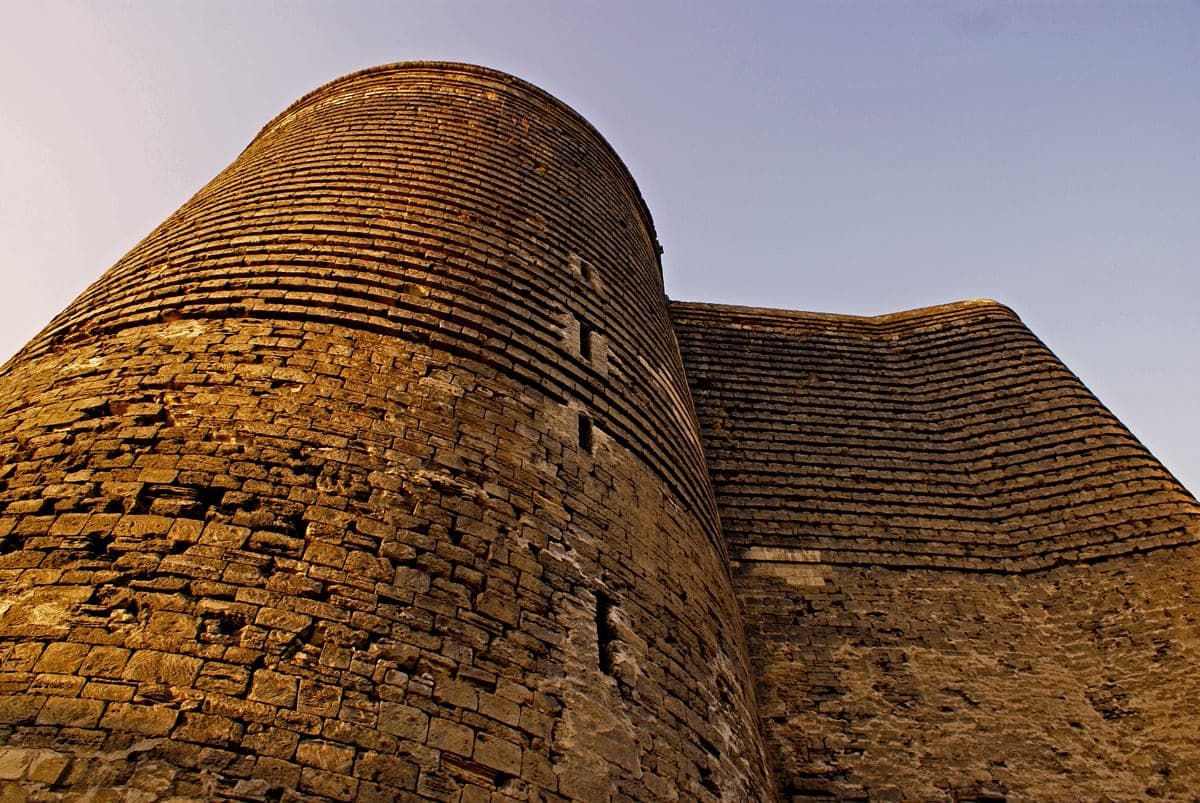
Baku. The capital wraps around a crescent bay on the Caspian, and at its heart the walled Old City, Icherisheher, holds the country's most famous monuments: the Maiden Tower, a stone cylinder whose date is still argued over, and the fifteenth-century Palace of the Shirvanshahs, together inscribed as a World Heritage site in 2000 (UNESCO). Beyond the walls the oil boom of around 1900 left grand mansions, and the new century has added the curving Flame Towers and Zaha Hadid's Heydar Aliyev Center.
 Nobody agrees what the Maiden Tower was for. Fire temple, observatory, fortress and beacon have all been argued, and the building gives no answer. Photograph by Ludvig14, CC BY-SA 4.0, via Wikimedia Commons.
Ganja. The second city, in the west, is one of the oldest settlements in the country and the birthplace of Nizami Ganjavi, the twelfth-century poet whose Persian-language romances rank among the classics of world literature. It keeps the mausoleum raised to Nizami and the memory of Javad Khan, the last ruler of its khanate, killed defending it against Russian forces in 1804.
Sheki. Set in a forested valley of the Greater Caucasus, Sheki was a Silk Road caravan town and a centre of silk weaving, and its historic core with the Khan's Palace joined the World Heritage List in 2019 (UNESCO). The palace is famous for shebeke, latticed windows of coloured glass assembled from thousands of hand-cut wooden pieces without a nail or drop of glue. The town is equally known for its dense halva.
Nakhchivan. The exclave, cut off from the rest of the country by Armenian territory, is a land of ancient towns and dry mountains. Its emblem is the Momine Khatun mausoleum, a twelfth-century tower of patterned brick by the architect Ajami, and its folk arts include the circling yalli dances that UNESCO lists for urgent safeguarding.
The eastern Caucasus was home in antiquity to Caucasian Albania, a state unrelated to the Balkan country of the same name, which adopted Christianity in the fourth century and developed its own alphabet; the Albanian church at Kish, near Sheki, survives from that world. Islam arrived with the Arab conquests of the seventh century. From around the ninth century the Shirvanshahs ruled the lands north of the Kura for more than six hundred years, eventually making Baku their seat and raising the palace that still crowns the Old City.
Nobody agrees what the Maiden Tower was for. Fire temple, observatory, fortress and beacon have all been argued, and the building gives no answer. Photograph by Ludvig14, CC BY-SA 4.0, via Wikimedia Commons.
Ganja. The second city, in the west, is one of the oldest settlements in the country and the birthplace of Nizami Ganjavi, the twelfth-century poet whose Persian-language romances rank among the classics of world literature. It keeps the mausoleum raised to Nizami and the memory of Javad Khan, the last ruler of its khanate, killed defending it against Russian forces in 1804.
Sheki. Set in a forested valley of the Greater Caucasus, Sheki was a Silk Road caravan town and a centre of silk weaving, and its historic core with the Khan's Palace joined the World Heritage List in 2019 (UNESCO). The palace is famous for shebeke, latticed windows of coloured glass assembled from thousands of hand-cut wooden pieces without a nail or drop of glue. The town is equally known for its dense halva.
Nakhchivan. The exclave, cut off from the rest of the country by Armenian territory, is a land of ancient towns and dry mountains. Its emblem is the Momine Khatun mausoleum, a twelfth-century tower of patterned brick by the architect Ajami, and its folk arts include the circling yalli dances that UNESCO lists for urgent safeguarding.
The eastern Caucasus was home in antiquity to Caucasian Albania, a state unrelated to the Balkan country of the same name, which adopted Christianity in the fourth century and developed its own alphabet; the Albanian church at Kish, near Sheki, survives from that world. Islam arrived with the Arab conquests of the seventh century. From around the ninth century the Shirvanshahs ruled the lands north of the Kura for more than six hundred years, eventually making Baku their seat and raising the palace that still crowns the Old City.
 Gobustan carries more than six thousand carvings spanning perhaps forty thousand years, including boats that suggest a very old seafaring tradition on the Caspian. Photograph by Radoslaw Botev, CC BY 3.0 PL, via Wikimedia Commons.
The Safavid dynasty, founded by Shah Ismail in 1501 and rooted in Azerbaijani-speaking Ardabil, made Twelver Shia Islam its state religion, and from this period Azerbaijan's Shia majority descends. As Safavid power waned the region split into semi-independent khanates centred on Baku, Ganja, Shaki, Karabakh and Quba. These were absorbed by the Russian Empire in two treaties with Persia, Gulistan in 1813 and Turkmenchay in 1828, which fixed the border along the Aras river and split the Azerbaijani-speaking population between Russian and Iranian rule (Britannica). Under Russian rule Baku's oil fields drew the Nobel and Rothschild fortunes and, by around 1900, produced roughly half the world's oil.
As the empire collapsed, Azerbaijan declared independence on 28 May 1918 as the Azerbaijan Democratic Republic, the first secular parliamentary republic in the Muslim world and among the first states anywhere to grant women the vote (Azerbaijan Democratic Republic). It lasted barely two years before the Red Army entered Baku in April 1920 and folded it into the Soviet Union. Seven Soviet decades industrialised the country and fuelled the wartime economy with Baku oil while suppressing public religion, ending in the violence of Black January in 1990. Azerbaijan restored its independence in 1991.
The state language is Azerbaijani, a Turkic tongue of the Oghuz branch closely related to Turkish, though the largest number of its speakers actually live across the border in Iran. Its written form has changed alphabet four times in a century: the Perso-Arabic script used for centuries gave way to Latin in the 1920s, to Cyrillic under Stalin, and back to Latin after independence, while minority languages such as Talysh and Tat survive in the mountains and along the borders.
The country's name carries its founding element inside it. Most scholars trace Azerbaijan through the Persian Aturpatakan to the Greek Atropatene, the kingdom of the satrap Atropates who governed here after Alexander the Great, whose name meant something close to "protected by fire" (Etymonline). Whether the fire in the name is the sacred flame of Zoroastrian worship or a later folk reading, it suits a land where gas fires burn from bare ground, and the modern motto Odlar Yurdu, the Land of Fire, has made the coincidence a national badge.
At the centre of Azerbaijani art sits mugham, a modal music of improvisation in which a singer, usually with the long-necked tar lute and the kamancha spike fiddle, moves through a sequence of moods built on classical poetry, often the verses of Fuzuli or Nizami; UNESCO recognised it in 2008 (UNESCO). Its country cousin is the art of the ashiq, the travelling bard who sings epic and love poetry to his own saz, recognised in 2009. Both carry a repertoire learned by ear and handed down through named masters and their pupils.
Wool is the other great Azerbaijani art. Carpet weaving, inscribed by UNESCO in 2010, is practised in regional schools, Guba, Shirvan, Ganja, Karabakh and Tabriz among them, and worked in both knotted pile and flat-woven kilim. Sheki adds silk, both its woven cloth and the coloured shebeke windows, while the towns near Baku still make the kelaghayi silk headscarf, itself a UNESCO listing. The table matters as much as the loom: plov, the saffron rice dish, comes in dozens of forms; dolma and thin flatbreads such as lavash carry their own UNESCO recognition; and tea is drunk from pear-shaped armudu glasses with jam and sweets. Novruz, the spring new year, remains the great feast of the calendar, its fires jumped and its ancestors remembered.
Azerbaijan is a Muslim-majority country with a Shia majority and a substantial Sunni minority, an inheritance of Safavid rule laid over older layers, and at the same time one of the more secular societies of the Islamic world after the Soviet decades. Belief is often held lightly and expressed through custom, feast and family rather than strict observance. Beneath Islam lies the memory of Zoroastrianism, kept alive at the Ateshgah fire temple and in the reverence for fire that survives in Novruz bonfires and in the country's very name.
The land has long carried other faiths as well. The churches of Caucasian Albania, including the chapel at Kish, mark an early Christianity, and Russian Orthodox and other communities remain. Above the town of Quba, the settlement of Qirmizi Qasaba, or Red Town, is one of the few places outside Israel to have been home to an all-Jewish community for centuries, its Mountain Jews keeping their synagogues and Judeo-Tat speech. Azerbaijanis often point to this coexistence as a defining feature of their culture.
Azerbaijani funerals follow Islamic practice with local colour. The body is washed and wrapped in a plain shroud and buried as soon as possible, laid on its side so the face turns toward Mecca, in a grave kept simple by custom. The family then holds the yas, a mourning gathering, often in a hired hall or a tent outside the home, where relatives and neighbours come to hear prayers and Quranic recitation and to offer condolences over tea.
The calendar of grief is precise. Commemorations fall on the third, seventh and fortieth days after a death, and again at the first anniversary, with visitors returning on Thursdays in the weeks between. Central to each is ehsan, a memorial meal offered to all who come in the name of the deceased; it is a point of honour that rich and poor alike provide it, and on the day of the death custom holds that nothing is cooked but halva, prepared by the most respected woman of the family (Global Informality Project). A distinctive Caucasus habit marks the graves: headstones are often engraved with a lifelike portrait, so the cemetery keeps not only names but faces.
Over this personal cycle the Shia year lays its own public mourning. During Muharram, and above all on Ashura, believers gather to grieve the death of Imam Husayn at Karbala with recitation, lament and processions, a practice driven underground under the Soviets and revived since. Older strata show through too: the sung laments known as agha, the visiting of family graves before Novruz so the dead share in the new year, and the sense that the living owe the dead a table, a prayer and a return on the appointed day.
Azerbaijani records follow the Russian imperial pattern, with a distinctive Muslim layer underneath.
The Caucasus came under Russian rule in the early nineteenth century, so the sources are the metrical books kept by religious authorities and the revision lists taken as tax censuses. For Muslim families the registers were kept by the qadi and the mosque rather than by a church, and their survival is patchier than the Orthodox and Armenian equivalents. The National Archives in Baku hold the imperial and Soviet series, and Soviet registration through ZAGS runs from the 1920s.
The oil boom is a documentary event. From the 1870s Baku became one of the world's great oil cities, and it drew in Russians, Armenians, Georgians, Iranians, Germans and Poles, along with the Nobel and Rothschild companies. Employment, municipal and property records from that period are unusually rich, and many Baku families are documented better than families in the provinces.
Two displacements shape the modern record. The conflict over Nagorno-Karabakh displaced hundreds of thousands of Azerbaijanis from Armenia and from the occupied districts in the early 1990s, and displaced Armenians in the other direction, most recently in 2023. Records left behind in those territories are in the hands of whichever administration now holds the ground.
Iranian Azerbaijan holds more Azerbaijanis than the republic does, and their records are Iranian, which means a family divided by the Aras river is documented by two different states in two different scripts.
Azerbaijan holds three cultural World Heritage sites. The Walled City of Baku with the Shirvanshahs' Palace and the Maiden Tower was inscribed in 2000 (UNESCO); the Gobustan Rock Art Cultural Landscape, whose stones carry thousands of engravings of hunters, boats and dancers reaching back many thousands of years, followed in 2007 (UNESCO); and the Historic Centre of Sheki with the Khan's Palace was added in 2019. The Old City spent six years, from 2003 to 2009, on the List of World Heritage in Danger after earthquake damage and development pressure before conservation work saw it removed.
The country's intangible listings run deeper still, with mugham, the ashiq art, carpet weaving, kelaghayi silk scarves, the craft of the tar, Lahij coppersmithing, the yalli dances of Nakhchivan, the horseback game of chovqan, the Dede Qorqud epic tradition, and the making of dolma and flatbread all recognised by UNESCO (full list). At home, a state reserve manages the Old City, and the Azerbaijan Carpet Museum in Baku, opened in 2014 in a building shaped like a rolled carpet, was the first museum in the world devoted wholly to the art. Teaching these crafts to a new generation is treated as the core of preservation, since they survive only as long as the hands that carry them.
Azerbaijan's memory institutions have moved steadily online. The Azerbaijan Carpet Museum has digitised its collection and offers access to weavings too fragile to travel, while the state reserve and national tourism bodies have produced virtual tours of Icherisheher and Gobustan, whose visitor centre pairs the ancient petroglyphs with digital reconstructions. Google Arts and Culture hosts online exhibitions of all three World Heritage sites.
Scholarship has its own digital front. The Institute of Manuscripts of the Academy of Sciences, named for the poet Fuzuli, holds tens of thousands of medieval manuscripts in Arabic, Persian and Turkic and has worked to digitise them, and the National Library has built digital collections of books, periodicals and archival material, keeping fragile paper, sound and stone in a form that can outlast the originals.
Modern Azerbaijan has projected its culture outward. Baku's architecture, from the Flame Towers to Zaha Hadid's flowing Heydar Aliyev Center, has become shorthand for the country's oil-era ambition, and the capital has hosted the Eurovision Song Contest in 2012, the first European Games in 2015 and a Formula 1 street race. The roots of that turn go back a century, to the composer Uzeyir Hajibeyov, whose 1908 Leyli and Majnun, drawn from mugham and Fuzuli's poetry, is regarded as the first opera composed in the Muslim world.
Mugham itself has found a global audience through singers such as Alim Qasimov, and the jazz-mugham fusion pioneered by Vagif Mustafazadeh has carried the mode far from the Caspian. The pomegranate, celebrated each autumn at the Nar Bayrami festival in Goychay and recognised by UNESCO, has become a culinary emblem abroad, and Azerbaijani cuisine travels with a large diaspora in Iran, Russia and Turkey.
The walled city saved. Placed on the List of World Heritage in Danger in 2003 after earthquake damage and unchecked building, the Old City of Baku was restored and removed from the list in 2009, and Icherisheher today is a living quarter as well as a monument.
A mode of music carried forward. Mugham, sidelined in the Soviet years, won UNESCO recognition in 2008, and an international mugham centre, national competitions and a generation of young performers have turned an endangered oral art into a confident living tradition.
A house built for carpets. Azerbaijan's carpet weaving was inscribed by UNESCO in 2010, and four years later the country opened, in the shape of a rolled rug on the Baku waterfront, the first museum anywhere devoted entirely to the art.
A silk-road town on the list. The inscription of Sheki in 2019 recognised both a Caucasus caravan town and the shebeke craft that fills the Khan's Palace with coloured light, drawing conservation funding to a region long overshadowed by the capital.
The first republic remembered. The centenary of the Azerbaijan Democratic Republic in 2018 renewed public memory of a state that, in barely two years, made itself the first secular parliamentary republic of the Muslim world and gave women the vote.
Gobustan carries more than six thousand carvings spanning perhaps forty thousand years, including boats that suggest a very old seafaring tradition on the Caspian. Photograph by Radoslaw Botev, CC BY 3.0 PL, via Wikimedia Commons.
The Safavid dynasty, founded by Shah Ismail in 1501 and rooted in Azerbaijani-speaking Ardabil, made Twelver Shia Islam its state religion, and from this period Azerbaijan's Shia majority descends. As Safavid power waned the region split into semi-independent khanates centred on Baku, Ganja, Shaki, Karabakh and Quba. These were absorbed by the Russian Empire in two treaties with Persia, Gulistan in 1813 and Turkmenchay in 1828, which fixed the border along the Aras river and split the Azerbaijani-speaking population between Russian and Iranian rule (Britannica). Under Russian rule Baku's oil fields drew the Nobel and Rothschild fortunes and, by around 1900, produced roughly half the world's oil.
As the empire collapsed, Azerbaijan declared independence on 28 May 1918 as the Azerbaijan Democratic Republic, the first secular parliamentary republic in the Muslim world and among the first states anywhere to grant women the vote (Azerbaijan Democratic Republic). It lasted barely two years before the Red Army entered Baku in April 1920 and folded it into the Soviet Union. Seven Soviet decades industrialised the country and fuelled the wartime economy with Baku oil while suppressing public religion, ending in the violence of Black January in 1990. Azerbaijan restored its independence in 1991.
The state language is Azerbaijani, a Turkic tongue of the Oghuz branch closely related to Turkish, though the largest number of its speakers actually live across the border in Iran. Its written form has changed alphabet four times in a century: the Perso-Arabic script used for centuries gave way to Latin in the 1920s, to Cyrillic under Stalin, and back to Latin after independence, while minority languages such as Talysh and Tat survive in the mountains and along the borders.
The country's name carries its founding element inside it. Most scholars trace Azerbaijan through the Persian Aturpatakan to the Greek Atropatene, the kingdom of the satrap Atropates who governed here after Alexander the Great, whose name meant something close to "protected by fire" (Etymonline). Whether the fire in the name is the sacred flame of Zoroastrian worship or a later folk reading, it suits a land where gas fires burn from bare ground, and the modern motto Odlar Yurdu, the Land of Fire, has made the coincidence a national badge.
At the centre of Azerbaijani art sits mugham, a modal music of improvisation in which a singer, usually with the long-necked tar lute and the kamancha spike fiddle, moves through a sequence of moods built on classical poetry, often the verses of Fuzuli or Nizami; UNESCO recognised it in 2008 (UNESCO). Its country cousin is the art of the ashiq, the travelling bard who sings epic and love poetry to his own saz, recognised in 2009. Both carry a repertoire learned by ear and handed down through named masters and their pupils.
Wool is the other great Azerbaijani art. Carpet weaving, inscribed by UNESCO in 2010, is practised in regional schools, Guba, Shirvan, Ganja, Karabakh and Tabriz among them, and worked in both knotted pile and flat-woven kilim. Sheki adds silk, both its woven cloth and the coloured shebeke windows, while the towns near Baku still make the kelaghayi silk headscarf, itself a UNESCO listing. The table matters as much as the loom: plov, the saffron rice dish, comes in dozens of forms; dolma and thin flatbreads such as lavash carry their own UNESCO recognition; and tea is drunk from pear-shaped armudu glasses with jam and sweets. Novruz, the spring new year, remains the great feast of the calendar, its fires jumped and its ancestors remembered.
Azerbaijan is a Muslim-majority country with a Shia majority and a substantial Sunni minority, an inheritance of Safavid rule laid over older layers, and at the same time one of the more secular societies of the Islamic world after the Soviet decades. Belief is often held lightly and expressed through custom, feast and family rather than strict observance. Beneath Islam lies the memory of Zoroastrianism, kept alive at the Ateshgah fire temple and in the reverence for fire that survives in Novruz bonfires and in the country's very name.
The land has long carried other faiths as well. The churches of Caucasian Albania, including the chapel at Kish, mark an early Christianity, and Russian Orthodox and other communities remain. Above the town of Quba, the settlement of Qirmizi Qasaba, or Red Town, is one of the few places outside Israel to have been home to an all-Jewish community for centuries, its Mountain Jews keeping their synagogues and Judeo-Tat speech. Azerbaijanis often point to this coexistence as a defining feature of their culture.
Azerbaijani funerals follow Islamic practice with local colour. The body is washed and wrapped in a plain shroud and buried as soon as possible, laid on its side so the face turns toward Mecca, in a grave kept simple by custom. The family then holds the yas, a mourning gathering, often in a hired hall or a tent outside the home, where relatives and neighbours come to hear prayers and Quranic recitation and to offer condolences over tea.
The calendar of grief is precise. Commemorations fall on the third, seventh and fortieth days after a death, and again at the first anniversary, with visitors returning on Thursdays in the weeks between. Central to each is ehsan, a memorial meal offered to all who come in the name of the deceased; it is a point of honour that rich and poor alike provide it, and on the day of the death custom holds that nothing is cooked but halva, prepared by the most respected woman of the family (Global Informality Project). A distinctive Caucasus habit marks the graves: headstones are often engraved with a lifelike portrait, so the cemetery keeps not only names but faces.
Over this personal cycle the Shia year lays its own public mourning. During Muharram, and above all on Ashura, believers gather to grieve the death of Imam Husayn at Karbala with recitation, lament and processions, a practice driven underground under the Soviets and revived since. Older strata show through too: the sung laments known as agha, the visiting of family graves before Novruz so the dead share in the new year, and the sense that the living owe the dead a table, a prayer and a return on the appointed day.
Azerbaijani records follow the Russian imperial pattern, with a distinctive Muslim layer underneath.
The Caucasus came under Russian rule in the early nineteenth century, so the sources are the metrical books kept by religious authorities and the revision lists taken as tax censuses. For Muslim families the registers were kept by the qadi and the mosque rather than by a church, and their survival is patchier than the Orthodox and Armenian equivalents. The National Archives in Baku hold the imperial and Soviet series, and Soviet registration through ZAGS runs from the 1920s.
The oil boom is a documentary event. From the 1870s Baku became one of the world's great oil cities, and it drew in Russians, Armenians, Georgians, Iranians, Germans and Poles, along with the Nobel and Rothschild companies. Employment, municipal and property records from that period are unusually rich, and many Baku families are documented better than families in the provinces.
Two displacements shape the modern record. The conflict over Nagorno-Karabakh displaced hundreds of thousands of Azerbaijanis from Armenia and from the occupied districts in the early 1990s, and displaced Armenians in the other direction, most recently in 2023. Records left behind in those territories are in the hands of whichever administration now holds the ground.
Iranian Azerbaijan holds more Azerbaijanis than the republic does, and their records are Iranian, which means a family divided by the Aras river is documented by two different states in two different scripts.
Azerbaijan holds three cultural World Heritage sites. The Walled City of Baku with the Shirvanshahs' Palace and the Maiden Tower was inscribed in 2000 (UNESCO); the Gobustan Rock Art Cultural Landscape, whose stones carry thousands of engravings of hunters, boats and dancers reaching back many thousands of years, followed in 2007 (UNESCO); and the Historic Centre of Sheki with the Khan's Palace was added in 2019. The Old City spent six years, from 2003 to 2009, on the List of World Heritage in Danger after earthquake damage and development pressure before conservation work saw it removed.
The country's intangible listings run deeper still, with mugham, the ashiq art, carpet weaving, kelaghayi silk scarves, the craft of the tar, Lahij coppersmithing, the yalli dances of Nakhchivan, the horseback game of chovqan, the Dede Qorqud epic tradition, and the making of dolma and flatbread all recognised by UNESCO (full list). At home, a state reserve manages the Old City, and the Azerbaijan Carpet Museum in Baku, opened in 2014 in a building shaped like a rolled carpet, was the first museum in the world devoted wholly to the art. Teaching these crafts to a new generation is treated as the core of preservation, since they survive only as long as the hands that carry them.
Azerbaijan's memory institutions have moved steadily online. The Azerbaijan Carpet Museum has digitised its collection and offers access to weavings too fragile to travel, while the state reserve and national tourism bodies have produced virtual tours of Icherisheher and Gobustan, whose visitor centre pairs the ancient petroglyphs with digital reconstructions. Google Arts and Culture hosts online exhibitions of all three World Heritage sites.
Scholarship has its own digital front. The Institute of Manuscripts of the Academy of Sciences, named for the poet Fuzuli, holds tens of thousands of medieval manuscripts in Arabic, Persian and Turkic and has worked to digitise them, and the National Library has built digital collections of books, periodicals and archival material, keeping fragile paper, sound and stone in a form that can outlast the originals.
Modern Azerbaijan has projected its culture outward. Baku's architecture, from the Flame Towers to Zaha Hadid's flowing Heydar Aliyev Center, has become shorthand for the country's oil-era ambition, and the capital has hosted the Eurovision Song Contest in 2012, the first European Games in 2015 and a Formula 1 street race. The roots of that turn go back a century, to the composer Uzeyir Hajibeyov, whose 1908 Leyli and Majnun, drawn from mugham and Fuzuli's poetry, is regarded as the first opera composed in the Muslim world.
Mugham itself has found a global audience through singers such as Alim Qasimov, and the jazz-mugham fusion pioneered by Vagif Mustafazadeh has carried the mode far from the Caspian. The pomegranate, celebrated each autumn at the Nar Bayrami festival in Goychay and recognised by UNESCO, has become a culinary emblem abroad, and Azerbaijani cuisine travels with a large diaspora in Iran, Russia and Turkey.
The walled city saved. Placed on the List of World Heritage in Danger in 2003 after earthquake damage and unchecked building, the Old City of Baku was restored and removed from the list in 2009, and Icherisheher today is a living quarter as well as a monument.
A mode of music carried forward. Mugham, sidelined in the Soviet years, won UNESCO recognition in 2008, and an international mugham centre, national competitions and a generation of young performers have turned an endangered oral art into a confident living tradition.
A house built for carpets. Azerbaijan's carpet weaving was inscribed by UNESCO in 2010, and four years later the country opened, in the shape of a rolled rug on the Baku waterfront, the first museum anywhere devoted entirely to the art.
A silk-road town on the list. The inscription of Sheki in 2019 recognised both a Caucasus caravan town and the shebeke craft that fills the Khan's Palace with coloured light, drawing conservation funding to a region long overshadowed by the capital.
The first republic remembered. The centenary of the Azerbaijan Democratic Republic in 2018 renewed public memory of a state that, in barely two years, made itself the first secular parliamentary republic of the Muslim world and gave women the vote.
National Overview
Notable Cities
Historical Foundations
Linguistic and Etymological Roots
Cultural Identity
Religion and Spirituality
Remembrance and Mourning Traditions
Tracing a Family in Azerbaijan
Heritage Preservation Efforts
Digital Heritage
Contemporary Cultural Influences
Success Stories
References and resources
- UNESCO World Heritage Centre, Azerbaijan. The country's World Heritage sites.
- Walled City of Baku with the Shirvanshah's Palace and Maiden Tower. Inscribed 2000.
- Gobustan Rock Art Cultural Landscape. Inscribed 2007.
- Historic Centre of Sheki with the Khan's Palace. Inscribed 2019.
- UNESCO Intangible Cultural Heritage, Azerbaijan. Mugham, ashiq, carpet weaving and more.
- Encyclopaedia Britannica, Azerbaijan. Geography, history and society.
- Britannica, Treaty of Turkmenchay. The 1828 border settlement.
- Azerbaijan Travel, sites of ancient fire. Ateshgah and Yanar Dag.
- International Crisis Group, Nagorno-Karabakh. A neutral overview of the dispute.