Heritage · Country
Georgia Culture and Heritage
Among the first nations on earth to make Christianity its state faith, Georgia has kept belief, wine and song in the same buried clay vessels for eight thousand years. A guide to the country's heritage, to its Orthodox rites of mourning, and to the long feast table where the living still raise a glass to the dead.Written to last.
By Confinity Heritage Editorial · Updated 2026-07-31 · 8-minute readQuiet tools, kept out of the way.
In Georgia, remembrance has a taste. At the supra, the ordered feast that governs Georgian social life, one of the first toasts belongs to the dead, and the room falls quiet while the wine is raised to those who are gone, the glasses left unclinked. That same wine has been made on this ground for perhaps eight thousand years, fermented in egg-shaped clay vessels buried to their necks in the earth, and the country that drinks it was among the earliest anywhere to adopt Christianity as its state religion, early in the fourth century. Faith, wine and song are not separate inheritances here. They meet at the same table and over the same graves.
The physical inheritance is kept with equal seriousness. Georgia counts four UNESCO World Heritage sites and several living traditions on the intangible list, from qvevri winemaking to polyphonic singing older than the country's cathedrals.
Georgia lies in the South Caucasus, on the isthmus between the Black Sea and the Caspian, with the high wall of the Greater Caucasus along its northern frontier with Russia and the Lesser Caucasus to the south. It borders Turkey and Armenia to the south and Azerbaijan to the east, and its western shore opens onto the Black Sea. The land rises from subtropical coast to permanent snow, reaching 5,193 metres at Mount Shkhara, near the sacred cone of Mount Kazbek (Britannica).
The population is roughly 3.7 million, about six in seven of them ethnic Georgians, alongside Azerbaijani, Armenian, Russian and Ossetian communities. Most belong to the Orthodox Church, while Muslim, Catholic and Jewish communities have deep local roots. Two regions, Abkhazia and South Ossetia, have lain outside the control of the central government since the conflicts of the early 1990s. More than a third of the population lives in the capital, Tbilisi, and a large diaspora carries Georgian language and custom abroad.
Tbilisi. Founded in the fifth century by King Vakhtang Gorgasali of Iberia, the capital takes its name from the Georgian word "tbili", meaning warm, after the sulphur springs that still steam beneath the domed bathhouses of the Abanotubani quarter. The old town climbs the gorge of the Mtkvari river beneath the Narikala fortress, past the sixth-century Anchiskhati Basilica and the Sioni Cathedral. Astride the road between Europe and Asia, it has been sacked and rebuilt many times, its streets layering Persian, Byzantine, Armenian, Russian and Art Nouveau architecture.
Mtskheta. The former capital of Iberia, north of Tbilisi, is the spiritual centre of the country and the place where Christianity took root in the fourth century. Its eleventh-century Svetitskhoveli Cathedral, whose name means the life-giving pillar, is held to shelter the robe of Christ and remains the burial church of Georgian royalty, while the sixth-century Jvari Monastery watches from the ridge above. The ensemble is inscribed by UNESCO as the Historical Monuments of Mtskheta (UNESCO).
Kutaisi. Georgia's second city, in Imereti, was the seat of ancient Colchis and later the medieval kingdom of the west. Above it rises the Bagrati Cathedral, consecrated around 1003 under King Bagrat III, and nearby stands the Gelati Monastery, founded in 1106 by David the Builder as a house of learning. Kutaisi served as the country's legislative capital in the 2010s.
Batumi. The main Black Sea port and capital of the autonomous republic of Adjara, Batumi sits in a subtropical belt of tea, citrus and palms. Long an Ottoman-influenced harbour and later an oil terminal for the Russian Empire, it has been rebuilt with a seafront of modern towers against a nineteenth-century core, beside a botanical garden laid out from 1912.
Georgian statehood grows from two ancient kingdoms. In the west lay Colchis, which the Greeks made the destination of Jason and the Argonauts in their quest for the Golden Fleece, its river-panned gold real by the second millennium BCE. In the east lay Iberia, also called Kartli, which formed as a kingdom around the fourth and third centuries BCE, after the campaigns of Alexander the Great (Britannica).
 The Svan towers were built by families against raiders and against each other, and the villages that kept them are among the highest permanently inhabited places in Europe. Photograph by Arian Zwegers, CC BY 2.0, via Wikimedia Commons.
The defining turn came early in the fourth century, when Saint Nino preached in Iberia and King Mirian III made Christianity the state religion, traditionally dated to around 326 to 337 CE, placing Iberia among the first states anywhere to embrace the faith. The church then became the keeper of Georgian language, script and identity. After centuries of contest between Byzantium and Persia, and then Arab rule at Tbilisi, the Georgian lands were united under a single crown around the year 1000.
A golden age followed. David IV, called the Builder, reigned from 1089 to 1125, broke the Seljuk Turks at the Battle of Didgori in 1121, recovered Tbilisi, and founded the academy at Gelati. His descendant Queen Tamar, who ruled from 1184 to 1213 as the first woman to hold the throne in her own right, presided over the kingdom at its widest extent and its cultural height, the age of Shota Rustaveli's epic "The Knight in the Panther's Skin" and of the cliff-cut cave city of Vardzia.
The Mongol invasions of the thirteenth century ended that ascendancy, and the campaigns of Timur around 1400 deepened the ruin. By about 1490 the realm had split into the kingdoms of Kartli, Kakheti and Imereti and a scatter of principalities, which for three centuries lived under heavy pressure from Safavid Persia and the Ottoman Empire, including the sack of Tbilisi in 1795. Seeking a Christian protector, the eastern kingdom signed the Treaty of Georgievsk with Russia in 1783, and the Russian Empire annexed eastern Georgia in 1801, absorbing the western lands over the following decades.
Georgia declared independence as the Democratic Republic of Georgia on 26 May 1918 and survived until the Red Army invaded in 1921, after which it became a Soviet republic. The Soviet decades brought industrialisation, mass literacy and severe political repression; Joseph Stalin, born Ioseb Jughashvili in Gori in 1878, rose from this small country to rule the Soviet Union. On 9 April 1989 Soviet troops broke up a peaceful demonstration in Tbilisi with deadly force, and on 9 April 1991 Georgia declared the restoration of its independence, confirmed with the dissolution of the Soviet Union that December.
Georgian belongs to the Kartvelian, or South Caucasian, language family, unrelated to the Indo-European, Turkic or Semitic languages around it; its relatives are Mingrelian, Laz and Svan. It is written in an alphabet found nowhere else, which has taken three forms: the rounded Asomtavruli of the earliest inscriptions, the angular Nuskhuri of medieval manuscripts, and the flowing Mkhedruli in use today. The oldest dated Georgian inscriptions survive from the fifth century CE, and the living use of all three scripts was inscribed on the UNESCO intangible list in 2016 (UNESCO).
The country answers to two names. Georgians call their homeland Sakartvelo, the land of the Kartvelians, built from Kartli, the central province around Mtskheta and Tbilisi, and recorded from around the ninth century. The English "Georgia", like its Russian and Turkish equivalents, derives from the Persian "Gurj", an old name for the people, which passed through Arabic into Europe, where medieval writers linked it by folk etymology to Saint George (Britannica).
Wine sits at the centre of Georgian self-understanding. Archaeologists have traced grape winemaking here to about six thousand years before the common era, among the oldest such traditions known, and the characteristic method uses the qvevri, a large clay vessel lined with beeswax and buried in the ground, where the wine ferments with its skins and stems at the stable temperature of the earth. This qvevri method was added to the UNESCO intangible list in 2013 (UNESCO). Wine is inseparable from the supra, the feast, and from the tamada, the toastmaster who leads its fixed sequence of toasts.
Song is the second pillar. Georgian polyphonic singing, in which three vocal lines weave against one another, was proclaimed among the first UNESCO Masterpieces of the Oral and Intangible Heritage of Humanity in 2001, its styles ranging from the harmonies of Svaneti to the drones of Kakheti (UNESCO); in 1977 a Georgian choral song, "Chakrulo", was chosen for the Voyager Golden Record and sent into interstellar space. The craft heritage is equally distinctive, above all the medieval art of cloisonné enamel, or minankari, in which coloured glass is fired within fine gold cells. Georgian food carries the same identity to the table: the cheese-filled khachapuri, boat-shaped and egg-topped in its Adjaran form; the soup dumplings called khinkali; and churchkhela, strings of nuts dipped in thickened grape juice.
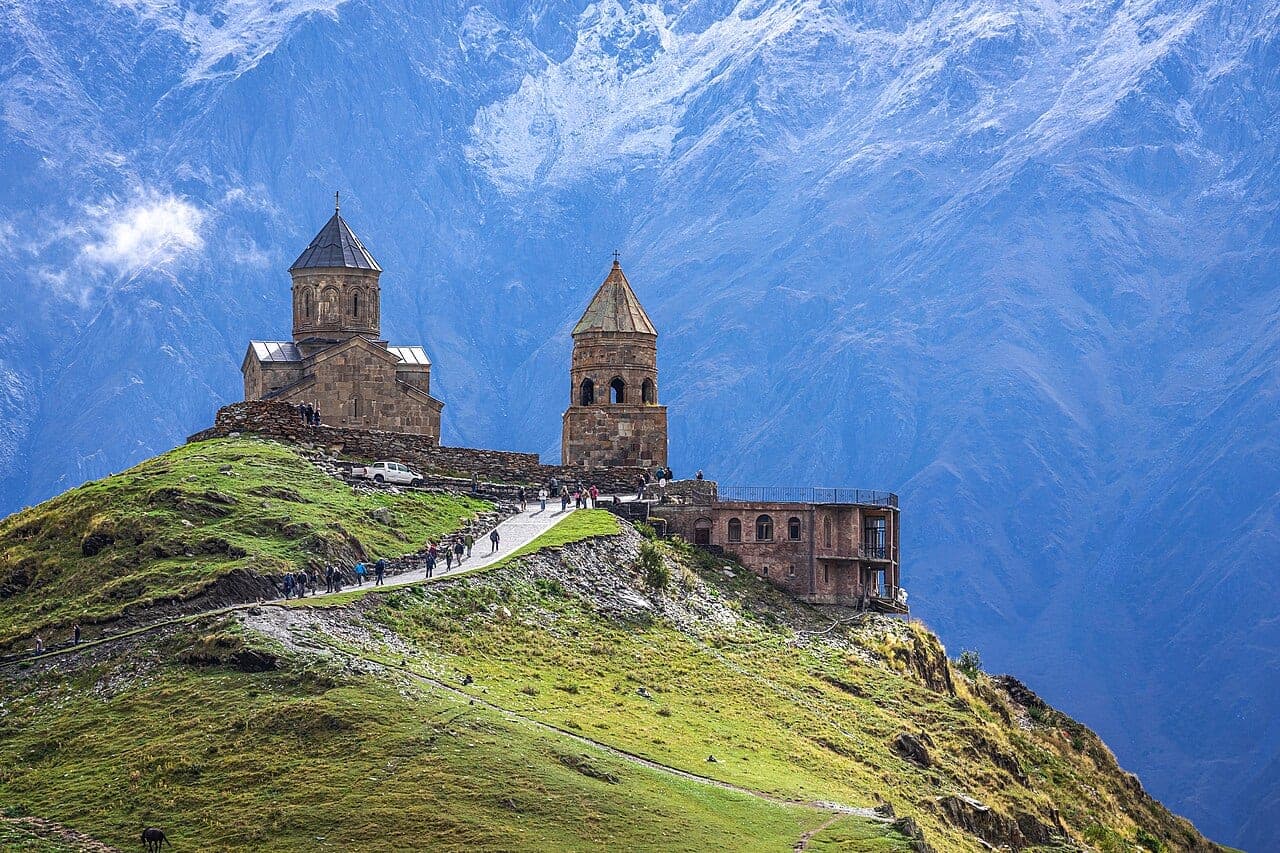
The Georgian Orthodox Apostolic Autocephalous Church is one of the oldest Christian bodies in the world. Tradition holds that the Apostle Andrew first preached in the land, and the fourth-century mission of Saint Nino brought the conversion of the crown. Led by a Catholicos-Patriarch, the church governs itself and remains woven through Georgian life, its feasts and saints, above all Saint George and Saint Nino, shaping the year. Pilgrims still climb to Svetitskhoveli at Mtskheta and to the Gergeti Trinity Church beneath Mount Kazbek.
The Svan towers were built by families against raiders and against each other, and the villages that kept them are among the highest permanently inhabited places in Europe. Photograph by Arian Zwegers, CC BY 2.0, via Wikimedia Commons.
The defining turn came early in the fourth century, when Saint Nino preached in Iberia and King Mirian III made Christianity the state religion, traditionally dated to around 326 to 337 CE, placing Iberia among the first states anywhere to embrace the faith. The church then became the keeper of Georgian language, script and identity. After centuries of contest between Byzantium and Persia, and then Arab rule at Tbilisi, the Georgian lands were united under a single crown around the year 1000.
A golden age followed. David IV, called the Builder, reigned from 1089 to 1125, broke the Seljuk Turks at the Battle of Didgori in 1121, recovered Tbilisi, and founded the academy at Gelati. His descendant Queen Tamar, who ruled from 1184 to 1213 as the first woman to hold the throne in her own right, presided over the kingdom at its widest extent and its cultural height, the age of Shota Rustaveli's epic "The Knight in the Panther's Skin" and of the cliff-cut cave city of Vardzia.
The Mongol invasions of the thirteenth century ended that ascendancy, and the campaigns of Timur around 1400 deepened the ruin. By about 1490 the realm had split into the kingdoms of Kartli, Kakheti and Imereti and a scatter of principalities, which for three centuries lived under heavy pressure from Safavid Persia and the Ottoman Empire, including the sack of Tbilisi in 1795. Seeking a Christian protector, the eastern kingdom signed the Treaty of Georgievsk with Russia in 1783, and the Russian Empire annexed eastern Georgia in 1801, absorbing the western lands over the following decades.
Georgia declared independence as the Democratic Republic of Georgia on 26 May 1918 and survived until the Red Army invaded in 1921, after which it became a Soviet republic. The Soviet decades brought industrialisation, mass literacy and severe political repression; Joseph Stalin, born Ioseb Jughashvili in Gori in 1878, rose from this small country to rule the Soviet Union. On 9 April 1989 Soviet troops broke up a peaceful demonstration in Tbilisi with deadly force, and on 9 April 1991 Georgia declared the restoration of its independence, confirmed with the dissolution of the Soviet Union that December.
Georgian belongs to the Kartvelian, or South Caucasian, language family, unrelated to the Indo-European, Turkic or Semitic languages around it; its relatives are Mingrelian, Laz and Svan. It is written in an alphabet found nowhere else, which has taken three forms: the rounded Asomtavruli of the earliest inscriptions, the angular Nuskhuri of medieval manuscripts, and the flowing Mkhedruli in use today. The oldest dated Georgian inscriptions survive from the fifth century CE, and the living use of all three scripts was inscribed on the UNESCO intangible list in 2016 (UNESCO).
The country answers to two names. Georgians call their homeland Sakartvelo, the land of the Kartvelians, built from Kartli, the central province around Mtskheta and Tbilisi, and recorded from around the ninth century. The English "Georgia", like its Russian and Turkish equivalents, derives from the Persian "Gurj", an old name for the people, which passed through Arabic into Europe, where medieval writers linked it by folk etymology to Saint George (Britannica).
Wine sits at the centre of Georgian self-understanding. Archaeologists have traced grape winemaking here to about six thousand years before the common era, among the oldest such traditions known, and the characteristic method uses the qvevri, a large clay vessel lined with beeswax and buried in the ground, where the wine ferments with its skins and stems at the stable temperature of the earth. This qvevri method was added to the UNESCO intangible list in 2013 (UNESCO). Wine is inseparable from the supra, the feast, and from the tamada, the toastmaster who leads its fixed sequence of toasts.
Song is the second pillar. Georgian polyphonic singing, in which three vocal lines weave against one another, was proclaimed among the first UNESCO Masterpieces of the Oral and Intangible Heritage of Humanity in 2001, its styles ranging from the harmonies of Svaneti to the drones of Kakheti (UNESCO); in 1977 a Georgian choral song, "Chakrulo", was chosen for the Voyager Golden Record and sent into interstellar space. The craft heritage is equally distinctive, above all the medieval art of cloisonné enamel, or minankari, in which coloured glass is fired within fine gold cells. Georgian food carries the same identity to the table: the cheese-filled khachapuri, boat-shaped and egg-topped in its Adjaran form; the soup dumplings called khinkali; and churchkhela, strings of nuts dipped in thickened grape juice.
The Georgian Orthodox Apostolic Autocephalous Church is one of the oldest Christian bodies in the world. Tradition holds that the Apostle Andrew first preached in the land, and the fourth-century mission of Saint Nino brought the conversion of the crown. Led by a Catholicos-Patriarch, the church governs itself and remains woven through Georgian life, its feasts and saints, above all Saint George and Saint Nino, shaping the year. Pilgrims still climb to Svetitskhoveli at Mtskheta and to the Gergeti Trinity Church beneath Mount Kazbek.
 Svetitskhoveli at Mtskheta, where Georgian kings were crowned and buried, and where the robe of Christ is said to lie beneath the floor. Photograph by Moahim, CC BY-SA 4.0, via Wikimedia Commons.
Older layers persist beneath and alongside the Orthodox faith, especially in the high valleys of the northeast, in Svaneti, Khevsureti and Tusheti, where shrine sanctuaries called jvari or khati and rituals with pre-Christian roots blend into local Christian practice. Georgia has also sheltered other communities for many centuries: its Jewish community traces its presence back some two and a half thousand years; Muslim Georgians are numerous in Adjara and the southeast; and Armenian Apostolic and Catholic congregations keep their own historic churches. These communities have shared the same towns and, often, the same reverence for the dead.
Georgian mourning follows the pattern of the Orthodox Church, deepened by local custom. When a person dies, the body is usually laid out at home for two or three days so that relatives and neighbours can pay their respects, and women of the family keep vigil beside the open coffin. A priest conducts the funeral service, and burial in the earth is the norm, in keeping with Orthodox teaching on the resurrection of the body. Mourners wear black, and widows have traditionally kept to dark clothing for a year or far longer.
Commemoration is spread across the year that follows. Memorial prayers are offered on the third, ninth and fortieth days after death, the fortieth day, the ormotsi, being the most important, when the soul is held to complete its passage and the family gathers again at church and table, with further remembrances at anniversaries. Central to all of them is the memorial supra, a feast held in honour of the departed at which the tamada leads toasts to the dead; at any Georgian table the toast to those who have passed is made early, drunk standing and in silence, the glasses deliberately not touched together as they would be for the living.
Georgians keep a close, physical relationship with the grave. Many cemeteries set a table and bench beside the headstone so that families can sit and share food and wine with the departed, leaving a glass of wine at the graveside. Headstones frequently carry an engraved or photographic portrait, so that the face remains among the living. The strongest collective observance comes in the days after Easter, when families across the country visit the cemeteries together, tend the graves, and eat beside them, turning the burial ground, for a day, into an extension of the family table.
Georgian records are church records, and the church has been keeping them for a very long time.
The Georgian Orthodox Church has been autocephalous since the fifth century, and its monasteries hold manuscripts, chronicles and the genealogies of the noble houses, many of which trace continuously across centuries. The National Centre of Manuscripts in Tbilisi holds a great deal of it. Ordinary families appear in parish metrical books, which under Russian rule from the early nineteenth century followed the imperial form, and in the revision lists taken as tax censuses.
The National Archives of Georgia hold the imperial and Soviet series and have digitised a substantial amount. Soviet registration ran through ZAGS offices from the 1920s.
Two absences shape the twentieth century. The repressions of the 1930s took a very large number of people from a small population, and the NKVD files that record them are in Tbilisi and in Moscow. And the conflicts of the early 1990s displaced around a quarter of a million people from Abkhazia and South Ossetia, whose records were left behind in territories now administered separately; for those families the Georgian state's registry and the de facto authorities' registry disagree about basic facts.
The distinctive Georgian source is the surname itself. Georgian surnames carry regional endings, dze and shvili in the east, ia and ava in Mingrelia, ani in Svaneti, so a name usually says which province a family came from before any document does.
Georgia's monuments are protected through the National Agency for Cultural Heritage Preservation, and the country holds four UNESCO World Heritage sites. Three are cultural: the Historical Monuments of Mtskheta, the churches of the ancient capital, inscribed in 1994; the Gelati Monastery, founded by David the Builder and celebrated for its mosaics, also from 1994; and Upper Svaneti, whose medieval villages bristle with stone defensive tower houses, inscribed in 1996 (UNESCO). The fourth, the Colchic Rainforests and Wetlands, was added in 2021 as a natural site.
Preservation has known setbacks too. The eleventh-century Bagrati Cathedral in Kutaisi, inscribed with Gelati in 1994, was placed on the List of World Heritage in Danger in 2010 after a reconstruction judged to have harmed its authenticity, and removed from the list in 2017. Georgia's living traditions are recognised on the UNESCO intangible list: polyphonic singing (2001), qvevri winemaking (2013), the three Georgian scripts (2016) and the wrestling tradition of chidaoba (2018). The cave cities of Vardzia and Uplistsikhe and the rock monasteries of David Gareja remain on the tentative list for future inscription.
Georgia has begun to move its written memory online. The Korneli Kekelidze National Centre of Manuscripts in Tbilisi holds the country's principal collection of medieval codices, and a body of Georgian and Byzantine manuscripts in its care was inscribed on the UNESCO Memory of the World Register in 2011, recognising documents that carry the earliest layers of Georgian literature. The National Archives and the Georgian National Museum have digitised photographs, films and objects, and Georgian institutions have contributed collections to Google Arts and Culture.
For a country with a large diaspora, this reach matters. Language resources, recordings of polyphonic ensembles, and online catalogues of the church calendar help families abroad keep the words, songs and feasts that hold their identity together.
Georgian culture reaches well beyond the Caucasus today. Georgian cinema built an international reputation in the Soviet era through directors such as Tengiz Abuladze, whose 1984 film "Repentance" reckoned with the Stalinist past, and Otar Iosseliani, while a younger generation has returned Georgian stories to festival screens. The polyphonic tradition travels through ensembles such as the Rustavi Choir, and the ballerina Nina Ananiashvili has carried the country's name to the great stages. Georgian natural wine is now sought after by sommeliers worldwide, and the cuisine, led by khachapuri and khinkali, has opened restaurants across Europe and North America.
Georgian names appear in fields far from folklore. The designer Demna Gvasalia reshaped global fashion at Vetements and Balenciaga, and Georgian athletes excel in wrestling, judo, rugby and football, where the winger Khvicha Kvaratskhelia has become a celebrated talent. Across all of it the pull of home remains strong, and success abroad is often turned back toward Georgian language, wine and song.
The qvevri revival. Soviet planning pushed Georgian wine toward mass industrial production, and the ancient buried-vessel method survived mainly in village households. Since independence, small producers and scholars have revived it, and, with its 2013 UNESCO recognition, Georgia now sits at the centre of the international natural-wine movement.
A song among the stars. Georgian polyphony passed from near-forgotten village repertoire to a place among the first UNESCO Masterpieces in 2001, and the choral song "Chakrulo", chosen for the Voyager Golden Record in 1977, continues to travel beyond the solar system, the most distant remembrance of any human music.
The towers of Svaneti. The medieval stone tower houses of Upper Svaneti have been documented and conserved as a World Heritage site since 1996, and the highland cluster of Ushguli remains inhabited, keeping one of Europe's highest permanent settlements a living place rather than a ruin.
Manuscripts saved and shared. The manuscripts of the Kekelidze National Centre, inscribed on the UNESCO Memory of the World Register in 2011, preserve texts that outlasted centuries of invasion, and their digitisation now places the oldest words of Georgian within reach of readers anywhere.
Svetitskhoveli at Mtskheta, where Georgian kings were crowned and buried, and where the robe of Christ is said to lie beneath the floor. Photograph by Moahim, CC BY-SA 4.0, via Wikimedia Commons.
Older layers persist beneath and alongside the Orthodox faith, especially in the high valleys of the northeast, in Svaneti, Khevsureti and Tusheti, where shrine sanctuaries called jvari or khati and rituals with pre-Christian roots blend into local Christian practice. Georgia has also sheltered other communities for many centuries: its Jewish community traces its presence back some two and a half thousand years; Muslim Georgians are numerous in Adjara and the southeast; and Armenian Apostolic and Catholic congregations keep their own historic churches. These communities have shared the same towns and, often, the same reverence for the dead.
Georgian mourning follows the pattern of the Orthodox Church, deepened by local custom. When a person dies, the body is usually laid out at home for two or three days so that relatives and neighbours can pay their respects, and women of the family keep vigil beside the open coffin. A priest conducts the funeral service, and burial in the earth is the norm, in keeping with Orthodox teaching on the resurrection of the body. Mourners wear black, and widows have traditionally kept to dark clothing for a year or far longer.
Commemoration is spread across the year that follows. Memorial prayers are offered on the third, ninth and fortieth days after death, the fortieth day, the ormotsi, being the most important, when the soul is held to complete its passage and the family gathers again at church and table, with further remembrances at anniversaries. Central to all of them is the memorial supra, a feast held in honour of the departed at which the tamada leads toasts to the dead; at any Georgian table the toast to those who have passed is made early, drunk standing and in silence, the glasses deliberately not touched together as they would be for the living.
Georgians keep a close, physical relationship with the grave. Many cemeteries set a table and bench beside the headstone so that families can sit and share food and wine with the departed, leaving a glass of wine at the graveside. Headstones frequently carry an engraved or photographic portrait, so that the face remains among the living. The strongest collective observance comes in the days after Easter, when families across the country visit the cemeteries together, tend the graves, and eat beside them, turning the burial ground, for a day, into an extension of the family table.
Georgian records are church records, and the church has been keeping them for a very long time.
The Georgian Orthodox Church has been autocephalous since the fifth century, and its monasteries hold manuscripts, chronicles and the genealogies of the noble houses, many of which trace continuously across centuries. The National Centre of Manuscripts in Tbilisi holds a great deal of it. Ordinary families appear in parish metrical books, which under Russian rule from the early nineteenth century followed the imperial form, and in the revision lists taken as tax censuses.
The National Archives of Georgia hold the imperial and Soviet series and have digitised a substantial amount. Soviet registration ran through ZAGS offices from the 1920s.
Two absences shape the twentieth century. The repressions of the 1930s took a very large number of people from a small population, and the NKVD files that record them are in Tbilisi and in Moscow. And the conflicts of the early 1990s displaced around a quarter of a million people from Abkhazia and South Ossetia, whose records were left behind in territories now administered separately; for those families the Georgian state's registry and the de facto authorities' registry disagree about basic facts.
The distinctive Georgian source is the surname itself. Georgian surnames carry regional endings, dze and shvili in the east, ia and ava in Mingrelia, ani in Svaneti, so a name usually says which province a family came from before any document does.
Georgia's monuments are protected through the National Agency for Cultural Heritage Preservation, and the country holds four UNESCO World Heritage sites. Three are cultural: the Historical Monuments of Mtskheta, the churches of the ancient capital, inscribed in 1994; the Gelati Monastery, founded by David the Builder and celebrated for its mosaics, also from 1994; and Upper Svaneti, whose medieval villages bristle with stone defensive tower houses, inscribed in 1996 (UNESCO). The fourth, the Colchic Rainforests and Wetlands, was added in 2021 as a natural site.
Preservation has known setbacks too. The eleventh-century Bagrati Cathedral in Kutaisi, inscribed with Gelati in 1994, was placed on the List of World Heritage in Danger in 2010 after a reconstruction judged to have harmed its authenticity, and removed from the list in 2017. Georgia's living traditions are recognised on the UNESCO intangible list: polyphonic singing (2001), qvevri winemaking (2013), the three Georgian scripts (2016) and the wrestling tradition of chidaoba (2018). The cave cities of Vardzia and Uplistsikhe and the rock monasteries of David Gareja remain on the tentative list for future inscription.
Georgia has begun to move its written memory online. The Korneli Kekelidze National Centre of Manuscripts in Tbilisi holds the country's principal collection of medieval codices, and a body of Georgian and Byzantine manuscripts in its care was inscribed on the UNESCO Memory of the World Register in 2011, recognising documents that carry the earliest layers of Georgian literature. The National Archives and the Georgian National Museum have digitised photographs, films and objects, and Georgian institutions have contributed collections to Google Arts and Culture.
For a country with a large diaspora, this reach matters. Language resources, recordings of polyphonic ensembles, and online catalogues of the church calendar help families abroad keep the words, songs and feasts that hold their identity together.
Georgian culture reaches well beyond the Caucasus today. Georgian cinema built an international reputation in the Soviet era through directors such as Tengiz Abuladze, whose 1984 film "Repentance" reckoned with the Stalinist past, and Otar Iosseliani, while a younger generation has returned Georgian stories to festival screens. The polyphonic tradition travels through ensembles such as the Rustavi Choir, and the ballerina Nina Ananiashvili has carried the country's name to the great stages. Georgian natural wine is now sought after by sommeliers worldwide, and the cuisine, led by khachapuri and khinkali, has opened restaurants across Europe and North America.
Georgian names appear in fields far from folklore. The designer Demna Gvasalia reshaped global fashion at Vetements and Balenciaga, and Georgian athletes excel in wrestling, judo, rugby and football, where the winger Khvicha Kvaratskhelia has become a celebrated talent. Across all of it the pull of home remains strong, and success abroad is often turned back toward Georgian language, wine and song.
The qvevri revival. Soviet planning pushed Georgian wine toward mass industrial production, and the ancient buried-vessel method survived mainly in village households. Since independence, small producers and scholars have revived it, and, with its 2013 UNESCO recognition, Georgia now sits at the centre of the international natural-wine movement.
A song among the stars. Georgian polyphony passed from near-forgotten village repertoire to a place among the first UNESCO Masterpieces in 2001, and the choral song "Chakrulo", chosen for the Voyager Golden Record in 1977, continues to travel beyond the solar system, the most distant remembrance of any human music.
The towers of Svaneti. The medieval stone tower houses of Upper Svaneti have been documented and conserved as a World Heritage site since 1996, and the highland cluster of Ushguli remains inhabited, keeping one of Europe's highest permanent settlements a living place rather than a ruin.
Manuscripts saved and shared. The manuscripts of the Kekelidze National Centre, inscribed on the UNESCO Memory of the World Register in 2011, preserve texts that outlasted centuries of invasion, and their digitisation now places the oldest words of Georgian within reach of readers anywhere.
National Overview
Notable Cities
Historical Foundations
Linguistic and Etymological Roots
Cultural Identity
Religion and Spirituality
Remembrance and Mourning Traditions
Tracing a Family in Georgia
Heritage Preservation Efforts
Digital Heritage
Contemporary Cultural Influences
Success Stories
References and resources
- Encyclopaedia Britannica: Georgia: geography, history and cultural background of the country.
- UNESCO World Heritage Centre: Georgia: the state-party page listing all four Georgian World Heritage sites.
- UNESCO World Heritage Centre: Historical Monuments of Mtskheta: the churches of the ancient capital where Christianity took root.
- UNESCO Intangible Cultural Heritage: Georgian polyphonic singing: the three-part vocal tradition inscribed in 2001.
- UNESCO Intangible Cultural Heritage: Ancient Georgian qvevri wine-making method: the buried clay-vessel tradition inscribed in 2013.
- UNESCO Intangible Cultural Heritage: Living culture of the three writing systems of the Georgian alphabet: the Asomtavruli, Nuskhuri and Mkhedruli scripts inscribed in 2016.
- UNESCO Memory of the World: Georgian Byzantine Manuscripts: the manuscript collection inscribed in 2011.
- Georgian National Museum: the national network of museums and its digitised collections.