Heritage · Country
Saint Kitts and Nevis Culture and Heritage
Brimstone Hill rises above the old cane fields as the Gibraltar of the West Indies, and Nevis keeps the Georgian square where Alexander Hamilton was born. This is a guide to the heritage of the smallest sovereign state in the Americas, and to the wakes, string bands and masquerade with which its people hold their dead in memory.Written to last.
By Confinity Heritage Editorial · Updated 2026-07-31 · 8-minute readQuiet tools, kept out of the way.
The Federation of Saint Kitts and Nevis is the smallest sovereign state in the Americas, in both land and people: two volcanic islands of roughly 261 square kilometres and some 54,000 residents, set in the northern Leeward Islands and divided by a two-mile channel called The Narrows. Saint Kitts, formally Saint Christopher, carries the green cone of Mount Liamuiga and the fortress of Brimstone Hill; Nevis, a near-circle of land around its cloud-wrapped peak, holds the Georgian streets of Charlestown, where Alexander Hamilton was born. Small as it is, the federation was once the mother colony of the West Indies, the first island the English and the French settled and the base from which they colonised much of the eastern Caribbean.
That primacy came at a cost the islands have never stopped reckoning with. Saint Kitts was the site, in 1626, of a massacre of its Kalinago people, and for two centuries afterward its economy ran on sugar and the forced labour of enslaved Africans. The heritage of the federation is therefore double: the estate ruins, the cane railway and the fortress alongside the wakes, string bands and Sugar Mas masquerade through which a mostly Afro-Caribbean people hold their dead in memory. Independent since 1983, the islands keep both halves of that inheritance in view.
Saint Kitts and Nevis lies near the northern end of the Lesser Antilles. Both islands are volcanic: Mount Liamuiga rises to 1,156 metres on Saint Kitts, its crater lake and rainforest now protected, while Nevis Peak lifts to 985 metres, almost always crowned in the cloud that gave the island its name. The two form fourteen parishes and share a federal parliament in Basseterre, though Nevis keeps its own assembly and a constitutional right to secede, which it came close to exercising in a 1998 referendum that fell just short of the required two-thirds majority (Encyclopaedia Britannica).
English is the official language and the East Caribbean dollar the currency, with the British monarch as head of state. For three and a half centuries the economy meant sugar; when the state-owned industry closed in 2005 the islands turned to tourism, offshore finance and the world's oldest citizenship-by-investment programme, begun in 1984 (Wikipedia). The population is overwhelmingly of African descent, with a large diaspora in Britain and North America.
Basseterre. The federal capital sits on the southern coast of Saint Kitts around a deep bay, its centre marked by The Circus and the green Berkeley Memorial clock. Founded by the French in 1627 and later the British capital, it was the terminus of the sugar railway. Independence Square, once a site of the slave trade, and the restored waterfront hold much of the islands' documented past, including the National Museum.
Charlestown. The chief town of Nevis is among the best-preserved Georgian towns in the Caribbean, its stone-and-timber houses little changed since the eighteenth century. On the main square the Museum of Nevis History occupies the reconstructed house where Alexander Hamilton was born, and nearby lie an early Jewish cemetery and the ruins of the Bath Hotel, once the region's grandest spa.
Sandy Point Town. On the north-western coast of Saint Kitts, beneath the walls of Brimstone Hill, Sandy Point was long the island's second town and a major sugar port. It lies close to Old Road, where the first English settlers under Thomas Warner came ashore in 1624, the earliest colonial ground in the eastern Caribbean.
Cayon. On the windward Atlantic coast north-east of Basseterre, Cayon, in the parish of Saint Mary Cayon, is one of the oldest villages on Saint Kitts, a former sugar district whose name recalls the French period and whose life still centres on its Anglican and Methodist churches.
Long before Europeans came, the islands passed through a succession of Indigenous peoples: ceramic-age Saladoid farmers, ancestral to the Arawak-speaking Igneri, and then the Kalinago, whom the Europeans called Caribs. The Kalinago knew Saint Kitts as Liamuiga, fertile land, and Nevis as Oualie, land of beautiful waters, and left petroglyphs pecked into boulders at Wingfield near Old Road and along the Stone Fort River, read as zemi spirits or fertility signs and the oldest human art the islands hold (Visit Saint Kitts).
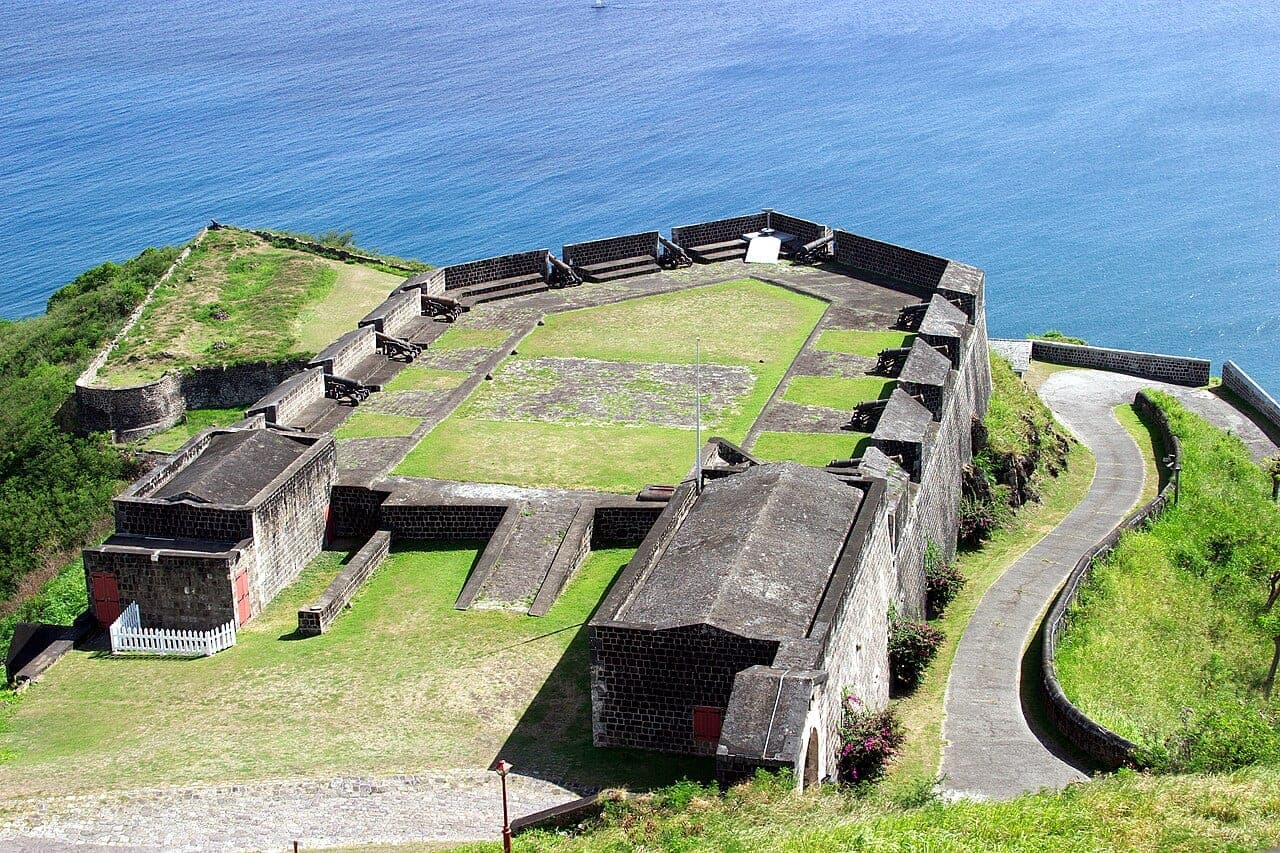
 Brimstone Hill was cut and carried into place by enslaved Africans over roughly a century, and the UNESCO citation names them as its builders. Photograph by Thank You, CC BY 2.0, via Wikimedia Commons.
In January 1624 Sir Thomas Warner landed at Old Road and planted the first lasting English colony in the Caribbean; Pierre Belain d'Esnambuc brought a French expedition the following year, and in 1627 the two powers partitioned Saint Kitts, the English holding the centre and the French the ends (Wikipedia). From this base they colonised Nevis in 1628 and, soon after, Antigua and Montserrat, which is why Saint Kitts became the mother colony of the West Indies.
The founding of that colony rested on violence against the island's first people. In 1626, fearing that the settlers would drive them out, the Kalinago were said to be preparing an attack; warned of it, Warner and d'Esnambuc struck first, killing the leaders at a gathering and hunting down the rest along the river at a place called Bloody Point ever since. Contemporary accounts, however inflated, describe some two thousand people killed and the water running red for days (Wikipedia). Organised Kalinago life on Saint Kitts came to an end, and the islands now name the killing plainly rather than pass over it.
What the settlers built on that ground was a plantation economy of grievous brutality. Tobacco gave way to sugar in the 1640s, and within a generation Saint Kitts and Nevis were among the wealthiest colonies in the Americas, their wealth extracted from enslaved Africans carried across the Atlantic in their tens of thousands. By the eighteenth century the enslaved outnumbered the free by roughly four to one; they cut and crushed the cane, boiled the sugar, and were worked, punished and buried on the estates whose stone windmills still stand across both islands. Those lives paid for fortunes made in Britain as much as in the Caribbean, and no honest account treats the ruined mills as picturesque rather than as the machinery of that system.
The rivalry of England and France ran through the colonial period, and its monument is Brimstone Hill, fortified by the British from 1690 on a volcanic outcrop above the coast and raised over the next century by enslaved Africans who quarried and hauled its stone, the largest fortress in the eastern Caribbean and the Gibraltar of the West Indies (Wikipedia). In January 1782 a French army under the Marquis de Bouillé, backed by Admiral de Grasse's fleet, took the garrison after a month's siege; the Treaty of Paris returned it to Britain the next year.
Slavery was abolished across the British Empire on 1 August 1834, though unpaid apprenticeship kept the freed people bound to the estates until 1838 (Historic St. Kitts). Sugar remained the single industry well into the twentieth century, and from 1912 a narrow-gauge railway carried cane from the estates to a central factory at Basseterre, completed in 1926 and worked each harvest for decades (Wikipedia). Conditions stayed hard enough to spark the Buckley's estate riot of 1935, part of the unrest behind the region's trade-union and independence movements.
Saint Kitts, Nevis and Anguilla were long a single colony, made a state in association with Britain in 1967. Anguilla, resisting rule from Basseterre, broke away that same year and returned to direct British administration, leaving the two remaining islands to move toward statehood as a pair. Full independence came on 19 September 1983, making the federation the last of Britain's Caribbean territories to become sovereign and the smallest in the hemisphere (Encyclopaedia Britannica).
English is the official and everyday language of the federation, but the speech of the street is Saint Kitts Creole, an English-lexicon creole shaped on the sugar estates and carrying West African grammar and vocabulary beneath its English words. Its rhythms surface in Sugar Mas songs, in the sermon and in the market, and mark a speaker as Kittitian or Nevisian at once.
The islands' names carry their history. Columbus charted them in 1493; tradition holds he named the larger island Saint Christopher, and English sailors later clipped it to Kitts, giving the odd pairing of a formal Saint Christopher and an affectionate Saint Kitts still in official use. Nevis is a Spanish inheritance: Columbus called it Nuestra Señora de las Nieves, Our Lady of the Snows, for the ring of white cloud around its peak that from the sea can resemble snow, and Nieves wore down to Nevis. Beneath both lie the Kalinago names, Liamuiga and Oualie, now revived for the volcano and for beaches and businesses across the islands.
The signature of Kittitian and Nevisian culture is Sugar Mas, the national carnival that runs from mid-December into the first days of January, its name a nod to the crop that once dictated the islands' calendar (caribbeansphere.com). It peaks at J'ouvert, the pre-dawn street jump-up on Boxing Day, but its most distinctive figures are older than the modern carnival: masquerade troupes in tall feather headdresses and ribboned costumes dance the bull, cracking whips to fife and drum in steps that blend West African and European folk forms, while moko jumbies stalk the crowd on stilts and clowns and mummers play out set pieces kept for generations.
Beside the masquerade stands the string band, small ensembles of guitar, cuatro, banjo, baha and shak-shak whose music accompanies weddings, wakes and Christmas serenading, a folk tradition kept alive alongside the amplified sound of soca. The sugar heritage runs through all of it, in the estate names people still use, in the railway that now carries visitors rather than cane, and in the food: the national dish pairs stewed saltfish with plantains and coconut dumplings, goat water stew appears at celebrations, and Nevis is known for its black pigeon peas.
Saint Kitts and Nevis is overwhelmingly Christian, with something over four-fifths of the population belonging to a church (Wikipedia). Anglicanism arrived with the first English settlers and remains a leading denomination; the stone parish churches of Saint George's in Basseterre and Saint Thomas's on Nevis are among the oldest in the Caribbean, their graveyards a register of planters, sailors and the enslaved. Methodism took deep root in the early nineteenth century, its missions closely tied to emancipation, and remains a major presence alongside Moravian, Roman Catholic and Pentecostal congregations.
Older beliefs carried from West Africa survive in the texture of daily life more than in open worship. Practices grouped under the local name obeah, a body of spiritual healing, protection and divination, persisted through slavery despite prohibition and are still consulted quietly. Folk understandings of the jumbie, the spirit of a dead person who may linger among the living, run from a child's bedtime caution to the whip-cracking bull of the masquerade, and inform the care with which the islands see their dead out of the world.
A death on Saint Kitts or Nevis draws the community in. In the older custom the body is watched over at home through a wake, a night or several of hymn-singing, scripture, prayer and shared food and drink, so the bereaved are never left alone with their grief. Hymns of the Anglican and Methodist traditions carry the night, and older people still keep the nine-night, a final gathering on the ninth evening after death, drawn from West African and wider Caribbean custom, at which the spirit is understood to take its leave.
Funerals are church-centred and unhurried, with full attendance expected across a wide circle of kin and neighbours; burial in the churchyard or family plot is usual, and graves are tended and visited, particularly at Christmas. Beneath these Christian rites runs an insistence, shared across the Afro-Caribbean world, that the dead be honoured with proper ceremony, a value with roots in the plantation era, when enslaved people were so often denied exactly that. The islands carry a wider grief as well: the unmarked burial grounds of the enslaved, and the site of Bloody Point, held in memory as the place where the Kalinago were destroyed. Emancipation each August and Independence each September are occasions of collective remembrance as much as celebration.
St Kitts was the first successful English colony in the Caribbean, and it was shared with France for seventy years, so the records begin in two languages.
English settlement dates from 1624 and French from 1625, with the island partitioned between them until 1713, so early records include French Catholic registers as well as Anglican ones. Nevis was settled from St Kitts in 1628.
Anglican parish registers survive from the seventeenth century, unusually early, and the slave registers of 1817 to 1834 name individuals with age, colour and origin. The compensation records of 1834 follow. Sugar dominated both islands for three centuries; the last estate closed in 2005.
The Nevis records include one detail with an outsized afterlife: Alexander Hamilton was born on Nevis and the probate and court records of his mother's affairs on St Croix and Nevis are among the best-documented episodes of ordinary Caribbean legal life in the period, because of who he became.
Civil registration is held by the Registrar General in Basseterre, and the National Archives hold the colonial series, with a substantial parallel body at Kew.
Brimstone Hill, the UNESCO-listed fortress, was built over a century by enslaved labour, and the engineering and ordnance records document the work if not always the workers.
The Kittitian and Nevisian diaspora, in Britain, the United States and the Virgin Islands, holds much of the twentieth-century record.
The centrepiece of the islands' heritage protection is Brimstone Hill Fortress National Park, inscribed on the UNESCO World Heritage List in 1999 as an exceptionally well-preserved example of British military architecture and of the enslaved African labour and skill that raised it (UNESCO). Restored from ruin since the 1960s and managed by the Brimstone Hill Fortress National Park Society, it draws the islands' largest share of heritage visitors and anchors interpretation of the colonial past.
On Nevis, the Nevis Historical and Conservation Society runs two museums that hold the island's memory: the Museum of Nevis History, in the reconstructed birthplace of Alexander Hamilton, and the Nelson Museum near Bath, whose collection on Horatio Nelson is among the largest anywhere. It records the years the young captain spent enforcing trade law in the Leewards and courting the Nevisian widow Frances Nisbet, whom he married on the island in 1787 with the future King William IV in attendance (Nevis Historical and Conservation Society). On Saint Kitts, the Saint Christopher National Trust protects estate ruins, churches and archives and runs the National Museum in Basseterre (St. Christopher National Trust).
Much of the documentary heritage of Saint Kitts and Nevis lies in records held far from the islands, and digitisation has begun to bring it within reach. The registers of the enslaved, compiled in the 1810s and 1820s and now at the British National Archives, are searchable online through the Legacies of British Slavery database at University College London, which traces the compensation paid to slave-owners at emancipation and lets descendants follow individual estates (Legacies of British Slavery).
Parish registers, plantation papers and colonial correspondence are increasingly available through British and Caribbean archives, and the museums maintain a growing online presence. Sugar Mas is documented year on year in video and photography, keeping family and island history in common hands for a nation with a large diaspora.
No Nevisian has shaped the wider world more than Alexander Hamilton, born in Charlestown in 1755, who left as a boy, became the first Treasury Secretary of the United States and the architect of its financial system, and returned to global fame two centuries later through the musical that bears his name (Smithsonian Magazine). Nevis embraces the connection openly, through his birthplace museum and a steady stream of visitors.
The islands' influence travels through their people too: Sugar Mas draws returning Kittitians and Nevisians from across the diaspora each Christmas, and string-band and soca artists tour the wider Caribbean. Cricket remains a shared passion, its local players representing the West Indies at Warner Park in Basseterre, which has hosted World Cup fixtures.
Brimstone Hill restored and recognised. Rescued from ruin by decades of volunteer and community work and inscribed by UNESCO in 1999, the fortress is both a national symbol and a place where the labour of the enslaved who built it is named.
The sugar train given a second life. When the sugar industry closed in 2005, the railway that served it reopened as the Saint Kitts Scenic Railway, the last working railway in the Leeward Islands, carrying visitors past the old estates.
Hamilton's birthplace as a museum. The reconstructed house on the Charlestown square where Alexander Hamilton was born now holds the Museum of Nevis History, turning a global figure's origins into a working centre of local heritage.
Sugar Mas kept in the community's hands. The Christmas carnival has grown into the federation's largest cultural event while keeping its masquerade, bull play and string bands at the centre and passing them on to new players.
Brimstone Hill was cut and carried into place by enslaved Africans over roughly a century, and the UNESCO citation names them as its builders. Photograph by Thank You, CC BY 2.0, via Wikimedia Commons.
In January 1624 Sir Thomas Warner landed at Old Road and planted the first lasting English colony in the Caribbean; Pierre Belain d'Esnambuc brought a French expedition the following year, and in 1627 the two powers partitioned Saint Kitts, the English holding the centre and the French the ends (Wikipedia). From this base they colonised Nevis in 1628 and, soon after, Antigua and Montserrat, which is why Saint Kitts became the mother colony of the West Indies.
The founding of that colony rested on violence against the island's first people. In 1626, fearing that the settlers would drive them out, the Kalinago were said to be preparing an attack; warned of it, Warner and d'Esnambuc struck first, killing the leaders at a gathering and hunting down the rest along the river at a place called Bloody Point ever since. Contemporary accounts, however inflated, describe some two thousand people killed and the water running red for days (Wikipedia). Organised Kalinago life on Saint Kitts came to an end, and the islands now name the killing plainly rather than pass over it.
What the settlers built on that ground was a plantation economy of grievous brutality. Tobacco gave way to sugar in the 1640s, and within a generation Saint Kitts and Nevis were among the wealthiest colonies in the Americas, their wealth extracted from enslaved Africans carried across the Atlantic in their tens of thousands. By the eighteenth century the enslaved outnumbered the free by roughly four to one; they cut and crushed the cane, boiled the sugar, and were worked, punished and buried on the estates whose stone windmills still stand across both islands. Those lives paid for fortunes made in Britain as much as in the Caribbean, and no honest account treats the ruined mills as picturesque rather than as the machinery of that system.
The rivalry of England and France ran through the colonial period, and its monument is Brimstone Hill, fortified by the British from 1690 on a volcanic outcrop above the coast and raised over the next century by enslaved Africans who quarried and hauled its stone, the largest fortress in the eastern Caribbean and the Gibraltar of the West Indies (Wikipedia). In January 1782 a French army under the Marquis de Bouillé, backed by Admiral de Grasse's fleet, took the garrison after a month's siege; the Treaty of Paris returned it to Britain the next year.
Slavery was abolished across the British Empire on 1 August 1834, though unpaid apprenticeship kept the freed people bound to the estates until 1838 (Historic St. Kitts). Sugar remained the single industry well into the twentieth century, and from 1912 a narrow-gauge railway carried cane from the estates to a central factory at Basseterre, completed in 1926 and worked each harvest for decades (Wikipedia). Conditions stayed hard enough to spark the Buckley's estate riot of 1935, part of the unrest behind the region's trade-union and independence movements.
Saint Kitts, Nevis and Anguilla were long a single colony, made a state in association with Britain in 1967. Anguilla, resisting rule from Basseterre, broke away that same year and returned to direct British administration, leaving the two remaining islands to move toward statehood as a pair. Full independence came on 19 September 1983, making the federation the last of Britain's Caribbean territories to become sovereign and the smallest in the hemisphere (Encyclopaedia Britannica).
English is the official and everyday language of the federation, but the speech of the street is Saint Kitts Creole, an English-lexicon creole shaped on the sugar estates and carrying West African grammar and vocabulary beneath its English words. Its rhythms surface in Sugar Mas songs, in the sermon and in the market, and mark a speaker as Kittitian or Nevisian at once.
The islands' names carry their history. Columbus charted them in 1493; tradition holds he named the larger island Saint Christopher, and English sailors later clipped it to Kitts, giving the odd pairing of a formal Saint Christopher and an affectionate Saint Kitts still in official use. Nevis is a Spanish inheritance: Columbus called it Nuestra Señora de las Nieves, Our Lady of the Snows, for the ring of white cloud around its peak that from the sea can resemble snow, and Nieves wore down to Nevis. Beneath both lie the Kalinago names, Liamuiga and Oualie, now revived for the volcano and for beaches and businesses across the islands.
The signature of Kittitian and Nevisian culture is Sugar Mas, the national carnival that runs from mid-December into the first days of January, its name a nod to the crop that once dictated the islands' calendar (caribbeansphere.com). It peaks at J'ouvert, the pre-dawn street jump-up on Boxing Day, but its most distinctive figures are older than the modern carnival: masquerade troupes in tall feather headdresses and ribboned costumes dance the bull, cracking whips to fife and drum in steps that blend West African and European folk forms, while moko jumbies stalk the crowd on stilts and clowns and mummers play out set pieces kept for generations.
Beside the masquerade stands the string band, small ensembles of guitar, cuatro, banjo, baha and shak-shak whose music accompanies weddings, wakes and Christmas serenading, a folk tradition kept alive alongside the amplified sound of soca. The sugar heritage runs through all of it, in the estate names people still use, in the railway that now carries visitors rather than cane, and in the food: the national dish pairs stewed saltfish with plantains and coconut dumplings, goat water stew appears at celebrations, and Nevis is known for its black pigeon peas.
Saint Kitts and Nevis is overwhelmingly Christian, with something over four-fifths of the population belonging to a church (Wikipedia). Anglicanism arrived with the first English settlers and remains a leading denomination; the stone parish churches of Saint George's in Basseterre and Saint Thomas's on Nevis are among the oldest in the Caribbean, their graveyards a register of planters, sailors and the enslaved. Methodism took deep root in the early nineteenth century, its missions closely tied to emancipation, and remains a major presence alongside Moravian, Roman Catholic and Pentecostal congregations.
Older beliefs carried from West Africa survive in the texture of daily life more than in open worship. Practices grouped under the local name obeah, a body of spiritual healing, protection and divination, persisted through slavery despite prohibition and are still consulted quietly. Folk understandings of the jumbie, the spirit of a dead person who may linger among the living, run from a child's bedtime caution to the whip-cracking bull of the masquerade, and inform the care with which the islands see their dead out of the world.
A death on Saint Kitts or Nevis draws the community in. In the older custom the body is watched over at home through a wake, a night or several of hymn-singing, scripture, prayer and shared food and drink, so the bereaved are never left alone with their grief. Hymns of the Anglican and Methodist traditions carry the night, and older people still keep the nine-night, a final gathering on the ninth evening after death, drawn from West African and wider Caribbean custom, at which the spirit is understood to take its leave.
Funerals are church-centred and unhurried, with full attendance expected across a wide circle of kin and neighbours; burial in the churchyard or family plot is usual, and graves are tended and visited, particularly at Christmas. Beneath these Christian rites runs an insistence, shared across the Afro-Caribbean world, that the dead be honoured with proper ceremony, a value with roots in the plantation era, when enslaved people were so often denied exactly that. The islands carry a wider grief as well: the unmarked burial grounds of the enslaved, and the site of Bloody Point, held in memory as the place where the Kalinago were destroyed. Emancipation each August and Independence each September are occasions of collective remembrance as much as celebration.
St Kitts was the first successful English colony in the Caribbean, and it was shared with France for seventy years, so the records begin in two languages.
English settlement dates from 1624 and French from 1625, with the island partitioned between them until 1713, so early records include French Catholic registers as well as Anglican ones. Nevis was settled from St Kitts in 1628.
Anglican parish registers survive from the seventeenth century, unusually early, and the slave registers of 1817 to 1834 name individuals with age, colour and origin. The compensation records of 1834 follow. Sugar dominated both islands for three centuries; the last estate closed in 2005.
The Nevis records include one detail with an outsized afterlife: Alexander Hamilton was born on Nevis and the probate and court records of his mother's affairs on St Croix and Nevis are among the best-documented episodes of ordinary Caribbean legal life in the period, because of who he became.
Civil registration is held by the Registrar General in Basseterre, and the National Archives hold the colonial series, with a substantial parallel body at Kew.
Brimstone Hill, the UNESCO-listed fortress, was built over a century by enslaved labour, and the engineering and ordnance records document the work if not always the workers.
The Kittitian and Nevisian diaspora, in Britain, the United States and the Virgin Islands, holds much of the twentieth-century record.
The centrepiece of the islands' heritage protection is Brimstone Hill Fortress National Park, inscribed on the UNESCO World Heritage List in 1999 as an exceptionally well-preserved example of British military architecture and of the enslaved African labour and skill that raised it (UNESCO). Restored from ruin since the 1960s and managed by the Brimstone Hill Fortress National Park Society, it draws the islands' largest share of heritage visitors and anchors interpretation of the colonial past.
On Nevis, the Nevis Historical and Conservation Society runs two museums that hold the island's memory: the Museum of Nevis History, in the reconstructed birthplace of Alexander Hamilton, and the Nelson Museum near Bath, whose collection on Horatio Nelson is among the largest anywhere. It records the years the young captain spent enforcing trade law in the Leewards and courting the Nevisian widow Frances Nisbet, whom he married on the island in 1787 with the future King William IV in attendance (Nevis Historical and Conservation Society). On Saint Kitts, the Saint Christopher National Trust protects estate ruins, churches and archives and runs the National Museum in Basseterre (St. Christopher National Trust).
Much of the documentary heritage of Saint Kitts and Nevis lies in records held far from the islands, and digitisation has begun to bring it within reach. The registers of the enslaved, compiled in the 1810s and 1820s and now at the British National Archives, are searchable online through the Legacies of British Slavery database at University College London, which traces the compensation paid to slave-owners at emancipation and lets descendants follow individual estates (Legacies of British Slavery).
Parish registers, plantation papers and colonial correspondence are increasingly available through British and Caribbean archives, and the museums maintain a growing online presence. Sugar Mas is documented year on year in video and photography, keeping family and island history in common hands for a nation with a large diaspora.
No Nevisian has shaped the wider world more than Alexander Hamilton, born in Charlestown in 1755, who left as a boy, became the first Treasury Secretary of the United States and the architect of its financial system, and returned to global fame two centuries later through the musical that bears his name (Smithsonian Magazine). Nevis embraces the connection openly, through his birthplace museum and a steady stream of visitors.
The islands' influence travels through their people too: Sugar Mas draws returning Kittitians and Nevisians from across the diaspora each Christmas, and string-band and soca artists tour the wider Caribbean. Cricket remains a shared passion, its local players representing the West Indies at Warner Park in Basseterre, which has hosted World Cup fixtures.
Brimstone Hill restored and recognised. Rescued from ruin by decades of volunteer and community work and inscribed by UNESCO in 1999, the fortress is both a national symbol and a place where the labour of the enslaved who built it is named.
The sugar train given a second life. When the sugar industry closed in 2005, the railway that served it reopened as the Saint Kitts Scenic Railway, the last working railway in the Leeward Islands, carrying visitors past the old estates.
Hamilton's birthplace as a museum. The reconstructed house on the Charlestown square where Alexander Hamilton was born now holds the Museum of Nevis History, turning a global figure's origins into a working centre of local heritage.
Sugar Mas kept in the community's hands. The Christmas carnival has grown into the federation's largest cultural event while keeping its masquerade, bull play and string bands at the centre and passing them on to new players.
National Overview
Notable Cities
Historical Foundations
Linguistic and Etymological Roots
Cultural Identity
Religion and Spirituality
Remembrance and Mourning Traditions
Tracing a Family in Saint Kitts and Nevis
Heritage Preservation Efforts
Digital Heritage
Contemporary Cultural Influences
Success Stories
References and resources
- UNESCO World Heritage Centre: Brimstone Hill Fortress National Park. The 1999 inscription and its justification.
- UNESCO World Heritage Centre: Saint Kitts and Nevis state party. The country's World Heritage record.
- Encyclopaedia Britannica: Saint Kitts and Nevis. Geography, history and government.
- Wikipedia: Brimstone Hill Fortress National Park. Construction, the 1782 siege and UNESCO status.
- Wikipedia: Kalinago genocide of 1626. The Bloody Point massacre and its sources.
- Wikipedia: St. Kitts Scenic Railway. The sugar railway and its conversion to a scenic line.
- Historic St. Kitts: Emancipation, 1 August 1834. Abolition and the apprenticeship system.
- Nevis Historical and Conservation Society. The Museum of Nevis History and the Nelson Museum.
- St. Christopher National Trust. Conservation of estate ruins, churches and archives on Saint Kitts.
- Legacies of British Slavery, University College London. Estate and slave-owner records for Saint Kitts and Nevis.