Heritage · Country
Antigua and Barbuda Culture and Heritage
In English Harbour the only Georgian naval dockyard still working anywhere sits above ground where enslaved hands laid every stone, and on Barbuda a lagoon shelters thousands of nesting frigatebirds over land the islanders still hold in common. A guide to the heritage of Antigua and Barbuda, and to the wakes, Carnival and emancipation memory through which two islands keep faith with their dead and their history.Written to last.
By Confinity Heritage Editorial · Updated 2026-07-31 · 8-minute readQuiet tools, kept out of the way.
Antigua and Barbuda is a small twin-island state in the eastern Caribbean, set among the Leeward Islands where the Atlantic meets the Caribbean Sea. Antigua is the larger and more populous island, ringed by so many coves and pale-sand bays that Antiguans like to say there is a beach for every day of the year; Barbuda lies some 40 kilometres to the north, low and quiet, fringed by a lagoon that shelters one of the great seabird colonies of the hemisphere. Between them the two islands carry a history far larger than their 440 square kilometres, one written in sugar, sail and the labour of enslaved people, and held now in landmarks, festivals and the customs by which the islanders remember their dead (Wikipedia).
That memory has hard edges. The Georgian dockyard at English Harbour, the only one of its kind still in use anywhere in the world, was raised by enslaved Africans for the Royal Navy, and the sugar estate at Betty's Hope, the island's first great plantation, was worked by hundreds of them (UNESCO). When freedom came on 1 August 1834, Antigua became the only sugar colony in the British Caribbean to release the enslaved at once, without the years of forced "apprenticeship" imposed elsewhere, a decision the island still marks each Carnival (Wikipedia).
Antigua and Barbuda lies in the Leeward Islands of the eastern Caribbean, roughly 17 degrees north of the equator, the state also including the small uninhabited island of Redonda. The land area is about 440 square kilometres, Antigua accounting for some 280 and Barbuda about 161, and the population is close to 106,000, most of it on Antigua (Wikipedia). The capital and only city is St John's, on Antigua's north-western coast. Both islands are low, built of limestone and coral rather than the volcanic peaks of their neighbours, with a dry climate and the pale beaches that draw visitors from around the world.
Antigua's deeply indented coast, studded with natural harbours, shaped its history: the bays that once sheltered the sugar fleets now shelter the yachts of the modern regattas. The country gained independence from the United Kingdom on 1 November 1981 and remains a Commonwealth realm, sharing the British monarch as head of state, with an economy resting today largely on tourism and offshore services (Wikipedia).
St John's. The capital gathers most of the nation's life around a deep harbour that has served as Antigua's main port for three centuries. Above the town rise the twin baroque towers of the Cathedral of St John the Divine, the Anglican cathedral rebuilt in stone in the 1840s after earthquakes destroyed its predecessors. The restored warehouses of Redcliffe Quay carry a sober history, for this was among the places where enslaved Africans were once bought and sold. The colonial Court House of 1747, the oldest building still in use in the city, houses the Museum of Antigua and Barbuda, and a few kilometres east at North Sound the Sir Vivian Richards Stadium, opened for the 2007 Cricket World Cup, honours the island's most celebrated son (Wikipedia).
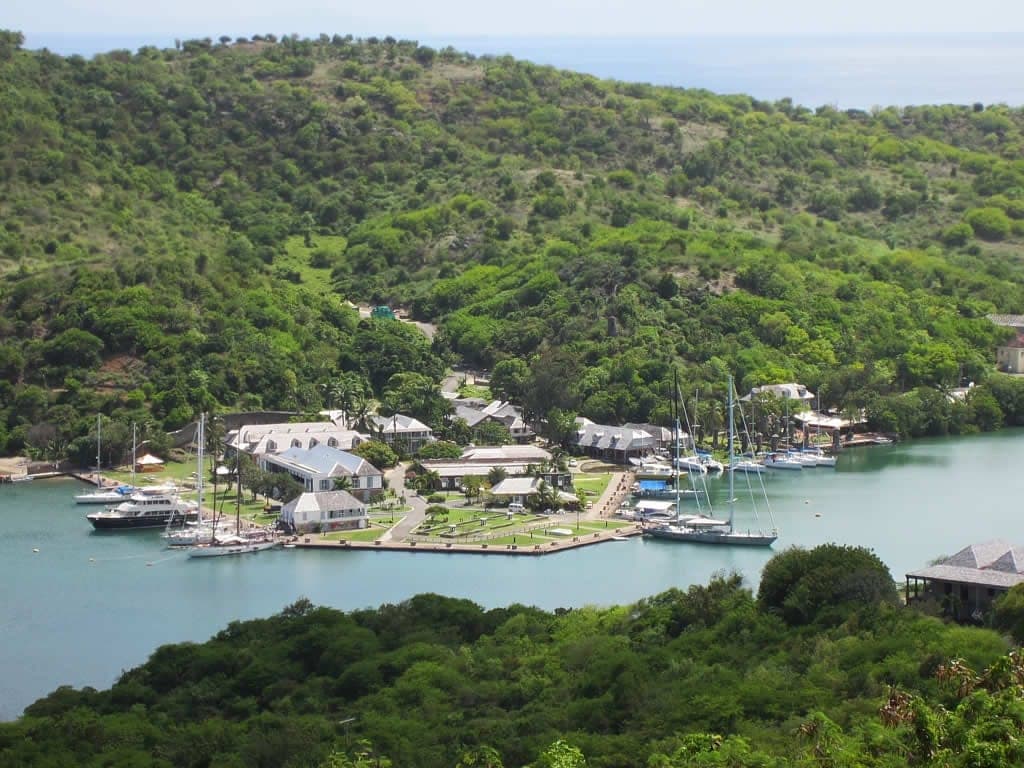
English Harbour. On Antigua's southern coast, this near-landlocked bay holds Nelson's Dockyard, the restored Georgian naval base that is the heart of the country's UNESCO World Heritage listing. Its stone quays and Georgian buildings survive as a working marina and museum, and on the ridge above sits Shirley Heights, a restored military lookout where a Sunday-evening gathering with steelband and barbecue has become an island institution (UNESCO).
Codrington. The only town on Barbuda, named for the family that leased the island from the Crown in 1685, sits beside the Codrington Lagoon. Its people have long held the island's land in common rather than as private plots, a tradition protected by the Barbuda Land Act of 2007. In September 2017 Hurricane Irma destroyed more than nine in ten of Barbuda's buildings and the entire population was evacuated to Antigua; most had returned within two years (Wikipedia).
Falmouth. Just west of English Harbour, Falmouth grew around another fine natural harbour and was one of Antigua's earliest settlements. Today Falmouth Harbour is a centre of Caribbean yachting, its anchorage filling each spring with the yachts of Antigua Sailing Week and the Classic Yacht Regatta.
The islands were peopled long before Europe knew of them. Hunter-gatherers often called the Ciboney reached Antigua by around 3100 BC, followed by Arawak-speaking Saladoid farmers who came north from the Orinoco basin and gave the islands their earliest names, Wadadli for Antigua and Wa'omoni for Barbuda (Wikipedia). Later came the Kalinago, the people the Europeans called Carib. Christopher Columbus sighted Antigua in 1493 and named it after Santa Maria la Antigua, an image venerated in Seville Cathedral, though no lasting Spanish settlement followed.
 Nelson's Dockyard is the only working Georgian naval yard left anywhere, and it was built and maintained by enslaved labour, which the site's own interpretation now says plainly. Public domain, via Wikimedia Commons.
English colonists settled Antigua in 1632, and in 1685 the Crown granted Barbuda to the Codrington family, who ran it for nearly two centuries as a single estate supplying their Antiguan plantations. On Antigua the seventeenth century brought the sugar revolution, and with it a system whose cost cannot be softened. Cane demanded relentless labour, and the planters met that demand with enslaved Africans carried across the Atlantic in their thousands. Betty's Hope, established around 1650 and held by the Codringtons from 1674, grew into the island's flagship estate; its records show 393 enslaved people at work there by 1680, and its twin windmills ground cane for generations (Wikipedia). By the eighteenth century the enslaved were the great majority of Antigua's population, and their forced labour underwrote every fortune the island produced.
That same labour built the island's most famous landmark. From the 1740s the Royal Navy developed a dockyard in the shelter of English Harbour, and enslaved men from nearby estates cut and hauled the stone, raised the walls and worked the yard alongside naval artificers (UNESCO). A young Horatio Nelson was stationed there from 1784 to 1787, and the base later took his name. The Navy abandoned the yard in 1889, and restoration began only in 1951 (Wikipedia).
Emancipation reached Antigua on 1 August 1834. Alone among the British sugar colonies, the Antigua legislature freed the enslaved outright rather than binding them to the years of unpaid "apprenticeship" imposed across the rest of the Caribbean, calculating that free labourers with nowhere else to go on a small island would cost the estates less than apprentices they had to feed and house (Wikipedia). Freedom, when it came, brought neither land nor security, and for many the change from bondage was painfully small. The islands moved slowly toward self-rule, gaining associated statehood with Britain in 1967, and Antigua and Barbuda became a single independent nation on 1 November 1981 (Wikipedia).
English is the official and working language of Antigua and Barbuda, a legacy of nearly three and a half centuries under the British Crown. In daily life, though, most people speak Antiguan and Barbudan Creole, an English-lexicon creole whose grammar, vocabulary and rhythm carry the West African languages of the enslaved who first shaped it (Wikipedia). The creole is the language of home, humour and song, and it long lived under official disapproval before being valued as the natural speech of the nation.
The name Antigua comes from the Spanish Santa Maria la Antigua, "Saint Mary the Old," the Seville image after which Columbus named the island; Barbuda is usually read as the Spanish barbuda, "bearded," thought to describe the bearded fig trees or the mossy look of its shores. Both names sit atop older ones the first islanders used, Wadadli and Wa'omoni, which Antiguans and Barbudans still invoke with pride; the national beer carries the name Wadadli to this day.
The defining event of the Antiguan year is Carnival, held from late July into the first Tuesday of August. Introduced in 1957, it deliberately gathers around the anniversary of emancipation, turning the memory of freedom into days of costume, music and street parade that reach their peak in the pre-dawn j'ouvert and the crowning of the Calypso Monarch (Wikipedia). The music that fills it runs from calypso and soca to the steelband and its pan orchestras. Older still is benna, a call-and-response folk form that grew after slavery as a way of carrying news, scandal and sly commentary from village to village; the great calypsonian King Short Shirt carried its spirit into modern social song.
The bays that once held the sugar fleets now host Antigua Sailing Week, founded in 1967 and among the leading regattas of the Caribbean, drawing about a hundred yachts and thousands of sailors and spectators to English Harbour each spring, alongside the Classic Yacht Regatta and its restored wooden vessels (Wikipedia). At the table the islands keep their own dishes: the national plate is fungie and pepperpot, cornmeal and okra cooked to a soft dumpling and served with a long-simmered stew of meat and greens, its roots in the cooking of the enslaved (Wikipedia). Ducana, a sweet dumpling of grated sweet potato and coconut, saltfish, and the small, intensely sweet Antigua black pineapple round out a cuisine of African, British and wider Caribbean threads.
Antigua and Barbuda is overwhelmingly Christian, and its churches carry the imprint of the colonial centuries. The Anglican communion, the established church of the old planter class, remains the largest single denomination at close to a fifth of the population (Wikipedia). The Moravian Church, which sent missionaries to the enslaved from the middle of the eighteenth century and gathered large congregations among them, is among the most significant, alongside Methodists, Roman Catholics, Baptists, Seventh-day Adventists and Pentecostal and Rastafarian communities.
Beneath and beside this Christian surface run older Afro-Caribbean beliefs, including the healing and spiritual practices once called obeah, long suppressed by colonial law yet never wholly gone, which shaped ideas of the spirit, of protection and of the dead that still colour island life. For most Antiguans and Barbudans faith is a public and communal matter: churches anchor village life, mark the turning points of birth, marriage and death, and lend their choirs and their calendars to the wider culture.
Death in Antigua and Barbuda is met first in the church and then in the home. A funeral usually centres on a full Christian service, Anglican, Moravian, Methodist or another, followed by burial. Around the service gathers an older communal rite, the wake, sometimes called a "nine-night" for the days it may span, when neighbours and kin fill the yard of the bereaved evening after evening to sing hymns, share food and drink, tell stories and keep the family company. Weeks or months later a memorial or thanksgiving service marks the passage from mourning back into ordinary time.
These customs carry an African inheritance as much as a Christian one, the same union of scripture and communal song that shaped the wakes of the wider Caribbean. The islands' remembrance also reaches back to the enslaved on whose labour the country was built. The restored windmills and boiling house at Betty's Hope are visited now as a place to remember the hundreds who lived and died in bondage there, just as the restored quays of St John's recall the market where people were once sold (Wikipedia). Emancipation itself is the island's largest act of public memory, kept not in solemnity alone but in the freedom-music of Carnival each August.
Antigua's records are unusually good for a small Caribbean island, and one reason is a religious community that arrived early and wrote everything down.
The Moravians came in 1756 and the Methodists in 1760, and both worked among the enslaved population and kept registers of baptisms, marriages and deaths that name people the Anglican church did not. Moravian records in particular are detailed, often noting African origins and family relationships, and they are held partly in Antigua and partly in the Moravian archives in Herrnhut and Bethlehem, Pennsylvania.
The slave registers of 1817 to 1832 name individuals with age, colour and origin. Antigua abolished slavery outright in 1834 without the apprenticeship period the other colonies used, so emancipation here is a single date rather than a process, and the compensation records name the owners paid.
Anglican parish registers run from the seventeenth century, civil registration from 1856, and the Antigua and Barbuda National Archives hold the series with parallel material at Kew.
Barbuda is a distinct case. The whole island was leased to the Codrington family, who used it to provision their Antiguan estates, and the population lived there under an arrangement that left land held in common. Barbudan land is still communal, and who counts as a Barbudan with rights in it is a live legal question, argued in court since the 2017 hurricane.
In 2016 UNESCO inscribed the Antigua Naval Dockyard and Related Archaeological Sites on the World Heritage List, recognising Nelson's Dockyard together with the forts, batteries and lookouts of English Harbour and Shirley Heights as an unusually complete Georgian naval landscape, and acknowledging that it was built and maintained by enslaved labour (UNESCO). The site sits within Nelson's Dockyard National Park, cared for by the country's National Parks Authority, which conserves the historic buildings while running the harbour as a living marina.
Elsewhere the Museum of Antigua and Barbuda, housed in the 1747 Court House in St John's and run by the Historical and Archaeological Society, holds the islands' Arawak and colonial collections and keeps the official register of historic sites (Wikipedia), while the Betty's Hope Trust has restored one of that estate's windmills and opened the grounds as an open-air museum. On Barbuda, heritage means the land itself: the communal ownership defended under the 2007 Land Act, and the Codrington Lagoon National Park that protects the frigatebird colony, both tested severely by Hurricane Irma and the reconstruction that followed (Wikipedia).
Antigua's plantation records have increasingly moved online, turning an archive of bondage into a resource for memory. University College London's Legacies of British Slavery database records the Antiguan estates, the people enslaved on them at the point of emancipation and the compensation paid to former owners in 1834, letting descendants and researchers trace the human ledger of the island's sugar economy (UCL Legacies of British Slavery). The Digital Library of the Caribbean has digitised Antiguan newspapers, colonial gazettes and photographs, making sources once locked in distant archives searchable from anywhere (dLOC).
The islands' own institutions add to this record, the Museum of Antigua and Barbuda and the National Parks publishing the history of the dockyard and the estates through their own channels. For a young nation whose paper records have been thinned by hurricanes and heat, such digital copies are insurance as much as access, keeping the evidence of the plantation economy and the culture that outlived it within reach.
For its size, Antigua has shaped world cricket to a remarkable degree, and no figure looms larger than Sir Vivian Richards. Born in St John's in 1952, he played for the West Indies from 1974 to 1991, captained the side without ever losing a Test series and is widely counted among the greatest batsmen the game has known; he was knighted in 1999, and the stadium at North Sound bears his name (Wikipedia). He was one of a line of Antiguan cricketers of the first rank, among them the fast bowlers Andy Roberts and Curtly Ambrose and the batsman Richie Richardson, and the old Antigua Recreation Ground in St John's saw Brian Lara set the record for the highest individual score in Test cricket.
Antigua's voice reaches the wider world through letters as well. The writer Jamaica Kincaid, born in St John's in 1949, has drawn on her island upbringing across her fiction and in the essay A Small Place, an unsparing reckoning with colonialism and the tourist economy. Through cricket, calypso, sailing and the written word, a nation of about a hundred thousand people keeps a presence in global culture out of all proportion to its size.
The dockyard inscribed. The 2016 UNESCO listing of the Antigua Naval Dockyard and Related Archaeological Sites secured protection for the last working Georgian naval dockyard on earth, and set its beauty honestly alongside the enslaved labour that raised it (UNESCO).
Betty's Hope remembered. Once the island's largest sugar estate, Betty's Hope has been reopened as an open-air museum with a restored windmill, giving Antiguans and visitors a place to confront the plantation economy and honour the enslaved who endured it (Wikipedia).
Barbuda's frigatebirds and its land. The Codrington Lagoon shelters one of the largest colonies of magnificent frigatebirds in the world, and the Barbudans' defence of their communal land, even through the devastation of Hurricane Irma, has kept a distinctive way of holding a homeland alive (Wikipedia).
A cricketing island honoured. From the crowds at the old Recreation Ground to the stadium named for Sir Vivian Richards, Antigua has turned its cricketing genius into lasting institutions and a source of national pride (Wikipedia).
Nelson's Dockyard is the only working Georgian naval yard left anywhere, and it was built and maintained by enslaved labour, which the site's own interpretation now says plainly. Public domain, via Wikimedia Commons.
English colonists settled Antigua in 1632, and in 1685 the Crown granted Barbuda to the Codrington family, who ran it for nearly two centuries as a single estate supplying their Antiguan plantations. On Antigua the seventeenth century brought the sugar revolution, and with it a system whose cost cannot be softened. Cane demanded relentless labour, and the planters met that demand with enslaved Africans carried across the Atlantic in their thousands. Betty's Hope, established around 1650 and held by the Codringtons from 1674, grew into the island's flagship estate; its records show 393 enslaved people at work there by 1680, and its twin windmills ground cane for generations (Wikipedia). By the eighteenth century the enslaved were the great majority of Antigua's population, and their forced labour underwrote every fortune the island produced.
That same labour built the island's most famous landmark. From the 1740s the Royal Navy developed a dockyard in the shelter of English Harbour, and enslaved men from nearby estates cut and hauled the stone, raised the walls and worked the yard alongside naval artificers (UNESCO). A young Horatio Nelson was stationed there from 1784 to 1787, and the base later took his name. The Navy abandoned the yard in 1889, and restoration began only in 1951 (Wikipedia).
Emancipation reached Antigua on 1 August 1834. Alone among the British sugar colonies, the Antigua legislature freed the enslaved outright rather than binding them to the years of unpaid "apprenticeship" imposed across the rest of the Caribbean, calculating that free labourers with nowhere else to go on a small island would cost the estates less than apprentices they had to feed and house (Wikipedia). Freedom, when it came, brought neither land nor security, and for many the change from bondage was painfully small. The islands moved slowly toward self-rule, gaining associated statehood with Britain in 1967, and Antigua and Barbuda became a single independent nation on 1 November 1981 (Wikipedia).
English is the official and working language of Antigua and Barbuda, a legacy of nearly three and a half centuries under the British Crown. In daily life, though, most people speak Antiguan and Barbudan Creole, an English-lexicon creole whose grammar, vocabulary and rhythm carry the West African languages of the enslaved who first shaped it (Wikipedia). The creole is the language of home, humour and song, and it long lived under official disapproval before being valued as the natural speech of the nation.
The name Antigua comes from the Spanish Santa Maria la Antigua, "Saint Mary the Old," the Seville image after which Columbus named the island; Barbuda is usually read as the Spanish barbuda, "bearded," thought to describe the bearded fig trees or the mossy look of its shores. Both names sit atop older ones the first islanders used, Wadadli and Wa'omoni, which Antiguans and Barbudans still invoke with pride; the national beer carries the name Wadadli to this day.
The defining event of the Antiguan year is Carnival, held from late July into the first Tuesday of August. Introduced in 1957, it deliberately gathers around the anniversary of emancipation, turning the memory of freedom into days of costume, music and street parade that reach their peak in the pre-dawn j'ouvert and the crowning of the Calypso Monarch (Wikipedia). The music that fills it runs from calypso and soca to the steelband and its pan orchestras. Older still is benna, a call-and-response folk form that grew after slavery as a way of carrying news, scandal and sly commentary from village to village; the great calypsonian King Short Shirt carried its spirit into modern social song.
The bays that once held the sugar fleets now host Antigua Sailing Week, founded in 1967 and among the leading regattas of the Caribbean, drawing about a hundred yachts and thousands of sailors and spectators to English Harbour each spring, alongside the Classic Yacht Regatta and its restored wooden vessels (Wikipedia). At the table the islands keep their own dishes: the national plate is fungie and pepperpot, cornmeal and okra cooked to a soft dumpling and served with a long-simmered stew of meat and greens, its roots in the cooking of the enslaved (Wikipedia). Ducana, a sweet dumpling of grated sweet potato and coconut, saltfish, and the small, intensely sweet Antigua black pineapple round out a cuisine of African, British and wider Caribbean threads.
Antigua and Barbuda is overwhelmingly Christian, and its churches carry the imprint of the colonial centuries. The Anglican communion, the established church of the old planter class, remains the largest single denomination at close to a fifth of the population (Wikipedia). The Moravian Church, which sent missionaries to the enslaved from the middle of the eighteenth century and gathered large congregations among them, is among the most significant, alongside Methodists, Roman Catholics, Baptists, Seventh-day Adventists and Pentecostal and Rastafarian communities.
Beneath and beside this Christian surface run older Afro-Caribbean beliefs, including the healing and spiritual practices once called obeah, long suppressed by colonial law yet never wholly gone, which shaped ideas of the spirit, of protection and of the dead that still colour island life. For most Antiguans and Barbudans faith is a public and communal matter: churches anchor village life, mark the turning points of birth, marriage and death, and lend their choirs and their calendars to the wider culture.
Death in Antigua and Barbuda is met first in the church and then in the home. A funeral usually centres on a full Christian service, Anglican, Moravian, Methodist or another, followed by burial. Around the service gathers an older communal rite, the wake, sometimes called a "nine-night" for the days it may span, when neighbours and kin fill the yard of the bereaved evening after evening to sing hymns, share food and drink, tell stories and keep the family company. Weeks or months later a memorial or thanksgiving service marks the passage from mourning back into ordinary time.
These customs carry an African inheritance as much as a Christian one, the same union of scripture and communal song that shaped the wakes of the wider Caribbean. The islands' remembrance also reaches back to the enslaved on whose labour the country was built. The restored windmills and boiling house at Betty's Hope are visited now as a place to remember the hundreds who lived and died in bondage there, just as the restored quays of St John's recall the market where people were once sold (Wikipedia). Emancipation itself is the island's largest act of public memory, kept not in solemnity alone but in the freedom-music of Carnival each August.
Antigua's records are unusually good for a small Caribbean island, and one reason is a religious community that arrived early and wrote everything down.
The Moravians came in 1756 and the Methodists in 1760, and both worked among the enslaved population and kept registers of baptisms, marriages and deaths that name people the Anglican church did not. Moravian records in particular are detailed, often noting African origins and family relationships, and they are held partly in Antigua and partly in the Moravian archives in Herrnhut and Bethlehem, Pennsylvania.
The slave registers of 1817 to 1832 name individuals with age, colour and origin. Antigua abolished slavery outright in 1834 without the apprenticeship period the other colonies used, so emancipation here is a single date rather than a process, and the compensation records name the owners paid.
Anglican parish registers run from the seventeenth century, civil registration from 1856, and the Antigua and Barbuda National Archives hold the series with parallel material at Kew.
Barbuda is a distinct case. The whole island was leased to the Codrington family, who used it to provision their Antiguan estates, and the population lived there under an arrangement that left land held in common. Barbudan land is still communal, and who counts as a Barbudan with rights in it is a live legal question, argued in court since the 2017 hurricane.
In 2016 UNESCO inscribed the Antigua Naval Dockyard and Related Archaeological Sites on the World Heritage List, recognising Nelson's Dockyard together with the forts, batteries and lookouts of English Harbour and Shirley Heights as an unusually complete Georgian naval landscape, and acknowledging that it was built and maintained by enslaved labour (UNESCO). The site sits within Nelson's Dockyard National Park, cared for by the country's National Parks Authority, which conserves the historic buildings while running the harbour as a living marina.
Elsewhere the Museum of Antigua and Barbuda, housed in the 1747 Court House in St John's and run by the Historical and Archaeological Society, holds the islands' Arawak and colonial collections and keeps the official register of historic sites (Wikipedia), while the Betty's Hope Trust has restored one of that estate's windmills and opened the grounds as an open-air museum. On Barbuda, heritage means the land itself: the communal ownership defended under the 2007 Land Act, and the Codrington Lagoon National Park that protects the frigatebird colony, both tested severely by Hurricane Irma and the reconstruction that followed (Wikipedia).
Antigua's plantation records have increasingly moved online, turning an archive of bondage into a resource for memory. University College London's Legacies of British Slavery database records the Antiguan estates, the people enslaved on them at the point of emancipation and the compensation paid to former owners in 1834, letting descendants and researchers trace the human ledger of the island's sugar economy (UCL Legacies of British Slavery). The Digital Library of the Caribbean has digitised Antiguan newspapers, colonial gazettes and photographs, making sources once locked in distant archives searchable from anywhere (dLOC).
The islands' own institutions add to this record, the Museum of Antigua and Barbuda and the National Parks publishing the history of the dockyard and the estates through their own channels. For a young nation whose paper records have been thinned by hurricanes and heat, such digital copies are insurance as much as access, keeping the evidence of the plantation economy and the culture that outlived it within reach.
For its size, Antigua has shaped world cricket to a remarkable degree, and no figure looms larger than Sir Vivian Richards. Born in St John's in 1952, he played for the West Indies from 1974 to 1991, captained the side without ever losing a Test series and is widely counted among the greatest batsmen the game has known; he was knighted in 1999, and the stadium at North Sound bears his name (Wikipedia). He was one of a line of Antiguan cricketers of the first rank, among them the fast bowlers Andy Roberts and Curtly Ambrose and the batsman Richie Richardson, and the old Antigua Recreation Ground in St John's saw Brian Lara set the record for the highest individual score in Test cricket.
Antigua's voice reaches the wider world through letters as well. The writer Jamaica Kincaid, born in St John's in 1949, has drawn on her island upbringing across her fiction and in the essay A Small Place, an unsparing reckoning with colonialism and the tourist economy. Through cricket, calypso, sailing and the written word, a nation of about a hundred thousand people keeps a presence in global culture out of all proportion to its size.
The dockyard inscribed. The 2016 UNESCO listing of the Antigua Naval Dockyard and Related Archaeological Sites secured protection for the last working Georgian naval dockyard on earth, and set its beauty honestly alongside the enslaved labour that raised it (UNESCO).
Betty's Hope remembered. Once the island's largest sugar estate, Betty's Hope has been reopened as an open-air museum with a restored windmill, giving Antiguans and visitors a place to confront the plantation economy and honour the enslaved who endured it (Wikipedia).
Barbuda's frigatebirds and its land. The Codrington Lagoon shelters one of the largest colonies of magnificent frigatebirds in the world, and the Barbudans' defence of their communal land, even through the devastation of Hurricane Irma, has kept a distinctive way of holding a homeland alive (Wikipedia).
A cricketing island honoured. From the crowds at the old Recreation Ground to the stadium named for Sir Vivian Richards, Antigua has turned its cricketing genius into lasting institutions and a source of national pride (Wikipedia).
National Overview
Notable Cities
Historical Foundations
Linguistic and Etymological Roots
Cultural Identity
Religion and Spirituality
Remembrance and Mourning Traditions
Tracing a Family in Antigua and Barbuda
Heritage Preservation Efforts
Digital Heritage
Contemporary Cultural Influences
Success Stories
References and resources
- UNESCO World Heritage Centre: Antigua Naval Dockyard and Related Archaeological Sites: the 2016 inscription covering Nelson's Dockyard and the English Harbour fortifications.
- Wikipedia: Antigua and Barbuda: geography, population, history, language and religion.
- Wikipedia: Nelson's Dockyard: the Georgian naval yard, Horatio Nelson's service and the restoration.
- Wikipedia: Betty's Hope: the Codrington sugar estate, its enslaved workforce and its museum.
- Wikipedia: Barbuda: Codrington, communal land, the frigate bird sanctuary and Hurricane Irma.
- Wikipedia: History of Antigua and Barbuda (1833–1870): emancipation in 1834 without an apprenticeship period.
- Wikipedia: Associated State of Antigua: associated statehood in 1967 and the path to independence.
- Wikipedia: Antigua Sailing Week: the regatta founded in 1967 at English Harbour.
- Wikipedia: Culture of Antigua and Barbuda: Carnival, calypso, steelband and benna.
- Wikipedia: Antigua and Barbuda cuisine: fungie and pepperpot and other island dishes.
- Wikipedia: Museum of Antigua and Barbuda: the Court House museum and the register of historic sites.
- Wikipedia: Viv Richards: the cricketer's career, knighthood and the stadium named for him.
- UCL Legacies of British Slavery: estate and compensation records for Antigua at emancipation.
- Digital Library of the Caribbean: digitised Antiguan newspapers, gazettes and photographs.
- Encyclopaedia Britannica: Antigua and Barbuda: general geography, history and political background.