Heritage · Country
Anguilla Culture and Heritage
In March 1969 British paratroopers landed on a dry limestone island whose people had rebelled in order to stay British. This is a guide to Anguillian heritage, from the petroglyphs at Big Spring to the open wooden sloops that race on every public holiday.Written to last.
By Confinity Heritage Editorial · Updated 2026-08-17 · 8-minute readQuiet tools, kept out of the way.
At first light on 19 March 1969, one hundred and thirty-five paratroopers of the Parachute Regiment came ashore on a Caribbean island of about six thousand people, followed by forty Metropolitan Police officers. They met no resistance, because the islanders were not fighting Britain. Anguillians had spent two years trying to get Britain's attention, having thrown out the police force of St Kitts, held two referendums and declared a republic, all in service of a demand the British press found comic and Anguillians found perfectly clear: they wanted to stop being governed from St Kitts and go back to being a British colony.
The rest of the island's inheritance explains why. Anguilla is flat, dry and made of coral limestone, with no rivers and thin soil, and sugar never worked here. What that produced was a scattering of smallholding families whose men went away to build other people's economies and sent money home. This is a guide to that inheritance, to the revolution that gave the island its national day, and to how Anguillians remember their dead.
Anguilla is a British Overseas Territory in the northern Leeward Islands, a single long island of about 91 square kilometres with a scatter of offshore cays, lying some ten kilometres north of Saint Martin. It runs roughly 26 kilometres end to end and is nowhere much more than five kilometres wide; the highest ground, Crocus Hill, reaches 73 metres. The island is coral and limestone rather than volcanic rock, which means it has no rivers, no streams and very little rainfall, and the soil that sits on it is thin. Around 16,000 people live here, against 13,452 at the 2011 census, and about 85 per cent identify as of African descent (Britannica). The capital is The Valley, and Anguilla has its own House of Assembly and premier under a governor appointed from London.
The Valley. The capital sits inland rather than on the coast, itself a consequence of Anguilla's history: there was no sugar port worth building a town around. Wallblake House, put up in 1787 and the oldest surviving domestic building here, stands beside St Gerard's Roman Catholic Church, whose walls were laid up in local rock and set with shells.
Sandy Ground. A narrow strip between the sea and Road Salt Pond on the north coast, Sandy Ground was the working harbour, the salt-raking centre and the port the schooners sailed from, and it remains the start and finish of the year's most important boat races.
Island Harbour. A fishing village whose families have worked the same grounds for generations, and the site of Big Spring.
Shoal Bay Village and Blowing Point. Shoal Bay Village holds Fountain Cavern, and Blowing Point on the south side is the ferry landing for Saint Martin.
People were on Anguilla long before Europeans reached it, with the earliest artefacts dated to around 1300 BC and settled village life from about AD 600. The Arawakan name for the island was Malliouhana, and its inhabitants left two sites of an importance out of all proportion to the island's size. Fountain Cavern, at Shoal Bay on the northeast coast, is a limestone cave dropping some fifteen metres from a hole in its ceiling to a freshwater pool, and it holds thirty-three petroglyphs and a stalagmite carved into a seated, cone-headed figure identified as Jocahu, the cassava deity of the Greater Antilles. The density of imported artefacts around it has led archaeologists to read the cave as a ceremonial centre for a much wider region (AAHS). Big Spring, at Island Harbour, is a partly collapsed sinkhole whose walls carry over a hundred carvings from AD 600 to 1200.
English settlers came from St Kitts in 1650 and found the land unpromising at once. Tobacco failed, cotton did a little better, and sugar could not be sustained on ground this dry. Enslaved Africans were brought here all the same, and slavery on Anguilla was real, but it was small and organised differently: with no reliable estate crop, many enslaved people were left to feed themselves from provision grounds and to work the sea. When emancipation came in 1834 and apprenticeship ended in 1838, most proprietors left for Britain, selling or abandoning their holdings, and much of Anguilla passed into the hands of the people who had been enslaved on it (Britannica). What emerged was a society of small proprietors, fishermen and sailors, poor but landed.
Poverty and land together produced a pattern of departure and return. Men raked salt at Road Pond, sailed schooners, and from the early twentieth century went in large numbers to cut cane around San Pedro de Macorís and then to the oil refineries of Aruba and Curaçao, leaving the island for months at a time as a community of women and children and sending wages back. Britain had joined Anguilla administratively to St Kitts in 1825 and federated the three islands in 1882, and Anguillians spent eighty years petitioning to be released from it.
The break came in 1967. On 27 February St Kitts, Nevis and Anguilla became an Associated State with full internal self-government under Premier Robert Bradshaw in Basseterre, which removed London as an arbiter and left Anguilla under a government it had never wanted. Protests began at once, and on 30 May Anguillians expelled the St Kitts police force and set up their own council. A referendum on 11 July returned 1,813 votes for separation and five against. Talks failed, an interim agreement lapsed, and on 7 February 1969 a second referendum voted 1,739 to 4 against any return to St Kitts, after which Ronald Webster was declared president of a self-proclaimed Republic of Anguilla (Wikipedia). A British junior minister sent to negotiate was escorted off the island by armed men in March, and Whitehall responded with Operation Sheepskin (Wikipedia). Fleet Street covered it as farce and missed the point: the troops were met with something close to relief, because a British presence was what the island had been asking for. Anguilla was placed under a British commissioner, given separate status by the Anguilla Act 1971, and formally separated from St Kitts and Nevis in 1980. Anguilla Day, on 30 May, marks the expulsion of the police and is the national holiday.
English is the language of school, court and church, but the speech of the yard and the boat is Anguillian Creole, an English-lexicon Creole of the Leeward Islands group closely related to those of St Kitts, Antigua and the Virgin Islands. Its speakers drop the copula where standard English requires it, mark tense and aspect with preverbal particles rather than inflection, and use dem to pluralise, so the grammar carries a West African shape under an English vocabulary. Older speakers keep words from the schooner trade and the salt ponds that have thinned out among the young.
The island's name is Romance rather than English. It comes from anguilla, the Italian and Latin word for eel, taken up by early European mariners for the long, low shape the island shows from the sea, and the French anguille carries the same sense; Anguillians themselves often prefer the older Malliouhana. The map is otherwise plain description: The Valley, Sandy Ground, Blowing Point, Island Harbour, Rendezvous Bay, Crocus Hill, The Quarter, Stoney Ground. Family names are a short list repeated across the island, among them Webster, Gumbs, Carty, Richardson, Hodge, Harrigan, Connor, Rogers, Lake and Vanterpool, so a surname will often place a person in a village before anything else is said.
Boat racing is the national sport of Anguilla, and it is neither a heritage revival nor a tourist attraction. It is the thing the island does. Anguilla is, as the boat-builder and writer David Carty put it, the only Commonwealth Caribbean territory where cricket comes second, and the reason lies in the century when going to sea was the only way to earn (Anguilla Archaeological and Historical Society). Fishermen working pots offshore fell into the habit of waiting for the rest of the fleet so the run home could be a race. Schooners carrying up to two hundred men down to Santo Domingo raced each other on the passage to make the discomfort bearable, and the Warspite and the Esmile became household names, with captains such as Joe Romney remembered the way other places remember footballers. When the men came back in June or July, hundreds of women walked to Sandy Ground to watch the finish, so the sport had its crowd before it had its calendar.
The boats are what make Anguillian racing unlike anything else. They are open wooden sloops, built on the island, carrying no deck at all and no external ballast, which means the crew must shift several hundred pounds of iron by hand amidships over the keel and go on shifting it as the wind changes. A race is sailed on two points instead of three: the fleet runs downwind to a stake boat some miles out, then beats back to a stake set a few yards from the beach, and the beat home is where the skill and the shouting are. The right of way that governs sailing everywhere else, by which the boat on the port tack gives way, is treated here as unthinkable. Crews and boats belong to villages, arguments about which is faster run all year, and money changes hands on the sand. The first organised August Monday race was held in 1940 with five classes, and the Anguilla Day race around the island and the August Monday race at Sandy Ground remain the year's two fixed points (Anguilla Boat Racing Association).
The rest of the calendar hangs off the same holidays. The August festivities, now the Anguilla Summer Festival, run from the emancipation anniversary through a week of racing, calypso, string band and parade, and the kitchen is a fishing kitchen: crayfish and lobster, conch, red snapper, salt fish, goat, pigeon peas cooked with rice, johnny cakes fried at the roadside.
Anguilla is a churchgoing island, and its denominations reflect nineteenth-century missionary work rather than colonial establishment. The 2001 census returned about 29 per cent Anglican and 24 per cent Methodist, with Pentecostal, Church of God and Baptist congregations accounting for a further fifth and Roman Catholics a smaller share. Methodism arrived with missionaries who preached to the enslaved and stayed to run schools, and the Anglican parish churches hold the island's older burial ground. St Gerard's in The Valley, built with rock, coral and shell gathered locally, is the Catholic parish and the reason Wallblake House survived: the estate passed to the church in the twentieth century and the house was restored under its care.
Sunday observance is taken seriously, funerals fill churches to the doors, and much ordinary Anguillian speech carries religious formulae without irony. Beneath that sits an older layer described carefully and rarely to visitors: jumbies, the unsettled dead, belong to the stock of stories told to children, and bush medicine remains in use in older households.
An Anguillian death is announced quickly and the house fills the same day. The wake keeps the family company through the night with hymns, food brought by neighbours and long talk about the dead, and in the older practice it ran on for several nights, in the pattern found across the eastern Caribbean and known in Jamaica and the Virgin Islands as nine nights (Wikipedia). Burial follows within a few days, and the funeral is a village event rather than a family one.
What Anguillians build over the grave is where the care shows. Because emancipation left ordinary families holding their own land, the older habit was to bury on it, and small family plots still sit beside houses and along village roads rather than gathered into one municipal ground. Public cemeteries came later, and the island now buries at Coronation Avenue, Sandy Hill, Sandy Ground and the churchyards; the tombs there are built above ground, rendered, painted and topped with a marker that families keep up themselves. Writing in The Anguillian, Kenneth Hodge described the cemetery as a historical site holding memory and life story for the generations coming after, and pressed families to take responsibility for the upkeep of graves rather than leaving it to church or government (The Anguillian).
Two absences shape how the island remembers. The first is the sea, which took men whose bodies never came home, in an economy where nearly every family had somebody on a boat. The second is migration: generations of Anguillians lived and died in Santo Domingo, Aruba, Curaçao, Britain and the United States, and bringing a body home for burial is an expense families still meet. Public remembrance runs on two dates. Anguilla Day belongs to the revolutionaries of 1967, and the August emancipation holidays belong to the enslaved generations who bought the island back by outlasting it.
Anguilla's records are Anglican and administrative, and for most of its history the administration was somewhere else.
The island was settled from St Kitts in 1650 and governed from there, then as part of Saint Christopher-Nevis-Anguilla, which is why so much of the older material is in Basseterre and at Kew rather than in The Valley. Anguilla's own separation, achieved after the revolution of 1967 in which islanders expelled the St Kitts police and asked to remain British, is the reason it has its own registry at all.
Anglican and Methodist church registers are the earliest vital records. The slave registers of 1827 to 1834 name the enslaved population, which was small, and the compensation records follow. Anguillan soil is poor and the plantation economy failed early, so many planters left and, unusually, a substantial number of enslaved people were left in effective possession of the land they worked, which shaped a society of smallholders rather than estates.
Seafaring is the working record. Anguillan men built and sailed schooners, worked in the Dominican Republic cane fields, in Aruba and Curaçao at the refineries, and in the Virgin Islands, and their movements are documented in the receiving territories' immigration and employment files.
The Anguilla National Archives hold what remains locally, and Hurricane Irma in 2017 damaged buildings and collections across the island.
Legislation establishing the Anguilla National Trust was passed in 1988, drawing its first council partly from the Anguilla Archaeological and Historical Society, which had been doing the survey work before there was a statutory body to do it. The Trust manages the island's protected areas, runs the marine parks and turtle monitoring, and is custodian of Fountain Cavern, designated a national park in 1985 and kept closed to casual visitors because the carvings and the cave floor cannot survive traffic (Anguilla National Trust). Big Spring is likewise protected.
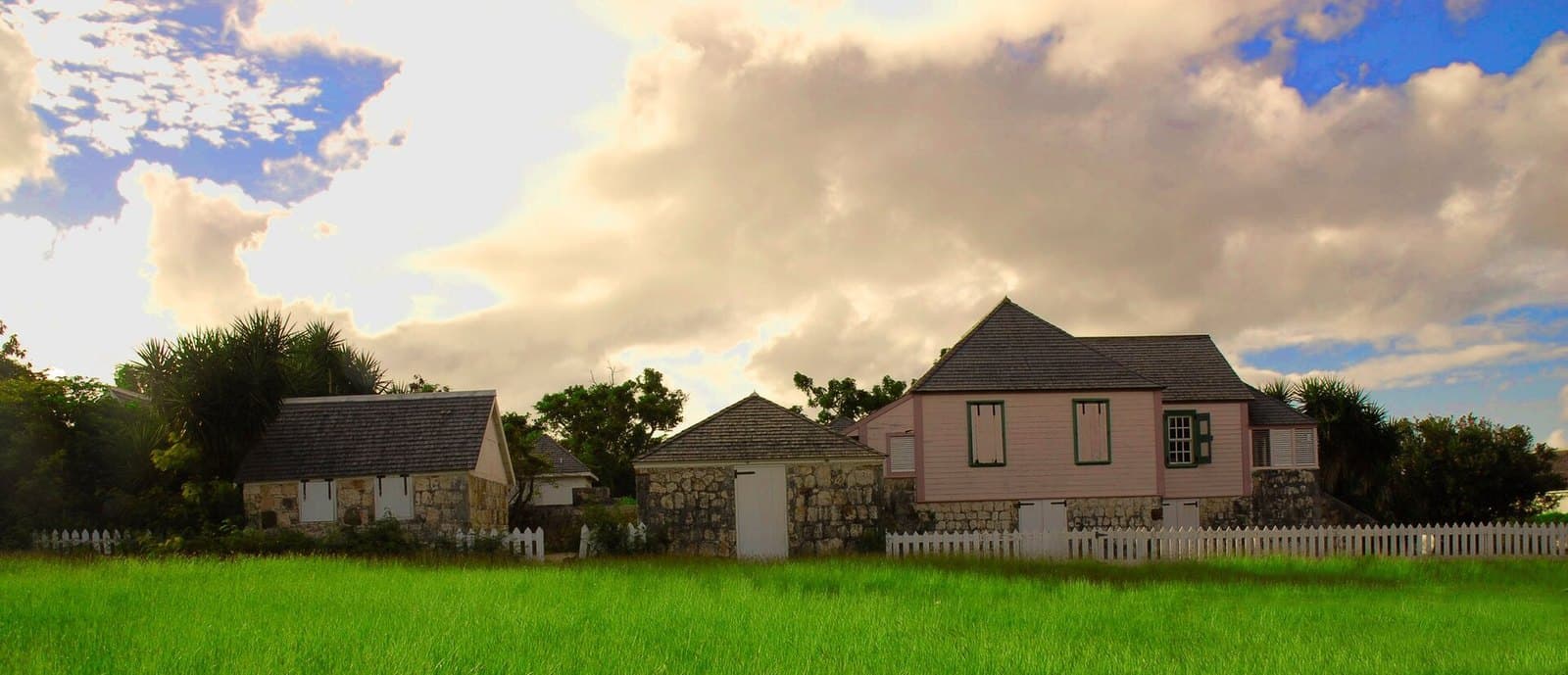
The built heritage sits on a few sites along the Anguilla Heritage Trail. Wallblake House, the 1787 planter's house in The Valley with its stone kitchen, stables and slave quarters still standing in the yard, is the only substantial eighteenth-century domestic complex to survive here and is open to visitors under the care of St Gerard's parish. The Heritage Collection Museum at East End was assembled from 1996 by Colville Petty out of his own gathering of Amerindian artefacts, salt-industry tools, revolution-era photographs and household objects, and he ran it as curator until 2024; the museum closed that March and its collection passed to the Government of Anguilla to form the basis of a national museum (Wikipedia). Everything here has to survive weather as well as neglect. Hurricane Irma passed directly over Anguilla on 6 September 2017, causing around 320 million United States dollars of damage and stripping roofs from schools, churches and historic buildings alike.
Anguilla's digital record has been built mostly by volunteers. The Anguilla Archaeological and Historical Society publishes its research library on the open web, including the excavation reports on Fountain Cavern and Big Spring and David Carty's history of boat racing, so the primary literature on the island's archaeology is free to read from anywhere (AAHS). The Anguillian, the island's weekly, keeps a searchable archive back to the early 2000s that has become the default record of obituaries, church anniversaries and festival results.
The records that matter most for family history sit in Britain. Colonial Office correspondence, census returns and the registers compiled at emancipation are held at The National Archives at Kew, and the Legacies of British Slavery database at University College London lists the 1834 compensation claims made against Anguillian holdings, naming the people paid for owning other people. The gap that remains is oral. The generation who sailed to Santo Domingo and lived through 1967 is nearly gone, and no systematic recorded oral history programme has been published.
Modern Anguilla lives on visitors and on a piece of the internet. Tourism is positioned at the expensive end of the Caribbean market, which keeps the beaches quiet and makes the economy narrow and weather-dependent, as 2017 showed. The second income is stranger. Anguilla holds the .ai country-code domain, and demand for those two letters has turned a registry into a public utility: the government reported 105.5 million East Caribbean dollars from domain fees in 2024, roughly a quarter of all revenue, on an island with no technology sector to speak of.
Culture travels with the diaspora. Anguillian communities in Britain, the United States and the wider Caribbean come home for the Summer Festival and for Anguilla Day, and the boat races are why a great many of them book flights. Bankie Banx, whose Dune Preserve at Rendezvous Bay is built largely from wrecked boats and driftwood, has carried Anguillian reggae beyond the island for four decades. The pressures Anguillians name are the ones small places always name: young people leaving and not returning, land values that put the coast out of reach of the families who farmed it, and the cost of insuring anything in a strengthening hurricane season.
A sport that never became a museum piece. Anguillian sloops are still built here, still raced without decks or fixed ballast, and still owned by villages rather than clubs.
Two ceremonial caves kept intact. Fountain Cavern and Big Spring, holding well over a hundred pre-Columbian carvings between them, were protected before tourism reached them and are managed with access controlled rather than open.
A private collection became a national one. Colville Petty's Heritage Collection Museum, built from his own gathering of artefacts over nearly thirty years, passed to the Government of Anguilla in 2024 to seed a state museum.
An island that argued its way home. The revolution of 1967 was won without a war, through referendums, petitions and refusal, and ended in 1980 with the separation Anguillians had sought since the nineteenth century.
National Overview
Notable Cities
Historical Foundations
Linguistic and Etymological Roots
Cultural Identity
Religion and Spirituality
Remembrance and Mourning Traditions
Tracing a Family in Anguilla
Heritage Preservation Efforts
Digital Heritage
Contemporary Cultural Influences
Success Stories
References and resources
- Encyclopaedia Britannica, Anguilla: geography and government.
- Britannica, Anguilla: History: settlement, emancipation and the sale of estates.
- AAHS, Fountain Cavern and Big Spring: the petroglyphs and the Jocahu stalagmite.
- David Carty, The History of Boat-Racing in Anguilla: the schooner trade and the racing rules.
- Anguilla Boat Racing Association: the calendar.
- 1969 Anguillian constitutional referendum, Wikipedia: the February vote and the republic.
- Operation Sheepskin, Wikipedia: the landing of 19 March 1969.
- Anguilla National Trust, Protected Areas: the Trust's sites and remit.
- Heritage Collection Museum, Wikipedia: the 2024 transfer.
- Wallblake House, Wikipedia: the 1787 house and its yard buildings.
- The Anguillian, Honouring Our Deceased: cemeteries and the upkeep of graves.
- Nine nights, Wikipedia: the Caribbean wake tradition.