Heritage · Country
Saint Martin Culture and Heritage
The French part of Saint Martin has held the northern two thirds of a shared island since 1648, and has been a collectivity in its own right only since 2007, when it left Guadeloupe and took charge of its own tax code. This is a guide to its heritage, from the Hope Estate excavations to Fort Louis and the lolos of Grand Case.Written to last.
By Confinity Heritage Editorial · Updated 2026-08-17 · 8-minute readQuiet tools, kept out of the way.
Saint Martin carries two borders. One was drawn across the island in 1648 and runs today past a roadside obelisk with no barrier, no booth and nobody checking anything; people cross it several times a day without registering that they have. The other is newer, invisible on the ground and consequential in every office: since 15 July 2007 the French part has been a collectivité d'outre-mer with its own general tax code, separated from Guadeloupe, which had administered it for more than three centuries.
Understanding heritage here means holding both. The northern two thirds of Soualiga have been French since a treaty signed on a hill in 1648, were governed as an outpost of a distant department until the twenty-first century, speak English at home and French at school, and were flattened in a single night in September 2017.
Saint Martin covers 53.2 square kilometres, the northern portion of an island shared with the Dutch constituent country of Sint Maarten, and the January 2021 census counted 31,477 residents (Wikipedia). The land is hilly and dry, with Pic Paradis at 424 metres, a coast of deep bays and headlands, and a chain of salt ponds and mangrove lagoons that determined where people settled and what they exported. It is an overseas collectivity of France under article 74 of the constitution, with a territorial council in Marigot, a prefect representing the state, a deputy and a senator in Paris, and, unlike its neighbour Saint-Barthélemy, continuing status as an outermost region of the European Union. French is official, English is what a great many families speak at home, and the euro is the currency although prices here are quoted in dollars as often as not. Catholicism is the largest denomination, with substantial Anglican, Methodist, Adventist and Pentecostal congregations, and the population is mostly of African and mixed descent with large Haitian, Dominican and metropolitan French communities.
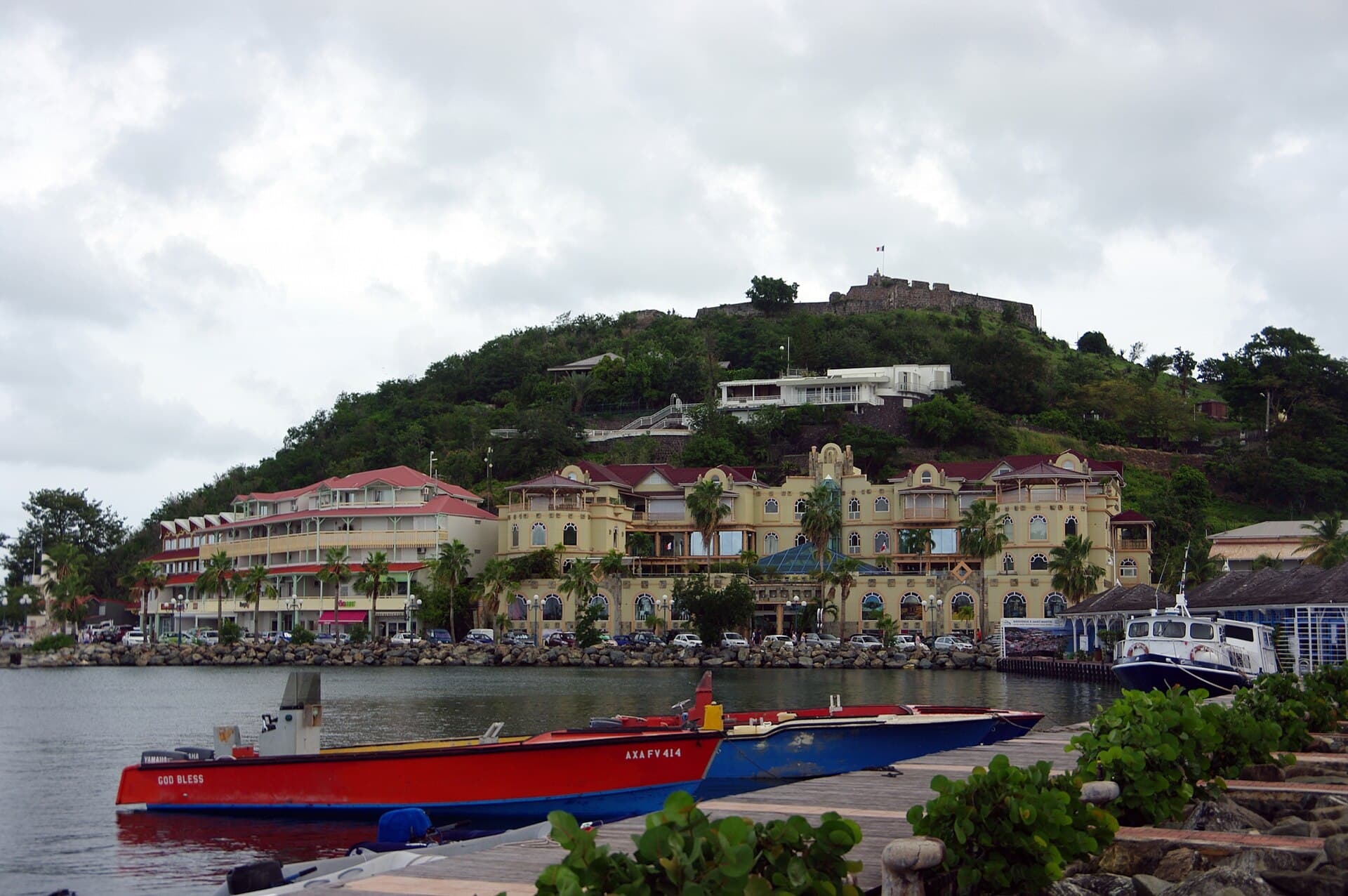
Marigot. The capital sits on the western shore between the sea and the Simpson Bay Lagoon, a town organised around a market and a fort. The waterfront market runs on Wednesdays and Saturdays with produce, fish, spices and cooked food under awnings, and the ferries to Anguilla leave from the pier beside it. On the hill above are the stone walls of Fort Louis, built in 1789, and the old streets behind the front hold the collectivity's offices, the Catholic church and the museum on rue Fichot.
Grand Case. A fishing village strung along one street behind its beach on the north-west coast, Grand Case is the eating capital of the island, with restaurant dining rooms and open-air lolos on the same boulevard. It began as a settlement of salt workers and fishers, many of them from Anguilla, who built on the beach without title and filled the lagoon edge because they could not buy land, which is also why it floods (Wikipédia). Behind it, on the plateau, is the Hope Estate archaeological site.
Quartier d'Orléans. Usually called French Quarter, this is among the oldest continuously inhabited settlements on the French side, historically the village of the island's Black population, with two church-run cemeteries. Colombier, Rambaud, Cul-de-Sac, Sandy Ground and Terres Basses make up the rest.
The earliest evidence of settlement on the island is around five thousand years old, and the most significant Amerindian site anywhere on it is on the French side. Hope Estate occupies a plateau of more than a hectare at about 80 metres, looking down over the Grand Case plain; discovered in 1987 by Michel Petit and excavated between 1991 and 2008, it produced two successive Saladoid occupations, Huecan and then Cedrosan, running roughly from 500 BC to AD 700, with decorated ceramics, worked shell and stone ornaments, and a faunal record of tens of thousands of bones showing what the villages ate (ADLFI). The Arawakan-speaking people here called the island Soualiga, land of salt. Kalinago groups came later, and Columbus sighted the coast on 11 November 1493 and named it for Martin of Tours without setting foot on it.
 Fort Louis was built in the 1760s to guard the salt ponds and the warehouses, and it was worked and defended by people who had no say in either. Photograph by Richie Diesterheft, CC BY-SA 2.0, via Wikimedia Commons.
French and Dutch settlers were both on the island by the late 1620s, working salt and tobacco alongside each other; Spain took the whole of it in 1633 and gave it up in 1648. What the French crown recorded next was a treaty. On 23 March 1648, Robert de Longvilliers for France and Martin Thomas for the States General signed the Treaty of Concordia on the hill afterwards called the Mont des Accords, dividing the island while guaranteeing free passage between the parts and common use of the harbours, the water and the salt. Read from the French side, the settlement gave France the larger and better-watered share, and it did so because a French squadron lay offshore while terms were agreed.
The story told to visitors is more entertaining. In it a Frenchman and a Dutchman were sent walking in opposite directions round the coast from a single point, the Frenchman having drunk wine and the Dutchman gin, and the Frenchman covered more ground before they met because the gin had put his rival to sleep; the line between their starting point and their meeting point became the border (Wikipedia). It is folklore, told on both sides in slightly different versions, and worth repeating as folklore. Neither government treated 1648 as settled: the line moved sixteen times before an agreement of 1817 fixed it near its present course.
Salt paid first, from the ponds at Grand Case, Chevrise and the Baie de l'Embouchure, and sugar, cotton and indigo followed on estates worked by enslaved Africans whose numbers came to far exceed the free population. Abolition arrived from Paris. The decree drafted under Victor Schœlcher was signed on 27 April 1848; Governor Layrle proclaimed it in Guadeloupe on 27 May, and it was read on Saint Martin the following day, Sunday 28 May, the date this side keeps. The historian Daniella Jeffry has noted that the effect was not instant, since the salt in the Great Salt Pond had to be lifted within ten or twelve days of the proclamation and the harvest was arranged before the freedom took hold (St Martin News Network).
The consequence for the island was lasting. The Netherlands did not abolish slavery until 1 July 1863, so for fifteen years the northern half of one small island was a jurisdiction in which a person from the southern half became free on arrival. Twenty-six people crossed from a Dutch-side estate on 29 May 1848, and when the Dutch commander wrote asking for them back, the French commander answered that anyone reaching French ground was free, and refused. More followed, and that correspondence is now on UNESCO's Memory of the World register (UNESCO).
Administratively, Saint Martin stayed a distant appendage of Guadeloupe, a commune and then from 1963 part of a third arrondissement with Saint-Barthélemy, while emigration to Curaçao, Aruba and the Virgin Islands drained the villages. Free-port status in 1939 and the 1986 loi Pons tax incentives for property investment brought a building boom and a population that multiplied several times in a generation. In December 2003 the electorate voted to leave Guadeloupe; parliament approved on 9 February 2007, and the collectivity came into being that July.
French is the language of the administration, the courts and the schools, which are run through the Académie de Guadeloupe, and it is not the mother tongue of much of the native population. Saint Martin's older families are Anglophone, descendants of a workforce that moved back and forth with Anguilla, St Kitts, Nevis and the Virgin Islands, and the prefecture has described the territory as essentially English-speaking. Guadeloupean Creole came with families and public servants from the department that governed the island until 2007, Haitian Creole and Spanish arrived with more recent migration, and children commonly grow up hearing three languages and being schooled in the one they use least at home.
The map records the same doubling. Marigot is a French colonial word for a creek or backwater, and case, in Grand Case, is the Creole word for a house. Anse Marcel, Baie Rouge and Terres Basses are plainly French; Sandy Ground, Friar's Bay, Oyster Pond and Happy Bay are plainly not, and they sit inside French territory because the people who named them lived here.
Carnival on the French side runs on the Catholic calendar. The season builds through January and February to the jours gras, with parades in Marigot and Grand Case, the election of a carnival queen, Mardi Gras itself, and then Ash Wednesday, when the crowd turns out in black and white for the vidé and Vaval, the carnival king, is burned. The Dutch side holds its Carnival in late April, on a date inherited from the Dutch royal calendar, and few things illustrate a border better than two carnivals nine weeks apart on one island of 87 square kilometres.
Food is where Saint Martin makes its strongest claim. The lolos are small open-air kitchens with grills at the front and long communal tables, serving ribs, chicken, snapper, lobster, conch, rice and peas and johnny cakes at a fraction of restaurant prices, clustered on the Marigot waterfront and along the boulevard at Grand Case beside dining rooms with French menus and wine lists. The Creole repertoire behind them, colombo, court-bouillon, accras, lambi and goat, is shared with Guadeloupe, while the johnny cakes and the guavaberry come from the Anglophone side of the family. Music mixes the two inheritances too: quadrille and mazurka from the estates, zouk and gwo ka from Guadeloupe, kompa from the Haitian community, calypso and soca from the English islands.
The island's song was written here. The priest of the French parish from 1954, a Dutchman named Gerard Kemps, composed "Saint-Martin si jolie" alongside an English version with its own words and its own melody, and the two halves of the island took up the pair as one anthem (Wikipedia).
The Catholic church here belongs to the Diocese of Basse-Terre in Guadeloupe, and its parish church in Marigot, built in 1941 and enlarged in 1971, is dedicated to St Martin of Tours (Wikipedia). What distinguishes the French side from other French Antillean territories is what surrounds that parish. Anglican and Methodist congregations have been established here for generations, because the population came from the Protestant English islands rather than from France, and Adventist, Baptist and Pentecostal churches have grown quickly since. A French village here may have a Methodist chapel at one end and a Catholic church at the other, an arrangement no commune in Guadeloupe would recognise.
Underneath sits a folk layer with two ancestries: the Guadeloupean vocabulary of quimbois and the gadèdzafè, the seer consulted about illness and interference, in families with roots in the department, and the obeah vocabulary of the Anglophone Caribbean in the older Saint Martin families, with bush medicine common to both.
The night wake is the constant. Between a death and the funeral, neighbours fill the house, coffee and rum go round, and the room works through hymns, prayers, Creole songs and stories about the person who died; in families with Anglican or Methodist roots the singing dominates, and in some the gathering carries on across nine nights. The funeral is a church service, the congregation follows the coffin on foot, and the meal afterwards is provided by everyone but the family.
Burial is above ground in family vaults, rendered white or faced in tile, added to as generations require. The collectivity manages four cemeteries, at Marigot, Grand Case, Cul-de-Sac and Saint-Georges in Quartier d'Orléans, two more are run by the church, and space in all of them is a recurring administrative problem on an island with this much pressure on land. The heart of the year for the dead is 1 November. In the days before, families come with brushes, water, paint and cement to clean and repair the vaults; then on the evening of All Saints the cemeteries fill with candles set along every ledge and slab, and people stay among the tombs into the night (Le 97150). The following day is the fête des morts, which in Creole usage belongs to the dead themselves.
Public remembrance runs to a French calendar with local dates inside it. Abolition is marked on 28 May, the day the 1848 decree was read on the island and a day later than Guadeloupe's 27 May, and France's national commemorations on 10 May and 23 May are observed as well. Then there is the saint's own day. Every 11 November the collectivity sends a delegation to the roadside obelisk that the two administrations put up in 1948 to mark three centuries since the partition, and meets the Dutch side there for a single ceremony.
The French side of the island has been a collectivity in its own right only since 2007, and before that its records were filed under Guadeloupe.
That is the first practical fact: for anything before 2007, a Saint-Martin family's civil registration, notarial acts and administrative papers are in the Guadeloupe series, held in Basse-Terre and at the French overseas archives at Aix-en-Provence, not in Marigot.
French civil registration applies from the nineteenth century and is continuous. Catholic parish registers carry the earlier vital events. Slavery was abolished in the French colonies in 1848, and the emancipation registers of that year, the registres d'individualité, record every freed person with the surname newly assigned to them, which is the single most important document for Afro-Caribbean families on the French side. Guadeloupe's are digitised.
The island's boundary has been open since 1648, so families straddle it, and a person may be French on paper and have grandparents registered in Dutch records a few kilometres away.
Saint-Martin's own recent history is the tourism economy and the storms. Hurricane Irma in 2017 was catastrophic on both sides, damaging archives along with everything else.
The pre-colonial record is Arawak and Carib and is archaeological rather than documentary, and the salt ponds, worked by enslaved labour and then by free labourers into the twentieth century, are the industrial record of the island's older economy.
Fort Louis is the collectivity's signature monument. Built in 1789 on the orders of Jean-Sébastien de Durat, governor of Saint-Martin and Saint-Barthélemy, to protect the Marigot warehouses where coffee, salt, rum and sugar were held, it was fought over, abandoned, patched in the nineteenth century and left to fall in again (Wikipédia). Restoration began in 1993, carried out by the Hope Estate archaeological association with units of the adapted military service from Guadeloupe, and the fort now belongs to the collectivity.
The same association built the museum. The Musée de Saint-Martin, subtitled "Sur la trace des Arawaks", sits on rue Fichot in Marigot and holds the Hope Estate finds with material on the colonial and plantation periods; a tripartite agreement signed on 10 July 2006 between the association, the collectivity and the regional cultural affairs directorate made it the island's archaeological repository (Musée de Saint-Martin). Irma disrupted it along with everything else, and its accommodation has been a live question since.
Natural and archaeological protection overlap. The Réserve naturelle nationale de Saint-Martin was created by decree on 3 September 1998 and covers 3,060 hectares, of which 2,796 are marine, taking in the coral, seagrass, mangrove and salt ponds of the north-east coast with the islets of Pinel and Tintamarre and the Rocher Créole off Grand Case (Réserve naturelle de Saint-Martin). Plantation traces survive inland at Spring and around Loterie Farm, and the ponds are protected partly as remains of the industry the island's Amerindian name describes.
The paper trail for Saint Martin families runs through Guadeloupe, which makes the French colonial archives the first stop. The Archives nationales d'outre-mer publish digitised état civil for the colonies, and Saint Martin's registers appear there in the Guadeloupe series, because that is how the island was administered until 2007 (ANOM). The departmental archives of Guadeloupe hold the parish and civil registers and the surviving registres des nouveaux libres, in which the people freed in 1848 were entered by name and given the surnames their descendants carry, and the Anchoukaj database indexes those registers (Anchoukaj).
Beyond genealogy, Manioc, the digital library of the Université des Antilles, carries digitised Antillean books and periodicals (Manioc). The archaeology of Hope Estate is published openly through the ADLFI bulletin and the theses of the researchers who worked the site, so a plateau above Grand Case is better documented online than most Caribbean sites of its age.
Hurricane Irma organises the present. The Category 5 storm crossed on 6 September 2017, killed eleven people on the French side and damaged the overwhelming majority of buildings; President Emmanuel Macron visited on 11 September and pledged fifty million euros. What followed has been slow and contested. Reconstruction required revising the plan for natural risk prevention, the PPRN, which forced arguments about where building should be allowed at all, and academic reviews found the process exposed tensions predating the storm (Bulletin de l'Association de géographes français). The Cour des comptes audited the recovery in both collectivities and reported in July 2021 that Saint-Barthélemy was largely rebuilt while less than half of Saint-Martin's buildings and equipment had been restored, and that the collectivity had drawn only 25 million euros of the 46 million allocated to it by the European Union Solidarity Fund (Soualiga Post).
People left. The population fell from around 36,000 in 2014 to roughly 31,500 in 2022, a decline running at about 2.3 per cent a year since 2017 and driven by out-migration rather than birth rates, while the share of residents under twenty-five dropped from 41 to 35 per cent (Faxinfo). A territory that multiplied in a generation is now shrinking and ageing at once.
The 2007 separation shapes the rest. The collectivity levies its own taxes under its own code, which was the point of leaving Guadeloupe, and manages roads, tourism, school buildings, transport and social services, while the state keeps criminal, commercial, monetary and labour law and is represented by a prefecture established in 2009. That gave Saint Martin the control it wanted and a narrow revenue base to exercise it with, and the balance between obligations and means is the standing argument of local politics. Meanwhile the older border does what it always did: people work on one side and shop on the other.
A Saladoid village kept and published. Hope Estate gave the Lesser Antilles one of its clearest stratigraphies for the Huecan and Cedrosan Saladoid, and its finds stayed on the island under the 2006 repository agreement.
A fort brought back by volunteers. Fort Louis, built in 1789 and twice abandoned, was restored from 1993 by the island's own archaeological association and is now owned by the collectivity.
A protected coast. The nature reserve created in 1998 covers 3,060 hectares of reef, seagrass, mangrove, salt pond and offshore islets, protecting the ponds that gave the island its first name.
A food culture that stayed local. The lolos of Marigot and Grand Case kept Creole grill cooking at the centre of the island's reputation, on the same street as the restaurants that made Grand Case famous.
Fort Louis was built in the 1760s to guard the salt ponds and the warehouses, and it was worked and defended by people who had no say in either. Photograph by Richie Diesterheft, CC BY-SA 2.0, via Wikimedia Commons.
French and Dutch settlers were both on the island by the late 1620s, working salt and tobacco alongside each other; Spain took the whole of it in 1633 and gave it up in 1648. What the French crown recorded next was a treaty. On 23 March 1648, Robert de Longvilliers for France and Martin Thomas for the States General signed the Treaty of Concordia on the hill afterwards called the Mont des Accords, dividing the island while guaranteeing free passage between the parts and common use of the harbours, the water and the salt. Read from the French side, the settlement gave France the larger and better-watered share, and it did so because a French squadron lay offshore while terms were agreed.
The story told to visitors is more entertaining. In it a Frenchman and a Dutchman were sent walking in opposite directions round the coast from a single point, the Frenchman having drunk wine and the Dutchman gin, and the Frenchman covered more ground before they met because the gin had put his rival to sleep; the line between their starting point and their meeting point became the border (Wikipedia). It is folklore, told on both sides in slightly different versions, and worth repeating as folklore. Neither government treated 1648 as settled: the line moved sixteen times before an agreement of 1817 fixed it near its present course.
Salt paid first, from the ponds at Grand Case, Chevrise and the Baie de l'Embouchure, and sugar, cotton and indigo followed on estates worked by enslaved Africans whose numbers came to far exceed the free population. Abolition arrived from Paris. The decree drafted under Victor Schœlcher was signed on 27 April 1848; Governor Layrle proclaimed it in Guadeloupe on 27 May, and it was read on Saint Martin the following day, Sunday 28 May, the date this side keeps. The historian Daniella Jeffry has noted that the effect was not instant, since the salt in the Great Salt Pond had to be lifted within ten or twelve days of the proclamation and the harvest was arranged before the freedom took hold (St Martin News Network).
The consequence for the island was lasting. The Netherlands did not abolish slavery until 1 July 1863, so for fifteen years the northern half of one small island was a jurisdiction in which a person from the southern half became free on arrival. Twenty-six people crossed from a Dutch-side estate on 29 May 1848, and when the Dutch commander wrote asking for them back, the French commander answered that anyone reaching French ground was free, and refused. More followed, and that correspondence is now on UNESCO's Memory of the World register (UNESCO).
Administratively, Saint Martin stayed a distant appendage of Guadeloupe, a commune and then from 1963 part of a third arrondissement with Saint-Barthélemy, while emigration to Curaçao, Aruba and the Virgin Islands drained the villages. Free-port status in 1939 and the 1986 loi Pons tax incentives for property investment brought a building boom and a population that multiplied several times in a generation. In December 2003 the electorate voted to leave Guadeloupe; parliament approved on 9 February 2007, and the collectivity came into being that July.
French is the language of the administration, the courts and the schools, which are run through the Académie de Guadeloupe, and it is not the mother tongue of much of the native population. Saint Martin's older families are Anglophone, descendants of a workforce that moved back and forth with Anguilla, St Kitts, Nevis and the Virgin Islands, and the prefecture has described the territory as essentially English-speaking. Guadeloupean Creole came with families and public servants from the department that governed the island until 2007, Haitian Creole and Spanish arrived with more recent migration, and children commonly grow up hearing three languages and being schooled in the one they use least at home.
The map records the same doubling. Marigot is a French colonial word for a creek or backwater, and case, in Grand Case, is the Creole word for a house. Anse Marcel, Baie Rouge and Terres Basses are plainly French; Sandy Ground, Friar's Bay, Oyster Pond and Happy Bay are plainly not, and they sit inside French territory because the people who named them lived here.
Carnival on the French side runs on the Catholic calendar. The season builds through January and February to the jours gras, with parades in Marigot and Grand Case, the election of a carnival queen, Mardi Gras itself, and then Ash Wednesday, when the crowd turns out in black and white for the vidé and Vaval, the carnival king, is burned. The Dutch side holds its Carnival in late April, on a date inherited from the Dutch royal calendar, and few things illustrate a border better than two carnivals nine weeks apart on one island of 87 square kilometres.
Food is where Saint Martin makes its strongest claim. The lolos are small open-air kitchens with grills at the front and long communal tables, serving ribs, chicken, snapper, lobster, conch, rice and peas and johnny cakes at a fraction of restaurant prices, clustered on the Marigot waterfront and along the boulevard at Grand Case beside dining rooms with French menus and wine lists. The Creole repertoire behind them, colombo, court-bouillon, accras, lambi and goat, is shared with Guadeloupe, while the johnny cakes and the guavaberry come from the Anglophone side of the family. Music mixes the two inheritances too: quadrille and mazurka from the estates, zouk and gwo ka from Guadeloupe, kompa from the Haitian community, calypso and soca from the English islands.
The island's song was written here. The priest of the French parish from 1954, a Dutchman named Gerard Kemps, composed "Saint-Martin si jolie" alongside an English version with its own words and its own melody, and the two halves of the island took up the pair as one anthem (Wikipedia).
The Catholic church here belongs to the Diocese of Basse-Terre in Guadeloupe, and its parish church in Marigot, built in 1941 and enlarged in 1971, is dedicated to St Martin of Tours (Wikipedia). What distinguishes the French side from other French Antillean territories is what surrounds that parish. Anglican and Methodist congregations have been established here for generations, because the population came from the Protestant English islands rather than from France, and Adventist, Baptist and Pentecostal churches have grown quickly since. A French village here may have a Methodist chapel at one end and a Catholic church at the other, an arrangement no commune in Guadeloupe would recognise.
Underneath sits a folk layer with two ancestries: the Guadeloupean vocabulary of quimbois and the gadèdzafè, the seer consulted about illness and interference, in families with roots in the department, and the obeah vocabulary of the Anglophone Caribbean in the older Saint Martin families, with bush medicine common to both.
The night wake is the constant. Between a death and the funeral, neighbours fill the house, coffee and rum go round, and the room works through hymns, prayers, Creole songs and stories about the person who died; in families with Anglican or Methodist roots the singing dominates, and in some the gathering carries on across nine nights. The funeral is a church service, the congregation follows the coffin on foot, and the meal afterwards is provided by everyone but the family.
Burial is above ground in family vaults, rendered white or faced in tile, added to as generations require. The collectivity manages four cemeteries, at Marigot, Grand Case, Cul-de-Sac and Saint-Georges in Quartier d'Orléans, two more are run by the church, and space in all of them is a recurring administrative problem on an island with this much pressure on land. The heart of the year for the dead is 1 November. In the days before, families come with brushes, water, paint and cement to clean and repair the vaults; then on the evening of All Saints the cemeteries fill with candles set along every ledge and slab, and people stay among the tombs into the night (Le 97150). The following day is the fête des morts, which in Creole usage belongs to the dead themselves.
Public remembrance runs to a French calendar with local dates inside it. Abolition is marked on 28 May, the day the 1848 decree was read on the island and a day later than Guadeloupe's 27 May, and France's national commemorations on 10 May and 23 May are observed as well. Then there is the saint's own day. Every 11 November the collectivity sends a delegation to the roadside obelisk that the two administrations put up in 1948 to mark three centuries since the partition, and meets the Dutch side there for a single ceremony.
The French side of the island has been a collectivity in its own right only since 2007, and before that its records were filed under Guadeloupe.
That is the first practical fact: for anything before 2007, a Saint-Martin family's civil registration, notarial acts and administrative papers are in the Guadeloupe series, held in Basse-Terre and at the French overseas archives at Aix-en-Provence, not in Marigot.
French civil registration applies from the nineteenth century and is continuous. Catholic parish registers carry the earlier vital events. Slavery was abolished in the French colonies in 1848, and the emancipation registers of that year, the registres d'individualité, record every freed person with the surname newly assigned to them, which is the single most important document for Afro-Caribbean families on the French side. Guadeloupe's are digitised.
The island's boundary has been open since 1648, so families straddle it, and a person may be French on paper and have grandparents registered in Dutch records a few kilometres away.
Saint-Martin's own recent history is the tourism economy and the storms. Hurricane Irma in 2017 was catastrophic on both sides, damaging archives along with everything else.
The pre-colonial record is Arawak and Carib and is archaeological rather than documentary, and the salt ponds, worked by enslaved labour and then by free labourers into the twentieth century, are the industrial record of the island's older economy.
Fort Louis is the collectivity's signature monument. Built in 1789 on the orders of Jean-Sébastien de Durat, governor of Saint-Martin and Saint-Barthélemy, to protect the Marigot warehouses where coffee, salt, rum and sugar were held, it was fought over, abandoned, patched in the nineteenth century and left to fall in again (Wikipédia). Restoration began in 1993, carried out by the Hope Estate archaeological association with units of the adapted military service from Guadeloupe, and the fort now belongs to the collectivity.
The same association built the museum. The Musée de Saint-Martin, subtitled "Sur la trace des Arawaks", sits on rue Fichot in Marigot and holds the Hope Estate finds with material on the colonial and plantation periods; a tripartite agreement signed on 10 July 2006 between the association, the collectivity and the regional cultural affairs directorate made it the island's archaeological repository (Musée de Saint-Martin). Irma disrupted it along with everything else, and its accommodation has been a live question since.
Natural and archaeological protection overlap. The Réserve naturelle nationale de Saint-Martin was created by decree on 3 September 1998 and covers 3,060 hectares, of which 2,796 are marine, taking in the coral, seagrass, mangrove and salt ponds of the north-east coast with the islets of Pinel and Tintamarre and the Rocher Créole off Grand Case (Réserve naturelle de Saint-Martin). Plantation traces survive inland at Spring and around Loterie Farm, and the ponds are protected partly as remains of the industry the island's Amerindian name describes.
The paper trail for Saint Martin families runs through Guadeloupe, which makes the French colonial archives the first stop. The Archives nationales d'outre-mer publish digitised état civil for the colonies, and Saint Martin's registers appear there in the Guadeloupe series, because that is how the island was administered until 2007 (ANOM). The departmental archives of Guadeloupe hold the parish and civil registers and the surviving registres des nouveaux libres, in which the people freed in 1848 were entered by name and given the surnames their descendants carry, and the Anchoukaj database indexes those registers (Anchoukaj).
Beyond genealogy, Manioc, the digital library of the Université des Antilles, carries digitised Antillean books and periodicals (Manioc). The archaeology of Hope Estate is published openly through the ADLFI bulletin and the theses of the researchers who worked the site, so a plateau above Grand Case is better documented online than most Caribbean sites of its age.
Hurricane Irma organises the present. The Category 5 storm crossed on 6 September 2017, killed eleven people on the French side and damaged the overwhelming majority of buildings; President Emmanuel Macron visited on 11 September and pledged fifty million euros. What followed has been slow and contested. Reconstruction required revising the plan for natural risk prevention, the PPRN, which forced arguments about where building should be allowed at all, and academic reviews found the process exposed tensions predating the storm (Bulletin de l'Association de géographes français). The Cour des comptes audited the recovery in both collectivities and reported in July 2021 that Saint-Barthélemy was largely rebuilt while less than half of Saint-Martin's buildings and equipment had been restored, and that the collectivity had drawn only 25 million euros of the 46 million allocated to it by the European Union Solidarity Fund (Soualiga Post).
People left. The population fell from around 36,000 in 2014 to roughly 31,500 in 2022, a decline running at about 2.3 per cent a year since 2017 and driven by out-migration rather than birth rates, while the share of residents under twenty-five dropped from 41 to 35 per cent (Faxinfo). A territory that multiplied in a generation is now shrinking and ageing at once.
The 2007 separation shapes the rest. The collectivity levies its own taxes under its own code, which was the point of leaving Guadeloupe, and manages roads, tourism, school buildings, transport and social services, while the state keeps criminal, commercial, monetary and labour law and is represented by a prefecture established in 2009. That gave Saint Martin the control it wanted and a narrow revenue base to exercise it with, and the balance between obligations and means is the standing argument of local politics. Meanwhile the older border does what it always did: people work on one side and shop on the other.
A Saladoid village kept and published. Hope Estate gave the Lesser Antilles one of its clearest stratigraphies for the Huecan and Cedrosan Saladoid, and its finds stayed on the island under the 2006 repository agreement.
A fort brought back by volunteers. Fort Louis, built in 1789 and twice abandoned, was restored from 1993 by the island's own archaeological association and is now owned by the collectivity.
A protected coast. The nature reserve created in 1998 covers 3,060 hectares of reef, seagrass, mangrove, salt pond and offshore islets, protecting the ponds that gave the island its first name.
A food culture that stayed local. The lolos of Marigot and Grand Case kept Creole grill cooking at the centre of the island's reputation, on the same street as the restaurants that made Grand Case famous.
National Overview
Notable Cities
Historical Foundations
Linguistic and Etymological Roots
Cultural Identity
Religion and Spirituality
Remembrance and Mourning Traditions
Tracing a Family in Saint Martin
Heritage Preservation Efforts
Digital Heritage
Contemporary Cultural Influences
Success Stories
References and resources
- Collectivity of Saint Martin, Wikipedia: status, area, population and the 2007 separation.
- Treaty of Concordia, Wikipedia: the 1648 partition and the walking-race legend.
- Saint-Martin, Hope Estate, ADLFI: excavation reports for the island's principal Amerindian site.
- Fort Louis (Marigot), Wikipédia: the 1789 fort and its 1993 restoration.
- Musée de Saint-Martin, Sur la trace des Arawaks: the Marigot museum and archaeological repository.
- Réserve naturelle nationale de Saint-Martin: the 1998 reserve and its 3,060 hectares.
- Grand-Case, Wikipédia: the village's origins among salt workers and fishers.
- St Martin News Network, Abolition of Slavery in Saint-Martin: the proclamation of 28 May 1848.
- UNESCO Memory of the World, Route to Freedom: the correspondence on crossings, 1848 to 1863.
- Soualiga Post, the Cour des comptes report on post-Irma reconstruction: the July 2021 audit.
- Bulletin de l'Association de géographes français, post-Irma reconstruction: the PPRN revision and the disputes it exposed.
- Faxinfo, population decline in Saint Martin: the demographic figures since 2017.
- Anchoukaj: surnames from the Guadeloupean registers of the newly freed.