Heritage · Country
Peru Culture and Heritage
From the five-thousand-year-old pyramids of Caral to the Inca citadel of Machu Picchu, Peru keeps one of the longest continuous records of civilisation in the Americas. It is a land where ancestors were once wrapped as mallki and kept close among the living, and where Andean families still feed and remember their own each November.Written to last.
By Confinity Heritage Editorial · Updated 2026-07-31 · 8-minute readQuiet tools, kept out of the way.
In the Andean world, the dead were never meant to leave. For centuries the peoples of what is now Peru kept their most honoured ancestors as mallki, wrapped figures carried in procession on feast days and offered food and drink as elders with a continuing voice in the ayllu, the kinship community that held land and memory in common. Over them lay Pachamama, the earth mother, and the apus, the mountain spirits, in a cosmos where the living, the departed and the land were bound in mutual obligation. Older than the Inca and never fully undone by conquest, that understanding still shapes how many Peruvian families remember their own.
Peru also holds one of the longest continuous records of civilisation in the Americas. Its sacred city of Caral was raised roughly five thousand years ago, while the pyramids of Egypt were still new; the highlands and desert coast later produced the Chavín, Paracas, Nazca, Moche and Chimú peoples, and finally the Inca, whose Tawantinsuyu was the largest empire the pre-Columbian Americas ever knew. Thirteen places now carry the UNESCO World Heritage designation, from Machu Picchu to the Andean road that once ran more than thirty thousand kilometres.
Peru covers about 1,285,216 square kilometres on the Pacific side of South America, the continent's third-largest country after Brazil and Argentina. Three landscapes divide it: the costa, a thin and mostly rainless coastal desert; the sierra, the high Andes, whose glaciated peak Huascarán reaches 6,768 metres; and the selva, the Amazon lowland to the east, which fills much of the map but holds few of its people.
Around 34 million people live in Peru, by the 2025 census, close to a third of them in greater Lima, the coastal capital and largest city. The population is mostly mestizo, of mixed Indigenous and European descent, with Quechua and Aymara peoples together about a fifth of the whole and Amazonian, Afro-Peruvian, Asian and European communities completing the picture. Spanish is the national language, while Quechua and Aymara hold co-official status where they predominate. Peru holds thirteen UNESCO World Heritage inscriptions and a long list of recognised living traditions.
Lima. Founded by Francisco Pizarro on 18 January 1535 as the Ciudad de los Reyes, the City of the Kings, Lima became the seat of Spanish power in South America and remains the country's centre of government. Its colonial core, with the cathedral and the convent of San Francisco above its catacombs, was inscribed by UNESCO in 1988, and the Larco Museum holds one of the foremost collections of ancient Peruvian art.
Cusco. The Inca capital and, in Andean belief, the navel of the world, Cusco was inscribed by UNESCO in 1983. Inca stonework still carries the colonial city: the walls of the Qorikancha, the Temple of the Sun, underpin the church of Santo Domingo, and the terraced site of Sacsayhuamán overlooks the town. It is the gateway to Machu Picchu.
Arequipa. Built of pale volcanic sillar that gives it the name the White City, Arequipa sits beneath the volcano El Misti; its historic centre was inscribed in 2000. Its Museum of Andean Sanctuaries holds the frozen remains of a young Inca girl recovered from Mount Ampato in 1995, cared for with dignity as a sacred figure.
Trujillo. Capital of the north coast, near the adobe city of Chan Chan and the Moche pyramids, Trujillo is the home of the marinera, the courtship dance many Peruvians take as their national one.
Puno. On the shore of Lake Titicaca, the highest large navigable lake in the world, Puno joins the Quechua and Aymara worlds and is the country's foremost centre of folkloric festival. Nearby rise the funerary towers of Sillustani, raised by the Colla people before the Inca.
Peru is one of the few places on earth where complex society arose on its own. In the Norte Chico region north of Lima, the people of Caral built plazas and stepped pyramids from about 3000 BCE, the oldest known urban centre in the Americas. The Chavín culture later drew pilgrims to its temple and oracle at Chavín de Huántar between about 900 and 200 BCE. On the southern coast the Paracas wove intricate mantles and wrapped their dead in great bundles, and the Nazca etched their lines and geoglyphs into the desert between roughly 100 BCE and 800 CE, later charted by the mathematician Maria Reiche. On the north coast the Moche produced some of the ancient world's finest ceramics; the tomb of the Lord of Sipán, found intact in 1987, ranks among the richest excavated in the Americas. Their successors, the Chimú, ruled from Chan Chan, the largest adobe city on the continent.
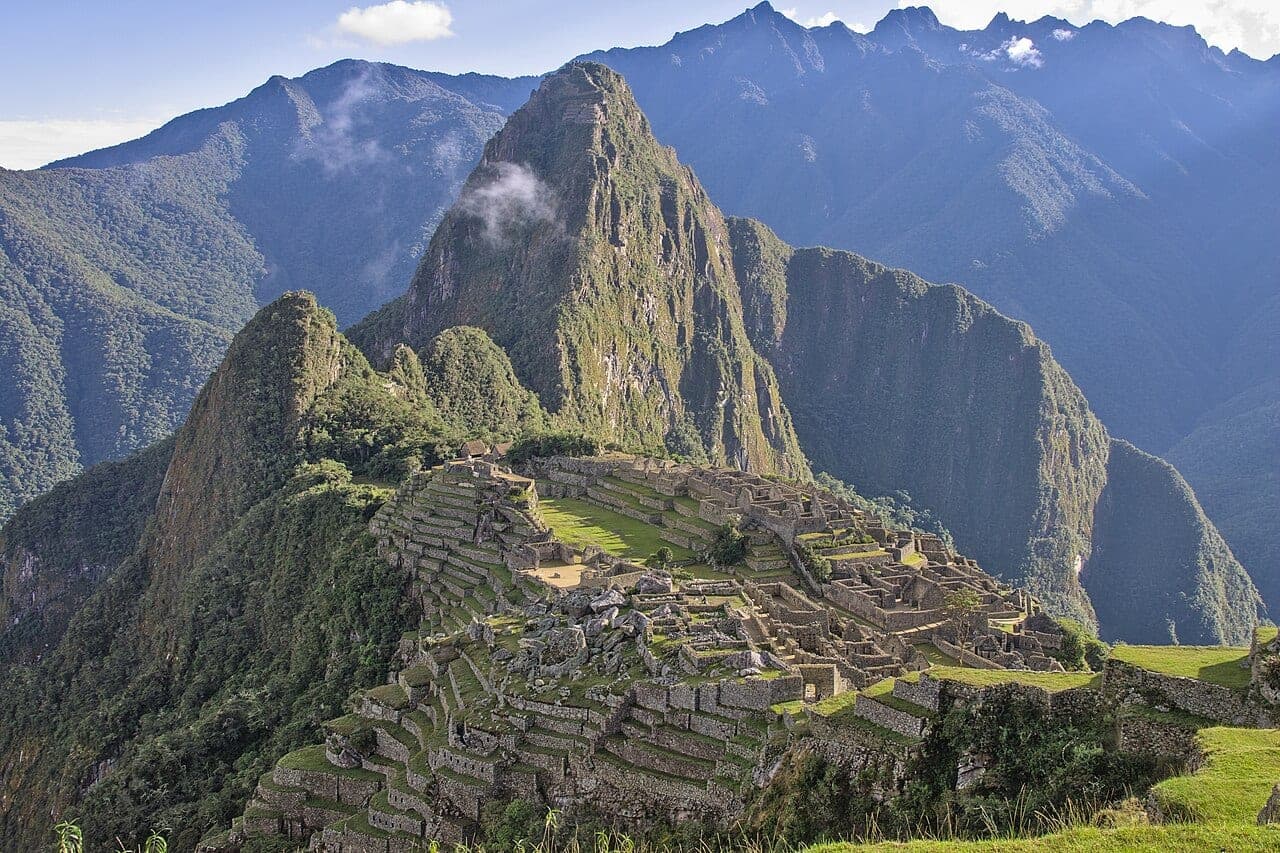
 Machu Picchu was never found by the Spanish, which is why it still stands. Photograph by Martin St-Amant, CC BY-SA 3.0, via Wikimedia Commons.
Out of the valley of Cusco a new power rose in the fifteenth century. Under the ruler Pachacuti, who took the throne about 1438, the Inca made a small kingdom into Tawantinsuyu, the Land of the Four Quarters, an empire that within three generations reached from Colombia to central Chile. They bound it with terraced fields, storehouses, the knotted-cord records called quipu and a road network of more than thirty thousand kilometres. Cusco was its sacred heart, and Machu Picchu, a royal estate on a high ridge, its most famous survival.
Civil war between the brothers Huáscar and Atahualpa had just split the empire when the Spanish arrived. On 16 November 1532 Francisco Pizarro seized Atahualpa at Cajamarca; the emperor filled a room with gold and silver for his ransom and was killed the next year. Cusco fell soon after, and in 1542 the Crown created the Viceroyalty of Peru, governed from Lima and enriched by Andean silver. Inca resistance held out at Vilcabamba until 1572, when the last ruler, Túpac Amaru, was executed; a descendant, Túpac Amaru II, led a great uprising in 1780. Independence came in stages: José de San Martín proclaimed it at Lima in 1821, and the campaigns of Simón Bolívar and Antonio José de Sucre sealed it at Ayacucho on 9 December 1824. The young republic lost southern territory to Chile in the War of the Pacific of 1879 to 1884 and endured a bitter internal conflict between 1980 and 2000, in which a Truth and Reconciliation Commission later estimated that more than sixty-nine thousand people were killed or forcibly disappeared, most of them Quechua-speaking villagers.
Spanish, brought by conquest and spread by schooling, is spoken by almost everyone, but Peru's deeper linguistic life is Andean and Amazonian. Quechua, the language of the Inca, is the most widely spoken Indigenous language of the Americas, used by several million Peruvians in a family of regional varieties across the sierra. Aymara is spoken around Lake Titicaca, and dozens of distinct languages survive among the peoples of the Amazon. Recognition of Quechua from 1975 and later laws gave these tongues official standing where they are spoken, and bilingual schooling now works to keep them alive.
The country's own name came from outside the Andes. Early Spanish explorers took it from Birú, a ruler whose lands lay near the Gulf of San Miguel in what is now Panama, and applied it loosely to the wealthy country reported to the south. The word is not of Quechua origin and was not used by the Inca, who called their realm Tawantinsuyu. Quechua has nonetheless given the world a wide vocabulary: puma, condor, llama, jerky (from charki), quinoa and coca all descend from it.
Andean weaving is among the oldest arts still in daily practice. The wrapped textiles of Paracas already showed astonishing skill more than two thousand years ago, and in villages such as Chinchero and the high Q'ero communities near Cusco women still weave on the backstrap loom, the cloth encoding a community's identity in its patterns and colours.
Machu Picchu was never found by the Spanish, which is why it still stands. Photograph by Martin St-Amant, CC BY-SA 3.0, via Wikimedia Commons.
Out of the valley of Cusco a new power rose in the fifteenth century. Under the ruler Pachacuti, who took the throne about 1438, the Inca made a small kingdom into Tawantinsuyu, the Land of the Four Quarters, an empire that within three generations reached from Colombia to central Chile. They bound it with terraced fields, storehouses, the knotted-cord records called quipu and a road network of more than thirty thousand kilometres. Cusco was its sacred heart, and Machu Picchu, a royal estate on a high ridge, its most famous survival.
Civil war between the brothers Huáscar and Atahualpa had just split the empire when the Spanish arrived. On 16 November 1532 Francisco Pizarro seized Atahualpa at Cajamarca; the emperor filled a room with gold and silver for his ransom and was killed the next year. Cusco fell soon after, and in 1542 the Crown created the Viceroyalty of Peru, governed from Lima and enriched by Andean silver. Inca resistance held out at Vilcabamba until 1572, when the last ruler, Túpac Amaru, was executed; a descendant, Túpac Amaru II, led a great uprising in 1780. Independence came in stages: José de San Martín proclaimed it at Lima in 1821, and the campaigns of Simón Bolívar and Antonio José de Sucre sealed it at Ayacucho on 9 December 1824. The young republic lost southern territory to Chile in the War of the Pacific of 1879 to 1884 and endured a bitter internal conflict between 1980 and 2000, in which a Truth and Reconciliation Commission later estimated that more than sixty-nine thousand people were killed or forcibly disappeared, most of them Quechua-speaking villagers.
Spanish, brought by conquest and spread by schooling, is spoken by almost everyone, but Peru's deeper linguistic life is Andean and Amazonian. Quechua, the language of the Inca, is the most widely spoken Indigenous language of the Americas, used by several million Peruvians in a family of regional varieties across the sierra. Aymara is spoken around Lake Titicaca, and dozens of distinct languages survive among the peoples of the Amazon. Recognition of Quechua from 1975 and later laws gave these tongues official standing where they are spoken, and bilingual schooling now works to keep them alive.
The country's own name came from outside the Andes. Early Spanish explorers took it from Birú, a ruler whose lands lay near the Gulf of San Miguel in what is now Panama, and applied it loosely to the wealthy country reported to the south. The word is not of Quechua origin and was not used by the Inca, who called their realm Tawantinsuyu. Quechua has nonetheless given the world a wide vocabulary: puma, condor, llama, jerky (from charki), quinoa and coca all descend from it.
Andean weaving is among the oldest arts still in daily practice. The wrapped textiles of Paracas already showed astonishing skill more than two thousand years ago, and in villages such as Chinchero and the high Q'ero communities near Cusco women still weave on the backstrap loom, the cloth encoding a community's identity in its patterns and colours.
 The Nazca lines survive because it almost never rains here. Photograph by Diego Delso, CC BY-SA 4.0, via Wikimedia Commons.
Peruvian cooking has become one of the country's proudest exports. Its national dish, ceviche, raw fish cured in lime and ají chilli, had its associated knowledge and practices recognised by UNESCO in 2023. Behind it lies an agricultural inheritance of great depth: the potato was domesticated in the Andes and survives in thousands of native varieties, alongside maize, quinoa, ají peppers and the grape spirit pisco. Chefs such as Gastón Acurio and Virgilio Martínez, whose Lima restaurant Central builds its menu by Andean altitude, have carried this cooking around the world.
Music and dance mark the calendar in every region. The huayno, with its charango, quena flute and panpipes, is the enduring song of the highlands; the marinera is danced in courtship along the coast; and the scissors dance of Ayacucho, in which performers compete in feats of skill to a pair of loose iron blades, was inscribed by UNESCO in 2010.
About three-quarters of Peruvians are Roman Catholic, and the faith has been woven together with Andean belief for nearly five centuries. Alongside the Mass, many communities still make offerings to Pachamama and the apus, laying out a despacho of coca leaves and other gifts to be burned or buried in thanks for good harvests and safe travel. The annual pilgrimage of Qoyllur Rit'i, which draws tens of thousands to a glacier sanctuary near Cusco and was inscribed by UNESCO in 2011, joins Catholic devotion to a far older reverence for the snow peaks.
Colonial festivals have taken deep local root. In Lima, the October processions of the Señor de los Milagros, the Lord of Miracles, are among the largest religious gatherings in South America, and in Cusco each June the festival of Inti Raymi re-enacts the Inca feast of the sun. Evangelical churches have grown in recent decades, but the sense that the sacred lives in the land itself remains widely held.
Before the conquest, Andean peoples did not part with their dead so much as change their standing. The most honoured were preserved as mallki, ancestor bundles kept by the ayllu in caves, on high shelves and in the stone funerary towers called chullpas, of which the finest surviving group rises at Sillustani. Far from being hidden, these ancestors were brought out for the great feasts, dressed and fed, consulted on marriages, planting and war, and understood as guarantors of the community's land and fertility. The dry coast preserved the wrapped dead of Paracas and, in the northern cloud forest, the Chachapoya; on the highest peaks the Inca left rare and solemn offerings, whose remains are now cared for with reverence in Peruvian museums.
Spanish priests saw idolatry in these practices and, in the campaigns known as the extirpation of idolatries, burned mallki and dismantled shrines. The veneration proved hard to end, surviving by folding itself into the Christian calendar, above all around the feast of All Saints. On the first and second of November, families across the Andes gather at the cemetery to clean and dress the graves and to spend the day with their dead over shared food, music and drink. Bakers prepare t'anta wawa, sweet bread shaped as swaddled infants, and small bread horses to carry the souls; portions are set aside for the departed, who are believed to return. Because November falls in the southern spring, a season of returning rain, the observance carries an Andean meaning older than the Church: the dead come back as the earth revives. In public, the nation keeps a similar grammar, honouring the victims of the 1980 to 2000 conflict at the memorial called El Ojo que Llora, the Eye that Weeps, in Lima.
Peruvian records are among the oldest in the Americas and among the most physically fragile.
Catholic parish registers begin within a generation of the conquest, and the archbishopric of Lima holds books from the 1530s and 1540s. As in Bolivia, many Andean parishes kept separate registers for Spaniards and for Indigenous parishioners, which means Quechua and Aymara families can be traced in the colonial record where in most colonised places they cannot. Civil registration began in 1852 and was reorganised in the twentieth century under RENIEC.
The colonial administrative archive is enormous. The Archivo General de la Nación in Lima holds notarial protocols going back to the sixteenth century, and a Peruvian will, dowry or manumission document typically names three generations. The tribute censuses, the padrones and revisitas taken to administer Indigenous obligations, list households by community across two centuries.
Peru's older record is not written at all. The quipu, knotted cords used for accounting and record-keeping under the Inca and after, encoded quantities and, in some surviving examples, appear to encode names and lineages. Most were destroyed as idolatrous, and the ones that survive are only partly readable.
The twentieth century's absence is the internal conflict of 1980 to 2000, in which around 69,000 people were killed, most of them rural Quechua speakers. The truth commission compiled a name-by-name record where it could, and the forensic teams working in Ayacucho are still returning people to their families.
Peru's Ministry of Culture oversees a heritage that spans five thousand years. Its thirteen UNESCO World Heritage sites include Cusco and Machu Picchu (both 1983), Chavín de Huántar (1985), Chan Chan (1986), the historic centres of Lima (1988) and Arequipa (2000), the Nazca and Palpa lines (1994), the sacred city of Caral (2009) and the Qhapaq Ñan, the Andean road system shared with five neighbouring countries (2014), alongside the natural parks of Huascarán and Manú.
Preservation here means managing both age and popularity. Chan Chan, vulnerable to rain and erosion, has been listed as World Heritage in Danger since its inscription, and conservators shelter its earthen reliefs. At Machu Picchu, visitor numbers are capped and timed to protect the site and its mountain setting. At Caral, the archaeologist Ruth Shady's decades of work turned a little-known valley into a protected showcase of the Americas' oldest civilisation.
Some of the most important records of Andean history survive far from the Andes, and digital work is bringing them back within reach. The illustrated chronicle of the Indigenous author Felipe Guaman Poma de Ayala, the Nueva corónica y buen gobierno, written about 1615 and held in Copenhagen since the seventeenth century, was published in full online by the Royal Danish Library from 2001, with a page-by-page facsimile and transcriptions in Spanish and Quechua. It is one of the fullest first-hand accounts of Andean life under early colonial rule, freely available to the communities it describes.
Beyond that landmark, the Ministry of Culture and Peruvian museums have digitised collections and site records, and platforms such as Google Arts and Culture host high-resolution imagery of Machu Picchu, Nazca and the Larco holdings, bringing the country's past to classrooms far from the sites themselves.
Peruvian creativity carries far beyond its borders. The novelist Mario Vargas Llosa won the Nobel Prize in Literature in 2010 for a body of work that anatomised power and resistance in Latin America; he died in Lima in 2025, mourned as a national figure. He follows a line that includes the poet César Vallejo and the novelist and ethnographer José María Arguedas, whose writing gave Quechua-speaking Peru a place in the country's literature. In 2007 Machu Picchu was named one of the New Seven Wonders of the World.
The country's cuisine has become a cultural ambassador of its own, with ceviche and pisco known worldwide and Lima counted among the leading dining cities anywhere. A large diaspora keeps Peruvian food, faith and remembrance alive across the Americas and beyond, yet what flows outward stays rooted at home in the village vigils, the woven cloth and the family graves tended each November.
A royal tomb saved from looters. The intact burial of the Lord of Sipán, recovered by Peruvian archaeologists in 1987 as grave robbers closed in, was preserved rather than scattered and now anchors the Royal Tombs of Sipán Museum in Lambayeque.
A bridge rewoven every year. The Q'eswachaka suspension bridge over the Apurímac gorge is rebuilt each June from twisted grass by the surrounding communities, using Inca technique; UNESCO inscribed the knowledge and ritual behind it in 2013.
Machu Picchu comes home. Thousands of objects taken from the site in the early twentieth century and long held at Yale University were returned to Cusco between 2011 and 2012, reuniting the finds with the place that produced them.
An Indigenous chronicle set free. The digital edition of Guaman Poma's Nueva corónica y buen gobierno has put a four-hundred-year-old Andean testimony, once accessible only to a few scholars in Copenhagen, into the hands of anyone with a connection.
The Nazca lines survive because it almost never rains here. Photograph by Diego Delso, CC BY-SA 4.0, via Wikimedia Commons.
Peruvian cooking has become one of the country's proudest exports. Its national dish, ceviche, raw fish cured in lime and ají chilli, had its associated knowledge and practices recognised by UNESCO in 2023. Behind it lies an agricultural inheritance of great depth: the potato was domesticated in the Andes and survives in thousands of native varieties, alongside maize, quinoa, ají peppers and the grape spirit pisco. Chefs such as Gastón Acurio and Virgilio Martínez, whose Lima restaurant Central builds its menu by Andean altitude, have carried this cooking around the world.
Music and dance mark the calendar in every region. The huayno, with its charango, quena flute and panpipes, is the enduring song of the highlands; the marinera is danced in courtship along the coast; and the scissors dance of Ayacucho, in which performers compete in feats of skill to a pair of loose iron blades, was inscribed by UNESCO in 2010.
About three-quarters of Peruvians are Roman Catholic, and the faith has been woven together with Andean belief for nearly five centuries. Alongside the Mass, many communities still make offerings to Pachamama and the apus, laying out a despacho of coca leaves and other gifts to be burned or buried in thanks for good harvests and safe travel. The annual pilgrimage of Qoyllur Rit'i, which draws tens of thousands to a glacier sanctuary near Cusco and was inscribed by UNESCO in 2011, joins Catholic devotion to a far older reverence for the snow peaks.
Colonial festivals have taken deep local root. In Lima, the October processions of the Señor de los Milagros, the Lord of Miracles, are among the largest religious gatherings in South America, and in Cusco each June the festival of Inti Raymi re-enacts the Inca feast of the sun. Evangelical churches have grown in recent decades, but the sense that the sacred lives in the land itself remains widely held.
Before the conquest, Andean peoples did not part with their dead so much as change their standing. The most honoured were preserved as mallki, ancestor bundles kept by the ayllu in caves, on high shelves and in the stone funerary towers called chullpas, of which the finest surviving group rises at Sillustani. Far from being hidden, these ancestors were brought out for the great feasts, dressed and fed, consulted on marriages, planting and war, and understood as guarantors of the community's land and fertility. The dry coast preserved the wrapped dead of Paracas and, in the northern cloud forest, the Chachapoya; on the highest peaks the Inca left rare and solemn offerings, whose remains are now cared for with reverence in Peruvian museums.
Spanish priests saw idolatry in these practices and, in the campaigns known as the extirpation of idolatries, burned mallki and dismantled shrines. The veneration proved hard to end, surviving by folding itself into the Christian calendar, above all around the feast of All Saints. On the first and second of November, families across the Andes gather at the cemetery to clean and dress the graves and to spend the day with their dead over shared food, music and drink. Bakers prepare t'anta wawa, sweet bread shaped as swaddled infants, and small bread horses to carry the souls; portions are set aside for the departed, who are believed to return. Because November falls in the southern spring, a season of returning rain, the observance carries an Andean meaning older than the Church: the dead come back as the earth revives. In public, the nation keeps a similar grammar, honouring the victims of the 1980 to 2000 conflict at the memorial called El Ojo que Llora, the Eye that Weeps, in Lima.
Peruvian records are among the oldest in the Americas and among the most physically fragile.
Catholic parish registers begin within a generation of the conquest, and the archbishopric of Lima holds books from the 1530s and 1540s. As in Bolivia, many Andean parishes kept separate registers for Spaniards and for Indigenous parishioners, which means Quechua and Aymara families can be traced in the colonial record where in most colonised places they cannot. Civil registration began in 1852 and was reorganised in the twentieth century under RENIEC.
The colonial administrative archive is enormous. The Archivo General de la Nación in Lima holds notarial protocols going back to the sixteenth century, and a Peruvian will, dowry or manumission document typically names three generations. The tribute censuses, the padrones and revisitas taken to administer Indigenous obligations, list households by community across two centuries.
Peru's older record is not written at all. The quipu, knotted cords used for accounting and record-keeping under the Inca and after, encoded quantities and, in some surviving examples, appear to encode names and lineages. Most were destroyed as idolatrous, and the ones that survive are only partly readable.
The twentieth century's absence is the internal conflict of 1980 to 2000, in which around 69,000 people were killed, most of them rural Quechua speakers. The truth commission compiled a name-by-name record where it could, and the forensic teams working in Ayacucho are still returning people to their families.
Peru's Ministry of Culture oversees a heritage that spans five thousand years. Its thirteen UNESCO World Heritage sites include Cusco and Machu Picchu (both 1983), Chavín de Huántar (1985), Chan Chan (1986), the historic centres of Lima (1988) and Arequipa (2000), the Nazca and Palpa lines (1994), the sacred city of Caral (2009) and the Qhapaq Ñan, the Andean road system shared with five neighbouring countries (2014), alongside the natural parks of Huascarán and Manú.
Preservation here means managing both age and popularity. Chan Chan, vulnerable to rain and erosion, has been listed as World Heritage in Danger since its inscription, and conservators shelter its earthen reliefs. At Machu Picchu, visitor numbers are capped and timed to protect the site and its mountain setting. At Caral, the archaeologist Ruth Shady's decades of work turned a little-known valley into a protected showcase of the Americas' oldest civilisation.
Some of the most important records of Andean history survive far from the Andes, and digital work is bringing them back within reach. The illustrated chronicle of the Indigenous author Felipe Guaman Poma de Ayala, the Nueva corónica y buen gobierno, written about 1615 and held in Copenhagen since the seventeenth century, was published in full online by the Royal Danish Library from 2001, with a page-by-page facsimile and transcriptions in Spanish and Quechua. It is one of the fullest first-hand accounts of Andean life under early colonial rule, freely available to the communities it describes.
Beyond that landmark, the Ministry of Culture and Peruvian museums have digitised collections and site records, and platforms such as Google Arts and Culture host high-resolution imagery of Machu Picchu, Nazca and the Larco holdings, bringing the country's past to classrooms far from the sites themselves.
Peruvian creativity carries far beyond its borders. The novelist Mario Vargas Llosa won the Nobel Prize in Literature in 2010 for a body of work that anatomised power and resistance in Latin America; he died in Lima in 2025, mourned as a national figure. He follows a line that includes the poet César Vallejo and the novelist and ethnographer José María Arguedas, whose writing gave Quechua-speaking Peru a place in the country's literature. In 2007 Machu Picchu was named one of the New Seven Wonders of the World.
The country's cuisine has become a cultural ambassador of its own, with ceviche and pisco known worldwide and Lima counted among the leading dining cities anywhere. A large diaspora keeps Peruvian food, faith and remembrance alive across the Americas and beyond, yet what flows outward stays rooted at home in the village vigils, the woven cloth and the family graves tended each November.
A royal tomb saved from looters. The intact burial of the Lord of Sipán, recovered by Peruvian archaeologists in 1987 as grave robbers closed in, was preserved rather than scattered and now anchors the Royal Tombs of Sipán Museum in Lambayeque.
A bridge rewoven every year. The Q'eswachaka suspension bridge over the Apurímac gorge is rebuilt each June from twisted grass by the surrounding communities, using Inca technique; UNESCO inscribed the knowledge and ritual behind it in 2013.
Machu Picchu comes home. Thousands of objects taken from the site in the early twentieth century and long held at Yale University were returned to Cusco between 2011 and 2012, reuniting the finds with the place that produced them.
An Indigenous chronicle set free. The digital edition of Guaman Poma's Nueva corónica y buen gobierno has put a four-hundred-year-old Andean testimony, once accessible only to a few scholars in Copenhagen, into the hands of anyone with a connection.
National Overview
Notable Cities
Historical Foundations
Linguistic and Etymological Roots
Cultural Identity
Religion and Spirituality
Remembrance and Mourning Traditions
Tracing a Family in Peru
Heritage Preservation Efforts
Digital Heritage
Contemporary Cultural Influences
Success Stories
References and resources
- UNESCO World Heritage Centre - Peru - the state-party page listing all thirteen inscribed sites.
- UNESCO World Heritage Centre - Historic Sanctuary of Machu Picchu - the mixed cultural and natural inscription of 1983.
- UNESCO World Heritage Centre - Sacred City of Caral-Supe - the oldest urban centre in the Americas.
- UNESCO World Heritage Centre - Qhapaq Ñan, Andean Road System - the Inca road network shared by six countries.
- UNESCO Intangible Cultural Heritage - Scissors dance - the danza de las tijeras of Ayacucho, inscribed 2010.
- UNESCO Intangible Cultural Heritage - Q'eswachaka bridge - the annual renewal of the last Inca rope bridge.
- Encyclopaedia Britannica - Battle of Cajamarca - the capture of Atahualpa in 1532.
- Nobel Prize - Mario Vargas Llosa - the 2010 Nobel Prize in Literature.
- The Royal Danish Library - Guaman Poma, Nueva corónica y buen gobierno - the digital edition of the illustrated chronicle.
- Truth and Reconciliation Commission (Peru) - the 2003 report on the internal conflict.