Heritage · Country
Ecuador Culture and Heritage
On the equator that gave the nation its name, Ecuador holds the Galápagos that reshaped Darwin's thinking, the best-preserved colonial core in the Americas, and Andean volcanoes that reach farther from the planet's centre than any other summit. Each November its families carry colada morada and infant-shaped guaguas de pan to the graves, feeding the dead in a rite older than any church.Written to last.
By Confinity Heritage Editorial · Updated 2026-07-31 · 8-minute readQuiet tools, kept out of the way.
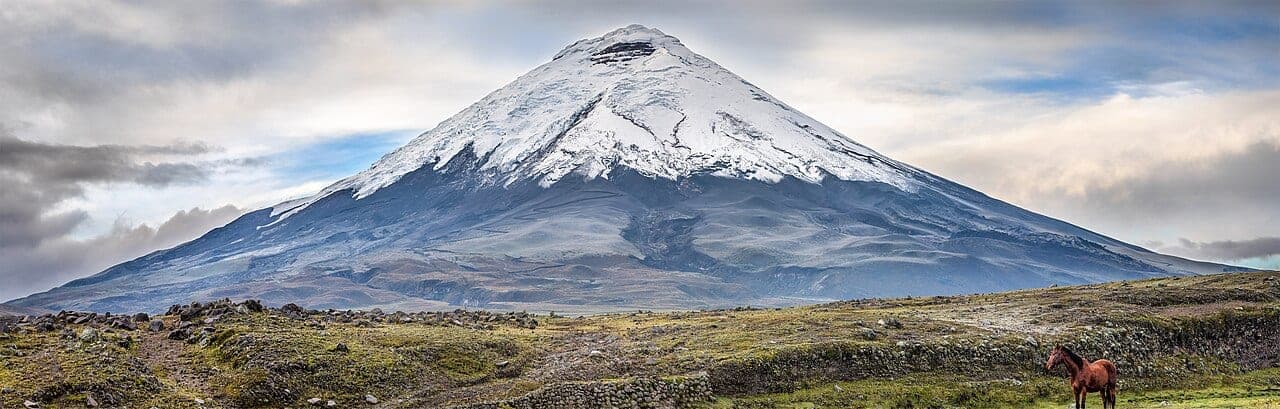
Ecuador sits astride the line that names it, a small country of extraordinary range. Within a few hours a traveller can pass from Pacific mangroves through the double file of Andean volcanoes into the western edge of the Amazon, and a thousand kilometres offshore lie the Galápagos Islands, whose finches and tortoises helped a young naturalist rethink the origin of life. The highlands are guarded by giants: Cotopaxi, one of the world's highest active volcanoes, and Chimborazo, whose summit, because the planet bulges at the equator, is the farthest point on Earth from the centre of the globe. Quito, the capital, was among the very first places anywhere to be named to the World Heritage List.
Every November families across the sierra brew colada morada, a thick purple drink of black corn and Andean berries, and bake guaguas de pan, sweet loaves shaped and painted like swaddled infants, then carry both to the cemetery to eat beside the graves. The custom joins a pre-Hispanic harvest reverence for the ancestors to the Catholic feast of All Souls, and it is one of the clearest windows into how the country holds its history close.
Ecuador is the smallest of the Andean republics, covering about 283,560 square kilometres yet among the most biologically dense on the planet. Geographers divide it into four worlds: the Costa along the Pacific, in banana plantations, cacao groves and shrimp farms; the Sierra, the volcanic corridor that Alexander von Humboldt called the Avenue of the Volcanoes; the Oriente, descending east into Amazonian rainforest; and the Galápagos, far out in the ocean. Around 18 million people live here, roughly three-quarters of them mestizo, alongside more than a million who self-identify as Indigenous and a large Afro-Ecuadorian population in Esmeraldas and the Chota valley.
Quito, in a high Andean basin at about 2,850 metres, is one of the world's highest capitals, while Guayaquil on the Guayas estuary is the largest city and main port. Spanish is the official language, with Kichwa and Shuar recognised as languages of intercultural relation. Since 2000 the country has used the United States dollar as its currency, adopted after a severe banking crisis. Ecuador carries five UNESCO World Heritage properties, and in 2008 it became the first nation to write the rights of nature, named as Pachamama, into its constitution.
Quito. Founded by the Spanish in 1534 on the ruins of an Inca settlement, the capital preserves what UNESCO calls one of the largest and least altered historic centres in Latin America. In 1978 it became, with Kraków, one of the first sites ever inscribed on the World Heritage List. Its old town holds dozens of churches, convents and squares, among them the gilded interior of La Compañía de Jesús and the plaza of San Francisco.
 Quito was among the first two places inscribed on the World Heritage List in 1978, and its centre is the least altered large colonial core in the Americas. Photograph by David Adam Kess, CC BY-SA 4.0, via Wikimedia Commons.
Guayaquil. The commercial heart of the country and its busiest port, Guayaquil spreads along the Guayas River. The restored Malecón 2000 riverfront and the painted hillside quarter of Las Peñas, its oldest district, anchor a city whose energy has long balanced the political weight of the highland capital.
Cuenca. Ecuador's third city was founded in 1557 on the Cañari settlement of Guapondelig and the Inca centre of Tomebamba. Its cobbled streets, red-tiled roofs and blue-domed New Cathedral earned the Historic Centre of Santa Ana de los Ríos de Cuenca World Heritage status in 1999. Cuenca remains a centre of the fine toquilla straw hat.
Otavalo. In the northern sierra, this Kichwa town holds one of the largest Indigenous markets in the Andes. Otavaleño weavers and traders are known across the world, carrying textiles and Andean music far beyond Ecuador while keeping their language and dress at home.
Human settlement here is old and inventive. On the Santa Elena coast the Valdivia culture produced some of the earliest fired pottery in the Americas from roughly 3500 BC, including the female figurines known as the Venuses of Valdivia. Later coastal societies followed, among them the Machalilla, Chorrera, La Tolita goldsmiths and the seafaring Manteño, who traded along the Pacific on balsa rafts. In the highlands the Quitu and the Cañari left their names to Quito and to the province of Cañar.
Quito was among the first two places inscribed on the World Heritage List in 1978, and its centre is the least altered large colonial core in the Americas. Photograph by David Adam Kess, CC BY-SA 4.0, via Wikimedia Commons.
Guayaquil. The commercial heart of the country and its busiest port, Guayaquil spreads along the Guayas River. The restored Malecón 2000 riverfront and the painted hillside quarter of Las Peñas, its oldest district, anchor a city whose energy has long balanced the political weight of the highland capital.
Cuenca. Ecuador's third city was founded in 1557 on the Cañari settlement of Guapondelig and the Inca centre of Tomebamba. Its cobbled streets, red-tiled roofs and blue-domed New Cathedral earned the Historic Centre of Santa Ana de los Ríos de Cuenca World Heritage status in 1999. Cuenca remains a centre of the fine toquilla straw hat.
Otavalo. In the northern sierra, this Kichwa town holds one of the largest Indigenous markets in the Andes. Otavaleño weavers and traders are known across the world, carrying textiles and Andean music far beyond Ecuador while keeping their language and dress at home.
Human settlement here is old and inventive. On the Santa Elena coast the Valdivia culture produced some of the earliest fired pottery in the Americas from roughly 3500 BC, including the female figurines known as the Venuses of Valdivia. Later coastal societies followed, among them the Machalilla, Chorrera, La Tolita goldsmiths and the seafaring Manteño, who traded along the Pacific on balsa rafts. In the highlands the Quitu and the Cañari left their names to Quito and to the province of Cañar.
 Ingapirca is Inca masonry built onto a Canari site, and the two peoples' structures stand next to each other rather than one replacing the other. Photograph by Cayambe, CC BY-SA 3.0, via Wikimedia Commons.
In the later fifteenth century the Inca pushed north under Túpac Yupanqui and his son Huayna Capac, who made Tomebamba, on the site of modern Cuenca, a northern capital he favoured over Cusco. At Ingapirca, Inca masons raised an elliptical Temple of the Sun on older Cañari foundations, still the country's most complete Inca monument. Huayna Capac died around 1527, probably of a European disease that ran ahead of the conquistadors, and the empire fell into civil war between his sons Atahualpa and Huáscar just as the Spanish arrived.
Sebastián de Benalcázar founded Spanish Quito in 1534, after the Inca general Rumiñahui burned the city rather than surrender it. Colonial rule ran through the Real Audiencia de Quito, created in 1563 under the Viceroyalty of Peru and later transferred to New Granada. Discontent surfaced early: on 10 August 1809 Quito raised what is remembered as the first cry of independence in Spanish America. Full liberation came with the Battle of Pichincha on 24 May 1822, when Antonio José de Sucre defeated the royalist army on the volcano's slopes above the city.
Freed Quito joined Simón Bolívar's union of Gran Colombia, but regional rivalry strained the arrangement, and on 13 May 1830 the territory left it to become the Republic of Ecuador under its first president, Juan José Flores. The republic swung between conservative and liberal camps until Eloy Alfaro's Liberal Revolution of 1895 secularised the state and built the Guayaquil-Quito railway. Cacao and then banana booms shaped the economy, oil transformed it after 1972, and dollarization in 2000 and a reforming constitution in 2008 opened the modern era.
The country's name is a plain geographical fact turned into an identity. Ecuador is simply the Spanish word for the equator, the imaginary line that crosses the country a short distance north of Quito. The choice was reinforced by the fame of the French Geodesic Mission of 1735–1744, led by Charles Marie de La Condamine, which came to measure the shape of the Earth at the equator, and the name República del Ecuador was fixed at independence in 1830.
Spanish is the official and majority language, but it shares the ground with Indigenous tongues that the 2008 constitution recognises. Kichwa, the Ecuadorian branch of the wider Quechua family once spread by the Inca, is by far the largest, with hundreds of thousands of speakers across the sierra and parts of the Amazon. Shuar is the main language of the southern Amazon, and more than a dozen further Amazonian and coastal languages, from Achuar to A'ingae and Tsafiki, are spoken by their nations. The land itself keeps this older memory in its place names: Cotopaxi, Chimborazo, Pichincha, Guayas and Napo all carry Indigenous roots, and the word guagua, used for the infant-shaped breads of the day of the dead, is Kichwa for baby.
Ecuador's most travelled object is misnamed. The Panama hat is Ecuadorian, woven from the pale fibre of the toquilla palm in the coastal town of Montecristi and around Cuenca; it took the wrong name in the nineteenth century, when the hats were shipped through Panama and worn by workers on the canal. The finest take months to weave, and in 2012 UNESCO added the traditional weaving of the Ecuadorian toquilla straw hat to its intangible heritage list, honouring the mostly women artisans who pass the skill within their families.
Music runs deep in daily life. The pasillo, a melancholic waltz-time song, is the national genre, and its greatest voice, the Guayaquil singer Julio Jaramillo, is remembered every 1 October as the Day of the Ecuadorian Pasillo. In the sierra the sanjuanito sets festivities dancing, while on the northern coast the marimba of the Afro-Ecuadorian people of Esmeraldas, shared with Colombia, holds its own place on UNESCO's intangible list. The table gathers the regions too: shrimp ceviche and encebollado, a tuna and cassava soup eaten at breakfast, on the coast; hornado roast pork, llapingacho potato cakes and highland roasted cuy; and the Lenten soup fanesca of twelve grains for Holy Week. Ecuador is also a homeland of fine cacao, the aromatic nacional variety prized by chocolate makers worldwide.
Ecuador is a historically Catholic country: about three-quarters of the population identify as Roman Catholic, with a growing evangelical minority near 15 per cent. The faith left a distinctive artistic legacy in the Escuela Quiteña, the colonial school of painting and polychrome sculpture whose gilded saints and dark Christs fill the churches of the old capital. Marian devotion remains strong, from the winged Virgin of Quito on the Panecillo hill to the highland pilgrimages.
Beneath and within that Catholicism runs an Andean spirituality that colonial pressure never erased. Kichwa communities honour Pachamama, the earth mother, and the apus, the spirits of the mountains, and the two systems have grown together over centuries so that a saint's day and an older agricultural rite often share a calendar. The June solstice brings Inti Raymi, the festival of the sun, celebrated with music, bathing rituals and dance across the northern sierra. In the Amazon, the Shuar, Achuar and other nations keep cosmologies bound to the forest and its plants, treating healing and dreaming as spiritual work. This layering is why the country could name Pachamama in its 2008 constitution without contradiction.
Death in Ecuador is met first with company. The velorio, or wake, keeps family and neighbours beside the body through the night with coffee, prayer and quiet talk, and after the burial a novena of nine evenings of the rosary carries the household through the first weeks of grief. Anniversary masses and printed notices mark the years that follow. What gives Ecuadorian mourning its character, though, is the annual reunion with the dead each November.
On 2 November, the Día de los Difuntos, families across the country visit the cemeteries to clean and repaint the tombs, lay flowers and spend the day near their people. Two foods make the occasion. Colada morada is a warm, thick drink whose deep violet colour comes from black corn flour and the small Andean blueberry called mortiño, cooked with blackberry, naranjilla, pineapple and spices; its colour is read as mourning and as a bond with those who have gone. Beside it come the guaguas de pan, sweet breads moulded and iced to look like swaddled babies, a form that Andean bakers began making in the nineteenth century to remember the dead, and children above all. Families eat and drink together at the graveside, and in towns such as Calderón, north of Quito, the cemetery fills with colour on the day.
The custom fuses two inheritances. Long before the Spanish, Andean peoples honoured their ancestors at harvest with food and drink, keeping the mummified dead close and offering them a share of the meal; the colada and the little bread bodies carry that reciprocity forward, now folded into the Catholic feast of All Souls. To hand a departed grandparent a cup of colada morada is to treat remembrance not as a private ache but as a meal shared across the boundary of death, an act repeated by millions on the same day.
Ecuadorian records are colonial, parochial and, for the highlands, unusually good at documenting Indigenous families.
Catholic parish registers survive from the sixteenth century in Quito and from the seventeenth in most other places, and the Andean parishes generally kept separate books for españoles and for indios. That separation, made for reasons of colonial hierarchy, is why Kichwa families can often be followed back three or four centuries where in many colonised countries they cannot.
Civil registration began in 1901 and is administered by the Registro Civil. The Archivo Nacional in Quito holds the colonial series, including the notarial protocols, which are the richest single source: wills and dowry contracts state relationships explicitly.
The tribute censuses are the other Indigenous source. The colonial state counted Indigenous households in order to tax them, and the padrones list families by community, name by name, across the period.
Two other Ecuadorian strands have their own paperwork. The Afro-Ecuadorian communities of Esmeraldas and the Chota valley descend partly from a shipwreck in the sixteenth century and partly from plantation slavery, and their records are in the parish books and in the manumission and estate papers. And the Ecuadorian emigration of the late twentieth century, largely from Azuay and Cañar to Spain and the United States, means a great many families now have their most recent generation documented in Madrid or Queens rather than in Cuenca.
Ecuador was present at the beginning of the World Heritage system. In 1978 both the City of Quito and the Galápagos Islands were inscribed in the first group of sites ever listed, the Galápagos as the first natural property in the world to receive the honour. Sangay National Park, a wilderness of active volcanoes and cloud forest sheltering the mountain tapir and the Andean condor, followed in 1983, and the historic centre of Cuenca in 1999. The country also shares in the Qhapaq Ñan, the Inca road system inscribed across six Andean nations in 2014, which links Ingapirca to a network that once bound the empire together.
The institutions that guard this heritage include the Instituto Nacional de Patrimonio Cultural, the Ministry of Culture and Heritage, the Galápagos National Park Directorate, founded in 1959, and the Charles Darwin Research Station, at work on the islands since 1964. Both the Galápagos and Sangay have spent time on the List of World Heritage in Danger, the park from 1992 to 2005 after poaching and encroachment, the islands from 2007 to 2010 under pressure from tourism and invasive species, and both were later returned to good standing. On the intangible side, the toquilla hat and the marimba of Esmeraldas keep living practice under protection alongside the built monuments.
Ecuador's cultural memory is steadily moving online. The Museo Nacional del Ecuador, or MuNa, housed in the Casa de la Cultura Ecuatoriana in Quito, holds the country's largest historical collection, more than a million catalogued assets drawn from the former holdings of the Central Bank. The Ministry of Culture and Heritage runs a public digital repository, REMAB, that gathers the national museum and other collections into a searchable archive, alongside the cultural-heritage information system that registers protected sites and objects.
Scientific heritage has its own digital life. The Charles Darwin Foundation maintains open data and research archives on Galápagos ecology, and the national park publishes monitoring records that let scholars anywhere follow the islands' recovery. Together these projects let a student far from Quito study Ecuador's past and its living laboratory from a screen.
Ecuador's reach abroad is carried above all by one painter. Oswaldo Guayasamín, of Kichwa and mestizo heritage, turned the suffering and dignity of Latin America's poor into some of the most recognised images of twentieth-century art, and the chapel he built in Quito, La Capilla del Hombre, completed after his death in 1999, remains a place of pilgrimage. In letters, Jorge Icaza's 1934 novel Huasipungo forced the plight of Indigenous highland labourers onto the national conscience and became a landmark of Latin American social fiction.
Living culture travels too. Otavaleño musicians and weavers have made Andean sound and cloth familiar across Europe, North America and Asia, and the large Ecuadorian communities in Spain and the United States keep pasillo, cuisine and the November remembrance alive far from home. The Galápagos, meanwhile, still shape global conversations about conservation and evolution more than a century and a half after Darwin sailed away.
A misnamed hat wins its true recognition. In 2012 UNESCO inscribed the traditional weaving of the Ecuadorian toquilla straw hat on the Representative List of the Intangible Cultural Heritage of Humanity, an acknowledgement that the finest so-called Panama hats are Ecuadorian craft, sustained by generations of largely women weavers in Montecristi and Cuenca.
The Galápagos back from the brink. After the archipelago was placed on the List of World Heritage in Danger in 2007, Ecuador tightened controls on tourism, migration and invasive species, and in 2010 the islands came off the danger list. Long-running captive breeding has meanwhile brought the giant tortoises of several islands back from near collapse.
Sangay restored. Listed as endangered in 1992 after poaching, grazing and road-building threatened its forests, Sangay National Park was returned to good standing in 2005, a rare recovery for a site once judged at risk.
Nature written into law. With its 2008 constitution Ecuador became the first country in the world to grant enforceable rights to nature, a principle since cited in its courts to defend rivers and forests and studied by reformers well beyond its borders.
Ingapirca is Inca masonry built onto a Canari site, and the two peoples' structures stand next to each other rather than one replacing the other. Photograph by Cayambe, CC BY-SA 3.0, via Wikimedia Commons.
In the later fifteenth century the Inca pushed north under Túpac Yupanqui and his son Huayna Capac, who made Tomebamba, on the site of modern Cuenca, a northern capital he favoured over Cusco. At Ingapirca, Inca masons raised an elliptical Temple of the Sun on older Cañari foundations, still the country's most complete Inca monument. Huayna Capac died around 1527, probably of a European disease that ran ahead of the conquistadors, and the empire fell into civil war between his sons Atahualpa and Huáscar just as the Spanish arrived.
Sebastián de Benalcázar founded Spanish Quito in 1534, after the Inca general Rumiñahui burned the city rather than surrender it. Colonial rule ran through the Real Audiencia de Quito, created in 1563 under the Viceroyalty of Peru and later transferred to New Granada. Discontent surfaced early: on 10 August 1809 Quito raised what is remembered as the first cry of independence in Spanish America. Full liberation came with the Battle of Pichincha on 24 May 1822, when Antonio José de Sucre defeated the royalist army on the volcano's slopes above the city.
Freed Quito joined Simón Bolívar's union of Gran Colombia, but regional rivalry strained the arrangement, and on 13 May 1830 the territory left it to become the Republic of Ecuador under its first president, Juan José Flores. The republic swung between conservative and liberal camps until Eloy Alfaro's Liberal Revolution of 1895 secularised the state and built the Guayaquil-Quito railway. Cacao and then banana booms shaped the economy, oil transformed it after 1972, and dollarization in 2000 and a reforming constitution in 2008 opened the modern era.
The country's name is a plain geographical fact turned into an identity. Ecuador is simply the Spanish word for the equator, the imaginary line that crosses the country a short distance north of Quito. The choice was reinforced by the fame of the French Geodesic Mission of 1735–1744, led by Charles Marie de La Condamine, which came to measure the shape of the Earth at the equator, and the name República del Ecuador was fixed at independence in 1830.
Spanish is the official and majority language, but it shares the ground with Indigenous tongues that the 2008 constitution recognises. Kichwa, the Ecuadorian branch of the wider Quechua family once spread by the Inca, is by far the largest, with hundreds of thousands of speakers across the sierra and parts of the Amazon. Shuar is the main language of the southern Amazon, and more than a dozen further Amazonian and coastal languages, from Achuar to A'ingae and Tsafiki, are spoken by their nations. The land itself keeps this older memory in its place names: Cotopaxi, Chimborazo, Pichincha, Guayas and Napo all carry Indigenous roots, and the word guagua, used for the infant-shaped breads of the day of the dead, is Kichwa for baby.
Ecuador's most travelled object is misnamed. The Panama hat is Ecuadorian, woven from the pale fibre of the toquilla palm in the coastal town of Montecristi and around Cuenca; it took the wrong name in the nineteenth century, when the hats were shipped through Panama and worn by workers on the canal. The finest take months to weave, and in 2012 UNESCO added the traditional weaving of the Ecuadorian toquilla straw hat to its intangible heritage list, honouring the mostly women artisans who pass the skill within their families.
Music runs deep in daily life. The pasillo, a melancholic waltz-time song, is the national genre, and its greatest voice, the Guayaquil singer Julio Jaramillo, is remembered every 1 October as the Day of the Ecuadorian Pasillo. In the sierra the sanjuanito sets festivities dancing, while on the northern coast the marimba of the Afro-Ecuadorian people of Esmeraldas, shared with Colombia, holds its own place on UNESCO's intangible list. The table gathers the regions too: shrimp ceviche and encebollado, a tuna and cassava soup eaten at breakfast, on the coast; hornado roast pork, llapingacho potato cakes and highland roasted cuy; and the Lenten soup fanesca of twelve grains for Holy Week. Ecuador is also a homeland of fine cacao, the aromatic nacional variety prized by chocolate makers worldwide.
Ecuador is a historically Catholic country: about three-quarters of the population identify as Roman Catholic, with a growing evangelical minority near 15 per cent. The faith left a distinctive artistic legacy in the Escuela Quiteña, the colonial school of painting and polychrome sculpture whose gilded saints and dark Christs fill the churches of the old capital. Marian devotion remains strong, from the winged Virgin of Quito on the Panecillo hill to the highland pilgrimages.
Beneath and within that Catholicism runs an Andean spirituality that colonial pressure never erased. Kichwa communities honour Pachamama, the earth mother, and the apus, the spirits of the mountains, and the two systems have grown together over centuries so that a saint's day and an older agricultural rite often share a calendar. The June solstice brings Inti Raymi, the festival of the sun, celebrated with music, bathing rituals and dance across the northern sierra. In the Amazon, the Shuar, Achuar and other nations keep cosmologies bound to the forest and its plants, treating healing and dreaming as spiritual work. This layering is why the country could name Pachamama in its 2008 constitution without contradiction.
Death in Ecuador is met first with company. The velorio, or wake, keeps family and neighbours beside the body through the night with coffee, prayer and quiet talk, and after the burial a novena of nine evenings of the rosary carries the household through the first weeks of grief. Anniversary masses and printed notices mark the years that follow. What gives Ecuadorian mourning its character, though, is the annual reunion with the dead each November.
On 2 November, the Día de los Difuntos, families across the country visit the cemeteries to clean and repaint the tombs, lay flowers and spend the day near their people. Two foods make the occasion. Colada morada is a warm, thick drink whose deep violet colour comes from black corn flour and the small Andean blueberry called mortiño, cooked with blackberry, naranjilla, pineapple and spices; its colour is read as mourning and as a bond with those who have gone. Beside it come the guaguas de pan, sweet breads moulded and iced to look like swaddled babies, a form that Andean bakers began making in the nineteenth century to remember the dead, and children above all. Families eat and drink together at the graveside, and in towns such as Calderón, north of Quito, the cemetery fills with colour on the day.
The custom fuses two inheritances. Long before the Spanish, Andean peoples honoured their ancestors at harvest with food and drink, keeping the mummified dead close and offering them a share of the meal; the colada and the little bread bodies carry that reciprocity forward, now folded into the Catholic feast of All Souls. To hand a departed grandparent a cup of colada morada is to treat remembrance not as a private ache but as a meal shared across the boundary of death, an act repeated by millions on the same day.
Ecuadorian records are colonial, parochial and, for the highlands, unusually good at documenting Indigenous families.
Catholic parish registers survive from the sixteenth century in Quito and from the seventeenth in most other places, and the Andean parishes generally kept separate books for españoles and for indios. That separation, made for reasons of colonial hierarchy, is why Kichwa families can often be followed back three or four centuries where in many colonised countries they cannot.
Civil registration began in 1901 and is administered by the Registro Civil. The Archivo Nacional in Quito holds the colonial series, including the notarial protocols, which are the richest single source: wills and dowry contracts state relationships explicitly.
The tribute censuses are the other Indigenous source. The colonial state counted Indigenous households in order to tax them, and the padrones list families by community, name by name, across the period.
Two other Ecuadorian strands have their own paperwork. The Afro-Ecuadorian communities of Esmeraldas and the Chota valley descend partly from a shipwreck in the sixteenth century and partly from plantation slavery, and their records are in the parish books and in the manumission and estate papers. And the Ecuadorian emigration of the late twentieth century, largely from Azuay and Cañar to Spain and the United States, means a great many families now have their most recent generation documented in Madrid or Queens rather than in Cuenca.
Ecuador was present at the beginning of the World Heritage system. In 1978 both the City of Quito and the Galápagos Islands were inscribed in the first group of sites ever listed, the Galápagos as the first natural property in the world to receive the honour. Sangay National Park, a wilderness of active volcanoes and cloud forest sheltering the mountain tapir and the Andean condor, followed in 1983, and the historic centre of Cuenca in 1999. The country also shares in the Qhapaq Ñan, the Inca road system inscribed across six Andean nations in 2014, which links Ingapirca to a network that once bound the empire together.
The institutions that guard this heritage include the Instituto Nacional de Patrimonio Cultural, the Ministry of Culture and Heritage, the Galápagos National Park Directorate, founded in 1959, and the Charles Darwin Research Station, at work on the islands since 1964. Both the Galápagos and Sangay have spent time on the List of World Heritage in Danger, the park from 1992 to 2005 after poaching and encroachment, the islands from 2007 to 2010 under pressure from tourism and invasive species, and both were later returned to good standing. On the intangible side, the toquilla hat and the marimba of Esmeraldas keep living practice under protection alongside the built monuments.
Ecuador's cultural memory is steadily moving online. The Museo Nacional del Ecuador, or MuNa, housed in the Casa de la Cultura Ecuatoriana in Quito, holds the country's largest historical collection, more than a million catalogued assets drawn from the former holdings of the Central Bank. The Ministry of Culture and Heritage runs a public digital repository, REMAB, that gathers the national museum and other collections into a searchable archive, alongside the cultural-heritage information system that registers protected sites and objects.
Scientific heritage has its own digital life. The Charles Darwin Foundation maintains open data and research archives on Galápagos ecology, and the national park publishes monitoring records that let scholars anywhere follow the islands' recovery. Together these projects let a student far from Quito study Ecuador's past and its living laboratory from a screen.
Ecuador's reach abroad is carried above all by one painter. Oswaldo Guayasamín, of Kichwa and mestizo heritage, turned the suffering and dignity of Latin America's poor into some of the most recognised images of twentieth-century art, and the chapel he built in Quito, La Capilla del Hombre, completed after his death in 1999, remains a place of pilgrimage. In letters, Jorge Icaza's 1934 novel Huasipungo forced the plight of Indigenous highland labourers onto the national conscience and became a landmark of Latin American social fiction.
Living culture travels too. Otavaleño musicians and weavers have made Andean sound and cloth familiar across Europe, North America and Asia, and the large Ecuadorian communities in Spain and the United States keep pasillo, cuisine and the November remembrance alive far from home. The Galápagos, meanwhile, still shape global conversations about conservation and evolution more than a century and a half after Darwin sailed away.
A misnamed hat wins its true recognition. In 2012 UNESCO inscribed the traditional weaving of the Ecuadorian toquilla straw hat on the Representative List of the Intangible Cultural Heritage of Humanity, an acknowledgement that the finest so-called Panama hats are Ecuadorian craft, sustained by generations of largely women weavers in Montecristi and Cuenca.
The Galápagos back from the brink. After the archipelago was placed on the List of World Heritage in Danger in 2007, Ecuador tightened controls on tourism, migration and invasive species, and in 2010 the islands came off the danger list. Long-running captive breeding has meanwhile brought the giant tortoises of several islands back from near collapse.
Sangay restored. Listed as endangered in 1992 after poaching, grazing and road-building threatened its forests, Sangay National Park was returned to good standing in 2005, a rare recovery for a site once judged at risk.
Nature written into law. With its 2008 constitution Ecuador became the first country in the world to grant enforceable rights to nature, a principle since cited in its courts to defend rivers and forests and studied by reformers well beyond its borders.
National Overview
Notable Cities
Historical Foundations
Linguistic and Etymological Roots
Cultural Identity
Religion and Spirituality
Remembrance and Mourning Traditions
Tracing a Family in Ecuador
Heritage Preservation Efforts
Digital Heritage
Contemporary Cultural Influences
Success Stories
References and resources
- UNESCO World Heritage Centre: Galápagos Islands. The first natural site inscribed on the World Heritage List, in 1978.
- UNESCO World Heritage Centre: City of Quito. One of the first cultural sites listed, in 1978.
- UNESCO World Heritage Centre: Historic Centre of Santa Ana de los Ríos de Cuenca. The 1999 inscription of the colonial city.
- UNESCO World Heritage Centre: Sangay National Park. The 1983 inscription of the volcanic wilderness.
- UNESCO Intangible Cultural Heritage: Traditional weaving of the Ecuadorian toquilla straw hat. The 2012 recognition of the hat-weavers' craft.
- Encyclopædia Britannica: Ecuador. Geography, history and society.
- Encyclopædia Britannica: Galapagos Islands. The archipelago and Darwin's 1835 visit.
- Wikipedia: Indigenous peoples in Ecuador. The Kichwa, Shuar, Waorani and other nations.
- Wikipedia: Battle of Pichincha. The 1822 victory that secured Quito's independence.
- Ministerio de Turismo del Ecuador: Día de los Difuntos y la colada morada. The November remembrance and its foods.