Heritage · Country
Colombia Culture and Heritage
From the Muisca goldwork sunk as offerings in Andean lakes to the walled harbour of Cartagena and the nine nights of the novena, Colombia keeps its memory in gold, stone and prayer. This guide follows the country's Indigenous, Spanish and African inheritance, its coffee country and UNESCO sites, and the customs by which Colombian families remember their dead.Written to last.
By Confinity Heritage Editorial · Updated 2026-07-31 · 8-minute readQuiet tools, kept out of the way.
The Muisca people of the high Andean plateau did not hoard their gold. They worked it into offerings and gave it back to the water, casting figurines and fine tumbaga into sacred lakes so the metal passed from the living world into the keeping of the divine. From that practice grew the legend of El Dorado, the gilded chief said to be dusted with gold and rowed to the centre of Lake Guatavita, and the small votive raft that records the rite is now the most studied object in the Gold Museum in Bogota.
Colombia has kept its memory in several materials at once: in pre-Columbian goldwork and megalithic tombs, in the coral-stone walls of a Caribbean port, in the accordion ballads that once carried a region's news from town to town, and in the novels that made a small riverside town a byword for magical realism. It has also learned, in recent decades, to hold loss with care, giving its long internal conflict and the 2016 peace agreement a settled place in national memory. unesco.org/en/statesparties/co), and into the customs by which Colombians mourn and remember.
Colombia occupies the north-western corner of South America and is the only country on the continent with coastlines on both the Caribbean Sea and the Pacific Ocean, according to Encyclopaedia Britannica. As the Andes cross the southern border they fan out into three ranges, the Cordillera Occidental, Central and Oriental, separated by the deep valleys of the Cauca and Magdalena rivers. East of the mountains the land falls away into the grass plains of the Llanos and, further south, the Amazon rainforest. The capital, Bogota, sits in a basin of the Cordillera Oriental at roughly 2,640 metres, among the highest large cities anywhere.
Around 52 million people live in Colombia, making it the second most populous Spanish-speaking country after Mexico. Its people carry Indigenous, European and African ancestry in varied combination: dozens of Indigenous peoples remain, from the Wayuu of the arid Guajira peninsula to the Nasa and Misak of the south-western mountains, alongside Afro-Colombian and Raizal communities on both coasts and the islands of San Andres. Some sixty-five Indigenous languages are still spoken. Colombia is also one of the world's seventeen megadiverse nations, ranked second on earth for overall biodiversity and first for birds, with more than 1,900 recorded species, and it leads the world in orchids as well.
Bogota. The capital and largest city holds the country's foremost museums, chief among them the Gold Museum, run by the Banco de la Republica, whose collection of tens of thousands of pre-Columbian gold objects is the largest of its kind. The colonial quarter of La Candelaria climbs toward the hill of Monserrate, and the Botero Museum gathers the gift of works that the painter Fernando Botero made to his country.
 Cartagena's walls took two centuries to build and were paid for by the trade that passed through its port, including the trade in enslaved people. Photograph by Bernard Gagnon, CC BY-SA 4.0, via Wikimedia Commons.
Medellin. Capital of Antioquia and Botero's home city, Medellin fills its central Plaza Botero with his rounded bronzes. Once known mainly for the violence of the 1980s and 1990s, the city has become a case study in urban renewal, its cable cars and library-parks reaching hillside neighbourhoods, and it hosts the Feria de las Flores each August.
Cartagena. The walled Caribbean port, founded in 1533, keeps the most complete colonial fortifications in South America, from the ramparts around the old town to the hilltop fortress of San Felipe de Barajas. Its historic centre was inscribed by UNESCO in 1984.
Cali. Capital of the Valle del Cauca and the recognised centre of Colombian salsa, Cali dances to a music imported from the Caribbean and remade as its own, with a large Afro-Colombian population and an annual fair in late December.
Barranquilla. The Caribbean industrial city holds Colombia's greatest street festival, the Carnival of Barranquilla, whose parades braid Indigenous, African and European figures and which UNESCO named a Masterpiece of intangible heritage in 2003.
Long before European contact, the mountains and valleys of Colombia held sophisticated societies. The Muisca of the central highlands, the Quimbaya of the middle Cauca, the Zenu with their vast drainage canals, the Calima, the Tolima and the Tairona of the Sierra Nevada were among the finest goldsmiths of the Americas, and it is their offerings that fill the Gold Museum today. Further south the San Agustin culture carved hundreds of megalithic statues and burial mounds, while the people of Tierradentro cut painted underground tombs into the hillsides. In the Sierra Nevada the Tairona built the stone terraces of the city now called Ciudad Perdida, founded around 800 CE, whose descendants, the Kogi, Wiwa, Arhuaco and Kankuamo, still tend the mountain as sacred ground.
Cartagena's walls took two centuries to build and were paid for by the trade that passed through its port, including the trade in enslaved people. Photograph by Bernard Gagnon, CC BY-SA 4.0, via Wikimedia Commons.
Medellin. Capital of Antioquia and Botero's home city, Medellin fills its central Plaza Botero with his rounded bronzes. Once known mainly for the violence of the 1980s and 1990s, the city has become a case study in urban renewal, its cable cars and library-parks reaching hillside neighbourhoods, and it hosts the Feria de las Flores each August.
Cartagena. The walled Caribbean port, founded in 1533, keeps the most complete colonial fortifications in South America, from the ramparts around the old town to the hilltop fortress of San Felipe de Barajas. Its historic centre was inscribed by UNESCO in 1984.
Cali. Capital of the Valle del Cauca and the recognised centre of Colombian salsa, Cali dances to a music imported from the Caribbean and remade as its own, with a large Afro-Colombian population and an annual fair in late December.
Barranquilla. The Caribbean industrial city holds Colombia's greatest street festival, the Carnival of Barranquilla, whose parades braid Indigenous, African and European figures and which UNESCO named a Masterpiece of intangible heritage in 2003.
Long before European contact, the mountains and valleys of Colombia held sophisticated societies. The Muisca of the central highlands, the Quimbaya of the middle Cauca, the Zenu with their vast drainage canals, the Calima, the Tolima and the Tairona of the Sierra Nevada were among the finest goldsmiths of the Americas, and it is their offerings that fill the Gold Museum today. Further south the San Agustin culture carved hundreds of megalithic statues and burial mounds, while the people of Tierradentro cut painted underground tombs into the hillsides. In the Sierra Nevada the Tairona built the stone terraces of the city now called Ciudad Perdida, founded around 800 CE, whose descendants, the Kogi, Wiwa, Arhuaco and Kankuamo, still tend the mountain as sacred ground.
 Ciudad Perdida was built by the Tairona around AD 800 and is still regarded as sacred by their descendants, who share its management. Photograph by McKay Savage, CC BY 2.0, via Wikimedia Commons.
Spanish expeditions reached the coast in the early sixteenth century, founded Santa Marta in 1525 and Cartagena in 1533, and pressed inland to establish Santa Fe de Bogota in 1538 in the heart of Muisca country. The territory was governed for much of the colonial period as the Viceroyalty of New Granada, a Catholic society of encomiendas, gold mining and the Atlantic slave trade, with Cartagena as its great fortified harbour. The independence movement that began with the events of 20 July 1810 was secured by Simon Bolivar at the Battle of Boyaca on 7 August 1819, after which New Granada joined Venezuela and Ecuador in the short-lived union known as Gran Colombia. That federation dissolved by 1831, and the remaining state passed through several names before becoming the Republic of Colombia in 1886.
The twentieth-century republic was shaped by the growth of coffee, the loss of Panama in 1903, and periods of political division. A long internal armed conflict, involving the state, left-wing guerrillas, right-wing paramilitary groups and criminal networks, ran from the 1960s over more than fifty years. In 2016 the national government and the FARC guerrilla group signed a peace agreement, and President Juan Manuel Santos received the Nobel Peace Prize that year for his part in reaching it. Colombia has since worked to record the experience through official truth and memory institutions, treating it as a shared national memory rather than a settled quarrel.
The country's name honours the navigator Christopher Columbus, known in Spanish as Cristobal Colon; the adjective "Colombia" was proposed in the independence era as a name for the whole of the Americas liberated from Spain and was later fixed on this republic. Spanish is the official and everyday language, and Colombian Spanish, especially the speech of the interior highlands, has a reputation for clarity and careful grammar.
Beneath and beside Spanish runs a plural inheritance. The state recognises some sixty-five Indigenous languages, among them Wayuunaiki of the Wayuu, the Chibchan tongues of the Sierra Nevada peoples, and languages of the Amazon and Pacific lowlands, and a 2010 Law of Native Languages set out to protect them. On the Caribbean coast the community of San Basilio de Palenque speaks Palenquero, a Spanish-based creole with African elements that is the only such language in the Americas, while the Raizal islanders of San Andres and Providencia speak an English-based creole. Place names carry the older layers everywhere: Bogota descends from the Muisca Bacata, and Cundinamarca, Guatavita and Chia keep Muisca roots on the modern map.
Colombia's music is regional before it is national. From the Caribbean coast comes cumbia, born of the meeting of African drums, Indigenous flutes and Spanish melody, and vallenato, the accordion-led song tradition of the Valledupar region whose travelling players once carried news and stories from town to town; UNESCO placed traditional vallenato on its list needing urgent safeguarding in 2015. The Pacific coast keeps the marimba music and chants of its Afro-Colombian communities, also UNESCO-listed, while the interior has its bambuco and the eastern plains their harp-driven joropo.
In letters, Colombia gave the world Gabriel Garcia Marquez, born in Aracataca in 1927, whose novel "One Hundred Years of Solitude" made the imaginary town of Macondo the capital of magical realism and won him the Nobel Prize in Literature in 1982. Coffee is the other national signature: grown on the steep slopes of the central Andes, organised since 1927 by the National Federation of Coffee Growers and personified since 1959 by the fictional grower Juan Valdez, Colombian mild Arabica became one of the most recognised agricultural products on earth. In the visual arts, Fernando Botero carried his rounded, generous figures from Medellin to museums worldwide.
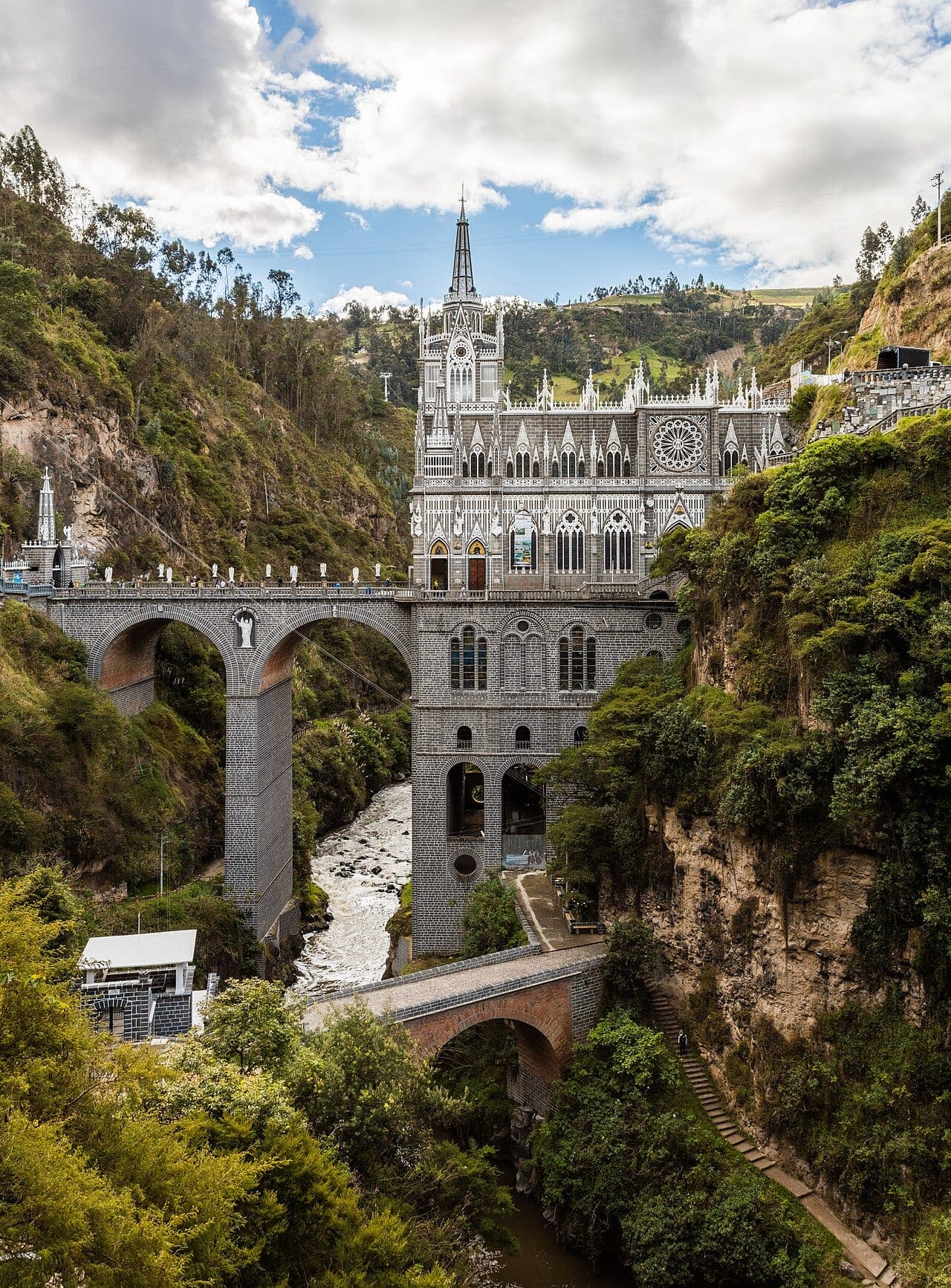
Colombia is a predominantly Roman Catholic country, and the Church has shaped its calendar, its architecture and its family life since the colonial centuries. Marian devotion runs deep: the Sanctuary of Las Lajas, a Gothic Revival basilica built between 1916 and 1949 across the Guaitara river gorge near Ipiales, draws pilgrims from Colombia and Ecuador to a site where the Virgin is said to have appeared, and the shrine of Our Lady of Chiquinquira is the country's national Marian centre. Holy Week processions in Popayan and Mompox are among the oldest in the Americas.
Older and other spiritualities persist alongside the Church. The Kogi, Arhuaco, Wiwa and Kankuamo of the Sierra Nevada understand their mountain as the Heart of the World and their role as elder brothers charged with keeping it in balance, an understanding expressed in payments and offerings at sacred sites. Afro-Colombian communities on the Pacific and Caribbean coasts blend Catholic saints with African-derived practice, and Protestant and Pentecostal churches have grown quickly in recent decades. This layering of Indigenous, African and Catholic devotion shapes how Colombians mark birth, marriage and, above all, death.
Colombian mourning centres on the velorio, the wake, which usually begins within a day of a death and is held in the family home or a funeral chapel. Relatives, neighbours and colleagues gather through the night to pray the rosary and accompany the bereaved, and no invitation is expected. The velorio is followed by a funeral Mass and burial, and then by the novenario, nine consecutive evenings of the rosary prayed in the home of the deceased. In many regions the ninth night closes with the levantada de la cruz, the raising of the cross, when a cross of earth or lime laid where the coffin rested is lifted in a final act of leave-taking. Black mourning dress and a year of luto may follow, and a Mass on the first anniversary marks the close of formal grief.
The wider calendar keeps the dead in view. Colombians observe All Saints and All Souls on 1 and 2 November, days often called Todos los Santos and the Dia de los Difuntos, when families visit and tend graves; the observance is quieter than the festive Day of the Dead of Mexico, but shares its purpose of return and remembrance. Afro-Colombian communities carry their own forms of accompaniment: in San Basilio de Palenque, the Lumbalu is a ritual of chant, drumming and dance kept over the nights after a death to guide the spirit on its journey, a practice UNESCO recognised within the cultural space of Palenque.
National memory has grown its own institutions. In the wake of the internal conflict Colombia established a National Centre for Historical Memory and, under the 2016 agreement, a Truth Commission, tasked with gathering testimony and honouring victims so that the experience is remembered rather than repeated. Museums and memorial spaces treat this work as an act of reconciliation, holding the losses of many communities within a common national record.
Colombian records are parish-based, old, and largely available without leaving the house.
Catholic registers of baptism, marriage and burial run from the sixteenth century in the older towns and are the primary source before the state's. Civil registration was introduced in the nineteenth century and made comprehensive in the twentieth, held by notaries and by the Registraduría. FamilySearch has digitised an enormous quantity of Colombian parish and civil material and publishes it free, which makes this one of the easier South American countries to research remotely.
The Archivo General de la Nación in Bogotá holds the colonial series, including the notarial records that are the most underused source in Latin American genealogy: a will, a dowry contract or a land sale names relationships that no register does.
The modern record is dominated by displacement. More than eight million people are registered as victims of the armed conflict, most of them displaced from their land, and the Unidad para las Víctimas maintains what is probably the largest registry of its kind anywhere. Alongside it the Unidad de Búsqueda works on the disappeared, whose number runs to the tens of thousands, using forensic identification and family DNA in the same way Argentina and Bosnia did.
For Afro-Colombian and Indigenous communities the collective land titles issued under the 1991 constitution are the documents that establish who belongs to a community, and they function as genealogy in practice even though they were written as property law.
Colombia holds nine UNESCO World Heritage sites. The colonial fortifications of Cartagena were inscribed in 1984; the archaeological parks of San Agustin and Tierradentro and the historic centre of Santa Cruz de Mompox followed in 1995; and the Coffee Cultural Landscape, the living farming country of Caldas, Quindio, Risaralda and northern Valle del Cauca, was added in 2011. On the natural side, Los Katios National Park (1994) and the Malpelo Flora and Fauna Sanctuary (2006) protect exceptional biodiversity, while Chiribiquete National Park, inscribed in 2018 for both its ecosystems and its ancient rock paintings, is the country's largest protected area. Colombia is also part of the transnational Qhapaq Nan, the Andean road system inscribed in 2014.
Alongside the built and natural sites sits a strong body of intangible heritage: the Carnival of Barranquilla, the cultural space of Palenque de San Basilio, the marimba music of the south Pacific, and traditional vallenato all carry UNESCO recognition. The national custodian is the Colombian Institute of Anthropology and History, and the Banco de la Republica maintains the Gold Museum, a network of regional museums and one of Latin America's largest cultural and library systems, giving heritage a durable institutional home.
Colombia's cultural institutions have moved much of their holdings online. The Banco de la Republica's cultural network publishes a large digital library, the Biblioteca Virtual, and the Gold Museum shares catalogue records and images of its pre-Columbian collection, opening the goldwork of the Muisca, Quimbaya and Tairona to anyone beyond Bogota. The National Library of Colombia, one of the oldest in the Americas, has digitised manuscripts, early printing and newspapers, and Colombian institutions contribute collections to Google Arts and Culture.
Memory work has its own digital archive. The National Centre for Historical Memory and the Truth Commission have published testimony, reports and interactive materials that document the internal conflict for a general audience, ensuring the record is accessible and searchable rather than confined to physical archives and extending the reach of Colombian heritage to schools, the diaspora and researchers worldwide.
Colombian culture carries far beyond its borders. Garcia Marquez remains among the most translated writers in the Spanish language, and his Macondo continues to shape how readers everywhere imagine Latin America. In popular music Colombia has become a global centre of gravity: Shakira built an international career from Barranquilla, and the reggaeton and Latin-pop artists J Balvin, Karol G and Maluma, all from Medellin, top charts and streaming lists around the world. Disney's animated film "Encanto", set in the Colombian coffee country and released in 2021, introduced its landscapes, music and family customs to a vast new audience.
Its coffee, emeralds and flowers, its salsa and vallenato festivals, and its growing tourism have raised the country's profile, and the transformation of Medellin has become a reference point for cities elsewhere, projecting an image of creativity and recovery set deliberately alongside the memory of harder years.
A national symbol brought into public keeping. The Gold Museum gathered the pre-Columbian goldwork that private hands and looters might otherwise have dispersed, and its Muisca raft, the object at the heart of the El Dorado legend, is now studied and shown as shared national property rather than lost treasure.
A working landscape recognised as heritage. The 2011 inscription of the Coffee Cultural Landscape honoured not ruins but a living farming tradition, linking the livelihoods of thousands of growers to the protection of their hillsides and villages.
A city that rewrote its story. Medellin's investment in transport, libraries and public space across its poorest neighbourhoods turned a byword for violence into an internationally studied example of urban renewal.
Memory institutions for a shared past. Through the National Centre for Historical Memory and the Truth Commission, Colombia has built lasting means of gathering testimony and honouring the losses of the internal conflict, placing remembrance at the centre of reconciliation.
Ciudad Perdida was built by the Tairona around AD 800 and is still regarded as sacred by their descendants, who share its management. Photograph by McKay Savage, CC BY 2.0, via Wikimedia Commons.
Spanish expeditions reached the coast in the early sixteenth century, founded Santa Marta in 1525 and Cartagena in 1533, and pressed inland to establish Santa Fe de Bogota in 1538 in the heart of Muisca country. The territory was governed for much of the colonial period as the Viceroyalty of New Granada, a Catholic society of encomiendas, gold mining and the Atlantic slave trade, with Cartagena as its great fortified harbour. The independence movement that began with the events of 20 July 1810 was secured by Simon Bolivar at the Battle of Boyaca on 7 August 1819, after which New Granada joined Venezuela and Ecuador in the short-lived union known as Gran Colombia. That federation dissolved by 1831, and the remaining state passed through several names before becoming the Republic of Colombia in 1886.
The twentieth-century republic was shaped by the growth of coffee, the loss of Panama in 1903, and periods of political division. A long internal armed conflict, involving the state, left-wing guerrillas, right-wing paramilitary groups and criminal networks, ran from the 1960s over more than fifty years. In 2016 the national government and the FARC guerrilla group signed a peace agreement, and President Juan Manuel Santos received the Nobel Peace Prize that year for his part in reaching it. Colombia has since worked to record the experience through official truth and memory institutions, treating it as a shared national memory rather than a settled quarrel.
The country's name honours the navigator Christopher Columbus, known in Spanish as Cristobal Colon; the adjective "Colombia" was proposed in the independence era as a name for the whole of the Americas liberated from Spain and was later fixed on this republic. Spanish is the official and everyday language, and Colombian Spanish, especially the speech of the interior highlands, has a reputation for clarity and careful grammar.
Beneath and beside Spanish runs a plural inheritance. The state recognises some sixty-five Indigenous languages, among them Wayuunaiki of the Wayuu, the Chibchan tongues of the Sierra Nevada peoples, and languages of the Amazon and Pacific lowlands, and a 2010 Law of Native Languages set out to protect them. On the Caribbean coast the community of San Basilio de Palenque speaks Palenquero, a Spanish-based creole with African elements that is the only such language in the Americas, while the Raizal islanders of San Andres and Providencia speak an English-based creole. Place names carry the older layers everywhere: Bogota descends from the Muisca Bacata, and Cundinamarca, Guatavita and Chia keep Muisca roots on the modern map.
Colombia's music is regional before it is national. From the Caribbean coast comes cumbia, born of the meeting of African drums, Indigenous flutes and Spanish melody, and vallenato, the accordion-led song tradition of the Valledupar region whose travelling players once carried news and stories from town to town; UNESCO placed traditional vallenato on its list needing urgent safeguarding in 2015. The Pacific coast keeps the marimba music and chants of its Afro-Colombian communities, also UNESCO-listed, while the interior has its bambuco and the eastern plains their harp-driven joropo.
In letters, Colombia gave the world Gabriel Garcia Marquez, born in Aracataca in 1927, whose novel "One Hundred Years of Solitude" made the imaginary town of Macondo the capital of magical realism and won him the Nobel Prize in Literature in 1982. Coffee is the other national signature: grown on the steep slopes of the central Andes, organised since 1927 by the National Federation of Coffee Growers and personified since 1959 by the fictional grower Juan Valdez, Colombian mild Arabica became one of the most recognised agricultural products on earth. In the visual arts, Fernando Botero carried his rounded, generous figures from Medellin to museums worldwide.
Colombia is a predominantly Roman Catholic country, and the Church has shaped its calendar, its architecture and its family life since the colonial centuries. Marian devotion runs deep: the Sanctuary of Las Lajas, a Gothic Revival basilica built between 1916 and 1949 across the Guaitara river gorge near Ipiales, draws pilgrims from Colombia and Ecuador to a site where the Virgin is said to have appeared, and the shrine of Our Lady of Chiquinquira is the country's national Marian centre. Holy Week processions in Popayan and Mompox are among the oldest in the Americas.
Older and other spiritualities persist alongside the Church. The Kogi, Arhuaco, Wiwa and Kankuamo of the Sierra Nevada understand their mountain as the Heart of the World and their role as elder brothers charged with keeping it in balance, an understanding expressed in payments and offerings at sacred sites. Afro-Colombian communities on the Pacific and Caribbean coasts blend Catholic saints with African-derived practice, and Protestant and Pentecostal churches have grown quickly in recent decades. This layering of Indigenous, African and Catholic devotion shapes how Colombians mark birth, marriage and, above all, death.
Colombian mourning centres on the velorio, the wake, which usually begins within a day of a death and is held in the family home or a funeral chapel. Relatives, neighbours and colleagues gather through the night to pray the rosary and accompany the bereaved, and no invitation is expected. The velorio is followed by a funeral Mass and burial, and then by the novenario, nine consecutive evenings of the rosary prayed in the home of the deceased. In many regions the ninth night closes with the levantada de la cruz, the raising of the cross, when a cross of earth or lime laid where the coffin rested is lifted in a final act of leave-taking. Black mourning dress and a year of luto may follow, and a Mass on the first anniversary marks the close of formal grief.
The wider calendar keeps the dead in view. Colombians observe All Saints and All Souls on 1 and 2 November, days often called Todos los Santos and the Dia de los Difuntos, when families visit and tend graves; the observance is quieter than the festive Day of the Dead of Mexico, but shares its purpose of return and remembrance. Afro-Colombian communities carry their own forms of accompaniment: in San Basilio de Palenque, the Lumbalu is a ritual of chant, drumming and dance kept over the nights after a death to guide the spirit on its journey, a practice UNESCO recognised within the cultural space of Palenque.
National memory has grown its own institutions. In the wake of the internal conflict Colombia established a National Centre for Historical Memory and, under the 2016 agreement, a Truth Commission, tasked with gathering testimony and honouring victims so that the experience is remembered rather than repeated. Museums and memorial spaces treat this work as an act of reconciliation, holding the losses of many communities within a common national record.
Colombian records are parish-based, old, and largely available without leaving the house.
Catholic registers of baptism, marriage and burial run from the sixteenth century in the older towns and are the primary source before the state's. Civil registration was introduced in the nineteenth century and made comprehensive in the twentieth, held by notaries and by the Registraduría. FamilySearch has digitised an enormous quantity of Colombian parish and civil material and publishes it free, which makes this one of the easier South American countries to research remotely.
The Archivo General de la Nación in Bogotá holds the colonial series, including the notarial records that are the most underused source in Latin American genealogy: a will, a dowry contract or a land sale names relationships that no register does.
The modern record is dominated by displacement. More than eight million people are registered as victims of the armed conflict, most of them displaced from their land, and the Unidad para las Víctimas maintains what is probably the largest registry of its kind anywhere. Alongside it the Unidad de Búsqueda works on the disappeared, whose number runs to the tens of thousands, using forensic identification and family DNA in the same way Argentina and Bosnia did.
For Afro-Colombian and Indigenous communities the collective land titles issued under the 1991 constitution are the documents that establish who belongs to a community, and they function as genealogy in practice even though they were written as property law.
Colombia holds nine UNESCO World Heritage sites. The colonial fortifications of Cartagena were inscribed in 1984; the archaeological parks of San Agustin and Tierradentro and the historic centre of Santa Cruz de Mompox followed in 1995; and the Coffee Cultural Landscape, the living farming country of Caldas, Quindio, Risaralda and northern Valle del Cauca, was added in 2011. On the natural side, Los Katios National Park (1994) and the Malpelo Flora and Fauna Sanctuary (2006) protect exceptional biodiversity, while Chiribiquete National Park, inscribed in 2018 for both its ecosystems and its ancient rock paintings, is the country's largest protected area. Colombia is also part of the transnational Qhapaq Nan, the Andean road system inscribed in 2014.
Alongside the built and natural sites sits a strong body of intangible heritage: the Carnival of Barranquilla, the cultural space of Palenque de San Basilio, the marimba music of the south Pacific, and traditional vallenato all carry UNESCO recognition. The national custodian is the Colombian Institute of Anthropology and History, and the Banco de la Republica maintains the Gold Museum, a network of regional museums and one of Latin America's largest cultural and library systems, giving heritage a durable institutional home.
Colombia's cultural institutions have moved much of their holdings online. The Banco de la Republica's cultural network publishes a large digital library, the Biblioteca Virtual, and the Gold Museum shares catalogue records and images of its pre-Columbian collection, opening the goldwork of the Muisca, Quimbaya and Tairona to anyone beyond Bogota. The National Library of Colombia, one of the oldest in the Americas, has digitised manuscripts, early printing and newspapers, and Colombian institutions contribute collections to Google Arts and Culture.
Memory work has its own digital archive. The National Centre for Historical Memory and the Truth Commission have published testimony, reports and interactive materials that document the internal conflict for a general audience, ensuring the record is accessible and searchable rather than confined to physical archives and extending the reach of Colombian heritage to schools, the diaspora and researchers worldwide.
Colombian culture carries far beyond its borders. Garcia Marquez remains among the most translated writers in the Spanish language, and his Macondo continues to shape how readers everywhere imagine Latin America. In popular music Colombia has become a global centre of gravity: Shakira built an international career from Barranquilla, and the reggaeton and Latin-pop artists J Balvin, Karol G and Maluma, all from Medellin, top charts and streaming lists around the world. Disney's animated film "Encanto", set in the Colombian coffee country and released in 2021, introduced its landscapes, music and family customs to a vast new audience.
Its coffee, emeralds and flowers, its salsa and vallenato festivals, and its growing tourism have raised the country's profile, and the transformation of Medellin has become a reference point for cities elsewhere, projecting an image of creativity and recovery set deliberately alongside the memory of harder years.
A national symbol brought into public keeping. The Gold Museum gathered the pre-Columbian goldwork that private hands and looters might otherwise have dispersed, and its Muisca raft, the object at the heart of the El Dorado legend, is now studied and shown as shared national property rather than lost treasure.
A working landscape recognised as heritage. The 2011 inscription of the Coffee Cultural Landscape honoured not ruins but a living farming tradition, linking the livelihoods of thousands of growers to the protection of their hillsides and villages.
A city that rewrote its story. Medellin's investment in transport, libraries and public space across its poorest neighbourhoods turned a byword for violence into an internationally studied example of urban renewal.
Memory institutions for a shared past. Through the National Centre for Historical Memory and the Truth Commission, Colombia has built lasting means of gathering testimony and honouring the losses of the internal conflict, placing remembrance at the centre of reconciliation.
National Overview
Notable Cities
Historical Foundations
Linguistic and Etymological Roots
Cultural Identity
Religion and Spirituality
Remembrance and Mourning Traditions
Tracing a Family in Colombia
Heritage Preservation Efforts
Digital Heritage
Contemporary Cultural Influences
Success Stories
References and resources
- UNESCO World Heritage Centre, Colombia. The state-party page listing all nine inscribed sites.
- Encyclopaedia Britannica, Colombia. Geography, population and historical background.
- Gold Museum, Banco de la Republica. The national collection of pre-Columbian goldwork in Bogota.
- Muisca raft, Wikipedia. The votive raft and its link to the El Dorado legend.
- Nobel Prize in Literature 1982, Gabriel Garcia Marquez. The award for his fiction of magical realism.
- Nobel Peace Prize 2016, press release. The prize marking the 2016 peace agreement.
- UNESCO, Cartagena. The colonial port and fortifications, inscribed in 1984.
- UNESCO, Coffee Cultural Landscape of Colombia. The living coffee-growing region inscribed in 2011.
- UNESCO, Carnival of Barranquilla. The Caribbean festival of intangible cultural heritage.
- UNESCO, Cultural Space of Palenque de San Basilio. The Afro-Colombian community and its Lumbalu funerary rite.
- Colombia country brand, megadiverse Colombia. The country's biodiversity and bird records.