Heritage · Country
Panama Culture and Heritage
Where the Americas narrow to a single ridge, Panama has funnelled silver, ships and peoples between two oceans for five centuries. This guide follows the isthmus from Panama Viejo and the Canal to the molas of the Guna and the drums of the Congo, and to the ways its families keep faith with the dead.Written to last.
By Confinity Heritage Editorial · Updated 2026-07-31 · 8-minute readQuiet tools, kept out of the way.
Around three million years ago the isthmus of Panama rose from the sea and joined two continents, closing the gap between North and South America and rerouting the oceans of the world. That accident of geology made a country of go-betweens. For five hundred years almost everything moving between the Atlantic and the Pacific, Peruvian silver, California-bound forty-niners, warships and container fleets, has crossed this narrow ground, and the peoples who carried, guarded and taxed that traffic settled into the layers that make Panama today.
The result is a heritage that reads like a cross-section of the hemisphere. Indigenous nations who held the land long before Europe arrived, the first Spanish city on the Pacific, the fortified silver ports of the Caribbean, the West Indian and worldwide labour that dug the Canal: each left its language, its faith and its way of grieving.
Panama occupies the slender southern end of the Central American isthmus, about 75,000 square kilometres of land bent into an S between Costa Rica and Colombia. Because the country curves east to west, its Caribbean coast lies to the north and its Pacific to the south, and at the narrowest point barely eighty kilometres separate the two seas. A spine of mountains runs its length, rising to the dormant volcano Barú at 3,475 metres in Chiriquí, while rainforest cloaks much of the Darién frontier with South America.
Around 4.4 million people live here, more than half in the metropolitan region of Panama City on the Pacific shore. The population is one of the most mixed in the Americas: mestizo and Afro-descendant majorities alongside seven recognised Indigenous nations and communities descended from Spanish colonists, West Indian canal workers and later migrants from Asia, the Middle East and Europe. The same land bridge is one of the planet's great biological corridors, and Panama shelters five UNESCO World Heritage sites, three of them wild.
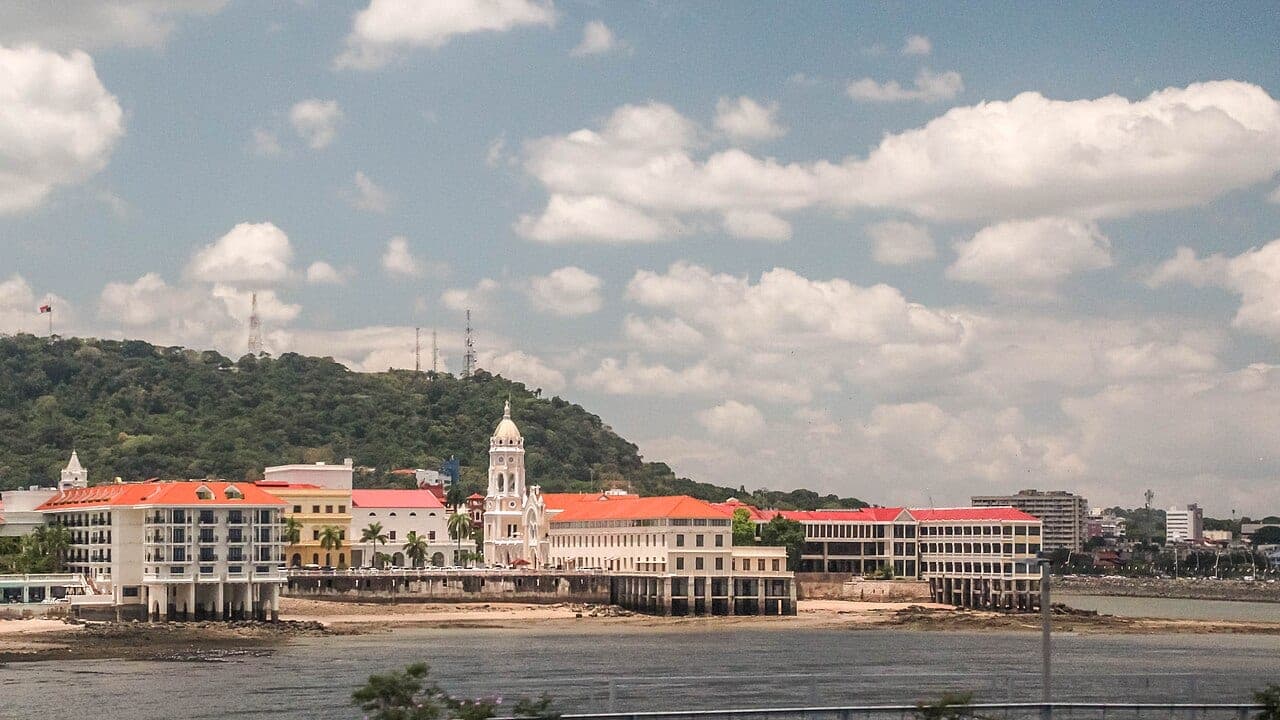
Panama City. The capital is really three cities in one: Panamá Viejo, raised on the Pacific in 1519 and sacked in 1671; the walled quarter of Casco Viejo, where the survivors rebuilt and the cathedral, plazas and balconied houses of the colonial capital still stand; and the glass skyline of a modern banking and shipping hub whose towers look out over the ships queued for the Canal.
 The Portobelo and San Lorenzo forts guarded the point where the silver of Peru crossed the isthmus, and they have sat on the List of World Heritage in Danger since 2012. Photograph by Jim Williams, CC BY-SA 3.0 IGO, via Wikimedia Commons.
Colón. Founded in 1850 at the Caribbean end of the Panama Railroad and long the Atlantic gateway of the Canal, Colón is the heartland of the country's Afro-Antillean population, whose ancestors came from Jamaica, Barbados and across the West Indies to build the railway and the waterway. It is home to the Colón Free Zone, one of the largest duty-free centres in the world.
Portobelo. Named "beautiful port" by Columbus in 1502, this Caribbean bay became the fortified terminus of Spain's silver route, where the ferias de Portobelo exchanged Peruvian bullion for European goods. Today its coral-stone forts and the shrine of the Black Christ, El Nazareno, make it a centre of colonial and Afro-Panamanian heritage.
David. The capital of Chiriquí in the far west and the country's third city, David anchors a highland of coffee farms and cattle ranches around Boquete, and serves as the commercial hub of the fertile Pacific interior.
Long before Europe, the isthmus was home to peoples whose goldwork and pottery were traded across the region; the ancestors of today's Guna, Ngäbe, Buglé, Emberá, Wounaan, Naso and Bri-bri nations lived along its coasts and rivers. Christopher Columbus reached the Caribbean shore on his fourth voyage in 1502, and in 1513 Vasco Núñez de Balboa crossed the mountains to become the first European to see the Pacific from the Americas, fixing the isthmus in Spanish minds as the hinge between two oceans.
The Portobelo and San Lorenzo forts guarded the point where the silver of Peru crossed the isthmus, and they have sat on the List of World Heritage in Danger since 2012. Photograph by Jim Williams, CC BY-SA 3.0 IGO, via Wikimedia Commons.
Colón. Founded in 1850 at the Caribbean end of the Panama Railroad and long the Atlantic gateway of the Canal, Colón is the heartland of the country's Afro-Antillean population, whose ancestors came from Jamaica, Barbados and across the West Indies to build the railway and the waterway. It is home to the Colón Free Zone, one of the largest duty-free centres in the world.
Portobelo. Named "beautiful port" by Columbus in 1502, this Caribbean bay became the fortified terminus of Spain's silver route, where the ferias de Portobelo exchanged Peruvian bullion for European goods. Today its coral-stone forts and the shrine of the Black Christ, El Nazareno, make it a centre of colonial and Afro-Panamanian heritage.
David. The capital of Chiriquí in the far west and the country's third city, David anchors a highland of coffee farms and cattle ranches around Boquete, and serves as the commercial hub of the fertile Pacific interior.
Long before Europe, the isthmus was home to peoples whose goldwork and pottery were traded across the region; the ancestors of today's Guna, Ngäbe, Buglé, Emberá, Wounaan, Naso and Bri-bri nations lived along its coasts and rivers. Christopher Columbus reached the Caribbean shore on his fourth voyage in 1502, and in 1513 Vasco Núñez de Balboa crossed the mountains to become the first European to see the Pacific from the Americas, fixing the isthmus in Spanish minds as the hinge between two oceans.
 Panama Viejo was burned in 1671 when Henry Morgan took it, and the city was rebuilt on a defensible point a few kilometres away rather than on its own ashes. Public domain, via Wikimedia Commons.
In 1519 the governor Pedrarias Dávila founded a city on the Pacific side, and by royal decree of 1521 it became Panamá, the first European city on the Pacific coast and the launching point for the conquest of Peru. Across the isthmus ran the Camino Real and the Camino de Cruces, the mule trails by which Andean silver reached the Caribbean ports of Nombre de Dios and later Portobelo for shipment to Spain. That wealth drew raiders, and in 1671 the Welsh privateer Henry Morgan crossed the isthmus and burned Panamá; its people abandoned the ruins and rebuilt at Casco Viejo in 1673.
Panama declared independence from Spain on 28 November 1821, a movement first raised in Los Santos on 10 November, and joined the union of Gran Colombia. When that federation dissolved in 1830, the isthmus remained a province of Colombia. During the California Gold Rush the Panama Railroad opened in 1855 as the first railway to link the world's two oceans. A French company under Ferdinand de Lesseps began a sea-level canal in 1880 but abandoned it by 1893 after disease and terrain defeated the effort, at a cost of perhaps 22,000 lives between 1881 and 1889.
The United States took up the project after backing Panama's separation from Colombia on 3 November 1903. American engineers built an elevated, lock-based canal, controlling yellow fever and malaria as they went, and the Panama Canal opened on 15 August 1914; more than 5,600 workers died between 1904 and 1914. The waterway and its Canal Zone stayed under United States sovereignty for decades, a grievance that shaped twentieth-century Panamanian nationalism, until the Torrijos-Carter Treaties of 1977 set the terms of return and, at noon on 31 December 1999, the Canal passed fully into Panamanian hands.
Spanish is the national language, carried by four centuries of settlement and schooling, though English has long circulated through the Canal, the banks and the Afro-Antillean coast, where some speak an English-based creole known locally as Guari-Guari. Panama's Indigenous nations keep languages from two families: the Chibchan tongues, including Guna (Dulegaya), Ngäbere, Buglere, Naso and Bri-bri, and the Chocoan languages of the Emberá and Wounaan, whose ancestors moved north from what is now Colombia.
The country's own name comes from the vanished language of the Cueva people, who lived on the isthmus at the conquest and have since disappeared as a distinct group. The word Panamá is usually glossed as "abundance of fish," or in another reading "abundance of butterflies," and tradition holds that the capital rose beside a fishing village of that name. Whatever its precise origin, the meaning suits a land defined by its waters.
Panamanian folk identity is concentrated in the Pacific interior, the provinces of Los Santos, Herrera, Veraguas and Coclé, where Spanish and African inheritances fused into the national arts. The pollera, the ceremonial dress, is its emblem: a full skirt and blouse of white cotton covered in fine embroidery, worn with cascades of gold chains and the tembleques, jewelled hair ornaments on trembling wires unique to the country. A formal pollera can take a year to make and passes down through generations.
Music and movement carry the same double ancestry. The tamborito, the national dance, sets a call-and-response of women's voices against three drums, a form documented since the seventeenth century that joined African rhythm to Iberian song, alongside the mejorana, the improvised décima and the música típica of the countryside. Carnival, staged with greatest fervour in Las Tablas and La Villa de los Santos before Lent, brings queens, floats, fireworks and the soaking culecos of the water trucks. The country's most distinctive craft heritage sits at two poles: the sombrero pinta'o, the braided hat of La Pintada whose making UNESCO recognised in 2017, and the molas of the Guna, layered panels of reverse appliqué in which cloth is cut away and stitched back to reveal fish, birds and geometric worlds. Panamanian cooking anchors all of it, from the national dish sancocho, a chicken soup scented with culantro and thickened with yam, to hojaldre, carimañolas, patacones and Pacific ceviche.
Roman Catholicism arrived with Spain and remains the largest faith and a strong presence in public life, though evangelical and Pentecostal churches have grown quickly amid guaranteed freedom of worship. The Afro-Antillean communities of Colón and Bocas del Toro brought Protestant, Anglican and Methodist traditions from the British West Indies, adding another Christian layer to the Caribbean coast.
Beneath and beside the churches, older cosmologies endure. The Guna honour the creator pair Baba and Nana and revere the prophet Ibeorgun, keeping a ceremonial life led by chanting specialists in the gathering house, while the Emberá, Wounaan and Ngäbe maintain their own spiritual worlds and healers. On the Caribbean coast, the Congo tradition of Portobelo, born among Africans who escaped enslavement, fuses defiant history with Catholic devotion, and its followers gather each 21 October for the pilgrimage of the Black Christ, El Nazareno, which draws tens of thousands of the faithful, many walking through the night and some approaching the shrine on their knees.
Catholic Panama grieves in a rhythm shared across Latin America but marked by its own restraint. Death is met first with the velorio, the wake, still often held in the family home, where relatives and neighbours keep vigil overnight with coffee and prayer before a prompt burial. There follows the rezo or novenario, nine evenings of the rosary prayed in the house of the bereaved to help ease the soul through purgatory, and a Mass at the cabo de año marks the first anniversary of the death.
The whole nation turns to its cemeteries on 2 November, the Día de los Difuntos, which grows from the Catholic feast of All Souls rather than from any carnival of the dead. Families clean and repaint the graves, heap them with flowers and gather to pray, and in provinces such as Veraguas they arrive before dawn to say the rosary over their dead. It is, by law and custom, a quiet holiday: the sale of alcohol is suspended and loud music discouraged, keeping the day closer to solemn remembrance than to spectacle.
The country's other peoples keep their own rites. Among the Guna, the dead are laid in a hammock within an earth chamber in a mainland burial ground, buried with belongings for the journey and accompanied by long chants that a specialist sings to guide the soul onward. The Emberá, Wounaan and Ngäbe observe their own burial customs and mourning within their communities. On the Caribbean coast, families of West Indian descent long kept the island "nine-night," in which songs, food and kin fill the house until the ninth night releases the spirit, while the Congo communities of Portobelo fold their ancestral memory into the drumming, dance and devotion for which they are known.
Panama's twentieth-century records were made by a canal, and they were made in two colours of ink.
The Isthmian Canal Commission employed tens of thousands of workers between 1904 and 1914, most of them from Barbados, Jamaica, Martinique and elsewhere in the Caribbean. It paid white American employees in gold and everyone else in silver, and it kept separate rolls accordingly. The Gold Roll and Silver Roll employment records name individuals with origin, occupation and dates, and for a very large number of Afro-Caribbean families in Panama, and in the United States and Britain afterwards, they are the founding document. The French attempt of the 1880s left its own records and its own dead, and the mortality figures for both efforts are in those files.
Colonial and republican records follow the Spanish American pattern: parish registers from the sixteenth century, and civil registration from the early twentieth, held by the Tribunal Electoral.
The Archivo Nacional in Panama City holds the national series, and the Panama Canal Museum collections, now at the University of Florida, hold much of the Zone material.
Panama's Indigenous peoples, the Guna above all, hold their own record. The Guna Yala comarca has been self-governing since 1925, and the congresses maintain the community's decisions and its people. Guna genealogy is matrilineal, and a husband moves into his wife's household, so descent and residence both run through women.
Panama holds five UNESCO World Heritage sites, split between the built and the wild. The first cultural inscription, in 1980, protects the Fortifications on the Caribbean Side of Panama: Portobelo-San Lorenzo, the seventeenth- and eighteenth-century forts guarding the silver route around Portobelo Bay and the mouth of the Chagres River. Threatened by decay, unmanaged building and coastal weather, they entered the List of World Heritage in Danger in 2012, and their conservation remains a national concern.
The capital's origins are safeguarded by the Archaeological Site of Panamá Viejo and the Historic District of Panamá, inscribed in 1997 and extended in 2003, pairing the ruins of the 1519 Pacific city with the colonial quarter of Casco Viejo. Three natural sites complete the roster: Darién National Park, the rainforest and wetland frontier with Colombia, inscribed in 1981; the Talamanca Range-La Amistad reserves, a mountain wilderness shared with Costa Rica whose Panamanian sector was added in 1990; and Coiba National Park with its marine protection zone, inscribed in 2005. The Congo culture and the pinta'o hat, listed as UNESCO intangible heritage in 2018 and 2017, complete a programme that reaches from stone to song.
Panama has begun to move its inheritance online. The Patronato Panamá Viejo, the foundation that manages the ruined first city, runs a site museum and publishes the archaeology of the settlement, while national institutions document the country's UNESCO sites and living traditions in photographs and video.
The Canal, the country's defining structure, is among the most watched pieces of infrastructure anywhere: the Panama Canal Authority streams live camera feeds of ships passing through the locks and keeps public archives of the waterway's history. Guna cooperatives, meanwhile, use the internet to teach and sell molas directly, carrying an art of the San Blas islands worldwide while keeping its making in Indigenous hands.
Panama's location keeps it at the centre of world commerce, and its culture travels the same routes. The salsa singer and one-time government minister Rubén Blades became one of Latin music's most respected voices, his narrative songs carrying Panamanian stories worldwide, while the reggae and dancehall of the Caribbean coast helped shape reggae en español and the reggaetón now heard across the hemisphere.
The Canal's second act has reasserted Panama's global weight. A major expansion opened in 2016, doubling the waterway's capacity and confirming the country as a hub of shipping, banking and logistics. That prosperity draws migrants and returning diaspora, and the arts of remembrance travel with them, so that a pollera from Los Santos or a mola from Guna Yala may now be worn as far from home as the families who carry them.
A drowned city preserved. More than three centuries after Henry Morgan burned it, Panamá Viejo is a protected archaeological park and UNESCO site, its cathedral tower restored and its street plan legible again for those who come to see how the first European city on the Pacific rose and fell.
Indigenous self-rule that held. The Guna Revolution of 1925, led by Nele Kantule and Simral Colman, won recognition of Guna authority over their homeland and, from 1938, the autonomous comarca of Guna Yala, letting the Guna keep their language, ceremony and molas on their own terms for a century.
The Canal comes home. The peaceful transfer of the Canal to Panamanian control at the end of 1999, followed by the 2016 expansion, turned a symbol of foreign sovereignty into one of the country's proudest chapters of self-determination.
Living heritage recognised. UNESCO's inscription of the pinta'o hat in 2017 and of the ritual and festive expressions of the Congo culture in 2018 gave international standing to two traditions rooted in the countryside and the Afro-Panamanian coast, strengthening the communities that keep them alive.
Panama Viejo was burned in 1671 when Henry Morgan took it, and the city was rebuilt on a defensible point a few kilometres away rather than on its own ashes. Public domain, via Wikimedia Commons.
In 1519 the governor Pedrarias Dávila founded a city on the Pacific side, and by royal decree of 1521 it became Panamá, the first European city on the Pacific coast and the launching point for the conquest of Peru. Across the isthmus ran the Camino Real and the Camino de Cruces, the mule trails by which Andean silver reached the Caribbean ports of Nombre de Dios and later Portobelo for shipment to Spain. That wealth drew raiders, and in 1671 the Welsh privateer Henry Morgan crossed the isthmus and burned Panamá; its people abandoned the ruins and rebuilt at Casco Viejo in 1673.
Panama declared independence from Spain on 28 November 1821, a movement first raised in Los Santos on 10 November, and joined the union of Gran Colombia. When that federation dissolved in 1830, the isthmus remained a province of Colombia. During the California Gold Rush the Panama Railroad opened in 1855 as the first railway to link the world's two oceans. A French company under Ferdinand de Lesseps began a sea-level canal in 1880 but abandoned it by 1893 after disease and terrain defeated the effort, at a cost of perhaps 22,000 lives between 1881 and 1889.
The United States took up the project after backing Panama's separation from Colombia on 3 November 1903. American engineers built an elevated, lock-based canal, controlling yellow fever and malaria as they went, and the Panama Canal opened on 15 August 1914; more than 5,600 workers died between 1904 and 1914. The waterway and its Canal Zone stayed under United States sovereignty for decades, a grievance that shaped twentieth-century Panamanian nationalism, until the Torrijos-Carter Treaties of 1977 set the terms of return and, at noon on 31 December 1999, the Canal passed fully into Panamanian hands.
Spanish is the national language, carried by four centuries of settlement and schooling, though English has long circulated through the Canal, the banks and the Afro-Antillean coast, where some speak an English-based creole known locally as Guari-Guari. Panama's Indigenous nations keep languages from two families: the Chibchan tongues, including Guna (Dulegaya), Ngäbere, Buglere, Naso and Bri-bri, and the Chocoan languages of the Emberá and Wounaan, whose ancestors moved north from what is now Colombia.
The country's own name comes from the vanished language of the Cueva people, who lived on the isthmus at the conquest and have since disappeared as a distinct group. The word Panamá is usually glossed as "abundance of fish," or in another reading "abundance of butterflies," and tradition holds that the capital rose beside a fishing village of that name. Whatever its precise origin, the meaning suits a land defined by its waters.
Panamanian folk identity is concentrated in the Pacific interior, the provinces of Los Santos, Herrera, Veraguas and Coclé, where Spanish and African inheritances fused into the national arts. The pollera, the ceremonial dress, is its emblem: a full skirt and blouse of white cotton covered in fine embroidery, worn with cascades of gold chains and the tembleques, jewelled hair ornaments on trembling wires unique to the country. A formal pollera can take a year to make and passes down through generations.
Music and movement carry the same double ancestry. The tamborito, the national dance, sets a call-and-response of women's voices against three drums, a form documented since the seventeenth century that joined African rhythm to Iberian song, alongside the mejorana, the improvised décima and the música típica of the countryside. Carnival, staged with greatest fervour in Las Tablas and La Villa de los Santos before Lent, brings queens, floats, fireworks and the soaking culecos of the water trucks. The country's most distinctive craft heritage sits at two poles: the sombrero pinta'o, the braided hat of La Pintada whose making UNESCO recognised in 2017, and the molas of the Guna, layered panels of reverse appliqué in which cloth is cut away and stitched back to reveal fish, birds and geometric worlds. Panamanian cooking anchors all of it, from the national dish sancocho, a chicken soup scented with culantro and thickened with yam, to hojaldre, carimañolas, patacones and Pacific ceviche.
Roman Catholicism arrived with Spain and remains the largest faith and a strong presence in public life, though evangelical and Pentecostal churches have grown quickly amid guaranteed freedom of worship. The Afro-Antillean communities of Colón and Bocas del Toro brought Protestant, Anglican and Methodist traditions from the British West Indies, adding another Christian layer to the Caribbean coast.
Beneath and beside the churches, older cosmologies endure. The Guna honour the creator pair Baba and Nana and revere the prophet Ibeorgun, keeping a ceremonial life led by chanting specialists in the gathering house, while the Emberá, Wounaan and Ngäbe maintain their own spiritual worlds and healers. On the Caribbean coast, the Congo tradition of Portobelo, born among Africans who escaped enslavement, fuses defiant history with Catholic devotion, and its followers gather each 21 October for the pilgrimage of the Black Christ, El Nazareno, which draws tens of thousands of the faithful, many walking through the night and some approaching the shrine on their knees.
Catholic Panama grieves in a rhythm shared across Latin America but marked by its own restraint. Death is met first with the velorio, the wake, still often held in the family home, where relatives and neighbours keep vigil overnight with coffee and prayer before a prompt burial. There follows the rezo or novenario, nine evenings of the rosary prayed in the house of the bereaved to help ease the soul through purgatory, and a Mass at the cabo de año marks the first anniversary of the death.
The whole nation turns to its cemeteries on 2 November, the Día de los Difuntos, which grows from the Catholic feast of All Souls rather than from any carnival of the dead. Families clean and repaint the graves, heap them with flowers and gather to pray, and in provinces such as Veraguas they arrive before dawn to say the rosary over their dead. It is, by law and custom, a quiet holiday: the sale of alcohol is suspended and loud music discouraged, keeping the day closer to solemn remembrance than to spectacle.
The country's other peoples keep their own rites. Among the Guna, the dead are laid in a hammock within an earth chamber in a mainland burial ground, buried with belongings for the journey and accompanied by long chants that a specialist sings to guide the soul onward. The Emberá, Wounaan and Ngäbe observe their own burial customs and mourning within their communities. On the Caribbean coast, families of West Indian descent long kept the island "nine-night," in which songs, food and kin fill the house until the ninth night releases the spirit, while the Congo communities of Portobelo fold their ancestral memory into the drumming, dance and devotion for which they are known.
Panama's twentieth-century records were made by a canal, and they were made in two colours of ink.
The Isthmian Canal Commission employed tens of thousands of workers between 1904 and 1914, most of them from Barbados, Jamaica, Martinique and elsewhere in the Caribbean. It paid white American employees in gold and everyone else in silver, and it kept separate rolls accordingly. The Gold Roll and Silver Roll employment records name individuals with origin, occupation and dates, and for a very large number of Afro-Caribbean families in Panama, and in the United States and Britain afterwards, they are the founding document. The French attempt of the 1880s left its own records and its own dead, and the mortality figures for both efforts are in those files.
Colonial and republican records follow the Spanish American pattern: parish registers from the sixteenth century, and civil registration from the early twentieth, held by the Tribunal Electoral.
The Archivo Nacional in Panama City holds the national series, and the Panama Canal Museum collections, now at the University of Florida, hold much of the Zone material.
Panama's Indigenous peoples, the Guna above all, hold their own record. The Guna Yala comarca has been self-governing since 1925, and the congresses maintain the community's decisions and its people. Guna genealogy is matrilineal, and a husband moves into his wife's household, so descent and residence both run through women.
Panama holds five UNESCO World Heritage sites, split between the built and the wild. The first cultural inscription, in 1980, protects the Fortifications on the Caribbean Side of Panama: Portobelo-San Lorenzo, the seventeenth- and eighteenth-century forts guarding the silver route around Portobelo Bay and the mouth of the Chagres River. Threatened by decay, unmanaged building and coastal weather, they entered the List of World Heritage in Danger in 2012, and their conservation remains a national concern.
The capital's origins are safeguarded by the Archaeological Site of Panamá Viejo and the Historic District of Panamá, inscribed in 1997 and extended in 2003, pairing the ruins of the 1519 Pacific city with the colonial quarter of Casco Viejo. Three natural sites complete the roster: Darién National Park, the rainforest and wetland frontier with Colombia, inscribed in 1981; the Talamanca Range-La Amistad reserves, a mountain wilderness shared with Costa Rica whose Panamanian sector was added in 1990; and Coiba National Park with its marine protection zone, inscribed in 2005. The Congo culture and the pinta'o hat, listed as UNESCO intangible heritage in 2018 and 2017, complete a programme that reaches from stone to song.
Panama has begun to move its inheritance online. The Patronato Panamá Viejo, the foundation that manages the ruined first city, runs a site museum and publishes the archaeology of the settlement, while national institutions document the country's UNESCO sites and living traditions in photographs and video.
The Canal, the country's defining structure, is among the most watched pieces of infrastructure anywhere: the Panama Canal Authority streams live camera feeds of ships passing through the locks and keeps public archives of the waterway's history. Guna cooperatives, meanwhile, use the internet to teach and sell molas directly, carrying an art of the San Blas islands worldwide while keeping its making in Indigenous hands.
Panama's location keeps it at the centre of world commerce, and its culture travels the same routes. The salsa singer and one-time government minister Rubén Blades became one of Latin music's most respected voices, his narrative songs carrying Panamanian stories worldwide, while the reggae and dancehall of the Caribbean coast helped shape reggae en español and the reggaetón now heard across the hemisphere.
The Canal's second act has reasserted Panama's global weight. A major expansion opened in 2016, doubling the waterway's capacity and confirming the country as a hub of shipping, banking and logistics. That prosperity draws migrants and returning diaspora, and the arts of remembrance travel with them, so that a pollera from Los Santos or a mola from Guna Yala may now be worn as far from home as the families who carry them.
A drowned city preserved. More than three centuries after Henry Morgan burned it, Panamá Viejo is a protected archaeological park and UNESCO site, its cathedral tower restored and its street plan legible again for those who come to see how the first European city on the Pacific rose and fell.
Indigenous self-rule that held. The Guna Revolution of 1925, led by Nele Kantule and Simral Colman, won recognition of Guna authority over their homeland and, from 1938, the autonomous comarca of Guna Yala, letting the Guna keep their language, ceremony and molas on their own terms for a century.
The Canal comes home. The peaceful transfer of the Canal to Panamanian control at the end of 1999, followed by the 2016 expansion, turned a symbol of foreign sovereignty into one of the country's proudest chapters of self-determination.
Living heritage recognised. UNESCO's inscription of the pinta'o hat in 2017 and of the ritual and festive expressions of the Congo culture in 2018 gave international standing to two traditions rooted in the countryside and the Afro-Panamanian coast, strengthening the communities that keep them alive.
National Overview
Notable Cities
Historical Foundations
Linguistic and Etymological Roots
Cultural Identity
Religion and Spirituality
Remembrance and Mourning Traditions
Tracing a Family in Panama
Heritage Preservation Efforts
Digital Heritage
Contemporary Cultural Influences
Success Stories
References and resources
- UNESCO: Fortifications on the Caribbean Side of Panama, Portobelo-San Lorenzo, the 1980 inscription and its danger listing.
- UNESCO: Archaeological Site and Historic Centre of Panamá City, Panamá Viejo and the Historic District.
- UNESCO Intangible Cultural Heritage: Panama, the Congo culture (2018) and pinta'o hat (2017).
- Encyclopaedia Britannica: Panama, geography, peoples and history.
- Panama Canal history (HISTORY), the French and American construction and the handover.
- Patronato Panamá Viejo, the site museum of the first city on the Pacific.
- Wikipedia: Guna people, the 1925 revolution and the comarca of Guna Yala.
- Wikipedia: Cristo Negro (Portobelo), the Black Christ pilgrimage of 21 October.