Heritage · Country
Palau Culture and Heritage
Palau keeps its history in mushroom-shaped limestone islands, in painted meeting houses, and in named pieces of clan money handed down through the mother's line. A guide to how one of the Pacific's oldest matrilineal societies remembers its dead and guards its sea.Written to last.
By Confinity Heritage Editorial · Updated 2026-07-31 · 8-minute readQuiet tools, kept out of the way.
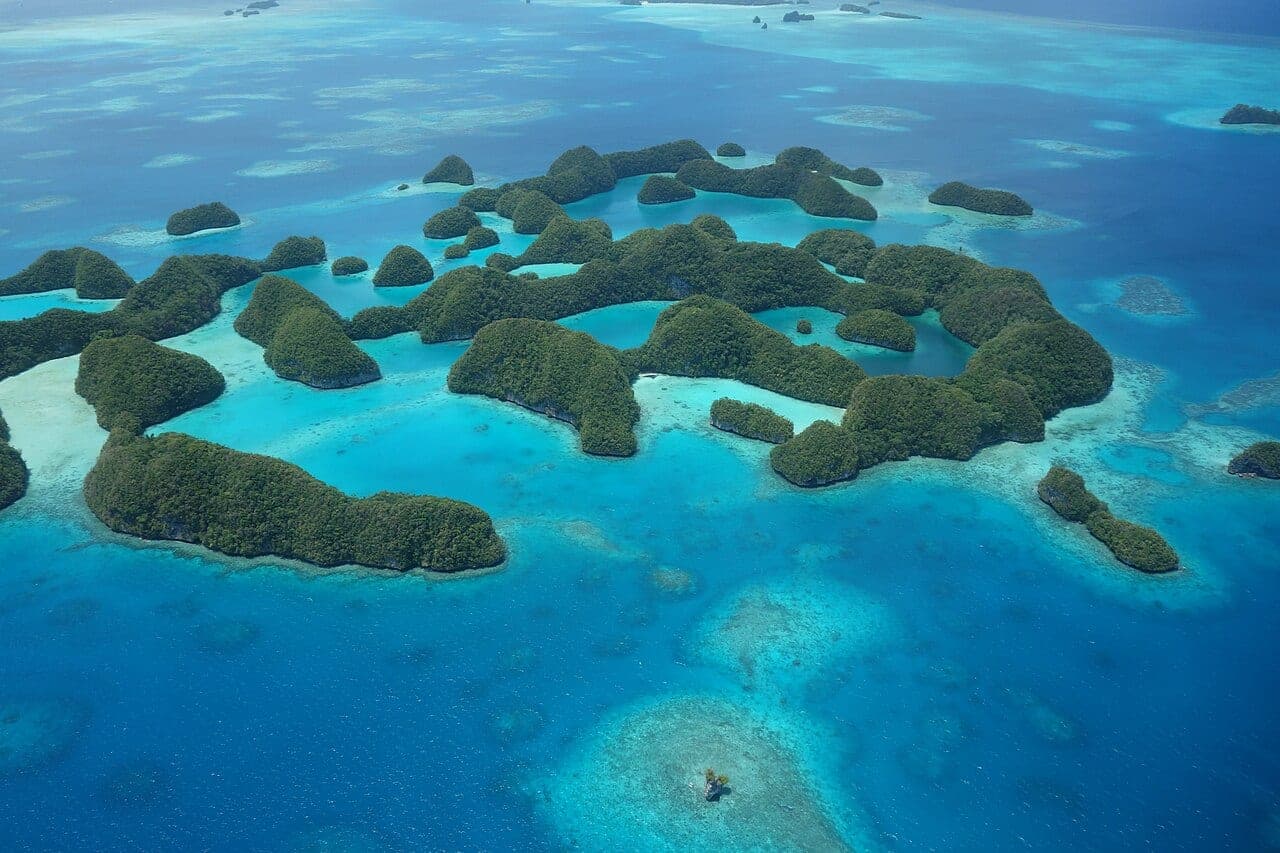
The Republic of Palau is an archipelago at the western edge of the Caroline Islands, set on one of the most intricate coastlines on earth. Its signature landscape is the Rock Islands Southern Lagoon: hundreds of forested limestone islets, many undercut at the waterline into the shape of a mushroom, scattered across a turquoise lagoon inside a barrier reef. Rainwater and time have hollowed some of them into marine lakes cut off from the open sea, the most famous being Jellyfish Lake, where millions of nearly stingless golden jellyfish drift across the water each day. Beneath the beauty lies a long human record: cave burials, rock art, and the stone foundations of villages that Palauans left behind centuries ago, when the pressures of a marginal island environment grew too heavy to carry.
Those empty villages are a fitting way into Palau, because this is a country that measures itself by memory. Palauan society is matrilineal and built around clans whose histories are held in named pieces of traditional money, in inherited titles, and in the carved and painted legends of the bai, the men's meeting house. The islands also hold one of the Pacific's heaviest wartime memories, the Battle of Peleliu in 1944, and one of its most deliberate rituals of remembrance, the funeral and the long calendar of obligations that follows a death. This profile traces how Palauans, whose name for their own land is Belau, keep faith with their ancestors while leading the world in the protection of the sea that made them.
Palau lies in the western Pacific, part of Micronesia, roughly 1,500 kilometres east of the Philippines and north of the equator. It gathers some 340 islands into a chain about 700 kilometres long, though most of its land and nearly all of its people cluster around Babeldaob, the country's largest island and the second largest in Micronesia after Guam. The population is small, a little under twenty thousand, roughly two thirds of them ethnic Palauans, with sizeable Filipino and other Asian communities drawn by tourism and construction. The country uses the United States dollar and is a presidential democracy in free association with the United States.
The republic is divided into sixteen states, several occupying a single island or a stretch of Babeldaob's coast. Its flag sets a golden full moon, long regarded by Palauans as the most favourable time for planting, fishing and ceremony, on a field of ocean blue. Fishing, subsistence gardening and tourism sit alongside the funding that flows from the Compact of Free Association, and Palauan clans continue to hold land and authority in ways that predate every foreign administration.
Ngerulmud. Palau's capital since 2006 is among the least populous national capitals on earth, a purpose-built seat rising from the forest of Melekeok state on eastern Babeldaob. Its domed capitol houses the national congress, the Olbiil Era Kelulau, and the executive and judiciary; the move from crowded Koror placed government at the traditional heart of the archipelago.
Koror. The former capital and still the commercial and cultural centre, Koror holds most of the country's population, its hotels and dive operators, and the Belau National Museum. Under Japanese rule it served as the headquarters not only of Palau but of the entire South Seas Mandate that governed Japanese Micronesia, growing by the 1930s into a substantial colonial town.
Melekeok and the states. Melekeok, on Babeldaob, is a traditional seat of the Reklai, one of Palau's two paramount chiefs, and now contains the capital district, with nearby Lake Ngardok the largest natural freshwater lake in Micronesia. Airai, near the international airport, keeps one of the oldest surviving traditional bai. To the south, the states of Peleliu and Angaur carry the memory of the Second World War; to the north, the atoll of Kayangel marks the country's tip; and far to the south-west, the remote islands of Sonsorol and Hatohobei preserve their own Carolinian languages, a reminder that Palau is a nation of several peoples.
Palau was settled by Austronesian voyagers roughly three thousand years ago, most likely from the islands of what are now the Philippines and eastern Indonesia, part of the long seaward expansion that carried farming and pottery across the Pacific. Over the following centuries these settlers reshaped the land itself: the interior of Babeldaob is terraced with monumental earthworks, and at Badrulchau in the northern state of Ngarchelong stands a field of basalt monoliths, some carved with faces, that tradition remembers as the pillars of a giant meeting house raised by the gods. Badrulchau, one of the oldest and largest archaeological sites in the country, was among the first places entered on the Palau Register of Historic Places in 1989.
By the time of European contact, Palauans lived in villages governed by councils of matrilineal clan chiefs under the two paramount lines of Koror and Melekeok. Contact stayed sporadic until 1783, when the English East India Company packet Antelope, under Captain Henry Wilson, wrecked on a reef off Ulong in the Rock Islands. The Ibedul, high chief of Koror, sheltered the crew and entrusted his son, Prince Lee Boo, to Wilson to be educated in England. The young prince reached London in 1784 but died of smallpox that December and was buried at Rotherhithe, his story later carried across Europe in George Keate's account of the voyage.
Spain claimed the islands as part of the Spanish East Indies through the nineteenth century, though its presence was slight, and after its defeat in 1898 it sold them to Germany, which held Palau from 1899 to 1914 and worked its phosphate and copra. When Japan took the islands early in the First World War, it governed them from 1914 to 1944 under a League of Nations mandate, developing Koror so intensively that Palauans became a minority in their own capital. That order ended in the Second World War. Between September and November 1944, American and Japanese forces fought the Battle of Peleliu across the island's coral ridges and caves; more than two thousand Americans and roughly ten thousand Japanese died, and the fighting left Peleliu and neighbouring Angaur scarred with wreckage and war graves that the states still tend. Palau marks the battle soberly, as a catastrophe visited upon islanders caught between empires rather than a triumph to celebrate.
After the war Palau became part of the United States-administered Trust Territory of the Pacific Islands, and its path to independence proved unusually deliberate. A constitution adopted in 1981 barred nuclear weapons from Palauan territory, and reconciling that clause with the defence terms of the Compact of Free Association required a decade of national plebiscites before approval in 1993. The Compact took effect on 1 October 1994, and Palau became a sovereign republic, the last part of the Trust Territory to reach independence.
Palau has two official languages, Palauan and English, with Sonsorolese and Tobian recognised in the south-western states where they are spoken. Palauan belongs to the Austronesian family but sits apart within it, its grammar and sound system distinctive enough that linguists treat it as a branch of its own; generations of foreign rule have layered it with Spanish, German, Japanese and English loanwords, so that a Palauan sentence can carry the sediment of a whole colonial century.
The country's two names reflect that history. "Palau" comes through the Spanish "Los Palaos" and the charts of European navigators, while the indigenous name, "Belau", is usually traced to the Palauan word beluu, meaning village or community, and in one creation account to aibebelau, a phrase bound up in the islands' origin story. Both names remain in everyday use.
At the centre of Palauan tradition is the bai, the community meeting house, historically the assembly place of a village's men. Built without nails from timber joined by lashing and joinery, the classic bai carries its meaning on its gables and beams, painted and carved with the legends, histories and moral tales of the community. From that architecture grew Palau's best-known art form: in 1935 the Japanese artist and folklorist Hisakatsu Hijikata encouraged Palauan carvers to translate the painted stories of the bai onto portable wooden boards, reviving a fading tradition in a form that could travel. The storyboard, cut in low relief and picking out figures from Palauan myth, remains a living craft taught and sold across the islands today.
 The Rock Islands are inscribed as a mixed site, for the reefs and for the abandoned villages, burials and rock art left by people who lived on them for around three thousand years and then left. Photograph by Peter R. Binter, public domain, via Wikimedia Commons.
Palauan social life runs on the matrilineal clan. Rights to land, titles and money descend through the mother's line, and while men hold the public chiefly offices, senior women choose and can remove title-holders and govern the flow of clan wealth. That wealth takes physical form in udoud, the traditional money of Palau: beads and pieces of coloured glass and fired ceramic, the most valuable of them, the bachel, individually named, worn by women and given between families at marriages, births and funerals. A separate women's currency of turtle-shell trays, the toluk, circulates in its own exchanges, given for labour at events such as the ocheraol, the ceremony held to help a family build a house. Dance and chant carry clan history in performance; the table remains firmly Palauan, built on taro and cassava, reef fish and dishes such as fruit-bat soup and coconut sweets; and the first-birth ceremony, in which a new mother is anointed with turmeric and honoured before her community, marks the clan's continuity into the next generation.
Most Palauans are Christian, the Roman Catholic Church being the largest denomination alongside Protestant and Seventh-day Adventist congregations, an inheritance of Spanish, German and American mission work. Christianity generally sits beside custom rather than against it, the church calendar and the clan calendar of feasts and funerals running together through the year.
Palau is also home to an indigenous faith of its own, Modekngei, which arose around 1915 when a man named Temedad of Chol village on Babeldaob experienced a spiritual revelation in the early years of Japanese rule. Modekngei, whose name carries the sense of coming together, blends belief in the Christian God and in Jesus with reverence for the older Palauan deities, and it emerged partly as a way to hold Palauan identity together against colonial pressures. It keeps no scripture and practises neither baptism nor communion, and it remains a recognised religion today, followed by a small but enduring minority. Beneath both faiths lies the memory of the older spiritual order, a world of clan gods and ancestral spirits whose sites and stories the bai once kept alive.
A death in Palau belongs to the whole clan, and the funeral, the kemeldiil, draws relatives home from across the islands and the diaspora. Custom assigns roles by kinship and gender: the women of the clan sit with the family and the body, cook and receive mourners, while the men manage the grave and the practical work of the gathering. In older practice the body was cleansed, anointed with turmeric and oil, and watched over for days before burial. The ceremonies that follow still order the grief: a rite four days after the death offers food to the spirit of the departed; a later one sees stones placed upon the grave; and months afterwards comes the cheldecheduch, at which the two families of a marriage settle the debts and obligations the death has opened.
It is in that final settlement that Palauan money does its most serious work. Pieces of udoud and toluk pass between the clan of the deceased and that of the surviving spouse, food and labour are accounted for, and the web of relationships a death tears is carefully repaired. These exchanges are neither a fee nor a transaction; they are how a matrilineal society keeps its ledger of care balanced across generations, and a family will plan for a funeral with the seriousness it gives to any founding event. Most funerals now centre on a Christian service and burial, and Palau has begun to build modern mortuaries, yet the customary economy of remembrance continues in full around that Christian core.
The land itself remembers. The abandoned villages of the Rock Islands, with their cave burials and rock art, are places of memory as much as of archaeology, marking where earlier Palauans lived and buried their dead before the environment could no longer sustain them. In this, Palau holds an idea that Confinity's own work takes as its starting point: that remembrance is not an archive set apart from life, but a set of obligations, faithfully discharged, that keeps the living and the dead in right relation.
Palauan descent runs through women, and it decides who holds a title and who may speak for land.
A Palauan belongs to a clan through the mother, and the clan holds land and the titles attached to it. Chiefly titles are conferred by the senior women of the clan, the ourrot, who choose from among eligible men, so authority is held by men and allocated by women. Knowing a lineage is therefore knowing who may be appointed, and disputes are heard by the Land Court, whose records contain a great deal of the country's genealogy in evidence form.
The bai, the men's meeting house, carried the record visually: its gables were painted with the stories and obligations of the village, and the surviving and reconstructed bai are read as documents.
Four administrations left paper. Spain to 1899, Germany to 1914, Japan under mandate to 1945, and the United States under trusteeship to 1994. The Japanese period was the most intensive, with household registration on the koseki pattern, and it also brought in a large Japanese and Okinawan population, so some Palauan families have Japanese ancestry recorded in Japanese registers.
Catholic and Protestant mission registers cover the vital events, and Palau's own civil registration dates from the American period.
The Second World War's Peleliu campaign killed thousands of soldiers on a small island and displaced the population, and remains are still being recovered and repatriated, which is its own kind of record-keeping.
Palau's central heritage achievement is the Rock Islands Southern Lagoon, inscribed on the UNESCO World Heritage List in 2012 as a mixed site of natural and cultural value. The property covers about 100,200 hectares and takes in 445 uninhabited limestone islands, their mushroom shapes rising from a lagoon dotted with 52 marine lakes that scientists study as natural laboratories of evolution. Its cultural value rests on the prehistoric cave burials, rock art and village remains on islands such as Ulong and Ngemelis, and on the record they preserve of communities that abandoned these islands in the seventeenth and eighteenth centuries as population, climate and the limits of the environment pressed upon them. Listed under three natural criteria and two cultural ones, it recognises that in Palau nature and human memory cannot be separated.
Institutional care centres on the Belau National Museum in Koror, founded in 1955 and the oldest continuously operating museum in Micronesia, whose collections of tools, money, carvings and photographs anchor the study of Palauan life. The national historic preservation office, the Bureau of Cultural and Historical Preservation, maintains the Palau Register of Historic Places and oversees archaeological sites from Badrulchau to the wartime landscapes of Peleliu, while the restoration of traditional bai keeps the country's signature architecture standing rather than only remembered.
Palau's small size makes digital preservation a practical necessity, since a single storm or fire can threaten records that exist nowhere else. The Belau National Museum and the Bureau of Cultural and Historical Preservation catalogue and photograph collections and sites, and the oral histories held by Palauan historians, traditions that never lived on paper, are increasingly captured as audio and video before their elder keepers pass. Palau's World Heritage documentation sits within UNESCO's public record, and its traditions of carving, dance and money feature in regional heritage databases that reach students and the diaspora far from the islands. The aim is not to replace the bai and the clan with a database, but to give the keepers of knowledge a durable second copy.
Modern Palau has turned its heritage of the sea into a form of global leadership. Drawing on bul, the traditional practice by which chiefs close a reef or fishing ground to let it recover, the country declared the world's first national shark sanctuary in 2009 and, in 2015, established the Palau National Marine Sanctuary, setting aside eighty per cent of its exclusive economic zone as a no-take reserve. In 2017 it became the first nation to write conservation into its border, requiring every visitor to sign the Palau Pledge, a promise stamped into the passport and addressed, in the voice of Palau's children, to tread lightly on the islands and their reefs. The same spirit is reviving older skills: the traditional canoe and the navigator's reading of stars and swells are being taught again, and in 2023 Palau welcomed the voyaging canoe Alingano Maisu into the wider Pacific renaissance of deep-sea navigation.
A mixed World Heritage inscription. The listing of the Rock Islands Southern Lagoon in 2012, honoured for its marine lakes and mushroom islands and equally for its cave burials and abandoned villages, placed Palau's fusion of nature and memory on the world register.
The Palau Pledge. By asking every visitor to sign a child-written promise to the islands, Palau turned an act of arrival into an act of care, an idea studied by other destinations.
A marine sanctuary at national scale. Reserving eighty per cent of its waters from commercial fishing, Palau matched the ancient logic of bul to a modern strategy and gave a small nation an outsized voice in the protection of the ocean.
A museum that has held for seventy years. The Belau National Museum, founded in 1955, has preserved the material record of Palauan life through independence and every administration before it, remaining the oldest working museum in Micronesia and a model of locally led stewardship.
The Rock Islands are inscribed as a mixed site, for the reefs and for the abandoned villages, burials and rock art left by people who lived on them for around three thousand years and then left. Photograph by Peter R. Binter, public domain, via Wikimedia Commons.
Palauan social life runs on the matrilineal clan. Rights to land, titles and money descend through the mother's line, and while men hold the public chiefly offices, senior women choose and can remove title-holders and govern the flow of clan wealth. That wealth takes physical form in udoud, the traditional money of Palau: beads and pieces of coloured glass and fired ceramic, the most valuable of them, the bachel, individually named, worn by women and given between families at marriages, births and funerals. A separate women's currency of turtle-shell trays, the toluk, circulates in its own exchanges, given for labour at events such as the ocheraol, the ceremony held to help a family build a house. Dance and chant carry clan history in performance; the table remains firmly Palauan, built on taro and cassava, reef fish and dishes such as fruit-bat soup and coconut sweets; and the first-birth ceremony, in which a new mother is anointed with turmeric and honoured before her community, marks the clan's continuity into the next generation.
Most Palauans are Christian, the Roman Catholic Church being the largest denomination alongside Protestant and Seventh-day Adventist congregations, an inheritance of Spanish, German and American mission work. Christianity generally sits beside custom rather than against it, the church calendar and the clan calendar of feasts and funerals running together through the year.
Palau is also home to an indigenous faith of its own, Modekngei, which arose around 1915 when a man named Temedad of Chol village on Babeldaob experienced a spiritual revelation in the early years of Japanese rule. Modekngei, whose name carries the sense of coming together, blends belief in the Christian God and in Jesus with reverence for the older Palauan deities, and it emerged partly as a way to hold Palauan identity together against colonial pressures. It keeps no scripture and practises neither baptism nor communion, and it remains a recognised religion today, followed by a small but enduring minority. Beneath both faiths lies the memory of the older spiritual order, a world of clan gods and ancestral spirits whose sites and stories the bai once kept alive.
A death in Palau belongs to the whole clan, and the funeral, the kemeldiil, draws relatives home from across the islands and the diaspora. Custom assigns roles by kinship and gender: the women of the clan sit with the family and the body, cook and receive mourners, while the men manage the grave and the practical work of the gathering. In older practice the body was cleansed, anointed with turmeric and oil, and watched over for days before burial. The ceremonies that follow still order the grief: a rite four days after the death offers food to the spirit of the departed; a later one sees stones placed upon the grave; and months afterwards comes the cheldecheduch, at which the two families of a marriage settle the debts and obligations the death has opened.
It is in that final settlement that Palauan money does its most serious work. Pieces of udoud and toluk pass between the clan of the deceased and that of the surviving spouse, food and labour are accounted for, and the web of relationships a death tears is carefully repaired. These exchanges are neither a fee nor a transaction; they are how a matrilineal society keeps its ledger of care balanced across generations, and a family will plan for a funeral with the seriousness it gives to any founding event. Most funerals now centre on a Christian service and burial, and Palau has begun to build modern mortuaries, yet the customary economy of remembrance continues in full around that Christian core.
The land itself remembers. The abandoned villages of the Rock Islands, with their cave burials and rock art, are places of memory as much as of archaeology, marking where earlier Palauans lived and buried their dead before the environment could no longer sustain them. In this, Palau holds an idea that Confinity's own work takes as its starting point: that remembrance is not an archive set apart from life, but a set of obligations, faithfully discharged, that keeps the living and the dead in right relation.
Palauan descent runs through women, and it decides who holds a title and who may speak for land.
A Palauan belongs to a clan through the mother, and the clan holds land and the titles attached to it. Chiefly titles are conferred by the senior women of the clan, the ourrot, who choose from among eligible men, so authority is held by men and allocated by women. Knowing a lineage is therefore knowing who may be appointed, and disputes are heard by the Land Court, whose records contain a great deal of the country's genealogy in evidence form.
The bai, the men's meeting house, carried the record visually: its gables were painted with the stories and obligations of the village, and the surviving and reconstructed bai are read as documents.
Four administrations left paper. Spain to 1899, Germany to 1914, Japan under mandate to 1945, and the United States under trusteeship to 1994. The Japanese period was the most intensive, with household registration on the koseki pattern, and it also brought in a large Japanese and Okinawan population, so some Palauan families have Japanese ancestry recorded in Japanese registers.
Catholic and Protestant mission registers cover the vital events, and Palau's own civil registration dates from the American period.
The Second World War's Peleliu campaign killed thousands of soldiers on a small island and displaced the population, and remains are still being recovered and repatriated, which is its own kind of record-keeping.
Palau's central heritage achievement is the Rock Islands Southern Lagoon, inscribed on the UNESCO World Heritage List in 2012 as a mixed site of natural and cultural value. The property covers about 100,200 hectares and takes in 445 uninhabited limestone islands, their mushroom shapes rising from a lagoon dotted with 52 marine lakes that scientists study as natural laboratories of evolution. Its cultural value rests on the prehistoric cave burials, rock art and village remains on islands such as Ulong and Ngemelis, and on the record they preserve of communities that abandoned these islands in the seventeenth and eighteenth centuries as population, climate and the limits of the environment pressed upon them. Listed under three natural criteria and two cultural ones, it recognises that in Palau nature and human memory cannot be separated.
Institutional care centres on the Belau National Museum in Koror, founded in 1955 and the oldest continuously operating museum in Micronesia, whose collections of tools, money, carvings and photographs anchor the study of Palauan life. The national historic preservation office, the Bureau of Cultural and Historical Preservation, maintains the Palau Register of Historic Places and oversees archaeological sites from Badrulchau to the wartime landscapes of Peleliu, while the restoration of traditional bai keeps the country's signature architecture standing rather than only remembered.
Palau's small size makes digital preservation a practical necessity, since a single storm or fire can threaten records that exist nowhere else. The Belau National Museum and the Bureau of Cultural and Historical Preservation catalogue and photograph collections and sites, and the oral histories held by Palauan historians, traditions that never lived on paper, are increasingly captured as audio and video before their elder keepers pass. Palau's World Heritage documentation sits within UNESCO's public record, and its traditions of carving, dance and money feature in regional heritage databases that reach students and the diaspora far from the islands. The aim is not to replace the bai and the clan with a database, but to give the keepers of knowledge a durable second copy.
Modern Palau has turned its heritage of the sea into a form of global leadership. Drawing on bul, the traditional practice by which chiefs close a reef or fishing ground to let it recover, the country declared the world's first national shark sanctuary in 2009 and, in 2015, established the Palau National Marine Sanctuary, setting aside eighty per cent of its exclusive economic zone as a no-take reserve. In 2017 it became the first nation to write conservation into its border, requiring every visitor to sign the Palau Pledge, a promise stamped into the passport and addressed, in the voice of Palau's children, to tread lightly on the islands and their reefs. The same spirit is reviving older skills: the traditional canoe and the navigator's reading of stars and swells are being taught again, and in 2023 Palau welcomed the voyaging canoe Alingano Maisu into the wider Pacific renaissance of deep-sea navigation.
A mixed World Heritage inscription. The listing of the Rock Islands Southern Lagoon in 2012, honoured for its marine lakes and mushroom islands and equally for its cave burials and abandoned villages, placed Palau's fusion of nature and memory on the world register.
The Palau Pledge. By asking every visitor to sign a child-written promise to the islands, Palau turned an act of arrival into an act of care, an idea studied by other destinations.
A marine sanctuary at national scale. Reserving eighty per cent of its waters from commercial fishing, Palau matched the ancient logic of bul to a modern strategy and gave a small nation an outsized voice in the protection of the ocean.
A museum that has held for seventy years. The Belau National Museum, founded in 1955, has preserved the material record of Palauan life through independence and every administration before it, remaining the oldest working museum in Micronesia and a model of locally led stewardship.
National Overview
Notable Cities
Historical Foundations
Linguistic and Etymological Roots
Cultural Identity
Religion and Spirituality
Remembrance and Mourning Traditions
Tracing a Family in Palau
Heritage Preservation Efforts
Digital Heritage
Contemporary Cultural Influences
Success Stories
References and resources
- UNESCO World Heritage Centre: Rock Islands Southern Lagoon
- Encyclopaedia Britannica: Palau
- Belau National Museum: About the Museum
- Wikipedia: Palau
- Wikipedia: Prince Lee Boo and the wreck of the Antelope
- Wikipedia: Modekngei
- Wikipedia: Badrulchau and the stone monoliths of Ngarchelong
- Penn Museum, Expedition Magazine: The Palauan Storyboards
- Micronesian Seminar: Palauan Custom and funerary practice