Heritage · Country
Micronesia Culture and Heritage
On a reef flat off Pohnpei rises Nan Madol, a city of a hundred islets laid in basalt log by log, while on Yap great limestone discs still hold their worth by memory alone. A guide to the Federated States of Micronesia, to its navigators and stone builders, and to how its people keep faith with the dead.Written to last.
By Confinity Heritage Editorial · Updated 2026-07-31 · 8-minute readQuiet tools, kept out of the way.
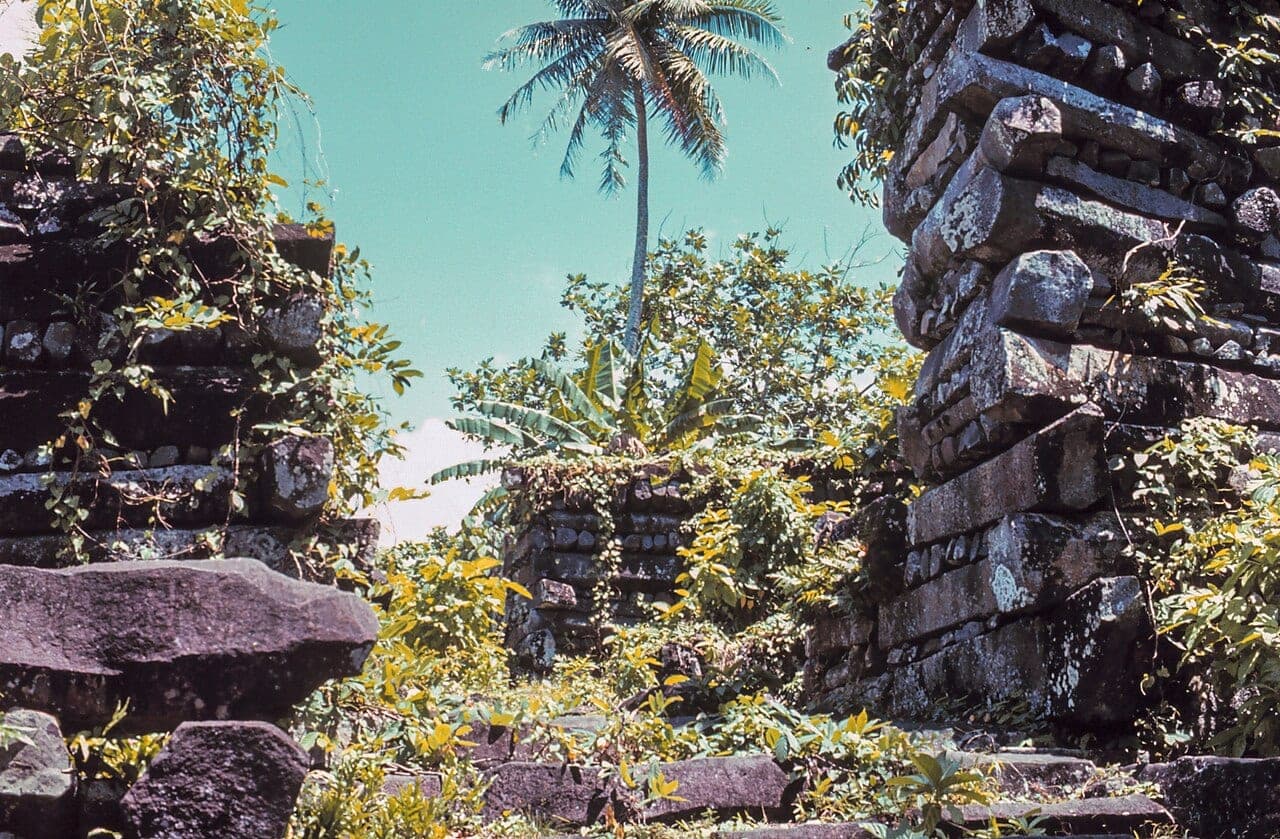
The Federated States of Micronesia gathers four island states, Yap, Chuuk, Pohnpei and Kosrae, along more than two and a half thousand kilometres of the western Pacific. Together they hold only about seven hundred square kilometres of land, scattered as some six hundred islands across nearly three million square kilometres of ocean, yet within that small ground rise two of the great stone monuments of the Pacific. Off Pohnpei, a hundred artificial islets carry the basalt walls of Nan Madol, ceremonial seat of the Saudeleur kings; on the reef of Kosrae lie the coral ramparts of Leluh, royal city of the Tokosra. On Yap, a different monument leans against garden paths and meeting houses: the great limestone discs of stone money, whose worth is carried not in a vault but in memory.
This is a country that has long trusted memory to do the work other societies give to writing. The value of a stone coin, the route across a thousand kilometres of open sea, the rank of a clan and the names of its dead were all held in trained recollection and passed by voice. That inheritance sits behind everything here: the navigators who read stars and swells, the chiefs honoured with garlands of flowers, the feast houses where sakau is pounded on stone, and the quiet obligations by which Micronesian families still keep company with those they have lost.
The country occupies the larger part of the Caroline Islands, a long chain in the western Pacific north of the equator and east of the Philippines. It is a federal republic of four states, Yap and Chuuk in the west and centre, Pohnpei and Kosrae in the east, each with its own language and customs. The federal capital is Palikir, on Pohnpei, and the United States dollar is the currency. Roughly a hundred thousand people live here, though numbers fall as families move abroad under the Compact of Free Association; the 2023 census counted about seventy-five thousand. Almost all of the country is water. Its high volcanic islands and low coral atolls hold little land, but its exclusive economic zone spans nearly three million square kilometres, giving Micronesian culture its enduring shape: a culture of the sea, of long voyages and exchange between distant islands.
Palikir. The national capital sits in a valley on Pohnpei, the largest and wettest island. Built in the 1980s to house the young federation's government, it is a quiet seat of ministries rather than a commercial centre.
Kolonia. The former capital and still the main town of Pohnpei, Kolonia carries the ruins of its Spanish, German and Japanese administrations, among them a German-era Catholic bell tower and the walls of an old Spanish fort. It remains the gateway to Nan Madol on the island's south-eastern coast.
Weno. The capital of Chuuk state and its most populous island lies inside the barrier reef of Chuuk Lagoon, base for the divers who visit the lagoon's sunken wartime fleet.
Colonia. The capital of Yap state is a small harbour town where the traditional order of clans and villages remains unusually strong, and where the banks of rai, the carved discs of stone money, still stand along village paths. Kosrae, the fourth state, is governed from Tofol, near the coral city of Lelu.
The ancestors of today's Micronesians were Austronesian voyagers who reached the Caroline Islands by sea more than two thousand years ago, part of the long expansion across the remote Pacific. On the high islands they raised monuments in stone. On Pohnpei, from around 1180, chiefs of the Saudeleur dynasty built Nan Madol, a ceremonial and political centre of more than a hundred islets set on a reef flat and enclosed by walls of stacked basalt columns and coral, some rising many metres high (UNESCO). The name is understood to mean the spaces between, for the canals that thread the islets. Oral tradition remembers the Saudeleur line ruling for centuries until it was overthrown, around the early seventeenth century, by the warrior Isokelekel, whose coming began the decentralised chiefly system of the Nahnmwarki that Pohnpei keeps today.
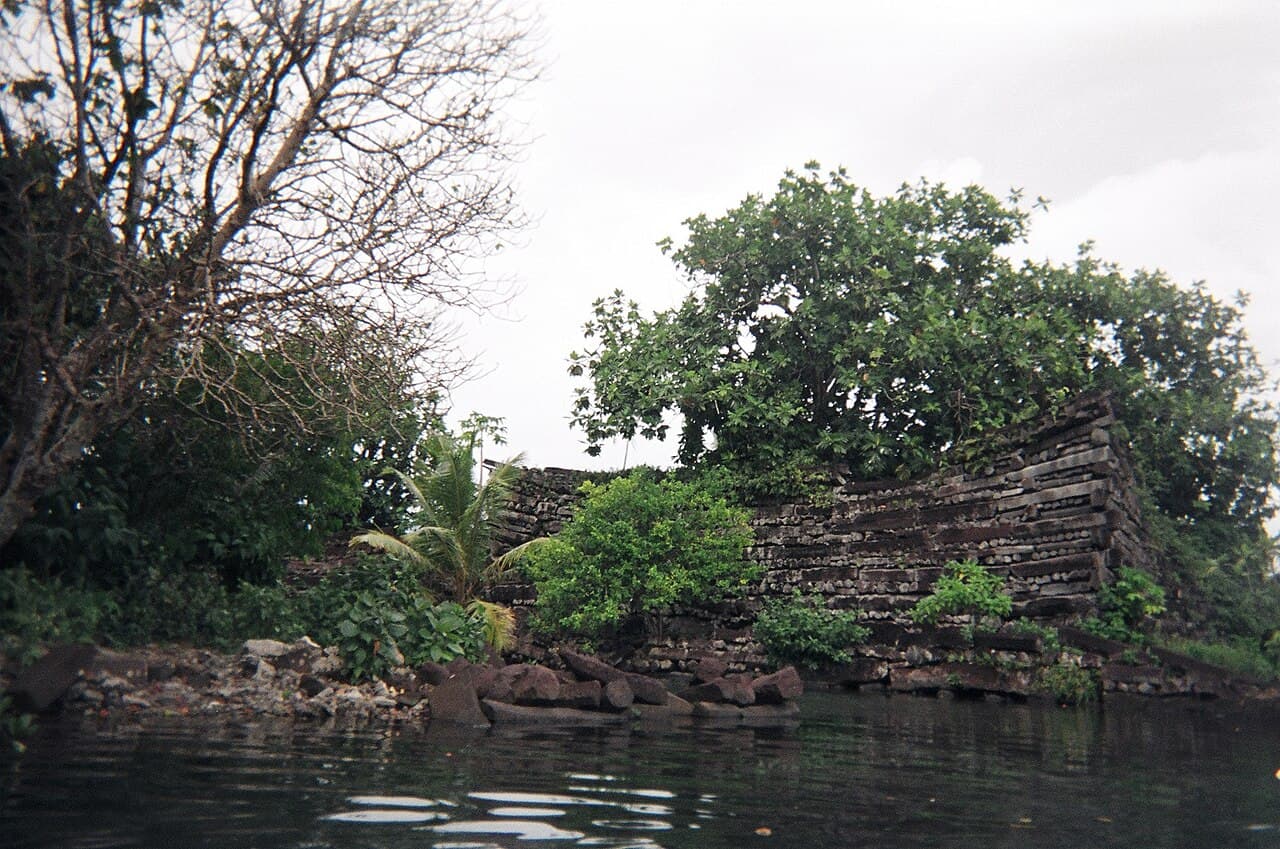 Nan Madol is a city of about a hundred artificial islets built from basalt columns weighing many tonnes each, and its northern sector was a mortuary precinct for the ruling line. Photograph by CT Snow, CC BY 2.0, via Wikimedia Commons.
Kosrae raised its own stone capital at Leluh, built up from about 1250 as an artificial city of coral and basalt walls and tombs where the paramount chief, the Tokosra, and the noble clans lived. Leluh reached its height in the fourteenth and fifteenth centuries and was still occupied when Europeans arrived (Wikipedia). Yap developed a monument of another kind, sailing some four hundred kilometres south to Palau to quarry great discs of limestone and enter them into an exchange network that bound distant islands in obligation and prestige (UNESCO).
The islands took their colonial name, the Carolines, from the Spanish king Charles II. Spain claimed but barely governed them, establishing an administration only in 1885 after Pope Leo XIII mediated a dispute with Germany. Spain sold the Carolines to Germany in 1899; Germany held them until 1914, when Japan seized them and received them as a League of Nations mandate in 1920, settling the islands in large numbers. The Second World War fell heavily on Chuuk, then called Truk, which the Japanese navy had fortified as its main forward base in the central Pacific. On 17–18 February 1944 a United States carrier force struck the anchorage in Operation Hailstone, sinking dozens of ships (Wikipedia); the wrecks, and the lives lost with them, are treated today as war graves, remembered soberly. After the war the islands became part of the United Nations Trust Territory of the Pacific Islands under United States administration. The four states adopted a shared constitution in 1979, the Compact of Free Association took effect on 3 November 1986 (U.S. Department of the Interior), and the country joined the United Nations in 1991.
The name comes from the Greek words for small and island, applied to this region of small Pacific islands by the navigator Jules Dumont d'Urville in the nineteenth century. English is the official language and the medium of government, but daily life is carried in the states' own tongues, all Oceanic members of the Austronesian family. Chuukese has the most speakers, followed by Pohnpeian, then Kosraean and Yapese, and beyond them the atoll languages of the outer islands, among them Ulithian, Woleaian and Mortlockese (Britannica). Two atolls of Pohnpei state, Nukuoro and Kapingamarangi, speak Polynesian languages, the trace of settlement from the south. Because so much knowledge here was preserved by memory rather than script, each language anchors chant, genealogy and lore that belongs to no other, and the smaller atoll tongues are watched with care as migration thins their communities.
No object expresses Micronesian identity more clearly than Yapese stone money. The rai are discs of quarried limestone, pierced at the centre to be carried on a pole, ranging from a hand's width to monuments three and a half metres across and several tonnes in weight. Their value rests less on size than on story: the danger of the quarrying voyage to Palau and the chain of owners recorded in memory. Ownership can pass without the stone moving, tracked by communal knowledge, so that a rai known to lie on the sea floor may still be counted as wealth. Economists have called it an early distributed ledger; on Yap it is first a record of obligation and honour.
The sea shaped every other art. Micronesian navigators sailed outrigger canoes across open ocean without instruments, holding their position by a star compass, the pattern of swells, the flight of birds and the colour of the water, a discipline refined on atolls such as Satawal. On land the meeting house is the heart of village life: the faluw and pebay of Yap, built by the shore, and the open nahs of Pohnpei, where feasts and councils turn on sakau, the pounded root drink known elsewhere as kava, beaten on a broad stone and served in an order that marks rank and respect (UNESCO ICHCAP). Women weave fine skirts and mats, the lavalava of Yap among the most prized, while men on Yap traditionally wear the woven loincloth called the thu. Dance and chant carry histories that writing never held. Yapese society is ordered by ranked villages and matrilineal clans, a system of caste and clan unusually well preserved, and rank and respect run through the culture from the feast house to the exchange of stone money.
Christianity reached the Caroline Islands in the nineteenth century and is the faith of the great majority today. Protestant Congregationalism took deep root on Kosrae and Pohnpei, carried by American missionaries, while Roman Catholicism, established under Spain and Germany, is strong on Yap and Chuuk. Churches anchor community life, and Sunday worship, hymn singing and church feasts fill the calendar. Beneath them persists an older understanding of the world. Before Christianity, Micronesians honoured gods, clan spirits and ancestors, and the stone cities of Nan Madol and Leluh were sacred as well as political places, their tombs charged with the presence of the dead. Something of that reverence survives in the respect shown to ancestral sites, and most Micronesians move easily between Christian devotion and the customary respect owed to clan, chief and forebears.
A death in the islands belongs to the whole clan, and the response is measured in gathering, feasting and the movement of gifts. Relatives come from across the island and beyond to keep the vigil; on Pohnpei and elsewhere mourning is marked by feasts at which sakau is shared and by exchanges of woven mats, food and valuables between the kin of the deceased. These exchanges are not incidental to grief but its proper expression, repairing the web of obligation that each death disturbs and honouring the standing of the one who has died. High rank is acknowledged with garlands, the fragrant head wreaths called mwaramwar on Pohnpei, placed on chiefs and honoured guests in life and offered in tribute at times of loss.
The great stone sites are themselves places of ancestral memory. Nan Madol held the tombs of the Saudeleur rulers on its mortuary islet of Nandauwas; Leluh enclosed the tombs of the Tokosra and the noble clans. For the communities descended from these societies the ruins are not merely archaeology but the resting places of forebears. In Chuuk, remembrance carries a sombre modern weight, for the wrecks of the lagoon are war graves, and the lives lost there in 1944 are marked with restraint. Most funerals today join Christian rites to these older customs, and graves are often kept close to the family home, tended and visited. Remembering the dead here is not a task apart from daily life but one of its central obligations. It is the same conviction that guides Confinity's own work: that memory is something a community keeps together, and keeps as a duty.
The Federated States of Micronesia have four colonial archives and one older system that outlasted all of them.
Spain, Germany, Japan and the United States each administered these islands in turn, and each counted the people. The Japanese period from 1914 to 1945 produced the most detailed records, including household registers on the koseki model, and those survive in part. American administration under the trusteeship after 1947 added its own censuses and court records, and the trust territory archives are split between Pohnpei, Guam, Hawai'i and Washington.
Mission registers are the earliest continuous vital records: Congregational from the 1850s in the east, Catholic in the west.
Underneath all of it, land and title pass by descent, and in most of Micronesia the descent that matters is matrilineal. Chuukese, Pohnpeian and Yapese clans hold land, and titles are conferred through lineages the community knows. On Yap the stone money, the rai, is a ledger of exactly this kind: a disc's value comes from its history, who quarried it, who moved it, who has held it, and that history is remembered rather than written down. Ownership can change without the stone moving at all.
Nan Madol, the basalt city on the reef at Pohnpei, is the built version of the same principle: a dynasty's genealogy laid out in stone islets, one for each function, and the chiefly lines that succeeded the Saudeleur are still known.
The country's foremost heritage effort surrounds Nan Madol, inscribed on the UNESCO World Heritage List in 2016 as the first World Heritage site in Micronesia, and placed at the same time on the List of World Heritage in Danger, because siltation of its canals, the spread of mangroves and storm erosion threaten to pull the ancient walls apart (UNESCO). Conservation specialists have since worked with the landowning community of Madolenihmw and with national and international agencies on a plan to clear the waterways and stabilise the structures, balancing preservation against the customary beliefs attached to a still-sacred site. Each state maintains its own historic preservation office and cultural programmes. The Leluh ruins on Kosrae were listed on the United States National Register of Historic Places in 1983 and are cared for alongside a state museum, while Yap's stone money, men's houses and traditional villages are sustained by the strength of Yapese custom itself. Because so much Micronesian heritage is intangible, held in language, navigation and ceremony, preservation here means keeping practices alive as much as guarding stone.
The turn to digital preservation reflects the same priority. Micronesian intangible heritage, from the sakau ceremony to weaving and chant, is documented on regional platforms such as the ichLinks network of the Asia-Pacific intangible heritage centre, and recordings of songs, oral histories and endangered outer-island languages are archived in open scholarly repositories. Nan Madol has drawn particular attention: photogrammetry and three-dimensional mapping of its islets, undertaken for its conservation, create a lasting record of a monument under threat and allow it to be studied far from Pohnpei. Navigation too is being carried into new media, as the star compasses, chants and canoe designs of the Carolinian wayfinders are filmed and taught to a wider generation.
The most far-reaching modern chapter of Micronesian heritage is the revival of traditional navigation. In 1976 the master navigator Mau Piailug, from the Yapese atoll of Satawal, guided the reconstructed Hawaiian canoe Hokule'a from Hawaii to Tahiti without instruments, proving that the old wayfinding could still cross the open Pacific (Britannica). Piailug went on to teach Hawaiian and other Pacific navigators, and the knowledge he carried from a small Micronesian island helped ignite a wayfinding renaissance that now reaches across Polynesia. Micronesian communities also carry their culture abroad: under the Compact many islanders have settled in Guam, Hawaii and the United States mainland, keeping language, dance and church life alive far from home, while artists take part in the Festival of Pacific Arts, the region's great gathering of Indigenous culture.
A stone city recognised and defended. The inscription of Nan Madol as a World Heritage site in 2016, the first in the country, brought international recognition and support to one of the Pacific's greatest monuments, and its parallel listing as endangered has focused conservation on holding its walls against the encroaching sea.
A navigation tradition that changed the Pacific. From the atoll of Satawal, the knowledge carried by Mau Piailug to the Hokule'a in 1976 seeded a revival of instrument-free voyaging that has spread across the ocean and restored a lost art to peoples throughout Polynesia.
War graves kept with care. In Chuuk, the sunken fleet of 1944 is protected as war graves and monuments, and the loss it holds is remembered with restraint, heritage handled as respect for the dead rather than attraction alone.
Wealth held in memory. On Yap, the great discs of stone money remain owned, counted and honoured, a system of value carried in communal recollection that has outlasted every colonial currency imposed on the islands.
Nan Madol is a city of about a hundred artificial islets built from basalt columns weighing many tonnes each, and its northern sector was a mortuary precinct for the ruling line. Photograph by CT Snow, CC BY 2.0, via Wikimedia Commons.
Kosrae raised its own stone capital at Leluh, built up from about 1250 as an artificial city of coral and basalt walls and tombs where the paramount chief, the Tokosra, and the noble clans lived. Leluh reached its height in the fourteenth and fifteenth centuries and was still occupied when Europeans arrived (Wikipedia). Yap developed a monument of another kind, sailing some four hundred kilometres south to Palau to quarry great discs of limestone and enter them into an exchange network that bound distant islands in obligation and prestige (UNESCO).
The islands took their colonial name, the Carolines, from the Spanish king Charles II. Spain claimed but barely governed them, establishing an administration only in 1885 after Pope Leo XIII mediated a dispute with Germany. Spain sold the Carolines to Germany in 1899; Germany held them until 1914, when Japan seized them and received them as a League of Nations mandate in 1920, settling the islands in large numbers. The Second World War fell heavily on Chuuk, then called Truk, which the Japanese navy had fortified as its main forward base in the central Pacific. On 17–18 February 1944 a United States carrier force struck the anchorage in Operation Hailstone, sinking dozens of ships (Wikipedia); the wrecks, and the lives lost with them, are treated today as war graves, remembered soberly. After the war the islands became part of the United Nations Trust Territory of the Pacific Islands under United States administration. The four states adopted a shared constitution in 1979, the Compact of Free Association took effect on 3 November 1986 (U.S. Department of the Interior), and the country joined the United Nations in 1991.
The name comes from the Greek words for small and island, applied to this region of small Pacific islands by the navigator Jules Dumont d'Urville in the nineteenth century. English is the official language and the medium of government, but daily life is carried in the states' own tongues, all Oceanic members of the Austronesian family. Chuukese has the most speakers, followed by Pohnpeian, then Kosraean and Yapese, and beyond them the atoll languages of the outer islands, among them Ulithian, Woleaian and Mortlockese (Britannica). Two atolls of Pohnpei state, Nukuoro and Kapingamarangi, speak Polynesian languages, the trace of settlement from the south. Because so much knowledge here was preserved by memory rather than script, each language anchors chant, genealogy and lore that belongs to no other, and the smaller atoll tongues are watched with care as migration thins their communities.
No object expresses Micronesian identity more clearly than Yapese stone money. The rai are discs of quarried limestone, pierced at the centre to be carried on a pole, ranging from a hand's width to monuments three and a half metres across and several tonnes in weight. Their value rests less on size than on story: the danger of the quarrying voyage to Palau and the chain of owners recorded in memory. Ownership can pass without the stone moving, tracked by communal knowledge, so that a rai known to lie on the sea floor may still be counted as wealth. Economists have called it an early distributed ledger; on Yap it is first a record of obligation and honour.
The sea shaped every other art. Micronesian navigators sailed outrigger canoes across open ocean without instruments, holding their position by a star compass, the pattern of swells, the flight of birds and the colour of the water, a discipline refined on atolls such as Satawal. On land the meeting house is the heart of village life: the faluw and pebay of Yap, built by the shore, and the open nahs of Pohnpei, where feasts and councils turn on sakau, the pounded root drink known elsewhere as kava, beaten on a broad stone and served in an order that marks rank and respect (UNESCO ICHCAP). Women weave fine skirts and mats, the lavalava of Yap among the most prized, while men on Yap traditionally wear the woven loincloth called the thu. Dance and chant carry histories that writing never held. Yapese society is ordered by ranked villages and matrilineal clans, a system of caste and clan unusually well preserved, and rank and respect run through the culture from the feast house to the exchange of stone money.
Christianity reached the Caroline Islands in the nineteenth century and is the faith of the great majority today. Protestant Congregationalism took deep root on Kosrae and Pohnpei, carried by American missionaries, while Roman Catholicism, established under Spain and Germany, is strong on Yap and Chuuk. Churches anchor community life, and Sunday worship, hymn singing and church feasts fill the calendar. Beneath them persists an older understanding of the world. Before Christianity, Micronesians honoured gods, clan spirits and ancestors, and the stone cities of Nan Madol and Leluh were sacred as well as political places, their tombs charged with the presence of the dead. Something of that reverence survives in the respect shown to ancestral sites, and most Micronesians move easily between Christian devotion and the customary respect owed to clan, chief and forebears.
A death in the islands belongs to the whole clan, and the response is measured in gathering, feasting and the movement of gifts. Relatives come from across the island and beyond to keep the vigil; on Pohnpei and elsewhere mourning is marked by feasts at which sakau is shared and by exchanges of woven mats, food and valuables between the kin of the deceased. These exchanges are not incidental to grief but its proper expression, repairing the web of obligation that each death disturbs and honouring the standing of the one who has died. High rank is acknowledged with garlands, the fragrant head wreaths called mwaramwar on Pohnpei, placed on chiefs and honoured guests in life and offered in tribute at times of loss.
The great stone sites are themselves places of ancestral memory. Nan Madol held the tombs of the Saudeleur rulers on its mortuary islet of Nandauwas; Leluh enclosed the tombs of the Tokosra and the noble clans. For the communities descended from these societies the ruins are not merely archaeology but the resting places of forebears. In Chuuk, remembrance carries a sombre modern weight, for the wrecks of the lagoon are war graves, and the lives lost there in 1944 are marked with restraint. Most funerals today join Christian rites to these older customs, and graves are often kept close to the family home, tended and visited. Remembering the dead here is not a task apart from daily life but one of its central obligations. It is the same conviction that guides Confinity's own work: that memory is something a community keeps together, and keeps as a duty.
The Federated States of Micronesia have four colonial archives and one older system that outlasted all of them.
Spain, Germany, Japan and the United States each administered these islands in turn, and each counted the people. The Japanese period from 1914 to 1945 produced the most detailed records, including household registers on the koseki model, and those survive in part. American administration under the trusteeship after 1947 added its own censuses and court records, and the trust territory archives are split between Pohnpei, Guam, Hawai'i and Washington.
Mission registers are the earliest continuous vital records: Congregational from the 1850s in the east, Catholic in the west.
Underneath all of it, land and title pass by descent, and in most of Micronesia the descent that matters is matrilineal. Chuukese, Pohnpeian and Yapese clans hold land, and titles are conferred through lineages the community knows. On Yap the stone money, the rai, is a ledger of exactly this kind: a disc's value comes from its history, who quarried it, who moved it, who has held it, and that history is remembered rather than written down. Ownership can change without the stone moving at all.
Nan Madol, the basalt city on the reef at Pohnpei, is the built version of the same principle: a dynasty's genealogy laid out in stone islets, one for each function, and the chiefly lines that succeeded the Saudeleur are still known.
The country's foremost heritage effort surrounds Nan Madol, inscribed on the UNESCO World Heritage List in 2016 as the first World Heritage site in Micronesia, and placed at the same time on the List of World Heritage in Danger, because siltation of its canals, the spread of mangroves and storm erosion threaten to pull the ancient walls apart (UNESCO). Conservation specialists have since worked with the landowning community of Madolenihmw and with national and international agencies on a plan to clear the waterways and stabilise the structures, balancing preservation against the customary beliefs attached to a still-sacred site. Each state maintains its own historic preservation office and cultural programmes. The Leluh ruins on Kosrae were listed on the United States National Register of Historic Places in 1983 and are cared for alongside a state museum, while Yap's stone money, men's houses and traditional villages are sustained by the strength of Yapese custom itself. Because so much Micronesian heritage is intangible, held in language, navigation and ceremony, preservation here means keeping practices alive as much as guarding stone.
The turn to digital preservation reflects the same priority. Micronesian intangible heritage, from the sakau ceremony to weaving and chant, is documented on regional platforms such as the ichLinks network of the Asia-Pacific intangible heritage centre, and recordings of songs, oral histories and endangered outer-island languages are archived in open scholarly repositories. Nan Madol has drawn particular attention: photogrammetry and three-dimensional mapping of its islets, undertaken for its conservation, create a lasting record of a monument under threat and allow it to be studied far from Pohnpei. Navigation too is being carried into new media, as the star compasses, chants and canoe designs of the Carolinian wayfinders are filmed and taught to a wider generation.
The most far-reaching modern chapter of Micronesian heritage is the revival of traditional navigation. In 1976 the master navigator Mau Piailug, from the Yapese atoll of Satawal, guided the reconstructed Hawaiian canoe Hokule'a from Hawaii to Tahiti without instruments, proving that the old wayfinding could still cross the open Pacific (Britannica). Piailug went on to teach Hawaiian and other Pacific navigators, and the knowledge he carried from a small Micronesian island helped ignite a wayfinding renaissance that now reaches across Polynesia. Micronesian communities also carry their culture abroad: under the Compact many islanders have settled in Guam, Hawaii and the United States mainland, keeping language, dance and church life alive far from home, while artists take part in the Festival of Pacific Arts, the region's great gathering of Indigenous culture.
A stone city recognised and defended. The inscription of Nan Madol as a World Heritage site in 2016, the first in the country, brought international recognition and support to one of the Pacific's greatest monuments, and its parallel listing as endangered has focused conservation on holding its walls against the encroaching sea.
A navigation tradition that changed the Pacific. From the atoll of Satawal, the knowledge carried by Mau Piailug to the Hokule'a in 1976 seeded a revival of instrument-free voyaging that has spread across the ocean and restored a lost art to peoples throughout Polynesia.
War graves kept with care. In Chuuk, the sunken fleet of 1944 is protected as war graves and monuments, and the loss it holds is remembered with restraint, heritage handled as respect for the dead rather than attraction alone.
Wealth held in memory. On Yap, the great discs of stone money remain owned, counted and honoured, a system of value carried in communal recollection that has outlasted every colonial currency imposed on the islands.
National Overview
Notable Cities
Historical Foundations
Linguistic and Etymological Roots
Cultural Identity
Religion and Spirituality
Remembrance and Mourning Traditions
Tracing a Family in Micronesia
Heritage Preservation Efforts
Digital Heritage
Contemporary Cultural Influences
Success Stories
References and resources
- UNESCO World Heritage Centre: Nan Madol, Ceremonial Centre of Eastern Micronesia
- UNESCO World Heritage Centre: State of Conservation report, Nan Madol
- Wikipedia: Leluh archaeological site, Kosrae
- UNESCO Tentative List: Yapese stone money and quarrying sites
- Wikipedia: Operation Hailstone, Chuuk Lagoon, 1944
- U.S. Department of the Interior: Federated States of Micronesia and the Compact of Free Association
- Encyclopaedia Britannica: History of Micronesia
- Encyclopaedia Britannica: Mau Piailug, Micronesian navigator
- UNESCO ICHCAP: Sakau, Gift of Gods and Root of Pohnpei
- Wikipedia: Federated States of Micronesia
- SPREP Pacific Environment: Lelu Ruins, A Legacy Written in Stone