Heritage · Country
Northern Mariana Islands Culture and Heritage
Fourteen islands north of Guam passed from Spain to Germany to Japan to the United States in half a century, and carried two indigenous peoples through all of it. This guide follows the Commonwealth's heritage, from the standing latte of the House of Taga to the memorials at Marpi.Written to last.
By Confinity Heritage Editorial · Updated 2026-08-17 · 8-minute readQuiet tools, kept out of the way.
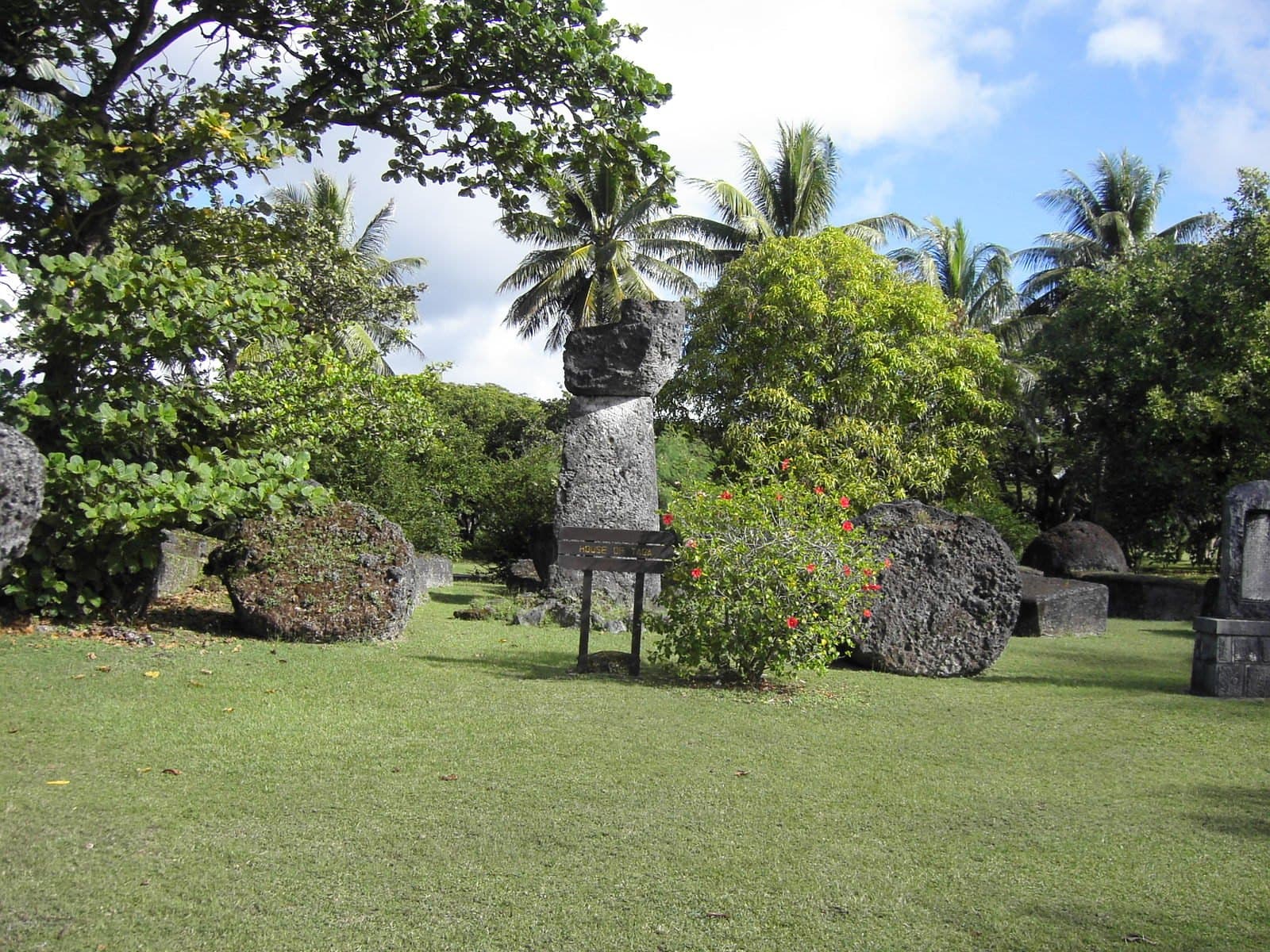
On a lawn in San Jose village on Tinian, one limestone pillar still stands upright with its bowl-shaped capstone in place, about five metres tall. Eleven others lie around it where earthquakes and centuries put them. This is the House of Taga, the largest set of latte ever raised in the Marianas, and the pillars are reckoned to weigh in the region of thirty tonnes apiece. Half a kilometre away is a harbour the Japanese sugar company dredged in the 1930s, and ten kilometres north is a coral airstrip complex that was briefly the busiest airfield on earth. Tinian is about a hundred square kilometres, and it holds all three at once.
That layering is what makes the Northern Marianas different from their larger neighbour to the south. Guam stayed in Spanish and then American hands without a break; these islands changed sovereign four times in fifty years, and each administration left buildings, graves, place names and loanwords behind. They also hold two indigenous peoples, because the CHamoru of the latte period were joined in the nineteenth century by Carolinian voyagers who sailed north after a typhoon and stayed. When the chance came in 1975 to settle the political question, the islands negotiated a commonwealth in union with the United States and wrote their own constitution.
The Commonwealth of the Northern Mariana Islands is a chain of fourteen islands running roughly 750 kilometres north from a point just above Guam, with a combined land area of about 477 square kilometres. The 2020 census counted 47,329 residents, almost all of them on the three southern islands of Saipan, Tinian and Rota; the volcanic islands to the north have been mostly empty since eruptions forced evacuations from Pagan in 1981 and Anatahan in 2003 (US Census Bureau). Saipan holds around nine in ten of the people and the seat of government at Capitol Hill. English, CHamoru and Carolinian are all official. Residents are United States citizens who elect a governor and a bicameral legislature, send one non-voting delegate to Congress, and take no part in presidential elections (Britannica).
Garapan. Saipan's main town was a Japanese city before it was anything else in living memory, with cinemas, shops, a hospital and a sugar railway, and it was destroyed in 1944 and rebuilt as the Commonwealth's commercial centre. What survives of the earlier town is walkable: the 1926 hospital that houses the NMI Museum, the ruins of the jail, the Katori shrine and Haruji Matsue's statue in Sugar King Park (Garapan Heritage Trail).
Chalan Kanoa and Susupe. Chalan Kanoa grew around the sugar mill and then the postwar refugee camps, and holds Mount Carmel Cathedral, seat of the Catholic diocese. Susupe next door has the government offices and the Guma Sakman canoe house.
San Jose, Tinian. The island's one village, home to fewer than three thousand people, sits beside the House of Taga. North Field, with its runways and preserved bomb loading pits, lies at the end of a straight road past fields that once grew cane.
Songsong, Rota. Rota, called Luta in CHamoru, escaped the ground fighting of 1944 and kept more of its prewar fabric and its latte sites than either neighbour, including the As Nieves quarry where enormous unfinished latte lie in the rock they were cut from (Guampedia).
The Marianas were settled about 3,500 years ago, and by roughly 900 CE their people were raising latte, the paired stone pillars and capstones that carried houses and meeting halls. The House of Taga takes its name from a chief of legend whose family, in the telling, ruled Tinian and quarried the largest stones in the archipelago (Wikipedia).
 The Taga latte are the largest ever raised, each a shaft with a capstone, cut and set by Chamorro builders. Only one still stands upright. Photograph by CT Snow, CC BY 2.0, via Wikimedia Commons.
Spanish colonisation from 1668 took a different course here than on Guam. Under the policy of reducción the Spanish moved the surviving population of the northern islands south, and by about 1720 Saipan, Tinian and the islands beyond had been effectively emptied, their people resettled on Guam and Rota while Tinian went over to cattle (Wikipedia). For a century they were pasture and anchorage.
Then came the Carolinians. After a typhoon devastated Satawal in 1815, a chief and navigator named Aghurubw led his people some 700 kilometres north in sailing canoes and asked the Spanish authorities for permission to settle on Saipan; accounts describe a fleet carrying several hundred people landing near what is now Micro Beach, where they founded the village of Arabwal (Wikipedia, Wikipedia). Further migrations followed. When CHamoru families began returning from Guam in the 1860s the Refaluwasch were already established, and the two peoples have shared the same small ground since. The Commonwealth recognises both as indigenous and restricts long-term land ownership to persons of Northern Marianas descent, defined to include CHamoru and Carolinian ancestry alike (Wikipedia).
Spain sold the islands after losing Guam and the Philippines in 1898. Under the German-Spanish Treaty of 1899 Germany bought the Carolines, Palau and the Marianas apart from Guam for 25 million pesetas, then administered them lightly for fifteen years, concentrating on copra, land registration and labour recruitment (Wikipedia). Japan took the islands in 1914 and received them in 1919 as a Class C League of Nations mandate.
The Japanese period changed them more than any before it. Nan'yō Kōhatsu, founded in 1921 by Matsue Haruji, cleared over 3,000 hectares for cane and built a refinery, a distillery and a railway on Saipan, bringing in more than five thousand workers from Okinawa and northern Japan; sugar output rose from 9,000 tonnes in 1925 to 68,000 tonnes a decade later (Wikipedia, Wikipedia). By the mid-1930s Saipan held around three thousand CHamorus and Carolinians and more than twenty thousand Japanese, Okinawan and Korean residents, and Garapan was a town of over fifteen thousand with a Japanese street plan and Japanese schools.
The American invasion of Saipan began on 15 June 1944 and the island was declared secure on 9 July. Around 29,000 Japanese defenders and roughly 3,000 Americans died. At least 8,000 civilians also died, most of them Japanese and Okinawan settlers, and a large share of those deaths came in the final days at the cliffs above Marpi Point that American accounts named Suicide Cliff and Banzai Cliff, where families jumped or were pushed, some urged on by soldiers and by official warnings about capture (Wikipedia, Wikipedia). Tinian was taken between 24 July and 1 August. Naval construction battalions turned its northern plateau into North Field, four parallel runways of 2,600 metres flying B-29 operations against the Japanese home islands, and on 6 and 9 August 1945 the aircraft that dropped the atomic bombs on Hiroshima and Nagasaki took off from it (Wikipedia, Wikipedia).
The islands then became part of the Trust Territory of the Pacific Islands, administered by the United States under United Nations strategic trusteeship from 1947, with headquarters moved to Saipan in 1962 (Wikipedia). Reunification with Guam went to voters in 1969: the Northern Marianas backed it strongly on 65 per cent turnout, and Guam turned it down, 3,720 votes to 2,688 (Guampedia). The islands negotiated separately after that. The Covenant establishing a Commonwealth in political union with the United States was signed on 15 February 1975, approved by 78.8 per cent of voters that June and enacted by Congress in March 1976; the local constitution took effect on 9 January 1978 and the trusteeship ended in 1986 (CNMI Law Revision Commission). Its mutual consent provisions mean certain terms cannot be altered by Congress alone, which is the practical difference between what the Northern Marianas negotiated and what Guam received by statute in 1950.
Three languages carry the Commonwealth's memory. CHamoru here is close to the CHamoru of Guam, with local differences in vocabulary and intonation and the same Spanish loan layer from the mission centuries. Carolinian, called Refaluwasch by its speakers, is a Chuukic language descended mainly from Satawalese, spoken by a few thousand people and taught in Commonwealth schools; it arrived with the canoes of the 1810s and has since absorbed CHamoru, Spanish, German, Japanese and English words while keeping its own structure (Wikipedia).
The Japanese decades left a residue islanders barely register as foreign: terms for tools, foods and institutions, and place names layered over older ones. Managaha, the island off Saipan where Aghurubw is buried, carries a Carolinian name meaning roughly a resting place (Wikipedia).
Spelling is one place where the archipelago's political division shows on paper. Guam's language commission adopted a revised orthography in 2018 writing the people and their language as CHamoru, with both letters of the digraph capitalised, while the Commonwealth has kept the older Chamorro spelling in many official contexts, including its own laws.
The two indigenous communities keep distinct performance and craft traditions while sharing an island. Carolinian dance is the most visible marker: men's stick dances and women's standing dances, performed in grass skirts and mwarmwar, the flower garlands worn on the head, with chants in Refaluwasch that carry genealogy and voyaging history. CHamoru groups perform their own chant and dance repertoire, largely reconstructed since the 1980s from Spanish-era accounts and from practice on Guam. Both appear at the Flame Tree Arts Festival, the Commonwealth's main annual gathering of artists, carvers and cooks, held on Saipan each spring.
Seafaring is the strongest common thread. The Refaluwasch arrived under sail and kept navigational knowledge alive longer than most of the Marianas, and the Commonwealth has become a centre for its revival. Weaving in pandanus and coconut leaf, carving and shell ornament continue as household skills. Food carries the layers plainly: red rice, kelaguen and titiyas from the CHamoru kitchen, breadfruit and taro from the Carolinian one, sashimi from the Japanese decades and Spam from the American ones, usually on the same fiesta table.
The Commonwealth is predominantly Catholic, and the Diocese of Chalan Kanoa, erected in 1984 and covering all three inhabited islands, organises much of community life through parishes, village fiestas and novenas (Wikipedia). Mount Carmel Cathedral is the mother church, and the Carolinian community maintains its own parish traditions and hymnody in Refaluwasch alongside CHamoru and English liturgy. Protestant congregations, a Buddhist presence from the Japanese period and churches serving Filipino, Korean and Chinese workers fill out the picture.
Older belief persists as it does across the Marianas. People speak of taotaomo'na, ancestral spirits associated with the bush, the banyan trees and the latte sites, and asking permission before disturbing such places is ordinary courtesy. On the Carolinian side, the respect owed to named ancestors and to burial grounds like Managaha is explicit and enforced by the community. The Katori shrine in Sugar King Park, rebuilt after the war, is tended and still visited (Wikipedia).
A death in a CHamoru or Carolinian family here begins a rosary that runs nine consecutive nights, led by a lay prayer leader and held at the house or the parish church, with the extended family and neighbours expected to attend and to arrive with food, money and hours of help. A year later the family gathers again for the anniversary rosary, the anos, which closes the mourning period. Obituaries in the Commonwealth's newspapers print the full schedule of nightly rosaries, and employers work around them.
What sets remembrance here apart is that the islands also hold the dead of nations that were briefly resident. The bluffs at Marpi carry the Japanese memorial and prefectural markers, the Okinawa memorial, the Korean Peace Memorial raised for the labourers brought here under Japanese rule, and the American markers at the Last Command Post nearby. Japanese bereaved family associations have travelled to Saipan for decades, and Japanese government teams have run repeated missions to recover and repatriate remains from the caves and cliff bases. In June 2005 Emperor Akihito and Empress Michiko came to Saipan on their first overseas visit to a battlefield, laid wreaths at the Japanese, American and Okinawan monuments, and made an unscheduled stop at the Korean memorial (China Daily).
Local remembrance sits within all of that. The Commonwealth marks Liberation Day on 4 July, the date in 1944 when American forces released civilians from the Camp Susupe internment area. Aghurubw's grave on Managaha is maintained by the Carolinian community, and 2 November brings families to the cemeteries to clean graves and light candles.
The Marianas have four colonial archives and one population whose survival is itself the story.
The CHamoru of Saipan, Tinian and Rota went through the same Spanish conquest as Guam, and the surviving population was concentrated by the Spanish administration; Catholic parish registers from the eighteenth century are the earliest vital records. Germany bought the islands in 1899 and Japan took them under mandate in 1914, running them intensively: Japanese and Okinawan settlers came in numbers that made the local population a minority, and the Japanese kept household registers on the koseki pattern, which survive in part.
The Carolinian population, the Refaluwasch, arrived from the atolls to the south in the nineteenth century after typhoons devastated their home islands, and they are a distinct community with their own language and their own clan system, matrilineal like the Micronesian societies they came from.
The battles of 1944 killed thousands of civilians as well as soldiers, and the Japanese population was repatriated afterwards.
American administration under the trusteeship, then commonwealth status from 1978, produced the modern record, and the trust territory archives are split between Saipan, Guam and Hawai'i.
The garment industry of the 1980s and 1990s brought tens of thousands of workers from China and the Philippines under a labour regime that was investigated by Congress, and their records are the largest recent body of paperwork about people here.
The NMI Museum of History and Culture occupies the old Japanese hospital in Garapan, built in 1926 and the largest Japanese building on Saipan to survive the fighting; it was listed on the National Register in 1974, renovated from 1996 and opened as the museum in 1998, with galleries running from the latte period through the Spanish, German, Japanese and American administrations (Wikipedia, Wikipedia). Putting the national museum inside a colonial hospital is itself an argument about how the Commonwealth handles its layers.
The Historic Preservation Office, part of the Department of Community and Cultural Affairs, serves as the state preservation office under the Historic Preservation Act of 1982, maintaining the site inventory, reviewing federal undertakings and running archaeological work on all three islands (NCSHPO). The House of Taga has been on the National Register since 1974, and North Field is a National Historic Landmark.
The National Park Service runs American Memorial Park on 54 hectares of Garapan shoreline, established in 1978 to honour the 5,204 American service members and Marianas islanders who died in the 1944 campaign; its Court of Honor carries their names and its visitor centre holds the main wartime interpretation on Saipan (National Park Service). Preservation here also fights the weather. Typhoon Soudelor in 2015 and Super Typhoon Yutu in 2018 damaged historic structures across Saipan and Tinian, including the grounds at the House of Taga (Wikipedia).
The Commonwealth's digital record is small, distributed and steadily growing. The Garapan Heritage Trail publishes its interpretive text online, site by site, so the prewar town can be read from anywhere (Garapan Heritage Trail). The Northern Marianas Humanities Council funds and hosts oral history, language and documentary projects, including recordings with elders who lived through the Japanese period and the battle (Northern Marianas Humanities Council). The Historic Preservation Office maintains the archaeological and National Register inventories.
Language documentation is the most consequential piece. Carolinian has few speakers and limited published material, so the dictionaries, school curricula and recorded chant held by the Commonwealth's education and cultural agencies carry real weight. Marianas-wide reference works such as Guampedia cover the northern islands too, so a family on Saipan and a family on Guam researching the same latte site often end up in the same archive.
Tourism has shaped the modern Commonwealth more than any other industry, first from Japan, later from Korea and China, and the wartime sites are part of the itinerary. The casino boom on Saipan in the late 2010s, built around a single operator, collapsed and left an unfinished building on the Garapan waterfront and a hole in public revenue (Wikipedia). The islands have been rebuilding from a smaller base since, with a workforce heavily made up of migrant labour from the Philippines and elsewhere in Asia.
Military planning is the other pressure. Tinian's North Field and the leaseback areas covering much of that island have been the focus of proposals for divert airfields and live-fire training that run through archaeological sites and grazing land, and Commonwealth agencies and community groups have contested the scope of that work through the environmental review process. Against it, the cultural work is visible and local: canoe building and sailing have returned to the lagoon, Refaluwasch and CHamoru are taught in schools, and Commonwealth performers travel to the Festival of Pacific Arts as a delegation in their own right.
A museum inside the building it interprets. The old Japanese hospital in Garapan was restored rather than cleared, and since 1998 it has held the Commonwealth's national collection, documenting the Japanese decades from inside one of the few structures that period left standing.
Canoes back on the water. 500 Sails, founded on Saipan in 2014, builds CHamoru and Carolinian sailing canoes to historical lines, including a design recorded from a canoe captured off Tinian in 1742, and teaches sailing from its canoe house in Susupe, aiming to put five hundred traditional proas back in Marianas waters (500 Sails).
Two indigenous peoples written into the founding law. The 1978 constitution recognises CHamoru and Carolinian alike as peoples of Northern Marianas descent and restricts long-term land ownership accordingly, so the Refaluwasch position rests on something firmer than custom.
A negotiated status. The 1975 Covenant was put to a plebiscite and carried with 78.8 per cent support, and its mutual consent clauses mean parts of it cannot be changed by Congress alone.
The Taga latte are the largest ever raised, each a shaft with a capstone, cut and set by Chamorro builders. Only one still stands upright. Photograph by CT Snow, CC BY 2.0, via Wikimedia Commons.
Spanish colonisation from 1668 took a different course here than on Guam. Under the policy of reducción the Spanish moved the surviving population of the northern islands south, and by about 1720 Saipan, Tinian and the islands beyond had been effectively emptied, their people resettled on Guam and Rota while Tinian went over to cattle (Wikipedia). For a century they were pasture and anchorage.
Then came the Carolinians. After a typhoon devastated Satawal in 1815, a chief and navigator named Aghurubw led his people some 700 kilometres north in sailing canoes and asked the Spanish authorities for permission to settle on Saipan; accounts describe a fleet carrying several hundred people landing near what is now Micro Beach, where they founded the village of Arabwal (Wikipedia, Wikipedia). Further migrations followed. When CHamoru families began returning from Guam in the 1860s the Refaluwasch were already established, and the two peoples have shared the same small ground since. The Commonwealth recognises both as indigenous and restricts long-term land ownership to persons of Northern Marianas descent, defined to include CHamoru and Carolinian ancestry alike (Wikipedia).
Spain sold the islands after losing Guam and the Philippines in 1898. Under the German-Spanish Treaty of 1899 Germany bought the Carolines, Palau and the Marianas apart from Guam for 25 million pesetas, then administered them lightly for fifteen years, concentrating on copra, land registration and labour recruitment (Wikipedia). Japan took the islands in 1914 and received them in 1919 as a Class C League of Nations mandate.
The Japanese period changed them more than any before it. Nan'yō Kōhatsu, founded in 1921 by Matsue Haruji, cleared over 3,000 hectares for cane and built a refinery, a distillery and a railway on Saipan, bringing in more than five thousand workers from Okinawa and northern Japan; sugar output rose from 9,000 tonnes in 1925 to 68,000 tonnes a decade later (Wikipedia, Wikipedia). By the mid-1930s Saipan held around three thousand CHamorus and Carolinians and more than twenty thousand Japanese, Okinawan and Korean residents, and Garapan was a town of over fifteen thousand with a Japanese street plan and Japanese schools.
The American invasion of Saipan began on 15 June 1944 and the island was declared secure on 9 July. Around 29,000 Japanese defenders and roughly 3,000 Americans died. At least 8,000 civilians also died, most of them Japanese and Okinawan settlers, and a large share of those deaths came in the final days at the cliffs above Marpi Point that American accounts named Suicide Cliff and Banzai Cliff, where families jumped or were pushed, some urged on by soldiers and by official warnings about capture (Wikipedia, Wikipedia). Tinian was taken between 24 July and 1 August. Naval construction battalions turned its northern plateau into North Field, four parallel runways of 2,600 metres flying B-29 operations against the Japanese home islands, and on 6 and 9 August 1945 the aircraft that dropped the atomic bombs on Hiroshima and Nagasaki took off from it (Wikipedia, Wikipedia).
The islands then became part of the Trust Territory of the Pacific Islands, administered by the United States under United Nations strategic trusteeship from 1947, with headquarters moved to Saipan in 1962 (Wikipedia). Reunification with Guam went to voters in 1969: the Northern Marianas backed it strongly on 65 per cent turnout, and Guam turned it down, 3,720 votes to 2,688 (Guampedia). The islands negotiated separately after that. The Covenant establishing a Commonwealth in political union with the United States was signed on 15 February 1975, approved by 78.8 per cent of voters that June and enacted by Congress in March 1976; the local constitution took effect on 9 January 1978 and the trusteeship ended in 1986 (CNMI Law Revision Commission). Its mutual consent provisions mean certain terms cannot be altered by Congress alone, which is the practical difference between what the Northern Marianas negotiated and what Guam received by statute in 1950.
Three languages carry the Commonwealth's memory. CHamoru here is close to the CHamoru of Guam, with local differences in vocabulary and intonation and the same Spanish loan layer from the mission centuries. Carolinian, called Refaluwasch by its speakers, is a Chuukic language descended mainly from Satawalese, spoken by a few thousand people and taught in Commonwealth schools; it arrived with the canoes of the 1810s and has since absorbed CHamoru, Spanish, German, Japanese and English words while keeping its own structure (Wikipedia).
The Japanese decades left a residue islanders barely register as foreign: terms for tools, foods and institutions, and place names layered over older ones. Managaha, the island off Saipan where Aghurubw is buried, carries a Carolinian name meaning roughly a resting place (Wikipedia).
Spelling is one place where the archipelago's political division shows on paper. Guam's language commission adopted a revised orthography in 2018 writing the people and their language as CHamoru, with both letters of the digraph capitalised, while the Commonwealth has kept the older Chamorro spelling in many official contexts, including its own laws.
The two indigenous communities keep distinct performance and craft traditions while sharing an island. Carolinian dance is the most visible marker: men's stick dances and women's standing dances, performed in grass skirts and mwarmwar, the flower garlands worn on the head, with chants in Refaluwasch that carry genealogy and voyaging history. CHamoru groups perform their own chant and dance repertoire, largely reconstructed since the 1980s from Spanish-era accounts and from practice on Guam. Both appear at the Flame Tree Arts Festival, the Commonwealth's main annual gathering of artists, carvers and cooks, held on Saipan each spring.
Seafaring is the strongest common thread. The Refaluwasch arrived under sail and kept navigational knowledge alive longer than most of the Marianas, and the Commonwealth has become a centre for its revival. Weaving in pandanus and coconut leaf, carving and shell ornament continue as household skills. Food carries the layers plainly: red rice, kelaguen and titiyas from the CHamoru kitchen, breadfruit and taro from the Carolinian one, sashimi from the Japanese decades and Spam from the American ones, usually on the same fiesta table.
The Commonwealth is predominantly Catholic, and the Diocese of Chalan Kanoa, erected in 1984 and covering all three inhabited islands, organises much of community life through parishes, village fiestas and novenas (Wikipedia). Mount Carmel Cathedral is the mother church, and the Carolinian community maintains its own parish traditions and hymnody in Refaluwasch alongside CHamoru and English liturgy. Protestant congregations, a Buddhist presence from the Japanese period and churches serving Filipino, Korean and Chinese workers fill out the picture.
Older belief persists as it does across the Marianas. People speak of taotaomo'na, ancestral spirits associated with the bush, the banyan trees and the latte sites, and asking permission before disturbing such places is ordinary courtesy. On the Carolinian side, the respect owed to named ancestors and to burial grounds like Managaha is explicit and enforced by the community. The Katori shrine in Sugar King Park, rebuilt after the war, is tended and still visited (Wikipedia).
A death in a CHamoru or Carolinian family here begins a rosary that runs nine consecutive nights, led by a lay prayer leader and held at the house or the parish church, with the extended family and neighbours expected to attend and to arrive with food, money and hours of help. A year later the family gathers again for the anniversary rosary, the anos, which closes the mourning period. Obituaries in the Commonwealth's newspapers print the full schedule of nightly rosaries, and employers work around them.
What sets remembrance here apart is that the islands also hold the dead of nations that were briefly resident. The bluffs at Marpi carry the Japanese memorial and prefectural markers, the Okinawa memorial, the Korean Peace Memorial raised for the labourers brought here under Japanese rule, and the American markers at the Last Command Post nearby. Japanese bereaved family associations have travelled to Saipan for decades, and Japanese government teams have run repeated missions to recover and repatriate remains from the caves and cliff bases. In June 2005 Emperor Akihito and Empress Michiko came to Saipan on their first overseas visit to a battlefield, laid wreaths at the Japanese, American and Okinawan monuments, and made an unscheduled stop at the Korean memorial (China Daily).
Local remembrance sits within all of that. The Commonwealth marks Liberation Day on 4 July, the date in 1944 when American forces released civilians from the Camp Susupe internment area. Aghurubw's grave on Managaha is maintained by the Carolinian community, and 2 November brings families to the cemeteries to clean graves and light candles.
The Marianas have four colonial archives and one population whose survival is itself the story.
The CHamoru of Saipan, Tinian and Rota went through the same Spanish conquest as Guam, and the surviving population was concentrated by the Spanish administration; Catholic parish registers from the eighteenth century are the earliest vital records. Germany bought the islands in 1899 and Japan took them under mandate in 1914, running them intensively: Japanese and Okinawan settlers came in numbers that made the local population a minority, and the Japanese kept household registers on the koseki pattern, which survive in part.
The Carolinian population, the Refaluwasch, arrived from the atolls to the south in the nineteenth century after typhoons devastated their home islands, and they are a distinct community with their own language and their own clan system, matrilineal like the Micronesian societies they came from.
The battles of 1944 killed thousands of civilians as well as soldiers, and the Japanese population was repatriated afterwards.
American administration under the trusteeship, then commonwealth status from 1978, produced the modern record, and the trust territory archives are split between Saipan, Guam and Hawai'i.
The garment industry of the 1980s and 1990s brought tens of thousands of workers from China and the Philippines under a labour regime that was investigated by Congress, and their records are the largest recent body of paperwork about people here.
The NMI Museum of History and Culture occupies the old Japanese hospital in Garapan, built in 1926 and the largest Japanese building on Saipan to survive the fighting; it was listed on the National Register in 1974, renovated from 1996 and opened as the museum in 1998, with galleries running from the latte period through the Spanish, German, Japanese and American administrations (Wikipedia, Wikipedia). Putting the national museum inside a colonial hospital is itself an argument about how the Commonwealth handles its layers.
The Historic Preservation Office, part of the Department of Community and Cultural Affairs, serves as the state preservation office under the Historic Preservation Act of 1982, maintaining the site inventory, reviewing federal undertakings and running archaeological work on all three islands (NCSHPO). The House of Taga has been on the National Register since 1974, and North Field is a National Historic Landmark.
The National Park Service runs American Memorial Park on 54 hectares of Garapan shoreline, established in 1978 to honour the 5,204 American service members and Marianas islanders who died in the 1944 campaign; its Court of Honor carries their names and its visitor centre holds the main wartime interpretation on Saipan (National Park Service). Preservation here also fights the weather. Typhoon Soudelor in 2015 and Super Typhoon Yutu in 2018 damaged historic structures across Saipan and Tinian, including the grounds at the House of Taga (Wikipedia).
The Commonwealth's digital record is small, distributed and steadily growing. The Garapan Heritage Trail publishes its interpretive text online, site by site, so the prewar town can be read from anywhere (Garapan Heritage Trail). The Northern Marianas Humanities Council funds and hosts oral history, language and documentary projects, including recordings with elders who lived through the Japanese period and the battle (Northern Marianas Humanities Council). The Historic Preservation Office maintains the archaeological and National Register inventories.
Language documentation is the most consequential piece. Carolinian has few speakers and limited published material, so the dictionaries, school curricula and recorded chant held by the Commonwealth's education and cultural agencies carry real weight. Marianas-wide reference works such as Guampedia cover the northern islands too, so a family on Saipan and a family on Guam researching the same latte site often end up in the same archive.
Tourism has shaped the modern Commonwealth more than any other industry, first from Japan, later from Korea and China, and the wartime sites are part of the itinerary. The casino boom on Saipan in the late 2010s, built around a single operator, collapsed and left an unfinished building on the Garapan waterfront and a hole in public revenue (Wikipedia). The islands have been rebuilding from a smaller base since, with a workforce heavily made up of migrant labour from the Philippines and elsewhere in Asia.
Military planning is the other pressure. Tinian's North Field and the leaseback areas covering much of that island have been the focus of proposals for divert airfields and live-fire training that run through archaeological sites and grazing land, and Commonwealth agencies and community groups have contested the scope of that work through the environmental review process. Against it, the cultural work is visible and local: canoe building and sailing have returned to the lagoon, Refaluwasch and CHamoru are taught in schools, and Commonwealth performers travel to the Festival of Pacific Arts as a delegation in their own right.
A museum inside the building it interprets. The old Japanese hospital in Garapan was restored rather than cleared, and since 1998 it has held the Commonwealth's national collection, documenting the Japanese decades from inside one of the few structures that period left standing.
Canoes back on the water. 500 Sails, founded on Saipan in 2014, builds CHamoru and Carolinian sailing canoes to historical lines, including a design recorded from a canoe captured off Tinian in 1742, and teaches sailing from its canoe house in Susupe, aiming to put five hundred traditional proas back in Marianas waters (500 Sails).
Two indigenous peoples written into the founding law. The 1978 constitution recognises CHamoru and Carolinian alike as peoples of Northern Marianas descent and restricts long-term land ownership accordingly, so the Refaluwasch position rests on something firmer than custom.
A negotiated status. The 1975 Covenant was put to a plebiscite and carried with 78.8 per cent support, and its mutual consent clauses mean parts of it cannot be changed by Congress alone.
National Overview
Notable Cities
Historical Foundations
Linguistic and Etymological Roots
Cultural Identity
Religion and Spirituality
Remembrance and Mourning Traditions
Tracing a Family in Northern Mariana Islands
Heritage Preservation Efforts
Digital Heritage
Contemporary Cultural Influences
Success Stories
References and resources
- Britannica, Northern Mariana Islands: geography, population and political status.
- US Census Bureau, 2020 Census results for the CNMI: the 47,329 count and its distribution.
- Wikipedia, House of Taga: the Tinian latte site and its National Register listing.
- Guampedia, Taga: the Taga tradition and the As Nieves quarry on Rota.
- Wikipedia, Carolinian people: the Refaluwasch migrations and their standing in the Commonwealth.
- Wikipedia, Aghurubw: the navigator of the 1815 voyage, and his burial on Managaha.
- Wikipedia, Carolinian language: the Chuukic language of the Refaluwasch.
- Wikipedia, South Seas Mandate: the 1899 sale to Germany and the Japanese mandate.
- Wikipedia, Nan'yō Kōhatsu: the sugar company, its output and its labour recruitment.
- Wikipedia, Battle of Saipan: the 1944 fighting and the civilian death toll.
- Wikipedia, North Field (Tinian): the airfield and the August 1945 atomic missions.
- Guampedia, Efforts to Reunify the Mariana Islands: the 1969 votes and the separate negotiations after them.
- CNMI Law Revision Commission, the Covenant: the 1975 text, including the mutual consent provisions.
- Wikipedia, NMI Museum of History and Culture: the museum and the 1926 hospital housing it.
- National Park Service, American Memorial Park: the Court of Honor naming the 1944 dead.
- Garapan Heritage Trail: the surviving prewar structures of Garapan.
- Northern Marianas Humanities Council: oral history, language and documentary projects.
- 500 Sails: the Saipan canoe revival and its building programme.