Heritage · Country
Nauru Culture and Heritage
The Republic of Nauru is a single coral island in the central Pacific, its raised interior of coral pinnacles laid bare by a century of phosphate mining, a landscape of loss the nation carries with unusual honesty. Its twelve clans, its frigatebird catchers and its Angam Day, which marks the survival of a people once reduced to fewer than 1,500, make this small island a study in how a community remembers.Written to last.
By Confinity Heritage Editorial · Updated 2026-07-31 · 8-minute readQuiet tools, kept out of the way.
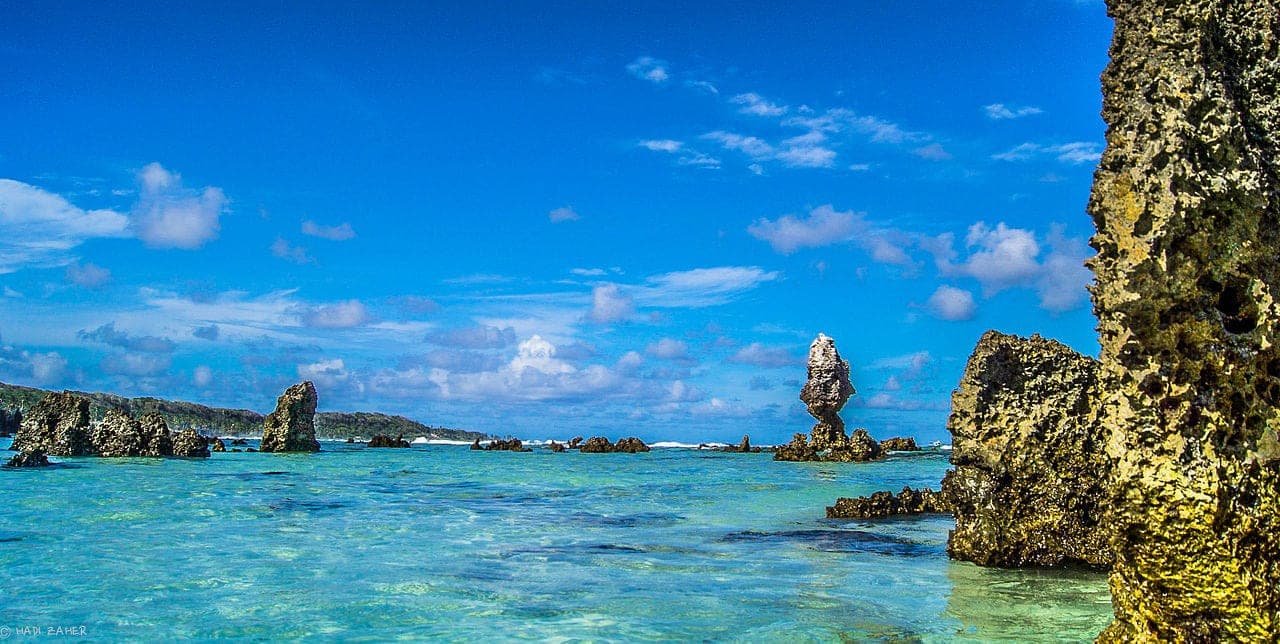
Few countries hold their history so plainly in the ground as the Republic of Nauru. This single coral island in the central Pacific, roughly twenty-one square kilometres of land a little south of the equator, is among the smallest sovereign states on earth, home to some twelve thousand people who live almost entirely along a narrow fertile rim between the reef and the interior. That interior, the raised limestone plateau Nauruans call Topside, is a field of grey coral pinnacles left standing after a century of phosphate extraction stripped the soil from between them. It is at once a wound and a record, and Nauru speaks of it with a candour that many larger nations reserve for gentler subjects (Britannica).
For an archive devoted to memory, Nauru is instructive precisely because loss and survival are so close to the surface here. The island's twelve traditional clans are gathered into the twelve-pointed star of its flag; its people once kept fish in a lagoon and trained seabirds to fish the open ocean; and every year on the twenty-sixth of October the nation observes Angam Day, which remembers the moment its population, worn down by disease and by the deportations of the Second World War, recovered to the fifteen hundred souls its elders judged the minimum for the survival of the people (Angam Day). This profile traces that heritage soberly: the land, the clans, the customs of remembrance, and the effort to keep a small people's memory whole.
Nauru is an oval coral island ringed by a fringing reef, with no natural harbour and no navigable river. Nearly all life is lived on the coastal belt, a strip only 150–300 metres wide holding the villages, the ring road and the coconut palms. Behind this rim the ground rises to the central plateau, whose highest point, Command Ridge, reaches 71 metres, or 233 feet, above the sea (Nauru). Inland, in the Buada district, lies Buada Lagoon, a slightly brackish landlocked pond shaded by palms, historically one of the few places on the island where food could be grown and raised. On the east coast the reef opens to Anibare Bay, whose white sand is the island's largest beach.
With around twelve thousand residents, Nauru has one of the smallest populations of any country in the world. It is divided into fourteen administrative districts, and although it has no formally designated capital, government offices and the parliament sit in the district of Yaren, beside the airport that is the island's single air link to the region. The economy has for more than a century turned on phosphate, the fossilised seabird deposit that gave the plateau its value and, in the mining, its scarred form; that history is treated below, and its economics kept brief.
As a single-island state, Nauru's places of note are its districts rather than cities, each a stretch of the coastal ring with its own character.
Yaren. The southern district of Yaren is the seat of national life. It holds the parliament house, government ministries and the courts, and it adjoins Nauru International Airport, so that arrivals and departures, and the business of the state, are concentrated in one small quarter. Yaren serves in practice as the country's capital, though no district carries that title in law.
Aiwo. On the west coast, Aiwo is the industrial heart of the island, where phosphate was processed and shipped. Its shore carries the loading works and the boat harbour cut into the reef, and its plant and jetties are the machinery on which the twentieth-century economy ran. Aiwo is among the more densely settled districts.
Anibare. Facing east, Anibare gives its name to Anibare Bay, the broad curve of sand and reef that is the finest beach on the island and a favoured place to gather. A small-boat harbour was built here in the 1990s to give fishermen safe access through the reef. The district is thinly populated, its coast more open than the crowded west.
Buada. Buada is the island's only wholly inland district, a green basin set within the plateau and built around Buada Lagoon. It is the most cultivated part of Nauru, planted with coconut, pandanus and breadfruit, and it was in the lagoon here that Nauruans practised their distinctive fish-raising, described below.
Nauru was settled roughly three thousand years ago by Micronesian and Polynesian seafarers, whose descendants organised themselves into twelve clans reckoned through the mother's line (Culture of Nauru). Isolated far from other islands, they developed a society, a language and a body of custom of marked distinctiveness. The first recorded European sighting came in 1798, when the British whaling captain John Fearn, passing in the ship Hunter, noted the island and named it Pleasant Island, an exonym that clung to it through the colonial era.
Sustained outside contact followed in the nineteenth century, bringing traders, beachcombers and firearms. In 1888 the German Empire annexed Nauru, attaching it to its Marshall Islands protectorate and imposing order on the clans. In 1900 the prospector Albert Fuller Ellis identified the island's rock as high-grade phosphate, and within a few years the Pacific Phosphate Company had begun to mine it, the beginning of the extraction that would reshape the interior. After the First World War the island passed under a League of Nations mandate administered jointly by Australia, Britain and New Zealand, with Australia acting on their behalf and the British Phosphate Commissioners working the deposit.
The Second World War fell hard on Nauru. Japanese forces occupied the island from 26 August 1942 until 13 September 1945, fortifying the heights, building an airstrip and setting heavy guns on Command Ridge. In 1943 the occupying authorities deported 1,201 Nauruans to Chuuk, then known as Truk, to labour; of those taken, only 737 survived to be repatriated in January 1946 (Japanese occupation of Nauru). This loss, following earlier epidemics, brought the people to the edge of viability, and it is the survival from that edge that Angam Day commemorates. Nauru's administrators and chiefs had fixed 1,500 as the number below which the people could not safely continue; the population first reached it on 26 October 1932, with the birth of a child named Eidagaruwo, and reached it again in 1949 as the community rebuilt after the war (Angam Day).
Nauru became an independent republic on 31 January 1968, one of the first Pacific island states to do so, and shortly afterwards took the phosphate industry into national ownership. For a period the revenue gave the country a high income per head; as the accessible reserves were worked out toward the end of the century, the island turned to a national trust and to other arrangements to provide for the years after phosphate. These economic matters, and the politics that accompanied them, are noted here only in outline.
Nauru has two official languages, Nauruan and English. Nauruan is an Austronesian language of the Micronesian branch, but a notably isolated one with no close relative among its neighbours, and it remains the everyday speech of home, clan and community; English is used in commerce, higher schooling and dealings abroad. Early missionaries produced the first written Nauruan, and the orthography they shaped still carries the sounds of a language rich in vowels.
The country's own name for itself is Naoero. The colonial label Pleasant Island long overlay it, but the endonym endured. The German anthropologist Paul Hambruch proposed that Nauru derived from the Nauruan phrase anáoero, understood as something close to "I go to the seashore", a reading later questioned by the Catholic missionary Alois Kayser, so that the precise origin of the name remains a matter of scholarly debate. In 2026 the parliament completed a constitutional amendment formally adopting Naoero as the nation's name, a change the government framed as honouring the language and identity of the people rather than the name given by outsiders (Naoero).
The frame of Nauruan life is the extended family within the clan. Twelve matrilineal clans have long ordered society, among them Deiboe, Eamwit, Eano, Emangum, Emea, Eoaru, Irutsi, Iruwa, Iwi and Ranibok, and it is these twelve that the twelve-pointed star of the flag records. Descent, land and belonging pass through the mother, and clan obligation still governs much of ceremonial life.
 Buada is one of the few parts of the island that phosphate mining did not strip. Four fifths of Nauru was cut away to bare limestone pinnacles, and the topsoil went to fertilise farms in Australia and New Zealand. Photograph by Lorrie Graham for AusAID, CC BY 2.0, via Wikimedia Commons.
Two practices set Nauruan culture apart. The first is the catching of frigatebirds. Men would lure the great seabirds, known in Nauruan as itsi and associated with the spirits of high-ranking ancestors, and train captured birds to return to their keepers; skill with the frigatebird carried real prestige, and the custom is preserved as a mark of patience and standing (frigatebird tradition). The second is the raising of ibija, the milkfish. Nauruans caught juvenile ibija at sea, acclimatised them to fresh water, and reared them in Buada Lagoon as a dependable food, a rare Pacific example of inland fish-keeping. The practice was largely given up in the 1960s, and there have since been efforts to revive it (Buada Lagoon).
Around these stand the quieter arts. Women weave pandanus leaf and coconut fibre into mats, baskets, hats and fans of fine geometric pattern, the craft handed from grandmother and aunt to daughter. String figures, called Ekawada, form an intricate tradition documented by the ethnographer Honor Maude in hundreds of designs, each often tied to a chant or story. Song and rhythmic circular dance, performed at feasts and celebrations, complete the picture, and the island's cuisine remains close to its resources: coconut, pandanus, breadfruit, reef fish and the lagoon-raised ibija.
Nauru today is overwhelmingly Christian. The largest bodies are the Nauru Congregational Church and the Roman Catholic Church, each claiming roughly a third of the population, with the Assemblies of God and other congregations making up much of the remainder. Christianity arrived in force in the early twentieth century through Protestant and Catholic missionaries, among them figures who gave the language its written form, and the church calendar now shapes the rhythm of communal life.
Beneath and within this Christian faith lie older understandings. Nauruan belief held to a female deity, Eijebong, and to a spirit land, an island called Buitani, to which the dead were thought to go; mediums were said to summon the spirits of the departed in trance (Nauruan indigenous religion). Much of this was displaced by conversion, yet a sensibility endures in the reverence for ancestors, in the association of the frigatebird with ancestral chiefs, and in the closeness Nauruans still feel to the generations who came before. The result is a spirituality in which Christian rite and inherited feeling are woven together.
In traditional Nauruan practice, a death was the concern of the whole clan. The extended family gathered around the bereaved, and the matrilineal ties that ordered life also ordered mourning, drawing kin into obligations of attendance, contribution and shared feasting through which grief was carried communally rather than borne alone. Reciprocity between clans, expressed in food and in presence, bound the living to one another in the loss of a member and honoured the standing of the dead.
Christian rites now frame the funeral itself, with a church service, prayer and burial, but the communal shape of mourning persists, and the gathering of family and clan remains its heart. Alongside the mourning of individuals, Nauru keeps a national act of remembrance in Angam Day. The Nauruan word angam speaks of having come through hardship, of homecoming and of having attained a goal, and the day marks the recovery of the people to the fifteen hundred once judged necessary for survival. It is a remembrance shadowed by the losses that made it necessary, the epidemics and the wartime deportation, and Nauruans observe it with a sober awareness of how near the community came to not enduring at all (Angam Day).
Nauru's records were made by three administrations and one company, and the company kept the best ones.
Germany annexed the island in 1888, Australia administered it under mandate and then trusteeship from 1920, and independence came in 1968. Through almost all of that, the thing that generated paperwork was phosphate. The British Phosphate Commissioners employed, housed, fed and paid a workforce that included Nauruans and thousands of contract labourers from Kiribati, Tuvalu, China and elsewhere, and the employment, housing and medical records of the operation are the fullest documentation of who was on the island and when.
Nauruan society is matrilineal and organised into twelve tribes, and descent decides land. Because phosphate royalties were paid to landowners, and land is held in tiny fragmented shares inherited through the mother, the Nauru Lands Committee has had to maintain a detailed record of who owns what through whom. That register is, in practice, the national genealogy.
Two catastrophes are in the record. The influenza of 1919 and 1920 killed a substantial part of the population. And in 1942 the Japanese occupation deported 1,200 Nauruans to Chuuk, where roughly a third died; 737 came back in 1946. Those deportation and repatriation lists name almost every Nauruan alive at the time.
Church registers, mainly Congregational and Catholic, carry the vital events either side of that.
Nauru's most demanding heritage is the mined landscape itself. The pinnacled interior of Topside, left when the phosphate between the coral columns was carried away, is a heritage of memory as much as of land, a plain record of a century of extraction that the country has chosen to acknowledge rather than conceal. Programmes of rehabilitation have sought over the years to reclaim parts of the plateau, breaking down the pinnacles and returning soil so that some of the interior might be habitable and green again, a slow work of repair set against a long depletion.
Command Ridge carries a second layer of remembrance. The Japanese guns emplaced on the heights during the occupation still stand, and with the relics of the Pacific war they mark the island's ordeal in those years; a small local museum keeps artefacts of the period. Beyond the physical sites, preservation on Nauru means holding the intangible: recording the clan genealogies, the chants and the string figures, the frigatebird lore and the memory of the ibija ponds, so that a small people's knowledge is not lost with the generation that still carries it.
As a microstate, Nauru maintains only modest formal archives, and much of its heritage remains in living practice rather than in digital form. Yet the record is beginning to move online. The scholarly documentation of Nauruan string figures and language, and the government's published collections of Nauruan stories, have carried parts of the tradition beyond the island, while Pacific heritage bodies have gathered accounts of customs such as the frigatebird catch. For a nation whose interior bears the marks of what was taken from it, the careful digital recording of oral tradition, genealogy and craft is a way of ensuring that what remains cannot be quietly worn away.
Nauruan identity in the present is expressed as much through sport as through any other public form. Australian rules football is the national game, followed with a devotion out of all proportion to the island's size, and weightlifting has given Nauru its brightest international moments; the weightlifter Marcus Stephen won a series of Commonwealth Games medals before later serving as the country's president, a rare passage from the medal platform to the head of state. Music, church choirs and the observances of the national calendar carry the culture in daily life. The 2026 adoption of the name Naoero belongs to this same current, a deliberate turn toward the island's own words for itself.
The Angam recovery. The rebuilding of the Nauruan people to the fifteen hundred their elders set as the threshold of survival, first in 1932 and again after the war in 1949, is the island's defining story of endurance, and it is honoured each year on Angam Day.
A champion who led the nation. Marcus Stephen carried Nauru's flag to the podium at successive Commonwealth Games and then into public office as president, giving a country of a few thousand people a presence on the world stage far beyond its scale.
Reviving the lagoon. Efforts to bring back the raising of ibija in Buada Lagoon, a practice all but abandoned in the 1960s, seek to recover a form of food and knowledge distinctive to Nauru among all Pacific peoples.
Reclaiming the name. The formal adoption of Naoero in 2026 set the nation's own language at the centre of its identity, a quiet assertion of heritage after a long history of names given from outside.
Buada is one of the few parts of the island that phosphate mining did not strip. Four fifths of Nauru was cut away to bare limestone pinnacles, and the topsoil went to fertilise farms in Australia and New Zealand. Photograph by Lorrie Graham for AusAID, CC BY 2.0, via Wikimedia Commons.
Two practices set Nauruan culture apart. The first is the catching of frigatebirds. Men would lure the great seabirds, known in Nauruan as itsi and associated with the spirits of high-ranking ancestors, and train captured birds to return to their keepers; skill with the frigatebird carried real prestige, and the custom is preserved as a mark of patience and standing (frigatebird tradition). The second is the raising of ibija, the milkfish. Nauruans caught juvenile ibija at sea, acclimatised them to fresh water, and reared them in Buada Lagoon as a dependable food, a rare Pacific example of inland fish-keeping. The practice was largely given up in the 1960s, and there have since been efforts to revive it (Buada Lagoon).
Around these stand the quieter arts. Women weave pandanus leaf and coconut fibre into mats, baskets, hats and fans of fine geometric pattern, the craft handed from grandmother and aunt to daughter. String figures, called Ekawada, form an intricate tradition documented by the ethnographer Honor Maude in hundreds of designs, each often tied to a chant or story. Song and rhythmic circular dance, performed at feasts and celebrations, complete the picture, and the island's cuisine remains close to its resources: coconut, pandanus, breadfruit, reef fish and the lagoon-raised ibija.
Nauru today is overwhelmingly Christian. The largest bodies are the Nauru Congregational Church and the Roman Catholic Church, each claiming roughly a third of the population, with the Assemblies of God and other congregations making up much of the remainder. Christianity arrived in force in the early twentieth century through Protestant and Catholic missionaries, among them figures who gave the language its written form, and the church calendar now shapes the rhythm of communal life.
Beneath and within this Christian faith lie older understandings. Nauruan belief held to a female deity, Eijebong, and to a spirit land, an island called Buitani, to which the dead were thought to go; mediums were said to summon the spirits of the departed in trance (Nauruan indigenous religion). Much of this was displaced by conversion, yet a sensibility endures in the reverence for ancestors, in the association of the frigatebird with ancestral chiefs, and in the closeness Nauruans still feel to the generations who came before. The result is a spirituality in which Christian rite and inherited feeling are woven together.
In traditional Nauruan practice, a death was the concern of the whole clan. The extended family gathered around the bereaved, and the matrilineal ties that ordered life also ordered mourning, drawing kin into obligations of attendance, contribution and shared feasting through which grief was carried communally rather than borne alone. Reciprocity between clans, expressed in food and in presence, bound the living to one another in the loss of a member and honoured the standing of the dead.
Christian rites now frame the funeral itself, with a church service, prayer and burial, but the communal shape of mourning persists, and the gathering of family and clan remains its heart. Alongside the mourning of individuals, Nauru keeps a national act of remembrance in Angam Day. The Nauruan word angam speaks of having come through hardship, of homecoming and of having attained a goal, and the day marks the recovery of the people to the fifteen hundred once judged necessary for survival. It is a remembrance shadowed by the losses that made it necessary, the epidemics and the wartime deportation, and Nauruans observe it with a sober awareness of how near the community came to not enduring at all (Angam Day).
Nauru's records were made by three administrations and one company, and the company kept the best ones.
Germany annexed the island in 1888, Australia administered it under mandate and then trusteeship from 1920, and independence came in 1968. Through almost all of that, the thing that generated paperwork was phosphate. The British Phosphate Commissioners employed, housed, fed and paid a workforce that included Nauruans and thousands of contract labourers from Kiribati, Tuvalu, China and elsewhere, and the employment, housing and medical records of the operation are the fullest documentation of who was on the island and when.
Nauruan society is matrilineal and organised into twelve tribes, and descent decides land. Because phosphate royalties were paid to landowners, and land is held in tiny fragmented shares inherited through the mother, the Nauru Lands Committee has had to maintain a detailed record of who owns what through whom. That register is, in practice, the national genealogy.
Two catastrophes are in the record. The influenza of 1919 and 1920 killed a substantial part of the population. And in 1942 the Japanese occupation deported 1,200 Nauruans to Chuuk, where roughly a third died; 737 came back in 1946. Those deportation and repatriation lists name almost every Nauruan alive at the time.
Church registers, mainly Congregational and Catholic, carry the vital events either side of that.
Nauru's most demanding heritage is the mined landscape itself. The pinnacled interior of Topside, left when the phosphate between the coral columns was carried away, is a heritage of memory as much as of land, a plain record of a century of extraction that the country has chosen to acknowledge rather than conceal. Programmes of rehabilitation have sought over the years to reclaim parts of the plateau, breaking down the pinnacles and returning soil so that some of the interior might be habitable and green again, a slow work of repair set against a long depletion.
Command Ridge carries a second layer of remembrance. The Japanese guns emplaced on the heights during the occupation still stand, and with the relics of the Pacific war they mark the island's ordeal in those years; a small local museum keeps artefacts of the period. Beyond the physical sites, preservation on Nauru means holding the intangible: recording the clan genealogies, the chants and the string figures, the frigatebird lore and the memory of the ibija ponds, so that a small people's knowledge is not lost with the generation that still carries it.
As a microstate, Nauru maintains only modest formal archives, and much of its heritage remains in living practice rather than in digital form. Yet the record is beginning to move online. The scholarly documentation of Nauruan string figures and language, and the government's published collections of Nauruan stories, have carried parts of the tradition beyond the island, while Pacific heritage bodies have gathered accounts of customs such as the frigatebird catch. For a nation whose interior bears the marks of what was taken from it, the careful digital recording of oral tradition, genealogy and craft is a way of ensuring that what remains cannot be quietly worn away.
Nauruan identity in the present is expressed as much through sport as through any other public form. Australian rules football is the national game, followed with a devotion out of all proportion to the island's size, and weightlifting has given Nauru its brightest international moments; the weightlifter Marcus Stephen won a series of Commonwealth Games medals before later serving as the country's president, a rare passage from the medal platform to the head of state. Music, church choirs and the observances of the national calendar carry the culture in daily life. The 2026 adoption of the name Naoero belongs to this same current, a deliberate turn toward the island's own words for itself.
The Angam recovery. The rebuilding of the Nauruan people to the fifteen hundred their elders set as the threshold of survival, first in 1932 and again after the war in 1949, is the island's defining story of endurance, and it is honoured each year on Angam Day.
A champion who led the nation. Marcus Stephen carried Nauru's flag to the podium at successive Commonwealth Games and then into public office as president, giving a country of a few thousand people a presence on the world stage far beyond its scale.
Reviving the lagoon. Efforts to bring back the raising of ibija in Buada Lagoon, a practice all but abandoned in the 1960s, seek to recover a form of food and knowledge distinctive to Nauru among all Pacific peoples.
Reclaiming the name. The formal adoption of Naoero in 2026 set the nation's own language at the centre of its identity, a quiet assertion of heritage after a long history of names given from outside.
National Overview
Notable Cities
Historical Foundations
Linguistic and Etymological Roots
Cultural Identity
Religion and Spirituality
Remembrance and Mourning Traditions
Tracing a Family in Nauru
Heritage Preservation Efforts
Digital Heritage
Contemporary Cultural Influences
Success Stories
References and resources
- Encyclopaedia Britannica: Nauru. Geography, history and political background of the island republic.
- Wikipedia: Nauru. Overview of the land, population, districts and phosphate history.
- Wikipedia: Angam Day. The 1,500 threshold, the first Angam baby and the meaning of the observance.
- Wikipedia: Buada Lagoon. The inland lagoon and the raising of ibija milkfish.
- Wikipedia: Districts of Nauru. The fourteen districts, including Yaren, Aiwo, Anibare and Buada.
- Wikipedia: Japanese occupation of Nauru. The 1942 to 1945 occupation and the deportation to Chuuk.
- Wikipedia: Culture of Nauru. The twelve matrilineal clans, weaving and traditional practice.
- Wikipedia: Nauruan indigenous religion. The deity Eijebong, the spirit land Buitani and older belief.
- SPREP PIPAP: Nauru tradition, to catch a frigate bird. The heritage of catching and training frigatebirds.
- Honor C. Maude: The String Figures of Nauru Island. The classic documentation of Ekawada.