Heritage · Country
Okinawa Culture and Heritage
Okinawa was an independent kingdom until 1879, lost a quarter of its people in 1945, and lost most of its family registers in the same three months. This is a guide to Ryukyuan heritage, from clan tombs that are still the family address to a memorial that lists the dead of every side in one wall.Written to last.
By Confinity Heritage Editorial · Updated 2026-08-20 · 8-minute readQuiet tools, kept out of the way.
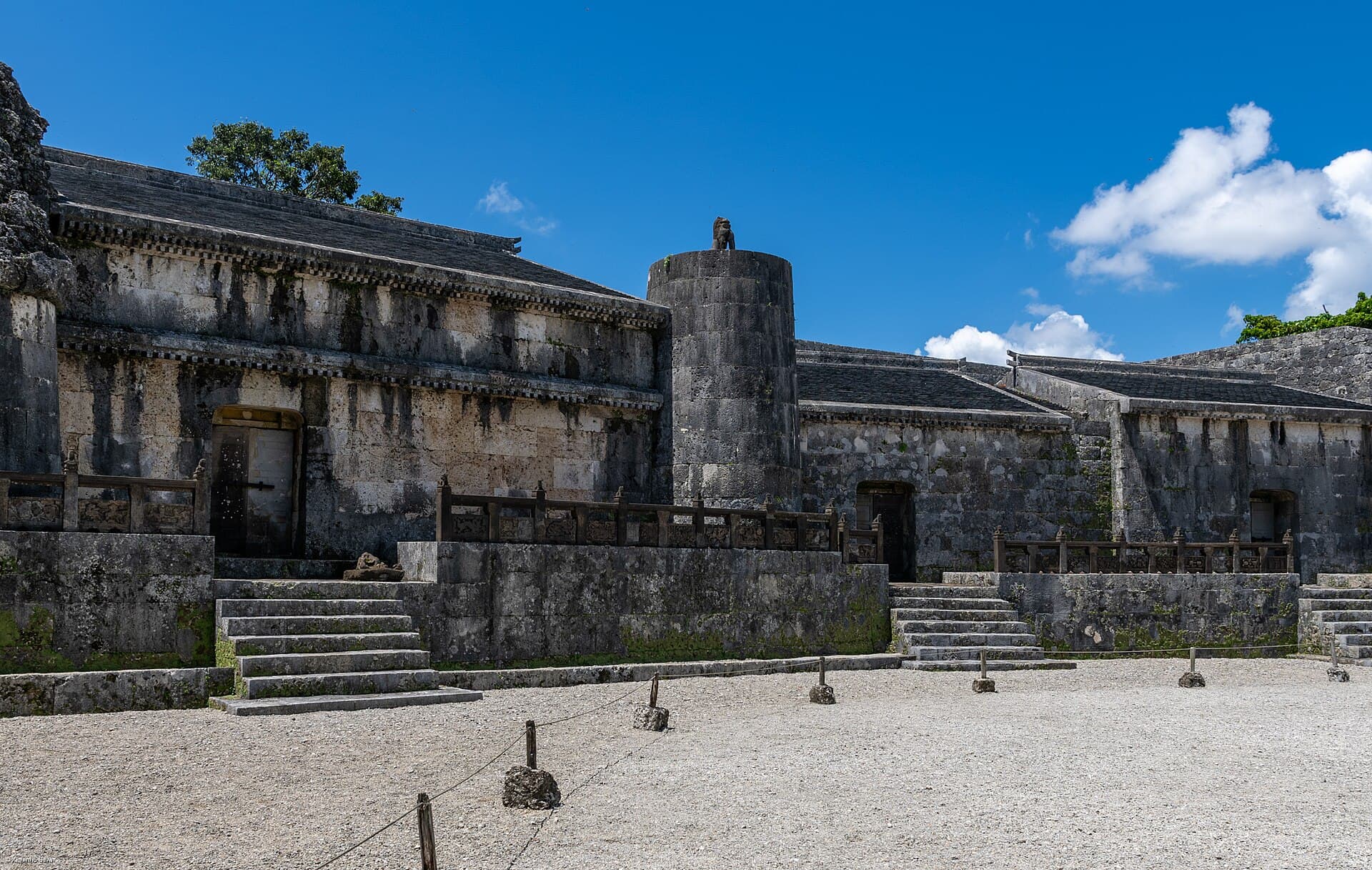
Tamaudun, below the walls of Shuri, is a low stone building with three chambers and a courtyard of coral gravel. Kings of the Ryukyus were laid in the eastern chamber until the flesh was gone, their bones were then washed, and only afterwards were they moved to their permanent place. It is a royal version of what ordinary Okinawan families did in their own tombs, and it explains something about the island: the dead here were not sent away, they were given an address and visited.
That continuity ran into the spring of 1945. In eighty-two days of fighting, more than a hundred thousand Okinawan civilians died, roughly a quarter of the population, and the town and village offices burned with almost every family register on the island. A place that had kept its genealogy with unusual care lost the paperwork of it in a season.
Okinawa Prefecture is the southernmost part of Japan, about 2,280 square kilometres of land spread across roughly 160 islands in a thousand-kilometre arc between Kyushu and Taiwan, of which some fifty are inhabited. The population is around 1.47 million, most of it on Okinawa Island itself, and the capital is Naha. The climate is subtropical, the geology is coral limestone, and the islands sit closer to Taipei than to Tokyo, which is the fact behind most of the history.
Okinawa is a Japanese prefecture and its people are Japanese citizens. It is also a place with its own former state, its own languages, its own religion and its own repertoire of performing arts, and the relationship between those two statements is the live question in Okinawan public life. The other governing fact is military: the prefecture holds a large majority of the land used exclusively by United States forces in Japan while accounting for well under one percent of the country's territory, a concentration that has driven local politics since the islands were returned to Japanese administration in 1972.
Naha. The capital and the old port of the kingdom, rebuilt from almost nothing after 1945. Shuri, now a district of the city, holds the castle, the royal mausoleum at Tamaudun and the Sonohyan-utaki stone gate. The Okinawa Prefectural Museum and Art Museum opened here in 2007, and Tsuboya is the historic pottery quarter, still working.
Itoman. The southern tip, where the battle ended. The Peace Memorial Park stands on the basin below Mabuni Hill, holding the Cornerstone of Peace, the Prefectural Peace Memorial Museum and the Himeyuri monument to the schoolgirls conscripted as nurses.
Nakijin. On the Motobu peninsula in the north, the seat of the northern kingdom before unification. Its castle ruin is a long run of curving limestone wall following the ridge, and it is the most convincing surviving demonstration of what a gusuku actually was.
Uruma. Holds Katsuren Castle, whose lord traded far enough abroad that Roman and Ottoman coins were excavated there in 2016, and Nakagusuku Castle, the best preserved of the five inscribed gusuku.
Ishigaki and Miyakojima. The Sakishima islands to the south-west, with their own languages, their own textile traditions and their own memory of the poll tax imposed on them under the kingdom, which is a reminder that Ryukyuan history had an inside as well as an outside.
The gusuku period, from roughly the twelfth century, produced fortified stone enclosures across the islands that served as citadel, court and sacred precinct at once. Three rival polities formed on Okinawa Island and were unified under Sho Hashi in 1429 as the Ryukyu Kingdom, with its capital at Shuri.
The kingdom's position was commercial and awkward. It sent tribute to Ming and then Qing China and received investiture from Chinese envoys, which gave it access to a trade network reaching Korea, Japan and Southeast Asia and made it wealthy out of all proportion to its size. In 1609 the Satsuma domain of southern Japan invaded and made the kingdom a subordinate, but deliberately kept it looking independent so that the China trade could continue through it. For more than two and a half centuries Ryukyu was formally a Chinese tributary and practically a Japanese dependency at the same time.
That arrangement ended in 1879, when Japan abolished the kingdom, deposed the last king and created Okinawa Prefecture in what is known as the Ryukyu disposition. What followed was assimilation: standard Japanese in schools, the local languages punished, and Ryukyuan practice treated as backwardness to be corrected.
Then 1945. The Battle of Okinawa ran from 26 March to 23 June and killed more than two hundred thousand people, among them over a hundred thousand Okinawan civilians. Civilians died in the crossfire, in mass suicides that occurred under military pressure, and at the hands of Japanese troops who suspected them of spying. Shuri Castle, sitting on top of the Japanese command bunker, was destroyed by naval bombardment. The United States then administered the islands until 15 May 1972, when they were returned to Japan with the bases in place.
The Ryukyuan languages are Japonic, related to Japanese but not descended from it, having split early enough that they are not mutually intelligible with it or reliably with one another. UNESCO's atlas, in its third edition of 2009, recognised six: Amami, Kunigami, Okinawan and Miyako as definitely endangered, Yaeyama and Yonaguni as severely endangered. All six are now spoken mainly by older people and rarely in daily life.
The decline was policy before it was drift. Under prefectural schooling from the late nineteenth century, children caught speaking Ryukyuan were made to wear a hogen fuda, a dialect placard, and could only pass it on by catching another child doing the same. Speakers who grew up under that system often did not pass the language to their own children, which is why the break falls so sharply by generation.
Okinawa is unusual in having legislated a response. Prefectural Ordinance No. 35, of 31 March 2006, established Shimakutuba Day on 18 September, the date chosen because nine, ten and eight can be read in a mixture of Okinawan and Japanese as ku-tu-ba, meaning word. It was the first ordinance in Japan promoting a local language. Shimakutuba, island speech, is the umbrella term Okinawans generally use for their own varieties, and the ordinance is a statement of standing more than a revival programme, since teaching hours remain limited.
The organising unit is the monchu, the patrilineal clan, which holds a common tomb, a genealogy and a set of obligations. Membership is not sentimental: it determines where a person is buried and who is expected to appear when the clan gathers.
Performing arts survived the kingdom that created them. Kumi odori, a form of musical theatre combining spoken word, dance and music, was devised in 1719 by Tamagusuku Chokun for the entertainment of Chinese investiture envoys, and UNESCO inscribed it on the Representative List of the Intangible Cultural Heritage of Humanity in 2010. The sanshin, a three-stringed instrument covered in snakeskin, is the ancestor of the Japanese shamisen and the backbone of Okinawan music. Eisa, a drum and dance procession performed at Obon to see the ancestors off, is now also a youth-group competition and one of the strongest living traditions in the prefecture.
The crafts are court crafts that survived without the court. Bingata is a resist-dyed textile in bright pigments once restricted by rank; Ryukyuan lacquerware developed its own techniques of inlay and raised decoration; Tsuboya and Yomitan pottery continue traditions of the same period; and the fine kasuri and basho-fu weaving of the outer islands were originally produced to pay tax. Karate developed here as te, drawing on Chinese methods and shaped partly by the kingdom's weapons restrictions, and it went to mainland Japan and then the world from Okinawa in the twentieth century.
Ryukyuan religion is not Shinto, though it has been folded into Japanese categories since annexation. Its centre of gravity is the ancestor, and its sacred places are utaki, groves and rock formations that are approached rather than built on. Sefa-utaki, on the south-east coast facing the island of Kudaka, was the most important of them, and it is one of the nine components of the World Heritage inscription.
The priesthood was female. Noro were community priestesses with responsibility for the agricultural and ritual calendar, and under the kingdom they were organised into a state hierarchy headed by the kikoe-ogimi, a royal woman who was installed at Sefa-utaki and whose spiritual authority ran parallel to the king's temporal one. Alongside that formal system are the yuta, uninstitutionalised spirit mediums consulted about illness, misfortune and above all about the dead, who are still visited today, including by people who describe themselves as otherwise unreligious.
The concept that carries most weight is the family altar. The butsudan holds the ihai, the memorial tablets of the household's dead, and the eldest son of the main line inherits both the altar and the duty to serve it. Because the tablets and the tomb pass together, an Okinawan family's relationship with its dead is inherited property in a fairly literal sense, and disputes about who succeeds to the altar are real disputes about real obligations.
The Okinawan tomb is a building. The kamekobaka, the turtleback tomb, has a domed roof said to resemble a turtle's shell and, more pointedly, a womb, with the opening understood as a birth canal through which the dead return to where they came from. These are not individual graves. A turtleback tomb is the vault of a monchu, holding many generations, and at ten to fourteen square metres it is often larger than the rooms the living occupied. Older forms cut chambers straight into limestone cliffs, and both types are still built and still used.
The rite that goes with them is senkotsu, bone washing. The body was laid in the tomb and left for several years; then the family, traditionally the women, returned, washed the bones clean, and placed them in a ceramic jar to be kept permanently in the tomb. It is an intimate and demanding practice, and it means an Okinawan funeral was historically not one event but two, separated by years, with the second requiring the family to handle the dead person directly. Cremation has largely replaced it since the war, and the jars remain.
The most visible tradition is the cheerful one. At Shimi, in early April, families gather at the clan tomb with boxes of food and eat in front of it, first as individual households and then as the whole clan, relatives travelling in for the day. It is a graveside picnic and a family reunion at once, and for many families it is the only occasion in the year when everyone appears. At Obon in the summer, the ancestors are welcomed home to the butsudan and then escorted out again by eisa drummers moving through the streets.
Against this stands the memorial at Itoman. The Cornerstone of Peace, unveiled on 23 June 1995 for the fiftieth anniversary, is a set of zig-zagging black granite walls carrying the names of everyone who died in the battle and in the Pacific War as it touched Okinawa, without sorting them. As of June 2015 there were 241,281 names: 149,329 from Okinawa Prefecture, 77,380 from elsewhere in Japan, 14,009 from the United States, 365 from South Korea, 82 from the United Kingdom, 82 from North Korea and 34 from Taiwan. Civilian and military, invader and defender, are inscribed on the same walls, and names are still added as they are established. Every 23 June, Irei no Hi, is a prefectural holiday, and the ceremony at Mabuni is the largest annual gathering in Okinawa.
Okinawan family records were burned in three months in 1945, and the rebuilding of them is one of the more remarkable things any community has done.
The Ryukyu Kingdom kept genealogies of unusual formality. From the seventeenth century aristocratic families maintained the kafu, official lineage records submitted to and certified by the royal government, and the surviving kafu are among the most complete East Asian genealogies of their period. Commoner families kept their own within the munchu, the patrilineal clan, which maintains the ancestral tomb.
Japan annexed the kingdom in 1879 and imposed the koseki household register. In the battle of Okinawa in 1945 the prefecture lost around a quarter of its civilian population and the great majority of its koseki records burned, along with the prefectural archives, at Shuri and elsewhere. After the war families reconstructed their registers by going to the surviving relatives and neighbours and swearing to what they remembered, so a substantial part of the Okinawan civil record is testimony written down in the late 1940s.
The tomb is what survived. Okinawan turtleback tombs hold the clan's dead, the bones are washed and reinterred, and the family gathers in front of the tomb at Shiimii each spring. The tomb is the register.
For the Okinawan diaspora, in Hawai'i, Brazil, Peru and the Philippines, the munchu associations abroad hold genealogies that were sent out before the war and survived because they had left.
The Gusuku Sites and Related Properties of the Kingdom of Ryukyu were inscribed by UNESCO in December 2000: five castle sites at Nakijin, Zakimi, Katsuren, Nakagusuku and Shuri, together with the Sonohyan-utaki stone gate, the royal mausoleum at Tamaudun, the garden at Shikinaen and the sacred site of Sefa-utaki. The listing deliberately mixes fortification, tomb, garden and grove, on the argument that they belong to one religious and political system.
 Shuri photographed before the fire of 31 October 2019. What carries the World Heritage designation is the stone foundation beneath, because the buildings above it have been destroyed and rebuilt twice. Photograph by CEphoto, Uwe Aranas, CC BY-SA 3.0, via Wikimedia Commons.
Shuri Castle has now been destroyed twice. Rebuilt from 1992 on the site levelled in 1945, its main hall burned again in the early hours of 31 October 2019, along with several other buildings. What survived, and what carries the World Heritage designation, are the stone foundations and remains beneath. Reconstruction has run in public since: the exterior of the main hall was completed in July 2025, the temporary roof came off that October, and the rebuilt hall is scheduled to open to visitors on 23 November 2026. The prefecture has treated the rebuild as a heritage skills programme, with Ryukyuan lacquer, tile and timber work done in view of the public.
The quieter effort concerns records. Because the battle destroyed most municipal offices, roughly half of Okinawan families can obtain their koseki, the Japanese family register, against more than nine in ten on the mainland. Recovery has therefore leaned on other sources: the kafu, the genealogy books kept by families of Ryukyuan gentry, held at the Naha City Museum of History, along with the collections of the Okinawa Prefectural Library and the Okinawa Prefectural Archives. The tombs themselves are part of the evidence, since a monchu vault records who belonged to it.
The Okinawa Prefectural Archives publishes digitised photographs, film and documents from the United States administration period, much of it returned from American holdings, and this material is the main visual record of the years between the battle and reversion. The Prefectural Library maintains emigration records that overseas descendants use to trace families back to a village.
Language documentation is comparatively strong for the number of speakers. Recorded corpora and dictionaries exist for several of the six Ryukyuan languages, built by Japanese and international linguists working against the clock, and the prefecture publishes learning material tied to Shimakutuba Day. The gap is between documentation and transmission: a well recorded language is not the same as a spoken one, and Okinawa currently has more of the first than the second.
Testimony from the battle has been systematically collected, by the Prefectural Peace Memorial Museum and by local governments compiling municipal histories, and survivors' accounts are increasingly published online as the generation that can give them ends. The Cornerstone of Peace has a searchable name register, which does the thing the koseki can no longer do for many families: confirms that a particular person existed and died.
Okinawan music travelled. The scale, the sanshin and the vocal style are recognisable across Japanese popular music, and groups from the islands found national audiences from the 1990s. Okinawan food, awamori, and the kariyushi shirt, adopted as official summer wear by the prefecture, are all part of a distinct public identity that is now an economic asset as much as a cultural one.
The diaspora is unusually organised. Emigration to Hawaii began in 1900 and continued to Brazil, Peru, Bolivia, Argentina and the Philippines, driven by poverty and later by the destruction of the war, and there are roughly 420,000 people of Okinawan descent living abroad. Since 1990 the prefecture has held the Worldwide Uchinanchu Festival every five years, bringing descendants back to the islands, and the network of overseas kenjinkai associations functions as a working genealogical infrastructure.
The base question runs through all of it. Land taken for military use after 1945 included village sites and tombs, and disputes over the return, relocation and construction of facilities, especially the works at Henoko, have been the central political argument for decades, tested repeatedly in referendums, elections and the courts. Related to it is the continuing recovery of remains from the battlefield, carried out largely by volunteers, which periodically intersects with construction work and is one of the sharpest points of local feeling.
A memorial that does not sort the dead. The Cornerstone of Peace lists Okinawan civilians, Japanese soldiers, Americans, Koreans, British and Taiwanese together on the same walls, and keeps adding names as they are confirmed.
A castle rebuilt in public, twice. After the 2019 fire, Okinawa turned the reconstruction of Shuri into a visible training ground for Ryukyuan lacquer, tile and timber crafts, with the main hall due to reopen in November 2026.
The first local-language ordinance in Japan. The 2006 law creating Shimakutuba Day gave the Ryukyuan languages a formal standing that no other regional language in Japan had been granted.
Genealogy rebuilt from what the fire missed. With half the family registers gone, Okinawan families have reconstructed descent from clan genealogy books, tomb records and emigration papers held at the Naha City Museum of History, the Prefectural Library and the Prefectural Archives.
Shuri photographed before the fire of 31 October 2019. What carries the World Heritage designation is the stone foundation beneath, because the buildings above it have been destroyed and rebuilt twice. Photograph by CEphoto, Uwe Aranas, CC BY-SA 3.0, via Wikimedia Commons.
Shuri Castle has now been destroyed twice. Rebuilt from 1992 on the site levelled in 1945, its main hall burned again in the early hours of 31 October 2019, along with several other buildings. What survived, and what carries the World Heritage designation, are the stone foundations and remains beneath. Reconstruction has run in public since: the exterior of the main hall was completed in July 2025, the temporary roof came off that October, and the rebuilt hall is scheduled to open to visitors on 23 November 2026. The prefecture has treated the rebuild as a heritage skills programme, with Ryukyuan lacquer, tile and timber work done in view of the public.
The quieter effort concerns records. Because the battle destroyed most municipal offices, roughly half of Okinawan families can obtain their koseki, the Japanese family register, against more than nine in ten on the mainland. Recovery has therefore leaned on other sources: the kafu, the genealogy books kept by families of Ryukyuan gentry, held at the Naha City Museum of History, along with the collections of the Okinawa Prefectural Library and the Okinawa Prefectural Archives. The tombs themselves are part of the evidence, since a monchu vault records who belonged to it.
The Okinawa Prefectural Archives publishes digitised photographs, film and documents from the United States administration period, much of it returned from American holdings, and this material is the main visual record of the years between the battle and reversion. The Prefectural Library maintains emigration records that overseas descendants use to trace families back to a village.
Language documentation is comparatively strong for the number of speakers. Recorded corpora and dictionaries exist for several of the six Ryukyuan languages, built by Japanese and international linguists working against the clock, and the prefecture publishes learning material tied to Shimakutuba Day. The gap is between documentation and transmission: a well recorded language is not the same as a spoken one, and Okinawa currently has more of the first than the second.
Testimony from the battle has been systematically collected, by the Prefectural Peace Memorial Museum and by local governments compiling municipal histories, and survivors' accounts are increasingly published online as the generation that can give them ends. The Cornerstone of Peace has a searchable name register, which does the thing the koseki can no longer do for many families: confirms that a particular person existed and died.
Okinawan music travelled. The scale, the sanshin and the vocal style are recognisable across Japanese popular music, and groups from the islands found national audiences from the 1990s. Okinawan food, awamori, and the kariyushi shirt, adopted as official summer wear by the prefecture, are all part of a distinct public identity that is now an economic asset as much as a cultural one.
The diaspora is unusually organised. Emigration to Hawaii began in 1900 and continued to Brazil, Peru, Bolivia, Argentina and the Philippines, driven by poverty and later by the destruction of the war, and there are roughly 420,000 people of Okinawan descent living abroad. Since 1990 the prefecture has held the Worldwide Uchinanchu Festival every five years, bringing descendants back to the islands, and the network of overseas kenjinkai associations functions as a working genealogical infrastructure.
The base question runs through all of it. Land taken for military use after 1945 included village sites and tombs, and disputes over the return, relocation and construction of facilities, especially the works at Henoko, have been the central political argument for decades, tested repeatedly in referendums, elections and the courts. Related to it is the continuing recovery of remains from the battlefield, carried out largely by volunteers, which periodically intersects with construction work and is one of the sharpest points of local feeling.
A memorial that does not sort the dead. The Cornerstone of Peace lists Okinawan civilians, Japanese soldiers, Americans, Koreans, British and Taiwanese together on the same walls, and keeps adding names as they are confirmed.
A castle rebuilt in public, twice. After the 2019 fire, Okinawa turned the reconstruction of Shuri into a visible training ground for Ryukyuan lacquer, tile and timber crafts, with the main hall due to reopen in November 2026.
The first local-language ordinance in Japan. The 2006 law creating Shimakutuba Day gave the Ryukyuan languages a formal standing that no other regional language in Japan had been granted.
Genealogy rebuilt from what the fire missed. With half the family registers gone, Okinawan families have reconstructed descent from clan genealogy books, tomb records and emigration papers held at the Naha City Museum of History, the Prefectural Library and the Prefectural Archives.
National Overview
Notable Cities
Historical Foundations
Linguistic and Etymological Roots
Cultural Identity
Religion and Spirituality
Remembrance and Mourning Traditions
Tracing a Family in Okinawa
Heritage Preservation Efforts
Digital Heritage
Contemporary Cultural Influences
Success Stories
References and resources
- UNESCO, Gusuku Sites and Related Properties of the Kingdom of Ryukyu: the 2000 inscription and its nine components.
- UNESCO, Kumiodori, traditional Okinawan musical theatre: the 2010 listing.
- Shuri Castle, Wikipedia: the 1945 destruction, the 2019 fire and the reconstruction schedule.
- Cornerstone of Peace, Wikipedia: the 1995 unveiling and the breakdown of names.
- Okinawa Memorial Day, Wikipedia: Irei no Hi and the ceremony at Mabuni.
- Ryukyuan languages, Wikipedia: the six languages and their endangerment.
- Shimakutuba Day, Wikipedia: the 2006 ordinance and the wordplay behind the date.
- Turtleback tomb, Wikipedia: the kamekobaka, the monchu and the symbolism of the form.
- Ryukyuan diaspora, Wikipedia: emigration destinations and descendant numbers.
- Okinawa Prefecture, Wikipedia: geography, population and administration.