Heritage · Country
Togo Culture and Heritage
In the hills of Koutammakou the Batammariba raise takyenta towers of mud and sacred wood, while along the old Slave Coast southern families still keep the spirits of the enslaved. This is a guide to how Togo remembers, from Vodun shrines and German-era Lomé to the wrestling grounds of Kara.Written to last.
By Confinity Heritage Editorial · Updated 2026-07-31 · 8-minute readQuiet tools, kept out of the way.
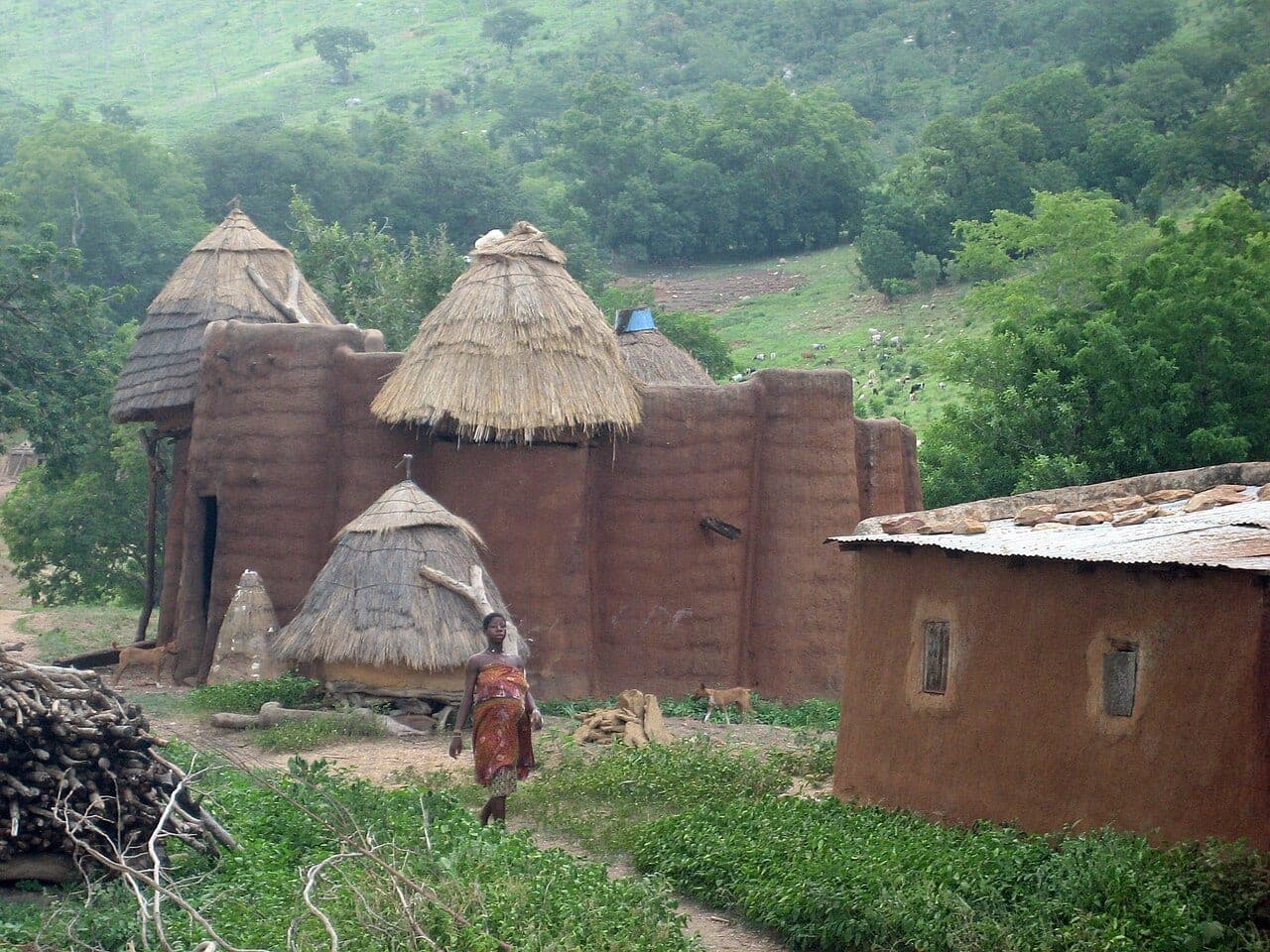
In the north-east of Togo, where the Atakora hills roll across the border into Benin, the Batammariba build in earth. Their two-storey tower-houses, called takyenta, rise from the red soil in smooth, sculpted forms: grain stores and animal pens below, hearths and sleeping terraces above, each dwelling at once a small fortress and a small cosmology. The name the people give themselves is usually translated as those who shape the earth well, and in 2004 UNESCO inscribed their homeland, Koutammakou, as a cultural landscape of outstanding value, and the towers have become an emblem of the country.
Togo is a narrow nation, in places barely a hundred kilometres wide, reaching from a short Atlantic coastline northward into dry savanna. Its heritage is layered by that geography and by a hard history: the coast was part of the stretch European traders named the Slave Coast; the interior and neighbouring peoples gave the world much of what is now called Vodun; and the territory passed through German, then French and British hands before independence in 1960.
The Togolese Republic covers roughly 56,785 square kilometres, a long ribbon of land on the Gulf of Guinea bordered by Ghana to the west, Benin to the east and Burkina Faso to the north. Its climate shifts from tropical and humid on the coast to dry savanna in the far north. The population is now above nine million, according to World Factbook estimates, and is administered through five regions: Maritime in the south, then Plateaux, Centrale, Kara and Savanes moving north.
Togo is ethnically varied for its size, with some forty distinct peoples and languages. The Ewe and related coastal groups such as the Mina dominate the south; the Kabye (Kabiyè) are the largest people of the north around Kara; the Tem, often called Kotokoli, cluster around Sokodé in the centre; and Gurma and other Voltaic peoples, the Batammariba among them, live in the Savanes. French is the official language, while Ewe and Kabiyè serve as the two main national languages. Lomé, on the coast in the far south-west, is the capital, chief port and by far the largest city.
Lomé. The capital sits on the Atlantic in the country's south-western corner, one of the few African capitals placed on a national border. Chosen as the seat of the German colony in the 1890s, it keeps some of the most legible German colonial architecture in West Africa, including the former governor's palace and the twin-spired Sacred Heart Cathedral. It is also home to the Akodessewa fetish market and the National Museum.
Sokodé. Togo's second city and the capital of the Centrale region is the heartland of the Tem, or Kotokoli, a predominantly Muslim people. Sokodé is known for the Adossa, a fire-and-knife dance performed at Islamic festivals, and its mosques and Hausa-influenced trading traditions give the centre of the country a distinct character.
Kara. The principal city of the north and the focus of Kabye life, Kara gives its name to a river, a region and a people. Every July it fills for Evala, the wrestling initiation that marks the passage of young Kabye men into adulthood, and the surrounding hills hold terraced farmland and the compact earth homesteads of the highlands.
Kpalimé. Set in the forested Plateaux region near the Ghanaian frontier, below Mount Agou, Kpalimé is Togo's craft and art town. Coffee and cocoa grow on the hillsides, and its artisans are known for batik, wood carving and weaving, with a long-running arts school making it a centre for painters and printmakers.
The peoples of Togo arrived in successive movements rather than a single migration. The Kabye and other Voltaic groups of the north are among the older inhabitants, farming and terracing the stony highlands for centuries. The Ewe reached the south-east in stages from the sixteenth and seventeenth centuries, tradition tracing their journey from Notsé, a walled town whose wall they are said to have broken through to escape a harsh ruler; from there the Ewe dispersed across what is now south-eastern Ghana, southern Togo and Benin. Coastal Mina communities formed later, with roots among traders and migrants from the Gold Coast.
This coast lay within the region Europeans called the Slave Coast, and for some three centuries it fed the Atlantic trade in enslaved people, with captives taken from the interior and shipped from ports along the Bight of Benin. The trade tore apart families and communities and scattered the region's people and their beliefs across the Americas; it is remembered here soberly, in ritual as much as in monument, and its marks remain in the memory of the coastal towns.
Germany claimed the territory in 1884, when the explorer Gustav Nachtigal signed a treaty with a local ruler at Togoville, and built the colony of Togoland. German administrators promoted it as a Musterkolonie, a "model colony", pointing to its railways, plantations and balanced budget. That reputation deserves scepticism: as historians of the period have argued, the claim to a "model colony" rested on heavy taxation, forced labour and routine corporal punishment, and served colonial propaganda more than the people it governed. When war broke out in 1914, British and French forces quickly overran the colony, and in 1922 the League of Nations divided it: about two-thirds, including Lomé, became French Togoland, and the western strip became British Togoland. The line cut through Ewe country, a grievance that outlasted the mandate, and in a 1956 plebiscite British Togoland voted to join the Gold Coast, becoming part of Ghana at its independence in 1957.
French Togoland moved to independence on 27 April 1960 under Sylvanus Olympio, an Ewe businessman who became the republic's first president. He was assassinated in January 1963 in what is often described as the first military coup in post-independence sub-Saharan Africa. Gnassingbé Eyadéma, from the northern Kabye, took power in 1967 and led the country until his death in 2005, after which his son Faure Gnassingbé assumed the presidency. Politics in Togo remains a subject of debate; this profile leaves those arguments to others and returns to the country's cultural inheritance.
The country's name comes from the coast. Togoville, on the northern shore of Lake Togo where the German treaty was signed, gave its name first to the lake and then to the whole territory. The word is generally traced to Ewe, with elements meaning water and shore, so that Togo is read as something like "behind the water" or "on the far side of the lake", a description of a village set back from the lagoon.
French remains the official language of government, courts and schooling, a colonial inheritance now firmly domesticated. Beneath it, Ewe (with its coastal Mina variant) serves as the lingua franca of the south, and Kabiyè plays a comparable role in the north; both are recognised as national languages and taught to keep them in written as well as spoken use. Around them sit dozens of others, Tem, Ifè, Aja, Moba, Gurma and the Ditammari of the Batammariba among them. Ewe carries a deep tradition of oral literature, from proverbs and praise names to the drummed and sung poetry of ceremony, and much of the region's history survives in this spoken record rather than in archives.
The signature of northern Togo is the earthen architecture of the Batammariba, whose takyenta towers join house, granary, altar and defence in one sculpted form. The buildings are made by hand from mud and sacred wood, oriented and shaped according to belief, so that a homestead is also a statement about the cosmos and the ancestors; the practice has made the Batammariba, in UNESCO's account, remarkable builders whose work reads the land.
 The Batammariba build takienta, tower-houses of mud that are granary, fortress and home together, and the building itself is treated as a model of the person who lives in it. Photograph by Alyssa K. Barry, CC BY-SA 4.0, via Wikimedia Commons.
The south is a home of Vodun, the ancestral religion of the Ewe, Fon and Aja peoples that spread across the Atlantic to become Haitian Vodou, Brazilian Candomblé and Louisiana Voodoo. Its most visible expression is the Akodessewa fetish market in Lomé, often called the largest Vodun market in West Africa, where healers and clients buy the animal remains, plants and carved objects used to prepare charms and remedies. To many Togolese it is a pharmacy of last resort, sought when other treatment has failed.
Craft and performance carry identity elsewhere. Ewe weavers produce kete, the strip-woven cloth known internationally as kente, sewing narrow bands of brilliant pattern into larger cloths for ceremony and status, and Ewe drumming and dance are studied by musicians worldwide. In the north, the Kabye mark manhood through Evala, the wrestling initiation held each July, when young men aged roughly 18–20 undergo tests and bouts that admit them to adult life. At the table, staples such as yam, cassava, maize and millet become fufu, akple and pâte, eaten with peppery sauces and dishes such as koklo meme, grilled chicken in chili.
Traditional belief, Vodun above all in the south and its counterparts among the northern Voltaic peoples, remains widely practised and, by many estimates, still claims a large share of the population, often as a layer beneath a professed Christianity or Islam. In Vodun cosmology a distant creator is approached through a company of deities and, above all, through the ancestors, who remain involved in the affairs of their descendants.
Christianity arrived with missions in the nineteenth and early twentieth centuries and is strong in the south and centre, with Roman Catholicism the largest single church alongside Methodist, Presbyterian and a growing number of Pentecostal congregations. Islam entered along northern trade routes and is the faith of the Tem of Sokodé and many peoples of the Savanes, its festivals and mosques shaping the centre and north. Constitutional freedom of religion and a long habit of coexistence mean these traditions overlap in practice; the same family may keep a Vodun shrine, attend a church and observe a Muslim relative's fast without any sense of contradiction.
In the Vodun world death is a change of state rather than an ending. The dead join the ancestors, who watch over the living and are honoured at shrines, in libations and at the great gatherings that follow a burial. Among the Ewe a funeral is one of the largest events a community holds, unfolding over many days and, in its fuller form, several distinct stages: the burial, the reception of principal mourners, the wake with its drumming and dancing, and the lineage rites that follow. Azaguno drummers set the rhythm of grief and celebration, and the scale of a funeral honours the dead and binds the extended family. Diaspora families often send the deceased home for burial, so that a person returns to their own.
One custom is distinctly Togolese in its honesty about the past. Among some southern Ewe and Mina families a Vodun called Tchamba, or Mama Tchamba, honours the spirits of enslaved people brought south from the interior and taken into coastal households in earlier centuries. Descendants keep shrines, wear particular beads and hold ceremonies for these spirits, a form of memory in which families acknowledge, rather than bury, the domestic slave trade that shaped them. Scholars of Tchamba read it as a living reckoning with that history.
Christian and Muslim Togolese fold their own rites into this landscape. Christian funerals combine church services and hymns with the vigils, feasting and communal mourning of local custom, and a later gravestone unveiling often marks the formal end of mourning. Muslim burials in Sokodé and the north follow Islamic practice, with prompt burial, prayer and the mourning periods set by tradition. Across all of them runs the conviction that the dead are not gone but re-placed, and that the duty of the living is to remember them well.
Togo's records are German, then split between France and Britain, which is an unusual amount of administrative history for a country this size.
Germany held Togoland from 1884 until 1914, and the German colonial record, including the mission registers of the Norddeutsche Missionsgesellschaft, is largely in Bremen and Berlin. After the First World War the territory was divided: the eastern part became French Togoland and the western part was administered with the Gold Coast, later joining Ghana. So an Ewe family divided by that line has its twentieth century documented in French and in English, in two countries.
French administrative records are split between Lomé and the overseas archives at Aix-en-Provence, and civil registration remains incomplete.
Ewe descent runs through patrilineal clans, and the Ewe tradition holds that the people came from Notsé, escaping the walled town at night by softening a section of the wall with water, which is the founding narrative recited at Agbogboza each September.
Epe Ekpe, the Guin new year at Glidji, is where the record becomes public in another sense: a priest takes a sacred stone from a grove and its colour is read as the verdict on the year to come, and the ceremony gathers the descent groups that have the right to be there.
Vodun lineages, and the priests attached to them, hold their own genealogies, and initiation into a shrine is a family matter transmitted down a line.
The keystone of Togo's official heritage is Koutammakou, inscribed on the World Heritage List in 2004 for its takyenta architecture and the way its people, farmland and forest form one cultural landscape. In 2023 the property was extended across the border to take in the Beninese part of the same territory, uniting the Batammariba homeland as a transnational site and, in UNESCO's framing, restoring its territorial integrity. Safeguarding here means supporting the living skills of building in earth.
In the capital, the National Museum in the Palais des Congrès holds ethnographic and historical collections, from pottery, carvings and textiles of the northern peoples to rooms tracing the colonial borders and independence. Lomé's German-era buildings are themselves heritage under active care: the former governor's palace, built between 1898 and 1905, was restored and reopened in 2019 as the Palais de Lomé, a state-funded arts centre that turned a symbol of colonial power into a space for Togolese art, while the neo-Gothic Sacred Heart Cathedral, completed in 1902, still anchors the city's centre.
Togo's digital heritage is early in its development but growing. UNESCO's documentation of Koutammakou, with its inscription files, maps and photographs, gives an open reference to the property, and the transnational extension has added fresh survey and mapping. Encyclopaedic resources, from Britannica to Wikipedia in French and Ewe, carry accessible entries on the country's history and peoples.
The most active archiving happens informally. Togolese at home and in the diaspora post funeral drumming, Evala bouts, kente weaving and cooking to social platforms, building a distributed record of living practice. Cultural institutions such as the Palais de Lomé maintain a web presence for their exhibitions, and language activists publish Ewe and Kabiyè material online. As elsewhere in the region, the challenge is less capturing material than sustaining stable, catalogued archives over time.
Togo's modern culture reaches well beyond its borders. In music, the singer Bella Bellow won continental fame around 1970 and remains a reference point at home; King Mensah has carried traditional rhythms into contemporary song, and the Lomé duo Toofan brought Togolese Afrobeats to dance floors across French-speaking Africa. In visual art, Paul Ahyi became one of the country's best-known modern artists, and the Palais de Lomé now gives a national stage to a new generation of painters and photographers.
Sport has been another route to the world: the footballer Emmanuel Adebayor, born in Lomé, became Togo's most celebrated athlete, and the national team's first World Cup qualification in 2006 remains a landmark of national pride. Togolese communities abroad keep language, cooking and ceremony alive and return home for festivals and funerals, so that the country's culture is renewed in both directions.
A homeland reunited on the map. The 2023 extension of Koutammakou to include the Beninese portion of the Batammariba territory turned a national World Heritage site into a transnational one, an act of cross-border cooperation that reconnected a single people split by a colonial line.
A colonial palace turned over to art. The restoration and 2019 reopening of the governor's palace as the Palais de Lomé converted a monument of German and French rule into a state-funded centre for Togolese art, a deliberate reuse of a difficult inheritance.
A rite of passage still filling the hills. Evala continues to draw thousands to Kara each July, passing the Kabye tradition intact to new generations, with an ongoing effort to have the festival recognised as part of Togo's cultural heritage.
A memory kept above ground. In the Tchamba shrines of the south, Togolese families continue to honour the spirits of the enslaved, turning a painful history into ongoing remembrance rather than forgetting.
The Batammariba build takienta, tower-houses of mud that are granary, fortress and home together, and the building itself is treated as a model of the person who lives in it. Photograph by Alyssa K. Barry, CC BY-SA 4.0, via Wikimedia Commons.
The south is a home of Vodun, the ancestral religion of the Ewe, Fon and Aja peoples that spread across the Atlantic to become Haitian Vodou, Brazilian Candomblé and Louisiana Voodoo. Its most visible expression is the Akodessewa fetish market in Lomé, often called the largest Vodun market in West Africa, where healers and clients buy the animal remains, plants and carved objects used to prepare charms and remedies. To many Togolese it is a pharmacy of last resort, sought when other treatment has failed.
Craft and performance carry identity elsewhere. Ewe weavers produce kete, the strip-woven cloth known internationally as kente, sewing narrow bands of brilliant pattern into larger cloths for ceremony and status, and Ewe drumming and dance are studied by musicians worldwide. In the north, the Kabye mark manhood through Evala, the wrestling initiation held each July, when young men aged roughly 18–20 undergo tests and bouts that admit them to adult life. At the table, staples such as yam, cassava, maize and millet become fufu, akple and pâte, eaten with peppery sauces and dishes such as koklo meme, grilled chicken in chili.
Traditional belief, Vodun above all in the south and its counterparts among the northern Voltaic peoples, remains widely practised and, by many estimates, still claims a large share of the population, often as a layer beneath a professed Christianity or Islam. In Vodun cosmology a distant creator is approached through a company of deities and, above all, through the ancestors, who remain involved in the affairs of their descendants.
Christianity arrived with missions in the nineteenth and early twentieth centuries and is strong in the south and centre, with Roman Catholicism the largest single church alongside Methodist, Presbyterian and a growing number of Pentecostal congregations. Islam entered along northern trade routes and is the faith of the Tem of Sokodé and many peoples of the Savanes, its festivals and mosques shaping the centre and north. Constitutional freedom of religion and a long habit of coexistence mean these traditions overlap in practice; the same family may keep a Vodun shrine, attend a church and observe a Muslim relative's fast without any sense of contradiction.
In the Vodun world death is a change of state rather than an ending. The dead join the ancestors, who watch over the living and are honoured at shrines, in libations and at the great gatherings that follow a burial. Among the Ewe a funeral is one of the largest events a community holds, unfolding over many days and, in its fuller form, several distinct stages: the burial, the reception of principal mourners, the wake with its drumming and dancing, and the lineage rites that follow. Azaguno drummers set the rhythm of grief and celebration, and the scale of a funeral honours the dead and binds the extended family. Diaspora families often send the deceased home for burial, so that a person returns to their own.
One custom is distinctly Togolese in its honesty about the past. Among some southern Ewe and Mina families a Vodun called Tchamba, or Mama Tchamba, honours the spirits of enslaved people brought south from the interior and taken into coastal households in earlier centuries. Descendants keep shrines, wear particular beads and hold ceremonies for these spirits, a form of memory in which families acknowledge, rather than bury, the domestic slave trade that shaped them. Scholars of Tchamba read it as a living reckoning with that history.
Christian and Muslim Togolese fold their own rites into this landscape. Christian funerals combine church services and hymns with the vigils, feasting and communal mourning of local custom, and a later gravestone unveiling often marks the formal end of mourning. Muslim burials in Sokodé and the north follow Islamic practice, with prompt burial, prayer and the mourning periods set by tradition. Across all of them runs the conviction that the dead are not gone but re-placed, and that the duty of the living is to remember them well.
Togo's records are German, then split between France and Britain, which is an unusual amount of administrative history for a country this size.
Germany held Togoland from 1884 until 1914, and the German colonial record, including the mission registers of the Norddeutsche Missionsgesellschaft, is largely in Bremen and Berlin. After the First World War the territory was divided: the eastern part became French Togoland and the western part was administered with the Gold Coast, later joining Ghana. So an Ewe family divided by that line has its twentieth century documented in French and in English, in two countries.
French administrative records are split between Lomé and the overseas archives at Aix-en-Provence, and civil registration remains incomplete.
Ewe descent runs through patrilineal clans, and the Ewe tradition holds that the people came from Notsé, escaping the walled town at night by softening a section of the wall with water, which is the founding narrative recited at Agbogboza each September.
Epe Ekpe, the Guin new year at Glidji, is where the record becomes public in another sense: a priest takes a sacred stone from a grove and its colour is read as the verdict on the year to come, and the ceremony gathers the descent groups that have the right to be there.
Vodun lineages, and the priests attached to them, hold their own genealogies, and initiation into a shrine is a family matter transmitted down a line.
The keystone of Togo's official heritage is Koutammakou, inscribed on the World Heritage List in 2004 for its takyenta architecture and the way its people, farmland and forest form one cultural landscape. In 2023 the property was extended across the border to take in the Beninese part of the same territory, uniting the Batammariba homeland as a transnational site and, in UNESCO's framing, restoring its territorial integrity. Safeguarding here means supporting the living skills of building in earth.
In the capital, the National Museum in the Palais des Congrès holds ethnographic and historical collections, from pottery, carvings and textiles of the northern peoples to rooms tracing the colonial borders and independence. Lomé's German-era buildings are themselves heritage under active care: the former governor's palace, built between 1898 and 1905, was restored and reopened in 2019 as the Palais de Lomé, a state-funded arts centre that turned a symbol of colonial power into a space for Togolese art, while the neo-Gothic Sacred Heart Cathedral, completed in 1902, still anchors the city's centre.
Togo's digital heritage is early in its development but growing. UNESCO's documentation of Koutammakou, with its inscription files, maps and photographs, gives an open reference to the property, and the transnational extension has added fresh survey and mapping. Encyclopaedic resources, from Britannica to Wikipedia in French and Ewe, carry accessible entries on the country's history and peoples.
The most active archiving happens informally. Togolese at home and in the diaspora post funeral drumming, Evala bouts, kente weaving and cooking to social platforms, building a distributed record of living practice. Cultural institutions such as the Palais de Lomé maintain a web presence for their exhibitions, and language activists publish Ewe and Kabiyè material online. As elsewhere in the region, the challenge is less capturing material than sustaining stable, catalogued archives over time.
Togo's modern culture reaches well beyond its borders. In music, the singer Bella Bellow won continental fame around 1970 and remains a reference point at home; King Mensah has carried traditional rhythms into contemporary song, and the Lomé duo Toofan brought Togolese Afrobeats to dance floors across French-speaking Africa. In visual art, Paul Ahyi became one of the country's best-known modern artists, and the Palais de Lomé now gives a national stage to a new generation of painters and photographers.
Sport has been another route to the world: the footballer Emmanuel Adebayor, born in Lomé, became Togo's most celebrated athlete, and the national team's first World Cup qualification in 2006 remains a landmark of national pride. Togolese communities abroad keep language, cooking and ceremony alive and return home for festivals and funerals, so that the country's culture is renewed in both directions.
A homeland reunited on the map. The 2023 extension of Koutammakou to include the Beninese portion of the Batammariba territory turned a national World Heritage site into a transnational one, an act of cross-border cooperation that reconnected a single people split by a colonial line.
A colonial palace turned over to art. The restoration and 2019 reopening of the governor's palace as the Palais de Lomé converted a monument of German and French rule into a state-funded centre for Togolese art, a deliberate reuse of a difficult inheritance.
A rite of passage still filling the hills. Evala continues to draw thousands to Kara each July, passing the Kabye tradition intact to new generations, with an ongoing effort to have the festival recognised as part of Togo's cultural heritage.
A memory kept above ground. In the Tchamba shrines of the south, Togolese families continue to honour the spirits of the enslaved, turning a painful history into ongoing remembrance rather than forgetting.
National Overview
Notable Cities
Historical Foundations
Linguistic and Etymological Roots
Cultural Identity
Religion and Spirituality
Remembrance and Mourning Traditions
Tracing a Family in Togo
Heritage Preservation Efforts
Digital Heritage
Contemporary Cultural Influences
Success Stories
References and resources
- UNESCO World Heritage Centre, Koutammakou, the Land of the Batammariba: inscription record, values and the transnational extension.
- Wikipedia, Koutammakou: overview of the cultural landscape and takyenta architecture.
- Encyclopaedia Britannica, Togo: geography, people and national background.
- Encyclopaedia Britannica, Togoland: the German colony and the later French and British division.
- Encyclopaedia Britannica, Sylvanus Olympio: independence, first presidency and assassination.
- CIA World Factbook, Togo: area, population and administrative regions.
- Wikipedia, Ewe people: origins, migration from Notsé and cultural life.
- Wikipedia, West African Vodún: the religion, its deities and its spread across the Atlantic.
- Wikipedia, Akodessawa Fetish Market: the Lomé Vodun market and its role.
- Africanews, Evala: wrestling as a rite of passage in Togo: the Kabye initiation festival.
- Academia.edu, Sacred Slaves: Tchamba Vodu in Southern Togo: remembrance of the enslaved in southern shrines.
- Springer, Transformation of Funeral Rituals in Togo: the stages and changes of Togolese mourning.
- The Art Newspaper, Togo opens arts centre in former colonial palace: the Palais de Lomé restoration.
- Wikipedia, Togoville: the lakeside town that gave the country its name.