Heritage · Country
Curaçao Culture and Heritage
For decades Curaçao was the Dutch West India Company's holding depot for the Atlantic slave trade, and the harbour that traffic paid for is now a UNESCO World Heritage Site. This is a guide to Curaçaoan heritage, from the sand floor of the 1732 synagogue to Tula's rebellion, the tambú drum and the eight days of ocho dia.Written to last.
By Confinity Heritage Editorial · Updated 2026-08-17 · 8-minute readQuiet tools, kept out of the way.
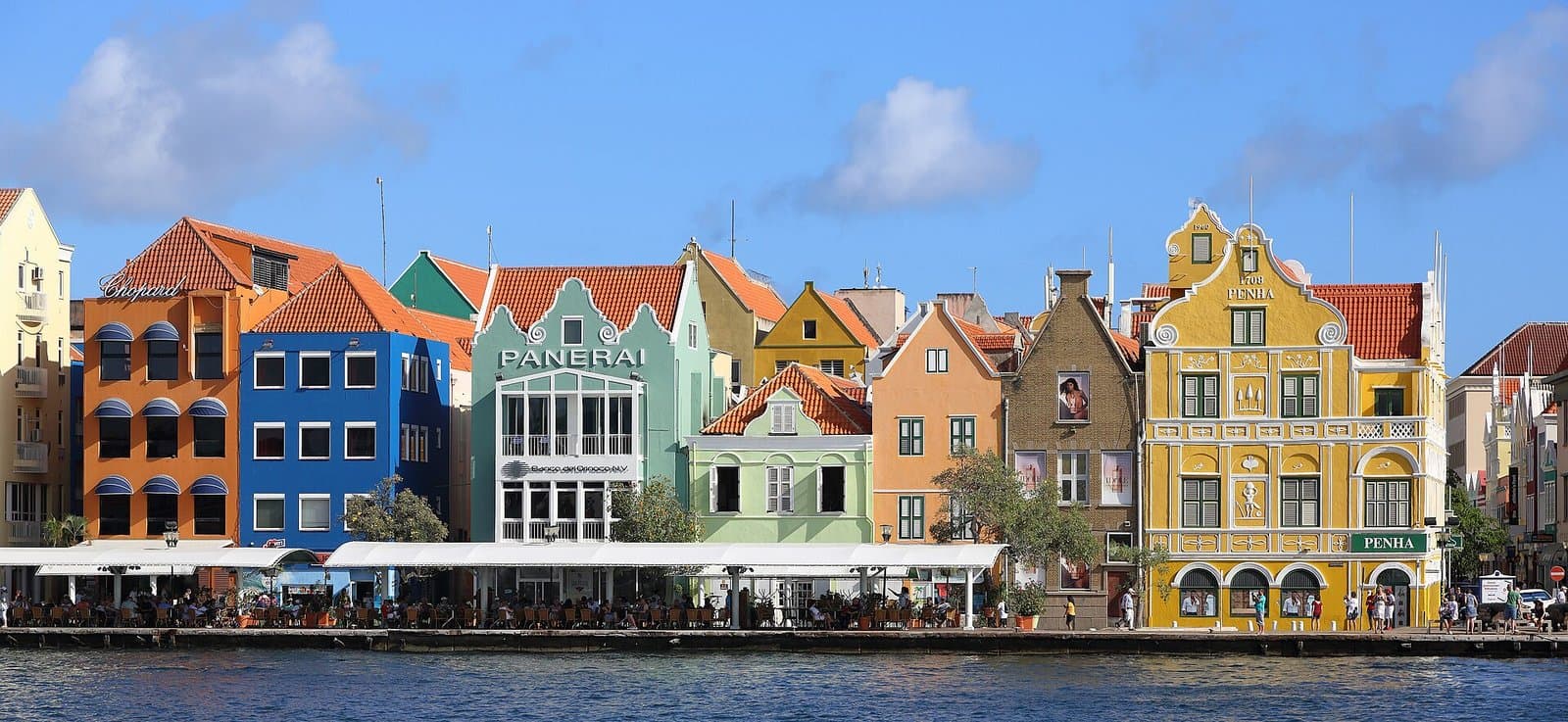
The photograph everyone takes on Curaçao is of the Handelskade, the row of merchant houses on the Punda side of St Anna Bay, painted orange and blue and mint green under red tiles. The colour is the point, and the buildings behind it are the point too. They are Dutch canal houses adapted to the tropics by traders whose fortunes came out of a harbour the Dutch West India Company ran, for a long generation, as the largest holding depot for enslaved Africans in the Caribbean. UNESCO inscribed the inner city and harbour in 1997, and the citation names the trade plainly.
Willemstad is therefore two things at once, and Curaçaoans have spent the past half-century insisting on both. The same island holds the oldest surviving synagogue in the Americas, with sand on its floor, and the plantation house where Tula began the 1795 rebellion; the refinery that made the modern economy, and the uprising of 30 May 1969 that forced the language of the majority into the schools and the parliament.
Curaçao covers 444 square kilometres about 65 kilometres north of the Venezuelan coast, and its 2023 census counted roughly 155,800 people, which makes it the largest and most populous of the three Dutch Caribbean islands. The land is dry limestone and volcanic rock, rising to Christoffelberg in the north-west, cut by a deep natural inlet at St Anna Bay that opens into the Schottegat, one of the best-protected deep-water harbours in the region and the reason the island had a history at all. Since 10 October 2010, when the Netherlands Antilles was dissolved, Curaçao has been a country within the Kingdom of the Netherlands. Papiamentu, Dutch and English are all official, and Papiamentu is the first language of a large majority. About nine residents in ten identify as Christian, most of them Roman Catholic, and the population is predominantly of African descent with substantial Dutch, Sephardic Jewish, Portuguese, Lebanese and Venezuelan communities.
Willemstad. The capital is really four historic districts around one harbour entrance, and the whole of it is a World Heritage Site. Punda, laid out from 1634 behind Fort Amsterdam, is the walled merchant town, with the Handelskade façades, the Penha Building of 1708 on the corner, and the floating market where Venezuelan boats sell produce. Otrobanda, literally "the other side", grew from 1707 as a freer, less regulated quarter of courtyards and kurá compounds and is where most of the island's Black population lived. Scharloo was built by Sephardic merchant families in the nineteenth century, and Pietermaai, the eighteenth-century suburb, has been substantially restored in the last two decades. The two banks are joined by the Queen Emma pontoon bridge of 1888, which swings open on its own engine to let ships pass.
 Willemstad is Dutch town planning built in the tropics and then painted, and the island also holds the oldest synagogue in continuous use in the Americas. Photograph by Martin Falbisoner, CC BY-SA 4.0, via Wikimedia Commons.
Bandabou. The western half of the island is the old plantation country, a landscape of landhuizen, the fortified plantation houses that stood on rises within sight of one another. Landhuis Kenepa, also called Knip, is where the 1795 rebellion began and is now a museum about slavery and about Tula. Landhuis Rooi Catootje holds the Mongui Maduro Library, and Landhuis Bloemhof is an arts centre. Westpunt and Barber lie at the far end, near Christoffel National Park.
Bandariba. The east holds Hato with its limestone caves, and Santa Rosa, which keeps some of the oldest farmed land on the island.
Arawakan-speaking Caquetío people crossed from the South American mainland in the centuries before contact and left rock paintings in caves at Hato and elsewhere. Spain claimed Curaçao in 1499 and, finding no metal, deported most of the population to Hispaniola while keeping the island as a stock ranch. In 1634 a Dutch West India Company fleet under Johannes van Walbeeck took it from the small Spanish garrison and began building Fort Amsterdam where the harbour narrows.
What the company had acquired was a defensible deep-water port at the doorstep of the Spanish Main, and from 1662 it put that port to a single dominant use. Spain contracted out the supply of enslaved labour to its American colonies through the asiento, a licence granted to private holders, and the Dutch West India Company became a subcontractor to successive asiento holders. Enslaved Africans shipped across the Atlantic were landed at Curaçao, held on plantations near the harbour where they were fed and inspected before sale, then re-exported in smaller vessels to Cartagena, Portobelo and the Spanish Caribbean. Zuurzak, recorded by 1688 as the company's largest holding camp, was one of the plantations where people were kept to recover before transhipment (Curaçao Monuments). Estimates for the peak decades run to around a hundred thousand people passing through the island's markets, and it is that traffic which built the merchant houses on the Handelskade.
Curaçao's own plantations were never rich, because the rainfall would not support cane at scale, so the enslaved population worked at maize, sorghum, salt, livestock and domestic service under an unusually harsh regime. On 17 August 1795 some forty or fifty enslaved men at the Knip plantation in Bandabou refused to work and marched out under a man remembered only as Tula, gathering others from Lagún and Santa Cruz until around two thousand were involved. Tula's argument was legal as much as moral: the Netherlands had just become a French client republic, France had abolished slavery in its colonies, and he demanded the same here. The revolt held for a month. Tula and Bastian Karpata were betrayed and taken on 19 September, and Tula was tortured and executed publicly on 3 October 1795 (Wikipedia).
The Dutch recorded him as a criminal for nearly two centuries. Curaçao declared Tula a national hero in 2010, and on 3 October 2023, the anniversary of his execution, the Dutch state formally restored his honour, an act issued on behalf of the cabinet and framed as recognition of a hero of the whole kingdom (DutchNews). It followed the Dutch government's apology for slavery in December 2022 and the king's apology in July 2023. Slavery itself was abolished in the Dutch colonies on 1 July 1863.
The twentieth century arrived as oil. Royal Dutch Shell opened the Isla refinery on the Schottegat in 1918 to process crude from Venezuela's Lake Maracaibo, and the island filled with workers from the Dutch and British Caribbean, Suriname, Portugal and Venezuela. Shell left in 1985 and sold the plant to the government for a symbolic guilder; it has been leased and relet since, and its emissions and its future remain the island's most contested domestic issue.
Papiamentu is the language of Curaçao, spelled with a final u here and taught with a phonetic orthography, while Aruba writes Papiamento etymologically. Most linguists now trace it to an Afro-Portuguese creole formed on the West African coast and carried to the Caribbean in the seventeenth century, where it was restructured under heavy Spanish influence and picked up Dutch and English vocabulary (Britannica). The island's four social groups in the 1600s, the Dutch Protestant administration, the Sephardic Portuguese merchants who arrived from Amsterdam and Brazil in the 1650s, the remaining Caquetío population and the enslaved Africans in the yards and on the plantations, all left something in it. Traces of the African speech of the western plantations survive under the name Guene.
The language was for centuries treated as a domestic patois with no standing in law, education or administration, a judgement that lasted well past emancipation. That changed after 1969. Papiamentu became an official language of the Netherlands Antilles on 7 March 2007 and remained official after the dissolution of 2010, and it is now used in parliament, in primary schools and in a substantial literature.
The island's name is disputed. The most repeated explanation, that Spanish sailors cured of scurvy there named it from curar, to heal, is a folk etymology; the likelier root is an indigenous word recorded by early navigators and later respelled. Willemstad is named for William of Orange.
Tambú is the island's core Afro-Curaçaoan form, and its history is a history of prohibition. Brought from West Africa in the seventeenth century, it is built on a single large hand drum, a struck iron implement often a hoe blade, hand clapping, and a lead singer whose verses handle politics, scandal and grievance in Papiamentu while the circle answers. Colonial authorities and the Catholic church banned it after the 1795 revolt, tightened the restrictions after emancipation in 1863, and the law criminalising tambú gatherings stood until 1952 (Biblioteka Nashonal Kòrsou). Even now the tambú season is concentrated in the weeks around Christmas and the new year, a rhythm inherited from the years when the drum could only be played under licence and on particular dates. Nanette de Jong's study treats the form as a politics of memory rather than a folk survival, which is close to how younger musicians here use it.
Around tambú sit other forms with other ancestries. Seú is the harvest procession, danced with the kachu, a cow-horn trumpet, and the wiri, a scraped metal rasp, and it now closes Easter Monday with a parade through the capital. The waltz, danza and mazurka of the nineteenth-century salons produced a Curaçaoan classical tradition whose best-known name is the composer Jan Gerard Palm. The kitchen keeps keshi yena, chicken baked in a hollowed Edam rind, stoba stews, funchi, pastechi, and the fruit liqueur the island exports under its own name.
Catholicism reached most Curaçaoans through missionary work among the enslaved population and is now the majority faith, the Protestant church of the Dutch establishment being much smaller. The building that draws visitors, though, is Jewish. Mikvé Israel-Emanuel in Punda has been in continuous use since its completion in 1732 and is the oldest surviving synagogue in the Americas (Wikipedia). The congregation was founded in 1651 by Sephardic families from Amsterdam, reinforced after 1654 by Portuguese Jews expelled from Dutch Brazil, and it became the mother congregation of Jewish communities across the Caribbean.
Sand covers the floor of the sanctuary. The explanation given in the congregation is that it recalls the makeshift prayer rooms of the Iberian conversos, where sand muffled footsteps informers might otherwise have heard, and it is also read as a memory of the Exodus. The attached Jewish Cultural Historical Museum holds ritual silver and casts of the carved tombstones from Beth Haim at Bleinheim, consecrated by 1659 and the oldest Jewish cemetery still in use in the western hemisphere. That cemetery now sits against the fence of the Isla refinery, and decades of emissions have eaten the sculpted marble of its seventeenth-century stones, the plainest illustration available of the island's two heritages working against each other.
Beneath the churches runs montamentu, a possession and healing practice with clear African antecedents, long driven underground alongside tambú and still not much discussed outside the families that keep it. Brua, the wider vocabulary of charms and folk cure, is more openly acknowledged.
A Curaçaoan death takes over a household for more than a week. The body is watched on the first night in a wake at which people sit up, drink coffee and rum, tell stories and play dominoes, and neighbours who barely knew the dead attend because attendance is what is owed. Then comes ocho dia, the eight days: an altar with the photograph, candles and flowers is set in the front room, and every evening for eight nights the rosary is said aloud by a prayer-leader with the room answering, followed by food and conversation. On the eighth night the altar is dismantled, the chairs are turned over, and the windows are opened so the spirit can go. Many families keep a mass at the month and another at un aña, the first anniversary.
Graves are visited, tended and talked to. Curaçaoan tombs are built above ground in concrete or tile and repainted by relatives, and the heaviest visiting day is 2 November, All Souls', when families arrive with brushes, paint, flowers and candles and stay past dark. Death notices are read on the radio; processions walk, and hymn singing in Papiamentu carries the coffin.
The island's collective remembrance is organised around slavery and its ending. Tula Day on 17 August marks the start of the 1795 revolt, the Desenkadená sculpture at the Rif seafront marks the enslaved dead, and 1 July is Emancipation Day, Dia di Libertat. The Kurá Hulanda museum in Otrobanda, opened in April 1999, sets out the Atlantic trade from capture in Africa through the middle passage to sale in the Americas, and does so in restored eighteenth-century buildings a few minutes from the water where the ships tied up (Kurá Hulanda Museum).
Curaçao's archives are Dutch, and the Dutch have opened them.
The island was the administrative centre of the Dutch West India Company in the Caribbean and one of the largest slave depots in the Americas: people were landed here, held, and sold on to the Spanish mainland. The company's records, held in The Hague, document that trade in commercial detail.
The slave registers of Curaçao, kept from 1839 until abolition in 1863, were digitised and indexed alongside Suriname's in the project run by Radboud University and the Dutch and Surinamese national archives, and they are free to search. They name individuals with age and owner, and the emancipation registers of 1863 record the surnames people were given or chose at that moment, which is the bridge most Afro-Curaçaoan families need.
Catholic and Protestant church registers, and civil registration from 1831, are held at the Nationaal Archief Curaçao in Willemstad.
The Jewish record is one of the oldest in the Americas. Mikvé Israel-Emanuel in Willemstad, founded by Sephardim from Amsterdam and Brazil, has been in continuous use since 1732 and the community's records and the Beth Haim cemetery, in use since the 1650s, document families that connect to Portugal, Amsterdam and Recife.
Papiamentu, the creole that everyone speaks, carries the Portuguese, Spanish, Dutch and West African strands of the population in its own vocabulary.
UNESCO inscribed the Historic Area of Willemstad, Inner City and Harbour in 1997, covering the four districts together with the harbour that shaped them, and the citation is explicit that this is a colonial trading settlement whose prosperity rested on the slave trade (UNESCO). The inscription arrived after decades in which Otrobanda had been left to decay, and it changed the economics of restoration: the Monumentenfonds Curaçao and the Stichting Monumentenzorg have since restored hundreds of protected buildings, and Pietermaai has gone from near-dereliction to a working quarter within twenty years.
The national heritage institution is NAAM, the National Archaeological and Anthropological Memory Management foundation, which holds the archaeological collections, runs excavation and publishes on plantation archaeology and the material record of slavery. Museum Tula at Landhuis Kenepa covers the 1795 revolt from the site where it started, the Curaçao Museum holds art and colonial material, and the Jewish Cultural Historical Museum, the Mongui Maduro Library and Landhuis Bloemhof carry the community collections. Christoffel National Park protects the dry forest and the plantation landscape it grew back over, and the Hato Caves hold the surviving Caquetío rock paintings.
The most consequential digital project for Curaçaoan families is the slave register. In August 2020 the Nationaal Archief in the Netherlands, the Nationaal Archief Curaçao, the University of Curaçao and Radboud University published the island's slave register for 1839 to 1863 with the two surviving emancipation registers of 1863, scanned, indexed and free to search (Nationaal Archief). The index runs to more than 46,000 personal entries, giving first name, year of birth, the name of the mother and the name of the owner, along with records of birth, death, sale, import and export. The emancipation registers matter most, because they record the surnames people were given in 1863, the join between an enslaved ancestor and a modern family.
Around that sit the other collections. The Biblioteka Nashonal Kòrsou digitises newspapers, photographs and sound, including field recordings of tambú. NAAM publishes its archaeological reports digitally, and the Dutch and Curaçaoan archives continue to open colonial administrative series that were physically out of reach on the island for most of the twentieth century.
The 30 May 1969 uprising is the hinge of modern Curaçaoan identity, and it began as a pay dispute. Workers for a Shell subcontractor demanded equal pay for equal work, a march from the refinery to Willemstad turned into riot and fire in the commercial centre, two people died, hundreds were arrested and Dutch marines were flown in to impose a curfew (Wikipedia). The strikers won their wage demands and the Netherlands Antilles government resigned. What followed mattered more: an inquiry that named racial hierarchy and government conduct as causes, the arrival of Afro-Curaçaoan politicians in numbers at the top of island politics, a fresh Dutch commitment to decolonisation, and the elevation of Papiamentu from kitchen language to a language of school and state. Curaçaoans call it Trinta di Mei, and the anniversary is marked every year.
Beyond that, Curaçaoan culture circulates through the diaspora in the Netherlands, where a large community sustains Papiamentu writing, tambú and Carnival. The arguments Curaçaoans have most often concern the refinery's future, emigration of the young, and how much of Willemstad's restoration reaches the people who live in Otrobanda.
Willemstad was recognised for what it was. The 1997 World Heritage inscription covers all four historic districts and the harbour, and names the slave trade as the source of the wealth that built them.
The registers of the enslaved were opened. More than 46,000 indexed entries from the 1839 to 1863 slave register and the 1863 emancipation registers went online free in 2020, letting families connect a modern surname to a named ancestor.
Tula's honour was restored. Declared a national hero on the island in 2010, the leader of the 1795 revolt was rehabilitated by the Dutch state on 3 October 2023, the anniversary of his execution.
A banned drum became a national form. Tambú, prohibited from 1795 and illegal to hold as a gathering until 1952, is now recorded, archived and taught as the island's central musical inheritance.
Willemstad is Dutch town planning built in the tropics and then painted, and the island also holds the oldest synagogue in continuous use in the Americas. Photograph by Martin Falbisoner, CC BY-SA 4.0, via Wikimedia Commons.
Bandabou. The western half of the island is the old plantation country, a landscape of landhuizen, the fortified plantation houses that stood on rises within sight of one another. Landhuis Kenepa, also called Knip, is where the 1795 rebellion began and is now a museum about slavery and about Tula. Landhuis Rooi Catootje holds the Mongui Maduro Library, and Landhuis Bloemhof is an arts centre. Westpunt and Barber lie at the far end, near Christoffel National Park.
Bandariba. The east holds Hato with its limestone caves, and Santa Rosa, which keeps some of the oldest farmed land on the island.
Arawakan-speaking Caquetío people crossed from the South American mainland in the centuries before contact and left rock paintings in caves at Hato and elsewhere. Spain claimed Curaçao in 1499 and, finding no metal, deported most of the population to Hispaniola while keeping the island as a stock ranch. In 1634 a Dutch West India Company fleet under Johannes van Walbeeck took it from the small Spanish garrison and began building Fort Amsterdam where the harbour narrows.
What the company had acquired was a defensible deep-water port at the doorstep of the Spanish Main, and from 1662 it put that port to a single dominant use. Spain contracted out the supply of enslaved labour to its American colonies through the asiento, a licence granted to private holders, and the Dutch West India Company became a subcontractor to successive asiento holders. Enslaved Africans shipped across the Atlantic were landed at Curaçao, held on plantations near the harbour where they were fed and inspected before sale, then re-exported in smaller vessels to Cartagena, Portobelo and the Spanish Caribbean. Zuurzak, recorded by 1688 as the company's largest holding camp, was one of the plantations where people were kept to recover before transhipment (Curaçao Monuments). Estimates for the peak decades run to around a hundred thousand people passing through the island's markets, and it is that traffic which built the merchant houses on the Handelskade.
Curaçao's own plantations were never rich, because the rainfall would not support cane at scale, so the enslaved population worked at maize, sorghum, salt, livestock and domestic service under an unusually harsh regime. On 17 August 1795 some forty or fifty enslaved men at the Knip plantation in Bandabou refused to work and marched out under a man remembered only as Tula, gathering others from Lagún and Santa Cruz until around two thousand were involved. Tula's argument was legal as much as moral: the Netherlands had just become a French client republic, France had abolished slavery in its colonies, and he demanded the same here. The revolt held for a month. Tula and Bastian Karpata were betrayed and taken on 19 September, and Tula was tortured and executed publicly on 3 October 1795 (Wikipedia).
The Dutch recorded him as a criminal for nearly two centuries. Curaçao declared Tula a national hero in 2010, and on 3 October 2023, the anniversary of his execution, the Dutch state formally restored his honour, an act issued on behalf of the cabinet and framed as recognition of a hero of the whole kingdom (DutchNews). It followed the Dutch government's apology for slavery in December 2022 and the king's apology in July 2023. Slavery itself was abolished in the Dutch colonies on 1 July 1863.
The twentieth century arrived as oil. Royal Dutch Shell opened the Isla refinery on the Schottegat in 1918 to process crude from Venezuela's Lake Maracaibo, and the island filled with workers from the Dutch and British Caribbean, Suriname, Portugal and Venezuela. Shell left in 1985 and sold the plant to the government for a symbolic guilder; it has been leased and relet since, and its emissions and its future remain the island's most contested domestic issue.
Papiamentu is the language of Curaçao, spelled with a final u here and taught with a phonetic orthography, while Aruba writes Papiamento etymologically. Most linguists now trace it to an Afro-Portuguese creole formed on the West African coast and carried to the Caribbean in the seventeenth century, where it was restructured under heavy Spanish influence and picked up Dutch and English vocabulary (Britannica). The island's four social groups in the 1600s, the Dutch Protestant administration, the Sephardic Portuguese merchants who arrived from Amsterdam and Brazil in the 1650s, the remaining Caquetío population and the enslaved Africans in the yards and on the plantations, all left something in it. Traces of the African speech of the western plantations survive under the name Guene.
The language was for centuries treated as a domestic patois with no standing in law, education or administration, a judgement that lasted well past emancipation. That changed after 1969. Papiamentu became an official language of the Netherlands Antilles on 7 March 2007 and remained official after the dissolution of 2010, and it is now used in parliament, in primary schools and in a substantial literature.
The island's name is disputed. The most repeated explanation, that Spanish sailors cured of scurvy there named it from curar, to heal, is a folk etymology; the likelier root is an indigenous word recorded by early navigators and later respelled. Willemstad is named for William of Orange.
Tambú is the island's core Afro-Curaçaoan form, and its history is a history of prohibition. Brought from West Africa in the seventeenth century, it is built on a single large hand drum, a struck iron implement often a hoe blade, hand clapping, and a lead singer whose verses handle politics, scandal and grievance in Papiamentu while the circle answers. Colonial authorities and the Catholic church banned it after the 1795 revolt, tightened the restrictions after emancipation in 1863, and the law criminalising tambú gatherings stood until 1952 (Biblioteka Nashonal Kòrsou). Even now the tambú season is concentrated in the weeks around Christmas and the new year, a rhythm inherited from the years when the drum could only be played under licence and on particular dates. Nanette de Jong's study treats the form as a politics of memory rather than a folk survival, which is close to how younger musicians here use it.
Around tambú sit other forms with other ancestries. Seú is the harvest procession, danced with the kachu, a cow-horn trumpet, and the wiri, a scraped metal rasp, and it now closes Easter Monday with a parade through the capital. The waltz, danza and mazurka of the nineteenth-century salons produced a Curaçaoan classical tradition whose best-known name is the composer Jan Gerard Palm. The kitchen keeps keshi yena, chicken baked in a hollowed Edam rind, stoba stews, funchi, pastechi, and the fruit liqueur the island exports under its own name.
Catholicism reached most Curaçaoans through missionary work among the enslaved population and is now the majority faith, the Protestant church of the Dutch establishment being much smaller. The building that draws visitors, though, is Jewish. Mikvé Israel-Emanuel in Punda has been in continuous use since its completion in 1732 and is the oldest surviving synagogue in the Americas (Wikipedia). The congregation was founded in 1651 by Sephardic families from Amsterdam, reinforced after 1654 by Portuguese Jews expelled from Dutch Brazil, and it became the mother congregation of Jewish communities across the Caribbean.
Sand covers the floor of the sanctuary. The explanation given in the congregation is that it recalls the makeshift prayer rooms of the Iberian conversos, where sand muffled footsteps informers might otherwise have heard, and it is also read as a memory of the Exodus. The attached Jewish Cultural Historical Museum holds ritual silver and casts of the carved tombstones from Beth Haim at Bleinheim, consecrated by 1659 and the oldest Jewish cemetery still in use in the western hemisphere. That cemetery now sits against the fence of the Isla refinery, and decades of emissions have eaten the sculpted marble of its seventeenth-century stones, the plainest illustration available of the island's two heritages working against each other.
Beneath the churches runs montamentu, a possession and healing practice with clear African antecedents, long driven underground alongside tambú and still not much discussed outside the families that keep it. Brua, the wider vocabulary of charms and folk cure, is more openly acknowledged.
A Curaçaoan death takes over a household for more than a week. The body is watched on the first night in a wake at which people sit up, drink coffee and rum, tell stories and play dominoes, and neighbours who barely knew the dead attend because attendance is what is owed. Then comes ocho dia, the eight days: an altar with the photograph, candles and flowers is set in the front room, and every evening for eight nights the rosary is said aloud by a prayer-leader with the room answering, followed by food and conversation. On the eighth night the altar is dismantled, the chairs are turned over, and the windows are opened so the spirit can go. Many families keep a mass at the month and another at un aña, the first anniversary.
Graves are visited, tended and talked to. Curaçaoan tombs are built above ground in concrete or tile and repainted by relatives, and the heaviest visiting day is 2 November, All Souls', when families arrive with brushes, paint, flowers and candles and stay past dark. Death notices are read on the radio; processions walk, and hymn singing in Papiamentu carries the coffin.
The island's collective remembrance is organised around slavery and its ending. Tula Day on 17 August marks the start of the 1795 revolt, the Desenkadená sculpture at the Rif seafront marks the enslaved dead, and 1 July is Emancipation Day, Dia di Libertat. The Kurá Hulanda museum in Otrobanda, opened in April 1999, sets out the Atlantic trade from capture in Africa through the middle passage to sale in the Americas, and does so in restored eighteenth-century buildings a few minutes from the water where the ships tied up (Kurá Hulanda Museum).
Curaçao's archives are Dutch, and the Dutch have opened them.
The island was the administrative centre of the Dutch West India Company in the Caribbean and one of the largest slave depots in the Americas: people were landed here, held, and sold on to the Spanish mainland. The company's records, held in The Hague, document that trade in commercial detail.
The slave registers of Curaçao, kept from 1839 until abolition in 1863, were digitised and indexed alongside Suriname's in the project run by Radboud University and the Dutch and Surinamese national archives, and they are free to search. They name individuals with age and owner, and the emancipation registers of 1863 record the surnames people were given or chose at that moment, which is the bridge most Afro-Curaçaoan families need.
Catholic and Protestant church registers, and civil registration from 1831, are held at the Nationaal Archief Curaçao in Willemstad.
The Jewish record is one of the oldest in the Americas. Mikvé Israel-Emanuel in Willemstad, founded by Sephardim from Amsterdam and Brazil, has been in continuous use since 1732 and the community's records and the Beth Haim cemetery, in use since the 1650s, document families that connect to Portugal, Amsterdam and Recife.
Papiamentu, the creole that everyone speaks, carries the Portuguese, Spanish, Dutch and West African strands of the population in its own vocabulary.
UNESCO inscribed the Historic Area of Willemstad, Inner City and Harbour in 1997, covering the four districts together with the harbour that shaped them, and the citation is explicit that this is a colonial trading settlement whose prosperity rested on the slave trade (UNESCO). The inscription arrived after decades in which Otrobanda had been left to decay, and it changed the economics of restoration: the Monumentenfonds Curaçao and the Stichting Monumentenzorg have since restored hundreds of protected buildings, and Pietermaai has gone from near-dereliction to a working quarter within twenty years.
The national heritage institution is NAAM, the National Archaeological and Anthropological Memory Management foundation, which holds the archaeological collections, runs excavation and publishes on plantation archaeology and the material record of slavery. Museum Tula at Landhuis Kenepa covers the 1795 revolt from the site where it started, the Curaçao Museum holds art and colonial material, and the Jewish Cultural Historical Museum, the Mongui Maduro Library and Landhuis Bloemhof carry the community collections. Christoffel National Park protects the dry forest and the plantation landscape it grew back over, and the Hato Caves hold the surviving Caquetío rock paintings.
The most consequential digital project for Curaçaoan families is the slave register. In August 2020 the Nationaal Archief in the Netherlands, the Nationaal Archief Curaçao, the University of Curaçao and Radboud University published the island's slave register for 1839 to 1863 with the two surviving emancipation registers of 1863, scanned, indexed and free to search (Nationaal Archief). The index runs to more than 46,000 personal entries, giving first name, year of birth, the name of the mother and the name of the owner, along with records of birth, death, sale, import and export. The emancipation registers matter most, because they record the surnames people were given in 1863, the join between an enslaved ancestor and a modern family.
Around that sit the other collections. The Biblioteka Nashonal Kòrsou digitises newspapers, photographs and sound, including field recordings of tambú. NAAM publishes its archaeological reports digitally, and the Dutch and Curaçaoan archives continue to open colonial administrative series that were physically out of reach on the island for most of the twentieth century.
The 30 May 1969 uprising is the hinge of modern Curaçaoan identity, and it began as a pay dispute. Workers for a Shell subcontractor demanded equal pay for equal work, a march from the refinery to Willemstad turned into riot and fire in the commercial centre, two people died, hundreds were arrested and Dutch marines were flown in to impose a curfew (Wikipedia). The strikers won their wage demands and the Netherlands Antilles government resigned. What followed mattered more: an inquiry that named racial hierarchy and government conduct as causes, the arrival of Afro-Curaçaoan politicians in numbers at the top of island politics, a fresh Dutch commitment to decolonisation, and the elevation of Papiamentu from kitchen language to a language of school and state. Curaçaoans call it Trinta di Mei, and the anniversary is marked every year.
Beyond that, Curaçaoan culture circulates through the diaspora in the Netherlands, where a large community sustains Papiamentu writing, tambú and Carnival. The arguments Curaçaoans have most often concern the refinery's future, emigration of the young, and how much of Willemstad's restoration reaches the people who live in Otrobanda.
Willemstad was recognised for what it was. The 1997 World Heritage inscription covers all four historic districts and the harbour, and names the slave trade as the source of the wealth that built them.
The registers of the enslaved were opened. More than 46,000 indexed entries from the 1839 to 1863 slave register and the 1863 emancipation registers went online free in 2020, letting families connect a modern surname to a named ancestor.
Tula's honour was restored. Declared a national hero on the island in 2010, the leader of the 1795 revolt was rehabilitated by the Dutch state on 3 October 2023, the anniversary of his execution.
A banned drum became a national form. Tambú, prohibited from 1795 and illegal to hold as a gathering until 1952, is now recorded, archived and taught as the island's central musical inheritance.
National Overview
Notable Cities
Historical Foundations
Linguistic and Etymological Roots
Cultural Identity
Religion and Spirituality
Remembrance and Mourning Traditions
Tracing a Family in Curaçao
Heritage Preservation Efforts
Digital Heritage
Contemporary Cultural Influences
Success Stories
References and resources
- UNESCO, Historic Area of Willemstad, Inner City and Harbour: the 1997 inscription and its four districts.
- Curaçao Slave Revolt of 1795, Wikipedia: Tula, Karpata and the month-long revolt.
- DutchNews, Dutch state rehabilitates leader of 1795 revolt: the restoration of Tula's honour in 2023.
- Mikvé Israel-Emanuel Synagogue, Wikipedia: the 1732 building, the sand floor and the congregation of 1651.
- Curaçao Monuments, Landhuis Zuurzak: the company's largest holding camp for enslaved people in transit.
- Canon van Nederland, Slavery: the Dutch trade and abolition in 1863.
- Nationaal Archief, Curaçao slave and emancipation registers 1839 to 1863: the digitised and indexed registers.
- Biblioteka Nashonal Kòrsou, How Tambú Music Almost Disappeared: the bans and the repeal of 1952.
- 1969 Curaçao uprising, Wikipedia: the 30 May revolt and its political consequences.
- Kurá Hulanda Museum: the Otrobanda museum of the Atlantic slave trade.
- Beth Haim of Curaçao: the Bleinheim cemetery of 1659 and its condition beside the refinery.
- Encyclopaedia Britannica, Papiamentu: the creole's origins across the ABC islands.
- Encyclopaedia Britannica, Curaçao: geography, government and the harbour economy.