Heritage · Country
Western Sahara Culture and Heritage
A stretch of Atlantic desert where Hassaniya Arabic carries a poetry tradition older than any border drawn across it. This guide follows Sahrawi heritage: the engraved ridges of Sluguilla Lawash, the tent and the three teas, and the museum, archive and film festival kept running in refugee camps.Written to last.
By Confinity Heritage Editorial · Updated 2026-08-17 · 8-minute readQuiet tools, kept out of the way.
Making tea properly takes about two hours. A small pot goes on charcoal, the leaves are boiled with a great deal of sugar, and the liquid is poured between pot and glass from a height until it carries a head of foam. Then it is served three times, and the rounds have a saying attached: the first glass bitter as life, the second sweet as love, the third gentle as death. Nobody leaves after the first. The ceremony is a clock and a courtesy at once, and among Sahrawi families it still sets the length of a visit.
Western Sahara is a territory of Atlantic coast and stone desert whose sovereignty has been argued over at the United Nations for more than sixty years, and whose people carry an inheritance that predates every one of those arguments. Herders crossed this ground when it was green enough for cattle and left tens of thousands of engravings on its ridges, and a Bedouin Arabic called Hassaniya later settled over an older Berber speech and became the vehicle of a demanding oral poetry.
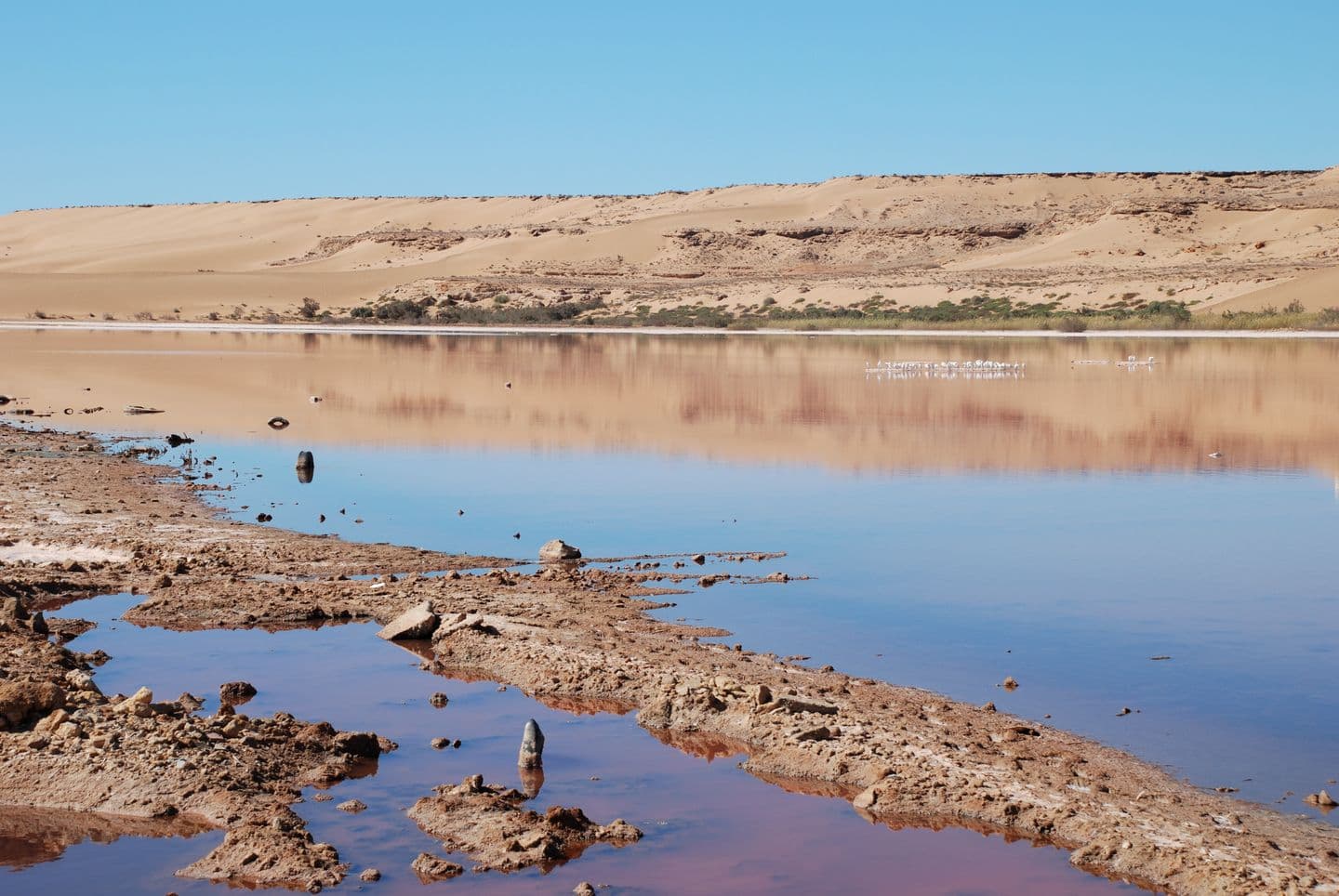
Western Sahara covers roughly 266,000 square kilometres on the Atlantic coast of northwest Africa, and the cold Canary Current makes its fishing grounds among the richest in the region. The land divides into two historic halves whose names remain in daily use: Saguia el Hamra in the north, after the seasonal watercourse that runs past Laayoune, and Río de Oro in the south, around Dakhla; most of the interior is hammada, flat stony desert with sparse scrub.
The territory's status is disputed and this page takes no position on it. Morocco administers roughly 80 per cent of Western Sahara, the portion west of a long defensive sand wall, and governs it as its Southern Provinces; its 2014 census counted about 511,000 people in the two southern regions it has created, which extend slightly beyond the territory. The Polisario Front proclaimed the Sahrawi Arab Democratic Republic at Bir Lehlou on 27 February 1976 and administers the area east of the wall, roughly 90,000 square kilometres, which it calls the Liberated Territories. The SADR has belonged to the African Union and its predecessor since 1982, a membership Morocco protested by leaving the organisation in 1984 before rejoining in 2017; it has been recognised at some point by 85 states, of which 36 maintained recognition as of 2022 while 39 had frozen or withdrawn it (Wikipedia). The United Nations has kept Western Sahara on its list of non-self-governing territories since 1963 and recognises no state's sovereignty over it.
Laayoune (El Aaiún). The largest city sits inland from the Atlantic on the Saguia el Hamra, and it is largely a twentieth-century creation: Spain founded it as the administrative centre of its Saharan possession in 1938, and Morocco has expanded it heavily since 1975. Spanish-era buildings with domed roofs survive among newer quarters.
 Dakhla was the Spanish colonial town of Villa Cisneros. The territory's status is disputed and this page takes no position on it. Photograph by YoTuT, CC BY 2.0, via Wikimedia Commons.
Dakhla (Villa Cisneros). On a thin peninsula reaching 40 kilometres into the Atlantic, Dakhla began as a Spanish trading fort in 1884 and is now a fishing port and a destination for kitesurfers.
Smara. Smara is the only town in the territory founded by Sahrawis themselves. The scholar and Sufi shaykh Ma al-Aynayn built it from 1898 with masons brought from Morocco, giving it a stone mosque, a palace and a manuscript library; French forces sacked it in 1913.
Tifariti and Bir Lehlou. East of the wall, these settlements are the administrative and ceremonial centres of the Polisario Front, which named Tifariti its provisional capital in 2008.
The camps near Tindouf. Since 1975 a large Sahrawi population has lived in five camps in southwestern Algeria, named for towns in the territory: Laayoune, Awserd, Smara, Dakhla and Boujdour. The administrative settlement of Rabouni holds the main hospital, the national archive and the museum.
The oldest record here belongs to a wetter Sahara. Engravings and paintings across the north show cattle, giraffe, elephant, antelope and human figures from a period when the desert supported grazing, and the concentrations at Sluguilla Lawash, Erqueyez and the painted shelters of the Zemmour are among the more significant prehistoric assemblages in northwest Africa.
Sanhaja Berber pastoralists held the western desert in the early Islamic centuries and produced the Almoravid movement that swept north into Morocco and Spain in the eleventh century. From the thirteenth century Arab tribes of the Beni Hassan moved west, and after the seventeenth-century conflict known as the Char Bouba war their language and social order prevailed, leaving a society divided between warrior lineages, scholarly lineages and tributary groups. Trade routes ran south to the Sahel and north to Morocco, and the sultans of Morocco maintained relationships of varying strength with tribes across the region.
Spain claimed the coast at Río de Oro in 1884, though control of the interior was not effective until the 1930s. Phosphate found at Bou Craa in the 1940s went into production in the early 1970s, carried to the coast near Laayoune on a conveyor belt about 100 kilometres long, the longest in the world, which leaves a pale streak of spilled ore visible from orbit (NASA Earth Observatory). The Polisario Front was founded on 10 May 1973 and began an armed campaign against Spanish rule.
The year 1975 decided the shape of everything since. On 16 October the International Court of Justice delivered an advisory opinion in response to questions from the General Assembly. The Court held unanimously that Western Sahara had not been terra nullius at the time of Spanish colonisation. It found that there had existed legal ties of allegiance between the Sultan of Morocco and some of the tribes living in the territory, and rights relating to the land between the territory and what it called the Mauritanian entity. It then stated that the materials before it did not establish any tie of territorial sovereignty between Western Sahara and either the Kingdom of Morocco or the Mauritanian entity, and that it had not found legal ties of such a nature as might affect the application of General Assembly resolution 1514 (XV) in the decolonisation of the territory, and in particular the principle of self-determination through the free and genuine expression of the will of the peoples of the territory (ICJ summary). Both parties cite the opinion, and both are routinely quoted as if it said only the half that suits them.
Three weeks later, on 6 November, King Hassan II sent some 350,000 unarmed Moroccan civilians across the border in what became known as the Green March. On 14 November Spain, Morocco and Mauritania signed the Madrid Accords, under which Spain agreed to withdraw and hand administration to the other two; Spain left in February 1976 and told the Secretary-General it considered itself released from responsibility. War followed, and Mauritania withdrew its claim in 1979. Between 1980 and 1987 Morocco built a berm of sand and stone about 2,700 kilometres long, with bunkers, radar and what is thought to be the longest continuous minefield anywhere (Wikipedia).
The Security Council established MINURSO, the mission for the referendum, by resolution 690 of 29 April 1991, and a ceasefire took effect that September. The referendum was set for January 1992 and has never been held, the parties having failed to agree who was entitled to vote (MINURSO). Morocco tabled an autonomy proposal in 2007 under which the territory would run its internal affairs under Moroccan sovereignty; the Polisario Front tabled one built on a referendum with independence as an option. In November 2020, after a confrontation over a road at Guerguerat, the Polisario Front announced it no longer considered itself bound by the ceasefire. On 31 October 2025 the Security Council adopted resolution 2797 by 11 votes to none with 3 abstentions, renewing MINURSO for a year and supporting negotiations on the basis of the Moroccan proposal (UN Meetings Coverage).
The everyday language of Sahrawis is Hassaniya, an Arabic variety carried west by the Beni Hassan and now spoken by roughly 5.6 million people across Mauritania, Western Sahara, Mali, southern Algeria, Senegal and Niger. It absorbed the Zenaga Berber speech it displaced and kept features most Maghrebi varieties lost, including the interdental consonants of Classical Arabic and a distinct pronunciation of the letter qaf, which is one reason it sounds closer to old poetry than the Moroccan Darija spoken a few hundred kilometres north (Wikipedia). Mali treats Hassaniya as an official language, and Morocco's 2011 constitution names Hassani among the cultural expressions the state undertakes to protect.
The poetry that language carries is the central literary form of the culture. Composition is oral, metrically strict and often competitive, ranging from the long ode to the short epigram, and a poet is expected to improvise on demand at a gathering. Much of the vocabulary is technical in ways a city dweller cannot follow: separate words for a camel by age, colour, gait and temperament, for the stages of a well, for the shades of a rain cloud. This is the part of the inheritance most at risk, because it lives in speech.
The place names read as plain description. Saguia el Hamra is the red channel, after the colour of the wadi bed. Río de Oro is Spanish for river of gold, given by fifteenth-century sailors who believed gold came down the coast from the interior. Tiris and Zemmour are older Berber names that survived the language shift, and Sahrawi is the Arabic adjective from sahra, desert.
The defining object is the khaima, the tent. Woven in strips from goat and camel hair by women, then sewn together and stretched over poles, it is a house that can be struck and carried, and its layout encodes the household: a men's side, a women's side, a hearth, a place for guests. Families who have lived in mud-brick rooms for forty years often keep a khaima pitched beside the house and receive visitors in it, because the tent is where hospitality properly happens.
Women wear the melhfa, a single length of light cloth four metres or so long, wrapped over the head and body in bright patterned colours. Men wear the darraa, a loose blue or white robe with wide open sides, and a long turban. Silverwork, leather tooling, carved bowls and the decorated camel saddle are the main crafts.
Music comes out of the Moorish tradition shared with Mauritania: a modal system of several ways a performance moves through in order, played on the tidinit lute and the ardin harp with the tbal drum, and sung by griot families who were also keepers of genealogy. Food is plain and built for a desert: camel and goat milk, dried meat, dates, barley, bread baked in sand, and couscous on occasions.
Sahrawis are Sunni Muslims of the Maliki school, and religious life in the western desert was organised less around mosques than around lineages. The zwaya, the scholarly and religious tribes, held Islamic learning and law while the hassan warrior lineages held force. Teaching happened in the mahdara, a travelling school where a shaykh taught Quran, grammar, law and poetry to boys who moved with the camp, memorising a text on a wooden tablet before being allowed the next.
Sufi orders shaped devotion, above all the Qadiriyya and the Tijaniyya. Ma al-Aynayn, who founded Smara, belonged to that world: a jurist and a shaykh with a substantial library, remembered as a scholar as much as a leader, and the ruins of his zawiya remain the territory's most important religious monument.
Burial follows Islamic practice and happens fast, usually the same day. The body is washed, wrapped in a plain white shroud and carried to the ground on a bier, and the grave is dug so that the body lies on its right side facing Mecca. Sahrawi graves in the desert are deliberately plain, often no more than a mound with a stone at the head and another at the foot, without inscription. Mourning is contained: three days of condolences at the family's tent, Quran recitation, food brought by neighbours, and no display. Elegy is the exception to the restraint, because the death of a person of standing is expected to produce poems, and those poems are how the memory is fixed.
What is specific to this territory is separation. Families were divided in 1975 and 1976 between the area Morocco administers and the camps in Algeria, and the berm has stood between them since the 1980s, in many cases for a person's entire adult life. Parents have died on one side while children lived on the other, and graves go untended because the people who would tend them cannot reach them. Since 2004 the UNHCR has run a family visit programme as a confidence-building measure, flying small groups in each direction for a few days; by early 2011 more than 12,800 people had travelled under it, with some 42,000 more on the waiting lists, and the flights have been suspended and resumed several times since (UNHCR).
There is also the question of the disappeared. Both parties have been accused of holding and killing prisoners during the war years, and both dispute the accusations made against them. Morocco's Equity and Reconciliation Commission, which sat in 2004 and 2005, documented cases involving Sahrawis and recommended reparations. Families on both sides of the wall are still waiting to be told where particular people are buried.
The most important document in Western Sahara is a Spanish census taken in 1974.
Spain enumerated the population of its Saharan province that year, listing around 74,000 people, and when the United Nations set up a mission to organise a referendum on self-determination in 1991, that census was made the basis of the electorate. Everything since has turned on it. Morocco argued for the inclusion of people with Saharan tribal descent who were not counted in 1974; the Polisario Front argued for the census list and the direct descendants of those on it. The identification process ran through the 1990s, examined more than 200,000 applications, and the referendum has never been held.
So in Western Sahara, genealogy is the whole of politics. Sahrawi descent runs through tribe and fraction, is recited, and was recorded by Spanish administrators in the tribal registers that accompanied the census.
Spanish colonial records are in Madrid and Aix, Spanish parish and military records covering the European population.
For the Sahrawis in the Tindouf camps in Algeria, where a substantial part of the population has lived since 1975, the record is the Polisario administration's and UNHCR's. Families there have been documented by an authority without a recognised state for fifty years.
Islamic court records and the genealogies of the zawiya families are the older written layer.
Heritage work here runs into the dispute at every step. Western Sahara is not a state party to the World Heritage Convention and cannot nominate sites, and no site in the territory has been inscribed, so the rock art lacks the protection comparable material has in Algeria or Libya. Fieldwork east of the berm has depended on collaborations between Sahrawi authorities and European universities, chiefly a team from the Universitat de Girona that surveyed Sluguilla Lawash, Erqueyez and the Zemmour shelters from the late 1990s. It found engravings running along ridges and buttes at Sluguilla Lawash for some thirty kilometres, with antelopes and gazelles accounting for around 40 per cent of the animals depicted and cattle for under 2 per cent (Semantic Scholar), and it recorded around thirty previously undocumented painted shelters at Erqueyez (Academia.edu). West of the berm, archaeological work proceeds under Moroccan institutions, and the two records do not easily join up.
The physical threats are ordinary ones made worse by circumstance: engraved slabs lifted and sold, vehicles driven across sites, mining, and mine contamination that puts whole areas out of reach. The intangible heritage is at least as exposed, because camel-herding vocabulary is disappearing with the pastoral economy that carried it, most Sahrawis now living in towns or camps rather than moving with animals.
The camps have built an archive out of necessity. The Sahrawi National Archives at Rabouni hold administrative records, photographs and audiovisual material gathered since 1976, and a partnership with Seton Hall University in the United States has worked on digitising and cataloguing Sahrawi collections so that scholars can reach them remotely (Seton Hall). The Abidin Kaid Saleh film school, opened in the Dakhla camp in 2011, has trained Sahrawi camera operators and editors who now produce their own documentary record.
Older material sits in Spain. The records of the Spanish administration, including censuses, maps, photographs and the 1974 population count, are held at the Archivo General de la Administración in Alcalá de Henares, the main documentary source for anyone tracing a Sahrawi family before 1975. Poetry and song circulate in Hassaniya through camp radio, video channels and diaspora sites, giving an oral form its first durable copies.
Two events in the camps have carried Sahrawi culture outward. FiSahara, the Sahara International Film Festival, has run since 2003 in the Dakhla camp, about 175 kilometres from Tindouf, screening films onto outdoor walls for camp residents and visitors flown in from Europe, and it is generally described as the only film festival in the world held in a refugee camp (Sahara International Film Festival). ARTifariti has brought artists to Tifariti since 2007 to make work on site.
A group of Sahrawi writers who studied in Cuba and Spain formed the Generación de la Amistad Saharaui in Madrid in 2005, publishing poetry in Spanish, which makes Sahrawis one of very few African peoples with a modern literature in that language. Group Doueh, Mariem Hassan and Aziza Brahim have found international labels. On the Moroccan-administered side, Laayoune and Dakhla have grown quickly with new fishing, agriculture and wind-energy investment, and Hassani music and dress feature in Moroccan cultural programming.
Heritage carried into exile. Schools, an archive, a museum, a radio station, a film school and a film festival have all been sustained in desert camps for half a century.
The engraved ridges mapped. Joint Sahrawi and Catalan survey work documented Sluguilla Lawash across some thirty kilometres of ridges and recorded around thirty new painted shelters at Erqueyez, sites that have no legal protection.
Hassani written into a constitution. Morocco's 2011 constitution names Hassani among the cultural expressions the state undertakes to protect, giving a spoken variety a standing it had not held.
Families flown across the wall. The UNHCR programme has taken more than 12,800 people across a closed frontier since 2004 to spend a few days with relatives they had not seen in decades.
Dakhla was the Spanish colonial town of Villa Cisneros. The territory's status is disputed and this page takes no position on it. Photograph by YoTuT, CC BY 2.0, via Wikimedia Commons.
Dakhla (Villa Cisneros). On a thin peninsula reaching 40 kilometres into the Atlantic, Dakhla began as a Spanish trading fort in 1884 and is now a fishing port and a destination for kitesurfers.
Smara. Smara is the only town in the territory founded by Sahrawis themselves. The scholar and Sufi shaykh Ma al-Aynayn built it from 1898 with masons brought from Morocco, giving it a stone mosque, a palace and a manuscript library; French forces sacked it in 1913.
Tifariti and Bir Lehlou. East of the wall, these settlements are the administrative and ceremonial centres of the Polisario Front, which named Tifariti its provisional capital in 2008.
The camps near Tindouf. Since 1975 a large Sahrawi population has lived in five camps in southwestern Algeria, named for towns in the territory: Laayoune, Awserd, Smara, Dakhla and Boujdour. The administrative settlement of Rabouni holds the main hospital, the national archive and the museum.
The oldest record here belongs to a wetter Sahara. Engravings and paintings across the north show cattle, giraffe, elephant, antelope and human figures from a period when the desert supported grazing, and the concentrations at Sluguilla Lawash, Erqueyez and the painted shelters of the Zemmour are among the more significant prehistoric assemblages in northwest Africa.
Sanhaja Berber pastoralists held the western desert in the early Islamic centuries and produced the Almoravid movement that swept north into Morocco and Spain in the eleventh century. From the thirteenth century Arab tribes of the Beni Hassan moved west, and after the seventeenth-century conflict known as the Char Bouba war their language and social order prevailed, leaving a society divided between warrior lineages, scholarly lineages and tributary groups. Trade routes ran south to the Sahel and north to Morocco, and the sultans of Morocco maintained relationships of varying strength with tribes across the region.
Spain claimed the coast at Río de Oro in 1884, though control of the interior was not effective until the 1930s. Phosphate found at Bou Craa in the 1940s went into production in the early 1970s, carried to the coast near Laayoune on a conveyor belt about 100 kilometres long, the longest in the world, which leaves a pale streak of spilled ore visible from orbit (NASA Earth Observatory). The Polisario Front was founded on 10 May 1973 and began an armed campaign against Spanish rule.
The year 1975 decided the shape of everything since. On 16 October the International Court of Justice delivered an advisory opinion in response to questions from the General Assembly. The Court held unanimously that Western Sahara had not been terra nullius at the time of Spanish colonisation. It found that there had existed legal ties of allegiance between the Sultan of Morocco and some of the tribes living in the territory, and rights relating to the land between the territory and what it called the Mauritanian entity. It then stated that the materials before it did not establish any tie of territorial sovereignty between Western Sahara and either the Kingdom of Morocco or the Mauritanian entity, and that it had not found legal ties of such a nature as might affect the application of General Assembly resolution 1514 (XV) in the decolonisation of the territory, and in particular the principle of self-determination through the free and genuine expression of the will of the peoples of the territory (ICJ summary). Both parties cite the opinion, and both are routinely quoted as if it said only the half that suits them.
Three weeks later, on 6 November, King Hassan II sent some 350,000 unarmed Moroccan civilians across the border in what became known as the Green March. On 14 November Spain, Morocco and Mauritania signed the Madrid Accords, under which Spain agreed to withdraw and hand administration to the other two; Spain left in February 1976 and told the Secretary-General it considered itself released from responsibility. War followed, and Mauritania withdrew its claim in 1979. Between 1980 and 1987 Morocco built a berm of sand and stone about 2,700 kilometres long, with bunkers, radar and what is thought to be the longest continuous minefield anywhere (Wikipedia).
The Security Council established MINURSO, the mission for the referendum, by resolution 690 of 29 April 1991, and a ceasefire took effect that September. The referendum was set for January 1992 and has never been held, the parties having failed to agree who was entitled to vote (MINURSO). Morocco tabled an autonomy proposal in 2007 under which the territory would run its internal affairs under Moroccan sovereignty; the Polisario Front tabled one built on a referendum with independence as an option. In November 2020, after a confrontation over a road at Guerguerat, the Polisario Front announced it no longer considered itself bound by the ceasefire. On 31 October 2025 the Security Council adopted resolution 2797 by 11 votes to none with 3 abstentions, renewing MINURSO for a year and supporting negotiations on the basis of the Moroccan proposal (UN Meetings Coverage).
The everyday language of Sahrawis is Hassaniya, an Arabic variety carried west by the Beni Hassan and now spoken by roughly 5.6 million people across Mauritania, Western Sahara, Mali, southern Algeria, Senegal and Niger. It absorbed the Zenaga Berber speech it displaced and kept features most Maghrebi varieties lost, including the interdental consonants of Classical Arabic and a distinct pronunciation of the letter qaf, which is one reason it sounds closer to old poetry than the Moroccan Darija spoken a few hundred kilometres north (Wikipedia). Mali treats Hassaniya as an official language, and Morocco's 2011 constitution names Hassani among the cultural expressions the state undertakes to protect.
The poetry that language carries is the central literary form of the culture. Composition is oral, metrically strict and often competitive, ranging from the long ode to the short epigram, and a poet is expected to improvise on demand at a gathering. Much of the vocabulary is technical in ways a city dweller cannot follow: separate words for a camel by age, colour, gait and temperament, for the stages of a well, for the shades of a rain cloud. This is the part of the inheritance most at risk, because it lives in speech.
The place names read as plain description. Saguia el Hamra is the red channel, after the colour of the wadi bed. Río de Oro is Spanish for river of gold, given by fifteenth-century sailors who believed gold came down the coast from the interior. Tiris and Zemmour are older Berber names that survived the language shift, and Sahrawi is the Arabic adjective from sahra, desert.
The defining object is the khaima, the tent. Woven in strips from goat and camel hair by women, then sewn together and stretched over poles, it is a house that can be struck and carried, and its layout encodes the household: a men's side, a women's side, a hearth, a place for guests. Families who have lived in mud-brick rooms for forty years often keep a khaima pitched beside the house and receive visitors in it, because the tent is where hospitality properly happens.
Women wear the melhfa, a single length of light cloth four metres or so long, wrapped over the head and body in bright patterned colours. Men wear the darraa, a loose blue or white robe with wide open sides, and a long turban. Silverwork, leather tooling, carved bowls and the decorated camel saddle are the main crafts.
Music comes out of the Moorish tradition shared with Mauritania: a modal system of several ways a performance moves through in order, played on the tidinit lute and the ardin harp with the tbal drum, and sung by griot families who were also keepers of genealogy. Food is plain and built for a desert: camel and goat milk, dried meat, dates, barley, bread baked in sand, and couscous on occasions.
Sahrawis are Sunni Muslims of the Maliki school, and religious life in the western desert was organised less around mosques than around lineages. The zwaya, the scholarly and religious tribes, held Islamic learning and law while the hassan warrior lineages held force. Teaching happened in the mahdara, a travelling school where a shaykh taught Quran, grammar, law and poetry to boys who moved with the camp, memorising a text on a wooden tablet before being allowed the next.
Sufi orders shaped devotion, above all the Qadiriyya and the Tijaniyya. Ma al-Aynayn, who founded Smara, belonged to that world: a jurist and a shaykh with a substantial library, remembered as a scholar as much as a leader, and the ruins of his zawiya remain the territory's most important religious monument.
Burial follows Islamic practice and happens fast, usually the same day. The body is washed, wrapped in a plain white shroud and carried to the ground on a bier, and the grave is dug so that the body lies on its right side facing Mecca. Sahrawi graves in the desert are deliberately plain, often no more than a mound with a stone at the head and another at the foot, without inscription. Mourning is contained: three days of condolences at the family's tent, Quran recitation, food brought by neighbours, and no display. Elegy is the exception to the restraint, because the death of a person of standing is expected to produce poems, and those poems are how the memory is fixed.
What is specific to this territory is separation. Families were divided in 1975 and 1976 between the area Morocco administers and the camps in Algeria, and the berm has stood between them since the 1980s, in many cases for a person's entire adult life. Parents have died on one side while children lived on the other, and graves go untended because the people who would tend them cannot reach them. Since 2004 the UNHCR has run a family visit programme as a confidence-building measure, flying small groups in each direction for a few days; by early 2011 more than 12,800 people had travelled under it, with some 42,000 more on the waiting lists, and the flights have been suspended and resumed several times since (UNHCR).
There is also the question of the disappeared. Both parties have been accused of holding and killing prisoners during the war years, and both dispute the accusations made against them. Morocco's Equity and Reconciliation Commission, which sat in 2004 and 2005, documented cases involving Sahrawis and recommended reparations. Families on both sides of the wall are still waiting to be told where particular people are buried.
The most important document in Western Sahara is a Spanish census taken in 1974.
Spain enumerated the population of its Saharan province that year, listing around 74,000 people, and when the United Nations set up a mission to organise a referendum on self-determination in 1991, that census was made the basis of the electorate. Everything since has turned on it. Morocco argued for the inclusion of people with Saharan tribal descent who were not counted in 1974; the Polisario Front argued for the census list and the direct descendants of those on it. The identification process ran through the 1990s, examined more than 200,000 applications, and the referendum has never been held.
So in Western Sahara, genealogy is the whole of politics. Sahrawi descent runs through tribe and fraction, is recited, and was recorded by Spanish administrators in the tribal registers that accompanied the census.
Spanish colonial records are in Madrid and Aix, Spanish parish and military records covering the European population.
For the Sahrawis in the Tindouf camps in Algeria, where a substantial part of the population has lived since 1975, the record is the Polisario administration's and UNHCR's. Families there have been documented by an authority without a recognised state for fifty years.
Islamic court records and the genealogies of the zawiya families are the older written layer.
Heritage work here runs into the dispute at every step. Western Sahara is not a state party to the World Heritage Convention and cannot nominate sites, and no site in the territory has been inscribed, so the rock art lacks the protection comparable material has in Algeria or Libya. Fieldwork east of the berm has depended on collaborations between Sahrawi authorities and European universities, chiefly a team from the Universitat de Girona that surveyed Sluguilla Lawash, Erqueyez and the Zemmour shelters from the late 1990s. It found engravings running along ridges and buttes at Sluguilla Lawash for some thirty kilometres, with antelopes and gazelles accounting for around 40 per cent of the animals depicted and cattle for under 2 per cent (Semantic Scholar), and it recorded around thirty previously undocumented painted shelters at Erqueyez (Academia.edu). West of the berm, archaeological work proceeds under Moroccan institutions, and the two records do not easily join up.
The physical threats are ordinary ones made worse by circumstance: engraved slabs lifted and sold, vehicles driven across sites, mining, and mine contamination that puts whole areas out of reach. The intangible heritage is at least as exposed, because camel-herding vocabulary is disappearing with the pastoral economy that carried it, most Sahrawis now living in towns or camps rather than moving with animals.
The camps have built an archive out of necessity. The Sahrawi National Archives at Rabouni hold administrative records, photographs and audiovisual material gathered since 1976, and a partnership with Seton Hall University in the United States has worked on digitising and cataloguing Sahrawi collections so that scholars can reach them remotely (Seton Hall). The Abidin Kaid Saleh film school, opened in the Dakhla camp in 2011, has trained Sahrawi camera operators and editors who now produce their own documentary record.
Older material sits in Spain. The records of the Spanish administration, including censuses, maps, photographs and the 1974 population count, are held at the Archivo General de la Administración in Alcalá de Henares, the main documentary source for anyone tracing a Sahrawi family before 1975. Poetry and song circulate in Hassaniya through camp radio, video channels and diaspora sites, giving an oral form its first durable copies.
Two events in the camps have carried Sahrawi culture outward. FiSahara, the Sahara International Film Festival, has run since 2003 in the Dakhla camp, about 175 kilometres from Tindouf, screening films onto outdoor walls for camp residents and visitors flown in from Europe, and it is generally described as the only film festival in the world held in a refugee camp (Sahara International Film Festival). ARTifariti has brought artists to Tifariti since 2007 to make work on site.
A group of Sahrawi writers who studied in Cuba and Spain formed the Generación de la Amistad Saharaui in Madrid in 2005, publishing poetry in Spanish, which makes Sahrawis one of very few African peoples with a modern literature in that language. Group Doueh, Mariem Hassan and Aziza Brahim have found international labels. On the Moroccan-administered side, Laayoune and Dakhla have grown quickly with new fishing, agriculture and wind-energy investment, and Hassani music and dress feature in Moroccan cultural programming.
Heritage carried into exile. Schools, an archive, a museum, a radio station, a film school and a film festival have all been sustained in desert camps for half a century.
The engraved ridges mapped. Joint Sahrawi and Catalan survey work documented Sluguilla Lawash across some thirty kilometres of ridges and recorded around thirty new painted shelters at Erqueyez, sites that have no legal protection.
Hassani written into a constitution. Morocco's 2011 constitution names Hassani among the cultural expressions the state undertakes to protect, giving a spoken variety a standing it had not held.
Families flown across the wall. The UNHCR programme has taken more than 12,800 people across a closed frontier since 2004 to spend a few days with relatives they had not seen in decades.
National Overview
Notable Cities
Historical Foundations
Linguistic and Etymological Roots
Cultural Identity
Religion and Spirituality
Remembrance and Mourning Traditions
Tracing a Family in Western Sahara
Heritage Preservation Efforts
Digital Heritage
Contemporary Cultural Influences
Success Stories
References and resources
- International Court of Justice, Western Sahara (advisory opinion, 1975): the case file and the opinion.
- MINURSO, Background: resolution 690 and the 1991 ceasefire.
- UN Meetings Coverage, Security Council resolution 2797 (2025).
- UNHCR, Family visit flights resume in Western Sahara.
- Sahrawi Arab Democratic Republic, Wikipedia: recognition counts and African Union membership.
- Moroccan Western Sahara Wall, Wikipedia: length and minefield.
- NASA Earth Observatory, World's Longest Conveyor Belt System: Bou Craa.
- Hassaniya Arabic, Wikipedia: origins, substrate, speaker numbers.
- Sluguilla Lawash, an open air site with rock art.
- Archaeological field survey at Erqueyez, Western Sahara.
- Sahara International Film Festival, Wikipedia: FiSahara and the film school.
- Encyclopaedia Britannica, Western Sahara: geography and population.