Heritage · Landmark
Stonehenge: History, Meaning and Visitor Guide
A prehistoric ring of standing stones on Salisbury Plain in Wiltshire, built c. 3000–2000 BC and a UNESCO World Heritage Site since 1986.Written to last.
By Confinity Heritage Editorial · Updated 2026-07-31 · 7-minute readQuiet tools, kept out of the way.
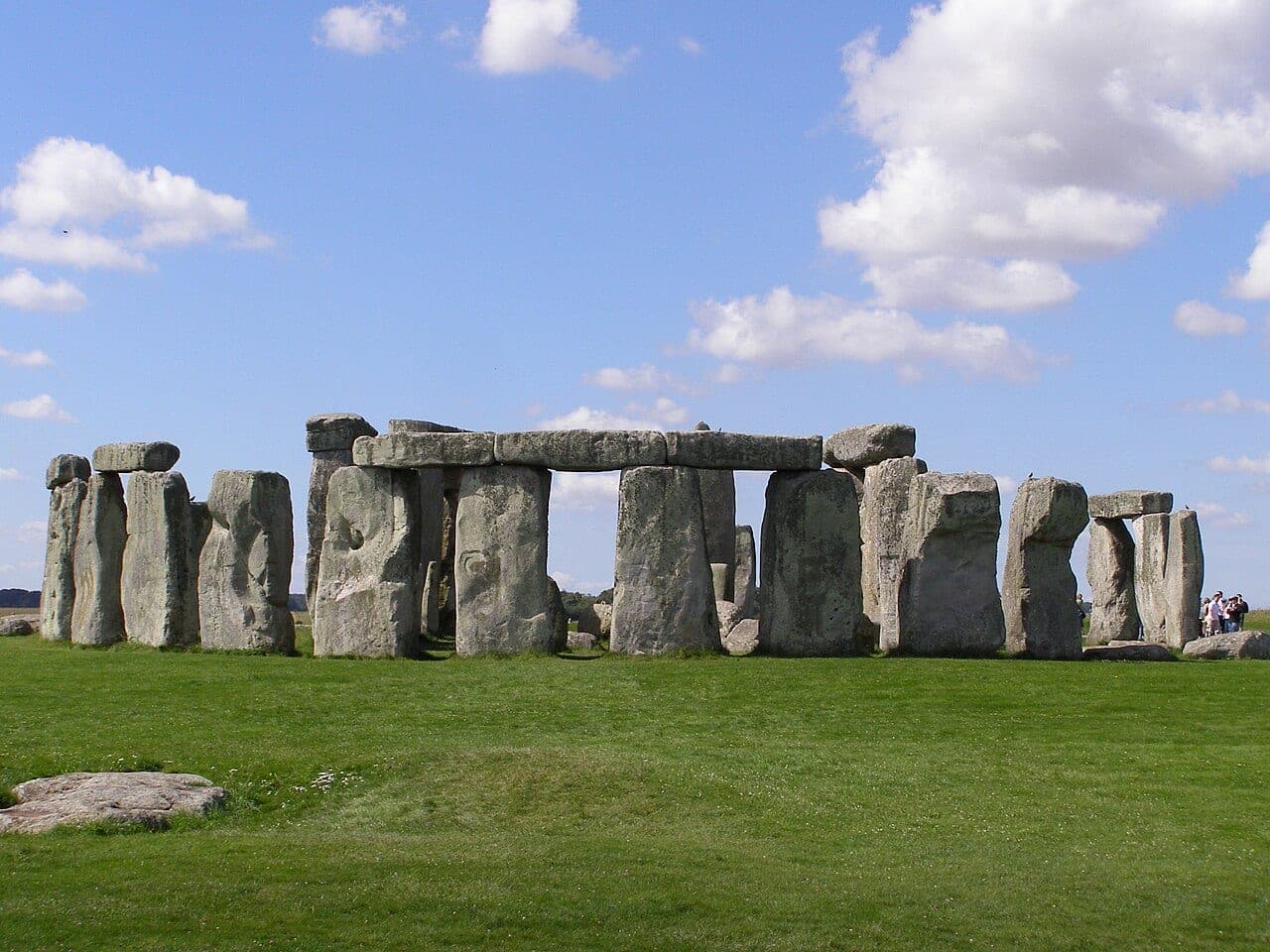
Stonehenge is a prehistoric monument on Salisbury Plain in Wiltshire, in southern England. At its centre is a ring of large standing stones, some capped by horizontal lintels, set within an earthwork bank and ditch and surrounded by a wider landscape of burial mounds and related features. It is the most architecturally sophisticated prehistoric stone circle known, and one of the most recognisable ancient structures anywhere.
The monument was built and rebuilt over roughly 1,500 years, beginning around 3000 BC in the Neolithic and continuing into the early Bronze Age. Its builders left no written record, so much of what visitors most want to know remains open. Archaeologists broadly agree that Stonehenge was a place of ceremony and burial aligned to the movements of the sun, but its precise purpose, whether temple, calendar, healing site, or something for which we have no modern word, is still debated (English Heritage).
What is not in doubt is the effort involved. Moving and shaping stones weighing up to around 30 tonnes, and carrying smaller stones from as far away as Wales, required organisation, skill, and shared belief on a scale that reshapes assumptions about Neolithic society. In 1986 UNESCO inscribed Stonehenge, together with the stone circles at Avebury and their surrounding monuments, as a World Heritage Site (UNESCO).
Construction unfolded in stages. Around 3000 BC, builders dug a circular ditch and bank about 100 metres across, with a ring of 56 pits known as the Aubrey Holes cut just inside the bank. During this early period the site served as a cremation cemetery, among the largest known in Neolithic Britain.
The stones came later. The smaller bluestones were raised, moved, and rearranged over several centuries. Around 2500 BC the great sarsen stones were brought to the site and set into the arrangement still visible today: an outer circle capped with lintels and an inner horseshoe of five trilithons. Activity continued into the early Bronze Age, with further rearrangement of the bluestones and the digging of the outer Y and Z Holes around 1600 BC, after which major building appears to have ceased (Wikipedia). Radiocarbon dating of antler tools and cremated remains underpins this sequence, though the exact figures are periodically revised as new evidence appears.
Stonehenge uses two main types of stone. The sarsens are hard silcrete sandstone boulders, the largest weighing around 25 to 30 tonnes; recent geochemical work traces most of them to West Woods, near Marlborough, roughly 25 kilometres to the north. The bluestones are smaller, weighing up to about 4 tonnes, and were brought from the Preseli Hills in Pembrokeshire, southwest Wales, some 240 kilometres (about 150 miles) away in a straight line. How they were transported, by land, by sea, or in part by earlier glacial movement, remains contested (Britannica).
 A trilithon: two uprights and a lintel, jointed with mortices and tenons borrowed from carpentry and cut into stone. Photograph by TobyEditor, CC BY 4.0, via Wikimedia Commons.
The builders used carpentry techniques in stone. Mortise-and-tenon joints lock the lintels onto the uprights, and tongue-and-groove joints link neighbouring lintels into a continuous curved ring. The monument is aligned on the solstices: its main axis frames sunrise on the longest day of the year and sunset on the shortest. On midsummer morning the sun rises over the horizon in the direction of the Avenue and the outlying Heel Stone, an alignment central to how the site is understood today.
For centuries Stonehenge has attracted explanation and myth. From the 17th century, antiquarians such as John Aubrey and William Stukeley linked it to the Druids. That association is popular but historically mistaken: the monument predates the Iron Age Druids by roughly two thousand years. Modern Druid and Pagan groups nonetheless gather there, especially at the solstices, and the site holds real spiritual meaning for many people.
Research continues to reshape the story. In 2024, analysis published in the journal Nature indicated that the Altar Stone, long assumed to be Welsh, most likely came from the Orcadian Basin in northeast Scotland, at least 700 kilometres away, which would be the longest known journey for any stone used in a British Neolithic monument (Nature). Findings like this show how much about Stonehenge is still being learned.
Stonehenge is cared for by English Heritage. A visitor centre stands at Airman's Corner, about 2.4 kilometres (1.5 miles) west of the stones, with a shuttle service running to the monument. A path circles the stone ring, but for conservation reasons visitors normally view the stones from a short distance rather than walking among them. Timed tickets are used and advance booking is strongly recommended. At the summer and winter solstices, English Heritage runs managed open access that allows people into the circle itself.
Several stones were straightened or re-erected during the 20th century, with concrete used to secure some of them in place. The most prominent recent controversy concerned the A303, a busy road that passes close to the site. A scheme to replace part of it with a road tunnel was intended to remove traffic from view, but critics argued it would cause irreversible harm to buried archaeology, and UNESCO warned the site could be added to its List of World Heritage in Danger. After legal challenges found the approval unlawful, the UK government cancelled the tunnel scheme in July 2024 (English Heritage). Balancing public access, traffic, and preservation across the wider landscape remains an ongoing challenge.
A trilithon: two uprights and a lintel, jointed with mortices and tenons borrowed from carpentry and cut into stone. Photograph by TobyEditor, CC BY 4.0, via Wikimedia Commons.
The builders used carpentry techniques in stone. Mortise-and-tenon joints lock the lintels onto the uprights, and tongue-and-groove joints link neighbouring lintels into a continuous curved ring. The monument is aligned on the solstices: its main axis frames sunrise on the longest day of the year and sunset on the shortest. On midsummer morning the sun rises over the horizon in the direction of the Avenue and the outlying Heel Stone, an alignment central to how the site is understood today.
For centuries Stonehenge has attracted explanation and myth. From the 17th century, antiquarians such as John Aubrey and William Stukeley linked it to the Druids. That association is popular but historically mistaken: the monument predates the Iron Age Druids by roughly two thousand years. Modern Druid and Pagan groups nonetheless gather there, especially at the solstices, and the site holds real spiritual meaning for many people.
Research continues to reshape the story. In 2024, analysis published in the journal Nature indicated that the Altar Stone, long assumed to be Welsh, most likely came from the Orcadian Basin in northeast Scotland, at least 700 kilometres away, which would be the longest known journey for any stone used in a British Neolithic monument (Nature). Findings like this show how much about Stonehenge is still being learned.
Stonehenge is cared for by English Heritage. A visitor centre stands at Airman's Corner, about 2.4 kilometres (1.5 miles) west of the stones, with a shuttle service running to the monument. A path circles the stone ring, but for conservation reasons visitors normally view the stones from a short distance rather than walking among them. Timed tickets are used and advance booking is strongly recommended. At the summer and winter solstices, English Heritage runs managed open access that allows people into the circle itself.
Several stones were straightened or re-erected during the 20th century, with concrete used to secure some of them in place. The most prominent recent controversy concerned the A303, a busy road that passes close to the site. A scheme to replace part of it with a road tunnel was intended to remove traffic from view, but critics argued it would cause irreversible harm to buried archaeology, and UNESCO warned the site could be added to its List of World Heritage in Danger. After legal challenges found the approval unlawful, the UK government cancelled the tunnel scheme in July 2024 (English Heritage). Balancing public access, traffic, and preservation across the wider landscape remains an ongoing challenge.
History
Design and construction