Heritage · Country
Cyprus Culture and Heritage
Cyprus gave copper its name and Aphrodite her legendary shore, and for nine thousand years it has layered Greek, Roman, Byzantine, Frankish, Venetian and Ottoman memory onto a single island. This guide follows that inheritance, from the Neolithic round houses of Choirokoitia and the mosaics of Paphos to the Orthodox and Muslim rites by which Cypriots remember their dead.Written to last.
By Confinity Heritage Editorial · Updated 2026-07-31 · 8-minute readQuiet tools, kept out of the way.
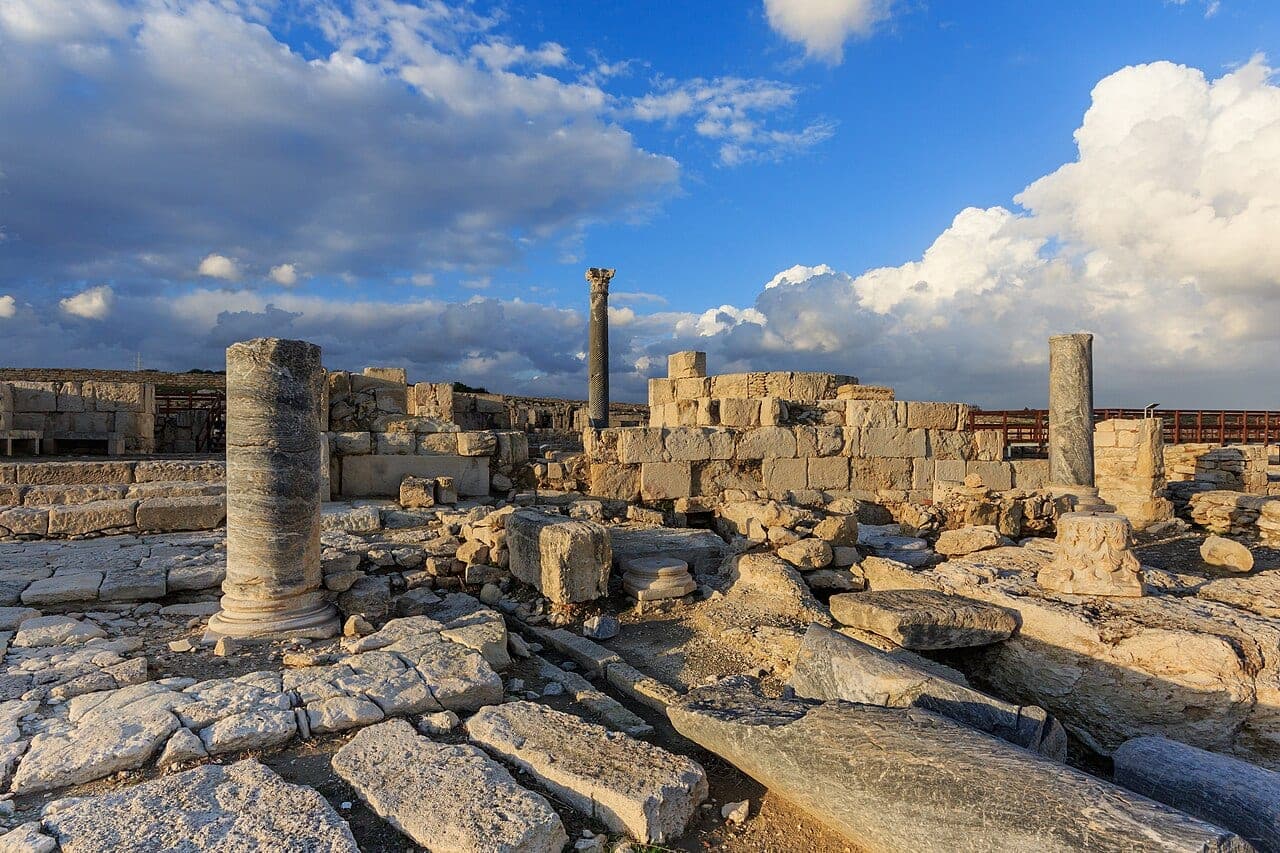
The island lent its name to a metal. When the miners of ancient Cyprus shipped their green ore across the eastern Mediterranean, the Romans called it aes Cyprium, the metal of Cyprus, and from that phrase came the Latin cuprum and, in time, the English word copper. The same coast was remembered as the birthplace of Aphrodite, the goddess said to have risen from the sea near the rock now called Petra tou Romiou, west of Paphos. Metal and myth together fixed Cyprus in the ancient mind, and its place between three continents drew Greeks, Phoenicians, Assyrians, Persians, Romans, Byzantines, Franks, Venetians, Ottomans and the British in turn, each leaving buildings, words and rites that later generations kept.
Cyprus today is home to two main communities, Greek Cypriot and Turkish Cypriot, whose Orthodox Christian and Muslim traditions of remembrance run side by side on a small island.
Cyprus is the third-largest island in the Mediterranean, covering roughly 9,250 square kilometres in the far east of that sea, south of Turkey and west of the Syrian and Lebanese coasts. Its spine is the Troodos massif, ancient oceanic rock whose ore made the island famous and whose highest point, Mount Olympus, reaches 1,952 metres; between it and the northern Kyrenia range lies the Mesaoria, the flat central plain on which the capital sits. Some 1.2 million people live on the island, the great majority Greek Cypriot and a substantial minority Turkish Cypriot, with smaller Maronite, Armenian and Latin communities of long standing.
The Republic of Cyprus joined the European Union in 2004 and adopted the euro in 2008. Since the events of 1974, the island has been divided by a United Nations buffer zone: the internationally recognised Republic governs the south and a Turkish Cypriot administration the north, while efforts toward a settlement continue.
Nicosia (Lefkosia, Lefkoşa). The capital lies inland on the Mesaoria plain within a near-perfect circle of star-shaped Venetian walls, built between 1567 and 1570. It is the last divided capital in Europe, split by the buffer zone, with pedestrian crossings such as Ledra Street now linking the two halves. Within the walls stand the Gothic former Cathedral of Saint Sophia, in use since 1571 as the Selimiye Mosque, and the Cyprus Museum, the island's chief archaeological collection.
Limassol (Lemesos). The main southern port and second city, set on Akrotiri Bay, is the centre of the wine country and the home of the island's largest carnival. Nearby rises Kolossi Castle, a stronghold of the crusading Knights whose surrounding estate, La Grande Commanderie, gave Commandaria wine its name.
Paphos (Pafos). On the southwest coast, Paphos was capital of the island under the Ptolemies and is inscribed whole on the UNESCO World Heritage List. Its archaeological park preserves the mosaic floors of Roman villas, the Houses of Dionysos, Theseus, Aion and Orpheus, alongside the rock-cut Tombs of the Kings. Paphos was a European Capital of Culture in 2017.
Famagusta (Ammochostos, Gazimağusa). On the east coast, Famagusta holds one of the finest walled medieval towns in the eastern Mediterranean, ringed by Venetian fortifications that include the so-called Othello Castle. Its Gothic Cathedral of Saint Nicholas has served since 1571 as the Lala Mustafa Pasha Mosque. Close by lie the ruins of ancient Salamis, the island's chief city in antiquity.
Kyrenia (Keryneia, Girne). On the northern coast beneath the mountains, Kyrenia is built around a horseshoe harbour guarded by a castle of Byzantine origin. Within it, the Shipwreck Museum displays the Kyrenia ship, a Greek merchant vessel that sank around 300 BC and is the oldest recovered Greek ship, raised from the seabed with much of its hull intact.
Human settlement on Cyprus reaches back roughly nine thousand years. The Neolithic village of Choirokoitia, occupied from the seventh to the fourth millennium BC, preserves the round stone houses of one of the best-known prehistoric communities in the region. In the Bronze Age the island's copper made it a hub of Mediterranean trade, and from the twelfth and eleventh centuries BC Mycenaean Greeks settled and founded city-kingdoms, among them Salamis, Kourion and Paphos, that carried Greek speech and worship onto the island. Phoenicians founded Kition at modern Larnaca, while Assyrian, Egyptian and Persian overlords in turn took tribute from the Cypriot kings.
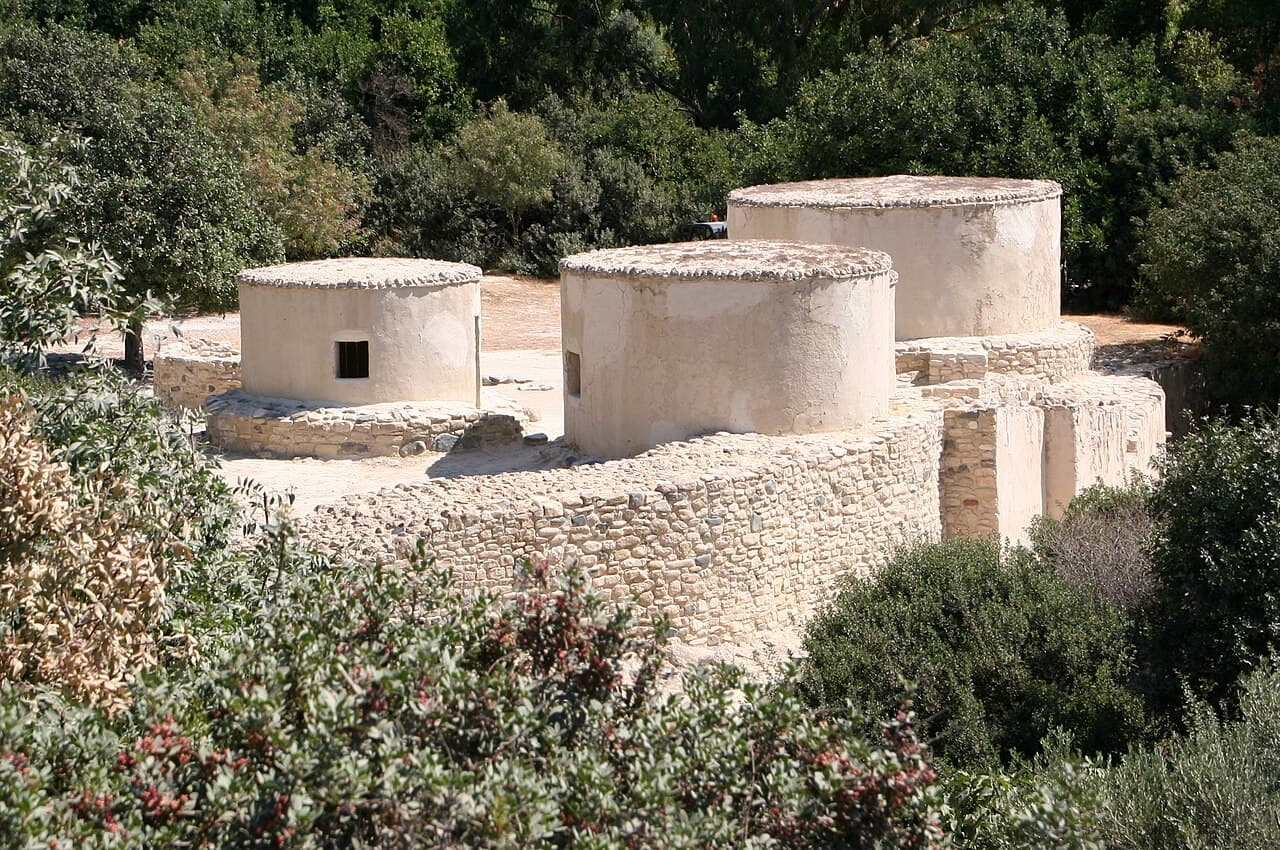 Choirokoitia was occupied from about 7000 BC, and its people buried their dead under the floors of the houses they went on living in. Photograph by Ophelia2, CC BY-SA 3.0, via Wikimedia Commons.
After Alexander the Great, Cyprus fell to the Ptolemies of Egypt, who made Paphos their capital, and in 58 BC it passed to Rome. It was in this Roman province that Christianity took early root: around 45 AD the apostles Paul and Barnabas, with John Mark, landed at Salamis and travelled to Paphos, where the proconsul Sergius Paulus embraced the faith, an episode recorded in the Acts of the Apostles. Barnabas, a native of Salamis, is honoured as the founder of the Church of Cyprus and was martyred on the island around 75 AD. Byzantine rule followed the division of the Roman world, and the discovery of Barnabas's tomb helped the Church of Cyprus secure its independence in 488 AD.
Richard the Lionheart seized the island during the Third Crusade in 1191 and soon sold it on, and from 1192 the French Lusignan dynasty ruled a Latin kingdom for three centuries (1192–1489). The Venetians took control in 1489 and fortified the towns before the Ottomans conquered the island in 1571, opening more than three centuries of Ottoman rule (1571–1878) during which the Orthodox Church retained the role of guardian of Greek Cypriot identity and a settled Muslim population became rooted in the land. Britain assumed administration in 1878, annexed the island in 1914 and governed it as a Crown Colony until independence in 1960. In July 1974 a coup by the Greek Cypriot National Guard, backed by the military government then ruling Greece, was followed within days by Turkish military intervention; a ceasefire that August left the island divided along a line patrolled since by the United Nations, a situation that endures while a negotiated settlement is sought.
Cyprus has two official languages, Greek and Turkish, reflecting its two main communities. Everyday speech takes the form of two distinctive vernaculars, Cypriot Greek and Cypriot Turkish, each carrying loanwords absorbed across centuries of shared life. Greek has been spoken on the island since the Bronze Age, and before the alphabet Cypriot Greek was written in a local syllabary, one of the last uses of syllabic writing in the Greek world.
The name of the island and the name of the metal are bound together. Cyprus exported copper so widely that the Romans called the metal aes Cyprium, the ore of Cyprus, later shortened to cuprum, from which English copper descends. The origin of the Greek name Kypros itself is uncertain, variously linked to the copper trade, to the cypress tree and to a fragrant shrub, but its long association with the metal is secure. The Turkish name Kıbrıs and the English Cyprus both descend from the same ancient root.
The best-known Cypriot craft is the needlework of Lefkara, a hill village whose women have produced Lefkara lace, or Lefkaritika, since at least the fourteenth century, blending local embroidery with patterns absorbed under Venetian rule. The tradition was inscribed on UNESCO's list of intangible cultural heritage in 2009, and the same village is known for hand-worked silver. Village pottery survives at places such as Kornos and Phini, and folk music, played on violin and laouto, accompanies the improvised sung poetry of tsiattista, a duel of rhyming couplets recognised by UNESCO in 2011.
The Cypriot table is shared across the divide. Its emblem is halloumi, a semi-hard cheese made for centuries from sheep's and goat's milk, folded with mint and set in brine so that it holds its shape over a grill; in 2021 it received Protected Designation of Origin status, reserving the name to cheese made on the island. Meals run to long spreads of meze, grilled souvla, stuffed vine leaves and pulses, and to the sweet, dark Commandaria, held to be the oldest named wine still in production, its name taken from the crusader commandery near Limassol. The pomace spirit zivania rounds out the island's drinking traditions.
Religion on Cyprus follows its two communities. The Church of Cyprus is one of the oldest autocephalous Orthodox churches, self-governing since 488 AD, and its bishops long spoke for the Greek Cypriots in matters far beyond the spiritual. Its monasteries, above all Kykkos in the Troodos, remain centres of pilgrimage, and the icon corner with its burning lamp is a fixture of Greek Cypriot homes.
Choirokoitia was occupied from about 7000 BC, and its people buried their dead under the floors of the houses they went on living in. Photograph by Ophelia2, CC BY-SA 3.0, via Wikimedia Commons.
After Alexander the Great, Cyprus fell to the Ptolemies of Egypt, who made Paphos their capital, and in 58 BC it passed to Rome. It was in this Roman province that Christianity took early root: around 45 AD the apostles Paul and Barnabas, with John Mark, landed at Salamis and travelled to Paphos, where the proconsul Sergius Paulus embraced the faith, an episode recorded in the Acts of the Apostles. Barnabas, a native of Salamis, is honoured as the founder of the Church of Cyprus and was martyred on the island around 75 AD. Byzantine rule followed the division of the Roman world, and the discovery of Barnabas's tomb helped the Church of Cyprus secure its independence in 488 AD.
Richard the Lionheart seized the island during the Third Crusade in 1191 and soon sold it on, and from 1192 the French Lusignan dynasty ruled a Latin kingdom for three centuries (1192–1489). The Venetians took control in 1489 and fortified the towns before the Ottomans conquered the island in 1571, opening more than three centuries of Ottoman rule (1571–1878) during which the Orthodox Church retained the role of guardian of Greek Cypriot identity and a settled Muslim population became rooted in the land. Britain assumed administration in 1878, annexed the island in 1914 and governed it as a Crown Colony until independence in 1960. In July 1974 a coup by the Greek Cypriot National Guard, backed by the military government then ruling Greece, was followed within days by Turkish military intervention; a ceasefire that August left the island divided along a line patrolled since by the United Nations, a situation that endures while a negotiated settlement is sought.
Cyprus has two official languages, Greek and Turkish, reflecting its two main communities. Everyday speech takes the form of two distinctive vernaculars, Cypriot Greek and Cypriot Turkish, each carrying loanwords absorbed across centuries of shared life. Greek has been spoken on the island since the Bronze Age, and before the alphabet Cypriot Greek was written in a local syllabary, one of the last uses of syllabic writing in the Greek world.
The name of the island and the name of the metal are bound together. Cyprus exported copper so widely that the Romans called the metal aes Cyprium, the ore of Cyprus, later shortened to cuprum, from which English copper descends. The origin of the Greek name Kypros itself is uncertain, variously linked to the copper trade, to the cypress tree and to a fragrant shrub, but its long association with the metal is secure. The Turkish name Kıbrıs and the English Cyprus both descend from the same ancient root.
The best-known Cypriot craft is the needlework of Lefkara, a hill village whose women have produced Lefkara lace, or Lefkaritika, since at least the fourteenth century, blending local embroidery with patterns absorbed under Venetian rule. The tradition was inscribed on UNESCO's list of intangible cultural heritage in 2009, and the same village is known for hand-worked silver. Village pottery survives at places such as Kornos and Phini, and folk music, played on violin and laouto, accompanies the improvised sung poetry of tsiattista, a duel of rhyming couplets recognised by UNESCO in 2011.
The Cypriot table is shared across the divide. Its emblem is halloumi, a semi-hard cheese made for centuries from sheep's and goat's milk, folded with mint and set in brine so that it holds its shape over a grill; in 2021 it received Protected Designation of Origin status, reserving the name to cheese made on the island. Meals run to long spreads of meze, grilled souvla, stuffed vine leaves and pulses, and to the sweet, dark Commandaria, held to be the oldest named wine still in production, its name taken from the crusader commandery near Limassol. The pomace spirit zivania rounds out the island's drinking traditions.
Religion on Cyprus follows its two communities. The Church of Cyprus is one of the oldest autocephalous Orthodox churches, self-governing since 488 AD, and its bishops long spoke for the Greek Cypriots in matters far beyond the spiritual. Its monasteries, above all Kykkos in the Troodos, remain centres of pilgrimage, and the icon corner with its burning lamp is a fixture of Greek Cypriot homes.
 The painted churches of the Troodos look like barns from outside, which is roughly why their frescoes survived four centuries of Ottoman rule. Photograph by Xenophon, CC BY-SA 3.0, via Wikimedia Commons.
Turkish Cypriots are predominantly Sunni Muslim, with a historic thread of Sufi and Bektashi devotion. The island holds one of the most revered Islamic sites in the eastern Mediterranean, the Hala Sultan Tekke on the shore of the Larnaca salt lake, built around the tomb of Umm Haram of the Prophet's household. Alongside these two majorities live Maronite Christians, Armenian Apostolic Christians and Latin Catholics, small communities whose churches and feasts add further strands to the island's religious life.
Greek Orthodox mourning on Cyprus follows the wider Orthodox pattern. Burial usually takes place within a day or two; the body lies in an open coffin facing east, and mourners take their leave with a last kiss. What follows is a structured calendar of memorial services, the mnimosyna, held on or near the third day after death, the ninth, and above all the fortieth, then at three, six and nine months and at each anniversary. At every service a dish of kollyva, boiled wheat sweetened with sugar and studded with pomegranate seeds, almonds and raisins, is blessed and shared among all present, the grain standing for resurrection. Widows traditionally wear black for a long period, graves are visited and tended weekly, and twice a year, on the Soul Saturdays before Lent and Pentecost, whole parishes commemorate their dead together.
Turkish Cypriot Muslim custom asks that the dead be buried quickly, often within a day, after the body is washed and wrapped in a plain white shroud. The community gathers at the family home, and before the coffin is carried out those present are asked to forgive the deceased any wrong, answering with the phrase helal olsun. Men shoulder the coffin in procession to the cemetery, where the grave is oriented toward Mecca, and the hoca leads the prayers. Condolences are received at the family home for several days, with helva and soup shared among visitors, and a mevlit, a devotional reading, is commonly held on the fortieth day and at the anniversary. Since crossing points along the buffer zone opened in 2003, many Cypriots of both communities have returned to ancestral villages on the other side to tend family graves and the churches and mosques left behind, so that remembrance now reaches across the line that divides the island.
Cyprus has one archive that both of its communities built together, and it exists because of the thing that divided them.
The Committee on Missing Persons was set up under United Nations auspices to find and identify people who disappeared in the intercommunal violence of the 1960s and the events of 1974, Greek Cypriots and Turkish Cypriots alike. Bicommunal teams of archaeologists and anthropologists excavate sites, and a genetics laboratory matches remains to relatives who have given blood. Well over a thousand people have been identified and returned to their families for burial, and each identification is a document produced jointly by two administrations that do not otherwise recognise each other.
The ordinary records are older and split. Ottoman rule from 1571 produced sharia court registers and tax registers; the Orthodox Church kept its own community's records under the millet system, and monastery archives hold a good deal. British administration from 1878 introduced systematic civil registration and a well-kept land register, and those series are in Nicosia.
1974 is the break. Records from the north were left behind or moved, families were displaced in both directions, and property records became the evidence in decades of legal claims. A Greek Cypriot family from Famagusta and a Turkish Cypriot family from Paphos both have a documentary life that stops in one place and starts again in another, and the land register is the thing that still connects the two halves.
Cyprus has protected its monuments through a Department of Antiquities since 1935, and three of its sites carry UNESCO World Heritage status. The archaeological ensemble of Paphos was inscribed in 1980 for its Roman mosaics and its role as the ancient island capital. The Painted Churches in the Troodos Region, a group of ten small mountain churches and monasteries whose interiors are covered with Byzantine and post-Byzantine frescoes spanning the eleventh to the early sixteenth centuries, were listed in 1985 and extended in 2001; their steep wooden roofs, built to shed mountain snow, shelter some of the finest medieval wall painting in the Greek world. Choirokoitia was added in 1998 for the light it throws on Neolithic life.
A distinctive strand of preservation crosses the political divide. The bicommunal Technical Committee on Cultural Heritage, established in 2008 and supported by the European Union and the United Nations Development Programme, brings together Greek Cypriot and Turkish Cypriot experts to conserve the island's shared inheritance. Since 2012 it has restored well over one hundred sites across both communities, among them Orthodox, Maronite and Armenian churches, mosques and minarets, fortifications, hamams and aqueducts, treating the heritage of each community as the concern of both.
The Cyprus Institute has made the island a centre for the digital documentation of heritage. Its Science and Technology in Archaeology and Culture Research Center records monuments and artefacts in high-resolution three dimensions, holding collections from sites such as Salamis and the sanctuary of Ayia Irini that, through European projects including 3D-ICONS, have been shared with Europeana, the European digital library.
Digitisation also serves reconciliation. The Technical Committee on Cultural Heritage has laser-scanned threatened churches and mosques on both sides of the buffer zone, building a record that survives even where the buildings do not, so that a divided island with a scattered diaspora can keep its shared places in common memory.
Modern Cypriot culture reaches well beyond the island. Halloumi has become one of the most widely exported grilling cheeses in the world, carrying the island's name far from the Mediterranean, while small producers revive Commandaria and old Cypriot grape varieties. Paphos as European Capital of Culture in 2017 drew international attention to the island's heritage, and the cultural life of Nicosia and Limassol has grown with the Republic's place in the European Union.
The diaspora is a second Cyprus, its parishes, schools and village associations in London, Melbourne and beyond keeping language and custom in daily use, and Cypriots have made their mark abroad from fashion, in the Turkish Cypriot-born designer Hussein Chalayan, to music and academia. Within the buffer zone itself, shared spaces such as the Home for Cooperation bring the two communities together around their common past.
Halloumi wins protected status. In 2021 the island's signature cheese received Protected Designation of Origin recognition, so that only cheese made on Cyprus to the traditional method may carry the name, safeguarding a product common to both communities.
A shared committee restores shared heritage. The bicommunal Technical Committee on Cultural Heritage, with European Union and United Nations support, has conserved more than a hundred monuments across the divide since 2012, from Orthodox chapels to Ottoman mosques, making preservation a point of contact rather than division.
The Kyrenia ship raised and rebuilt. A Greek merchant vessel that sank around 300 BC, located off Kyrenia in the 1960s and excavated between 1967 and 1969, is displayed in Kyrenia Castle as the oldest recovered Greek ship, its conserved hull rebuilt from the seabed timbers.
Lefkara lace kept alive. The inscription of Lefkara lace on UNESCO's intangible heritage list in 2009 has helped sustain a living craft, still practised by the women of the village and taught to a younger generation.
The painted churches of the Troodos look like barns from outside, which is roughly why their frescoes survived four centuries of Ottoman rule. Photograph by Xenophon, CC BY-SA 3.0, via Wikimedia Commons.
Turkish Cypriots are predominantly Sunni Muslim, with a historic thread of Sufi and Bektashi devotion. The island holds one of the most revered Islamic sites in the eastern Mediterranean, the Hala Sultan Tekke on the shore of the Larnaca salt lake, built around the tomb of Umm Haram of the Prophet's household. Alongside these two majorities live Maronite Christians, Armenian Apostolic Christians and Latin Catholics, small communities whose churches and feasts add further strands to the island's religious life.
Greek Orthodox mourning on Cyprus follows the wider Orthodox pattern. Burial usually takes place within a day or two; the body lies in an open coffin facing east, and mourners take their leave with a last kiss. What follows is a structured calendar of memorial services, the mnimosyna, held on or near the third day after death, the ninth, and above all the fortieth, then at three, six and nine months and at each anniversary. At every service a dish of kollyva, boiled wheat sweetened with sugar and studded with pomegranate seeds, almonds and raisins, is blessed and shared among all present, the grain standing for resurrection. Widows traditionally wear black for a long period, graves are visited and tended weekly, and twice a year, on the Soul Saturdays before Lent and Pentecost, whole parishes commemorate their dead together.
Turkish Cypriot Muslim custom asks that the dead be buried quickly, often within a day, after the body is washed and wrapped in a plain white shroud. The community gathers at the family home, and before the coffin is carried out those present are asked to forgive the deceased any wrong, answering with the phrase helal olsun. Men shoulder the coffin in procession to the cemetery, where the grave is oriented toward Mecca, and the hoca leads the prayers. Condolences are received at the family home for several days, with helva and soup shared among visitors, and a mevlit, a devotional reading, is commonly held on the fortieth day and at the anniversary. Since crossing points along the buffer zone opened in 2003, many Cypriots of both communities have returned to ancestral villages on the other side to tend family graves and the churches and mosques left behind, so that remembrance now reaches across the line that divides the island.
Cyprus has one archive that both of its communities built together, and it exists because of the thing that divided them.
The Committee on Missing Persons was set up under United Nations auspices to find and identify people who disappeared in the intercommunal violence of the 1960s and the events of 1974, Greek Cypriots and Turkish Cypriots alike. Bicommunal teams of archaeologists and anthropologists excavate sites, and a genetics laboratory matches remains to relatives who have given blood. Well over a thousand people have been identified and returned to their families for burial, and each identification is a document produced jointly by two administrations that do not otherwise recognise each other.
The ordinary records are older and split. Ottoman rule from 1571 produced sharia court registers and tax registers; the Orthodox Church kept its own community's records under the millet system, and monastery archives hold a good deal. British administration from 1878 introduced systematic civil registration and a well-kept land register, and those series are in Nicosia.
1974 is the break. Records from the north were left behind or moved, families were displaced in both directions, and property records became the evidence in decades of legal claims. A Greek Cypriot family from Famagusta and a Turkish Cypriot family from Paphos both have a documentary life that stops in one place and starts again in another, and the land register is the thing that still connects the two halves.
Cyprus has protected its monuments through a Department of Antiquities since 1935, and three of its sites carry UNESCO World Heritage status. The archaeological ensemble of Paphos was inscribed in 1980 for its Roman mosaics and its role as the ancient island capital. The Painted Churches in the Troodos Region, a group of ten small mountain churches and monasteries whose interiors are covered with Byzantine and post-Byzantine frescoes spanning the eleventh to the early sixteenth centuries, were listed in 1985 and extended in 2001; their steep wooden roofs, built to shed mountain snow, shelter some of the finest medieval wall painting in the Greek world. Choirokoitia was added in 1998 for the light it throws on Neolithic life.
A distinctive strand of preservation crosses the political divide. The bicommunal Technical Committee on Cultural Heritage, established in 2008 and supported by the European Union and the United Nations Development Programme, brings together Greek Cypriot and Turkish Cypriot experts to conserve the island's shared inheritance. Since 2012 it has restored well over one hundred sites across both communities, among them Orthodox, Maronite and Armenian churches, mosques and minarets, fortifications, hamams and aqueducts, treating the heritage of each community as the concern of both.
The Cyprus Institute has made the island a centre for the digital documentation of heritage. Its Science and Technology in Archaeology and Culture Research Center records monuments and artefacts in high-resolution three dimensions, holding collections from sites such as Salamis and the sanctuary of Ayia Irini that, through European projects including 3D-ICONS, have been shared with Europeana, the European digital library.
Digitisation also serves reconciliation. The Technical Committee on Cultural Heritage has laser-scanned threatened churches and mosques on both sides of the buffer zone, building a record that survives even where the buildings do not, so that a divided island with a scattered diaspora can keep its shared places in common memory.
Modern Cypriot culture reaches well beyond the island. Halloumi has become one of the most widely exported grilling cheeses in the world, carrying the island's name far from the Mediterranean, while small producers revive Commandaria and old Cypriot grape varieties. Paphos as European Capital of Culture in 2017 drew international attention to the island's heritage, and the cultural life of Nicosia and Limassol has grown with the Republic's place in the European Union.
The diaspora is a second Cyprus, its parishes, schools and village associations in London, Melbourne and beyond keeping language and custom in daily use, and Cypriots have made their mark abroad from fashion, in the Turkish Cypriot-born designer Hussein Chalayan, to music and academia. Within the buffer zone itself, shared spaces such as the Home for Cooperation bring the two communities together around their common past.
Halloumi wins protected status. In 2021 the island's signature cheese received Protected Designation of Origin recognition, so that only cheese made on Cyprus to the traditional method may carry the name, safeguarding a product common to both communities.
A shared committee restores shared heritage. The bicommunal Technical Committee on Cultural Heritage, with European Union and United Nations support, has conserved more than a hundred monuments across the divide since 2012, from Orthodox chapels to Ottoman mosques, making preservation a point of contact rather than division.
The Kyrenia ship raised and rebuilt. A Greek merchant vessel that sank around 300 BC, located off Kyrenia in the 1960s and excavated between 1967 and 1969, is displayed in Kyrenia Castle as the oldest recovered Greek ship, its conserved hull rebuilt from the seabed timbers.
Lefkara lace kept alive. The inscription of Lefkara lace on UNESCO's intangible heritage list in 2009 has helped sustain a living craft, still practised by the women of the village and taught to a younger generation.
National Overview
Notable Cities
Historical Foundations
Linguistic and Etymological Roots
Cultural Identity
Religion and Spirituality
Remembrance and Mourning Traditions
Tracing a Family in Cyprus
Heritage Preservation Efforts
Digital Heritage
Contemporary Cultural Influences
Success Stories
References and resources
- UNESCO World Heritage Centre. Cyprus.
- UNESCO World Heritage Centre. Paphos. Archaeological park and Roman mosaics, inscribed 1980.
- UNESCO World Heritage Centre. Painted Churches in the Troodos Region. Ten frescoed churches, inscribed 1985, extended 2001.
- UNESCO World Heritage Centre. Choirokoitia. The Neolithic settlement, inscribed 1998.
- UNESCO Intangible Cultural Heritage. Lefkara Laces or Lefkaritika. The lace tradition, inscribed 2009.
- Encyclopaedia Britannica. Cyprus.
- United Nations Development Programme. Support to Cultural Heritage in Cyprus. The bicommunal Technical Committee on Cultural Heritage.
- The Cyprus Institute. Digital Cultural Heritage.