Heritage · Landmark
Persepolis: History, Ruins and Visitor Guide
Persepolis, ceremonial capital of the Achaemenid Persian Empire in Fars Province, Iran, founded c. 518 BC and burned by Alexander in 330 BC.Written to last.
By Confinity Heritage Editorial · Updated 2026-07-31 · 7-minute readQuiet tools, kept out of the way.
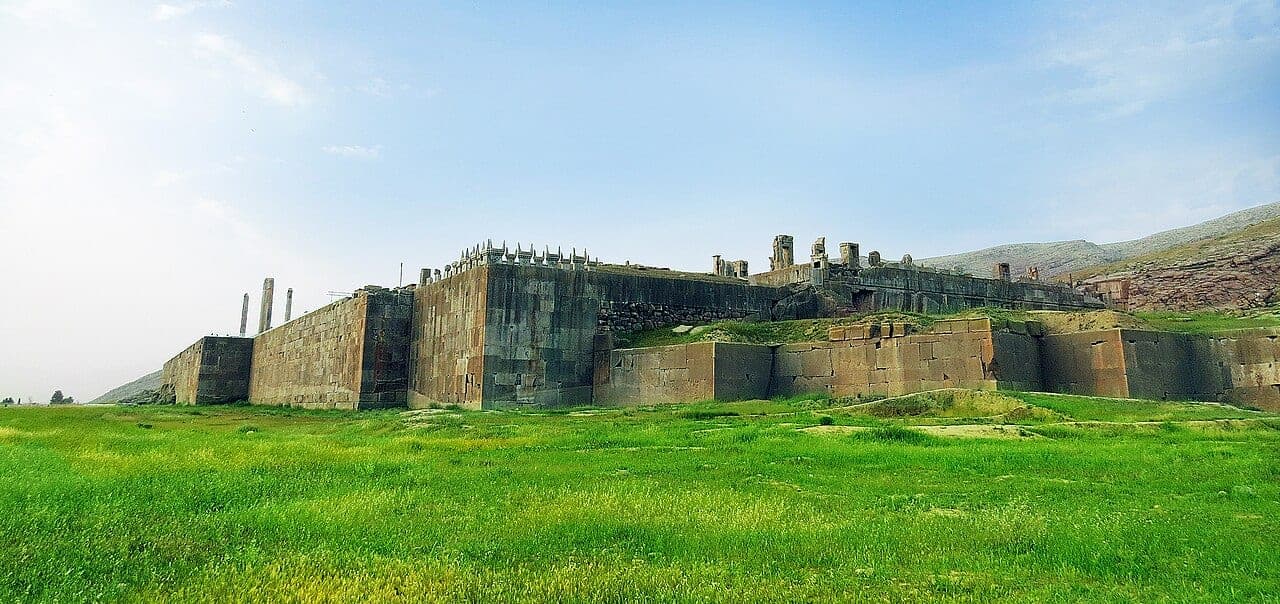
Persepolis was the ceremonial capital of the Achaemenid Persian Empire, raised on a vast stone terrace at the foot of the Kuh-e Rahmat, the Mountain of Mercy, in what is now Fars Province in southwestern Iran. The Greeks called it Persepolis, "city of the Persians," while later Iranians knew the ruins as Takht-e Jamshid, the Throne of Jamshid, after a legendary king. For roughly two centuries it served the kings of the Achaemenid dynasty as a stage for imperial ritual rather than as an everyday city, and its half-ruined columns and carved staircases remain among the most complete records of Persian power at its height.
The site was never truly lost. Its columns stood above the plain of Marvdasht for more than two thousand years, and it has been studied, drawn, and excavated by travellers and archaeologists since the seventeenth century. What survives is a platform of palaces, gateways, and reliefs that together show how the Achaemenids wished to be seen: as the rulers of many peoples, gathered in peaceful procession before a single king.
Persepolis was founded around 518 BC by Darius I, often called Darius the Great, who chose the site as a new dynastic and ceremonial centre distinct from the older Persian capitals at Pasargadae and Susa. Darius ordered the building of the great terrace and began its first palaces, including the audience hall known as the Apadana and the treasury. The work outlasted him by generations. His son Xerxes I added the monumental Gate of All Nations, the Throne Hall, and his own palace, and Artaxerxes I and later kings continued to build and extend the complex through the fifth and fourth centuries BC.
The city's purpose was largely ceremonial. Scholars associate it above all with Nowruz, the Persian New Year at the spring equinox, when delegations from across the empire are thought to have come to present gifts and tribute to the king. The carved processions on the Apadana staircase are often read as an image of that gathering, a ritual affirmation of loyalty from Persia's many subject nations.
That role ended abruptly. In 330 BC, during the reign of Darius III, Alexander the Great captured Persepolis, seized its enormous treasury, and burned its palaces. Ancient writers disagree on why. Some accounts present the fire as a calculated act of revenge for the Persian sack of Athens in 480 BC. Others, following the historian Diodorus, describe it as an impulsive act sparked during a drunken feast, urged on by the Athenian courtesan Thaïs. The two explanations have never been fully reconciled, and the layer of ash and charred cedar found by excavators confirms only that the destruction was real and deliberate, whatever the immediate motive.
Everything at Persepolis rests on a single artificial terrace, roughly 450 by 300 metres and up to about 18 metres high, cut partly from the living rock and partly built up with stone blocks fitted without mortar. A monumental double staircase, its steps shallow enough for horses and dignitaries to ascend with ease, leads up to the platform.
 The Apadana staircase carries delegations from twenty-three subject peoples, each in its own dress and bringing its own tribute, which is where much of what is known about Achaemenid provincial costume comes from. Photograph by Adam Jones, CC BY-SA 2.0, via Wikimedia Commons.
At the head of the stair stood the Gate of All Nations, built by Xerxes and guarded by colossal human-headed winged bulls in the Assyrian manner. Beyond it lay the Apadana, the great audience hall begun by Darius, whose roof was once carried by seventy-two slender stone columns, some more than twenty metres tall; today thirteen still stand. The northern and eastern staircases of the Apadana carry the most celebrated reliefs on the site: long files of tribute-bearers, some twenty-three delegations of Medes, Elamites, Babylonians, Egyptians, Indians, and others, each in distinctive dress and each bringing gifts appropriate to its land. Nearby stood the Throne Hall, also called the Hall of a Hundred Columns, and the residential palaces of Darius and Xerxes. The carving throughout favours order and repetition over violence; the reliefs show cooperation and homage rather than conquest, an idealised portrait of an empire held together by consent.
For Iran, Persepolis has long served as a symbol of ancient statehood and continuity, a physical link to the first Persian empire and the reigns of Cyrus, Darius, and Xerxes. That symbolism has been claimed by successive eras. In October 1971 the ruins were the setting for the 2,500th-anniversary celebrations of the founding of the Persian Empire, staged by Shah Mohammad Reza Pahlavi. Heads of state were received in a purpose-built tent city beside the ancient terrace in a display of lavish pageantry that drew both international attention and domestic criticism for its cost. The site remains a focus of national identity and a place of pilgrimage for visitors seeking the roots of Iranian civilisation.
Persepolis lies near the town of Marvdasht, about 60 kilometres northeast of Shiraz, the nearest major city and the usual base for travellers. Shiraz has an international airport and good road connections, and the site is reached by car or organised tour in roughly an hour. Many visitors combine it with the nearby royal rock tombs of Naqsh-e Rostam and the earlier Achaemenid capital at Pasargadae, the burial place of Cyrus the Great. The exposed terrace offers little shade, so early morning and late afternoon are the most comfortable and best-lit times to walk the ruins.
As one of Iran's most important ancient sites, Persepolis was inscribed on the UNESCO World Heritage List in 1979. Its stone reliefs face slow decay from wind, temperature swings, salt, lichen, and rainfall, and conservators have worked for decades to stabilise the carvings and control the effects of weathering and visitor pressure. Air pollution and the growth of surrounding development add further concern for the wider setting. Ongoing documentation, cleaning, and structural monitoring aim to preserve both the standing architecture and the fragile surface detail of the tribute reliefs for future study.
The Apadana staircase carries delegations from twenty-three subject peoples, each in its own dress and bringing its own tribute, which is where much of what is known about Achaemenid provincial costume comes from. Photograph by Adam Jones, CC BY-SA 2.0, via Wikimedia Commons.
At the head of the stair stood the Gate of All Nations, built by Xerxes and guarded by colossal human-headed winged bulls in the Assyrian manner. Beyond it lay the Apadana, the great audience hall begun by Darius, whose roof was once carried by seventy-two slender stone columns, some more than twenty metres tall; today thirteen still stand. The northern and eastern staircases of the Apadana carry the most celebrated reliefs on the site: long files of tribute-bearers, some twenty-three delegations of Medes, Elamites, Babylonians, Egyptians, Indians, and others, each in distinctive dress and each bringing gifts appropriate to its land. Nearby stood the Throne Hall, also called the Hall of a Hundred Columns, and the residential palaces of Darius and Xerxes. The carving throughout favours order and repetition over violence; the reliefs show cooperation and homage rather than conquest, an idealised portrait of an empire held together by consent.
For Iran, Persepolis has long served as a symbol of ancient statehood and continuity, a physical link to the first Persian empire and the reigns of Cyrus, Darius, and Xerxes. That symbolism has been claimed by successive eras. In October 1971 the ruins were the setting for the 2,500th-anniversary celebrations of the founding of the Persian Empire, staged by Shah Mohammad Reza Pahlavi. Heads of state were received in a purpose-built tent city beside the ancient terrace in a display of lavish pageantry that drew both international attention and domestic criticism for its cost. The site remains a focus of national identity and a place of pilgrimage for visitors seeking the roots of Iranian civilisation.
Persepolis lies near the town of Marvdasht, about 60 kilometres northeast of Shiraz, the nearest major city and the usual base for travellers. Shiraz has an international airport and good road connections, and the site is reached by car or organised tour in roughly an hour. Many visitors combine it with the nearby royal rock tombs of Naqsh-e Rostam and the earlier Achaemenid capital at Pasargadae, the burial place of Cyrus the Great. The exposed terrace offers little shade, so early morning and late afternoon are the most comfortable and best-lit times to walk the ruins.
As one of Iran's most important ancient sites, Persepolis was inscribed on the UNESCO World Heritage List in 1979. Its stone reliefs face slow decay from wind, temperature swings, salt, lichen, and rainfall, and conservators have worked for decades to stabilise the carvings and control the effects of weathering and visitor pressure. Air pollution and the growth of surrounding development add further concern for the wider setting. Ongoing documentation, cleaning, and structural monitoring aim to preserve both the standing architecture and the fragile surface detail of the tribute reliefs for future study.
History
Architecture and reliefs
Cultural role
Visiting
Preservation
References and resources
- UNESCO World Heritage Centre: Persepolis: inscription details, criteria, and site boundaries for the 1979 listing.
- Encyclopaedia Britannica: Persepolis: overview of the site's founding, architecture, and destruction.
- Wikipedia: Persepolis: detailed history, building programme, reliefs, and modern celebrations with sources.