Heritage · Country
Pakistan Culture and Heritage
From the brick streets of Mohenjo-daro, laid out five thousand years ago, to the qawwali sung at Sufi shrines each night, Pakistan holds some of the oldest and most layered memory in South Asia. A guide to the country's heritage, its Islamic and Sufi traditions of mourning, and how a nation born in the migrations of 1947 keeps faith with its past.Written to last.
By Confinity Heritage Editorial · Updated 2026-07-31 · 8-minute readQuiet tools, kept out of the way.
Few countries rest on so deep a floor of memory. Beside the Indus in Sindh lie the brick streets of Mohenjo-daro, a city of the Indus Valley Civilization laid out on a grid around 2500 BCE, with covered drains, a great public bath and granaries built before much of the world had learned to write (UNESCO World Heritage list). Northward, at Taxila and Takht-i-Bahi, the Buddhist kingdoms of Gandhara left monasteries and a school of sculpture that carried the first human image of the Buddha across Asia. In Lahore the Mughals raised the Badshahi Mosque, the Wazir Khan Mosque and the Shalimar Gardens, so that a single day's travel can pass through five thousand years of building.
Pakistan is also a country founded in departure. When British India was partitioned in August 1947, roughly fourteen million people crossed the new border, in one of the largest migrations in modern history, and estimates of the dead run from several hundred thousand into the millions (Encyclopaedia Britannica). That founding sorrow sits beside a living culture of remembrance: the nightly qawwali at Sufi shrines, the annual urs that draw crowds in the hundreds of thousands, and the Islamic funeral rites that return the dead quickly and simply to the earth.
Pakistan occupies about 796,000 square kilometres in the north-west of South Asia (Encyclopaedia Britannica). It borders India to the east, Afghanistan and Iran to the west, and China to the north-east, with the Arabian Sea along its southern coast; the status of the wider Kashmir region, divided along a line of control, is disputed between Pakistan and India. The land runs from some of the highest mountains on earth, including K2 in the Karakoram at 8,611 metres, the world's second-highest peak, down through the Hindu Kush to the plain of the Indus and the deserts of Thar and Balochistan. The river's ancient name, the Sanskrit Sindhu behind the Greek Indos, gave the subcontinent its own.
The population reached about 241.5 million at the 2023 census, making Pakistan the fifth most populous country in the world (2023 census). It is organised into four provinces, Punjab, Sindh, Khyber Pakhtunkhwa and Balochistan, with the Islamabad Capital Territory and the administered regions of Gilgit-Baltistan and Azad Jammu and Kashmir. Punjab holds more than half the people, Karachi in Sindh is the largest city and the commercial centre, and Islamabad, built in the 1960s, is the purpose-made capital.
Lahore. The cultural heart of the country and the old Mughal capital of the Punjab holds the densest concentration of built heritage: the Lahore Fort, the Badshahi Mosque, the Wazir Khan Mosque and the Shalimar Gardens, together with the shrine of Data Ganj Bakhsh, the largest Sufi shrine in South Asia. The Lahore Museum holds the celebrated Gandharan sculpture of the Fasting Buddha.
Karachi. The largest city and the country's port and financial engine grew from a small Sindhi harbour into a metropolis after 1947, when Muhajir migrants from India settled there in great numbers. It holds the Mazar-e-Quaid, the marble mausoleum of the nation's founder, and is the most plural of Pakistan's cities.
Islamabad. The modern capital, laid out in the 1960s beneath the Margalla Hills, is quieter and greener than the older cities; its landmark is the Faisal Mosque, among the largest in the world, whose tent-like form recalls a Bedouin encampment.
Multan. Known for centuries as the City of Saints, Multan is a centre of Sufi devotion, with the tiled tombs of Shah Rukn-e-Alam and Bahauddin Zakariya above the old town, and is famed for its blue-glazed pottery.
Peshawar. One of the oldest cities in the region and the historic gateway to Central Asia, Peshawar was a Gandharan capital under the Kushans and remains the cultural centre of the Pashtun people.
Thatta. Once a Sindhi capital of learning, Thatta gives its name to the necropolis of Makli, a field of carved tombs from the fourteenth to the eighteenth centuries that is among the largest funerary sites anywhere (UNESCO list).
The story begins with the Indus Valley Civilization, one of the three earliest urban cultures alongside Mesopotamia and Egypt. From around 2500 BCE its cities, above all Mohenjo-daro in Sindh and Harappa in Punjab, ran planned streets, standardised baked bricks, granaries and early urban drainage. Their script has never been deciphered, so the civilization keeps its own counsel; excavation in the 1920s brought Mohenjo-daro back into the light after nearly four millennia.
 Mohenjo-daro was laid out on a grid with covered drains around 2500 BC, and nobody can read the script its people left. Photograph by Junhi Han, CC BY-SA 3.0 IGO, via Wikimedia Commons.
The region then passed through waves of empire. Alexander of Macedon crossed the Indus in 326 BCE; the Mauryan emperor Ashoka spread Buddhism in the third century BCE; and under the Kushans the Buddhist civilization of Gandhara flourished around Taxila and Peshawar, its sculptors fusing Greek form with Buddhist subject to make the first images of the Buddha in human shape. Islam arrived early, with the Umayyad general Muhammad bin Qasim reaching Sindh in 711 CE, followed by the Ghaznavids, the Delhi Sultanate and finally the Mughal Empire, founded by Babur in 1526. The Mughals made Lahore a chief seat, and the reigns of Akbar, Shah Jahan and Aurangzeb left the fort, gardens and mosques that define the city still.
Mughal power waned in the eighteenth century, and in the Punjab the Sikh Empire of Ranjit Singh rose from Lahore. The British took Sindh in 1843 and the Punjab in 1849 and absorbed the region into their Indian Raj. As colonial rule ended, the All-India Muslim League, guided by the poet-philosopher Allama Muhammad Iqbal, pressed for a separate Muslim homeland and adopted the demand in the Lahore Resolution of 1940 (Britannica: Jinnah). Under Muhammad Ali Jinnah, the Quaid-e-Azam, Pakistan came into being on 14 August 1947. Independence and Partition arrived together: the Radcliffe Line drawn through Punjab and Bengal set off the migration and violence that mark the country's birth. In 1971, after civil war, the eastern wing separated to become the independent state of Bangladesh.
Urdu is the national language and chief lingua franca, written in a flowing Perso-Arabic script called nastaliq. An Indo-Aryan tongue shaped in the camps and courts of the subcontinent, it carries a heavy inheritance of Persian and Arabic vocabulary and a ghazal tradition running from Mir and Ghalib to Iqbal and Faiz Ahmed Faiz. English, a legacy of colonial rule, remains an official language of administration, yet Urdu is the first language of only a minority; most Pakistanis grow up in the regional tongues.
Punjabi, spoken by close to half the population, is the most widely used mother tongue (Britannica: People of Pakistan). Sindhi, with one of the oldest literary traditions in the region, carries the mystical verse of Shah Abdul Latif Bhittai; Pashto, an Eastern Iranian language, is the tongue of the Pashtun north-west and preserves the honour code of Pashtunwali; and Balochi and Saraiki complete the main family, alongside smaller languages such as Brahui and the endangered Kalasha of Chitral. The country's own name was coined in 1933 by the student Choudhry Rahmat Ali in a Cambridge pamphlet titled "Now or Never", as an acronym of the Muslim-majority lands of the north-west, Punjab, Afghania, Kashmir and Sindh, with the -tan of Balochistan (Britannica: Rahmat Ali). By coincidence the word also reads in Persian and Urdu as "land of the pure", from pak, meaning pure, and the suffix -stan, meaning place.
Pakistan is a federation of peoples rather than a single one: Punjabis, Sindhis, Pashtuns, Baloch, Saraikis and the Urdu-speaking Muhajirs who came at Partition each hold their own language, dress, music and custom. What binds them includes Islam, the Urdu tongue, and a devotion to poetry so strong that a good couplet circulates like common currency and the public recitals called mushaira draw large audiences.
Material culture is regional and distinctive: the block-printed ajrak of Sindh, the cobalt-blue pottery of Multan, the dense embroidery of Balochistan, and the painted trucks that serve as moving folk galleries. The table is central to hospitality, from slow-cooked nihari and layered biryani to endless cups of milky chai and celebratory sweets. Weddings unfold over several days of mehndi and feasting, the two Eids punctuate the year, the spring kite festival of Basant once filled the Lahore sky, and cricket is closer to a shared language than a mere sport.
Pakistan is an overwhelmingly Muslim country, with about 96 per cent of the population professing Islam, most of them Sunni and a significant minority, generally estimated at 15–20 per cent of Muslims, Shia (Britannica: People of Pakistan). The rhythms of Islam order daily and yearly life: the five daily prayers, the fast of Ramadan, the two Eids, and the aspiration to make the Hajj to Mecca. Islam is the state religion, and its ethics of charity and hospitality run through the culture.
Mohenjo-daro was laid out on a grid with covered drains around 2500 BC, and nobody can read the script its people left. Photograph by Junhi Han, CC BY-SA 3.0 IGO, via Wikimedia Commons.
The region then passed through waves of empire. Alexander of Macedon crossed the Indus in 326 BCE; the Mauryan emperor Ashoka spread Buddhism in the third century BCE; and under the Kushans the Buddhist civilization of Gandhara flourished around Taxila and Peshawar, its sculptors fusing Greek form with Buddhist subject to make the first images of the Buddha in human shape. Islam arrived early, with the Umayyad general Muhammad bin Qasim reaching Sindh in 711 CE, followed by the Ghaznavids, the Delhi Sultanate and finally the Mughal Empire, founded by Babur in 1526. The Mughals made Lahore a chief seat, and the reigns of Akbar, Shah Jahan and Aurangzeb left the fort, gardens and mosques that define the city still.
Mughal power waned in the eighteenth century, and in the Punjab the Sikh Empire of Ranjit Singh rose from Lahore. The British took Sindh in 1843 and the Punjab in 1849 and absorbed the region into their Indian Raj. As colonial rule ended, the All-India Muslim League, guided by the poet-philosopher Allama Muhammad Iqbal, pressed for a separate Muslim homeland and adopted the demand in the Lahore Resolution of 1940 (Britannica: Jinnah). Under Muhammad Ali Jinnah, the Quaid-e-Azam, Pakistan came into being on 14 August 1947. Independence and Partition arrived together: the Radcliffe Line drawn through Punjab and Bengal set off the migration and violence that mark the country's birth. In 1971, after civil war, the eastern wing separated to become the independent state of Bangladesh.
Urdu is the national language and chief lingua franca, written in a flowing Perso-Arabic script called nastaliq. An Indo-Aryan tongue shaped in the camps and courts of the subcontinent, it carries a heavy inheritance of Persian and Arabic vocabulary and a ghazal tradition running from Mir and Ghalib to Iqbal and Faiz Ahmed Faiz. English, a legacy of colonial rule, remains an official language of administration, yet Urdu is the first language of only a minority; most Pakistanis grow up in the regional tongues.
Punjabi, spoken by close to half the population, is the most widely used mother tongue (Britannica: People of Pakistan). Sindhi, with one of the oldest literary traditions in the region, carries the mystical verse of Shah Abdul Latif Bhittai; Pashto, an Eastern Iranian language, is the tongue of the Pashtun north-west and preserves the honour code of Pashtunwali; and Balochi and Saraiki complete the main family, alongside smaller languages such as Brahui and the endangered Kalasha of Chitral. The country's own name was coined in 1933 by the student Choudhry Rahmat Ali in a Cambridge pamphlet titled "Now or Never", as an acronym of the Muslim-majority lands of the north-west, Punjab, Afghania, Kashmir and Sindh, with the -tan of Balochistan (Britannica: Rahmat Ali). By coincidence the word also reads in Persian and Urdu as "land of the pure", from pak, meaning pure, and the suffix -stan, meaning place.
Pakistan is a federation of peoples rather than a single one: Punjabis, Sindhis, Pashtuns, Baloch, Saraikis and the Urdu-speaking Muhajirs who came at Partition each hold their own language, dress, music and custom. What binds them includes Islam, the Urdu tongue, and a devotion to poetry so strong that a good couplet circulates like common currency and the public recitals called mushaira draw large audiences.
Material culture is regional and distinctive: the block-printed ajrak of Sindh, the cobalt-blue pottery of Multan, the dense embroidery of Balochistan, and the painted trucks that serve as moving folk galleries. The table is central to hospitality, from slow-cooked nihari and layered biryani to endless cups of milky chai and celebratory sweets. Weddings unfold over several days of mehndi and feasting, the two Eids punctuate the year, the spring kite festival of Basant once filled the Lahore sky, and cricket is closer to a shared language than a mere sport.
Pakistan is an overwhelmingly Muslim country, with about 96 per cent of the population professing Islam, most of them Sunni and a significant minority, generally estimated at 15–20 per cent of Muslims, Shia (Britannica: People of Pakistan). The rhythms of Islam order daily and yearly life: the five daily prayers, the fast of Ramadan, the two Eids, and the aspiration to make the Hajj to Mecca. Islam is the state religion, and its ethics of charity and hospitality run through the culture.
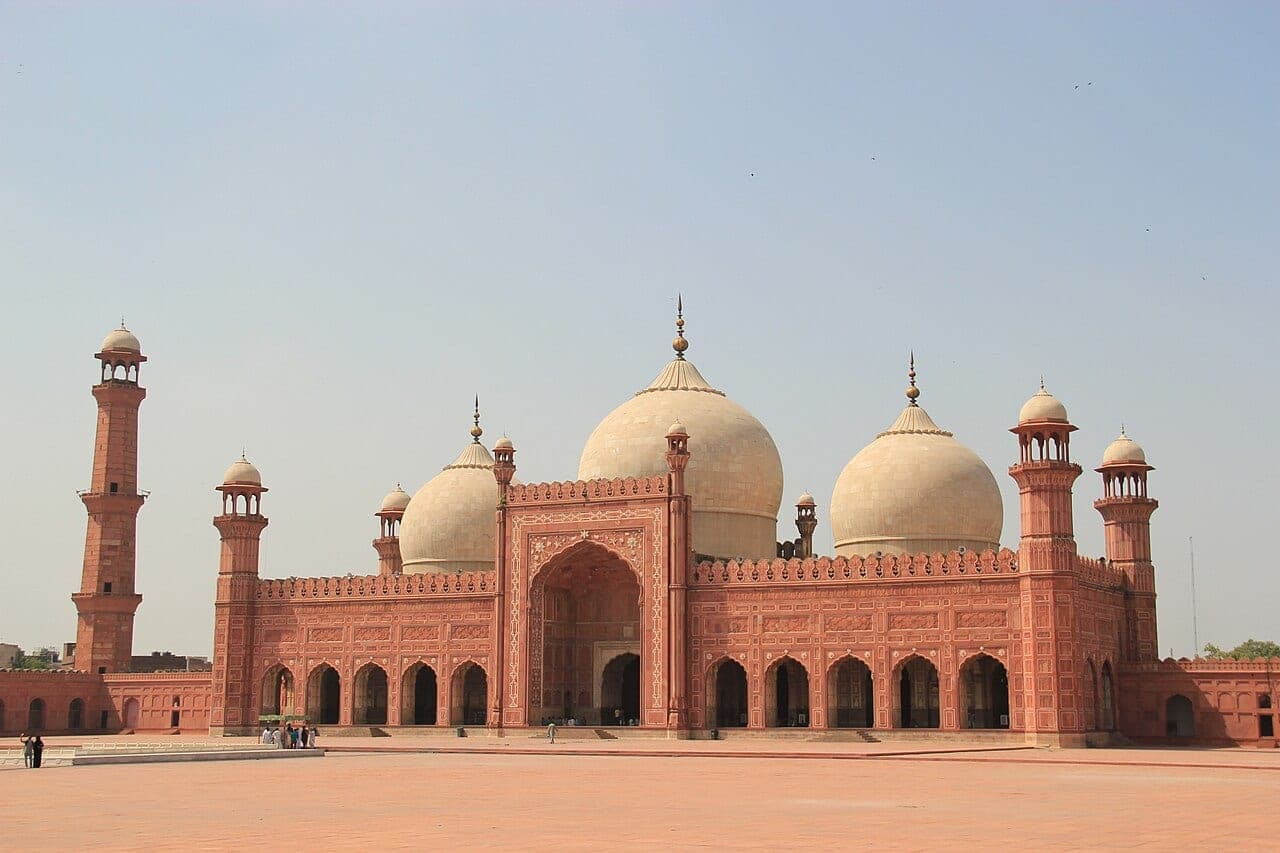
 The Badshahi Mosque at Lahore, finished in 1673 and for three centuries the largest mosque in the world. Photograph by Fassifarooq, CC BY-SA 4.0, via Wikimedia Commons.
Alongside orthodox practice runs the deep current of Sufism, the mystical dimension of Islam, which has shaped South Asian devotion for a thousand years. The great orders, the Chishti, Qadiri, Suhrawardi and Naqshbandi, spread Islam by example, and their saints lie buried in shrines that remain places of pilgrimage: Data Ganj Bakhsh, the eleventh-century Ali al-Hujwiri, in Lahore; Lal Shahbaz Qalandar in Sehwan Sharif; Shah Rukn-e-Alam in Multan; and Shah Abdul Latif Bhittai in Sindh (Data Darbar). At these shrines the devotional song called qawwali is performed to carry listeners toward the divine, a form Nusrat Fateh Ali Khan later brought to the wider world. Religious minorities are part of the national fabric too: Hindus, about 1.6 per cent and concentrated in Sindh; Christians, some 1.4 per cent; Sikhs, whose founder Guru Nanak was born at Nankana Sahib; Parsis and Baha'is; and the Kalash of the Chitral valleys, a few thousand people who keep an ancient polytheistic faith.
Islamic burial in Pakistan is swift, plain and communal. The body is washed in the ritual cleansing called ghusl, wrapped in a simple white shroud, the kafan, and carried to the funeral prayer, the salat al-janazah, offered by the community standing in rows. Burial follows as soon as possible, usually within a day, the body laid on its right side facing the Qibla toward Mecca and the grave kept modest so that rich and poor lie alike before God; cremation has no place in the tradition. The general mourning period is three days, while a widow observes a longer withdrawal, the iddah, of four months and ten days. Families gather again to recite the Quran on the third day, the soyem, on the fortieth, the chehlum, and at the yearly anniversary, the barsi. Among Shia communities the month of Muharram brings public mourning for the martyrdom of Imam Husayn at Karbala.
Sufi remembrance takes a different key. The death anniversary of a saint is the urs, an Arabic word for wedding, because the saint's passing is understood as the soul's union with God, and it is kept with celebration rather than grief. For days the shrines fill with pilgrims, with qawwali sung through the night, the ecstatic drumming and whirling called dhamaal, and the free communal meal, the langar. The urs of Data Ganj Bakhsh in Lahore and of Lal Shahbaz Qalandar in Sehwan each draw crowds in the hundreds of thousands.
The other great weight of Pakistani memory is Partition. The migration of 1947 tore families apart, emptied ancestral villages and left survivors carrying grief that many kept private for a lifetime. That memory is now being gathered before it is lost, an act of mourning conducted in the present tense to save the stories of a founding trauma from the silence of the very old.
Pakistan holds one of the largest population databases in the world and one of the deepest documentary silences, and they are about eighty years apart.
NADRA, the national database and registration authority, has registered the great majority of adult Pakistanis biometrically and issues the computerised identity card that governs almost every transaction. It records family relationships, so it is, in effect, a national family tree for the living. Birth registration below that has historically been poor, and many older Pakistanis have no birth certificate.
The land record is the older civil source. The patwari has kept village land registers since colonial times, and because inheritance divides land among heirs, successive mutations of a holding trace a family across generations. Those records are being digitised province by province.
Islamic marriage is registered through the nikah nama and the union council, and Christian, Hindu and Parsi communities kept their own registers.
Partition is the break. Around fifteen million people moved in 1947 and perhaps a million died, and the migration was not a documented process. Families arrived with nothing and were allotted evacuee property on the basis of claims, so the claim files of the Rehabilitation Department are frequently the earliest Pakistani document a muhajir family holds. What they left behind is in Indian district records, in a village they can often still name.
The oral genealogy is tribal and it is precise: Pashtun, Baloch, Sindhi and Punjabi biradari lines are recited and continue to organise marriage.
Pakistan holds six UNESCO World Heritage sites, all of them cultural (UNESCO list). The Archaeological Ruins at Moenjodaro and the ruins of Taxila were inscribed in 1980, with the Buddhist Ruins of Takht-i-Bahi and the neighbouring remains at Sahr-i-Bahlol; the Historical Monuments at Makli, Thatta, and the Fort and Shalamar Gardens in Lahore followed in 1981; and Rohtas Fort, the sixteenth-century fortress built by Sher Shah Suri, was added in 1997. Alongside these, the richly tiled Wazir Khan Mosque of 1634–1641 and the Badshahi Mosque of 1671–1673 anchor many more monuments.
Conservation is a serious struggle. Mohenjo-daro, built of unfired mud brick, is under constant threat from rising groundwater and salt and from flooding, worst in the 2022 monsoon disaster; a UNESCO-led safeguarding campaign ran from 1974 to 1997 to control the salinity, and the work continues today. In Lahore the Walled City of Lahore Authority, with the Aga Khan Trust for Culture, has restored the Wazir Khan Mosque, the Shahi Hammam and stretches of the old city (Aga Khan Development Network). In Gilgit-Baltistan the Aga Khan's cultural service has brought the Baltit and Shigar forts back from ruin as museums and heritage inns, reviving whole valley economies.
Pakistan's move into digital preservation has been led, appropriately, by the memory of Partition. The crowdsourced 1947 Partition Archive has recorded more than ten thousand survivor histories across dozens of countries, and the Citizens Archive of Pakistan, founded in 2007, digitises photographs, documents and oral histories and runs education programmes for schoolchildren; the filmmaker Sharmeen Obaid-Chinoy drew on such testimony for her Partition project HOME1947.
Museums and libraries have begun to open their holdings as well. The Lahore Museum and the national archaeology department are cataloguing their Gandharan sculpture and Indus artefacts, and the British Library's Endangered Archives Programme has supported the digitisation of Sindhi, Urdu and Persian manuscripts in Pakistani collections, placing fragile documents online for distant scholars.
Pakistani culture reaches far beyond its borders, and its music travels furthest: the qawwali of Nusrat Fateh Ali Khan, whose collaborations with Western musicians introduced Sufi song to global audiences, and the long-running television series Coke Studio, whose 2022 hit "Pasoori" fused folk and pop. Writers in English such as Mohsin Hamid, Kamila Shamsie and Mohammed Hanif have won major prizes abroad, and Sharmeen Obaid-Chinoy has taken two Academy Awards for her documentaries.
The country has produced figures of global standing in other fields. Malala Yousafzai, shot for defending girls' education, became the youngest Nobel laureate when she shared the Peace Prize in 2014 (Nobel Prize); the physicist Abdus Salam won the 1979 Nobel Prize in Physics. A large diaspora in Britain, the Gulf and North America carries Pakistani food, music and festivals abroad, and cricket, above all the 1992 World Cup win under Imran Khan, remains a source of shared national feeling.
The old city restored. The Walled City of Lahore Authority, with the Aga Khan Trust for Culture, has conserved the Wazir Khan Mosque, reopened the Mughal-era Shahi Hammam and revived the core around Delhi Gate, a model of urban heritage recovery.
The forts of the mountains. In Gilgit-Baltistan the Aga Khan Cultural Service rescued the six-hundred-year-old Baltit Fort above Hunza and the Shigar Fort in Baltistan from collapse, restoring them as museums and lodgings and reviving the surrounding valleys (Aga Khan Development Network).
Saving a city of mud. The long international effort to protect Mohenjo-daro from salt and groundwater has kept the world's earliest planned city legible, even as the 2022 floods showed how much work remains.
The witnesses recorded. The 1947 Partition Archive and the Citizens Archive of Pakistan have preserved the testimony of thousands of Partition survivors, so the memory of the migration outlives those who lived through it.
Qawwali carried to the world. From the shrine courtyards of the Punjab, Nusrat Fateh Ali Khan brought qawwali to concert halls and film scores worldwide, making a form of Sufi remembrance one of Pakistan's most recognised gifts.
The Badshahi Mosque at Lahore, finished in 1673 and for three centuries the largest mosque in the world. Photograph by Fassifarooq, CC BY-SA 4.0, via Wikimedia Commons.
Alongside orthodox practice runs the deep current of Sufism, the mystical dimension of Islam, which has shaped South Asian devotion for a thousand years. The great orders, the Chishti, Qadiri, Suhrawardi and Naqshbandi, spread Islam by example, and their saints lie buried in shrines that remain places of pilgrimage: Data Ganj Bakhsh, the eleventh-century Ali al-Hujwiri, in Lahore; Lal Shahbaz Qalandar in Sehwan Sharif; Shah Rukn-e-Alam in Multan; and Shah Abdul Latif Bhittai in Sindh (Data Darbar). At these shrines the devotional song called qawwali is performed to carry listeners toward the divine, a form Nusrat Fateh Ali Khan later brought to the wider world. Religious minorities are part of the national fabric too: Hindus, about 1.6 per cent and concentrated in Sindh; Christians, some 1.4 per cent; Sikhs, whose founder Guru Nanak was born at Nankana Sahib; Parsis and Baha'is; and the Kalash of the Chitral valleys, a few thousand people who keep an ancient polytheistic faith.
Islamic burial in Pakistan is swift, plain and communal. The body is washed in the ritual cleansing called ghusl, wrapped in a simple white shroud, the kafan, and carried to the funeral prayer, the salat al-janazah, offered by the community standing in rows. Burial follows as soon as possible, usually within a day, the body laid on its right side facing the Qibla toward Mecca and the grave kept modest so that rich and poor lie alike before God; cremation has no place in the tradition. The general mourning period is three days, while a widow observes a longer withdrawal, the iddah, of four months and ten days. Families gather again to recite the Quran on the third day, the soyem, on the fortieth, the chehlum, and at the yearly anniversary, the barsi. Among Shia communities the month of Muharram brings public mourning for the martyrdom of Imam Husayn at Karbala.
Sufi remembrance takes a different key. The death anniversary of a saint is the urs, an Arabic word for wedding, because the saint's passing is understood as the soul's union with God, and it is kept with celebration rather than grief. For days the shrines fill with pilgrims, with qawwali sung through the night, the ecstatic drumming and whirling called dhamaal, and the free communal meal, the langar. The urs of Data Ganj Bakhsh in Lahore and of Lal Shahbaz Qalandar in Sehwan each draw crowds in the hundreds of thousands.
The other great weight of Pakistani memory is Partition. The migration of 1947 tore families apart, emptied ancestral villages and left survivors carrying grief that many kept private for a lifetime. That memory is now being gathered before it is lost, an act of mourning conducted in the present tense to save the stories of a founding trauma from the silence of the very old.
Pakistan holds one of the largest population databases in the world and one of the deepest documentary silences, and they are about eighty years apart.
NADRA, the national database and registration authority, has registered the great majority of adult Pakistanis biometrically and issues the computerised identity card that governs almost every transaction. It records family relationships, so it is, in effect, a national family tree for the living. Birth registration below that has historically been poor, and many older Pakistanis have no birth certificate.
The land record is the older civil source. The patwari has kept village land registers since colonial times, and because inheritance divides land among heirs, successive mutations of a holding trace a family across generations. Those records are being digitised province by province.
Islamic marriage is registered through the nikah nama and the union council, and Christian, Hindu and Parsi communities kept their own registers.
Partition is the break. Around fifteen million people moved in 1947 and perhaps a million died, and the migration was not a documented process. Families arrived with nothing and were allotted evacuee property on the basis of claims, so the claim files of the Rehabilitation Department are frequently the earliest Pakistani document a muhajir family holds. What they left behind is in Indian district records, in a village they can often still name.
The oral genealogy is tribal and it is precise: Pashtun, Baloch, Sindhi and Punjabi biradari lines are recited and continue to organise marriage.
Pakistan holds six UNESCO World Heritage sites, all of them cultural (UNESCO list). The Archaeological Ruins at Moenjodaro and the ruins of Taxila were inscribed in 1980, with the Buddhist Ruins of Takht-i-Bahi and the neighbouring remains at Sahr-i-Bahlol; the Historical Monuments at Makli, Thatta, and the Fort and Shalamar Gardens in Lahore followed in 1981; and Rohtas Fort, the sixteenth-century fortress built by Sher Shah Suri, was added in 1997. Alongside these, the richly tiled Wazir Khan Mosque of 1634–1641 and the Badshahi Mosque of 1671–1673 anchor many more monuments.
Conservation is a serious struggle. Mohenjo-daro, built of unfired mud brick, is under constant threat from rising groundwater and salt and from flooding, worst in the 2022 monsoon disaster; a UNESCO-led safeguarding campaign ran from 1974 to 1997 to control the salinity, and the work continues today. In Lahore the Walled City of Lahore Authority, with the Aga Khan Trust for Culture, has restored the Wazir Khan Mosque, the Shahi Hammam and stretches of the old city (Aga Khan Development Network). In Gilgit-Baltistan the Aga Khan's cultural service has brought the Baltit and Shigar forts back from ruin as museums and heritage inns, reviving whole valley economies.
Pakistan's move into digital preservation has been led, appropriately, by the memory of Partition. The crowdsourced 1947 Partition Archive has recorded more than ten thousand survivor histories across dozens of countries, and the Citizens Archive of Pakistan, founded in 2007, digitises photographs, documents and oral histories and runs education programmes for schoolchildren; the filmmaker Sharmeen Obaid-Chinoy drew on such testimony for her Partition project HOME1947.
Museums and libraries have begun to open their holdings as well. The Lahore Museum and the national archaeology department are cataloguing their Gandharan sculpture and Indus artefacts, and the British Library's Endangered Archives Programme has supported the digitisation of Sindhi, Urdu and Persian manuscripts in Pakistani collections, placing fragile documents online for distant scholars.
Pakistani culture reaches far beyond its borders, and its music travels furthest: the qawwali of Nusrat Fateh Ali Khan, whose collaborations with Western musicians introduced Sufi song to global audiences, and the long-running television series Coke Studio, whose 2022 hit "Pasoori" fused folk and pop. Writers in English such as Mohsin Hamid, Kamila Shamsie and Mohammed Hanif have won major prizes abroad, and Sharmeen Obaid-Chinoy has taken two Academy Awards for her documentaries.
The country has produced figures of global standing in other fields. Malala Yousafzai, shot for defending girls' education, became the youngest Nobel laureate when she shared the Peace Prize in 2014 (Nobel Prize); the physicist Abdus Salam won the 1979 Nobel Prize in Physics. A large diaspora in Britain, the Gulf and North America carries Pakistani food, music and festivals abroad, and cricket, above all the 1992 World Cup win under Imran Khan, remains a source of shared national feeling.
The old city restored. The Walled City of Lahore Authority, with the Aga Khan Trust for Culture, has conserved the Wazir Khan Mosque, reopened the Mughal-era Shahi Hammam and revived the core around Delhi Gate, a model of urban heritage recovery.
The forts of the mountains. In Gilgit-Baltistan the Aga Khan Cultural Service rescued the six-hundred-year-old Baltit Fort above Hunza and the Shigar Fort in Baltistan from collapse, restoring them as museums and lodgings and reviving the surrounding valleys (Aga Khan Development Network).
Saving a city of mud. The long international effort to protect Mohenjo-daro from salt and groundwater has kept the world's earliest planned city legible, even as the 2022 floods showed how much work remains.
The witnesses recorded. The 1947 Partition Archive and the Citizens Archive of Pakistan have preserved the testimony of thousands of Partition survivors, so the memory of the migration outlives those who lived through it.
Qawwali carried to the world. From the shrine courtyards of the Punjab, Nusrat Fateh Ali Khan brought qawwali to concert halls and film scores worldwide, making a form of Sufi remembrance one of Pakistan's most recognised gifts.
National Overview
Notable Cities
Historical Foundations
Linguistic and Etymological Roots
Cultural Identity
Religion and Spirituality
Remembrance and Mourning Traditions
Tracing a Family in Pakistan
Heritage Preservation Efforts
Digital Heritage
Contemporary Cultural Influences
Success Stories
References and resources
- UNESCO World Heritage Centre: Pakistan: the state-party page for all six World Heritage sites.
- List of World Heritage Sites in Pakistan (Wikipedia): names, locations and inscription dates.
- Encyclopaedia Britannica: Pakistan: geography, history and society.
- Encyclopaedia Britannica: Partition of India: the 1947 division, migration and its toll.
- Encyclopaedia Britannica: Mohammed Ali Jinnah: the founder and the road to independence.
- The 1947 Partition Archive: crowdsourced oral histories of Partition survivors.
- Citizens Archive of Pakistan (Oral History Society): oral history and digitisation of the Partition generation.
- Aga Khan Development Network: Pakistan: heritage conservation in Lahore and the northern valleys.
- Nobel Prize: Malala Yousafzai: the 2014 Peace Prize and its context.