Heritage · Country
Haiti Culture and Heritage
Haiti is the only nation forged by a victorious uprising of the enslaved, the first Black-led republic and the first country to abolish slavery for good. From the mountaintop Citadelle Laferrière to the candlelit cemeteries of Fèt Gede, this is a guide to how Haitians built their freedom and how they keep faith with their dead.Written to last.
By Confinity Heritage Editorial · Updated 2026-07-31 · 8-minute readQuiet tools, kept out of the way.
No nation carries a claim quite like Haiti's. Between 1791 and 1804 the enslaved people of the French colony of Saint-Domingue rose, fought, and won, defeating the armies of the greatest powers of the age to found the first independent nation in Latin America and the Caribbean, the first republic led by people of African descent, and the first state anywhere to abolish slavery and never restore it. Its consequences reached every plantation society in the hemisphere.
That founding act shapes what followed: a mountaintop fortress raised by free hands against the enslavers' return, a language born in the cane fields that is now a people's mother tongue, a spirituality that carried West and Central African memory across the Middle Passage intact, and a way of honouring the dead in which the ancestors remain present at the family table.
Haiti occupies the western third of Hispaniola, the second-largest island of the Greater Antilles, which it shares with the Dominican Republic. Its roughly 27,750 square kilometres are dominated by the mountain chains that gave the country its name, rising to Pic la Selle at about 2,680 metres. Two arms of land reach westward around the Golfe de la Gonâve, at whose head sits the capital, Port-au-Prince. The population is estimated at around 11.5 to 12 million, according to Encyclopaedia Britannica.
The republic was proclaimed on 1 January 1804, making Haiti the second independent nation in the Americas after the United States and the first led by formerly enslaved people. Its everyday national language, Haitian Creole, grew directly from the encounter of Africa and Europe on colonial soil. That combination of a young state and a long, hard-won memory runs through Haitian life, from a national holiday built around a bowl of soup to the largest fortress in the Western Hemisphere.
Port-au-Prince. Founded by the French in 1749 and soon made colonial capital, the city holds the country's principal cultural institutions, among them the Musée du Panthéon National Haïtien (MUPANAH), whose collection includes the anchor said to be from Columbus's Santa María and the pistol with which Henri Christophe ended his life. The 2010 earthquake struck the metropolitan area directly, collapsing the National Palace and the cathedral, and the city has been rebuilding and mourning ever since.
Cap-Haïtien. The northern port, called Cap-Français in colonial times, was the wealthiest city of Saint-Domingue and the capital of Henri Christophe's Kingdom of Haiti. Its arcaded streets and balconied townhouses survive as one of the most complete pieces of French colonial urbanism in the Caribbean, and it is the gateway to the royal sites at nearby Milot.
Jacmel. The southern coastal town, once rich from coffee, is Haiti's arts capital. Its historic centre of cast-iron balconies and brick warehouses, much of it imported prefabricated in the nineteenth century, sits on Haiti's UNESCO tentative list, and its February carnival is famous for enormous papier-mâché masks made in the town's workshops.
Milot. Now a small northern town, Milot was the seat of Henri Christophe's court. Here stand the ruins of the Sans-Souci Palace and, on the mountain above, the Citadelle, together the core of the country's only World Heritage site.
The island's first people were the Taíno, an Arawak-speaking society who called their homeland Ayiti. When Christopher Columbus arrived in December 1492 his flagship Santa María ran aground near present-day Cap-Haïtien, and its timbers built the first European settlement in the Americas, La Navidad. Within a few decades disease, forced labour and violence had all but destroyed the Taíno, among the earliest and gravest losses of the colonial era.
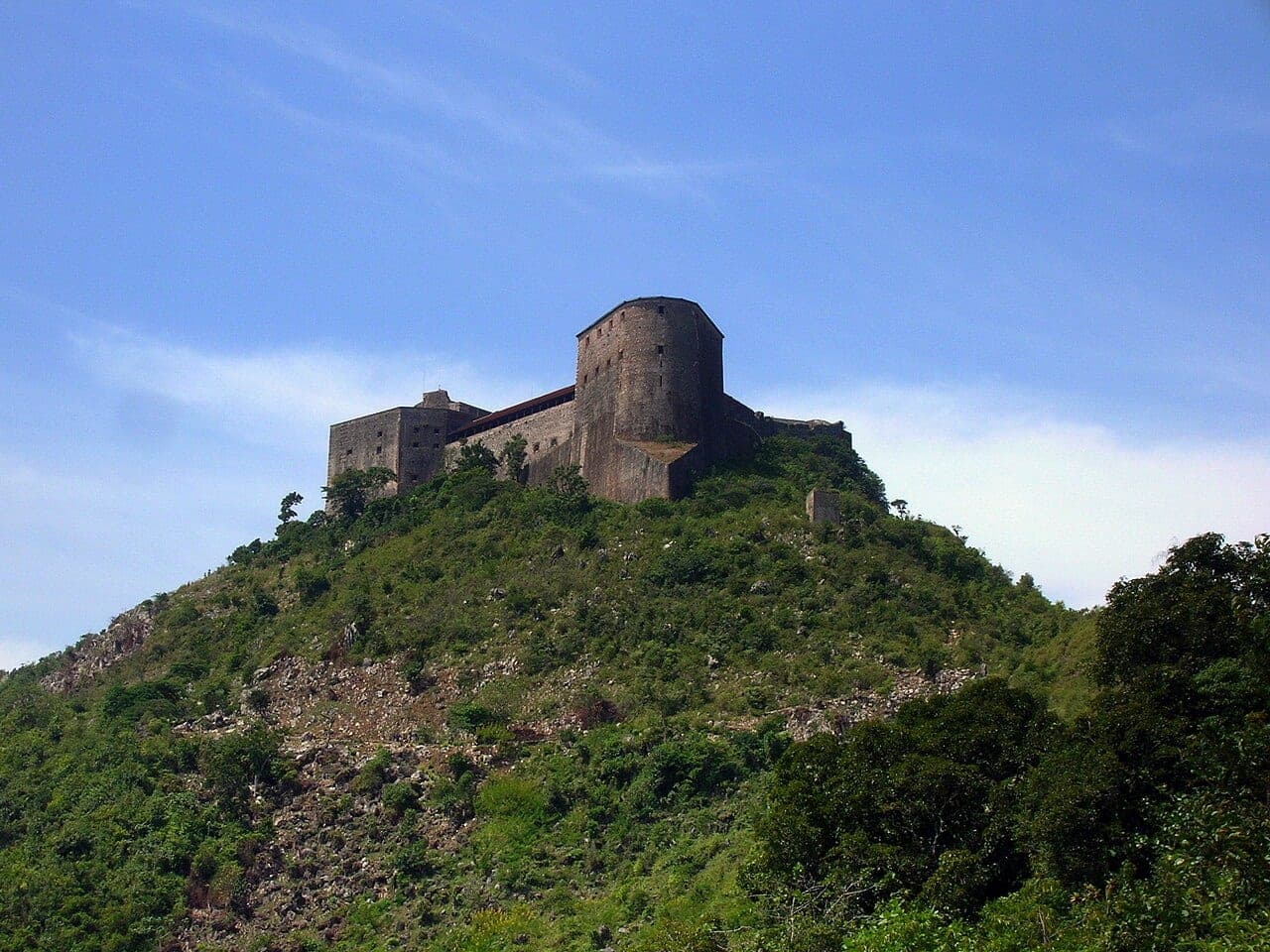
 The Citadelle was built after independence by a people who had just freed themselves, against a French return that never came. It is the largest fortress in the Americas. Photograph by Remi Kaupp, CC BY-SA 3.0, via Wikimedia Commons.
Spain ceded the island's western third to France under the Treaty of Ryswick in 1697, and Saint-Domingue became the most profitable colony in the world, a source of much of Europe's sugar and coffee. That wealth rested on extraordinary cruelty: on the eve of the revolution the colony held roughly half a million enslaved Africans, worked so lethally that their numbers had to be continually replenished by the transatlantic trade.
In August 1791 a mass uprising broke out in the northern plain, an event traditionally linked to the Vodou gathering at Bois Caïman. Over thirteen years the enslaved and free people of colour fought the French, Spanish and British in turn. Toussaint Louverture, a formerly enslaved man of exceptional political gifts, rose to lead the colony before he was seized under a flag of truce and shipped to France, where he died in prison in 1803. His lieutenant Jean-Jacques Dessalines carried the war to victory over Napoleon's expeditionary force, and on 1 January 1804 he proclaimed independence at Gonaïves, restoring the Taíno name Ayiti. Britannica records it as the only slave uprising in history to produce a lasting free state.
Recognition came at a punishing price. In 1825, with French warships off the coast, Haiti agreed to pay an indemnity of 150 million gold francs to compensate former slaveholders for their lost "property," a sum it could meet only by borrowing at ruinous rates. Reduced to 90 million in 1838, the burden, later described as a "double debt" once the servicing loans are counted, was not fully discharged until deep into the twentieth century, according to UN News and the record of the Haitian independence debt. It drained the young republic of capital for generations.
The nineteenth century brought division and reunion, Christophe's northern kingdom and Alexandre Pétion's southern republic joined again under Jean-Pierre Boyer in 1820. The twentieth century brought a United States occupation from 1915 to 1934 and, later, the Duvalier dictatorship from 1957 to 1986. Then, on 12 January 2010, a magnitude-7.0 earthquake struck near Léogâne, close to the capital. Estimates of the dead range from around 160,000 to far higher official figures, and more than a million and a half people were displaced. The National Palace, the cathedral, ministries, churches, schools and archives fell, a heritage loss recorded soberly by Britannica alongside the human toll.
Haiti has two official languages. French, the language of the colonial administration, remains that of formal law, higher education and much of the press, used fluently by a minority. Haitian Creole, or Kreyòl ayisyen, is the shared language of the whole population, roughly twelve million speakers, and has been co-official since the 1987 constitution. It grew in colonial Saint-Domingue, drawing its core vocabulary from French while its grammar and sound carry the deep influence of West African languages, chiefly Fon and Ewe, with contributions from Kongo, Spanish, Taíno and English. Far from a simplified dialect, it is a complete language with its own standardized orthography, and the Akademi Kreyòl Ayisyen was established in 2014 to guide it.
The country's name is itself an act of remembrance. Ayiti is the Taíno word usually translated as "land of high mountains," fitting a country where mountains cover most of the terrain, and when Dessalines named the new nation in 1804 he deliberately reached past the French colonial title to the island's Indigenous name. In choosing Ayiti the founders anchored a nation of Africans and their descendants in the ground of the Americas.
Haitian painting is among the most recognizable in the world. The Centre d'Art, opened in Port-au-Prince in 1944 by the American teacher DeWitt Peters, gave self-taught painters a workshop and an international audience, launching figures such as the Vodou priest Hector Hyppolite. Two regional currents took shape: the Cap-Haïtien school, led by Philomé Obin and his family, favoured historical narrative and documentary scenes of northern life, while the Saint-Soleil movement, founded near Pétion-Ville in 1973 by Jean-Claude Garoute, known as Tiga, and Maud Robart, produced dreamlike abstractions steeped in the symbolism of the spirits, as surveyed in accounts of Haitian art.
Craft carries the same inventiveness. In Croix-des-Bouquets, metalworkers led from the mid-twentieth century by Georges Liautaud cut flattened oil drums into intricate sculpture, still worked in the town's forges, while Jacmel's papier-mâché artisans build the towering animal masks of its February carnival. Rara, the marching music of drums, bamboo trumpets and song, moves through the countryside each Lenten season and is closely tied to Vodou, and the national dance music is kompa, created in 1955 by the bandleader Nemours Jean-Baptiste, who fused Caribbean rhythms with a distinctly Haitian pulse. At the table, griot, diri ak pwa and, above all, soup joumou bind the culture as firmly as painting and music do.
Most Haitians are Christian. Roman Catholicism was the established colonial faith and remains the largest single tradition, while Protestant and evangelical churches have grown quickly in recent decades. Alongside and often within this Christian majority lives Vodou, the spiritual system that West and Central African peoples carried across the Atlantic and remade in Saint-Domingue, weaving Fon, Yoruba and Kongo traditions with elements of Catholicism.
Vodou is a coherent religion. The sensational caricature exported by outsiders bears almost no relation to it. Its practitioners serve the lwa, the spirits who mediate between humanity and Bondye, the one distant creator, each associated with particular colours, offerings and rhythms. Many Haitians see no contradiction in attending Mass and also honouring the lwa, and the faith carries the memory of resistance, for the ceremony at Bois Caïman is remembered as a spark of the revolution. In 2003 the Haitian state formally recognized Vodou as a religion, giving its weddings, baptisms and funerals legal standing, a dignity long withheld.
Haitian mourning joins two inheritances. In the Catholic and broader Christian pattern, a death is followed by the veye, a night-long wake of prayer, song and food, and by the denyè priyè, a cycle of prayers over roughly nine days that helps the soul on its way. Burial is a matter of deep pride and expense: families build above-ground tombs and painted mausoleums, and a dignified funeral is understood as a debt owed to the departed and to the standing of the living.
Vodou tradition holds that a person is made of several spiritual parts, and its funerary rites tend to the safekeeping of the soul so that, in time, the dead may be recalled to take their place among the ancestors. This care comes fully into view at Fèt Gede, the festival of the dead observed on 1–2 November, which coincides with the Catholic days of All Saints and All Souls. As the Haitian Times describes it, communities converge on the cemeteries to honour the Gede, the spirits of the dead led by Baron Samedi and Gran Brijit, lighting candles at the graves, bringing the food, drink and flowers their loved ones favoured, and pouring libations. The mood is deliberately life-affirming rather than sombre, a communion in which music and colour affirm that the dead remain part of the family.
Grief also has a national date. Each 12 January, Haitians mark the earthquake's anniversary, remembering the thousands buried in mass graves at sites such as Titanyen and a loss that touched nearly every family in the capital.
Haiti's paperwork is fragile and its record of itself is not.
The colony of Saint-Domingue generated an enormous French archive: notarial registers, plantation inventories, and the parish books that recorded baptisms of the enslaved. Most of it is in France, at the overseas archives at Aix-en-Provence and in the notarial series, and it is the deepest source for Haitian families before 1804. The Archives Nationales d'Haïti in Port-au-Prince holds the post-independence civil registration, which began early and has been kept under conditions no archive should have to endure.
The state's own record has taken repeated damage: political violence, the fire of 1869, hurricanes, and the earthquake of 2010, which destroyed government buildings across the capital and killed a substantial part of the administrative class along with everyone else.
What has never been at risk is the lineage kept through Vodou. A Haitian family belongs to a lakou, an ancestral compound and the people attached to it, and the lwa served by that family are inherited. Knowing which spirits your family serves is knowing where your family is from, and the ceremonies name the dead. It is a genealogical system that requires no paper and has survived everything that has happened to the paper.
For the Haitian diaspora, in the Dominican Republic, the United States, Canada, France and the Bahamas, the practical record is usually the receiving country's immigration file, and statelessness on the Dominican side has made proving descent a legal emergency for many families.
Haiti's National History Park, comprising the Citadelle, Sans-Souci and Ramiers, was inscribed by UNESCO in 1982. The Citadelle Laferrière, commissioned by Henri Christophe soon after independence and completed around 1820, stands on a peak above Milot at some 900 metres. Built by tens of thousands of free labourers to repel any French reconquest, it is the largest fortress in the Americas and, with the ruined Sans-Souci Palace below, a monument raised by formerly enslaved people to defend their own freedom. The Institut de Sauvegarde du Patrimoine National (ISPAN) is charged with protecting these and other sites.
Preservation has often meant recovery. After 2010 the Smithsonian Institution led the Haiti Cultural Recovery Project, which stabilized and re-housed more than 35,000 works of art, artifacts, rare books and archives and trained more than 150 Haitian conservators, according to the Smithsonian Cultural Rescue Initiative. Damaged murals from the cathedral of Sainte-Trinité and countless paintings were rescued from the rubble, and institutions including the Centre d'Art rebuilt. Efforts to guard Jacmel's historic centre and the northern royal sites continue alongside work to steady the country's museums.
Because so much of Haiti's material heritage is fragile, digital preservation carries particular weight. The Digital Library of the Caribbean, a shared international archive, hosts a substantial body of Haitian newspapers, government documents, photographs and rare printed works that once existed only in vulnerable single copies. After the earthquake, the Smithsonian's teams digitized records and artworks as they conserved them, and academic projects have documented Vodou liturgy, art and song. Haitian institutions and diaspora groups now publish oral histories, family testimony and images of monuments online, so that a heritage repeatedly tested by disaster is held in more than one place at once.
Haiti's influence has always run beyond its shores. The revolution reshaped the Atlantic world, hastening the end of slavery elsewhere and inspiring abolitionists, a story told in C. L. R. James's classic history of the uprising. A large diaspora in the United States, Canada, France and the Dominican Republic keeps Haitian culture in motion: writers such as Edwidge Danticat and Dany Laferrière, elected to the Académie française, carry Haitian memory into world literature, after an earlier line including Jacques Roumain and Marie Vieux-Chauvet.
Music travels just as far, from kompa bands filling dance floors across the Caribbean and its diaspora to the global career of Wyclef Jean. Haitian painting and metal sculpture are collected internationally, and in 2021 soup joumou became the first Haitian element inscribed on UNESCO's Representative List of the Intangible Cultural Heritage of Humanity, as recorded by UNESCO.
A soup that means freedom. Under slavery, joumou soup was reserved for the colonists; on 1 January 1804 free Haitians claimed it as their own, and eating it each Independence Day became a ritual of dignity. Its 2021 UNESCO inscription made the dish a recognized heritage of humanity, the first such honour Haiti received.
Rescue from the rubble. After the 2010 earthquake, the Smithsonian-led Haiti Cultural Recovery Project stabilized more than 35,000 artworks and archival items and trained scores of Haitian conservators, ensuring that the country's cultural memory survived a disaster that took so much else.
A fortress that still stands. The Citadelle Laferrière, raised by free hands to guard a newly free nation, endured earthquakes and two centuries of weather to become Haiti's first World Heritage site and its enduring national symbol.
A language comes of age. Haitian Creole, once dismissed as a mere patois, gained co-official status in 1987 and its own state academy in 2014, securing the mother tongue of an entire nation as a language of law, learning and literature.
The Citadelle was built after independence by a people who had just freed themselves, against a French return that never came. It is the largest fortress in the Americas. Photograph by Remi Kaupp, CC BY-SA 3.0, via Wikimedia Commons.
Spain ceded the island's western third to France under the Treaty of Ryswick in 1697, and Saint-Domingue became the most profitable colony in the world, a source of much of Europe's sugar and coffee. That wealth rested on extraordinary cruelty: on the eve of the revolution the colony held roughly half a million enslaved Africans, worked so lethally that their numbers had to be continually replenished by the transatlantic trade.
In August 1791 a mass uprising broke out in the northern plain, an event traditionally linked to the Vodou gathering at Bois Caïman. Over thirteen years the enslaved and free people of colour fought the French, Spanish and British in turn. Toussaint Louverture, a formerly enslaved man of exceptional political gifts, rose to lead the colony before he was seized under a flag of truce and shipped to France, where he died in prison in 1803. His lieutenant Jean-Jacques Dessalines carried the war to victory over Napoleon's expeditionary force, and on 1 January 1804 he proclaimed independence at Gonaïves, restoring the Taíno name Ayiti. Britannica records it as the only slave uprising in history to produce a lasting free state.
Recognition came at a punishing price. In 1825, with French warships off the coast, Haiti agreed to pay an indemnity of 150 million gold francs to compensate former slaveholders for their lost "property," a sum it could meet only by borrowing at ruinous rates. Reduced to 90 million in 1838, the burden, later described as a "double debt" once the servicing loans are counted, was not fully discharged until deep into the twentieth century, according to UN News and the record of the Haitian independence debt. It drained the young republic of capital for generations.
The nineteenth century brought division and reunion, Christophe's northern kingdom and Alexandre Pétion's southern republic joined again under Jean-Pierre Boyer in 1820. The twentieth century brought a United States occupation from 1915 to 1934 and, later, the Duvalier dictatorship from 1957 to 1986. Then, on 12 January 2010, a magnitude-7.0 earthquake struck near Léogâne, close to the capital. Estimates of the dead range from around 160,000 to far higher official figures, and more than a million and a half people were displaced. The National Palace, the cathedral, ministries, churches, schools and archives fell, a heritage loss recorded soberly by Britannica alongside the human toll.
Haiti has two official languages. French, the language of the colonial administration, remains that of formal law, higher education and much of the press, used fluently by a minority. Haitian Creole, or Kreyòl ayisyen, is the shared language of the whole population, roughly twelve million speakers, and has been co-official since the 1987 constitution. It grew in colonial Saint-Domingue, drawing its core vocabulary from French while its grammar and sound carry the deep influence of West African languages, chiefly Fon and Ewe, with contributions from Kongo, Spanish, Taíno and English. Far from a simplified dialect, it is a complete language with its own standardized orthography, and the Akademi Kreyòl Ayisyen was established in 2014 to guide it.
The country's name is itself an act of remembrance. Ayiti is the Taíno word usually translated as "land of high mountains," fitting a country where mountains cover most of the terrain, and when Dessalines named the new nation in 1804 he deliberately reached past the French colonial title to the island's Indigenous name. In choosing Ayiti the founders anchored a nation of Africans and their descendants in the ground of the Americas.
Haitian painting is among the most recognizable in the world. The Centre d'Art, opened in Port-au-Prince in 1944 by the American teacher DeWitt Peters, gave self-taught painters a workshop and an international audience, launching figures such as the Vodou priest Hector Hyppolite. Two regional currents took shape: the Cap-Haïtien school, led by Philomé Obin and his family, favoured historical narrative and documentary scenes of northern life, while the Saint-Soleil movement, founded near Pétion-Ville in 1973 by Jean-Claude Garoute, known as Tiga, and Maud Robart, produced dreamlike abstractions steeped in the symbolism of the spirits, as surveyed in accounts of Haitian art.
Craft carries the same inventiveness. In Croix-des-Bouquets, metalworkers led from the mid-twentieth century by Georges Liautaud cut flattened oil drums into intricate sculpture, still worked in the town's forges, while Jacmel's papier-mâché artisans build the towering animal masks of its February carnival. Rara, the marching music of drums, bamboo trumpets and song, moves through the countryside each Lenten season and is closely tied to Vodou, and the national dance music is kompa, created in 1955 by the bandleader Nemours Jean-Baptiste, who fused Caribbean rhythms with a distinctly Haitian pulse. At the table, griot, diri ak pwa and, above all, soup joumou bind the culture as firmly as painting and music do.
Most Haitians are Christian. Roman Catholicism was the established colonial faith and remains the largest single tradition, while Protestant and evangelical churches have grown quickly in recent decades. Alongside and often within this Christian majority lives Vodou, the spiritual system that West and Central African peoples carried across the Atlantic and remade in Saint-Domingue, weaving Fon, Yoruba and Kongo traditions with elements of Catholicism.
Vodou is a coherent religion. The sensational caricature exported by outsiders bears almost no relation to it. Its practitioners serve the lwa, the spirits who mediate between humanity and Bondye, the one distant creator, each associated with particular colours, offerings and rhythms. Many Haitians see no contradiction in attending Mass and also honouring the lwa, and the faith carries the memory of resistance, for the ceremony at Bois Caïman is remembered as a spark of the revolution. In 2003 the Haitian state formally recognized Vodou as a religion, giving its weddings, baptisms and funerals legal standing, a dignity long withheld.
Haitian mourning joins two inheritances. In the Catholic and broader Christian pattern, a death is followed by the veye, a night-long wake of prayer, song and food, and by the denyè priyè, a cycle of prayers over roughly nine days that helps the soul on its way. Burial is a matter of deep pride and expense: families build above-ground tombs and painted mausoleums, and a dignified funeral is understood as a debt owed to the departed and to the standing of the living.
Vodou tradition holds that a person is made of several spiritual parts, and its funerary rites tend to the safekeeping of the soul so that, in time, the dead may be recalled to take their place among the ancestors. This care comes fully into view at Fèt Gede, the festival of the dead observed on 1–2 November, which coincides with the Catholic days of All Saints and All Souls. As the Haitian Times describes it, communities converge on the cemeteries to honour the Gede, the spirits of the dead led by Baron Samedi and Gran Brijit, lighting candles at the graves, bringing the food, drink and flowers their loved ones favoured, and pouring libations. The mood is deliberately life-affirming rather than sombre, a communion in which music and colour affirm that the dead remain part of the family.
Grief also has a national date. Each 12 January, Haitians mark the earthquake's anniversary, remembering the thousands buried in mass graves at sites such as Titanyen and a loss that touched nearly every family in the capital.
Haiti's paperwork is fragile and its record of itself is not.
The colony of Saint-Domingue generated an enormous French archive: notarial registers, plantation inventories, and the parish books that recorded baptisms of the enslaved. Most of it is in France, at the overseas archives at Aix-en-Provence and in the notarial series, and it is the deepest source for Haitian families before 1804. The Archives Nationales d'Haïti in Port-au-Prince holds the post-independence civil registration, which began early and has been kept under conditions no archive should have to endure.
The state's own record has taken repeated damage: political violence, the fire of 1869, hurricanes, and the earthquake of 2010, which destroyed government buildings across the capital and killed a substantial part of the administrative class along with everyone else.
What has never been at risk is the lineage kept through Vodou. A Haitian family belongs to a lakou, an ancestral compound and the people attached to it, and the lwa served by that family are inherited. Knowing which spirits your family serves is knowing where your family is from, and the ceremonies name the dead. It is a genealogical system that requires no paper and has survived everything that has happened to the paper.
For the Haitian diaspora, in the Dominican Republic, the United States, Canada, France and the Bahamas, the practical record is usually the receiving country's immigration file, and statelessness on the Dominican side has made proving descent a legal emergency for many families.
Haiti's National History Park, comprising the Citadelle, Sans-Souci and Ramiers, was inscribed by UNESCO in 1982. The Citadelle Laferrière, commissioned by Henri Christophe soon after independence and completed around 1820, stands on a peak above Milot at some 900 metres. Built by tens of thousands of free labourers to repel any French reconquest, it is the largest fortress in the Americas and, with the ruined Sans-Souci Palace below, a monument raised by formerly enslaved people to defend their own freedom. The Institut de Sauvegarde du Patrimoine National (ISPAN) is charged with protecting these and other sites.
Preservation has often meant recovery. After 2010 the Smithsonian Institution led the Haiti Cultural Recovery Project, which stabilized and re-housed more than 35,000 works of art, artifacts, rare books and archives and trained more than 150 Haitian conservators, according to the Smithsonian Cultural Rescue Initiative. Damaged murals from the cathedral of Sainte-Trinité and countless paintings were rescued from the rubble, and institutions including the Centre d'Art rebuilt. Efforts to guard Jacmel's historic centre and the northern royal sites continue alongside work to steady the country's museums.
Because so much of Haiti's material heritage is fragile, digital preservation carries particular weight. The Digital Library of the Caribbean, a shared international archive, hosts a substantial body of Haitian newspapers, government documents, photographs and rare printed works that once existed only in vulnerable single copies. After the earthquake, the Smithsonian's teams digitized records and artworks as they conserved them, and academic projects have documented Vodou liturgy, art and song. Haitian institutions and diaspora groups now publish oral histories, family testimony and images of monuments online, so that a heritage repeatedly tested by disaster is held in more than one place at once.
Haiti's influence has always run beyond its shores. The revolution reshaped the Atlantic world, hastening the end of slavery elsewhere and inspiring abolitionists, a story told in C. L. R. James's classic history of the uprising. A large diaspora in the United States, Canada, France and the Dominican Republic keeps Haitian culture in motion: writers such as Edwidge Danticat and Dany Laferrière, elected to the Académie française, carry Haitian memory into world literature, after an earlier line including Jacques Roumain and Marie Vieux-Chauvet.
Music travels just as far, from kompa bands filling dance floors across the Caribbean and its diaspora to the global career of Wyclef Jean. Haitian painting and metal sculpture are collected internationally, and in 2021 soup joumou became the first Haitian element inscribed on UNESCO's Representative List of the Intangible Cultural Heritage of Humanity, as recorded by UNESCO.
A soup that means freedom. Under slavery, joumou soup was reserved for the colonists; on 1 January 1804 free Haitians claimed it as their own, and eating it each Independence Day became a ritual of dignity. Its 2021 UNESCO inscription made the dish a recognized heritage of humanity, the first such honour Haiti received.
Rescue from the rubble. After the 2010 earthquake, the Smithsonian-led Haiti Cultural Recovery Project stabilized more than 35,000 artworks and archival items and trained scores of Haitian conservators, ensuring that the country's cultural memory survived a disaster that took so much else.
A fortress that still stands. The Citadelle Laferrière, raised by free hands to guard a newly free nation, endured earthquakes and two centuries of weather to become Haiti's first World Heritage site and its enduring national symbol.
A language comes of age. Haitian Creole, once dismissed as a mere patois, gained co-official status in 1987 and its own state academy in 2014, securing the mother tongue of an entire nation as a language of law, learning and literature.
National Overview
Notable Cities
Historical Foundations
Linguistic and Etymological Roots
Cultural Identity
Religion and Spirituality
Remembrance and Mourning Traditions
Tracing a Family in Haiti
Heritage Preservation Efforts
Digital Heritage
Contemporary Cultural Influences
Success Stories
References and resources
- Encyclopaedia Britannica: Haiti. Geography and background.
- Encyclopaedia Britannica: Haitian Revolution. The 1791–1804 uprising and independence.
- UNESCO World Heritage Centre: National History Park, Citadel, Sans Souci, Ramiers. The 1982 inscription.
- UNESCO: Joumou soup. The 2021 heritage inscription.
- UN News: How Haiti paid for its freedom, twice over. The 1825 indemnity.
- Encyclopaedia Britannica: 2010 Haiti earthquake. The disaster and its toll.
- Smithsonian Cultural Rescue Initiative: Haiti earthquake recovery. Post-quake conservation.
- Haitian Times: Fèt Gede. The festival of the dead.
- Wikipedia: Haitian art. The Centre d'Art and its schools.
- Wikipedia: Citadelle Laferrière. Henri Christophe's fortress.