Heritage · Country
Dominican Republic Culture and Heritage
On the west bank of the Ozama stands the first cathedral, the first university and the first stone palace that Europe raised anywhere in the Americas, and around them a nation that layers Taino, Spanish and African memory into a single Caribbean voice. A guide to the heritage of the Dominican Republic and to the novenario, the drum brotherhoods and the gagá processions with which its people keep faith with the dead.Written to last.
By Confinity Heritage Editorial · Updated 2026-07-31 · 8-minute readQuiet tools, kept out of the way.
The Dominican Republic occupies the eastern two thirds of Hispaniola, the Caribbean island the Taino called Quisqueya, "mother of all lands", and Ayití, "land of high mountains". On the west bank of the Ozama River its capital, Santo Domingo, holds the first cathedral, the first university, the first hospital and the first paved street that Europe built anywhere in the Americas, a grid laid out from 1502 that became the model for colonial cities from Havana to Lima. Around that founding core the country has grown into a nation of roughly eleven million people whose identity braids three deep roots: the Taino who met Columbus's ships in 1492, the Spanish who planted the first European colony of the New World here, and the Africans carried in bondage to work its sugar.
Memory is the thread running through Dominican life, and it is worked in several registers at once. Catholic families keep the novenario, nine nights of the rosary that carry a soul out of the world; the drum brotherhoods of Villa Mella sing their dead across the boundary with music that UNESCO now protects; and in the batey sugar settlements the gagá processions and the rites of Dominican vodú keep an African inheritance alive. The same instinct animates the country's music. Merengue and bachata, both inscribed on UNESCO's list of the intangible heritage of humanity, began as the songs of ordinary people and became the way a whole nation remembers itself.
The Dominican Republic shares Hispaniola with Haiti, the only case in the Caribbean of two sovereign states dividing a single island, along a land border of some 380 kilometres. Its landscape is more dramatic than its beaches suggest: the Cordillera Central rises to Pico Duarte, at about 3,100 metres the highest peak in the Caribbean, while in the arid south-west Lake Enriquillo, a hypersaline lake named for a Taino chief, lies roughly 40 metres below sea level, the region's lowest point. Between mountain and sea run the fertile Cibao valley, the sugar plains of the south-east and the beach resorts of Punta Cana that anchor the largest tourism economy in the Caribbean.
Spanish is the official language and Roman Catholicism the majority faith, though evangelical churches and Afro-Dominican traditions are widely present. About a third of the population lives in Greater Santo Domingo, and several million more Dominicans live abroad, chiefly in the United States and Spain. According to Encyclopaedia Britannica, the country has one of the largest economies of Central America and the Caribbean, built on tourism, services, mining and the diaspora.
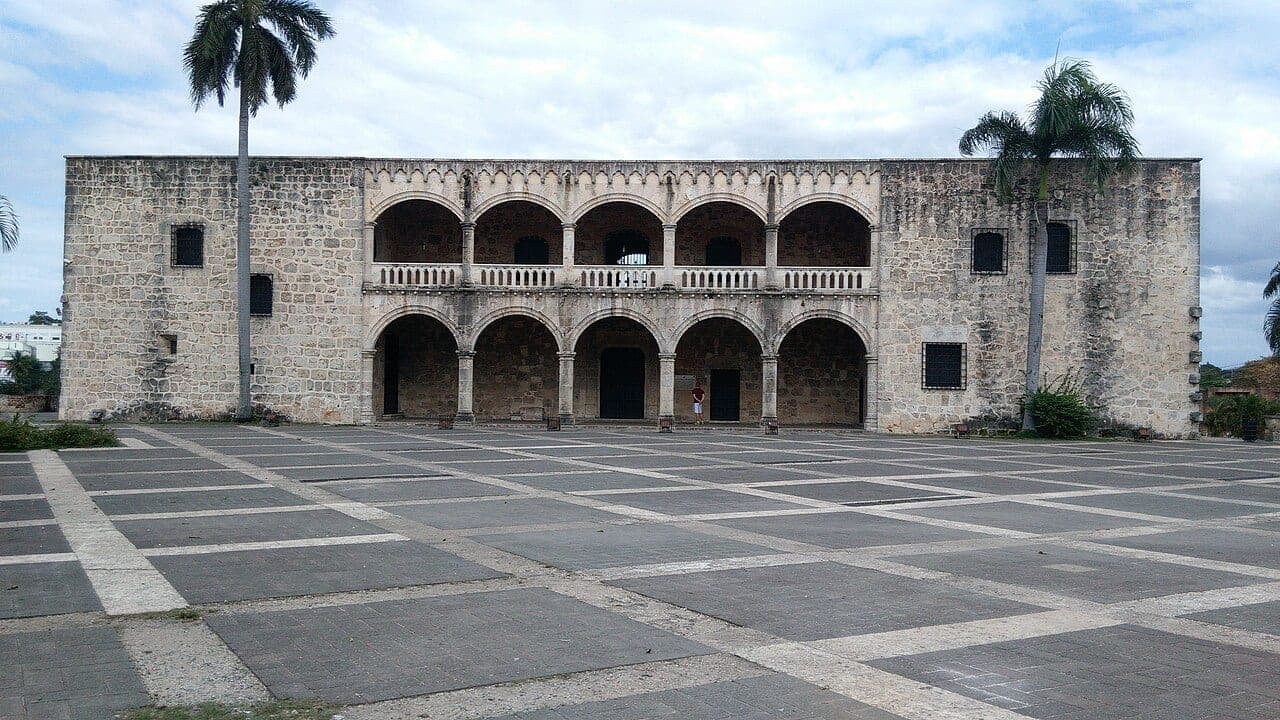
Santo Domingo. The capital is the oldest continuously inhabited European city in the Americas, first settled on the Ozama's east bank in 1496 and rebuilt on the west bank from 1502. Its Colonial City, a UNESCO World Heritage Site since 1990, holds the Catedral Primada de América, the first cathedral of the New World, finished around 1540; the Alcázar de Colón, the palace of Columbus's son Diego, built between 1510 and 1512; and the Fortaleza Ozama, the oldest European military structure in the Americas.
 Santo Domingo holds the first cathedral, the first hospital and the first university built by Europeans in the Americas, and the grid they were laid out on became the template for colonial cities across the hemisphere. Photograph by Mariordo, CC BY-SA 4.0, via Wikimedia Commons.
Santiago de los Caballeros. The second city, seated in the Cibao valley near the Yaque del Norte River, takes its name from the thirty Spanish knights who settled there early in the sixteenth century. An earthquake destroyed the first town in 1562 and it was rebuilt on its present site. Santiago is the heart of the tobacco country and home to the Centro León, one of the finest cultural museums in the country.
Puerto Plata. The Atlantic port founded in the colony's first years, ringed by the Fortaleza San Felipe and overlooked by the Isabel de Torres mountain, grew rich on tobacco and amber and later pioneered Caribbean beach tourism. Its Victorian gingerbread houses recall a merchant boom of the nineteenth century.
La Vega. Concepción de la Vega, in the central valley, hosts the most celebrated Carnival in the country, its streets filled each February by the diablos cojuelos, the "limping devils" in horned masks who chase onlookers with inflated bladders. The tradition descends from the earliest Carnivals held in the Americas.
When Columbus landed in 1492 the island was home to the Taino, an Arawak people organised into chiefdoms under leaders called caciques. Within a generation their world collapsed under forced labour in the encomienda system, imported disease and violence; the cacique Enriquillo led a long resistance in the Bahoruco mountains from 1519, one of the earliest Indigenous rebellions in the Americas, ending in a negotiated peace around 1533. Santo Domingo, meanwhile, became the first seat of Spanish rule in the New World and the base from which further conquests were launched.
As the Taino population fell, the colony turned to sugar and to the enslaved Africans forced to grow it, a trade whose cruelty shaped the island for centuries and whose descendants form much of the modern population. Spain neglected the colony after the mainland conquests, and in 1697 ceded the western third of Hispaniola to France, which built the plantation colony of Saint-Domingue. The 1791 uprising there produced the independent Black republic of Haiti in 1804. Haitian forces governed the whole island from 1822 to 1844.
Independence came on 27 February 1844, when a secret society called La Trinitaria, founded by Juan Pablo Duarte with Ramón Matías Mella and Francisco del Rosario Sánchez, led a rising that seized the Ozama fortress and declared the Dominican Republic. Sovereignty proved fragile: the country annexed itself to Spain in 1861, then fought the War of the Restoration from 1863 to 1865 to win independence again. A United States occupation followed from 1916 to 1924, and from 1930 to 1961 the dictator Rafael Trujillo ruled with a brutality that included the 1937 massacre of thousands of Haitians. Democracy took hold slowly after a further United States intervention in 1965.
Dominicans speak Spanish, in a Caribbean dialect known for its speed, its dropped final consonants and its warmth. Yet the island's first language lives on inside it. Taino words passed through Spanish into the world's vocabularies: huracán became hurricane, hamaca gave hammock, canoa gave canoe, barbacoa gave barbecue and tabaco gave tobacco, while cacique, iguana, caimán, maíz and yuca remain in daily use. Dominicans still call their island Quisqueya and themselves quisqueyanos in song and poem.
The country's own name reaches back to the capital. Santo Domingo was named for Saint Dominic, Santo Domingo de Guzmán, founder of the Dominican order, with some accounts also tracing it to the Sunday, domingo, on which the settlement took shape; the República Dominicana takes its name in turn from that city. The national anthem prefers the older word altogether, hailing the land not as dominicanos but as "valientes quisqueyanos", brave people of Quisqueya, a small act of remembrance embedded in the country's most official song.
Dominican culture speaks first through music and dance. Merengue, built on the accordion, the two-headed tambora drum and the metal güira scraper, took shape in the nineteenth century and became the national sound, danced everywhere from the colmado corner store to the presidential palace. Bachata grew up later in the rural south and the poor barrios of the capital, a guitar music of heartbreak once dismissed as música de amargue, "music of bitterness", before it conquered the world. Both are now recognised by UNESCO as heritage of humanity.
Beyond music, identity gathers around Carnival, where the diablos cojuelos of La Vega fill February with satire and colour. It gathers around cigars, for the Cibao valley supplies the leaf that makes the country the largest exporter of hand-rolled cigars on earth. And it gathers, above all, around baseball, the pelota that the Dominican Republic sends to Major League Baseball in greater numbers than any nation outside the United States, with San Pedro de Macorís long known as the cradle of shortstops. The shared table completes the picture: la bandera dominicana of rice, red beans and stewed meat; mangú, the mashed plantain eaten with fried cheese, salami and egg; the sancocho stew reserved for gatherings; and habichuelas con dulce, the sweet cream of beans made in Lent.
Roman Catholicism arrived with the first settlers and remains the majority faith and, under a 1954 concordat with the Vatican, holds a formal place in national life; the Catedral Primada de América has anchored Christian worship in the Americas for nearly five centuries. Patron-saint festivals structure the year in every town, and pilgrimages to shrines such as Higüey, home of the Virgin of La Altagracia, draw hundreds of thousands. Evangelical and Pentecostal churches have grown quickly in recent decades.
Alongside and often inside Catholic practice runs a body of Afro-Dominican belief. Dominican vodú, sometimes called Las 21 Divisiones, honours a pantheon of spirits, the misterios or luases, mapped onto Catholic saints, and its practitioners serve as healers and mediums. Its most visible public form is the gagá, the processional society of drums, whistles and dancers that emerges from the sugar bateyes during Holy Week, blending Haitian rara with Dominican devotion. The cofradías, lay brotherhoods founded by enslaved and free Africans as early as the sixteenth century, keep their own drum traditions in service of the saints, most famously at Villa Mella just north of the capital.
Dominican mourning begins with the velorio, the wake, when family and neighbours gather through the night beside the body with coffee, prayer and shared memory. The central rite is the novenario, the nine nights of the rosary, called los nueve días, prayed in the home of the deceased so that the soul may be accompanied out of the world; many families keep a further gathering on the first anniversary, the cabo de año, and honour their dead each 2 November on the Day of the Dead. When a young child dies, the older tradition of the baquiní treats the wake as the passage of an angelito, an angel, sometimes with song rather than only weeping.
Afro-Dominican communities carry death across the same boundary with drums. Among the Congos of Villa Mella the Cofradía del Espíritu Santo performs funerary rites in which the two-headed congo drums, held to be inhabited by the Holy Spirit, play through the wake and again at the banko, the ceremony marking the anniversary that finally releases the soul. In the vodú tradition the dead are guarded by the spirits of the Guedé division, and the gagá societies of the bateyes fold remembrance of their own ancestors into the Holy Week processions. Whether the family prays a rosary or beats a congo, the pattern is the same: mourning is a shared labour that binds the living together as it sends the dead on.
Dominican records are old and, for one group of Dominicans, they were retroactively taken away.
Parish registers begin in the sixteenth century in Santo Domingo, the oldest European settlement in the Americas, and the cathedral holds books that predate anything in North America. Civil registration was established in the nineteenth century and is administered by the Junta Central Electoral, which issues the cédula that every Dominican needs for almost everything.
That last point is where the trouble sits. In 2013 a constitutional court ruling reinterpreted citizenship retroactively to 1929, stripping Dominican nationality from people born in the country to parents without regular migration status, overwhelmingly Dominicans of Haitian descent. Tens of thousands of people who held birth certificates found them annulled or suspended, and a substantial number remain stateless despite subsequent legislation. For those families, genealogy stopped being a hobby and became the difference between having a country and not.
The older wound is 1937, when the Dominican army killed thousands of Haitians and Haitian-Dominicans along the border in the space of days. It was not documented at the time and the number is still argued about.
Colonial administrative papers are largely at the Archivo General de Indias in Seville, digitised and free, and the Archivo General de la Nación in Santo Domingo holds the national series and has done substantial digitisation of its own.
The Dominican Republic was an early adopter of the World Heritage idea: the Colonial City of Santo Domingo was inscribed in 1990, protecting the oldest surviving cluster of European buildings in the Americas, and remains the country's only World Heritage Site. On the intangible side the recognition has come faster. The cultural space of the Congos of Villa Mella was proclaimed in 2001 and inscribed in 2008; the Cocolo dance drama tradition of San Pedro de Macorís, carried by descendants of English-speaking Caribbean labourers, followed on the same path from 2005. Merengue was inscribed in 2016 and the music and dance of Dominican bachata in 2019.
Institutions carry the work at home. The Museo del Hombre Dominicano, opened in 1973, holds the largest collection of Taino artefacts on Hispaniola and studies the country's Indigenous and African past. The El Pomier caves near San Cristóbal preserve the greatest concentration of pre-Columbian rock art in the Caribbean. The Faro a Colón, the vast cross-shaped monument opened in 1992, houses a museum and a mausoleum that claims to hold Columbus's remains, a memorial whose meaning Dominicans continue to debate.
Dominican memory is steadily moving online. The Archivo General de la Nación, the national archive descended from records first kept in the colonial era, has digitised documentary collections and offers remote consultation, opening the raw materials of family and national history to researchers abroad. UNESCO's own intangible-heritage inventory publishes films, photographs and nomination files for merengue, bachata, the Congos of Villa Mella and the Cocolo tradition, so these living arts are documented as well as practised.
Cultural institutions extend the reach. The Centro León in Santiago maintains online exhibitions of Dominican art and ethnography, and museums in the Colonial City increasingly share their collections through the web. For a diaspora of millions, these resources are a way to hold a homeland at a distance, to trace a grandparent's town or teach a child born abroad the words of "Quisqueyanos valientes".
The Dominican Republic exports its culture far beyond the island. Juan Luis Guerra reshaped merengue and bachata into music heard across the Spanish-speaking world; the groups Aventura and Romeo Santos carried bachata to global stardom; and dembow, born in Dominican barrios, now drives much of Latin urban music. In New York, where Washington Heights is so Dominican it is nicknamed Quisqueya Heights, that heritage powers the fiction of Julia Álvarez and the Pulitzer-winning Junot Díaz, the fashion of Oscar de la Renta and the musical "In the Heights".
Sport carries the flag just as far. Dominican players fill Major League rosters and the country has won the World Baseball Classic, while Olympic and boxing champions add to a record out of all proportion to the island's size. These achievements bind a two-shore nation in which the barrios of Santo Domingo and the Bronx share a single culture.
Bachata's rise from the barrio. A guitar music once barred from respectable radio as too crude and too sad became, within two generations, a global genre and, in 2019, a treasure of humanity recognised by UNESCO.
The Colonial City restored. The oldest European quarter in the Americas, protected since 1990, has been steadily conserved as a living neighbourhood rather than a museum piece, open to residents and visitors alike.
Villa Mella keeps its drums. The Congos brotherhood, safeguarded by UNESCO since 2001, still plays its sacred congo drums at wakes and anniversaries even as its elders age, drawing new support from the Ministry of Culture to keep the tradition from fading.
A home for the Taino inheritance. The Museo del Hombre Dominicano has, for more than fifty years, gathered and studied the largest body of Taino artefacts on Hispaniola, ensuring the island's first people remain part of the national story.
Santo Domingo holds the first cathedral, the first hospital and the first university built by Europeans in the Americas, and the grid they were laid out on became the template for colonial cities across the hemisphere. Photograph by Mariordo, CC BY-SA 4.0, via Wikimedia Commons.
Santiago de los Caballeros. The second city, seated in the Cibao valley near the Yaque del Norte River, takes its name from the thirty Spanish knights who settled there early in the sixteenth century. An earthquake destroyed the first town in 1562 and it was rebuilt on its present site. Santiago is the heart of the tobacco country and home to the Centro León, one of the finest cultural museums in the country.
Puerto Plata. The Atlantic port founded in the colony's first years, ringed by the Fortaleza San Felipe and overlooked by the Isabel de Torres mountain, grew rich on tobacco and amber and later pioneered Caribbean beach tourism. Its Victorian gingerbread houses recall a merchant boom of the nineteenth century.
La Vega. Concepción de la Vega, in the central valley, hosts the most celebrated Carnival in the country, its streets filled each February by the diablos cojuelos, the "limping devils" in horned masks who chase onlookers with inflated bladders. The tradition descends from the earliest Carnivals held in the Americas.
When Columbus landed in 1492 the island was home to the Taino, an Arawak people organised into chiefdoms under leaders called caciques. Within a generation their world collapsed under forced labour in the encomienda system, imported disease and violence; the cacique Enriquillo led a long resistance in the Bahoruco mountains from 1519, one of the earliest Indigenous rebellions in the Americas, ending in a negotiated peace around 1533. Santo Domingo, meanwhile, became the first seat of Spanish rule in the New World and the base from which further conquests were launched.
As the Taino population fell, the colony turned to sugar and to the enslaved Africans forced to grow it, a trade whose cruelty shaped the island for centuries and whose descendants form much of the modern population. Spain neglected the colony after the mainland conquests, and in 1697 ceded the western third of Hispaniola to France, which built the plantation colony of Saint-Domingue. The 1791 uprising there produced the independent Black republic of Haiti in 1804. Haitian forces governed the whole island from 1822 to 1844.
Independence came on 27 February 1844, when a secret society called La Trinitaria, founded by Juan Pablo Duarte with Ramón Matías Mella and Francisco del Rosario Sánchez, led a rising that seized the Ozama fortress and declared the Dominican Republic. Sovereignty proved fragile: the country annexed itself to Spain in 1861, then fought the War of the Restoration from 1863 to 1865 to win independence again. A United States occupation followed from 1916 to 1924, and from 1930 to 1961 the dictator Rafael Trujillo ruled with a brutality that included the 1937 massacre of thousands of Haitians. Democracy took hold slowly after a further United States intervention in 1965.
Dominicans speak Spanish, in a Caribbean dialect known for its speed, its dropped final consonants and its warmth. Yet the island's first language lives on inside it. Taino words passed through Spanish into the world's vocabularies: huracán became hurricane, hamaca gave hammock, canoa gave canoe, barbacoa gave barbecue and tabaco gave tobacco, while cacique, iguana, caimán, maíz and yuca remain in daily use. Dominicans still call their island Quisqueya and themselves quisqueyanos in song and poem.
The country's own name reaches back to the capital. Santo Domingo was named for Saint Dominic, Santo Domingo de Guzmán, founder of the Dominican order, with some accounts also tracing it to the Sunday, domingo, on which the settlement took shape; the República Dominicana takes its name in turn from that city. The national anthem prefers the older word altogether, hailing the land not as dominicanos but as "valientes quisqueyanos", brave people of Quisqueya, a small act of remembrance embedded in the country's most official song.
Dominican culture speaks first through music and dance. Merengue, built on the accordion, the two-headed tambora drum and the metal güira scraper, took shape in the nineteenth century and became the national sound, danced everywhere from the colmado corner store to the presidential palace. Bachata grew up later in the rural south and the poor barrios of the capital, a guitar music of heartbreak once dismissed as música de amargue, "music of bitterness", before it conquered the world. Both are now recognised by UNESCO as heritage of humanity.
Beyond music, identity gathers around Carnival, where the diablos cojuelos of La Vega fill February with satire and colour. It gathers around cigars, for the Cibao valley supplies the leaf that makes the country the largest exporter of hand-rolled cigars on earth. And it gathers, above all, around baseball, the pelota that the Dominican Republic sends to Major League Baseball in greater numbers than any nation outside the United States, with San Pedro de Macorís long known as the cradle of shortstops. The shared table completes the picture: la bandera dominicana of rice, red beans and stewed meat; mangú, the mashed plantain eaten with fried cheese, salami and egg; the sancocho stew reserved for gatherings; and habichuelas con dulce, the sweet cream of beans made in Lent.
Roman Catholicism arrived with the first settlers and remains the majority faith and, under a 1954 concordat with the Vatican, holds a formal place in national life; the Catedral Primada de América has anchored Christian worship in the Americas for nearly five centuries. Patron-saint festivals structure the year in every town, and pilgrimages to shrines such as Higüey, home of the Virgin of La Altagracia, draw hundreds of thousands. Evangelical and Pentecostal churches have grown quickly in recent decades.
Alongside and often inside Catholic practice runs a body of Afro-Dominican belief. Dominican vodú, sometimes called Las 21 Divisiones, honours a pantheon of spirits, the misterios or luases, mapped onto Catholic saints, and its practitioners serve as healers and mediums. Its most visible public form is the gagá, the processional society of drums, whistles and dancers that emerges from the sugar bateyes during Holy Week, blending Haitian rara with Dominican devotion. The cofradías, lay brotherhoods founded by enslaved and free Africans as early as the sixteenth century, keep their own drum traditions in service of the saints, most famously at Villa Mella just north of the capital.
Dominican mourning begins with the velorio, the wake, when family and neighbours gather through the night beside the body with coffee, prayer and shared memory. The central rite is the novenario, the nine nights of the rosary, called los nueve días, prayed in the home of the deceased so that the soul may be accompanied out of the world; many families keep a further gathering on the first anniversary, the cabo de año, and honour their dead each 2 November on the Day of the Dead. When a young child dies, the older tradition of the baquiní treats the wake as the passage of an angelito, an angel, sometimes with song rather than only weeping.
Afro-Dominican communities carry death across the same boundary with drums. Among the Congos of Villa Mella the Cofradía del Espíritu Santo performs funerary rites in which the two-headed congo drums, held to be inhabited by the Holy Spirit, play through the wake and again at the banko, the ceremony marking the anniversary that finally releases the soul. In the vodú tradition the dead are guarded by the spirits of the Guedé division, and the gagá societies of the bateyes fold remembrance of their own ancestors into the Holy Week processions. Whether the family prays a rosary or beats a congo, the pattern is the same: mourning is a shared labour that binds the living together as it sends the dead on.
Dominican records are old and, for one group of Dominicans, they were retroactively taken away.
Parish registers begin in the sixteenth century in Santo Domingo, the oldest European settlement in the Americas, and the cathedral holds books that predate anything in North America. Civil registration was established in the nineteenth century and is administered by the Junta Central Electoral, which issues the cédula that every Dominican needs for almost everything.
That last point is where the trouble sits. In 2013 a constitutional court ruling reinterpreted citizenship retroactively to 1929, stripping Dominican nationality from people born in the country to parents without regular migration status, overwhelmingly Dominicans of Haitian descent. Tens of thousands of people who held birth certificates found them annulled or suspended, and a substantial number remain stateless despite subsequent legislation. For those families, genealogy stopped being a hobby and became the difference between having a country and not.
The older wound is 1937, when the Dominican army killed thousands of Haitians and Haitian-Dominicans along the border in the space of days. It was not documented at the time and the number is still argued about.
Colonial administrative papers are largely at the Archivo General de Indias in Seville, digitised and free, and the Archivo General de la Nación in Santo Domingo holds the national series and has done substantial digitisation of its own.
The Dominican Republic was an early adopter of the World Heritage idea: the Colonial City of Santo Domingo was inscribed in 1990, protecting the oldest surviving cluster of European buildings in the Americas, and remains the country's only World Heritage Site. On the intangible side the recognition has come faster. The cultural space of the Congos of Villa Mella was proclaimed in 2001 and inscribed in 2008; the Cocolo dance drama tradition of San Pedro de Macorís, carried by descendants of English-speaking Caribbean labourers, followed on the same path from 2005. Merengue was inscribed in 2016 and the music and dance of Dominican bachata in 2019.
Institutions carry the work at home. The Museo del Hombre Dominicano, opened in 1973, holds the largest collection of Taino artefacts on Hispaniola and studies the country's Indigenous and African past. The El Pomier caves near San Cristóbal preserve the greatest concentration of pre-Columbian rock art in the Caribbean. The Faro a Colón, the vast cross-shaped monument opened in 1992, houses a museum and a mausoleum that claims to hold Columbus's remains, a memorial whose meaning Dominicans continue to debate.
Dominican memory is steadily moving online. The Archivo General de la Nación, the national archive descended from records first kept in the colonial era, has digitised documentary collections and offers remote consultation, opening the raw materials of family and national history to researchers abroad. UNESCO's own intangible-heritage inventory publishes films, photographs and nomination files for merengue, bachata, the Congos of Villa Mella and the Cocolo tradition, so these living arts are documented as well as practised.
Cultural institutions extend the reach. The Centro León in Santiago maintains online exhibitions of Dominican art and ethnography, and museums in the Colonial City increasingly share their collections through the web. For a diaspora of millions, these resources are a way to hold a homeland at a distance, to trace a grandparent's town or teach a child born abroad the words of "Quisqueyanos valientes".
The Dominican Republic exports its culture far beyond the island. Juan Luis Guerra reshaped merengue and bachata into music heard across the Spanish-speaking world; the groups Aventura and Romeo Santos carried bachata to global stardom; and dembow, born in Dominican barrios, now drives much of Latin urban music. In New York, where Washington Heights is so Dominican it is nicknamed Quisqueya Heights, that heritage powers the fiction of Julia Álvarez and the Pulitzer-winning Junot Díaz, the fashion of Oscar de la Renta and the musical "In the Heights".
Sport carries the flag just as far. Dominican players fill Major League rosters and the country has won the World Baseball Classic, while Olympic and boxing champions add to a record out of all proportion to the island's size. These achievements bind a two-shore nation in which the barrios of Santo Domingo and the Bronx share a single culture.
Bachata's rise from the barrio. A guitar music once barred from respectable radio as too crude and too sad became, within two generations, a global genre and, in 2019, a treasure of humanity recognised by UNESCO.
The Colonial City restored. The oldest European quarter in the Americas, protected since 1990, has been steadily conserved as a living neighbourhood rather than a museum piece, open to residents and visitors alike.
Villa Mella keeps its drums. The Congos brotherhood, safeguarded by UNESCO since 2001, still plays its sacred congo drums at wakes and anniversaries even as its elders age, drawing new support from the Ministry of Culture to keep the tradition from fading.
A home for the Taino inheritance. The Museo del Hombre Dominicano has, for more than fifty years, gathered and studied the largest body of Taino artefacts on Hispaniola, ensuring the island's first people remain part of the national story.
National Overview
Notable Cities
Historical Foundations
Linguistic and Etymological Roots
Cultural Identity
Religion and Spirituality
Remembrance and Mourning Traditions
Tracing a Family in Dominican Republic
Heritage Preservation Efforts
Digital Heritage
Contemporary Cultural Influences
Success Stories
References and resources
- UNESCO World Heritage Centre: Colonial City of Santo Domingo. The 1990 inscription of the first European city in the Americas.
- UNESCO: Music and dance of Dominican bachata. The 2019 intangible-heritage listing.
- UNESCO: Cultural space of the Congos of the Holy Spirit of Villa Mella. The Afro-Dominican drum brotherhood.
- UNESCO: Cocolo dance drama tradition. The San Pedro de Macorís masquerade heritage.
- Encyclopaedia Britannica: Dominican Republic. Geography, economy and history.
- Encyclopaedia Britannica: Juan Pablo Duarte. The father of Dominican independence and La Trinitaria.
- Encyclopaedia Britannica: Santo Domingo. The founding and history of the capital.
- Encyclopaedia Britannica: Hispaniola. The shared island of the Taino Quisqueya.