Heritage · Country
Guam Culture and Heritage
Guåhan has been governed from Madrid, Tokyo and Washington without a single break since 1668, and the CHamoru people have outlasted all three administrations. This guide follows Guam's heritage from the latte stones of Hagåtña to the nine nights of rosary that still follow a death in the family.Written to last.
By Confinity Heritage Editorial · Updated 2026-08-17 · 8-minute readQuiet tools, kept out of the way.
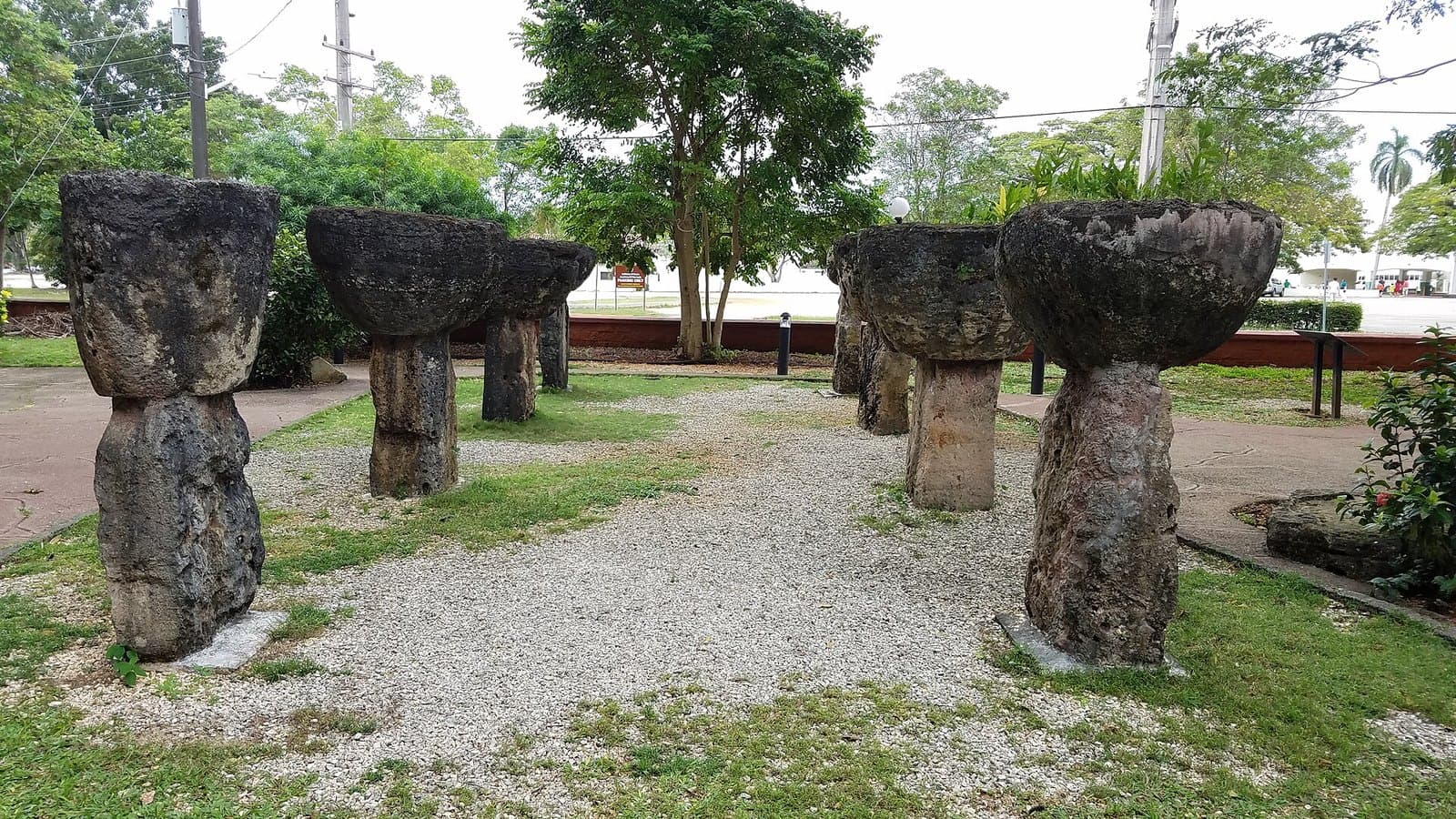
In a small park a short walk from Guam's cathedral, eight pairs of stone pillars stand in two rows, each one capped with a hemispherical stone the shape of an upturned bowl. These are latte, the pillar-and-capstone supports on which CHamoru houses once rested, and they are the signature monument of the Mariana Islands. The ones in Hagåtña were carried there in the 1950s from a site inland; the older ones lie where they fell, in the limestone forest, in the villages the Spanish emptied, at Pågat and Ritidian and a hundred unmarked places. They mark a settled society that had been working stone on this island for centuries before any European chart carried its name.
Guam's particular inheritance is continuity under other people's flags. Since Padre Diego Luis de San Vitores stepped ashore in 1668 the island has never once governed itself: Spain for two hundred and thirty years, the United States Navy for forty-two, Japan for thirty-one months, and the United States again ever since. What survived all of that is a people, a language classed as endangered and being taught back into children's mouths, a Catholicism grown into older obligations, and a set of duties toward the dead that no administration ever managed to interrupt.
Guam, Guåhan in CHamoru, is the southernmost and by far the largest of the Mariana Islands, about 544 square kilometres of raised coral limestone in the north and volcanic hills in the south, roughly 2,500 kilometres east of Manila and about 6,000 kilometres west of Honolulu. The 2020 census counted 153,836 residents across nineteen villages; Hagåtña is the seat of government and one of the smallest of them, while Dededo in the north holds by far the most people. Guam is an unincorporated organised territory of the United States, and its residents are American citizens under the Organic Act of 1950 who elect their own governor and legislature, send one non-voting delegate to Congress, and cannot vote for the president who serves as their head of state (Guampedia). CHamoru and English are both official. Roughly a quarter of the island's land is held by the United States military, a proportion that shapes almost every argument about heritage, water and access on Guåhan.
Hagåtña. The capital was the Spanish administrative seat and the island's largest settlement until the war levelled it in 1944, and it has never regained its population; a few hundred people live there now among government buildings, the Dulce Nombre de Maria Cathedral-Basilica, the Guam Museum and the Plaza de España, where the Chocolate House and the arched gateways of the old Spanish governor's palace still stand. Senator Angel Leon Guerrero Santos Memorial Park, known to everyone as Latte Stone Park, sits just behind it.
Dededo and Tamuning. The population moved north after the war and stayed there. Dededo, the largest village, holds the flea market that has become the island's weekend gathering place, while neighbouring Tamuning and the hotel strip at Tumon carry the tourist economy. Tumon Bay is also where San Vitores was killed in 1672, a fact the beachfront signage mentions and most visitors miss.
Hågat and Asan. The two invasion beaches of July 1944 are now units of the War in the Pacific National Historical Park, with gun emplacements, memorials and the Asan Bay Overlook, where a memorial wall carries more than sixteen thousand names of American service members and CHamoru civilians who died in the occupation and the recapture (National Park Service).
Malesso and Humåtak. In the far south, Malesso, sometimes written Merizo, is where the Tinta and Faha massacres took place in July 1944 and where the village still walks to the sites each year. Humåtak, or Umatac, is by tradition the bay where Magellan's ships came in from the Pacific in 1521, and it marks the landfall with an annual reenactment that has itself become a subject of argument.
People reached the Marianas roughly 3,500 years ago in one of the longest open-ocean crossings any human population had then attempted, and they built a society that by about 900 CE was raising latte, quarrying the haligi and tåsa from limestone outcrops and hauling them into place for houses, meeting halls and storehouses (Guampedia). Ferdinand Magellan's expedition made landfall in March 1521, took on water, and left behind the name Islas de los Ladrones after a dispute over a stolen boat; Miguel López de Legazpi claimed the islands for Spain in 1565, and for a century they served as a watering stop on the galleon route between Manila and Acapulco without any permanent Spanish presence.
 Umatac bay is where the Manila galleons put in for water, and the fort guarded a route that ran between Mexico and the Philippines for two hundred and fifty years. Photograph by Daderot, CC0, via Wikimedia Commons.
That changed in June 1668, when the Jesuit Diego Luis de San Vitores landed with priests, lay brothers and a small garrison and founded a mission, renaming the archipelago for the Spanish queen regent Mariana of Austria. San Vitores was killed at Tumon in April 1672 by the maga'låhi Matå'pang after baptising his daughter against his wishes, and the killing opened nearly three decades of intermittent war (Guampedia).
The consequences have to be stated plainly. Estimates of the CHamoru population of Guam at contact range widely, from around 24,000 at the low end through the 35,000 to 50,000 suggested by a 1668 account describing some 180 villages, to San Vitores' own figure of 100,000. By 1710 a Spanish census recorded 3,539 CHamorus alive, and by 1786 the count for Guam and Rota together had fallen to roughly 1,500 (Guampedia, Wikipedia). Warfare accounts for part of that; introduced smallpox and influenza, the forced concentration of survivors into mission villages under the policy of reducción, and the resulting collapse of food production account for most of it. The people who came through it intermarried with Spanish, Filipino and Mexican soldiers and settlers, kept their language, and rebuilt.
Spain ceded Guam to the United States under the Treaty of Paris in 1898, and from 1899 the island was run by a succession of naval officers governing by decree, with no legislature and no bill of rights; CHamoru was discouraged and at times punished in schools. Japan invaded on 8 December 1941, hours after Pearl Harbor across the date line, and held the island for thirty-one months. In July 1944, as the American fleet approached, the Japanese command ordered the civilian population marched inland to camps, above all to the Manenggon valley between Yona and Talo'fo'fo, and thousands walked there carrying what they could (Guampedia). On 15 and 16 July soldiers murdered around fifty people from Malesso at Tinta and Faha, throwing grenades into a cave and then using bayonets; fourteen survived Tinta by lying still among the dead (Guampedia). American forces landed on 21 July 1944 and declared the island secure in August.
The Organic Act followed in 1950, granting citizenship and civil government. Guam has been on the United Nations list of non-self-governing territories since 1946 (United Nations).
CHamoru is an Austronesian language, the sole survivor of its branch in the Marianas, and after three centuries of Spanish contact its vocabulary carries a heavy Spanish load: the numbers above a certain point, the days of the week, much kinship and nearly all religious terminology. The grammar underneath stayed CHamoru. The name Guåhan is generally understood to derive from a root meaning "to have", which islanders gloss as "we have", a reference to the island's water and food; Hagåtña takes its name from håga', blood, in the sense of a bloodline or artery.
Spelling has been a live political question. The 1971 Marianas orthography, re-adopted in 1983, was revised by Guam's language commission, the Kumisión i Fino' CHamoru, and formally launched in September 2018; among its decisions was to write the name of the people and their language as CHamoru, with both letters of the digraph capitalised, in place of the Spanish-derived Chamorro that had been standard (Guampedia, Guampedia). You will still see Chamorro in older laws, older books and across the water in the Northern Marianas.
The language is in real trouble. Fluent speakers are overwhelmingly older, transmission at home thinned badly during the decades when English was the language of school and advancement, and UNESCO classes CHamoru as endangered. The response has been immersion: the Hurao Academy, public school programmes, university coursework and a commission with a statutory mandate to restore the language (Guampedia).
The organising value is inafa'maolek, which translates roughly as making things good again, and which describes an obligation to restore balance within a family and a village rather than to win an exchange (Guampedia). Its practical arm is chenchule', a system of reciprocal giving in which contributions of money, food, labour and time at weddings, funerals, novenas and christenings are remembered and repaid across decades and generations. Families keep track. When someone dies, the chenchule' that arrives is a ledger entry as much as a kindness, and the family will be expected to answer it in turn when the giver's own household is grieving.
Respect for elders is embodied in mannginge', the gesture of taking an older relative's hand and touching it to the nose while saying ñot or ñora. Each village keeps its own patron saint and its own fiesta, and the fiesta calendar organises the year: red rice, kelaguen, kådu, finadene, a tent in the yard, a rosary before the meal. Weaving from pandanus and coconut, the carving of proa canoes, and the chant and dance traditions revived from the 1980s onward by cultural groups all sit alongside a strong CHamoru presence in contemporary Pacific music and spoken word. Guam hosted the Festival of Pacific Arts in 2016, which brought performers from across Oceania to the island and gave a generation of local practitioners a stage.
Guam is overwhelmingly Catholic, the legacy of the Jesuit mission and its Augustinian and Capuchin successors, and the Archdiocese of Agaña organises much of village life through parish fiestas, novenas and confraternities. The island's patroness is Santa Marian Kamalen, whose statue is carried through Hagåtña each 8 December in a procession that closes the streets. Pedro Calungsod, the young Visayan catechist killed alongside San Vitores in 1672, was canonised in 2012, and San Vitores himself was beatified in 1985, which keeps a contested colonial episode inside the liturgical calendar.
Older belief did not disappear so much as move alongside. CHamorus speak of taotaomo'na, the people of before, ancestral spirits who inhabit the jungle, the older trees and the ruins, and it remains ordinary good manners to ask permission aloud before relieving yourself or cutting a branch in unfamiliar bush. Suruhånu and suruhåna, traditional herbalists and healers, still practise, sometimes in parallel with the hospital and sometimes instead of it, and their knowledge of åmot, medicinal plants, is now the subject of formal documentation projects.
Death on Guam sets off a long and highly organised sequence. The bela, the wake or vigil, gathers the extended family at the house or the church, and the lisåyu, the rosary, begins almost immediately, led by a techa, a lay prayer leader, usually a woman, whose command of the sung Catholic and CHamoru responses gives her real standing in the village (Guampedia). The rosary is prayed for nine consecutive nights, the lisåyon måtai, after which the immediate family prays another nine nights privately as the lisåyon familia. A year later the family gathers again for the lisåyon komple'åños, the anniversary rosary that Guam commonly calls the anos, which closes the formal mourning period and asks everyone who came at the beginning to come once more (Guampedia, Guampedia).
Chenchule' runs through all of it. Relatives and neighbours arrive with cash envelopes, rice, meat, folding chairs and hours of work in the kitchen, and someone records what came from whom. The obligation crosses the ocean: CHamoru families in California, Washington and Texas send money home for rosaries they cannot attend, and the ledger holds. On 2 November, Todus i Santos, families clean and repaint the graves, bring flowers and candles, and eat beside them.
The war added a public layer to the private one. Survivors of the occupation walk the Manenggon trail each July, Malesso holds its own observances at Tinta and Faha, and Liberation Day on 21 July fills Marine Corps Drive with a parade, a carnival and a queen contest that has run since 1948. The day carries more than one meaning at once. For the shrinking number who lived through the occupation and its atrocities, 21 July is exactly what its name says. For a good many CHamorus, particularly since the activism of the 1970s, the word liberation sits awkwardly on an event that returned the island to a power that had governed it by naval decree, took thousands of acres of family land for bases afterwards, and has still not held the status vote it promises (Wikipedia). Both readings show up at the same parade.
Guam's records begin in Spanish, continue in American and were nearly lost in the middle.
Catholic parish registers, kept by Jesuit and later Augustinian Recollect priests, run from the late seventeenth century and are the earliest vital records in the Pacific islands. They are also the record of a catastrophe: the CHamoru population fell from tens of thousands to a few thousand in the decades after Spanish conquest, through war and disease, and the registers document the survivors being resettled into a handful of villages.
Spanish administrative records are largely in Seville and Manila. After 1898 the United States Navy governed the island and kept censuses, court records and the paperwork of a naval station.
Then 1941 to 1944. Japanese occupation and the American reconquest destroyed Agana almost entirely, and with it a great deal of the archive. What survived did so because it was elsewhere. The Micronesian Area Research Center at the University of Guam has spent decades gathering copies from Spain, Mexico, the Philippines, Japan and the United States, and it holds the reassembled record.
CHamoru genealogy is carried in the clan nickname. Almost every family has one, unrelated to the surname, and CHamorus identify each other by it, so two people meeting will establish kinship by exchanging clan names rather than surnames. It survived the Spanish surname assignments, the American administration and the war, because it was never written down anywhere that could burn.
The Senator Antonio M. Palomo Guam Museum and CHamoru Educational Facility opened in Hagåtña in 2016 after decades of false starts, giving the island its first purpose-built national museum; its permanent exhibition, I Hinanao-ta Nu Manaotao Tåno', traces the CHamoru journey from settlement through the colonial centuries to the present (Guam Museum, Guampedia). The Guam Preservation Trust funds the restoration of historic structures and archaeological work, and the territory's Historic Resources Division administers National Register listings.
The War in the Pacific National Historical Park, authorised in 1978, protects seven units across the western side of the island, including the Asan and Hågat landing beaches, the Piti coastal guns and the Fonte Plateau, and it is one of the few American national parks whose founding purpose is to commemorate the suffering of civilians alongside soldiers (National Park Service). At the northern tip, the Ritidian unit of the Guam National Wildlife Refuge protects limestone forest, caves with pictographs and one of the earliest occupation sites in the Marianas, a place CHamorus call Litekyan (Guampedia). Pågat, on the north-east coast, holds a latte village and a freshwater cave and became the focus of a preservation campaign during the military buildup (Guampedia).
Guam's most used heritage resource is online. Guampedia, a non-profit encyclopaedia launched from the University of Guam, now runs to thousands of peer-reviewed entries covering CHamoru history, biography, language, war testimony and cultural practice, and it is the reference that islanders, students and researchers actually reach for (Guampedia). The Micronesian Area Research Center at the University of Guam holds the Spanish, German and American documentary record for the region and has been digitising it, and the war survivor oral histories collected since the 1980s are steadily being published in transcript and audio.
The Kumisión i Fino' CHamoru publishes the 2018 orthography, teaching materials and word lists digitally, which matters for a language whose learners are scattered across the mainland United States. The National Park Service maintains digital interpretation for the war sites, and Guam's own decolonisation commission puts its educational material and status-option explanations on the public web (Commission on Decolonization).
The dominant contemporary fact is the military buildup. Under a 2006 agreement with Japan, thousands of Marines are being relocated from Okinawa to Guam, and Marine Corps Base Camp Blaz was activated in 2020 as the first new Marine Corps base since 1952 (Guampedia). The programme brings construction money, jobs and federal investment. It also requires land, live-fire training space and water on an island where the military already holds a large share of both, and where much of the land taken after 1944 was never returned to the families it came from. Guam's heritage sites sit inside that argument rather than beside it, which is why Pågat and Litekyan became rallying points and why groups such as We Are Guåhan formed around them (Guampedia).
Running underneath is the status question. Guam's Commission on Decolonization is charged with putting independence, free association and statehood to a vote, but the 2000 plebiscite law limited the ballot to "native inhabitants of Guam", and in 2019 the Ninth Circuit held in Davis v. Guam that the restriction used ancestry as a proxy for race and violated the Fifteenth Amendment (Guampedia, Harvard Law Review). Supporters of the restriction argue that decolonisation is by definition a right of the colonised people; opponents argue that every American citizen resident on Guam should vote on Guam's future. The plebiscite has not been held, and the island's constitutional relationship remains as it was in 1950.
Beyond politics, the CHamoru diaspora is now larger than the population at home, and it exports the culture: fiestas in San Diego and Seattle, language classes on video call, Guam-raised musicians and writers with audiences across the Pacific, and a steady traffic of families flying back for a funeral or an anos.
A national museum, finally built. After more than fifty years of proposals, the Guam Museum opened in Hagåtña in 2016 with a permanent CHamoru history exhibition and a public archive, giving the island a place to hold its own account of itself.
Pågat stayed out of the range. Community litigation and a preservation campaign during the buildup ended with a 2011 programmatic agreement excluding the Pågat village and cave from the proposed firing range footprint and guaranteeing continued public access to the site.
Compensation for the occupation, seventy years on. The Guam World War II Loyalty Recognition Act, signed into law in December 2016, established a claims programme for survivors and heirs of the 1941 to 1944 occupation, covering forced march, forced labour, internment, injury and death; the Foreign Claims Settlement Commission began taking claims in 2017 (US Department of Justice).
One spelling for the language. The 2018 orthography gave CHamoru a single agreed writing system, backed by a statutory commission and used by immersion schools such as Hurao Academy, so that a child learning the language and an adult writing it are now working from the same rules.
Umatac bay is where the Manila galleons put in for water, and the fort guarded a route that ran between Mexico and the Philippines for two hundred and fifty years. Photograph by Daderot, CC0, via Wikimedia Commons.
That changed in June 1668, when the Jesuit Diego Luis de San Vitores landed with priests, lay brothers and a small garrison and founded a mission, renaming the archipelago for the Spanish queen regent Mariana of Austria. San Vitores was killed at Tumon in April 1672 by the maga'låhi Matå'pang after baptising his daughter against his wishes, and the killing opened nearly three decades of intermittent war (Guampedia).
The consequences have to be stated plainly. Estimates of the CHamoru population of Guam at contact range widely, from around 24,000 at the low end through the 35,000 to 50,000 suggested by a 1668 account describing some 180 villages, to San Vitores' own figure of 100,000. By 1710 a Spanish census recorded 3,539 CHamorus alive, and by 1786 the count for Guam and Rota together had fallen to roughly 1,500 (Guampedia, Wikipedia). Warfare accounts for part of that; introduced smallpox and influenza, the forced concentration of survivors into mission villages under the policy of reducción, and the resulting collapse of food production account for most of it. The people who came through it intermarried with Spanish, Filipino and Mexican soldiers and settlers, kept their language, and rebuilt.
Spain ceded Guam to the United States under the Treaty of Paris in 1898, and from 1899 the island was run by a succession of naval officers governing by decree, with no legislature and no bill of rights; CHamoru was discouraged and at times punished in schools. Japan invaded on 8 December 1941, hours after Pearl Harbor across the date line, and held the island for thirty-one months. In July 1944, as the American fleet approached, the Japanese command ordered the civilian population marched inland to camps, above all to the Manenggon valley between Yona and Talo'fo'fo, and thousands walked there carrying what they could (Guampedia). On 15 and 16 July soldiers murdered around fifty people from Malesso at Tinta and Faha, throwing grenades into a cave and then using bayonets; fourteen survived Tinta by lying still among the dead (Guampedia). American forces landed on 21 July 1944 and declared the island secure in August.
The Organic Act followed in 1950, granting citizenship and civil government. Guam has been on the United Nations list of non-self-governing territories since 1946 (United Nations).
CHamoru is an Austronesian language, the sole survivor of its branch in the Marianas, and after three centuries of Spanish contact its vocabulary carries a heavy Spanish load: the numbers above a certain point, the days of the week, much kinship and nearly all religious terminology. The grammar underneath stayed CHamoru. The name Guåhan is generally understood to derive from a root meaning "to have", which islanders gloss as "we have", a reference to the island's water and food; Hagåtña takes its name from håga', blood, in the sense of a bloodline or artery.
Spelling has been a live political question. The 1971 Marianas orthography, re-adopted in 1983, was revised by Guam's language commission, the Kumisión i Fino' CHamoru, and formally launched in September 2018; among its decisions was to write the name of the people and their language as CHamoru, with both letters of the digraph capitalised, in place of the Spanish-derived Chamorro that had been standard (Guampedia, Guampedia). You will still see Chamorro in older laws, older books and across the water in the Northern Marianas.
The language is in real trouble. Fluent speakers are overwhelmingly older, transmission at home thinned badly during the decades when English was the language of school and advancement, and UNESCO classes CHamoru as endangered. The response has been immersion: the Hurao Academy, public school programmes, university coursework and a commission with a statutory mandate to restore the language (Guampedia).
The organising value is inafa'maolek, which translates roughly as making things good again, and which describes an obligation to restore balance within a family and a village rather than to win an exchange (Guampedia). Its practical arm is chenchule', a system of reciprocal giving in which contributions of money, food, labour and time at weddings, funerals, novenas and christenings are remembered and repaid across decades and generations. Families keep track. When someone dies, the chenchule' that arrives is a ledger entry as much as a kindness, and the family will be expected to answer it in turn when the giver's own household is grieving.
Respect for elders is embodied in mannginge', the gesture of taking an older relative's hand and touching it to the nose while saying ñot or ñora. Each village keeps its own patron saint and its own fiesta, and the fiesta calendar organises the year: red rice, kelaguen, kådu, finadene, a tent in the yard, a rosary before the meal. Weaving from pandanus and coconut, the carving of proa canoes, and the chant and dance traditions revived from the 1980s onward by cultural groups all sit alongside a strong CHamoru presence in contemporary Pacific music and spoken word. Guam hosted the Festival of Pacific Arts in 2016, which brought performers from across Oceania to the island and gave a generation of local practitioners a stage.
Guam is overwhelmingly Catholic, the legacy of the Jesuit mission and its Augustinian and Capuchin successors, and the Archdiocese of Agaña organises much of village life through parish fiestas, novenas and confraternities. The island's patroness is Santa Marian Kamalen, whose statue is carried through Hagåtña each 8 December in a procession that closes the streets. Pedro Calungsod, the young Visayan catechist killed alongside San Vitores in 1672, was canonised in 2012, and San Vitores himself was beatified in 1985, which keeps a contested colonial episode inside the liturgical calendar.
Older belief did not disappear so much as move alongside. CHamorus speak of taotaomo'na, the people of before, ancestral spirits who inhabit the jungle, the older trees and the ruins, and it remains ordinary good manners to ask permission aloud before relieving yourself or cutting a branch in unfamiliar bush. Suruhånu and suruhåna, traditional herbalists and healers, still practise, sometimes in parallel with the hospital and sometimes instead of it, and their knowledge of åmot, medicinal plants, is now the subject of formal documentation projects.
Death on Guam sets off a long and highly organised sequence. The bela, the wake or vigil, gathers the extended family at the house or the church, and the lisåyu, the rosary, begins almost immediately, led by a techa, a lay prayer leader, usually a woman, whose command of the sung Catholic and CHamoru responses gives her real standing in the village (Guampedia). The rosary is prayed for nine consecutive nights, the lisåyon måtai, after which the immediate family prays another nine nights privately as the lisåyon familia. A year later the family gathers again for the lisåyon komple'åños, the anniversary rosary that Guam commonly calls the anos, which closes the formal mourning period and asks everyone who came at the beginning to come once more (Guampedia, Guampedia).
Chenchule' runs through all of it. Relatives and neighbours arrive with cash envelopes, rice, meat, folding chairs and hours of work in the kitchen, and someone records what came from whom. The obligation crosses the ocean: CHamoru families in California, Washington and Texas send money home for rosaries they cannot attend, and the ledger holds. On 2 November, Todus i Santos, families clean and repaint the graves, bring flowers and candles, and eat beside them.
The war added a public layer to the private one. Survivors of the occupation walk the Manenggon trail each July, Malesso holds its own observances at Tinta and Faha, and Liberation Day on 21 July fills Marine Corps Drive with a parade, a carnival and a queen contest that has run since 1948. The day carries more than one meaning at once. For the shrinking number who lived through the occupation and its atrocities, 21 July is exactly what its name says. For a good many CHamorus, particularly since the activism of the 1970s, the word liberation sits awkwardly on an event that returned the island to a power that had governed it by naval decree, took thousands of acres of family land for bases afterwards, and has still not held the status vote it promises (Wikipedia). Both readings show up at the same parade.
Guam's records begin in Spanish, continue in American and were nearly lost in the middle.
Catholic parish registers, kept by Jesuit and later Augustinian Recollect priests, run from the late seventeenth century and are the earliest vital records in the Pacific islands. They are also the record of a catastrophe: the CHamoru population fell from tens of thousands to a few thousand in the decades after Spanish conquest, through war and disease, and the registers document the survivors being resettled into a handful of villages.
Spanish administrative records are largely in Seville and Manila. After 1898 the United States Navy governed the island and kept censuses, court records and the paperwork of a naval station.
Then 1941 to 1944. Japanese occupation and the American reconquest destroyed Agana almost entirely, and with it a great deal of the archive. What survived did so because it was elsewhere. The Micronesian Area Research Center at the University of Guam has spent decades gathering copies from Spain, Mexico, the Philippines, Japan and the United States, and it holds the reassembled record.
CHamoru genealogy is carried in the clan nickname. Almost every family has one, unrelated to the surname, and CHamorus identify each other by it, so two people meeting will establish kinship by exchanging clan names rather than surnames. It survived the Spanish surname assignments, the American administration and the war, because it was never written down anywhere that could burn.
The Senator Antonio M. Palomo Guam Museum and CHamoru Educational Facility opened in Hagåtña in 2016 after decades of false starts, giving the island its first purpose-built national museum; its permanent exhibition, I Hinanao-ta Nu Manaotao Tåno', traces the CHamoru journey from settlement through the colonial centuries to the present (Guam Museum, Guampedia). The Guam Preservation Trust funds the restoration of historic structures and archaeological work, and the territory's Historic Resources Division administers National Register listings.
The War in the Pacific National Historical Park, authorised in 1978, protects seven units across the western side of the island, including the Asan and Hågat landing beaches, the Piti coastal guns and the Fonte Plateau, and it is one of the few American national parks whose founding purpose is to commemorate the suffering of civilians alongside soldiers (National Park Service). At the northern tip, the Ritidian unit of the Guam National Wildlife Refuge protects limestone forest, caves with pictographs and one of the earliest occupation sites in the Marianas, a place CHamorus call Litekyan (Guampedia). Pågat, on the north-east coast, holds a latte village and a freshwater cave and became the focus of a preservation campaign during the military buildup (Guampedia).
Guam's most used heritage resource is online. Guampedia, a non-profit encyclopaedia launched from the University of Guam, now runs to thousands of peer-reviewed entries covering CHamoru history, biography, language, war testimony and cultural practice, and it is the reference that islanders, students and researchers actually reach for (Guampedia). The Micronesian Area Research Center at the University of Guam holds the Spanish, German and American documentary record for the region and has been digitising it, and the war survivor oral histories collected since the 1980s are steadily being published in transcript and audio.
The Kumisión i Fino' CHamoru publishes the 2018 orthography, teaching materials and word lists digitally, which matters for a language whose learners are scattered across the mainland United States. The National Park Service maintains digital interpretation for the war sites, and Guam's own decolonisation commission puts its educational material and status-option explanations on the public web (Commission on Decolonization).
The dominant contemporary fact is the military buildup. Under a 2006 agreement with Japan, thousands of Marines are being relocated from Okinawa to Guam, and Marine Corps Base Camp Blaz was activated in 2020 as the first new Marine Corps base since 1952 (Guampedia). The programme brings construction money, jobs and federal investment. It also requires land, live-fire training space and water on an island where the military already holds a large share of both, and where much of the land taken after 1944 was never returned to the families it came from. Guam's heritage sites sit inside that argument rather than beside it, which is why Pågat and Litekyan became rallying points and why groups such as We Are Guåhan formed around them (Guampedia).
Running underneath is the status question. Guam's Commission on Decolonization is charged with putting independence, free association and statehood to a vote, but the 2000 plebiscite law limited the ballot to "native inhabitants of Guam", and in 2019 the Ninth Circuit held in Davis v. Guam that the restriction used ancestry as a proxy for race and violated the Fifteenth Amendment (Guampedia, Harvard Law Review). Supporters of the restriction argue that decolonisation is by definition a right of the colonised people; opponents argue that every American citizen resident on Guam should vote on Guam's future. The plebiscite has not been held, and the island's constitutional relationship remains as it was in 1950.
Beyond politics, the CHamoru diaspora is now larger than the population at home, and it exports the culture: fiestas in San Diego and Seattle, language classes on video call, Guam-raised musicians and writers with audiences across the Pacific, and a steady traffic of families flying back for a funeral or an anos.
A national museum, finally built. After more than fifty years of proposals, the Guam Museum opened in Hagåtña in 2016 with a permanent CHamoru history exhibition and a public archive, giving the island a place to hold its own account of itself.
Pågat stayed out of the range. Community litigation and a preservation campaign during the buildup ended with a 2011 programmatic agreement excluding the Pågat village and cave from the proposed firing range footprint and guaranteeing continued public access to the site.
Compensation for the occupation, seventy years on. The Guam World War II Loyalty Recognition Act, signed into law in December 2016, established a claims programme for survivors and heirs of the 1941 to 1944 occupation, covering forced march, forced labour, internment, injury and death; the Foreign Claims Settlement Commission began taking claims in 2017 (US Department of Justice).
One spelling for the language. The 2018 orthography gave CHamoru a single agreed writing system, backed by a statutory commission and used by immersion schools such as Hurao Academy, so that a child learning the language and an adult writing it are now working from the same rules.
National Overview
Notable Cities
Historical Foundations
Linguistic and Etymological Roots
Cultural Identity
Religion and Spirituality
Remembrance and Mourning Traditions
Tracing a Family in Guam
Heritage Preservation Efforts
Digital Heritage
Contemporary Cultural Influences
Success Stories
References and resources
- Guampedia: the University of Guam's online encyclopaedia of CHamoru history, language and culture, and the source for most entries cited here.
- Guampedia, Spanish Response to CHamoru Depopulation: contact-era population estimates and the census figures of 1710 and 1786.
- Wikipedia, Spanish-Chamorro Wars: the conflict of 1671 to 1698 and the policy of reducción.
- Guampedia, Father Diego Luis de San Vitores: the 1668 mission, the killing at Tumon in 1672 and its aftermath.
- Guampedia, Latte: the quarrying, shaping and function of the haligi and tåsa.
- Guampedia, War Atrocities: Manenggon Concentration Camp: the forced marches of July 1944.
- Guampedia, War Atrocities: Tinta and Faha Massacres: the killings at Malesso on 15 and 16 July 1944.
- Guampedia, Organic Act of Guam: the 1950 grant of citizenship and civil government.
- United Nations, Guam: Guam's listing as a non-self-governing territory since 1946.
- Guam Commission on Decolonization: the three status options and the territory's official position.
- Harvard Law Review, Davis v. Guam: the Ninth Circuit's 2019 ruling on the plebiscite electorate.
- Guampedia, CHamoru Orthography Rules: the 2018 orthography and the spelling of CHamoru.
- Guampedia, Burial Practices: the lisåyu, the nine nights and the anniversary rosary.
- Guampedia, Inafa'maolek: the value of restoring harmony and its place in chenchule'.
- National Park Service, War in the Pacific National Historical Park: the 1944 battle sites and the Asan Bay Overlook memorial wall.
- Guam Museum: the Senator Antonio M. Palomo Guam Museum and CHamoru Educational Facility in Hagåtña.
- US Department of Justice, Guam World War II Loyalty Recognition Act claims: the compensation programme for occupation survivors and heirs.