Heritage · Country
Falkland Islands Culture and Heritage
An archipelago of peat, tussac and stone runs in the South Atlantic, settled by shepherds and claimed by two countries. This is a guide to its heritage: the sailing hulks in Stanley harbour, the gaucho words still used for horse gear, and the war cemetery whose graves finally got names.Written to last.
By Confinity Heritage Editorial · Updated 2026-08-17 · 8-minute readQuiet tools, kept out of the way.
The Falkland Islands, called the Islas Malvinas in Spanish and by Argentina, are an archipelago of two large islands and several hundred small ones in the South Atlantic, about 500 kilometres east of Patagonia. Sovereignty over them is disputed between the United Kingdom, which administers them, and Argentina, which claims them. This profile uses the English name because that is what the resident population uses; the Spanish name is equally current in Argentina and across much of Latin America.
What the islands hold is a settler heritage of unusual density for a place with 3,662 people in it. Sailing ships that could not round Cape Horn limped in here to be condemned, and their hulls are still in the harbour. Uruguayan gauchos taught the first shepherds to ride and left behind the words for the tack. Children on the outlying farms were taught by radio and by teachers who moved in with the family for a fortnight at a time. And on a hillside above Darwin lies a cemetery that spent thirty-five years full of graves marked only as known to God, until a forensic project gave most of them their names back.
The Falklands cover about 12,173 square kilometres, roughly the size of Northern Ireland, split between East Falkland, West Falkland and some 776 smaller islands. The land is low, treeless and wind-scoured, a surface of acid peat, tussac grass, diddle-dee heath and quartzite stone runs, with sheep almost everywhere and no native land mammals apart from the warrah, a fox-like canid hunted to extinction by 1876. The 2021 census recorded 3,662 residents, four in five of them in Stanley (Falkland Islands).
The territory is internally self-governing under an elected Legislative Assembly, with the United Kingdom responsible for defence and foreign affairs. Fishing licences, chiefly for squid, provide half or more of GDP; wool and cruise tourism make up much of the rest. English is the language of daily life, and a substantial minority of residents were born elsewhere, mainly in Britain, Chile and St Helena.
Sovereignty is disputed, and the two governments argue from different starting points. The United Kingdom rests its case on continuous administration since 1833 and on the islanders' right to self-determination, and declines to negotiate sovereignty against their wishes. Argentina holds that it inherited the islands from Spain on independence in 1816, that Britain's action in January 1833 was an act of usurpation in which Argentine officials and the garrison were expelled, and that the principle of territorial integrity applies because the present population was implanted by the administering power and so cannot constitute a people entitled to self-determination. Islanders were asked on 10 and 11 March 2013 whether they wished to keep their status as a British Overseas Territory; 1,513 voted yes and 3 voted no, a margin of 99.8 per cent on a turnout of 92 per cent (2013 referendum). Argentina rejected the vote's validity on the ground that the electorate itself is the matter in dispute, and the United Nations Special Committee on Decolonization continues to call annually for bilateral negotiations, as it has since General Assembly resolution 2065 of 1965.
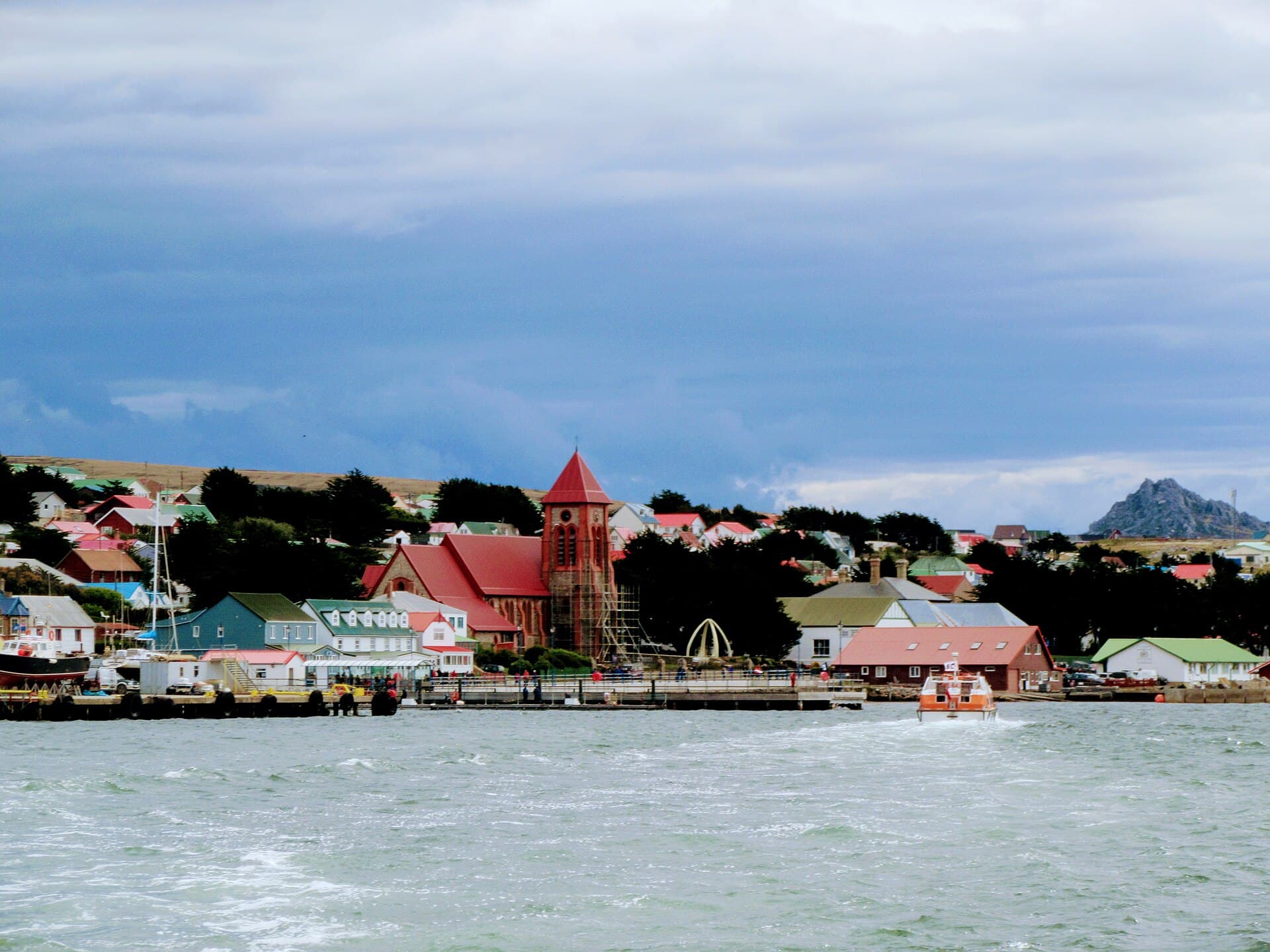
Stanley. The capital holds 2,974 people in a long single-sided town facing north across its harbour. It has the corrugated iron and painted roofs that give it its look from the water, a whalebone arch, Government House of 1845, the Historic Dockyard, and a working port. Stanley was granted city status on 14 June 2022, the fortieth anniversary of the end of the 1982 conflict.
 The cathedral is the southernmost Anglican one in the world, and the arch of blue whale jawbones beside it was raised in 1933 from the whaling that built much of the settlement. Photograph by Stefan Brending, CC BY-SA 3.0 DE, via Wikimedia Commons.
Port Louis. The first settlement, founded by the French in 1764 on the north-east coast of East Falkland, later the Spanish Puerto Soledad and then the seat of British administration until 1845. Its ruins and old farm buildings are the oldest European structures in the territory.
Goose Green and Darwin. A shearing settlement on the isthmus of Lafonia, site of the largest sheep station and of the first land battle of 1982, with the Argentine military cemetery on the slope above.
The Camp. Everything outside Stanley is called Camp, from the Spanish campo, and its people are scattered across farm settlements of a few families each: Fox Bay, Port Howard, San Carlos, Hill Cove, Saunders Island, Pebble Island and the rest.
The early record is contested at almost every point, which is part of why the dispute persists. An English expedition under John Davis sighted islands here in 1592, and John Strong made the first recorded landing in 1690, naming the sound between the two main islands for Viscount Falkland, the Treasurer of the Navy. France planted the first settlement, Port Saint Louis, in 1764 under Louis Antoine de Bougainville, whose men came from Saint-Malo and gave the islands the name Îles Malouines, from which Malvinas descends. Britain established Port Egmont on Saunders Island in 1765 without knowing the French were there. France transferred its colony to Spain in 1767; Spain expelled the British from Port Egmont in 1770 and restored it a year later after a diplomatic crisis; Britain withdrew in 1774 for reasons of cost, leaving a plaque asserting its claim, and Spain withdrew from Puerto Soledad in 1811.
The islands were effectively without government for a decade. In 1820 David Jewett, commanding a privateer in the service of the United Provinces of the River Plate, claimed them at Puerto Soledad. From 1826 the merchant Luis Vernet built a settlement there under Buenos Aires authority, seizing American sealers in 1831 for breaching his fishing rules; the USS Lexington raided the settlement in reprisal that December. In January 1833 the British warship Clio arrived, and Captain James Onslow required the small Argentine garrison to leave, which it did. British administration has been continuous since. What that sequence means is precisely what the two governments dispute.
Governor Richard Moody moved the seat of government to a deeper anchorage in 1843, and it was named Stanley in July 1845. For the next seventy years the town lived off Cape Horn. Ships battered rounding the Horn put into Stanley to be repaired, and many were condemned there instead: bought cheaply, stripped, and sunk or beached as jetties, warehouses and coal hulks, so that the harbour filled with the hulls of nineteenth-century merchantmen. The opening of the Panama Canal in 1914 ended the trade, and the wrecks stayed where they were.
Ashore, the economy became wool. The Falkland Islands Company received its royal charter in 1851 and came to own much of the land, running large stations worked by shepherds on horseback. Sheep numbers passed half a million by the 1880s, and the pattern of a few big farms with settlements attached lasted until the government subdivided the largest from the 1980s.
On 2 April 1982 Argentine forces landed and took Stanley. Britain sent a naval task force 12,000 kilometres south, landed at San Carlos on 21 May, fought at Goose Green, Mount Longdon, Two Sisters, Tumbledown and Wireless Ridge, and accepted the Argentine surrender on 14 June, 74 days after the landing. The dead numbered 649 Argentine servicemen, 255 British, and three Falkland Islanders, Doreen Bonner, Mary Goodwin and Susan Whitley, killed by shelling in Stanley on 11 June (Falklands War).
The English name comes from Falkland Sound, which Strong named in 1690 for Anthony Cary, fifth Viscount Falkland, who had paid for his voyage. Malvinas comes through Spanish from the French Malouines, for the sailors of Saint-Malo who settled Port Louis in 1764. Neither name has any connection to the islands themselves, which is a fair summary of how they were populated.
Falkland Islands English is a British variety with a distinct South Atlantic accent and a vocabulary shaped by the sheep trade and by Spanish. Uruguayan and Argentine gauchos were brought over in the nineteenth century to break horses and work cattle, and they left more than two hundred Spanish place names on the map, among them Rincon Grande and Arroyo Malo, along with almost the whole vocabulary of horse gear. Islanders still say bozal for a halter, maneas for hobbles, cincha for a girth, cojinillo for the sheepskin over the saddle, and use Spanish colour terms for horses: zaino, alazan, colorado, mala cara (Journal of Linguistic Geography). The commonest borrowing is the plainest: camp, from campo, for the countryside and everyone who lives in it. Older speakers also use "smoko" for a tea break and "kelper" for an islander, the second of which some accept and some resent.
Falkland Islanders describe themselves as islanders first, and the strength of that identification is bound up with a dispute in which their existence is one of the arguments. Family lines run back five or six generations to shepherds from Scotland, Wales and the West Country, and the older surnames are known to everyone.
Camp life produced most of the traditions. Peat was cut by hand from the bogs each summer, stacked to dry and carted home for winter fuel, a communal season with its own etiquette. Shearing gangs moved between settlements, and the sports meetings at the end of the season combined horse racing, sheepdog trials and dancing over several days, as they still do. Horses mattered more than roads, because until the 1980s there were almost none: travel was by horse, by coastal steamer, or by the small aircraft of the government air service.
Education in the Camp was carried out by two-way radio and by travelling teachers, a system begun in the 1890s that survives in modified form. A teacher moves in with an outlying family for a fortnight at a time and tutors the children in the house, with radio or telephone lessons filling the weeks between visits (Education in the Falkland Islands). Generations of islanders learned to read that way, and the radio schedule structured the day for whole farms.
The table is British and Patagonian at once: mutton in every form, smoko cake, diddle-dee jam from the local heath berry, and a good deal of squid now that the fishery pays for everything.
Christ Church Cathedral in Stanley, consecrated on 21 February 1892 and designed by Sir Arthur Blomfield in local stone and brick, is the southernmost Anglican cathedral in the world (Christ Church Cathedral). Beside it stands the whalebone arch, put up in 1933 from the jaws of two blue whales to mark the centenary of British administration, the most photographed object in the islands and a monument to two histories at once, the whaling trade and the sovereignty claim.
St Mary's, the Catholic church, serves a congregation that includes many Chilean and St Helenian residents. The Tabernacle, a United Free Church chapel of 1892 in the same street, was prefabricated in Britain and shipped out in sections. Around two-thirds of residents recorded a Christian affiliation at the last census that asked and about a third recorded none, and attendance is modest outside the days that matter: Remembrance Sunday, Christmas and Liberation Day.
Remembrance here is unusually formal for so small a population, and it is practised on both sides of a war.
Liberation Day, 14 June, is the territory's central public occasion, with a service at the cathedral, a parade, and wreaths at the Liberation Monument on Ross Road, which carries the names of the British servicemen who died and the inscription "In memory of those who liberated us". The 1982 Memorial Wood outside Stanley holds a tree for each of the 255 British dead, planted and tended by islanders, and the battlefields at Goose Green, Mount Longdon and Tumbledown have their own cairns, several put up by the units that fought there.
The Argentine dead are buried at Darwin. In late 1982 a British officer, Colonel Geoffrey Cardozo, was given the task of recovering Argentine bodies from across East Falkland and gathering them into one cemetery on a hillside near Goose Green; he built it with civilian undertakers, laid it out with care, and recorded everything he could about each burial. Argentina declined for years to repatriate the bodies, holding that the men lay in Argentine soil, and the cemetery remained. For thirty-five years most of its graves carried a plaque reading "Soldado argentino sólo conocido por Dios", Argentine soldier known only to God.
The names came back through a humanitarian project agreed by both governments and run by the International Committee of the Red Cross with Argentine and British forensic teams. Under the first plan, in 2017, the remains of 122 men were exhumed, sampled and reburied, and DNA comparison with families in Argentina identified 115 of them; a second plan in 2021 opened one further grave and identified six more (ICRC). Relatives who had never known which grave to stand at travelled to Darwin and found their sons and brothers named on the plaques. The work was done with the agreement of the Falkland Islands government and with the graves left in place: two governments that agree on almost nothing about these islands managed to agree about this.
The Falklands have a small, unusually complete set of records and one enormous gap that other countries argue about.
Permanent British settlement dates from 1833, and the Jane Cameron National Archives in Stanley hold the colonial series, the civil registration, the church registers and a substantial body of family papers. Because the population has never exceeded a few thousand, the records are close to comprehensive: censuses, land grants, the Falkland Islands Company's employment books, and the shepherds' contracts that brought men from the Scottish islands and from Uruguay and Chile.
The founding population came from Britain, particularly Scotland, and from Gibraltar, Scandinavia and South America, and Camp settlements were small enough that everyone is documented.
Whaling and sealing ships called constantly, and the wrecks in Stanley harbour are the physical record of that traffic. The Battle of the Falkland Islands in 1914 and the sinking of ships in both wars are in the naval records.
The 1982 war is the recent archive. Argentina's dead were buried at Darwin, and for decades many headstones read only that the soldier was known unto God; a project run by the Red Cross with both governments identified more than a hundred of them by DNA between 2017 and 2021, and Argentine families were able to visit named graves for the first time. It is the same forensic work done in Bosnia and Cyprus, carried out between two states that do not agree about the ground it happened on.
The Falkland Islands Museum and National Trust runs the Historic Dockyard Museum on Ross Road in Stanley, a group of nineteenth-century dockyard buildings holding maritime, natural history, Antarctic and social history collections, with a reconstructed Camp house and material from 1982. The Trust also maintains listed buildings and the wreck sites.
Those wrecks are the territory's most distinctive heritage asset. The Jhelum, a Liverpool barque of 1849, arrived leaking with a cargo of guano in 1870, was condemned when her crew refused to sail her again, and was beached at the west end of Stanley, where her frames still stand out of the water. The Lady Elizabeth, an 1879 Sunderland ship holed on a rock in 1913, sits complete with masts on a sandbank east of town. The Charles Cooper of 1856, the Vicar of Bray of 1841 at Goose Green, and Brunel's SS Great Britain, towed to Bristol from Sparrow Cove in 1970 for restoration, belong to the same story of a harbour that became a graveyard for the age of sail.
Landmine clearance is a preservation story of another kind. Argentine forces laid roughly 30,000 mines across more than 120 areas in 1982, and after early casualties the fields were fenced and left. A civilian clearance programme funded by the British government ran from 2009, destroyed over 10,000 mines and items of ordnance, and returned more than 23 million square metres of ground, including beaches closed for a generation; the islands were declared mine-free on 14 November 2020 (UKOTA). Falklands Conservation holds the ecological archive, including seabird and tussac records going back decades.
For a population this size the documentary record online is generous. The Jane Cameron National Archives in Stanley have digitised and catalogued much of the government, company and church record, including farm records, shipping registers and the parish registers genealogists need, and their finding aids are published online. The Falkland Islands Museum has put collection material and oral history online, and a good deal of Camp memory survives as recorded interviews rather than as documents, which suits a place where most knowledge was passed on by radio and at shearing time.
The 1982 record is heavily digitised on both sides, in British regimental archives, in the Argentine veterans' organisations, and in the ICRC's reports on the Darwin identifications. Family historians tracing a Falklands line work from the census returns of 1851 onward, which for a population that never exceeded a few thousand makes something close to a complete reconstruction possible.
The islands now earn well and look outward. Squid and toothfish licences fund a public sector that would be unusual anywhere, the tourist season brings tens of thousands of cruise passengers to Stanley, and Antarctic logistics traffic passes through constantly.
Culturally the territory is small and self-aware. It runs its own radio and newspaper, sends teams to the Commonwealth and Island Games, and publishes a steady stream of memoir and local history. The 1982 anniversaries, particularly the fortieth in 2022, brought veterans from both countries and a good deal of reflection about how the war should be remembered. Relations with Argentina still govern practical matters such as flights, and remain the fact that shapes almost everything about the islands' external life.
Most of the unnamed graves at Darwin were given names. A humanitarian forensic project agreed by both governments identified 115 Argentine soldiers in 2017 and six more in 2021, and families who had spent thirty-five years without a grave to visit were able to stand at one.
A harbour full of condemned sailing ships became a museum. The Jhelum, the Lady Elizabeth and their companions are protected wreck sites, and the SS Great Britain was recovered from Sparrow Cove in 1970 and restored in Bristol.
A generation of children was taught by radio. The Camp education system, running since the 1890s, kept schooling going for families a day's ride from the nearest neighbour, and still sends teachers to live in the house.
The minefields were cleared and the beaches came back. Between 2009 and 2020 civilian deminers removed the ordnance left in 1982 and returned 23 million square metres of ground.
The cathedral is the southernmost Anglican one in the world, and the arch of blue whale jawbones beside it was raised in 1933 from the whaling that built much of the settlement. Photograph by Stefan Brending, CC BY-SA 3.0 DE, via Wikimedia Commons.
Port Louis. The first settlement, founded by the French in 1764 on the north-east coast of East Falkland, later the Spanish Puerto Soledad and then the seat of British administration until 1845. Its ruins and old farm buildings are the oldest European structures in the territory.
Goose Green and Darwin. A shearing settlement on the isthmus of Lafonia, site of the largest sheep station and of the first land battle of 1982, with the Argentine military cemetery on the slope above.
The Camp. Everything outside Stanley is called Camp, from the Spanish campo, and its people are scattered across farm settlements of a few families each: Fox Bay, Port Howard, San Carlos, Hill Cove, Saunders Island, Pebble Island and the rest.
The early record is contested at almost every point, which is part of why the dispute persists. An English expedition under John Davis sighted islands here in 1592, and John Strong made the first recorded landing in 1690, naming the sound between the two main islands for Viscount Falkland, the Treasurer of the Navy. France planted the first settlement, Port Saint Louis, in 1764 under Louis Antoine de Bougainville, whose men came from Saint-Malo and gave the islands the name Îles Malouines, from which Malvinas descends. Britain established Port Egmont on Saunders Island in 1765 without knowing the French were there. France transferred its colony to Spain in 1767; Spain expelled the British from Port Egmont in 1770 and restored it a year later after a diplomatic crisis; Britain withdrew in 1774 for reasons of cost, leaving a plaque asserting its claim, and Spain withdrew from Puerto Soledad in 1811.
The islands were effectively without government for a decade. In 1820 David Jewett, commanding a privateer in the service of the United Provinces of the River Plate, claimed them at Puerto Soledad. From 1826 the merchant Luis Vernet built a settlement there under Buenos Aires authority, seizing American sealers in 1831 for breaching his fishing rules; the USS Lexington raided the settlement in reprisal that December. In January 1833 the British warship Clio arrived, and Captain James Onslow required the small Argentine garrison to leave, which it did. British administration has been continuous since. What that sequence means is precisely what the two governments dispute.
Governor Richard Moody moved the seat of government to a deeper anchorage in 1843, and it was named Stanley in July 1845. For the next seventy years the town lived off Cape Horn. Ships battered rounding the Horn put into Stanley to be repaired, and many were condemned there instead: bought cheaply, stripped, and sunk or beached as jetties, warehouses and coal hulks, so that the harbour filled with the hulls of nineteenth-century merchantmen. The opening of the Panama Canal in 1914 ended the trade, and the wrecks stayed where they were.
Ashore, the economy became wool. The Falkland Islands Company received its royal charter in 1851 and came to own much of the land, running large stations worked by shepherds on horseback. Sheep numbers passed half a million by the 1880s, and the pattern of a few big farms with settlements attached lasted until the government subdivided the largest from the 1980s.
On 2 April 1982 Argentine forces landed and took Stanley. Britain sent a naval task force 12,000 kilometres south, landed at San Carlos on 21 May, fought at Goose Green, Mount Longdon, Two Sisters, Tumbledown and Wireless Ridge, and accepted the Argentine surrender on 14 June, 74 days after the landing. The dead numbered 649 Argentine servicemen, 255 British, and three Falkland Islanders, Doreen Bonner, Mary Goodwin and Susan Whitley, killed by shelling in Stanley on 11 June (Falklands War).
The English name comes from Falkland Sound, which Strong named in 1690 for Anthony Cary, fifth Viscount Falkland, who had paid for his voyage. Malvinas comes through Spanish from the French Malouines, for the sailors of Saint-Malo who settled Port Louis in 1764. Neither name has any connection to the islands themselves, which is a fair summary of how they were populated.
Falkland Islands English is a British variety with a distinct South Atlantic accent and a vocabulary shaped by the sheep trade and by Spanish. Uruguayan and Argentine gauchos were brought over in the nineteenth century to break horses and work cattle, and they left more than two hundred Spanish place names on the map, among them Rincon Grande and Arroyo Malo, along with almost the whole vocabulary of horse gear. Islanders still say bozal for a halter, maneas for hobbles, cincha for a girth, cojinillo for the sheepskin over the saddle, and use Spanish colour terms for horses: zaino, alazan, colorado, mala cara (Journal of Linguistic Geography). The commonest borrowing is the plainest: camp, from campo, for the countryside and everyone who lives in it. Older speakers also use "smoko" for a tea break and "kelper" for an islander, the second of which some accept and some resent.
Falkland Islanders describe themselves as islanders first, and the strength of that identification is bound up with a dispute in which their existence is one of the arguments. Family lines run back five or six generations to shepherds from Scotland, Wales and the West Country, and the older surnames are known to everyone.
Camp life produced most of the traditions. Peat was cut by hand from the bogs each summer, stacked to dry and carted home for winter fuel, a communal season with its own etiquette. Shearing gangs moved between settlements, and the sports meetings at the end of the season combined horse racing, sheepdog trials and dancing over several days, as they still do. Horses mattered more than roads, because until the 1980s there were almost none: travel was by horse, by coastal steamer, or by the small aircraft of the government air service.
Education in the Camp was carried out by two-way radio and by travelling teachers, a system begun in the 1890s that survives in modified form. A teacher moves in with an outlying family for a fortnight at a time and tutors the children in the house, with radio or telephone lessons filling the weeks between visits (Education in the Falkland Islands). Generations of islanders learned to read that way, and the radio schedule structured the day for whole farms.
The table is British and Patagonian at once: mutton in every form, smoko cake, diddle-dee jam from the local heath berry, and a good deal of squid now that the fishery pays for everything.
Christ Church Cathedral in Stanley, consecrated on 21 February 1892 and designed by Sir Arthur Blomfield in local stone and brick, is the southernmost Anglican cathedral in the world (Christ Church Cathedral). Beside it stands the whalebone arch, put up in 1933 from the jaws of two blue whales to mark the centenary of British administration, the most photographed object in the islands and a monument to two histories at once, the whaling trade and the sovereignty claim.
St Mary's, the Catholic church, serves a congregation that includes many Chilean and St Helenian residents. The Tabernacle, a United Free Church chapel of 1892 in the same street, was prefabricated in Britain and shipped out in sections. Around two-thirds of residents recorded a Christian affiliation at the last census that asked and about a third recorded none, and attendance is modest outside the days that matter: Remembrance Sunday, Christmas and Liberation Day.
Remembrance here is unusually formal for so small a population, and it is practised on both sides of a war.
Liberation Day, 14 June, is the territory's central public occasion, with a service at the cathedral, a parade, and wreaths at the Liberation Monument on Ross Road, which carries the names of the British servicemen who died and the inscription "In memory of those who liberated us". The 1982 Memorial Wood outside Stanley holds a tree for each of the 255 British dead, planted and tended by islanders, and the battlefields at Goose Green, Mount Longdon and Tumbledown have their own cairns, several put up by the units that fought there.
The Argentine dead are buried at Darwin. In late 1982 a British officer, Colonel Geoffrey Cardozo, was given the task of recovering Argentine bodies from across East Falkland and gathering them into one cemetery on a hillside near Goose Green; he built it with civilian undertakers, laid it out with care, and recorded everything he could about each burial. Argentina declined for years to repatriate the bodies, holding that the men lay in Argentine soil, and the cemetery remained. For thirty-five years most of its graves carried a plaque reading "Soldado argentino sólo conocido por Dios", Argentine soldier known only to God.
The names came back through a humanitarian project agreed by both governments and run by the International Committee of the Red Cross with Argentine and British forensic teams. Under the first plan, in 2017, the remains of 122 men were exhumed, sampled and reburied, and DNA comparison with families in Argentina identified 115 of them; a second plan in 2021 opened one further grave and identified six more (ICRC). Relatives who had never known which grave to stand at travelled to Darwin and found their sons and brothers named on the plaques. The work was done with the agreement of the Falkland Islands government and with the graves left in place: two governments that agree on almost nothing about these islands managed to agree about this.
The Falklands have a small, unusually complete set of records and one enormous gap that other countries argue about.
Permanent British settlement dates from 1833, and the Jane Cameron National Archives in Stanley hold the colonial series, the civil registration, the church registers and a substantial body of family papers. Because the population has never exceeded a few thousand, the records are close to comprehensive: censuses, land grants, the Falkland Islands Company's employment books, and the shepherds' contracts that brought men from the Scottish islands and from Uruguay and Chile.
The founding population came from Britain, particularly Scotland, and from Gibraltar, Scandinavia and South America, and Camp settlements were small enough that everyone is documented.
Whaling and sealing ships called constantly, and the wrecks in Stanley harbour are the physical record of that traffic. The Battle of the Falkland Islands in 1914 and the sinking of ships in both wars are in the naval records.
The 1982 war is the recent archive. Argentina's dead were buried at Darwin, and for decades many headstones read only that the soldier was known unto God; a project run by the Red Cross with both governments identified more than a hundred of them by DNA between 2017 and 2021, and Argentine families were able to visit named graves for the first time. It is the same forensic work done in Bosnia and Cyprus, carried out between two states that do not agree about the ground it happened on.
The Falkland Islands Museum and National Trust runs the Historic Dockyard Museum on Ross Road in Stanley, a group of nineteenth-century dockyard buildings holding maritime, natural history, Antarctic and social history collections, with a reconstructed Camp house and material from 1982. The Trust also maintains listed buildings and the wreck sites.
Those wrecks are the territory's most distinctive heritage asset. The Jhelum, a Liverpool barque of 1849, arrived leaking with a cargo of guano in 1870, was condemned when her crew refused to sail her again, and was beached at the west end of Stanley, where her frames still stand out of the water. The Lady Elizabeth, an 1879 Sunderland ship holed on a rock in 1913, sits complete with masts on a sandbank east of town. The Charles Cooper of 1856, the Vicar of Bray of 1841 at Goose Green, and Brunel's SS Great Britain, towed to Bristol from Sparrow Cove in 1970 for restoration, belong to the same story of a harbour that became a graveyard for the age of sail.
Landmine clearance is a preservation story of another kind. Argentine forces laid roughly 30,000 mines across more than 120 areas in 1982, and after early casualties the fields were fenced and left. A civilian clearance programme funded by the British government ran from 2009, destroyed over 10,000 mines and items of ordnance, and returned more than 23 million square metres of ground, including beaches closed for a generation; the islands were declared mine-free on 14 November 2020 (UKOTA). Falklands Conservation holds the ecological archive, including seabird and tussac records going back decades.
For a population this size the documentary record online is generous. The Jane Cameron National Archives in Stanley have digitised and catalogued much of the government, company and church record, including farm records, shipping registers and the parish registers genealogists need, and their finding aids are published online. The Falkland Islands Museum has put collection material and oral history online, and a good deal of Camp memory survives as recorded interviews rather than as documents, which suits a place where most knowledge was passed on by radio and at shearing time.
The 1982 record is heavily digitised on both sides, in British regimental archives, in the Argentine veterans' organisations, and in the ICRC's reports on the Darwin identifications. Family historians tracing a Falklands line work from the census returns of 1851 onward, which for a population that never exceeded a few thousand makes something close to a complete reconstruction possible.
The islands now earn well and look outward. Squid and toothfish licences fund a public sector that would be unusual anywhere, the tourist season brings tens of thousands of cruise passengers to Stanley, and Antarctic logistics traffic passes through constantly.
Culturally the territory is small and self-aware. It runs its own radio and newspaper, sends teams to the Commonwealth and Island Games, and publishes a steady stream of memoir and local history. The 1982 anniversaries, particularly the fortieth in 2022, brought veterans from both countries and a good deal of reflection about how the war should be remembered. Relations with Argentina still govern practical matters such as flights, and remain the fact that shapes almost everything about the islands' external life.
Most of the unnamed graves at Darwin were given names. A humanitarian forensic project agreed by both governments identified 115 Argentine soldiers in 2017 and six more in 2021, and families who had spent thirty-five years without a grave to visit were able to stand at one.
A harbour full of condemned sailing ships became a museum. The Jhelum, the Lady Elizabeth and their companions are protected wreck sites, and the SS Great Britain was recovered from Sparrow Cove in 1970 and restored in Bristol.
A generation of children was taught by radio. The Camp education system, running since the 1890s, kept schooling going for families a day's ride from the nearest neighbour, and still sends teachers to live in the house.
The minefields were cleared and the beaches came back. Between 2009 and 2020 civilian deminers removed the ordnance left in 1982 and returned 23 million square metres of ground.
National Overview
Notable Cities
Historical Foundations
Linguistic and Etymological Roots
Cultural Identity
Religion and Spirituality
Remembrance and Mourning Traditions
Tracing a Family in Falkland Islands
Heritage Preservation Efforts
Digital Heritage
Contemporary Cultural Influences
Success Stories
References and resources
- Falkland Islands, Wikipedia: geography, population and the positions of both governments.
- History of the Falkland Islands, Wikipedia: the disputed settlements, 1833 and the wool economy.
- 2013 Falkland Islands sovereignty referendum, Wikipedia: the question, the result and the reactions.
- Falklands War, Wikipedia: the 1982 campaign and the casualty figures.
- Argentine Military Cemetery, Wikipedia: the Darwin cemetery and the unnamed graves.
- ICRC, final report on the Darwin identifications: the two humanitarian plans and their results.
- Christ Church Cathedral, Stanley, Wikipedia: the 1892 consecration and the whalebone arch.
- Education in the Falkland Islands, Wikipedia: travelling teachers and Camp education by radio.
- Journal of Linguistic Geography, gaucho place names: the Spanish toponyms and horse vocabulary.
- Falkland Islands Museum and National Trust: the Historic Dockyard Museum.
- Lady Elizabeth (1879), Wikipedia: the hulk east of town.
- UKOTA, Falkland Islands declared mine free: the clearance programme and the 2020 declaration.
- Falklands Conservation: the seabird and tussac record.