Heritage · Country
Northern Ireland Culture and Heritage
Armagh has two cathedrals on two hills, both named for Saint Patrick, and the Giant's Causeway has forty thousand basalt columns and a giant. This guide follows Northern Ireland's heritage: Emain Macha and the Ulster Cycle, the linen mills and the Titanic slipways, the wake, and the search for the Disappeared.Written to last.
By Confinity Heritage Editorial · Updated 2026-08-17 · 8-minute readQuiet tools, kept out of the way.
Armagh has two cathedrals on two hills, each named for Saint Patrick, each the seat of an archbishop styled Primate of All Ireland. The older one, now Church of Ireland, stands where Patrick is said to have founded his stone church around 445; the Roman Catholic cathedral went up on the hill opposite between 1840 and 1904, its twin spires answering the squat medieval tower across the valley. Both jurisdictions cover the whole island rather than any modern border. Two institutions, one saint, one name: worth holding in mind before anything else.
Names here carry weight, so it is worth settling them at the start. The second city is Londonderry under the royal charter of 1613 and Derry to the council that has borne that name since 1984, and the preference usually tracks community background; this page uses Derry, the form the local authority and most residents use, while noting that Londonderry remains the legal name of city and county. The place as a whole is Northern Ireland in law and in the census, the North to many nationalists, Ulster to many unionists although the historic province held nine counties and only six are here, and the six counties to some republicans. This page uses Northern Ireland, takes no position on the constitutional question, and spends its length on the heritage.
Northern Ireland covers about 14,130 square kilometres in the north-east of the island of Ireland: six of the nine counties of the historic province of Ulster, namely Antrim, Armagh, Down, Fermanagh, Londonderry and Tyrone. At its centre sits Lough Neagh, the largest freshwater lake in the British Isles at roughly 392 square kilometres, fed by rivers from every county around it and drained north by the Bann. The land rises to the Sperrins, the basalt plateau and glens of Antrim, and the granite Mournes, where Slieve Donard reaches 850 metres.
The 2021 census counted 1,903,175 residents, of whom 45.7 per cent were Catholic or brought up Catholic and 43.5 per cent Protestant or brought up in another Christian tradition, the first count in which the Catholic-background share was the larger (NISRA). Northern Ireland is part of the United Kingdom, with a devolved Assembly and Executive at Stormont; under the 1998 Agreement everyone born here may hold British citizenship, Irish citizenship or both.
Belfast. The capital grew from a river-mouth settlement into the linen and shipbuilding city of the nineteenth century, and its Victorian centre records the money that made: the City Hall of 1906, the Grand Opera House, the Crown Liquor Saloon with its snugs and gas lamps. The Ulster Museum sits in the Botanic Gardens, and on the Lagan the Harland and Wolff cranes Samson and Goliath stand over the slipways where the Titanic was built.
 Derry's walls have never been breached, which is why the city is called the Maiden City, and the siege of 1689 is still commemorated annually by one community and read very differently by the other. Photograph by Simon Burchell, CC BY-SA 4.0, via Wikimedia Commons.
Derry. The only completely walled city on the island, its seventeenth-century ramparts unbroken for about a mile and a half above the Bogside and the Foyle. St Columb's Cathedral of 1633 was the first purpose-built Protestant cathedral in these islands, and the Tower Museum and the Museum of Free Derry are a short walk apart.
Armagh. The ecclesiastical capital of Ireland for both churches, a small Georgian city of limestone terraces with an observatory founded in 1789. Navan Fort lies two miles west.
The oldest known settlement in Ireland is at Mount Sandel above the Bann, dated to around 7900 BCE. Later prehistory left the stone circles at Beaghmore and the hilltop enclosure at Navan Fort in Armagh, Emain Macha, where a forty-metre timber structure raised around 95 BCE was packed with thousands of stones, burned, and buried under a mound (Navan Fort). Medieval writers made Emain Macha the royal seat of the Ulaid, who gave Ulster its name, and the setting for the Ulster Cycle: the court of Conchobar mac Nessa and the cattle raid of the Táin Bó Cúailnge, in which the young Cú Chulainn holds the ford alone against the army of Connacht.
Christianity arrived in the fifth century, and monasteries at Bangor, Nendrum and Devenish became centres of learning. Gaelic Ulster remained the most independent part of the island until the Nine Years War ended at Kinsale in 1601 and the Flight of the Earls in 1607 removed its leadership. The Plantation of Ulster followed from 1609, settling English and, in far greater numbers, Lowland Scottish tenants on confiscated land, with the London livery companies granted the county that took the name Londonderry (Plantation of Ulster). Much followed from that settlement: the rising of 1641, the siege of Derry in 1689, the Boyne in 1690.
Linen then made Ulster industrial, turning Belfast into the world's largest producer by the 1860s, and the Queen's Island shipyards followed. The Home Rule crisis divided the province: the Ulster Covenant of 1912 was signed by roughly 471,000 people, the Ulster Volunteer Force was raised, and the Government of Ireland Act 1920 partitioned the island. A civil rights movement from 1967 demanded reform of housing allocation, electoral practice and policing; disorder in 1968 and 1969 brought British troops on to the streets, and the Troubles followed.
The Troubles should be reported plainly. The Sutton index compiled at Ulster University's CAIN archive records 3,532 deaths from 1969 to 2001, of whom 1,840 were civilians, and attributes 2,058 to republican paramilitary groups, 1,027 to loyalist paramilitary groups, 366 to British security forces, 5 to Irish security forces and 76 to organisations not known (CAIN). The Good Friday Agreement of 10 April 1998 was endorsed on 22 May in simultaneous referendums, by about 71 per cent in Northern Ireland on an 81 per cent turnout and about 94 per cent in the Republic. It created a power-sharing Assembly and Executive, north-south and east-west bodies, prisoner releases and policing reform; the Provisional IRA completed decommissioning in 2005, the UVF in 2009 and the UDA in 2010. The institutions have collapsed or been suspended several times since. The Agreement also provides for a poll on Irish unity if it appears likely that a majority would vote for one, with any change requiring majorities on both sides of the border.
Three speech traditions meet here. Irish, a Goidelic Celtic language, named almost everything on the map: Belfast is Béal Feirste, the mouth of the sandbank ford; Derry is Doire, an oak grove; Armagh is Ard Mhacha, Macha's height, after the goddess whose name also attaches to Emain Macha, and the prefixes bally- (baile, a settlement), carrick- (carraig, a rock) and drum- (droim, a ridge) recur across every county. Ulster Scots descends from the Lowland Scots brought by seventeenth-century settlers, is spoken mainly in parts of Antrim and Down, and keeps words such as thole, greetin and forbye.
At the 2021 census 12.4 per cent of people aged three and over reported some ability in Irish, up from 10.7 per cent in 2011, and 10.4 per cent reported some ability in Ulster Scots (NISRA).
Both now hold statutory recognition. The Identity and Language (Northern Ireland) Act 2022 gave official status to Irish, recognised Ulster Scots as a minority language, created an Irish Language Commissioner and a Commissioner for the Ulster Scots and Ulster British tradition, and repealed a 1737 statute that had barred Irish from the courts (legislation.gov.uk). The revival behind that Act began in west Belfast, where in 1969 a handful of families built houses on the Shaw's Road and agreed to raise their children through Irish; the school they founded in 1971 grew into the Irish-medium network and the Gaeltacht Quarter around the Falls (Gaeltacht Quarter).
Two industries shaped the modern culture. Linen employed tens of thousands, most of them women and girls in the spinning rooms, and left mill villages, bleach greens and a vocabulary of hackling and scutching. Shipbuilding built the other half of Belfast's self-image, and the Titanic, launched from Queen's Island on 31 May 1911 and lost the following April, was for most of the twentieth century a subject the city preferred to leave alone; the Titanic Quarter now tells it as a story about the yard and its workforce.
Derry's walls have never been breached, which is why the city is called the Maiden City, and the siege of 1689 is still commemorated annually by one community and read very differently by the other. Photograph by Simon Burchell, CC BY-SA 4.0, via Wikimedia Commons.
Derry. The only completely walled city on the island, its seventeenth-century ramparts unbroken for about a mile and a half above the Bogside and the Foyle. St Columb's Cathedral of 1633 was the first purpose-built Protestant cathedral in these islands, and the Tower Museum and the Museum of Free Derry are a short walk apart.
Armagh. The ecclesiastical capital of Ireland for both churches, a small Georgian city of limestone terraces with an observatory founded in 1789. Navan Fort lies two miles west.
The oldest known settlement in Ireland is at Mount Sandel above the Bann, dated to around 7900 BCE. Later prehistory left the stone circles at Beaghmore and the hilltop enclosure at Navan Fort in Armagh, Emain Macha, where a forty-metre timber structure raised around 95 BCE was packed with thousands of stones, burned, and buried under a mound (Navan Fort). Medieval writers made Emain Macha the royal seat of the Ulaid, who gave Ulster its name, and the setting for the Ulster Cycle: the court of Conchobar mac Nessa and the cattle raid of the Táin Bó Cúailnge, in which the young Cú Chulainn holds the ford alone against the army of Connacht.
Christianity arrived in the fifth century, and monasteries at Bangor, Nendrum and Devenish became centres of learning. Gaelic Ulster remained the most independent part of the island until the Nine Years War ended at Kinsale in 1601 and the Flight of the Earls in 1607 removed its leadership. The Plantation of Ulster followed from 1609, settling English and, in far greater numbers, Lowland Scottish tenants on confiscated land, with the London livery companies granted the county that took the name Londonderry (Plantation of Ulster). Much followed from that settlement: the rising of 1641, the siege of Derry in 1689, the Boyne in 1690.
Linen then made Ulster industrial, turning Belfast into the world's largest producer by the 1860s, and the Queen's Island shipyards followed. The Home Rule crisis divided the province: the Ulster Covenant of 1912 was signed by roughly 471,000 people, the Ulster Volunteer Force was raised, and the Government of Ireland Act 1920 partitioned the island. A civil rights movement from 1967 demanded reform of housing allocation, electoral practice and policing; disorder in 1968 and 1969 brought British troops on to the streets, and the Troubles followed.
The Troubles should be reported plainly. The Sutton index compiled at Ulster University's CAIN archive records 3,532 deaths from 1969 to 2001, of whom 1,840 were civilians, and attributes 2,058 to republican paramilitary groups, 1,027 to loyalist paramilitary groups, 366 to British security forces, 5 to Irish security forces and 76 to organisations not known (CAIN). The Good Friday Agreement of 10 April 1998 was endorsed on 22 May in simultaneous referendums, by about 71 per cent in Northern Ireland on an 81 per cent turnout and about 94 per cent in the Republic. It created a power-sharing Assembly and Executive, north-south and east-west bodies, prisoner releases and policing reform; the Provisional IRA completed decommissioning in 2005, the UVF in 2009 and the UDA in 2010. The institutions have collapsed or been suspended several times since. The Agreement also provides for a poll on Irish unity if it appears likely that a majority would vote for one, with any change requiring majorities on both sides of the border.
Three speech traditions meet here. Irish, a Goidelic Celtic language, named almost everything on the map: Belfast is Béal Feirste, the mouth of the sandbank ford; Derry is Doire, an oak grove; Armagh is Ard Mhacha, Macha's height, after the goddess whose name also attaches to Emain Macha, and the prefixes bally- (baile, a settlement), carrick- (carraig, a rock) and drum- (droim, a ridge) recur across every county. Ulster Scots descends from the Lowland Scots brought by seventeenth-century settlers, is spoken mainly in parts of Antrim and Down, and keeps words such as thole, greetin and forbye.
At the 2021 census 12.4 per cent of people aged three and over reported some ability in Irish, up from 10.7 per cent in 2011, and 10.4 per cent reported some ability in Ulster Scots (NISRA).
Both now hold statutory recognition. The Identity and Language (Northern Ireland) Act 2022 gave official status to Irish, recognised Ulster Scots as a minority language, created an Irish Language Commissioner and a Commissioner for the Ulster Scots and Ulster British tradition, and repealed a 1737 statute that had barred Irish from the courts (legislation.gov.uk). The revival behind that Act began in west Belfast, where in 1969 a handful of families built houses on the Shaw's Road and agreed to raise their children through Irish; the school they founded in 1971 grew into the Irish-medium network and the Gaeltacht Quarter around the Falls (Gaeltacht Quarter).
Two industries shaped the modern culture. Linen employed tens of thousands, most of them women and girls in the spinning rooms, and left mill villages, bleach greens and a vocabulary of hackling and scutching. Shipbuilding built the other half of Belfast's self-image, and the Titanic, launched from Queen's Island on 31 May 1911 and lost the following April, was for most of the twentieth century a subject the city preferred to leave alone; the Titanic Quarter now tells it as a story about the yard and its workforce.
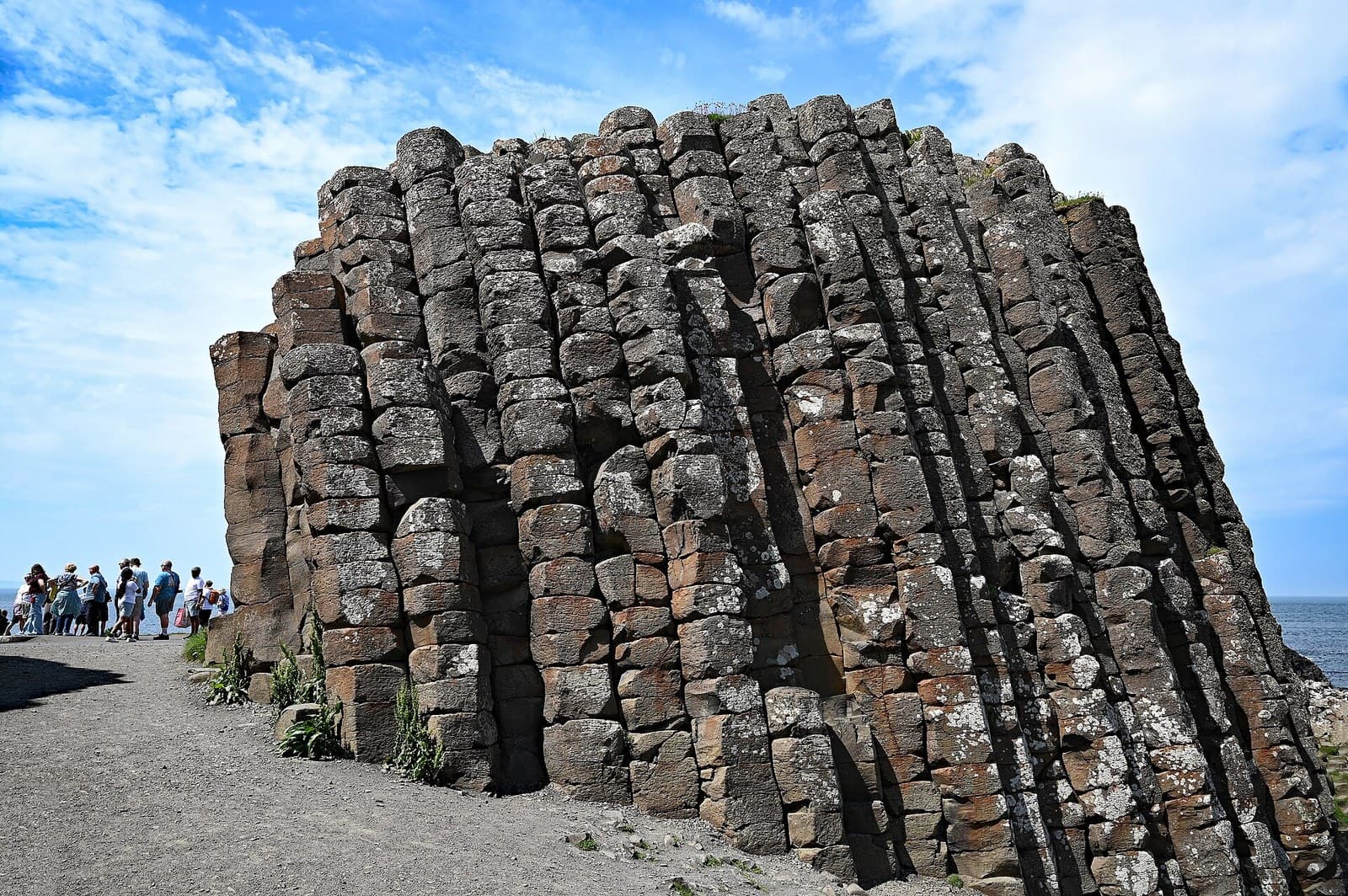
 The Causeway is forty thousand basalt columns and one of the oldest arguments in geology, between those who thought it volcanic and those who thought it laid down by water. Photograph by Chmee2, CC BY 3.0, via Wikimedia Commons.
Sport divides and connects in specific ways. Gaelic football and hurling are run by the Gaelic Athletic Association through Ulster GAA and are played overwhelmingly by the Catholic community; association football has separate leagues north and south; rugby union and cricket are organised on an all-island basis, so an Ulster player represents Ireland. Underneath the divisions sits a shared culture of griddle bread and the Ulster fry, the fiddle and flute traditions of the Glens and Fermanagh, and a body of poetry running from John Hewitt and Seamus Heaney to Michael Longley and Paul Muldoon.
Parading is a practice of long standing in both communities. The Orange Order, founded in 1795 near Loughgall, marches in large numbers on the Twelfth of July to commemorate the Boyne, with lodges, banners, sashes and accompanying flute, accordion and pipe bands, and the Lambeg, a huge goatskin drum played with cane rods, is a distinctive Ulster instrument (The Twelfth). The Ancient Order of Hibernians parades on 15 August in Catholic districts, and the Apprentice Boys commemorate the siege of Derry. A minority of routes has been contested for a century and more, chiefly where a parade passes an area whose residents object, and since 1998 a statutory Parades Commission has ruled on those routes (Parades Commission). Bonfires are lit on the eve of the Twelfth in some loyalist areas and in mid-August in some nationalist ones, and both draw argument about safety and the burning of flags.
Patrick is the common inheritance. He is said to have begun his mission at Saul near Downpatrick, founded his principal church at Armagh, and to lie under a granite slab in the graveyard of Down Cathedral, placed there in 1900 to mark a grave the town had long pointed out (Down Cathedral).
The Reformation and the Plantation produced the present pattern. The Church of Ireland kept the medieval cathedrals; Presbyterianism came with the Scots, and the first presbytery on the island was constituted at Carrickfergus in 1642, growing into the largest Protestant denomination here. Attendance is higher than in most of western Europe and falling, and the 2021 census recorded 17.4 per cent with no religion.
The wake is still ordinary practice, north and south. When a death occurs the body is usually brought home, laid out in a downstairs room, and waked for a night or two while neighbours call at any hour; the house stays open, tea and sandwiches and whiskey go round, the rosary is said in the evening, and the talk moves between grief and gossip and laughter in a way visitors often find surprising. Then comes the removal, when the coffin is taken to the church, and the funeral Mass and burial the next day, followed in Catholic practice by the month's mind Mass about four weeks later and by anniversary Masses for years. Death notices are read on local radio, and the phrase said at the door, over and over, is "sorry for your trouble".
Protestant funerals are shorter and plainer. The body may be waked at home or rest in a funeral home, the service is held in church or house with psalms and hymns, and until recent decades it was common in many Presbyterian congregations for women to remain at the house while the men walked behind the hearse. Both traditions shoulder the coffin in relays, a long line of relatives and neighbours each taking a turn under it on the last stretch of road.
The memory of the Troubles is worked into the landscape. The Museum of Free Derry in the Bogside, run by the Bloody Sunday Trust, holds the archive of the civil rights period and of 30 January 1972, when soldiers of the Parachute Regiment shot dead thirteen people at a march and a fourteenth died later; the Saville Inquiry reported in June 2010 that the killings were unjustified and unjustifiable, and the British prime minister apologised the same day (Museum of Free Derry). Memorial gardens sit in housing estates in both communities, names cut into granite and wreaths laid on set weekends, and painted gable walls carry portraits of the dead in loyalist and republican districts alike; many walls now show sporting or historical subjects, but the older paramilitary murals remain a live argument about what commemoration is for. Enniskillen keeps 8 November 1987, when an IRA bomb killed eleven people at the Remembrance Sunday cenotaph ceremony, and Omagh keeps 15 August 1998, when a Real IRA car bomb killed twenty-nine.
One strand of that grief belongs at the centre of any page about remembering. Seventeen people are officially listed as the Disappeared: abducted, killed and secretly buried, most of them by the IRA in the 1970s, their families left for decades without a body. The Independent Commission for the Location of Victims' Remains was established by treaty between the British and Irish governments on 27 April 1999 with a narrow and deliberate mandate: it receives information confidentially, that information cannot be used in any prosecution, and its only purpose is to find remains and return them (ICLVR). Thirteen have been recovered, several after repeated searches of the same bogland over many years; four remain missing, Joseph Lynskey, Columba McVeigh, Robert Nairac and Seamus Maguire (The Disappeared). What the families have said they wanted, again and again, is a grave to stand at.
War remembrance carries its own history. On 1 July 1916 the 36th (Ulster) Division, raised in 1914 largely from the Ulster Volunteer Force, attacked at Thiepval and took the Schwaben Redoubt, suffering roughly 5,500 casualties in two days (36th (Ulster) Division). The 16th (Irish) Division, drawn largely from nationalist Ireland, fought at Guillemont and Ginchy that September, and the two attacked side by side at Messines in June 1917. For most of the twentieth century the Somme was remembered as a unionist inheritance while the 16th Division was quietly dropped from memory in the south; that changed in the 1990s, and on 11 November 1998 the President of Ireland and Queen Elizabeth II opened the Island of Ireland Peace Park at Messines, a round tower commemorating all the Irish dead of the First World War without distinction (Island of Ireland Peace Park).
Northern Ireland's records survived the fire that destroyed the rest of Ireland's, which makes it the exception in Irish genealogy.
The Public Record Office of Northern Ireland in Belfast holds an unusually rich collection, because it was founded in 1923 and set about gathering copies of everything it could, including material that had been transcribed before the Four Courts explosion of 1922 destroyed the originals in Dublin. Its holdings run from estate papers and church registers to school rolls and emigration records, and a great deal is catalogued online.
Civil registration began for the whole island in 1864, with non-Catholic marriages from 1845, and is administered from Belfast for the six counties. The 1901 and 1911 censuses survive for all of Ireland and are free.
The church record is divided the way the province is. Church of Ireland, Presbyterian and Catholic registers each cover part of the population, and Presbyterian records in particular matter because of the Ulster Scots settlement, which is the origin of the Scots-Irish migration to America. The Ulster Historical Foundation and the Mellon Centre for Migration Studies at Omagh document that departure.
The Troubles are the hardest recent record. More than three and a half thousand people were killed between 1968 and 1998, and the Lost Lives project documented every one of them individually, which no state did. The disappeared, sixteen people abducted and secretly buried, are still being searched for.
The Giant's Causeway and Causeway Coast became a UNESCO World Heritage Site in 1986, the only one in Northern Ireland: roughly 40,000 interlocking basalt columns formed when lava cooled and contracted some 50 to 60 million years ago and, in the older account, the pavement laid by Fionn mac Cumhaill so he could cross to Scotland and fight the giant Benandonner (UNESCO). Most of it belongs to the National Trust, which also holds Mount Stewart and much of the Mourne coast.
Between 1904 and 1922 the Belfast Water Commissioners built a drystone wall about 31 kilometres long across fifteen summits to enclose the catchment feeding the city's reservoirs, laid without mortar in all weathers; the Mourne Wall is now walked as a route in its own right, and repaired as a monument (Mourne Wall).
Three museums carry the social memory. The Ulster Museum in Belfast holds the archaeology, the art and a permanent Troubles gallery rebuilt after criticism that it said too little (Ulster Museum). The Ulster Folk Museum at Cultra has re-erected farmhouses, a church, a school, mills and a whole Belfast street above Belfast Lough, with weavers, printers and smiths at work (Ulster Folk Museum). The Ulster American Folk Park at Omagh, built around the cottage of the emigrant Thomas Mellon, walks visitors from an Irish street on to a ship and off into a Pennsylvania settlement.
The Public Record Office of Northern Ireland has put much of the documentary memory online free: will calendars from 1858, street directories, valuation records, and the digitised signatures of the 1912 Ulster Covenant, so a descendant anywhere can find a great-grandfather's hand (PRONI).
The CAIN archive at Ulster University is the standard open reference for the conflict: the Sutton index of every death with date, place and organisation, chronologies, agreement texts and a mural database (CAIN).
Seamus Heaney won the Nobel Prize in Literature in 1995, and the Seamus Heaney HomePlace centre opened in his home village of Bellaghy in 2016, built around the fields and names in the poems (Seamus Heaney HomePlace). Screen work has done as much for the region's profile: Game of Thrones was made largely in and around Belfast for a decade, turning the Dark Hedges and Ballintoy into pilgrimage sites, and Derry Girls made a comedy of the mid-1990s ceasefire years that the whole island watched.
Belfast became a UNESCO City of Music in 2021, Derry was the first UK City of Culture in 2013, and the music runs from Van Morrison and the Undertones to the Irish-language rap group Kneecap.
Thirteen families got a grave. The Independent Commission for the Location of Victims' Remains has recovered thirteen of the seventeen people listed as the Disappeared since 1999, working on confidential information that cannot be used in court, and continues to search for the remaining four.
A shared memorial at Messines. The Island of Ireland Peace Park, opened in 1998, commemorates the men of the 36th (Ulster) and 16th (Irish) Divisions together, and the Somme is now marked in both jurisdictions.
Two languages written into law. The Identity and Language (Northern Ireland) Act 2022 gave Irish official status, recognised Ulster Scots, appointed commissioners for both, and repealed the 1737 statute that had kept Irish out of the courts.
The Causeway is forty thousand basalt columns and one of the oldest arguments in geology, between those who thought it volcanic and those who thought it laid down by water. Photograph by Chmee2, CC BY 3.0, via Wikimedia Commons.
Sport divides and connects in specific ways. Gaelic football and hurling are run by the Gaelic Athletic Association through Ulster GAA and are played overwhelmingly by the Catholic community; association football has separate leagues north and south; rugby union and cricket are organised on an all-island basis, so an Ulster player represents Ireland. Underneath the divisions sits a shared culture of griddle bread and the Ulster fry, the fiddle and flute traditions of the Glens and Fermanagh, and a body of poetry running from John Hewitt and Seamus Heaney to Michael Longley and Paul Muldoon.
Parading is a practice of long standing in both communities. The Orange Order, founded in 1795 near Loughgall, marches in large numbers on the Twelfth of July to commemorate the Boyne, with lodges, banners, sashes and accompanying flute, accordion and pipe bands, and the Lambeg, a huge goatskin drum played with cane rods, is a distinctive Ulster instrument (The Twelfth). The Ancient Order of Hibernians parades on 15 August in Catholic districts, and the Apprentice Boys commemorate the siege of Derry. A minority of routes has been contested for a century and more, chiefly where a parade passes an area whose residents object, and since 1998 a statutory Parades Commission has ruled on those routes (Parades Commission). Bonfires are lit on the eve of the Twelfth in some loyalist areas and in mid-August in some nationalist ones, and both draw argument about safety and the burning of flags.
Patrick is the common inheritance. He is said to have begun his mission at Saul near Downpatrick, founded his principal church at Armagh, and to lie under a granite slab in the graveyard of Down Cathedral, placed there in 1900 to mark a grave the town had long pointed out (Down Cathedral).
The Reformation and the Plantation produced the present pattern. The Church of Ireland kept the medieval cathedrals; Presbyterianism came with the Scots, and the first presbytery on the island was constituted at Carrickfergus in 1642, growing into the largest Protestant denomination here. Attendance is higher than in most of western Europe and falling, and the 2021 census recorded 17.4 per cent with no religion.
The wake is still ordinary practice, north and south. When a death occurs the body is usually brought home, laid out in a downstairs room, and waked for a night or two while neighbours call at any hour; the house stays open, tea and sandwiches and whiskey go round, the rosary is said in the evening, and the talk moves between grief and gossip and laughter in a way visitors often find surprising. Then comes the removal, when the coffin is taken to the church, and the funeral Mass and burial the next day, followed in Catholic practice by the month's mind Mass about four weeks later and by anniversary Masses for years. Death notices are read on local radio, and the phrase said at the door, over and over, is "sorry for your trouble".
Protestant funerals are shorter and plainer. The body may be waked at home or rest in a funeral home, the service is held in church or house with psalms and hymns, and until recent decades it was common in many Presbyterian congregations for women to remain at the house while the men walked behind the hearse. Both traditions shoulder the coffin in relays, a long line of relatives and neighbours each taking a turn under it on the last stretch of road.
The memory of the Troubles is worked into the landscape. The Museum of Free Derry in the Bogside, run by the Bloody Sunday Trust, holds the archive of the civil rights period and of 30 January 1972, when soldiers of the Parachute Regiment shot dead thirteen people at a march and a fourteenth died later; the Saville Inquiry reported in June 2010 that the killings were unjustified and unjustifiable, and the British prime minister apologised the same day (Museum of Free Derry). Memorial gardens sit in housing estates in both communities, names cut into granite and wreaths laid on set weekends, and painted gable walls carry portraits of the dead in loyalist and republican districts alike; many walls now show sporting or historical subjects, but the older paramilitary murals remain a live argument about what commemoration is for. Enniskillen keeps 8 November 1987, when an IRA bomb killed eleven people at the Remembrance Sunday cenotaph ceremony, and Omagh keeps 15 August 1998, when a Real IRA car bomb killed twenty-nine.
One strand of that grief belongs at the centre of any page about remembering. Seventeen people are officially listed as the Disappeared: abducted, killed and secretly buried, most of them by the IRA in the 1970s, their families left for decades without a body. The Independent Commission for the Location of Victims' Remains was established by treaty between the British and Irish governments on 27 April 1999 with a narrow and deliberate mandate: it receives information confidentially, that information cannot be used in any prosecution, and its only purpose is to find remains and return them (ICLVR). Thirteen have been recovered, several after repeated searches of the same bogland over many years; four remain missing, Joseph Lynskey, Columba McVeigh, Robert Nairac and Seamus Maguire (The Disappeared). What the families have said they wanted, again and again, is a grave to stand at.
War remembrance carries its own history. On 1 July 1916 the 36th (Ulster) Division, raised in 1914 largely from the Ulster Volunteer Force, attacked at Thiepval and took the Schwaben Redoubt, suffering roughly 5,500 casualties in two days (36th (Ulster) Division). The 16th (Irish) Division, drawn largely from nationalist Ireland, fought at Guillemont and Ginchy that September, and the two attacked side by side at Messines in June 1917. For most of the twentieth century the Somme was remembered as a unionist inheritance while the 16th Division was quietly dropped from memory in the south; that changed in the 1990s, and on 11 November 1998 the President of Ireland and Queen Elizabeth II opened the Island of Ireland Peace Park at Messines, a round tower commemorating all the Irish dead of the First World War without distinction (Island of Ireland Peace Park).
Northern Ireland's records survived the fire that destroyed the rest of Ireland's, which makes it the exception in Irish genealogy.
The Public Record Office of Northern Ireland in Belfast holds an unusually rich collection, because it was founded in 1923 and set about gathering copies of everything it could, including material that had been transcribed before the Four Courts explosion of 1922 destroyed the originals in Dublin. Its holdings run from estate papers and church registers to school rolls and emigration records, and a great deal is catalogued online.
Civil registration began for the whole island in 1864, with non-Catholic marriages from 1845, and is administered from Belfast for the six counties. The 1901 and 1911 censuses survive for all of Ireland and are free.
The church record is divided the way the province is. Church of Ireland, Presbyterian and Catholic registers each cover part of the population, and Presbyterian records in particular matter because of the Ulster Scots settlement, which is the origin of the Scots-Irish migration to America. The Ulster Historical Foundation and the Mellon Centre for Migration Studies at Omagh document that departure.
The Troubles are the hardest recent record. More than three and a half thousand people were killed between 1968 and 1998, and the Lost Lives project documented every one of them individually, which no state did. The disappeared, sixteen people abducted and secretly buried, are still being searched for.
The Giant's Causeway and Causeway Coast became a UNESCO World Heritage Site in 1986, the only one in Northern Ireland: roughly 40,000 interlocking basalt columns formed when lava cooled and contracted some 50 to 60 million years ago and, in the older account, the pavement laid by Fionn mac Cumhaill so he could cross to Scotland and fight the giant Benandonner (UNESCO). Most of it belongs to the National Trust, which also holds Mount Stewart and much of the Mourne coast.
Between 1904 and 1922 the Belfast Water Commissioners built a drystone wall about 31 kilometres long across fifteen summits to enclose the catchment feeding the city's reservoirs, laid without mortar in all weathers; the Mourne Wall is now walked as a route in its own right, and repaired as a monument (Mourne Wall).
Three museums carry the social memory. The Ulster Museum in Belfast holds the archaeology, the art and a permanent Troubles gallery rebuilt after criticism that it said too little (Ulster Museum). The Ulster Folk Museum at Cultra has re-erected farmhouses, a church, a school, mills and a whole Belfast street above Belfast Lough, with weavers, printers and smiths at work (Ulster Folk Museum). The Ulster American Folk Park at Omagh, built around the cottage of the emigrant Thomas Mellon, walks visitors from an Irish street on to a ship and off into a Pennsylvania settlement.
The Public Record Office of Northern Ireland has put much of the documentary memory online free: will calendars from 1858, street directories, valuation records, and the digitised signatures of the 1912 Ulster Covenant, so a descendant anywhere can find a great-grandfather's hand (PRONI).
The CAIN archive at Ulster University is the standard open reference for the conflict: the Sutton index of every death with date, place and organisation, chronologies, agreement texts and a mural database (CAIN).
Seamus Heaney won the Nobel Prize in Literature in 1995, and the Seamus Heaney HomePlace centre opened in his home village of Bellaghy in 2016, built around the fields and names in the poems (Seamus Heaney HomePlace). Screen work has done as much for the region's profile: Game of Thrones was made largely in and around Belfast for a decade, turning the Dark Hedges and Ballintoy into pilgrimage sites, and Derry Girls made a comedy of the mid-1990s ceasefire years that the whole island watched.
Belfast became a UNESCO City of Music in 2021, Derry was the first UK City of Culture in 2013, and the music runs from Van Morrison and the Undertones to the Irish-language rap group Kneecap.
Thirteen families got a grave. The Independent Commission for the Location of Victims' Remains has recovered thirteen of the seventeen people listed as the Disappeared since 1999, working on confidential information that cannot be used in court, and continues to search for the remaining four.
A shared memorial at Messines. The Island of Ireland Peace Park, opened in 1998, commemorates the men of the 36th (Ulster) and 16th (Irish) Divisions together, and the Somme is now marked in both jurisdictions.
Two languages written into law. The Identity and Language (Northern Ireland) Act 2022 gave Irish official status, recognised Ulster Scots, appointed commissioners for both, and repealed the 1737 statute that had kept Irish out of the courts.
National Overview
Notable Cities
Historical Foundations
Linguistic and Etymological Roots
Cultural Identity
Religion and Spirituality
Remembrance and Mourning Traditions
Tracing a Family in Northern Ireland
Heritage Preservation Efforts
Digital Heritage
Contemporary Cultural Influences
Success Stories
References and resources
- CAIN Web Service, Ulster University: the open archive of the conflict, its chronologies and texts.
- CAIN, Sutton Index of Deaths: 3,532 deaths, broken down by the organisation held responsible.
- Independent Commission for the Location of Victims' Remains: the confidential search for the Disappeared, by treaty since 1999.
- UNESCO, Giant's Causeway and Causeway Coast: the 1986 inscription and its geology.
- Identity and Language (Northern Ireland) Act 2022: official status for Irish and recognition for Ulster Scots.
- Encyclopaedia Britannica, Northern Ireland: geography and history.