Heritage · Country
Saint Helena Culture and Heritage
Three volcanic islands scattered across the South Atlantic share one government and almost nothing else: Napoleon's prison, a garrison rock where nobody may settle, and the loneliest village on earth. This is a guide to their heritage, their burial grounds and the people who chose to go home.Written to last.
By Confinity Heritage Editorial · Updated 2026-08-17 · 8-minute readQuiet tools, kept out of the way.
Saint Helena, Ascension and Tristan da Cunha is one territory covering three places that share a governor, a currency and very little else. Saint Helena is a green and deeply eroded volcanic island with about 4,400 residents whose families have been there for three and a half centuries. Ascension, some 1,300 kilometres to the north-west, is a cinder field with a planted cloud forest on top and no citizens at all. Tristan da Cunha, roughly 2,400 kilometres to the south, is a farming village of a couple of hundred people on the flank of an active volcano, further from any other settled place than anywhere else on earth.
Each holds its past in a different form. Saint Helena's is written into churchyards, into a French-owned house where an emperor died, and into a valley where thousands of Africans taken off slave ships were buried without names. Ascension's is institutional, kept in the log books of a garrison that has never had a community to outlive it. Tristan's is oral and familial, carried in seven or eight surnames and in the memory of the year the entire island was put aboard a ship and taken to England.
This is a British Overseas Territory of three widely separated island groups, governed under a 2009 constitution that gave Ascension and Tristan da Cunha their own councils while keeping a single governor resident on Saint Helena. Saint Helena itself is 122 square kilometres of volcanic rock rising to 818 metres at Diana's Peak, with a 2021 census population of 4,439 (Saint Helena). Ascension had 806 people at its 2016 census, all of them there on contract for the airhead, the satellite and cable stations, or the conservation service (Ascension Island). Tristan da Cunha, the main island of a group that also includes Inaccessible, Nightingale and Gough, has fewer than 250 residents in one settlement.
English is the language of all three, and the Saint Helena pound circulates at parity with sterling. The economy rests on public administration, fishing and, since 2017, a small tourist trade; Ascension runs almost entirely on the military and communications contracts that justify its existence. All three sit far outside the shipping lanes, which is why they were settled at all and why so much of what happened on them was done to people who had no say in going.
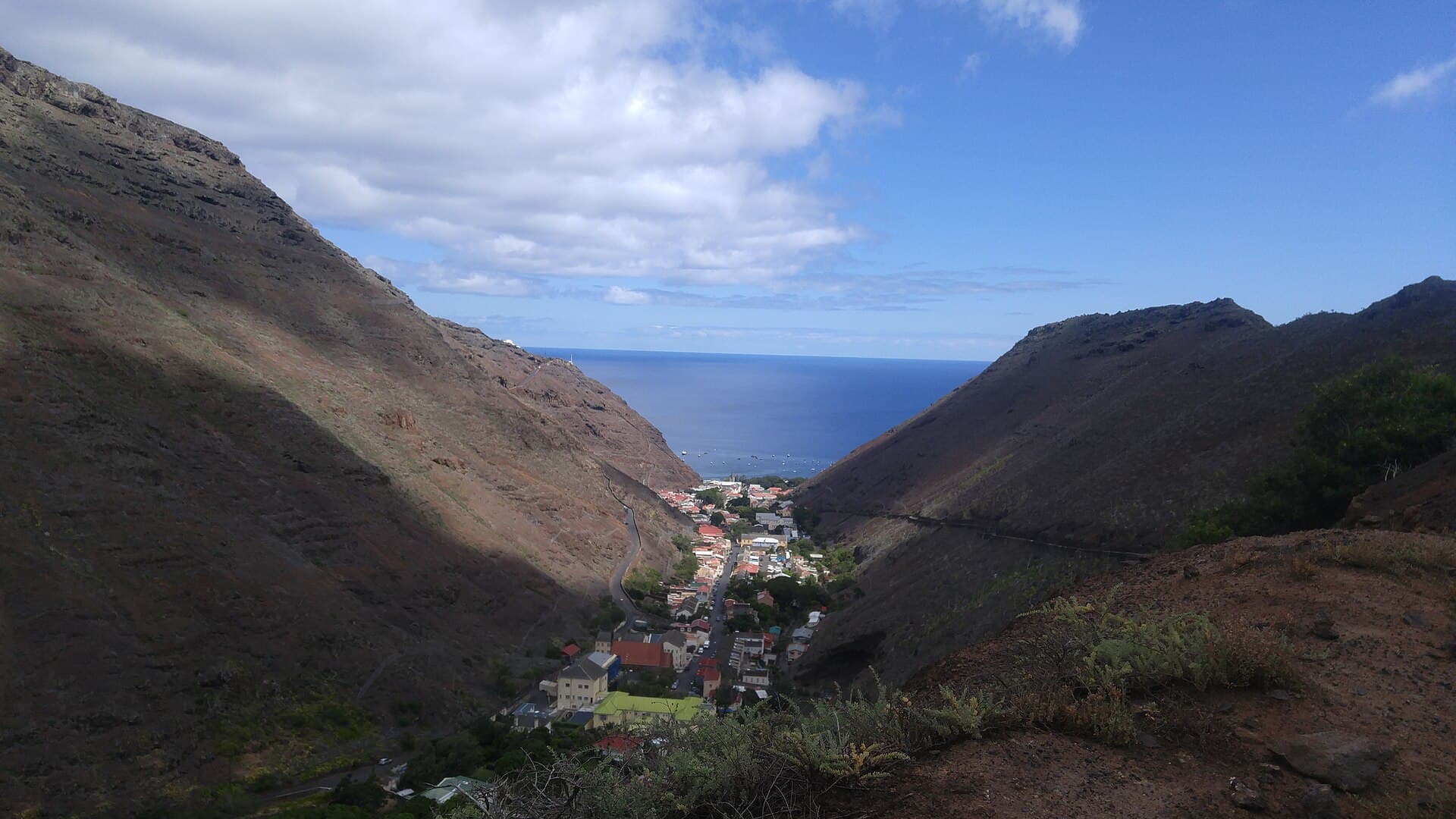
Jamestown. Saint Helena's capital is a single Georgian street wedged into a valley barely two hundred metres wide, with cliffs on both sides and the anchorage at its mouth. Founded in 1659 and named for the Duke of York, it survives as one of the most complete small Georgian townscapes anywhere, its castle, courthouse, market and St James' Church all listed. Jacob's Ladder climbs the western wall in 699 steps, laid in 1829 as an inclined railway to haul goods up to the garrison at Ladder Hill and converted to a staircase in 1871 (Jacob's Ladder).
 Jamestown is a Georgian town squeezed into a narrow valley, largely unaltered because the island had no economic reason to rebuild it and no road out of the ravine. Photograph by Kevstan, CC BY-SA 4.0, via Wikimedia Commons.
Half Tree Hollow and Longwood. Most Saints now live on the ridges above Jamestown. Longwood, on the windswept eastern plateau, is where the British put Napoleon, and the French tricolour still flies over the house.
Georgetown, Ascension. A row of buildings on a black lava shore below the mountain, with a Royal Marines barracks of 1830, a stone church, and the pierhead where everything still comes ashore.
Edinburgh of the Seven Seas, Tristan da Cunha. Known to everybody who lives there simply as the Settlement, it sits on the only level ground on the island, a narrow shelf between the volcano and a cliff. It holds the whole population, the school, the shop, the pub, and the potato patches to the west where every family works its own plot.
Saint Helena was uninhabited when Portuguese navigators found it, by tradition on 21 May 1502, and it stayed that way while they used it quietly as a watering stop. The English East India Company took it in 1659, fortified Jamestown, and ran it for nearly two centuries as a provisioning station on the homeward passage from India, where ships took on water, fresh meat and vegetables before the last leg to England. The Company brought planters, then soldiers, then enslaved labourers from Madagascar, the East Indies and West Africa, and from 1810 several hundred Chinese labourers on indenture. The island's people descend from all of these in combination, and they call themselves Saints.
Napoleon Bonaparte arrived on 15 October 1815, five months after Waterloo, and stayed until he died on 5 May 1821. He spent his first weeks at the Briars pavilion above Jamestown and then moved to Longwood House, a converted farm on the wet and wind-scoured plateau, where he dictated his memoirs, quarrelled with Governor Hudson Lowe and declined. He was buried in a valley below the house under an unmarked slab, because the British and the French could not agree what name to cut into it. In 1840 a French expedition took the body away to the Invalides in Paris, and the tomb has been empty ever since. France bought Longwood House and the Valley of the Tomb in 1858, and both are still French property.
Between 1840 and 1872 something happened on Saint Helena that almost nobody outside the island knows about. After Britain abolished the slave trade, the Royal Navy's West Africa Squadron intercepted slaving ships in the South Atlantic, and Saint Helena became the site of the Vice-Admiralty court that condemned them and of the Liberated African Depot that received the people found aboard. More than 25,000 Africans were landed at Rupert's Valley, the bare ravine next to Jamestown, over those three decades. They arrived starved, dehydrated and carrying dysentery, smallpox and ophthalmia after weeks in a hold, and roughly a third died within days or weeks of coming ashore. Around 8,000 are believed to be buried in the valley, most of them children and teenagers, and the true figure may be higher (St Helena National Trust). Some survivors settled and their descendants are Saints today; most were shipped on to the British Caribbean as indentured labour.
Around 6,000 Boer prisoners of war were interned on the island between 1900 and 1902, pushing its population to a recorded peak of nearly 10,000, and several hundred of their graves remain at Knollcombes. Ascension was claimed for the Crown on 22 October 1815, garrisoned partly to deny it to anyone planning to rescue Napoleon, and administered by the Royal Navy as a commissioned stone frigate, HMS Ascension, until 1922. Tristan da Cunha, sighted in 1506 and named for the admiral Tristão da Cunha, was garrisoned in 1816 for the same reason; when the troops withdrew the following year, Corporal William Glass of the Royal Artillery asked to stay with his wife and two children, and the community has been continuous ever since.
All three names come from the Portuguese calendar and the Portuguese fleet. Saint Helena was named for the mother of Constantine, whose feast fell on the day it was sighted. Ascension takes its name from Ascension Day 1503, when Afonso de Albuquerque came upon an island João da Nova had already recorded two years earlier and named it again. Tristan da Cunha carries the name of the man who saw it.
The speech of Saint Helena is the oldest form of Southern Hemisphere English, more than a century older than the varieties that developed in South Africa, Australia and New Zealand, and it grew out of contact between English seamen and planters, enslaved Malagasy and West Africans, and later Chinese and Indian labourers. Linguists working on the dialect record th-sounds pronounced as stops, so that "that" comes out as "dat"; a flapped intervocalic t; questions formed without inversion or auxiliary do, as in "Where you lef' you car?"; double negation; and double modals of the kind found in Scots and the American South (Saint Helena Island Info). Saints switch between this and standard English depending on who is listening. Tristan's English is a separate case, formed from a founder group of Scots, Americans, Dutch speakers from St Helena and two Italian sailors, and it keeps grammatical features that have gone elsewhere.
Saints have a strong sense of themselves as a people rather than as residents of a British possession, and the word is used with pride. Family networks run across the whole island, so most people can place a stranger by surname within a sentence or two. The calendar turns on Saint Helena's Day on 21 May, the Festival of Lights in December, cricket at Francis Plain and the annual carnival. The food is a plain Atlantic mixture: tuna fishcakes, pilau, black pudding, coconut fingers, and tungi spirit distilled from prickly pear. New Zealand flax, planted for rope and mats, carried the economy until the mills closed in 1966, and the abandoned crop still covers the central ridge.
Ascension has a culture without continuity, because nobody is allowed to grow old there. Its social life is organised around the workplaces, the club, the turtle-nesting season and the two-year contract, and its Saint Helenian majority keeps it tied to the community 1,300 kilometres away that most of its workers return to.
Tristan is the opposite: a place where almost everything is shared and nothing is sold to outsiders. Land is held communally, no non-islander may buy it, and every household has an equal stake in the pastures and the potato patches. The surnames tell the settlement history plainly: Glass from the founding corporal, Green, Swain and Rogers from shipwrecked or discharged sailors, Hagan from an American whaler, Repetto and Lavarello from two Italians off the wrecked barque Italia in 1892.
Saint Helena has been Anglican since the East India Company's first chaplain arrived in 1671, and the Diocese of Saint Helena, founded in 1859, is one of the oldest in Africa. St James' Church in Jamestown, rebuilt in its present form in 1774, is the oldest Anglican church in the southern hemisphere; its spire was taken down as unsafe in 1980 and restored in 2020 (Saint James' Church, Jamestown). St Paul's Cathedral, in the green interior, is the mother church of the diocese. Baptists have been on the island since 1845 and remain the largest non-Anglican body, with Seventh-day Adventists, the Salvation Army and a small Catholic congregation making up the rest. Attendance is high by British standards, and funerals in particular fill a building.
Ascension has St Mary's Church at Georgetown, built by the Royal Marines, and a Catholic church, both serving whoever is on contract. Tristan has two, St Mary's, Anglican, and St Joseph's, Catholic, a division that follows the Italian and Irish lines in the island's ancestry and has never divided the village in any other respect.
On Saint Helena a death is an island event. The bereaved family is visited continuously, the funeral notice is read on the radio, and the churchyards at St Paul's, St James' and Baptist Chapel are tended by descendants who can name every stone. Because the population is small and closely related, most funerals draw people connected to the dead in more than one way.
The island's largest burial ground held no names at all. When work began in 2007 and 2008 on the access road for the new airport, archaeologists excavating Rupert's Valley recovered 325 individual burials and a quantity of disarticulated remains from a small fraction of the depot's cemetery. The bones told the story the documents only summarised: mostly young, many showing the effects of starvation and disease, buried in shallow mass graves within days of arrival. Isotope and DNA work has since traced their origins to particular regions of West Central Africa, giving the depot's dead the beginnings of a geography they were stripped of when they were taken (Smithsonian).
The remains sat in storage for fourteen years while the community argued about what should be done with them, and what was eventually done was careful and public. On 20 August 2022 the 325 individuals were reburied in Rupert's Valley, on ground between St Michael's Church and the fuel tanks, in coffins made by students at the island's secondary school, and a ceremony of poems, hymns, speeches and a blessing was held at the burial ground the next day (St Helena National Trust). People who arrived as cargo and were buried as a public health problem went back into the ground as individuals, with full ceremony.
Tristan da Cunha has one graveyard, above the Settlement below the cliff, and everyone in it is related to everyone in the village; funerals are attended by the entire island, which closes for the day. Ascension's cemeteries hold a different sort of memory, chiefly sailors of the nineteenth-century squadron and the yellow fever dead of the Bonetta, in ground no descendants visit because no descendants live there.
Saint Helena's records are British, continuous since 1659, and they document one of the most unusual populations in the world.
The East India Company held the island as a victualling station for ships between Europe and Asia, and its records, in the India Office collections at the British Library, name the garrison, the settlers, the enslaved people brought from Madagascar, India and West Africa, and the Chinese labourers recruited in the eighteenth and nineteenth centuries. The Saint Helena Archives on the island hold the local series, and the population's small size and isolation mean the record is unusually complete.
Slavery here ended by a local act in 1827, before the empire-wide abolition.
Two arrivals give the island its distinctive archive. Napoleon was exiled here from 1815 until his death in 1821, and the paperwork of his confinement is voluminous. And from 1840 the Royal Navy landed Africans from intercepted slave ships at Rupert's Valley; something over twenty-five thousand people were brought ashore, many desperately ill, and around eight thousand died and were buried there. Excavations in 2008 found their graves. The Liberated African depot registers name individuals, and the survivors' descendants are part of the Saint Helenian population.
The Saints, as they call themselves, have emigrated to Ascension, the Falklands and Britain for work, and their status as British citizens was restored only in 2002.
The Saint Helena National Trust, founded in 2002, runs the island's cultural and natural heritage work, including the Rupert's Valley memorial programme, the cloud forest restoration on the central ridge and the conservation of the wirebird. The Museum of Saint Helena, opened in its present building at the foot of Jacob's Ladder on 21 May 2002, holds the collections of natural history, Napoleonic material and East India Company records (Museum of Saint Helena). The Saint Helena Archives in the Castle at Jamestown keep a Company record series running back to the seventeenth century, one of the fuller colonial archives held in the place it describes rather than in London.
The French domaines, Longwood House, the Briars pavilion and the Valley of the Tomb, are conserved by the French state and were restored for the bicentenary of Napoleon's death in 2021. Ascension's Green Mountain has been a national park since 2005, and its planted forest is managed as heritage in its own right. Tristan designated a Marine Protection Zone of 687,000 square kilometres in November 2020 (Tristan da Cunha Government).
Access has been the constraint on all of it. Saint Helena depended on the mail ship RMS St Helena until an airport was built on Prosperous Bay Plain at a cost of about £285 million; wind shear across the runway threshold delayed the opening, and scheduled service finally began on 14 October 2017 (Saint Helena Airport). Tristan still has no airstrip and no harbour a ship can enter, and reaches the world by fishing vessel from Cape Town six or seven times a year.
Distance has made digitisation unusually valuable here. The Saint Helena Archives have been photographing their East India Company series, and the independent reference site Saint Helena Island Info has assembled a public compendium of island history, dialect, genealogy and photographs that works as the island's encyclopaedia. Research on the liberated Africans, including the bioarchaeology of the Rupert's Valley burials, is published openly, which is how a story confined to one valley reached an international audience. Tristan runs its own news and history site at tristandc.com, carrying the eruption and resettlement record year by year. Saint Helena joined the Equiano submarine fibre-optic cable in 2023, which made all of this practical for the first time.
Saint Helena's public profile abroad still runs mostly through Napoleon, and the bicentenary in 2021 brought French attention, scholarship and restoration money. Jonathan, a Seychelles giant tortoise hatched around 1832 and brought to Plantation House in 1882, is the island's other export: the oldest known living land animal, photographed constantly and used with some irony by Saints as a symbol of a place where nothing is in a hurry (Jonathan).
Ascension's future is genuinely unsettled. Its population exists at the pleasure of the contracts that employ it, and the question of whether people who have worked there for decades should be able to stay has been raised repeatedly without being resolved. Tristan has become a case study for community ownership, and its 2020 marine designation put a village of two hundred people in charge of an area of ocean larger than most countries.
The dead of Rupert's Valley were reburied with ceremony. After fourteen years in storage, 325 liberated Africans exhumed during airport construction were returned to the valley in August 2022, in coffins made by island schoolchildren, before the whole community.
An island voted to go back to a volcano. Evacuated to England after the 1961 eruption and settled in a former RAF camp at Calshot, the Tristan islanders were balloted in December 1962 and voted 148 to 5 to return; an advance party sailed in March 1963 and the rest followed.
A barren rock was given a forest on purpose. After Charles Darwin's 1836 visit, Joseph Hooker at Kew arranged from the 1840s for hundreds of plant species to be shipped to Ascension and planted on its summit, producing the cloud forest now studied as the earliest deliberate terraforming experiment.
A Georgian town survived by being too remote to modernise. Jamestown's eighteenth-century street, church, castle and fortifications came through three centuries intact, and are protected as a listed townscape.
Jamestown is a Georgian town squeezed into a narrow valley, largely unaltered because the island had no economic reason to rebuild it and no road out of the ravine. Photograph by Kevstan, CC BY-SA 4.0, via Wikimedia Commons.
Half Tree Hollow and Longwood. Most Saints now live on the ridges above Jamestown. Longwood, on the windswept eastern plateau, is where the British put Napoleon, and the French tricolour still flies over the house.
Georgetown, Ascension. A row of buildings on a black lava shore below the mountain, with a Royal Marines barracks of 1830, a stone church, and the pierhead where everything still comes ashore.
Edinburgh of the Seven Seas, Tristan da Cunha. Known to everybody who lives there simply as the Settlement, it sits on the only level ground on the island, a narrow shelf between the volcano and a cliff. It holds the whole population, the school, the shop, the pub, and the potato patches to the west where every family works its own plot.
Saint Helena was uninhabited when Portuguese navigators found it, by tradition on 21 May 1502, and it stayed that way while they used it quietly as a watering stop. The English East India Company took it in 1659, fortified Jamestown, and ran it for nearly two centuries as a provisioning station on the homeward passage from India, where ships took on water, fresh meat and vegetables before the last leg to England. The Company brought planters, then soldiers, then enslaved labourers from Madagascar, the East Indies and West Africa, and from 1810 several hundred Chinese labourers on indenture. The island's people descend from all of these in combination, and they call themselves Saints.
Napoleon Bonaparte arrived on 15 October 1815, five months after Waterloo, and stayed until he died on 5 May 1821. He spent his first weeks at the Briars pavilion above Jamestown and then moved to Longwood House, a converted farm on the wet and wind-scoured plateau, where he dictated his memoirs, quarrelled with Governor Hudson Lowe and declined. He was buried in a valley below the house under an unmarked slab, because the British and the French could not agree what name to cut into it. In 1840 a French expedition took the body away to the Invalides in Paris, and the tomb has been empty ever since. France bought Longwood House and the Valley of the Tomb in 1858, and both are still French property.
Between 1840 and 1872 something happened on Saint Helena that almost nobody outside the island knows about. After Britain abolished the slave trade, the Royal Navy's West Africa Squadron intercepted slaving ships in the South Atlantic, and Saint Helena became the site of the Vice-Admiralty court that condemned them and of the Liberated African Depot that received the people found aboard. More than 25,000 Africans were landed at Rupert's Valley, the bare ravine next to Jamestown, over those three decades. They arrived starved, dehydrated and carrying dysentery, smallpox and ophthalmia after weeks in a hold, and roughly a third died within days or weeks of coming ashore. Around 8,000 are believed to be buried in the valley, most of them children and teenagers, and the true figure may be higher (St Helena National Trust). Some survivors settled and their descendants are Saints today; most were shipped on to the British Caribbean as indentured labour.
Around 6,000 Boer prisoners of war were interned on the island between 1900 and 1902, pushing its population to a recorded peak of nearly 10,000, and several hundred of their graves remain at Knollcombes. Ascension was claimed for the Crown on 22 October 1815, garrisoned partly to deny it to anyone planning to rescue Napoleon, and administered by the Royal Navy as a commissioned stone frigate, HMS Ascension, until 1922. Tristan da Cunha, sighted in 1506 and named for the admiral Tristão da Cunha, was garrisoned in 1816 for the same reason; when the troops withdrew the following year, Corporal William Glass of the Royal Artillery asked to stay with his wife and two children, and the community has been continuous ever since.
All three names come from the Portuguese calendar and the Portuguese fleet. Saint Helena was named for the mother of Constantine, whose feast fell on the day it was sighted. Ascension takes its name from Ascension Day 1503, when Afonso de Albuquerque came upon an island João da Nova had already recorded two years earlier and named it again. Tristan da Cunha carries the name of the man who saw it.
The speech of Saint Helena is the oldest form of Southern Hemisphere English, more than a century older than the varieties that developed in South Africa, Australia and New Zealand, and it grew out of contact between English seamen and planters, enslaved Malagasy and West Africans, and later Chinese and Indian labourers. Linguists working on the dialect record th-sounds pronounced as stops, so that "that" comes out as "dat"; a flapped intervocalic t; questions formed without inversion or auxiliary do, as in "Where you lef' you car?"; double negation; and double modals of the kind found in Scots and the American South (Saint Helena Island Info). Saints switch between this and standard English depending on who is listening. Tristan's English is a separate case, formed from a founder group of Scots, Americans, Dutch speakers from St Helena and two Italian sailors, and it keeps grammatical features that have gone elsewhere.
Saints have a strong sense of themselves as a people rather than as residents of a British possession, and the word is used with pride. Family networks run across the whole island, so most people can place a stranger by surname within a sentence or two. The calendar turns on Saint Helena's Day on 21 May, the Festival of Lights in December, cricket at Francis Plain and the annual carnival. The food is a plain Atlantic mixture: tuna fishcakes, pilau, black pudding, coconut fingers, and tungi spirit distilled from prickly pear. New Zealand flax, planted for rope and mats, carried the economy until the mills closed in 1966, and the abandoned crop still covers the central ridge.
Ascension has a culture without continuity, because nobody is allowed to grow old there. Its social life is organised around the workplaces, the club, the turtle-nesting season and the two-year contract, and its Saint Helenian majority keeps it tied to the community 1,300 kilometres away that most of its workers return to.
Tristan is the opposite: a place where almost everything is shared and nothing is sold to outsiders. Land is held communally, no non-islander may buy it, and every household has an equal stake in the pastures and the potato patches. The surnames tell the settlement history plainly: Glass from the founding corporal, Green, Swain and Rogers from shipwrecked or discharged sailors, Hagan from an American whaler, Repetto and Lavarello from two Italians off the wrecked barque Italia in 1892.
Saint Helena has been Anglican since the East India Company's first chaplain arrived in 1671, and the Diocese of Saint Helena, founded in 1859, is one of the oldest in Africa. St James' Church in Jamestown, rebuilt in its present form in 1774, is the oldest Anglican church in the southern hemisphere; its spire was taken down as unsafe in 1980 and restored in 2020 (Saint James' Church, Jamestown). St Paul's Cathedral, in the green interior, is the mother church of the diocese. Baptists have been on the island since 1845 and remain the largest non-Anglican body, with Seventh-day Adventists, the Salvation Army and a small Catholic congregation making up the rest. Attendance is high by British standards, and funerals in particular fill a building.
Ascension has St Mary's Church at Georgetown, built by the Royal Marines, and a Catholic church, both serving whoever is on contract. Tristan has two, St Mary's, Anglican, and St Joseph's, Catholic, a division that follows the Italian and Irish lines in the island's ancestry and has never divided the village in any other respect.
On Saint Helena a death is an island event. The bereaved family is visited continuously, the funeral notice is read on the radio, and the churchyards at St Paul's, St James' and Baptist Chapel are tended by descendants who can name every stone. Because the population is small and closely related, most funerals draw people connected to the dead in more than one way.
The island's largest burial ground held no names at all. When work began in 2007 and 2008 on the access road for the new airport, archaeologists excavating Rupert's Valley recovered 325 individual burials and a quantity of disarticulated remains from a small fraction of the depot's cemetery. The bones told the story the documents only summarised: mostly young, many showing the effects of starvation and disease, buried in shallow mass graves within days of arrival. Isotope and DNA work has since traced their origins to particular regions of West Central Africa, giving the depot's dead the beginnings of a geography they were stripped of when they were taken (Smithsonian).
The remains sat in storage for fourteen years while the community argued about what should be done with them, and what was eventually done was careful and public. On 20 August 2022 the 325 individuals were reburied in Rupert's Valley, on ground between St Michael's Church and the fuel tanks, in coffins made by students at the island's secondary school, and a ceremony of poems, hymns, speeches and a blessing was held at the burial ground the next day (St Helena National Trust). People who arrived as cargo and were buried as a public health problem went back into the ground as individuals, with full ceremony.
Tristan da Cunha has one graveyard, above the Settlement below the cliff, and everyone in it is related to everyone in the village; funerals are attended by the entire island, which closes for the day. Ascension's cemeteries hold a different sort of memory, chiefly sailors of the nineteenth-century squadron and the yellow fever dead of the Bonetta, in ground no descendants visit because no descendants live there.
Saint Helena's records are British, continuous since 1659, and they document one of the most unusual populations in the world.
The East India Company held the island as a victualling station for ships between Europe and Asia, and its records, in the India Office collections at the British Library, name the garrison, the settlers, the enslaved people brought from Madagascar, India and West Africa, and the Chinese labourers recruited in the eighteenth and nineteenth centuries. The Saint Helena Archives on the island hold the local series, and the population's small size and isolation mean the record is unusually complete.
Slavery here ended by a local act in 1827, before the empire-wide abolition.
Two arrivals give the island its distinctive archive. Napoleon was exiled here from 1815 until his death in 1821, and the paperwork of his confinement is voluminous. And from 1840 the Royal Navy landed Africans from intercepted slave ships at Rupert's Valley; something over twenty-five thousand people were brought ashore, many desperately ill, and around eight thousand died and were buried there. Excavations in 2008 found their graves. The Liberated African depot registers name individuals, and the survivors' descendants are part of the Saint Helenian population.
The Saints, as they call themselves, have emigrated to Ascension, the Falklands and Britain for work, and their status as British citizens was restored only in 2002.
The Saint Helena National Trust, founded in 2002, runs the island's cultural and natural heritage work, including the Rupert's Valley memorial programme, the cloud forest restoration on the central ridge and the conservation of the wirebird. The Museum of Saint Helena, opened in its present building at the foot of Jacob's Ladder on 21 May 2002, holds the collections of natural history, Napoleonic material and East India Company records (Museum of Saint Helena). The Saint Helena Archives in the Castle at Jamestown keep a Company record series running back to the seventeenth century, one of the fuller colonial archives held in the place it describes rather than in London.
The French domaines, Longwood House, the Briars pavilion and the Valley of the Tomb, are conserved by the French state and were restored for the bicentenary of Napoleon's death in 2021. Ascension's Green Mountain has been a national park since 2005, and its planted forest is managed as heritage in its own right. Tristan designated a Marine Protection Zone of 687,000 square kilometres in November 2020 (Tristan da Cunha Government).
Access has been the constraint on all of it. Saint Helena depended on the mail ship RMS St Helena until an airport was built on Prosperous Bay Plain at a cost of about £285 million; wind shear across the runway threshold delayed the opening, and scheduled service finally began on 14 October 2017 (Saint Helena Airport). Tristan still has no airstrip and no harbour a ship can enter, and reaches the world by fishing vessel from Cape Town six or seven times a year.
Distance has made digitisation unusually valuable here. The Saint Helena Archives have been photographing their East India Company series, and the independent reference site Saint Helena Island Info has assembled a public compendium of island history, dialect, genealogy and photographs that works as the island's encyclopaedia. Research on the liberated Africans, including the bioarchaeology of the Rupert's Valley burials, is published openly, which is how a story confined to one valley reached an international audience. Tristan runs its own news and history site at tristandc.com, carrying the eruption and resettlement record year by year. Saint Helena joined the Equiano submarine fibre-optic cable in 2023, which made all of this practical for the first time.
Saint Helena's public profile abroad still runs mostly through Napoleon, and the bicentenary in 2021 brought French attention, scholarship and restoration money. Jonathan, a Seychelles giant tortoise hatched around 1832 and brought to Plantation House in 1882, is the island's other export: the oldest known living land animal, photographed constantly and used with some irony by Saints as a symbol of a place where nothing is in a hurry (Jonathan).
Ascension's future is genuinely unsettled. Its population exists at the pleasure of the contracts that employ it, and the question of whether people who have worked there for decades should be able to stay has been raised repeatedly without being resolved. Tristan has become a case study for community ownership, and its 2020 marine designation put a village of two hundred people in charge of an area of ocean larger than most countries.
The dead of Rupert's Valley were reburied with ceremony. After fourteen years in storage, 325 liberated Africans exhumed during airport construction were returned to the valley in August 2022, in coffins made by island schoolchildren, before the whole community.
An island voted to go back to a volcano. Evacuated to England after the 1961 eruption and settled in a former RAF camp at Calshot, the Tristan islanders were balloted in December 1962 and voted 148 to 5 to return; an advance party sailed in March 1963 and the rest followed.
A barren rock was given a forest on purpose. After Charles Darwin's 1836 visit, Joseph Hooker at Kew arranged from the 1840s for hundreds of plant species to be shipped to Ascension and planted on its summit, producing the cloud forest now studied as the earliest deliberate terraforming experiment.
A Georgian town survived by being too remote to modernise. Jamestown's eighteenth-century street, church, castle and fortifications came through three centuries intact, and are protected as a listed townscape.
National Overview
Notable Cities
Historical Foundations
Linguistic and Etymological Roots
Cultural Identity
Religion and Spirituality
Remembrance and Mourning Traditions
Tracing a Family in Saint Helena
Heritage Preservation Efforts
Digital Heritage
Contemporary Cultural Influences
Success Stories
References and resources
- Saint Helena, Wikipedia: discovery, settlement, population and census figures.
- Ascension Island, Wikipedia: the 1815 claim, HMS Ascension, and the absence of a right of abode.
- Tristan da Cunha, Wikipedia: settlement from 1816, the founding families and the 1961 eruption.
- St Helena National Trust, Trans-Atlantic Slave Memorial: the Liberated African Depot, arrivals from 1840 to 1872, the burials.
- St Helena National Trust, Phase I reburial: the August 2022 reburial of the 325 exhumed individuals.
- Smithsonian Magazine, Evidence in Their Teeth: tracing the origins of the Rupert's Valley dead.
- UK Saint Helena Heritage Trust, Liberated African Establishment: the depot and the Vice-Admiralty court.
- Saint Helena Island Info, Speak Saint: the dialect and its features.
- Saint Helena Airport, Wikipedia: wind shear and the first scheduled flight, October 2017.
- Tristan da Cunha Government, Marine Protection Zone: the 2020 designation.
- Tristan da Cunha, resettlement: Calshot, the December 1962 ballot and the 1963 return.
- National Geographic, Terraformed Ascension Island: Hooker's planting scheme and Green Mountain.