Heritage · Country
Aruba Culture and Heritage
Spain wrote Aruba off around 1513 as an isla inútil, and the neglect that followed spared it the plantation economy that reshaped the rest of the Caribbean. This is a guide to Aruban heritage, from the Arikok cave drawings to the aloe fields, the refinery town of San Nicolas and the eight days of ocho dia.Written to last.
By Confinity Heritage Editorial · Updated 2026-08-17 · 8-minute readQuiet tools, kept out of the way.
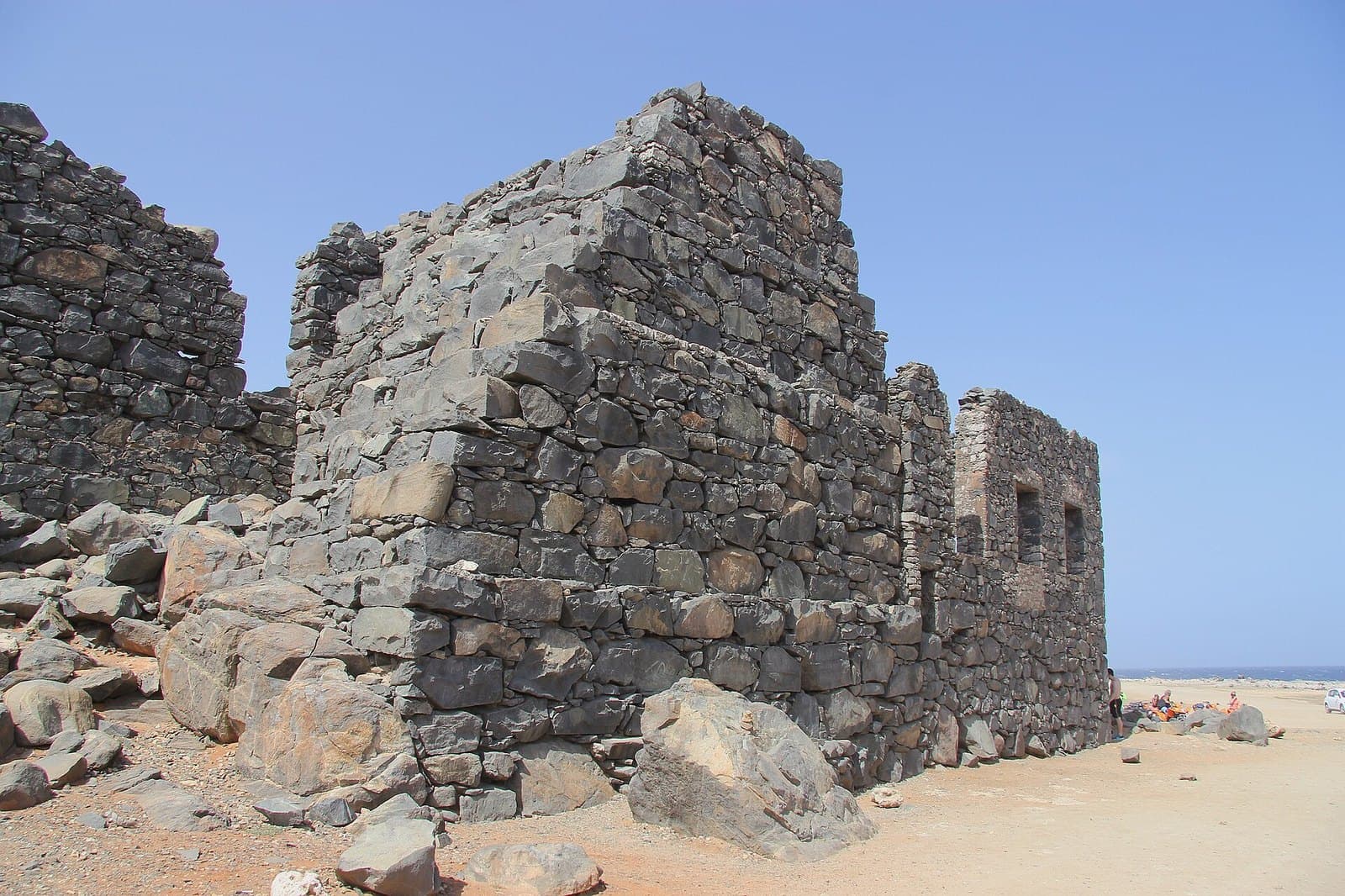
Around 1513 a Spanish expedition carried most of the Caquetío people of Aruba off to the mines of Hispaniola, and the crown filed the island away as one of the islas inútiles, the useless islands, holding nothing worth the cost of a settlement. The judgement was wrong twice. Gold turned up three centuries later and was worked for most of a century, and in the meantime the indifference that followed the deportation kept Aruba outside the sugar system, so indigenous families drifted back, stayed, and were still there when everyone else arrived.
That is why Aruba does not read like its neighbours. Enslaved Africans were brought here, but in nothing like the numbers shipped to the plantation colonies, and the island's people grew instead out of Caquetío households, Dutch and Spanish settlers, and later out of the tens of thousands who came from across the Caribbean to work an oil refinery. Mitochondrial DNA work by Oswald Wever on Aruba with Juan Martínez Cruzado in Puerto Rico found Amerindian maternal lines in most of the Arubans sampled, settling a long argument about whether the indigenous line had died out (Aruba Today).
Aruba is a flat, dry island of about 180 square kilometres lying some 29 kilometres off the Paraguaná Peninsula of Venezuela, with a population of roughly 108,000. It sits outside the main hurricane track, and its landscape runs to divi-divi trees bent permanently westward by the trade wind, cactus, and diorite boulders piled at Ayo and Casibari. Since 1 January 1986 Aruba has been a constituent country of the Kingdom of the Netherlands in its own right, holding what Arubans call status aparte, with its own parliament, government and flag, while defence and foreign affairs remain kingdom matters. Papiamento and Dutch are official, Papiamento since 2003, and Spanish and English are spoken widely enough that most Arubans move between four tongues without thinking about it. Roman Catholicism is the majority religion, and the refinery decades left a population drawn from more than ninety nationalities on an island you can drive across in half an hour.
Oranjestad. The capital grew up around Fort Zoutman, begun in 1796 on the bay the Dutch called Paardenbaai, Horses' Bay, for the livestock shipped out of it. The Willem III Tower was added in 1868 as a lighthouse and clock tower, and the fort now holds the Historical Museum and the weekly Bon Bini Festival of Aruban music and dance. The centre keeps a run of Dutch colonial buildings in pastel render with gabled fronts, and the National Archaeological Museum Aruba occupies the restored Ecury family complex.
San Nicolas. The island's second town, at the eastern end, is the refinery town and the most mixed place in Aruba. Named for the landowner Nicolaas van der Biest, it filled after 1924 with workers from the British and French Caribbean, Venezuela, Suriname, Madeira and China, whose descendants still speak a local English creole known as San Nicolaas English or Village Talk. Since the refinery closed the town has been rebuilt around culture, with more than fifty painted murals, a community museum and the Museum of Industry in the old water tower.
Savaneta and Noord. Savaneta is the oldest continuously settled village and was the seat of government before Oranjestad. North of the capital stand the Alto Vista Chapel, on the site of the island's first Catholic chapel of 1750, and Santa Anna Church, whose carved oak neo-Gothic altar came from the Netherlands.
People reached Aruba at least 4,000 years ago, and Caquetío communities speaking an Arawakan language crossed from the Venezuelan mainland around a thousand years ago, bringing pottery, cassava farming and the burial practices archaeologists have since excavated at Tanki Flip. Alonso de Ojeda's expedition, with Amerigo Vespucci aboard, reached the island in 1499. Within about fifteen years the Spanish had removed most of its inhabitants to the mines of Hispaniola and written the island off, and it was that dismissal, rather than any treaty, that shaped everything after: with no plantation worth planting, Spain returned indigenous families to Aruba as herders and left them largely alone.
The Dutch West India Company took the island in 1636, two years after Curaçao, and ran it from Willemstad as a stock ranch and a strategic outpost. For more than a century the company barred European settlement, which preserved a largely indigenous rural population well into the eighteenth century, an arrangement almost unheard of elsewhere in the Caribbean at that date. Salt, horses, goats and wood were the exports, and the small enslaved population worked alongside free indigenous and mixed households rather than in gangs.
In 1824 a twelve-year-old herder named Willem Rasmijn found gold in a gully on the north coast, and the island Spain had judged worthless produced ore for the next ninety years (Britannica). The Aruba Island Gold Mining Company built the stone smelter at Bushiribana in 1872, whose walls still stand on the windward shore, and the Balashi mill followed in 1899; mining stopped in 1916 when wartime supply lines failed. Aloe, introduced in 1840, did better than gold: by the 1920s roughly two-thirds of the island's surface was under aloe, Aruba was the largest exporter of aloe resin in the world, and the crop gave it the nickname Island of Aloes (Royal Aruba Aloe).
Oil changed the island completely. The Lago Oil and Transport Company opened a transshipment terminal at San Nicolas in 1924 to move crude from Lake Maracaibo, Standard Oil of Indiana bought it in 1928 and added refining capacity, and by the Second World War the Lago refinery was among the largest on earth and a principal source of aviation fuel for the Allies, which is why a German submarine shelled it and torpedoed tankers in Aruban waters in February 1942 (Wikipedia). Thousands of workers came from across the Caribbean basin, and the island turned multilingual and multi-ethnic in one generation. Exxon closed the refinery in 1985.
The refinery decades also produced separation. Arubans had long resented being administered from Curaçao within the Netherlands Antilles, and the teacher and politician Gilberto François Croes, known to everyone as Betico, built a movement around leaving it. A referendum in 1977 returned an overwhelming vote for separate status, and on 1 January 1986 Aruba took status aparte. Croes was in a coma from a road accident on the eve of that date and died in November 1986 without seeing the state he had argued for. His birthday, 25 January, is a public holiday, and Flag and Anthem Day on 18 March marks the adoption of the Aruban flag in 1976.
Papiamento is the mother tongue of most Arubans and the ordinary language of the street, the shop and the family. Linguists broadly agree that it grew from an Afro-Portuguese creole carried across the Atlantic in the seventeenth century, restructured on the Dutch islands under heavy Spanish influence, with Dutch, English and a scatter of Arawak words layered on since (Britannica). A West African substrate survives in Guene, the name given to the African speech remembered on the plantations. The oldest surviving text in the language is a private letter of 1775, and the first printed book was a Catholic catechism of 1837.
What makes Papiamento unusual is its standing rather than its age. Aruba made it an official language alongside Dutch in 2003; it is taught in schools, used in parliament, printed in newspapers, and carries a body of poetry and fiction, a combination of official recognition and full literary use that very few creoles anywhere have achieved. The two islands even spell it differently: Aruba writes Papiamento with an etymological orthography, while Curaçao and Bonaire write Papiamentu phonetically, so the word for lead appears as chumbo on one island and chumbu on another.
The island's own name is unsettled. Popular etymology derives it from the Spanish oro hubo, "there was gold", which is hard to sustain because gold was not found until 1824, three centuries after the name is first recorded; the likelier source is a Caquetío word reaching Spanish through the mainland languages of Falcón. Aruban place names are a plain record of who came: Bushiribana and Arikok from indigenous and Papiamento roots, Oranjestad and Zoutman from the Dutch, Savaneta and Seroe Colorado from Spanish.
The Aruban year has a shape, and its markers are local. Dande opens it: from New Year's Eve until Epiphany, groups of musicians move from house to house singing a single repeating melody in Papiamento while the lead singer improvises a personal blessing for each member of the household and a hat goes round. The practice is usually traced to the years around emancipation, when freed people went door to door with drums to wish their neighbours well, and it is now sustained by a national Dande festival held every December (Aruba.com).
Carnival, organised on the island since 1954, runs from January to the Lighting Parade, the Grand Parade and the burning of King Momo. The music includes calypso and soca, but the older Aruban form is tumba, a fast, syncopated song contest with an annual final. On 24 June comes Dera Gai, the feast of St John the Baptist, whose name means "bury the rooster": a rooster was once buried to the neck while blindfolded dancers tried to strike it, an act read by the church as the beheading of the Baptist and by older belief as blood spilled to open the growing season. The rooster gave way to a calabash gourd generations ago, and what survives is a dance in yellow and red with bonfires in the neighbourhood centres (VisitAruba).
The countryside carries its own architecture. The cas di torto, also called cas di lodo, is a house of mud, straw and cactus wattle packed onto a frame of round poles with rounded corners and a thatched roof, a technique probably brought from the Paraguaná Peninsula in the eighteenth century and used until about 1925. A survey in 2005 counted 62 surviving examples, only four of them sound; three of those stand restored inside Arikok National Park (Wikipedia). The kitchen keeps its own record, in pastechi, keshi yena baked in a hollowed cheese rind, funchi and pan bati.
Aruba is predominantly Roman Catholic, a legacy of missionary work directed from Venezuela long before the Dutch church took an interest. The Alto Vista Chapel above the north coast marks the site of the first chapel on the island, built in 1750 by the Venezuelan missionary Domingo Antonio Silvestre with Caquetío converts, and the small yellow building of 1952 is approached by a lane of white crosses walked by pilgrims in Holy Week. San Nicolas has the widest religious range on the island, because the refinery brought Anglicans, Methodists and Baptists from the English-speaking Caribbean, and it holds their congregations still, along with a small Jewish community whose synagogue, Beth Israel, dates from 1962.
 The first chapel here was raised in 1750 for a congregation of Arawak and Spanish converts, before the island had a parish church, and the present building stands on its foundations. Photograph by Erik Cleves Kristensen, CC BY 2.0, via Wikimedia Commons.
Alongside the churches runs brua, the Papiamento word covering folk healing, protective charms and the reading of misfortune. It draws on African, indigenous and Iberian practice, was disapproved of from the pulpit for generations, and is discussed carefully with outsiders, but people still consult a kurandera for complaints a clinic has not settled. Bush medicine using aloe, calabash and cunucu herbs sits alongside it.
Aruban mourning is measured in days. A death is announced on the radio and by word of mouth, neighbours arrive at once, and the family begins ocho dia, the eight days. An altar goes up in the house with the photograph of the dead person, candles and flowers; each evening for eight nights family, neighbours and church members gather to say the rosary and then to sit, eat and talk about the person who has died. The funeral, usually a Catholic mass followed by burial, falls within those days, and the eighth night closes the sequence: the altar comes down, chairs in the room are turned upside down, and the windows are opened so the spirit can leave the house. Many families keep a further mass at the month and again at un aña, the first anniversary.
Burial matters more than cremation, and graves are treated as family property. Arubans build above-ground tombs in concrete, often for several generations of one household, and relatives repaint and re-letter them, which is why the island's cemeteries look tended rather than weathered. The heaviest visiting day is 2 November, All Souls', when families clean the tombs, lay flowers and light candles until the graveyards are full well after dark.
The island also remembers collectively, and it does so around names rather than battles. Betico Croes is the central figure, commemorated on his birthday each January; Flag and Anthem Day on 18 March gathers schoolchildren for the anthem Aruba Dushi Tera, written in 1952 by Juan Chabaya "Padú" Lampe with Rufo Wever. The Caquetío dead are remembered differently again, through the excavated cemeteries and through a National Archaeological Museum that treats the human remains in its care as ancestors of the living population rather than as specimens.
Aruba's records are Dutch in form, and the island's family history is unusually shaped by two things: a small colonial population and a very large refinery.
The island was administered from Curaçao for most of its history, so the older records are in Willemstad and The Hague as well as at the Archivo Nacional Aruba in Oranjestad. Catholic parish registers, the island being overwhelmingly Catholic, and civil registration from 1831 are the vital records.
Aruba had little plantation agriculture, so slavery here was on a smaller scale than in Curaçao or Suriname, and a substantial part of the population descends instead from the Caquetío, the Arawakan people who were here before the Spanish, mixed with Dutch, Spanish and African ancestry. Aruban identity has long emphasised that Indigenous descent, and recent genetic studies have supported it.
The refinery changed everything. Lago at San Nicolas opened in 1929 and drew workers from across the Caribbean, particularly from the British islands, along with Americans and Venezuelans, and its employment records document a population that arrived within a generation. English-speaking San Nicolas and Papiamentu-speaking Oranjestad are the result.
Since 1986 Aruba has been a separate country within the Kingdom of the Netherlands, so its civil registry is its own, though Dutch nationality law still applies. The Venezuelan crisis has brought a large undocumented population across twenty-nine kilometres of water, and their records are on the other side.
Aruba has no UNESCO World Heritage Site, so its protection runs through national law and a few committed institutions. The monuments ordinance created a national register of protected buildings, and the Monumentenfonds Aruba buys, restores and re-lets historic properties so they earn their keep instead of decaying, an approach that has saved a series of Oranjestad town houses and rural cunucu homes (Monumentenfonds Aruba). The National Archaeological Museum Aruba, reopened in its restored Ecury complex in 2009, holds the excavated record of the Caquetío period and of the pre-ceramic peoples.
Arikok National Park, established in 2000, protects roughly a fifth of Aruba, including the Fontein and Quadirikiri caves. Fontein holds pre-Columbian drawings in red and brown made by Caquetío hands, overlaid in places by the scratched names of later Europeans, and access is now by guided tour only so the pigment survives handling (Arikok National Park). The park also holds the restored farmstead at Cunucu Arikok with its cactus hedges, dry stone walls and mud house, the best surviving picture of how rural Arubans lived. Fort Zoutman carries the Historical Museum, and the Aruba Aloe factory at Hato keeps a museum of the aloe industry.
The island's memory institutions have pooled their digital work rather than competing. Coleccion Aruba brings the holdings of the National Archives, the National Library and the museums onto a single searchable platform of photographs, newspapers, maps, sound recordings and oral history (Coleccion Aruba). The Biblioteca Nacional Aruba has digitised long runs of the island's Papiamento and Dutch newspapers, which for genealogists is often the only route to a nineteenth-century family. The Archivo Nacional Aruba has gone further and released substantial photographic collections, including the Meiners and De Graaff archives, under open licences on Wikimedia Commons, so an image of the Bushiribana works or a 1960s village street can be reused freely by anyone writing about the island.
Language has its own digital footing. Papiamento dictionaries, spelling guides and school materials are published online, and the 1826 Papiamento catechism is inscribed on UNESCO's Memory of the World register for Latin America and the Caribbean (UNESCO).
Aruba's culture now reaches most people through tourism, which supplies the great majority of the island's income and brings visitors in numbers many times the resident population. That pressure has produced a deliberate counterweight: Bon Bini Festival at Fort Zoutman puts Aruban music and dance in front of visitors weekly rather than leaving them to the hotels, and the Aruba Art Fair in San Nicolas, running since 2016, turned a shuttered refinery town into a mural district Arubans visit as much as tourists do. Tumba and dande stay current because both are run as annual contests with broadcast finals.
The arguments Arubans have about their own heritage are practical ones. Papiamento's official status has not settled which language children should be taught to read in, and a multilingual schools pilot has run for years against a Dutch-medium tradition. Underneath the recurring public issues of migration, housing costs and the fate of the refinery site sits the question of how a small island keeps a rural culture legible when almost everyone now works in hospitality.
A creole became a state language. Papiamento was made official alongside Dutch in 2003 and is now used in parliament, in schools and in print, an outcome most creoles elsewhere have never achieved.
The Caquetío line was proved. Genetic sampling found Amerindian maternal ancestry in most Arubans tested, a continuity colonial records had written off five centuries earlier.
A fifth of the island is protected. Arikok National Park holds the Fontein and Quadirikiri caves, the pre-Columbian drawings and three restored cas di torto houses under guided access.
A refinery town reopened as an art district. After Exxon closed Lago in 1985 and San Nicolas emptied, murals, a community museum and an annual art fair gave the island's most multi-ethnic town a second reason to exist.
The first chapel here was raised in 1750 for a congregation of Arawak and Spanish converts, before the island had a parish church, and the present building stands on its foundations. Photograph by Erik Cleves Kristensen, CC BY 2.0, via Wikimedia Commons.
Alongside the churches runs brua, the Papiamento word covering folk healing, protective charms and the reading of misfortune. It draws on African, indigenous and Iberian practice, was disapproved of from the pulpit for generations, and is discussed carefully with outsiders, but people still consult a kurandera for complaints a clinic has not settled. Bush medicine using aloe, calabash and cunucu herbs sits alongside it.
Aruban mourning is measured in days. A death is announced on the radio and by word of mouth, neighbours arrive at once, and the family begins ocho dia, the eight days. An altar goes up in the house with the photograph of the dead person, candles and flowers; each evening for eight nights family, neighbours and church members gather to say the rosary and then to sit, eat and talk about the person who has died. The funeral, usually a Catholic mass followed by burial, falls within those days, and the eighth night closes the sequence: the altar comes down, chairs in the room are turned upside down, and the windows are opened so the spirit can leave the house. Many families keep a further mass at the month and again at un aña, the first anniversary.
Burial matters more than cremation, and graves are treated as family property. Arubans build above-ground tombs in concrete, often for several generations of one household, and relatives repaint and re-letter them, which is why the island's cemeteries look tended rather than weathered. The heaviest visiting day is 2 November, All Souls', when families clean the tombs, lay flowers and light candles until the graveyards are full well after dark.
The island also remembers collectively, and it does so around names rather than battles. Betico Croes is the central figure, commemorated on his birthday each January; Flag and Anthem Day on 18 March gathers schoolchildren for the anthem Aruba Dushi Tera, written in 1952 by Juan Chabaya "Padú" Lampe with Rufo Wever. The Caquetío dead are remembered differently again, through the excavated cemeteries and through a National Archaeological Museum that treats the human remains in its care as ancestors of the living population rather than as specimens.
Aruba's records are Dutch in form, and the island's family history is unusually shaped by two things: a small colonial population and a very large refinery.
The island was administered from Curaçao for most of its history, so the older records are in Willemstad and The Hague as well as at the Archivo Nacional Aruba in Oranjestad. Catholic parish registers, the island being overwhelmingly Catholic, and civil registration from 1831 are the vital records.
Aruba had little plantation agriculture, so slavery here was on a smaller scale than in Curaçao or Suriname, and a substantial part of the population descends instead from the Caquetío, the Arawakan people who were here before the Spanish, mixed with Dutch, Spanish and African ancestry. Aruban identity has long emphasised that Indigenous descent, and recent genetic studies have supported it.
The refinery changed everything. Lago at San Nicolas opened in 1929 and drew workers from across the Caribbean, particularly from the British islands, along with Americans and Venezuelans, and its employment records document a population that arrived within a generation. English-speaking San Nicolas and Papiamentu-speaking Oranjestad are the result.
Since 1986 Aruba has been a separate country within the Kingdom of the Netherlands, so its civil registry is its own, though Dutch nationality law still applies. The Venezuelan crisis has brought a large undocumented population across twenty-nine kilometres of water, and their records are on the other side.
Aruba has no UNESCO World Heritage Site, so its protection runs through national law and a few committed institutions. The monuments ordinance created a national register of protected buildings, and the Monumentenfonds Aruba buys, restores and re-lets historic properties so they earn their keep instead of decaying, an approach that has saved a series of Oranjestad town houses and rural cunucu homes (Monumentenfonds Aruba). The National Archaeological Museum Aruba, reopened in its restored Ecury complex in 2009, holds the excavated record of the Caquetío period and of the pre-ceramic peoples.
Arikok National Park, established in 2000, protects roughly a fifth of Aruba, including the Fontein and Quadirikiri caves. Fontein holds pre-Columbian drawings in red and brown made by Caquetío hands, overlaid in places by the scratched names of later Europeans, and access is now by guided tour only so the pigment survives handling (Arikok National Park). The park also holds the restored farmstead at Cunucu Arikok with its cactus hedges, dry stone walls and mud house, the best surviving picture of how rural Arubans lived. Fort Zoutman carries the Historical Museum, and the Aruba Aloe factory at Hato keeps a museum of the aloe industry.
The island's memory institutions have pooled their digital work rather than competing. Coleccion Aruba brings the holdings of the National Archives, the National Library and the museums onto a single searchable platform of photographs, newspapers, maps, sound recordings and oral history (Coleccion Aruba). The Biblioteca Nacional Aruba has digitised long runs of the island's Papiamento and Dutch newspapers, which for genealogists is often the only route to a nineteenth-century family. The Archivo Nacional Aruba has gone further and released substantial photographic collections, including the Meiners and De Graaff archives, under open licences on Wikimedia Commons, so an image of the Bushiribana works or a 1960s village street can be reused freely by anyone writing about the island.
Language has its own digital footing. Papiamento dictionaries, spelling guides and school materials are published online, and the 1826 Papiamento catechism is inscribed on UNESCO's Memory of the World register for Latin America and the Caribbean (UNESCO).
Aruba's culture now reaches most people through tourism, which supplies the great majority of the island's income and brings visitors in numbers many times the resident population. That pressure has produced a deliberate counterweight: Bon Bini Festival at Fort Zoutman puts Aruban music and dance in front of visitors weekly rather than leaving them to the hotels, and the Aruba Art Fair in San Nicolas, running since 2016, turned a shuttered refinery town into a mural district Arubans visit as much as tourists do. Tumba and dande stay current because both are run as annual contests with broadcast finals.
The arguments Arubans have about their own heritage are practical ones. Papiamento's official status has not settled which language children should be taught to read in, and a multilingual schools pilot has run for years against a Dutch-medium tradition. Underneath the recurring public issues of migration, housing costs and the fate of the refinery site sits the question of how a small island keeps a rural culture legible when almost everyone now works in hospitality.
A creole became a state language. Papiamento was made official alongside Dutch in 2003 and is now used in parliament, in schools and in print, an outcome most creoles elsewhere have never achieved.
The Caquetío line was proved. Genetic sampling found Amerindian maternal ancestry in most Arubans tested, a continuity colonial records had written off five centuries earlier.
A fifth of the island is protected. Arikok National Park holds the Fontein and Quadirikiri caves, the pre-Columbian drawings and three restored cas di torto houses under guided access.
A refinery town reopened as an art district. After Exxon closed Lago in 1985 and San Nicolas emptied, murals, a community museum and an annual art fair gave the island's most multi-ethnic town a second reason to exist.
National Overview
Notable Cities
Historical Foundations
Linguistic and Etymological Roots
Cultural Identity
Religion and Spirituality
Remembrance and Mourning Traditions
Tracing a Family in Aruba
Heritage Preservation Efforts
Digital Heritage
Contemporary Cultural Influences
Success Stories
References and resources
- Encyclopaedia Britannica, Aruba: geography, the gold rush, aloe and the oil economy.
- Encyclopaedia Britannica, Papiamentu: the creole's Afro-Portuguese base.
- Aruba Today, The Living Indigenous Heritage of Aruba: the mtDNA research on Caquetío maternal ancestry.
- Caquetio, Wikipedia: the Arawakan people of the Leeward Antilles.
- Lago Oil and Transport Company, Wikipedia: the San Nicolas refinery, 1924 to 1985.
- Royal Aruba Aloe: the 1840 introduction and the aloe export years.
- Arikok National Park: the protected fifth of the island and its caves.
- Cas di torto, Wikipedia: the mud and wattle house and the 2005 survey.
- VisitAruba, Dera Gai: the 24 June festival and the buried rooster.
- Aruba.com, Dande Festival: the New Year blessing sung house to house.
- Monumentenfonds Aruba: the monuments fund and its restorations.
- Coleccion Aruba: the shared digital platform of archives, library and museums.
- UNESCO Memory of the World, First Catechism in Papiamento, 1826: the language's earliest documented phase.