Heritage · Country
Chad Culture and Heritage
Chad holds one of the oldest fossils of the human family and some of the Sahara's greatest galleries of rock art, from the arches of the Ennedi to the desert lakes of Ounianga. A guide to the country's deep past and to how its many peoples keep memory alive.Written to last.
By Confinity Heritage Editorial · Updated 2026-07-31 · 8-minute readQuiet tools, kept out of the way.
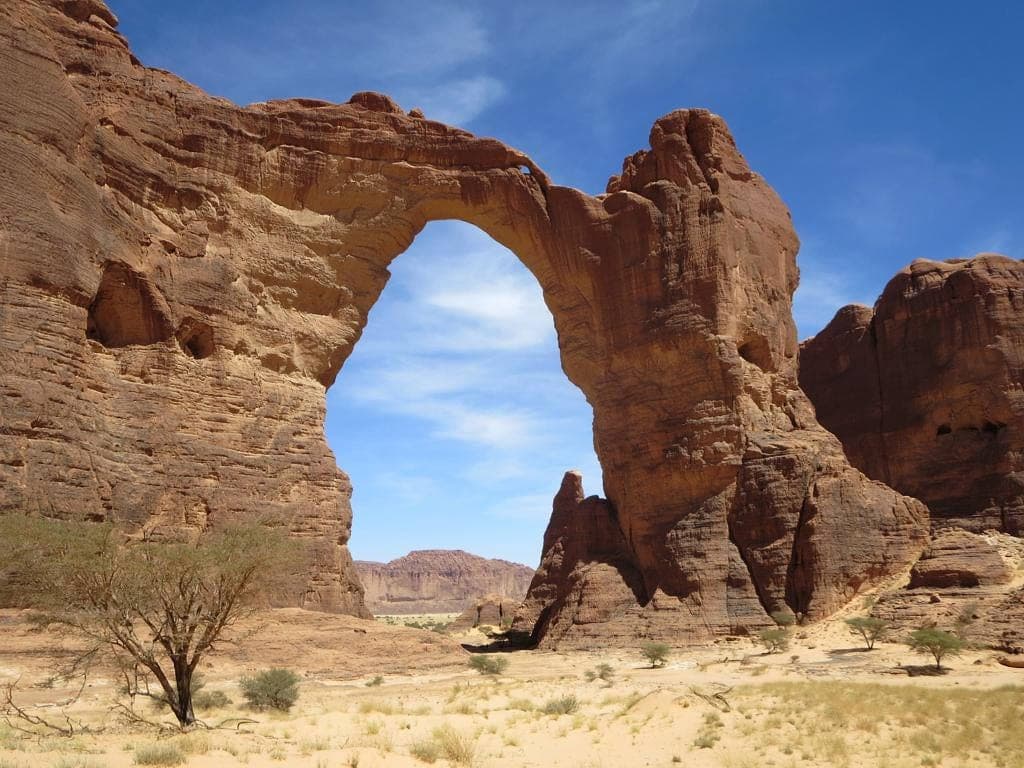
Chad reaches from the deep Sahara in the north to the wooded savanna of the south, and along the way it holds one of the oldest records of the human family found anywhere on Earth. In the Djurab desert, researchers uncovered Toumaï, a fossil close to seven million years old and among the earliest known hominins. On the sandstone plateau of the Ennedi, herders painted and engraved their cattle, hunters and horses across thousands of years of a wetter Sahara. Around the shallow, shifting waters of Lake Chad rose the Sao towns and then the long-lived empires of Kanem and Bornu, whose caravans tied the Sahel to the Mediterranean.
Two places carry that inheritance onto the UNESCO World Heritage List: the Ennedi Massif, a mixed natural and cultural landscape of arches, gorges and rock-art shelters, and the Lakes of Ounianga, a group of Saharan lakes that survive against long odds. Chad is home to more than two hundred peoples, among them the Sara, Kanembu, Toubou and Arab communities, with Muslim, Christian and traditional ways of honouring the dead.
Chad is a landlocked country at the meeting point of North, West and Central Africa, bordered by Libya, Sudan, the Central African Republic, Cameroon, Nigeria and Niger. At roughly 1.28 million square kilometres it is the fifth-largest country in Africa, and its landscape falls into three belts: the Sahara across the north, a semi-arid Sahelian band through the centre, and Sudanian savanna in the wetter south. Lake Chad, which gives the country its name, sits at the western edge and, once far larger, has shrunk sharply over the past half-century (Britannica).
The population is close to twenty million, with more than two hundred ethnic and linguistic groups. The Sara peoples of the south form the largest cluster; the Kanembu live around Lake Chad, the Toubou (Teda and Daza) in the northern deserts, and Arab communities across the Sahelian centre. French and Arabic are the two official languages. Most Chadians are Muslim, with a large Christian minority and communities that keep traditional beliefs, a distribution that broadly follows the north-to-south geography. N'Djamena, on the Chari River near the Cameroon border, is the capital and largest city.
N'Djamena. The capital was founded on 29 May 1900 as Fort-Lamy, a French military post at the confluence of the Chari and Logone rivers, facing the Cameroonian town of Kousséri. In 1973 President François Tombalbaye renamed it N'Djamena, from an Arabic phrase understood as a place of rest, as part of a wider effort to Africanise colonial place names. It is the seat of government and home to the Chad National Museum (N'Djamena, Wikipedia).
Moundou. Chad's second city lies on the Logone in the cotton-growing south, founded in 1923. It is the main industrial centre, known for cotton processing and the Gala brewery, the largest in the country.
Sarh. Founded as the French post of Fort-Archambault on the Chari, Sarh anchors the southern agricultural belt as a hub for cotton and sugar, within the historic homeland of Sara communities.
Abéché. In the east, Abéché was the capital of the Muslim Wadai (Ouaddaï) Sultanate from around 1850 until the French conquest. Once a stage on the trans-Saharan caravan routes toward the Mediterranean, it preserves the remains of a sultan's palace, the tombs of former rulers and an old mosque within its walls (Britannica: Abéché).
Chad's deepest chapter belongs to the whole human story. On 19 July 2001, a team working with Chad's national research centre and the palaeontologist Michel Brunet recovered a cranium in the northern Djurab desert. Named Toumaï, a Daza word for a child born just before the dry season, often rendered "hope of life", the fossil is dated to roughly six to seven million years ago and described as Sahelanthropus tchadensis, among the oldest known members of the human lineage (Sahelanthropus, Wikipedia). Nearby work in the Bahr el Ghazal region also yielded Australopithecus bahrelghazali, nicknamed Abel, evidence that this desert was once a well-watered home to early human relatives.
During later wet millennia, savanna and shallow lakes returned to what is now sand, and the people there left an extraordinary record on the rocks of the Ennedi Massif. Across its shelters and gorges, paintings and engravings span thousands of years from around 5000 BC onward, moving from wild game and hunters to great herds of cattle and finally to horses and camels as the climate dried. Wind has sculpted the plateau's stone into towers, pillars and natural bridges, among them the Aloba Arch, with a span of about 76 metres and a height near 120 metres (Ennedi Plateau, Wikipedia).
Nearer Lake Chad, along the Chari basin, the Sao civilisation built walled towns from roughly the sixth or fifth century BC and reached its height between about the ninth and fifteenth centuries AD. Sao artisans are remembered for their terracotta and bronze figures of people and animals, along with funerary urns and decorated pottery. Present-day Sara and Kotoko communities count the Sao among their ancestors, and the towns gave way as the Bornu state expanded and Islam spread (Sao civilisation, Wikipedia).
The most enduring of the region's states grew on the north-eastern shore of Lake Chad. The Kanem Empire took shape around the eighth century and, after its ruling house adopted Islam in the eleventh century, was governed by the long Sayfawa dynasty from Njimi. Its heartland later moved west of the lake to become Bornu, and historians speak of a single Kanem-Bornu polity that endured, in one form or another, from about 700 to 1902 (Kanem-Bornu, Wikipedia). Its wealth rested on the trans-Saharan trade in salt, natron, ivory and enslaved people, and its courts became centres of Islamic scholarship.
Other Muslim states rose in the second millennium. The Wadai Sultanate, founded in 1635, prospered on the caravan routes from Wara and later Abéché, while the Baguirmi Sultanate between the Chari and Logone was drawn into its orbit. In the late nineteenth century the warlord Rabih az-Zubayr swept across the region; his defeat by French forces at Kousséri in 1900 opened the way for colonial rule, and Chad became part of French Equatorial Africa, with Abéché falling in 1909.
Chad gained independence on 11 August 1960, with François Tombalbaye, a southern Sara teacher, as its first president. The decades that followed were difficult, marked by tension between north and south, prolonged civil conflict, and a border war with Libya over the Aouzou Strip during the 1980s. Political change since has come largely through coups and contested transitions. These events are noted here only in outline, belonging to the country's political history rather than its heritage.
The country's name comes from Lake Chad, and the word itself derives from a local term for a large body of water, applied first to the lake and then to the land around it. French and Arabic are the two official languages: French serves administration, higher education and most written public life, while Chadian Arabic has long been the everyday language of trade and travel across the Sahel and a common tongue among peoples who share no other.
Beneath these two run more than a hundred indigenous languages. The Sara languages of the south, part of the Nilo-Saharan family, are spoken by the largest group of communities; Kanembu and Kanuri carry the heritage of the Lake Chad empires; and the Toubou of the northern deserts speak Tedaga and Dazaga, the language that gave Toumaï its name. Many Chadians move easily between a home language, Chadian Arabic and French, and the country's linguistic map records the migrations and states that met here.
Chad's cultural memory reaches back to the Sao, whose terracotta heads and figures, recovered from mounds along the Chari, are emblems of its ancient artistry. That inheritance lives on in the traditions of its peoples: the desert craft and pastoral endurance of the Toubou, the fishing and farming life of the Kanembu on the lakeshore, and the drumming, dance and oral literature of the Sara and their neighbours in the south. The Islamic legacy of Kanem-Bornu shaped courtly dress, manuscript learning and Sahelian etiquette.
 Eighteen lakes survive in one of the driest places on earth, fed by groundwater left from a wetter Sahara, and the pattern only makes sense from above. Image by NASA, public domain, via Wikimedia Commons.
Music and dance vary by region and occasion. In the south, Sara, Ngambaye and related communities are known for polyrhythmic drumming, the balafon (a wooden xylophone) and call-and-response singing at harvests and weddings. The Sahelian courts favour the kakaki, a long metal ceremonial trumpet, along with drums and stringed instruments, and craft traditions include leatherwork, basketry, weaving and silver jewellery.
Chadian cuisine builds on the grains of the Sahel. Millet and sorghum are pounded into a stiff porridge called boule, served with sauces such as sauce gombo, a thick okra stew, or daraba, a peanut-and-leaf stew often enriched with dried fish and tomato. Meat dishes such as jarret de boeuf, a slow-cooked beef stew, reflect the mingling of Arab and sub-Saharan cooking, and strong sweet tea is a central act of hospitality.
Chad's religious life reflects its geography. Islam predominates across the northern and central regions and is the faith of a little over half the population, with roots in the conversion of the Kanem court in the eleventh century and the scholarly traditions of Kanem-Bornu. Christianity, both Catholic and Protestant, is strong in the south and among city populations and accounts for roughly four in ten Chadians, having spread largely through the colonial and post-independence periods. Communities that keep traditional beliefs, centred on ancestors and local spirits, remain present especially in rural southern areas, and their practices often blend with Muslim or Christian observance rather than standing apart (Britannica).
Mosques, churches and older sacred sites all belong to the country's religious landscape. Sufi orders have shaped devotional life in the Muslim regions, while church networks run many of the south's schools and clinics, so that both faiths are woven into daily life as much as into worship.
Ways of honouring the dead in Chad follow the country's three religious currents, and often draw on more than one at once. Among Muslim communities, burial follows Islamic practice closely: the body is washed and wrapped in a plain white shroud, the funeral prayer is offered, and burial takes place quickly, usually within a day, with the deceased laid facing Mecca in a simple grave. A period of condolence follows, when relatives and neighbours gather at the family home, recite the Qur'an, and share meals so that the household need not cook; charity and prayer in the name of the dead continue on Fridays and religious feasts.
Christian communities in the south mark death with a wake, a church service and burial, often accompanied by hymns and vigils that may last through the night. Across many southern peoples, older customs of ancestor respect run alongside these services: the dead are remembered as continuing members of the family, graves are tended, and anniversaries or communal rites reaffirm the bond between the living and those who came before, with drumming, dance and oral tribute often honouring the funeral of an elder.
For all the differences of doctrine, the pattern is shared: mourning in Chad is communal rather than private, hospitality toward the bereaved is a duty, and remembering the dead, whether through Qur'anic recitation, Christian liturgy or ancestral rite, is an obligation owed to each member of the community.
Chad's written record is thin, and the most important archive in the country was found by accident.
French administration created an état civil that applied properly to a small share of the population, and the colonial series is divided between N'Djamena and the French overseas archives at Aix-en-Provence. Independence came in 1960 and civil registration remains incomplete, particularly in the north and east, so for most Chadian families the record of the twentieth century is spoken rather than written: lineage recited within the clan, and the memory of who came from where held by elders.
The exception is the DDS files. In 2001 investigators from Human Rights Watch, looking through an abandoned building in N'Djamena, found the archive of the Direction de la documentation et de la sécurité, the political police of Hissène Habré's government. It ran to tens of thousands of documents: arrest lists, interrogation reports, death-in-custody notices, daily situation reports naming individuals. Families who had been told nothing for twenty years found the date and the fact of a relative's death in those papers. The archive became the documentary spine of the case that convicted Habré in Dakar in 2016, the first time a former head of state was tried for atrocities by the courts of another African country.
It is a grim way for a country to acquire a genealogical resource, and for a great many Chadian families it is the only document that names their dead.
Chad has two sites on the UNESCO World Heritage List. The Lakes of Ounianga, in the north-eastern Ennedi region, were inscribed in 2012 as a natural property: a system of eighteen lakes set in the hyper-arid Sahara, where rainfall is almost nil and the waters survive on fossil groundwater laid down in wetter ages. In one group, thick mats of reeds slow evaporation and keep several lakes fresh even as others turn saline, an interplay recognised as a rare natural phenomenon (Lakes of Ounianga, Wikipedia). The Ennedi Massif followed in 2016 as a mixed natural and cultural site, honouring both its sculpted sandstone landscape, including the Guelta d'Archei, a permanent gorge pool that shelters a small isolated population of desert crocodiles, and the thousands of years of rock art in its shelters.
The Chad National Museum in N'Djamena is the country's principal keeper of movable heritage. Founded on 6 October 1962 and rehoused in a new building in 2010, it holds collections spanning archaeology, history, palaeontology and Islamic heritage, including Sao material and casts associated with the Toumaï fossil, which Chadians regard as an ancestor of humankind (Chad National Museum, Wikipedia). Preservation faces real constraints: parts of the museum's holdings were lost during the conflict of the 1980s, funding is limited, and the desert sites lie far from population centres, so safeguarding their fragile environments and irreplaceable paintings remains an ongoing task.
Because Chad's most important sites are remote and its institutions modestly resourced, digital tools carry a growing share of the preservation effort. The Toumaï cranium has been studied through detailed scans and virtual reconstructions, making one of the oldest fossils of the human family available to researchers worldwide without risk to the original. Documentation projects record the Ennedi rock art through high-resolution photography and mapping, building a reference archive against weathering and vandalism, while satellite imagery helps monitor Lake Chad and the northern desert sites, where ground access is difficult. The UNESCO nomination files for Ounianga and the Ennedi have made maps, photographs and survey data publicly available, and digitising museum collections and oral traditions offers a way to share and safeguard the country's heritage online.
Chad's creative voice reaches well beyond its borders. The filmmaker Mahamat-Saleh Haroun has brought the country to the front rank of African cinema, winning the Jury Prize at the 2010 Cannes Film Festival for Un homme qui crie (A Screaming Man) and making films that examine memory, family and conflict in contemporary Chad. In literature, poets and novelists such as Nimrod have carried Chadian experience into French-language writing, while younger musicians blend Sahelian rhythms with hip-hop and popular styles.
The diaspora, spread across France and beyond, sustains publishing, film and music that keep Chadian identity active abroad. Within the country, radio, community theatre and religious and cultural festivals remain the everyday channels through which the traditions of the Sara, Kanembu, Toubou, Arab and other communities are passed on.
Toumaï takes its place in the human story. The discovery of Sahelanthropus tchadensis in the Djurab desert in 2001 pushed the known origins of the human lineage back toward seven million years and shifted attention toward the centre of the continent.
Two Saharan wonders reach the World Heritage List. The inscription of the Lakes of Ounianga in 2012 and the Ennedi Massif in 2016 brought international recognition to two of the Sahara's most striking landscapes, and to the rock art and desert crocodiles they shelter.
A national museum rebuilds. Rehoused in a new building in 2010 after years of hardship, the Chad National Museum continues to gather and present the country's archaeology, palaeontology and Sao heritage.
Chadian cinema wins global honour. Mahamat-Saleh Haroun's success at Cannes has shown that stories told from N'Djamena and the Chadian interior can reach the world's most demanding audiences, opening doors for other filmmakers from the region.
Eighteen lakes survive in one of the driest places on earth, fed by groundwater left from a wetter Sahara, and the pattern only makes sense from above. Image by NASA, public domain, via Wikimedia Commons.
Music and dance vary by region and occasion. In the south, Sara, Ngambaye and related communities are known for polyrhythmic drumming, the balafon (a wooden xylophone) and call-and-response singing at harvests and weddings. The Sahelian courts favour the kakaki, a long metal ceremonial trumpet, along with drums and stringed instruments, and craft traditions include leatherwork, basketry, weaving and silver jewellery.
Chadian cuisine builds on the grains of the Sahel. Millet and sorghum are pounded into a stiff porridge called boule, served with sauces such as sauce gombo, a thick okra stew, or daraba, a peanut-and-leaf stew often enriched with dried fish and tomato. Meat dishes such as jarret de boeuf, a slow-cooked beef stew, reflect the mingling of Arab and sub-Saharan cooking, and strong sweet tea is a central act of hospitality.
Chad's religious life reflects its geography. Islam predominates across the northern and central regions and is the faith of a little over half the population, with roots in the conversion of the Kanem court in the eleventh century and the scholarly traditions of Kanem-Bornu. Christianity, both Catholic and Protestant, is strong in the south and among city populations and accounts for roughly four in ten Chadians, having spread largely through the colonial and post-independence periods. Communities that keep traditional beliefs, centred on ancestors and local spirits, remain present especially in rural southern areas, and their practices often blend with Muslim or Christian observance rather than standing apart (Britannica).
Mosques, churches and older sacred sites all belong to the country's religious landscape. Sufi orders have shaped devotional life in the Muslim regions, while church networks run many of the south's schools and clinics, so that both faiths are woven into daily life as much as into worship.
Ways of honouring the dead in Chad follow the country's three religious currents, and often draw on more than one at once. Among Muslim communities, burial follows Islamic practice closely: the body is washed and wrapped in a plain white shroud, the funeral prayer is offered, and burial takes place quickly, usually within a day, with the deceased laid facing Mecca in a simple grave. A period of condolence follows, when relatives and neighbours gather at the family home, recite the Qur'an, and share meals so that the household need not cook; charity and prayer in the name of the dead continue on Fridays and religious feasts.
Christian communities in the south mark death with a wake, a church service and burial, often accompanied by hymns and vigils that may last through the night. Across many southern peoples, older customs of ancestor respect run alongside these services: the dead are remembered as continuing members of the family, graves are tended, and anniversaries or communal rites reaffirm the bond between the living and those who came before, with drumming, dance and oral tribute often honouring the funeral of an elder.
For all the differences of doctrine, the pattern is shared: mourning in Chad is communal rather than private, hospitality toward the bereaved is a duty, and remembering the dead, whether through Qur'anic recitation, Christian liturgy or ancestral rite, is an obligation owed to each member of the community.
Chad's written record is thin, and the most important archive in the country was found by accident.
French administration created an état civil that applied properly to a small share of the population, and the colonial series is divided between N'Djamena and the French overseas archives at Aix-en-Provence. Independence came in 1960 and civil registration remains incomplete, particularly in the north and east, so for most Chadian families the record of the twentieth century is spoken rather than written: lineage recited within the clan, and the memory of who came from where held by elders.
The exception is the DDS files. In 2001 investigators from Human Rights Watch, looking through an abandoned building in N'Djamena, found the archive of the Direction de la documentation et de la sécurité, the political police of Hissène Habré's government. It ran to tens of thousands of documents: arrest lists, interrogation reports, death-in-custody notices, daily situation reports naming individuals. Families who had been told nothing for twenty years found the date and the fact of a relative's death in those papers. The archive became the documentary spine of the case that convicted Habré in Dakar in 2016, the first time a former head of state was tried for atrocities by the courts of another African country.
It is a grim way for a country to acquire a genealogical resource, and for a great many Chadian families it is the only document that names their dead.
Chad has two sites on the UNESCO World Heritage List. The Lakes of Ounianga, in the north-eastern Ennedi region, were inscribed in 2012 as a natural property: a system of eighteen lakes set in the hyper-arid Sahara, where rainfall is almost nil and the waters survive on fossil groundwater laid down in wetter ages. In one group, thick mats of reeds slow evaporation and keep several lakes fresh even as others turn saline, an interplay recognised as a rare natural phenomenon (Lakes of Ounianga, Wikipedia). The Ennedi Massif followed in 2016 as a mixed natural and cultural site, honouring both its sculpted sandstone landscape, including the Guelta d'Archei, a permanent gorge pool that shelters a small isolated population of desert crocodiles, and the thousands of years of rock art in its shelters.
The Chad National Museum in N'Djamena is the country's principal keeper of movable heritage. Founded on 6 October 1962 and rehoused in a new building in 2010, it holds collections spanning archaeology, history, palaeontology and Islamic heritage, including Sao material and casts associated with the Toumaï fossil, which Chadians regard as an ancestor of humankind (Chad National Museum, Wikipedia). Preservation faces real constraints: parts of the museum's holdings were lost during the conflict of the 1980s, funding is limited, and the desert sites lie far from population centres, so safeguarding their fragile environments and irreplaceable paintings remains an ongoing task.
Because Chad's most important sites are remote and its institutions modestly resourced, digital tools carry a growing share of the preservation effort. The Toumaï cranium has been studied through detailed scans and virtual reconstructions, making one of the oldest fossils of the human family available to researchers worldwide without risk to the original. Documentation projects record the Ennedi rock art through high-resolution photography and mapping, building a reference archive against weathering and vandalism, while satellite imagery helps monitor Lake Chad and the northern desert sites, where ground access is difficult. The UNESCO nomination files for Ounianga and the Ennedi have made maps, photographs and survey data publicly available, and digitising museum collections and oral traditions offers a way to share and safeguard the country's heritage online.
Chad's creative voice reaches well beyond its borders. The filmmaker Mahamat-Saleh Haroun has brought the country to the front rank of African cinema, winning the Jury Prize at the 2010 Cannes Film Festival for Un homme qui crie (A Screaming Man) and making films that examine memory, family and conflict in contemporary Chad. In literature, poets and novelists such as Nimrod have carried Chadian experience into French-language writing, while younger musicians blend Sahelian rhythms with hip-hop and popular styles.
The diaspora, spread across France and beyond, sustains publishing, film and music that keep Chadian identity active abroad. Within the country, radio, community theatre and religious and cultural festivals remain the everyday channels through which the traditions of the Sara, Kanembu, Toubou, Arab and other communities are passed on.
Toumaï takes its place in the human story. The discovery of Sahelanthropus tchadensis in the Djurab desert in 2001 pushed the known origins of the human lineage back toward seven million years and shifted attention toward the centre of the continent.
Two Saharan wonders reach the World Heritage List. The inscription of the Lakes of Ounianga in 2012 and the Ennedi Massif in 2016 brought international recognition to two of the Sahara's most striking landscapes, and to the rock art and desert crocodiles they shelter.
A national museum rebuilds. Rehoused in a new building in 2010 after years of hardship, the Chad National Museum continues to gather and present the country's archaeology, palaeontology and Sao heritage.
Chadian cinema wins global honour. Mahamat-Saleh Haroun's success at Cannes has shown that stories told from N'Djamena and the Chadian interior can reach the world's most demanding audiences, opening doors for other filmmakers from the region.
National Overview
Notable Cities
Historical Foundations
Linguistic and Etymological Roots
Cultural Identity
Religion and Spirituality
Remembrance and Mourning Traditions
Tracing a Family in Chad
Heritage Preservation Efforts
Digital Heritage
Contemporary Cultural Influences
Success Stories
References and resources
- UNESCO World Heritage Centre: Ennedi Massif, Natural and Cultural Landscape
- UNESCO World Heritage Centre: Lakes of Ounianga
- Encyclopaedia Britannica: Chad
- Encyclopaedia Britannica: Abéché
- Sahelanthropus (Toumaï), Wikipedia
- Sao civilisation, Wikipedia
- Kanem-Bornu Empire, Wikipedia
- Wadai Sultanate, Wikipedia
- Lakes of Ounianga, Wikipedia
- Ennedi Plateau, Wikipedia
- Chad National Museum, Wikipedia
- N'Djamena, Wikipedia