Heritage · Country
Cornwall Culture and Heritage
Cornwall is a county of England whose people were recognised as a national minority under the Council of Europe's Framework Convention in April 2014. This is a guide to Kernow's heritage, from the engine houses of a UNESCO mining landscape to a Brythonic language UNESCO moved off its extinct list in 2010.Written to last.
By Confinity Heritage Editorial · Updated 2026-08-17 · 8-minute readQuiet tools, kept out of the way.
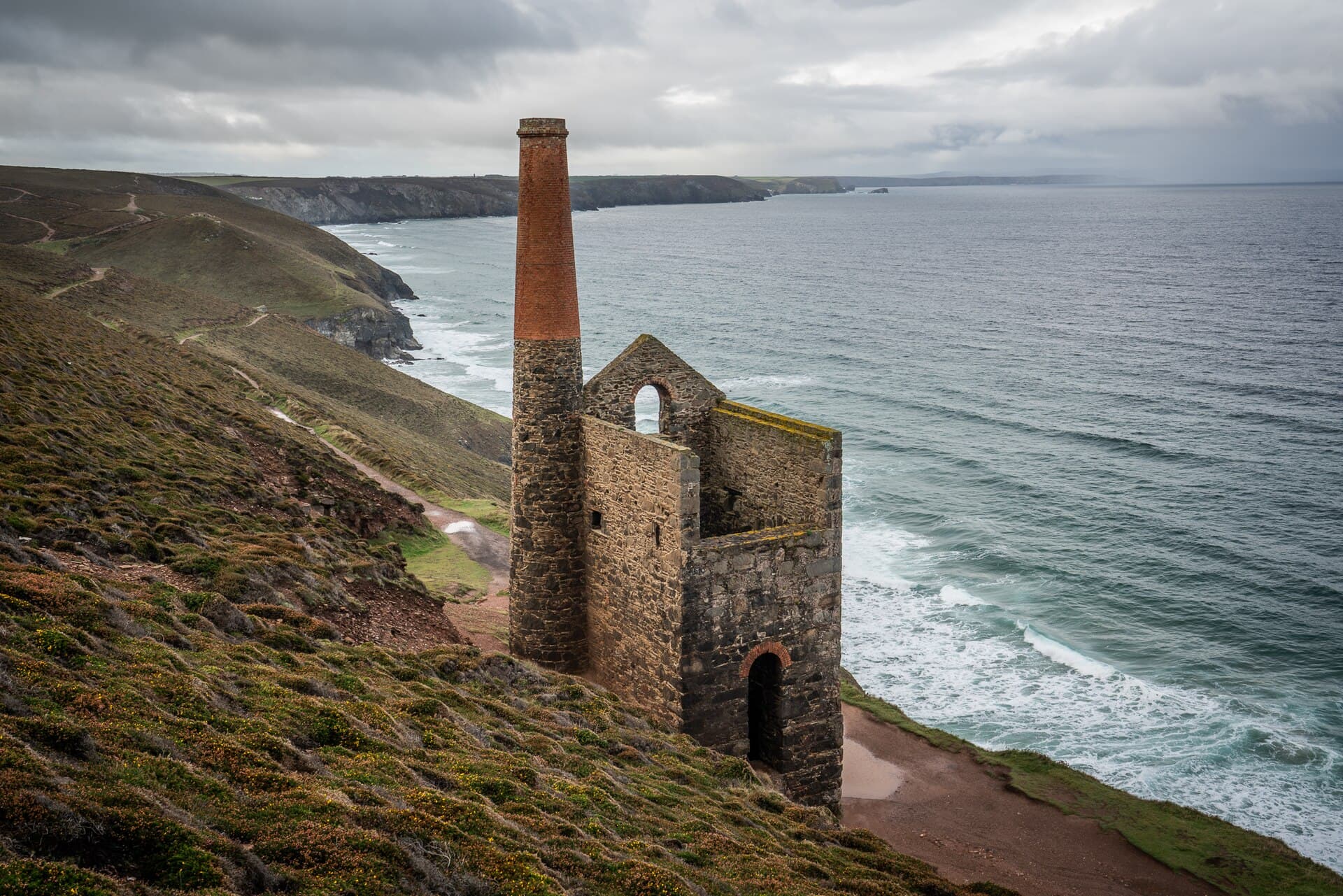
Walk the coast path west from St Agnes and you come on a roofless stone box with a brick chimney, set into the cliff above the Atlantic, its walls thick enough to have held a pumping engine's beam steady while the sea worked below. There are hundreds of these in Cornwall, and hundreds more in Mexico, South Australia, Michigan, Wisconsin and South Africa, built to the same pattern by the same families, because when the copper and tin failed at home the men who knew how to sink a shaft took the drawings with them.
On 24 April 2014 the United Kingdom announced that the Cornish would be protected under the Council of Europe's Framework Convention for the Protection of National Minorities, giving them the same standing as the Scots, the Welsh and the Irish. That is the formal fact which admits Cornwall to a guide of this kind, and it settled, in law, an older argument about whether a county of England could also be a people.
Cornwall covers about 3,563 square kilometres of the far south-western peninsula of Great Britain, bounded on the east by the River Tamar, which has marked the border since the tenth century and still does most of the work of separating it from Devon. Around 570,000 people live there in small towns and villages with no large city among them, governed since 2009 by Cornwall Council. The Cornish language has held recognition under Part II of the European Charter for Regional or Minority Languages since 2002, and the Cornish people came under the Framework Convention in April 2014. The interior is granite moor and china clay country, and for a long nineteenth century this was one of the most heavily industrialised places in Europe.
Truro. Cornwall's only city, grown from a stannary town and tin port. Its three-spired cathedral, designed by John Loughborough Pearson and built between 1880 and 1910, was the first new Anglican cathedral raised in England since St Paul's, and it went up around the surviving aisle of the parish church it replaced.
Penzance and Newlyn. The far west, looking across Mount's Bay to St Michael's Mount. Newlyn is one of England's largest fishing ports and gave its name to the painters who settled there in the 1880s, whose work hangs at Penlee House.
Falmouth. Built around one of the deepest natural harbours in the world, base of the Post Office Packet Service from 1689 and home to the National Maritime Museum Cornwall.
Camborne and Redruth. The mining heartland, once the densest concentration of deep mining anywhere. Richard Trevithick was born at Illogan nearby, and Kresen Kernow, the county archive, opened in Redruth in 2019.
St Ives. A pilchard town that became a centre of British modernism under Alfred Wallis, Ben Nicholson and Barbara Hepworth, with Tate St Ives above Porthmeor beach since 1993.
Cornwall's oldest monuments are the Neolithic quoits, chambered tombs whose capstones sit bare on the moors at Lanyon, Trethevy, Chûn and Zennor. Bronze Age Cornwall traded tin along the Atlantic seaways and left the Hurlers on Bodmin Moor, three stone circles in a line near Minions. In the Iron Age people lived in courtyard houses of the kind excavated at Chysauster and Carn Euny, thick-walled dwellings around an open yard, several with a fogou, an underground passage still argued over.
 Tintagel drawn by George Cooke. The Arthurian association is medieval literary invention, and the excavated settlement beneath it is a real and unusually wealthy post-Roman trading site. Yale Center for British Art, CC0, via Wikimedia Commons.
Rome touched Cornwall lightly, and the post-Roman kingdom of Dumnonia kept a British language and church while the Saxon kingdoms formed to the east. Athelstan fixed the boundary at the Tamar in the tenth century. From the twelfth century the tin trade ran under the stannaries, with its own courts and parliament, and in 1337 Edward III created the Duchy of Cornwall to endow his eldest son. Two risings shaped Cornish memory: in 1497 Michael An Gof, a blacksmith of St Keverne, and the lawyer Thomas Flamank led an army to Blackheath against taxation and were executed; in 1549 the Prayer Book Rebellion broke out against an English liturgy imposed on parishes that did not speak it, and was put down with heavy loss.
Tintagel sits apart from all this. Geoffrey of Monmouth's Historia Regum Britanniae, written around 1136, placed the conception of King Arthur on the headland, and the legend has drawn people there ever since; Richard, Earl of Cornwall, built a castle on the site in the 1230s partly for the association. The archaeology is a separate matter and interesting on its own terms: excavation has found a high-status settlement of the fifth to seventh centuries importing pottery and glass from the Mediterranean, which tells us that post-Roman Cornwall traded at long range and nothing at all about Arthur.
Then came the industrial century. Deep-lode mining took Cornwall to roughly two-thirds of world copper output in the early 1800s, and the collapse was just as fast: copper prices broke in the 1860s, cheaper tin arrived from Malaya and Bolivia, and mine after mine drowned. Between 1841 and 1901 about 250,000 Cornish people left. China clay, fishing and tourism followed, and South Crofty, the last working tin mine, closed in 1998.
Cornish, Kernewek, is a Brythonic Celtic language, the closest relative of Breton and a cousin of Welsh. Kernow comes from the Cornovii; the English name joins that root to Old English wealas, the Saxon word for the Britons. The language remains legible in the map: tre is a farmstead, pol a pool, pen a headland, lan an enclosed churchyard, and the old saying holds that by Tre, Pol and Pen shall ye know all Cornishmen.
The decline was long and it had a turning point. Welsh survived partly because it got a printed Bible in 1588; Cornish never did, and 1549 ended with an English liturgy in parishes that could not follow it. By the eighteenth century the language had retreated to the far west. Dolly Pentreath of Mousehole, baptised in 1692 and buried in December 1777, is the figure usually named as the last speaker, and Prince Louis Lucien Bonaparte paid for a monument to her at Paul church in 1860 calling her the last person who conversed in the ancient Cornish. The scholarship is less tidy than the monument. Daines Barrington found her speaking Cornish fluently in 1768, though she spoke English too; William Bodinar of Mousehole wrote to Barrington in Cornish in 1776, in what is taken as the last prose composed in the traditional language, and said only four or five old people in his village still spoke it. Others outlived her, among them John Davey of Zennor, who died in 1891, though accounts of what Davey knew disagree and linguists note that nobody can now tell whether the late reported speakers were using Cornish or English carrying a heavy Cornish substratum. Chesten Marchant of Gwithian, usually named as the last who knew no English at all, died a century before Pentreath. A language does not stop on a Tuesday.
The revival is dated to 1904, when Henry Jenner published A Handbook of the Cornish Language. Robert Morton Nance built Unified Cornish in 1929 on the medieval literature and it held the field for fifty years, after which the arguments began: Ken George's Kernewek Kemmyn, adopted by the Cornish Language Board in the 1980s, applied a reconstructed medieval phonology to a new spelling and was attacked by Nicholas Williams and Jon Mills for encoding distinctions the traditional texts do not show, while Richard Gendall built a Modern Cornish from the language's last traditional stage. Underneath the spellings sat a genuine question about which century a revived language should sound like, and the split ran through classes and publishers for a generation. A commissioned process produced the Standard Written Form in 2008, though a 2025 survey found published Cornish still appearing in five orthographies.
In 2010 UNESCO changed its classification of Cornish from extinct to critically endangered. The census recorded 557 people in England and Wales giving Cornish as their main language in 2011 and 563 in 2021; Cornwall Council's estimate runs to a few hundred fluent speakers, and a small, growing number of families now raise children in it from birth.
Mining is the inheritance most Cornish people reach for first. Richard Trevithick, born at Illogan in 1771, built the high-pressure steam engine that made deep pumping and then locomotion possible, ran his Puffing Devil up Camborne Hill on Christmas Eve 1801, and is remembered each April at Trevithick Day; Cornish beam engines went from the foundries at Hayle to mining fields worldwide.
The emigration went with them. Cornish miners abroad were known as Cousin Jacks, their wives and sisters as Cousin Jennies, from the habit of asking a foreman whether there might be a place for a cousin at home named Jack, and the saying goes that wherever there is a hole in the ground you will find a Cornishman in it. Moonta, Kadina and Wallaroo in South Australia became a copper district still called Little Cornwall, which still holds the Kernewek Lowender festival; Grass Valley in California, the Keweenaw of Michigan and Mineral Point in Wisconsin filled with Cornish families; at Real del Monte and Pachuca in Hidalgo they left the paste, a local descendant of the pasty, and the first football played in Mexico; on the Witwatersrand they worked the deep gold and died young of dust on the lungs. The pasty, crimped along one side and carried underground as a whole meal, took European protected status in 2011.
The public calendar is dense. St Piran's Day on 5 March has become the national day, its white cross on black now the flag. Helston keeps Flora Day on 8 May, when the Furry Dance goes in and out of the houses and shops of the town to a tune played there for centuries; Padstow's Obby Oss comes out at midnight on May Day; Penzance revived Montol at the winter solstice; and Guldize, the harvest feast with its Crying the Neck ceremony over the last sheaf, has been revived by the Old Cornwall Societies. Male voice choirs, brass bands and pub carol singing carry the rest.
Christianity reached Cornwall early from Ireland and Wales, and the map records it: the lan- names mark early enclosed church sites, and parishes are named for saints who appear almost nowhere else, Piran, Petroc, Ia, Buryan, Just. Cornwall has more standing medieval wayside crosses than any comparable area of Britain.
The greater religious fact of the last three centuries is Methodism. John Wesley made more than thirty journeys into Cornwall from 1743, and at Gwennap Pit, a grassy hollow left by old workings near Redruth, he preached repeatedly to open-air congregations he numbered in the thousands. Chapels went up in every mining hamlet, often built by the miners themselves in the evenings, and by the religious census of 1851 Cornwall was the most thoroughly Methodist part of England, with chapel attendance far above the national pattern and Anglican attendance far below it. Chapel gave those communities their singing, their Sunday schools, their burial clubs and their funerals. Many of those buildings are houses now, yet the hymn tunes have outlived the institutions and are still sung at rugby matches and in pubs at Christmas.
Older belief persisted alongside all of it. Underground the knockers tapped in the workings, sometimes warning of a fall and sometimes leading a man to good ore, so miners left them the corner of a pasty. The Cornish took the knockers abroad, and American mining camps knew them as tommyknockers.
Cornish grief is industrial, maritime and emigrant, and each has left its own monuments. The mines killed steadily and occasionally in numbers: twenty died at Wheal Owles in 1893 when a level was driven into the flooded workings of a neighbouring mine and their bodies were never recovered, and thirty-one at Levant on 20 October 1919 when the man engine carrying the shift up the shaft failed and dropped them. The chapel funeral that followed such a day was a village event, with a band leading the cortege and hymns sung at the graveside as the coffin was carried in. The churchyards keep the record on slate, quarried at Delabole and incised with lettering that has outlasted the granite around it.
The sea takes the other share. Coastal parishes hold graves of drowned sailors, many unnamed; at Morwenstow the vicar Robert Stephen Hawker, who wrote the words of Trelawny, recovered bodies from the cliffs below and buried them in his churchyard, where the figurehead of the wrecked Caledonia still stands. On 19 December 1981 the Penlee lifeboat Solomon Browne went out to the coaster Union Star in a south-westerly storm and was lost with all eight of her crew, every one of them from the village of Mousehole, along with the eight aboard the ship. The old Penlee boathouse has never launched a lifeboat since, and Mousehole switches off its Christmas lights for an hour each 19 December.
Gorsedh Kernow, the Cornish gorsedd of bards, was founded with Welsh help and first held on 21 September 1928 at the Boscawen-Ûn stone circle; it meets annually in the open air, conducts its ceremony in Cornish, and admits new bards under bardic names for service to Cornwall, which makes it a standing register of whom this community has chosen to honour. The emigration was itself a bereavement, since a passage to Adelaide or Johannesburg in the 1870s was usually final: families were parted permanently, and men who had gone out to the deep gold came home to die of miners' phthisis in their forties. Cornish associations abroad have turned that separation into an institution, and their members come back to find the parish their people left.
Cornish records are English in form and Cornish in what they are about, and mining runs through all of it.
Parish registers begin in 1538 as they do across England, and the Cornwall Record Office holds them with the wills, manorial rolls and estate papers. Civil registration from 1837 and the census from 1841 apply as elsewhere. The particular Cornish difficulty is the surname pool: Tre, Pol and Pen names are heavily concentrated in specific parishes, and a Cornish family is found by place before it is found by name.
The mining record is the distinctive one. Cornwall's copper and tin mines employed generations, and the cost book accounts, the dues records and the mine plans name setts and the men who worked them. When the industry collapsed in the later nineteenth century, Cornish miners left in enormous numbers, and the phrase used at home was that wherever a hole was being dug anywhere in the world, a Cornishman would be at the bottom of it. The Cornish diaspora is documented in South Australia, Michigan, Montana, Mexico, South Africa and Brazil, and the Cornish Global Migration Programme has been assembling those records for decades.
Methodism is the other archive. Wesley's preaching reshaped Cornwall, and chapel registers and circuit plans cover much of the population where the parish church does not.
Cornish, a Brythonic language, died as a community tongue and was revived; UNESCO moved it from extinct to critically endangered in 2010, which is a rare direction of travel.
The Cornwall and West Devon Mining Landscape was inscribed as a UNESCO World Heritage Site in 2006, covering nearly twenty thousand hectares in separate areas from St Just to the Tamar Valley, and it protects a whole working landscape rather than isolated monuments: engine houses, dressing floors, leats, smallholdings, harbours and miners' rows. Geevor at Pendeen, which worked until 1990, is the largest preserved mine site in Britain, and the National Trust keeps the Levant beam engine of 1840 in steam.
The county's records came under one roof in 2019. Kresen Kernow, built on the derelict Redruth Brewery site with about £11.7 million from the National Lottery Heritage Fund, holds more than 1.5 million items on fourteen miles of shelving, covering 850 years and gathering in the former Cornwall Record Office and the Cornish Studies Library. The Federation of Old Cornwall Societies, founded by Henry Jenner in 1920, still works to its original motto, gather ye the fragments that are left, that nothing be lost. The Cornish Language Partnership was set up in 2005 and its successors maintain the standard orthography and the dictionary; central government ended its annual grant of about £150,000 in 2016, and Cornwall Council has funded the work since.
Kresen Kernow's catalogue is searchable online, and a growing share of its holdings, including mine plans and parish registers, has been digitised. The Cornwall and Isles of Scilly Historic Environment Record publishes the county's archaeological and industrial sites as a public map layer. The Cornish Audio Visual Archive keeps recorded oral history, dialect and song, the Cornwall Family History Society has indexed parish registers and monumental inscriptions, and the Cornish Global Migration Programme at Redruth keeps emigrant records for the descendants who come looking. For the language there is an online dictionary from the Akademi Kernewek and free teaching material through the Go Cornish schools programme.
Cornwall's modern economy runs largely on the strength of its image. Millions of visitors come each year for the coast, the Eden Project, opened in 2001 inside a worked-out china clay pit, the Minack Theatre cut into a cliff at Porthcurno, and the food around the fishing ports.
The same attention creates the sharpest domestic argument. Cornwall has one of the highest concentrations of second homes and holiday lets in England, wages are low against house prices, and in 2016 residents of St Ives voted by a large majority for a neighbourhood plan restricting new-build housing to principal residences, later upheld in the High Court; the council has since used powers created in 2023 to charge a council tax premium on second homes. On constitutional questions, the Cornish Constitutional Convention gathered a petition of around fifty thousand signatures in 2001 for a Cornish assembly, Cornwall Council signed the first rural devolution deal in 2015, and in 2023 it declined a further offer requiring a directly elected mayor. These are live disputes, and this profile records the positions rather than choosing between them.
Recognition as a national minority. In April 2014 the Cornish were brought within the Council of Europe's Framework Convention, alongside the Scots, Welsh and Irish, giving the identity a footing in international law.
A language off the extinct list. The Standard Written Form of 2008 ended decades of orthographic division in official use, and in 2010 UNESCO moved Cornish from extinct to critically endangered.
A whole working landscape protected. The 2006 World Heritage inscription covers mines, harbours, foundries and settlements together, so the engine houses are read as part of the society that built them.
A county's records under one roof. Kresen Kernow opened in Redruth in 2019 with 1.5 million items spanning 850 years, replacing scattered archives with one searchable collection.
Tintagel drawn by George Cooke. The Arthurian association is medieval literary invention, and the excavated settlement beneath it is a real and unusually wealthy post-Roman trading site. Yale Center for British Art, CC0, via Wikimedia Commons.
Rome touched Cornwall lightly, and the post-Roman kingdom of Dumnonia kept a British language and church while the Saxon kingdoms formed to the east. Athelstan fixed the boundary at the Tamar in the tenth century. From the twelfth century the tin trade ran under the stannaries, with its own courts and parliament, and in 1337 Edward III created the Duchy of Cornwall to endow his eldest son. Two risings shaped Cornish memory: in 1497 Michael An Gof, a blacksmith of St Keverne, and the lawyer Thomas Flamank led an army to Blackheath against taxation and were executed; in 1549 the Prayer Book Rebellion broke out against an English liturgy imposed on parishes that did not speak it, and was put down with heavy loss.
Tintagel sits apart from all this. Geoffrey of Monmouth's Historia Regum Britanniae, written around 1136, placed the conception of King Arthur on the headland, and the legend has drawn people there ever since; Richard, Earl of Cornwall, built a castle on the site in the 1230s partly for the association. The archaeology is a separate matter and interesting on its own terms: excavation has found a high-status settlement of the fifth to seventh centuries importing pottery and glass from the Mediterranean, which tells us that post-Roman Cornwall traded at long range and nothing at all about Arthur.
Then came the industrial century. Deep-lode mining took Cornwall to roughly two-thirds of world copper output in the early 1800s, and the collapse was just as fast: copper prices broke in the 1860s, cheaper tin arrived from Malaya and Bolivia, and mine after mine drowned. Between 1841 and 1901 about 250,000 Cornish people left. China clay, fishing and tourism followed, and South Crofty, the last working tin mine, closed in 1998.
Cornish, Kernewek, is a Brythonic Celtic language, the closest relative of Breton and a cousin of Welsh. Kernow comes from the Cornovii; the English name joins that root to Old English wealas, the Saxon word for the Britons. The language remains legible in the map: tre is a farmstead, pol a pool, pen a headland, lan an enclosed churchyard, and the old saying holds that by Tre, Pol and Pen shall ye know all Cornishmen.
The decline was long and it had a turning point. Welsh survived partly because it got a printed Bible in 1588; Cornish never did, and 1549 ended with an English liturgy in parishes that could not follow it. By the eighteenth century the language had retreated to the far west. Dolly Pentreath of Mousehole, baptised in 1692 and buried in December 1777, is the figure usually named as the last speaker, and Prince Louis Lucien Bonaparte paid for a monument to her at Paul church in 1860 calling her the last person who conversed in the ancient Cornish. The scholarship is less tidy than the monument. Daines Barrington found her speaking Cornish fluently in 1768, though she spoke English too; William Bodinar of Mousehole wrote to Barrington in Cornish in 1776, in what is taken as the last prose composed in the traditional language, and said only four or five old people in his village still spoke it. Others outlived her, among them John Davey of Zennor, who died in 1891, though accounts of what Davey knew disagree and linguists note that nobody can now tell whether the late reported speakers were using Cornish or English carrying a heavy Cornish substratum. Chesten Marchant of Gwithian, usually named as the last who knew no English at all, died a century before Pentreath. A language does not stop on a Tuesday.
The revival is dated to 1904, when Henry Jenner published A Handbook of the Cornish Language. Robert Morton Nance built Unified Cornish in 1929 on the medieval literature and it held the field for fifty years, after which the arguments began: Ken George's Kernewek Kemmyn, adopted by the Cornish Language Board in the 1980s, applied a reconstructed medieval phonology to a new spelling and was attacked by Nicholas Williams and Jon Mills for encoding distinctions the traditional texts do not show, while Richard Gendall built a Modern Cornish from the language's last traditional stage. Underneath the spellings sat a genuine question about which century a revived language should sound like, and the split ran through classes and publishers for a generation. A commissioned process produced the Standard Written Form in 2008, though a 2025 survey found published Cornish still appearing in five orthographies.
In 2010 UNESCO changed its classification of Cornish from extinct to critically endangered. The census recorded 557 people in England and Wales giving Cornish as their main language in 2011 and 563 in 2021; Cornwall Council's estimate runs to a few hundred fluent speakers, and a small, growing number of families now raise children in it from birth.
Mining is the inheritance most Cornish people reach for first. Richard Trevithick, born at Illogan in 1771, built the high-pressure steam engine that made deep pumping and then locomotion possible, ran his Puffing Devil up Camborne Hill on Christmas Eve 1801, and is remembered each April at Trevithick Day; Cornish beam engines went from the foundries at Hayle to mining fields worldwide.
The emigration went with them. Cornish miners abroad were known as Cousin Jacks, their wives and sisters as Cousin Jennies, from the habit of asking a foreman whether there might be a place for a cousin at home named Jack, and the saying goes that wherever there is a hole in the ground you will find a Cornishman in it. Moonta, Kadina and Wallaroo in South Australia became a copper district still called Little Cornwall, which still holds the Kernewek Lowender festival; Grass Valley in California, the Keweenaw of Michigan and Mineral Point in Wisconsin filled with Cornish families; at Real del Monte and Pachuca in Hidalgo they left the paste, a local descendant of the pasty, and the first football played in Mexico; on the Witwatersrand they worked the deep gold and died young of dust on the lungs. The pasty, crimped along one side and carried underground as a whole meal, took European protected status in 2011.
The public calendar is dense. St Piran's Day on 5 March has become the national day, its white cross on black now the flag. Helston keeps Flora Day on 8 May, when the Furry Dance goes in and out of the houses and shops of the town to a tune played there for centuries; Padstow's Obby Oss comes out at midnight on May Day; Penzance revived Montol at the winter solstice; and Guldize, the harvest feast with its Crying the Neck ceremony over the last sheaf, has been revived by the Old Cornwall Societies. Male voice choirs, brass bands and pub carol singing carry the rest.
Christianity reached Cornwall early from Ireland and Wales, and the map records it: the lan- names mark early enclosed church sites, and parishes are named for saints who appear almost nowhere else, Piran, Petroc, Ia, Buryan, Just. Cornwall has more standing medieval wayside crosses than any comparable area of Britain.
The greater religious fact of the last three centuries is Methodism. John Wesley made more than thirty journeys into Cornwall from 1743, and at Gwennap Pit, a grassy hollow left by old workings near Redruth, he preached repeatedly to open-air congregations he numbered in the thousands. Chapels went up in every mining hamlet, often built by the miners themselves in the evenings, and by the religious census of 1851 Cornwall was the most thoroughly Methodist part of England, with chapel attendance far above the national pattern and Anglican attendance far below it. Chapel gave those communities their singing, their Sunday schools, their burial clubs and their funerals. Many of those buildings are houses now, yet the hymn tunes have outlived the institutions and are still sung at rugby matches and in pubs at Christmas.
Older belief persisted alongside all of it. Underground the knockers tapped in the workings, sometimes warning of a fall and sometimes leading a man to good ore, so miners left them the corner of a pasty. The Cornish took the knockers abroad, and American mining camps knew them as tommyknockers.
Cornish grief is industrial, maritime and emigrant, and each has left its own monuments. The mines killed steadily and occasionally in numbers: twenty died at Wheal Owles in 1893 when a level was driven into the flooded workings of a neighbouring mine and their bodies were never recovered, and thirty-one at Levant on 20 October 1919 when the man engine carrying the shift up the shaft failed and dropped them. The chapel funeral that followed such a day was a village event, with a band leading the cortege and hymns sung at the graveside as the coffin was carried in. The churchyards keep the record on slate, quarried at Delabole and incised with lettering that has outlasted the granite around it.
The sea takes the other share. Coastal parishes hold graves of drowned sailors, many unnamed; at Morwenstow the vicar Robert Stephen Hawker, who wrote the words of Trelawny, recovered bodies from the cliffs below and buried them in his churchyard, where the figurehead of the wrecked Caledonia still stands. On 19 December 1981 the Penlee lifeboat Solomon Browne went out to the coaster Union Star in a south-westerly storm and was lost with all eight of her crew, every one of them from the village of Mousehole, along with the eight aboard the ship. The old Penlee boathouse has never launched a lifeboat since, and Mousehole switches off its Christmas lights for an hour each 19 December.
Gorsedh Kernow, the Cornish gorsedd of bards, was founded with Welsh help and first held on 21 September 1928 at the Boscawen-Ûn stone circle; it meets annually in the open air, conducts its ceremony in Cornish, and admits new bards under bardic names for service to Cornwall, which makes it a standing register of whom this community has chosen to honour. The emigration was itself a bereavement, since a passage to Adelaide or Johannesburg in the 1870s was usually final: families were parted permanently, and men who had gone out to the deep gold came home to die of miners' phthisis in their forties. Cornish associations abroad have turned that separation into an institution, and their members come back to find the parish their people left.
Cornish records are English in form and Cornish in what they are about, and mining runs through all of it.
Parish registers begin in 1538 as they do across England, and the Cornwall Record Office holds them with the wills, manorial rolls and estate papers. Civil registration from 1837 and the census from 1841 apply as elsewhere. The particular Cornish difficulty is the surname pool: Tre, Pol and Pen names are heavily concentrated in specific parishes, and a Cornish family is found by place before it is found by name.
The mining record is the distinctive one. Cornwall's copper and tin mines employed generations, and the cost book accounts, the dues records and the mine plans name setts and the men who worked them. When the industry collapsed in the later nineteenth century, Cornish miners left in enormous numbers, and the phrase used at home was that wherever a hole was being dug anywhere in the world, a Cornishman would be at the bottom of it. The Cornish diaspora is documented in South Australia, Michigan, Montana, Mexico, South Africa and Brazil, and the Cornish Global Migration Programme has been assembling those records for decades.
Methodism is the other archive. Wesley's preaching reshaped Cornwall, and chapel registers and circuit plans cover much of the population where the parish church does not.
Cornish, a Brythonic language, died as a community tongue and was revived; UNESCO moved it from extinct to critically endangered in 2010, which is a rare direction of travel.
The Cornwall and West Devon Mining Landscape was inscribed as a UNESCO World Heritage Site in 2006, covering nearly twenty thousand hectares in separate areas from St Just to the Tamar Valley, and it protects a whole working landscape rather than isolated monuments: engine houses, dressing floors, leats, smallholdings, harbours and miners' rows. Geevor at Pendeen, which worked until 1990, is the largest preserved mine site in Britain, and the National Trust keeps the Levant beam engine of 1840 in steam.
The county's records came under one roof in 2019. Kresen Kernow, built on the derelict Redruth Brewery site with about £11.7 million from the National Lottery Heritage Fund, holds more than 1.5 million items on fourteen miles of shelving, covering 850 years and gathering in the former Cornwall Record Office and the Cornish Studies Library. The Federation of Old Cornwall Societies, founded by Henry Jenner in 1920, still works to its original motto, gather ye the fragments that are left, that nothing be lost. The Cornish Language Partnership was set up in 2005 and its successors maintain the standard orthography and the dictionary; central government ended its annual grant of about £150,000 in 2016, and Cornwall Council has funded the work since.
Kresen Kernow's catalogue is searchable online, and a growing share of its holdings, including mine plans and parish registers, has been digitised. The Cornwall and Isles of Scilly Historic Environment Record publishes the county's archaeological and industrial sites as a public map layer. The Cornish Audio Visual Archive keeps recorded oral history, dialect and song, the Cornwall Family History Society has indexed parish registers and monumental inscriptions, and the Cornish Global Migration Programme at Redruth keeps emigrant records for the descendants who come looking. For the language there is an online dictionary from the Akademi Kernewek and free teaching material through the Go Cornish schools programme.
Cornwall's modern economy runs largely on the strength of its image. Millions of visitors come each year for the coast, the Eden Project, opened in 2001 inside a worked-out china clay pit, the Minack Theatre cut into a cliff at Porthcurno, and the food around the fishing ports.
The same attention creates the sharpest domestic argument. Cornwall has one of the highest concentrations of second homes and holiday lets in England, wages are low against house prices, and in 2016 residents of St Ives voted by a large majority for a neighbourhood plan restricting new-build housing to principal residences, later upheld in the High Court; the council has since used powers created in 2023 to charge a council tax premium on second homes. On constitutional questions, the Cornish Constitutional Convention gathered a petition of around fifty thousand signatures in 2001 for a Cornish assembly, Cornwall Council signed the first rural devolution deal in 2015, and in 2023 it declined a further offer requiring a directly elected mayor. These are live disputes, and this profile records the positions rather than choosing between them.
Recognition as a national minority. In April 2014 the Cornish were brought within the Council of Europe's Framework Convention, alongside the Scots, Welsh and Irish, giving the identity a footing in international law.
A language off the extinct list. The Standard Written Form of 2008 ended decades of orthographic division in official use, and in 2010 UNESCO moved Cornish from extinct to critically endangered.
A whole working landscape protected. The 2006 World Heritage inscription covers mines, harbours, foundries and settlements together, so the engine houses are read as part of the society that built them.
A county's records under one roof. Kresen Kernow opened in Redruth in 2019 with 1.5 million items spanning 850 years, replacing scattered archives with one searchable collection.
National Overview
Notable Cities
Historical Foundations
Linguistic and Etymological Roots
Cultural Identity
Religion and Spirituality
Remembrance and Mourning Traditions
Tracing a Family in Cornwall
Heritage Preservation Efforts
Digital Heritage
Contemporary Cultural Influences
Success Stories
References and resources
- UNESCO, Cornwall and West Devon Mining Landscape: the 2006 inscription.
- Cornwall Council, Cornish national minority: the April 2014 recognition.
- Cornish language, Wikipedia: the decline, the orthographies and speaker numbers.
- Dolly Pentreath, Wikipedia: Bonaparte's monument and the rival claimants.
- Cornish diaspora, Wikipedia: emigration figures and the overseas communities.
- Kresen Kernow: the county archive at Redruth and its catalogue.
- Gorsedh Kernow: the bardic gorsedd founded in 1928.
- Geevor Tin Mine: the preserved mine at Pendeen.
- Penlee lifeboat disaster, Wikipedia: the Solomon Browne, 19 December 1981.
- Cornwall, Wikipedia: geography and history.