Heritage · University
University of the Punjab: History and Overview
Constituted at Lahore in 1882, the University of the Punjab was the fourth university of British India and the first in what is now Pakistan. Unlike its elders at Calcutta, Bombay and Madras it was founded to teach as well as examine, and to carry learning in the languages of the region, a brief that made its Oriental College one of the places where an academic Urdu was built.Written to last.
By Confinity Heritage Editorial · 2026-08-25 · 8-minute readQuiet tools, kept out of the way.
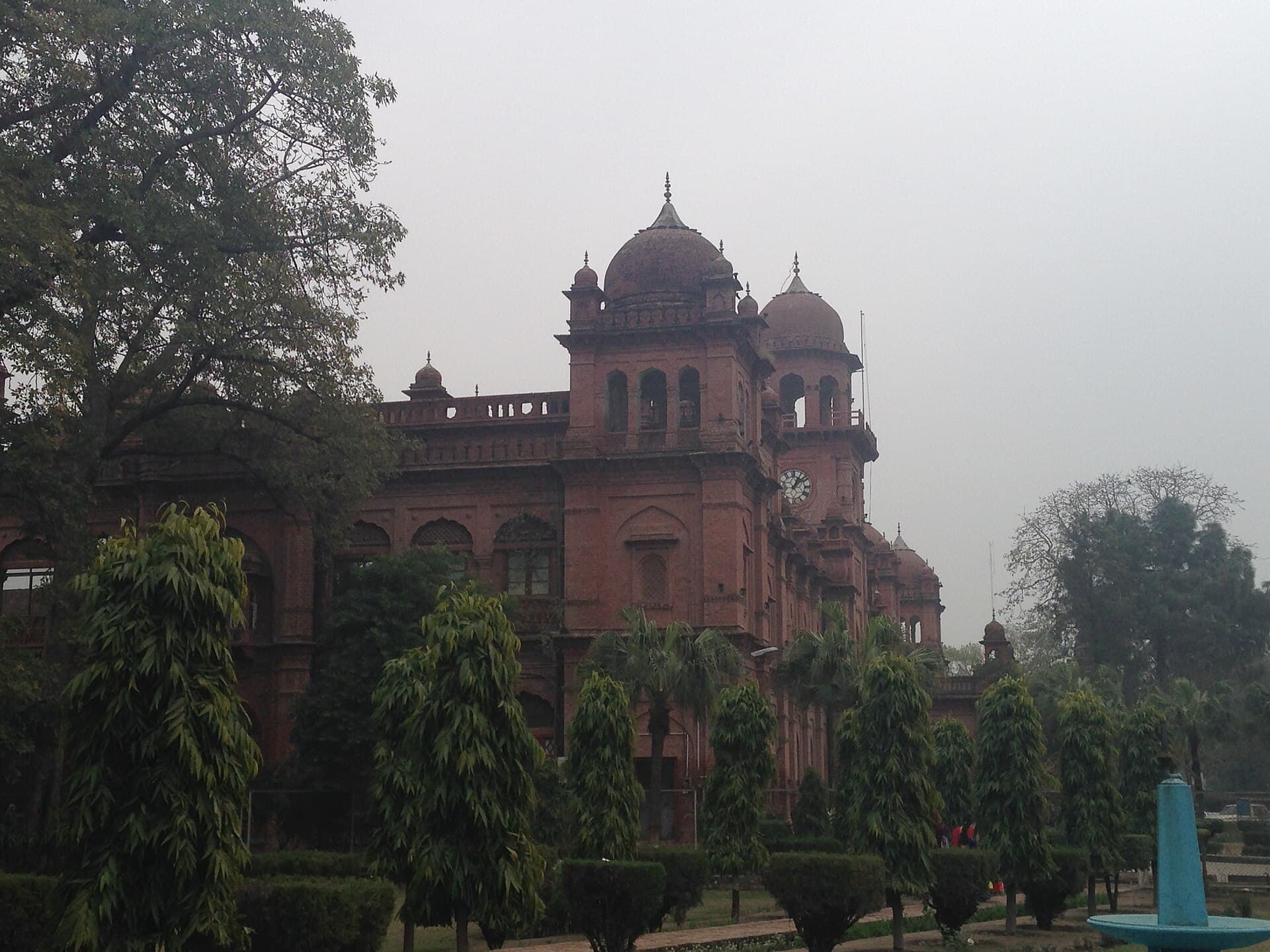
The University of the Punjab was formally constituted on 14 October 1882, when its Senate met for the first time at Simla. It was the fourth university the British founded in India, after Calcutta, Bombay and Madras, and the first anywhere in the territory that would become Pakistan. Its oldest buildings still stand on the Mall in central Lahore, red brick under domes and corner kiosks, screened in terracotta, with a heavy clock tower over the entrance porch opposite the Lahore Museum.
The three elder institutions were built as examining bodies. The University of Calcutta and its counterparts set papers, conferred degrees, left teaching to affiliated colleges and did all of it in English. Punjab was different in a way written into its founding: it was made a teaching and examining institution from the start, with a brief to promote learning in the vernacular and classical languages of the region. That brief set generations of Lahore scholars to the slow work of building an academic register for Urdu.
The university grew out of a society rather than a decree. In 1865 Gottlieb Wilhelm Leitner, a Hungarian-born orientalist who had become principal of Government College, Lahore, the year before, founded the Anjuman-i-Punjab, a literary association whose stated aims were the revival of oriental learning and the spread of useful knowledge through the medium of the vernacular. It ran a free library, held public lectures, commissioned educational texts and had them rendered into Indian languages, and from 1870 published its own Urdu journal.
Out of that campaign came a school of oriental sciences, the Madrasah-e-Uloom-e-Mashreqi, opened in 1870 and raised to the standing of the Oriental College two years later under Leitner as principal. A Punjab University College followed, examining candidates through the 1870s in Arabic, Persian, Sanskrit and Gurmukhi alongside the ordinary matriculation, and the campaign for a full university succeeded in 1882, with Leitner as first registrar. The institution both taught in its own departments and examined the colleges of a province that then reached from Delhi to the north-west frontier.
Partition in 1947 cut that province, and the university with it. The buildings, the library and the endowments lay in Lahore, on the Pakistani side of the new border, and the Lahore institution continued without a break. The government of East Punjab, left with affiliated colleges and no university to examine them, brought an ordinance on 27 September 1947 and established the East Punjab University on 1 October, a body that took on the obligations of the parent university but received none of its buildings or collections; it ran from Solan and settled at Chandigarh in 1956. What divided at Lahore was people. The university's own account records that the migration of its non-Muslim scholars left the faculty badly thinned, and that rebuilding it fell to Umar Hayat Malik, the first vice-chancellor after independence.
The Allama Iqbal Campus, still known as the Old Campus, occupies about fifty acres in the middle of the city. Its principal hall is attributed to Bhai Ram Singh, the Lahore architect whose other work includes the Lahore Museum and Aitchison College, and was completed in 1905 in the Indo-Saracenic manner: multi-foiled arches, bracketed balconies, jharokas, and cupolas of several sizes gathered around the clock tower over the porch. Administration, the law college and several older institutes remain there.
Most teaching has moved south. The Quaid-i-Azam Campus, laid out from 1958 along the canal roughly twelve kilometres from the Mall, covers close to 1,800 acres and holds the bulk of the university's academic life. Thirteen faculties run from arts and humanities, law and Islamic studies to engineering, medicine and the sciences, with oriental learning still a faculty in its own right.
Leitner's original proposal had been for an oriental university in which Arabic, Persian, Sanskrit and Urdu would sit beside European science, and in which subjects could be studied and examined in those languages. What was built instead was a college inside a conventional university, but the purpose survived the compromise. The Oriental College taught Arabic, Persian and Sanskrit alongside arithmetic, algebra and geography, adding Hindi and Punjabi later.
That combination created the problem that turned out to be the productive one. If algebra and geography were to be taught in the vernacular, somebody had to decide what the words were. Textbooks had to be commissioned, translated and argued over, and terms found or coined for ideas never before set down in Urdu. Leitner himself worked with the scholar Maulvi Karim-ud-Din on a two-volume history of Islam written in Urdu and published in 1871 and 1876. This is the unglamorous work by which a language acquires a technical register, and Lahore is one of the places where Urdu acquired its.
The scholarly apparatus followed. A Department of Urdu was founded inside the college in 1928 as a research department and began teaching the MA in 1948. Its early figures established the textual methods Urdu studies still use, above all Hafiz Mahmud Shirani, whose work on manuscripts and literary history is treated as the beginning of systematic Urdu research. Shirani's own library came to the university in 1942, 1,710 books, 434 documents and 2,284 volumes of manuscripts, one of some forty personal collections in a library founded in 1873 whose manuscript holdings now run into the tens of thousands.
The largest undertaking was the Urdu Daira Maarif Islamiya, the Urdu Encyclopaedia of Islam, begun at the university in the 1950s under Muhammad Shafi. It set out to render the Leiden Encyclopaedia of Islam into Urdu and ended by amending and expanding it, its Lahore editors writing their own entries where they disagreed. The first volume appeared in February 1954, Shafi died in 1963, funding lapsed, and the work resumed under Syed Muhammad Abdullah; twenty-three volumes were finished by 1989 and the first sequence completed in 1992. It remains the largest reference work of its kind in the language.
Because Punjab examined the colleges of the province as well as teaching in its own departments, many of the names attached to it belong to students of affiliated institutions who took Punjab degrees. The clearest case is Government College, Lahore, founded in 1864 and affiliated until it became a university in its own right in 2002.
Muhammad Iqbal, the poet and philosopher claimed as a national figure by both Pakistan and India, took his MA in philosophy at Government College in 1899 and then held the Macleod Readership in Arabic at the Oriental College from 1899 to 1903, so his tie runs in both directions, as graduate and as teacher; the Old Campus carries his name.
Abdus Salam came to Lahore from Jhang as a schoolboy, having taken, in the words of his Nobel biography, the highest marks ever recorded in the university's matriculation examination. He won a scholarship to Government College, took his MA in 1946 and left for Cambridge, returned in 1952 to head the mathematics department at Punjab University, found he could not build a research school there, and went abroad again. In 1979 he shared the Nobel Prize in Physics for the unification of the weak and electromagnetic interactions, the first Pakistani laureate.
Har Gobind Khorana, born in a Punjabi village to a family that was close to the only literate one in it, studied at the Punjab University in Lahore and took his MSc under the chemist Mahan Singh before leaving for Liverpool in 1945. He shared the 1968 Nobel Prize in Physiology or Medicine for work on the genetic code. The poet Faiz Ahmed Faiz is counted among the Oriental College's own alumni.
The university describes itself as the largest and oldest seat of higher learning in Pakistan, with more than 54,000 students on campus and 513 affiliated colleges whose examinations it still sets, which puts several hundred thousand further candidates under its seal each year. Its 125 departments and institutes cover the range of a modern research university, and the Faculty of Oriental Learning continues at the Old Campus.
The archival side matters as much as the teaching. The library's manuscript rooms hold the working collections of the scholars who made Urdu an academic language, some acquired before Partition and some assembled afterwards by people who crossed the new border with what they could carry.
The Old Campus stands on Shahrah-e-Quaid-e-Azam, the road still called the Mall, within a short walk of the Lahore Museum, the National College of Arts and Government College University. Entry is controlled and the buildings are in daily use, but the front elevation and the clock tower read clearly from the road, and this stretch of the Mall is among the better preserved runs of Indo-Saracenic building in the city. The Quaid-i-Azam Campus lies about twelve kilometres south along the canal, reached from Canal Bank Road.
History
Campus and academics
The Oriental College and the making of an academic Urdu
Scholarship
The university today
Visiting
References and resources
- University of the Punjab: History (official)
- University of the Punjab: Oriental Learning (official)
- University of the Punjab: Campuses (official)
- Punjab University Library: collections (official)
- Nobel Prize: Abdus Salam (biographical)
- Nobel Prize: Har Gobind Khorana (biographical)
- Wikipedia: University of the Punjab
- Wikipedia: Urdu Daira Maarif Islamiya