Heritage · University
KU Leuven: History and Overview
Founded by papal bull in 1425, KU Leuven is the oldest university in the Low Countries and marked six centuries of teaching in 2025. Its history holds Erasmus, Mercator, Vesalius and Georges Lemaître, and a library that was deliberately burned in 1914, rebuilt by international donation, burned again in 1940, and rebuilt once more.Written to last.
By Confinity Heritage Editorial · 2026-08-24 · 8-minute readQuiet tools, kept out of the way.
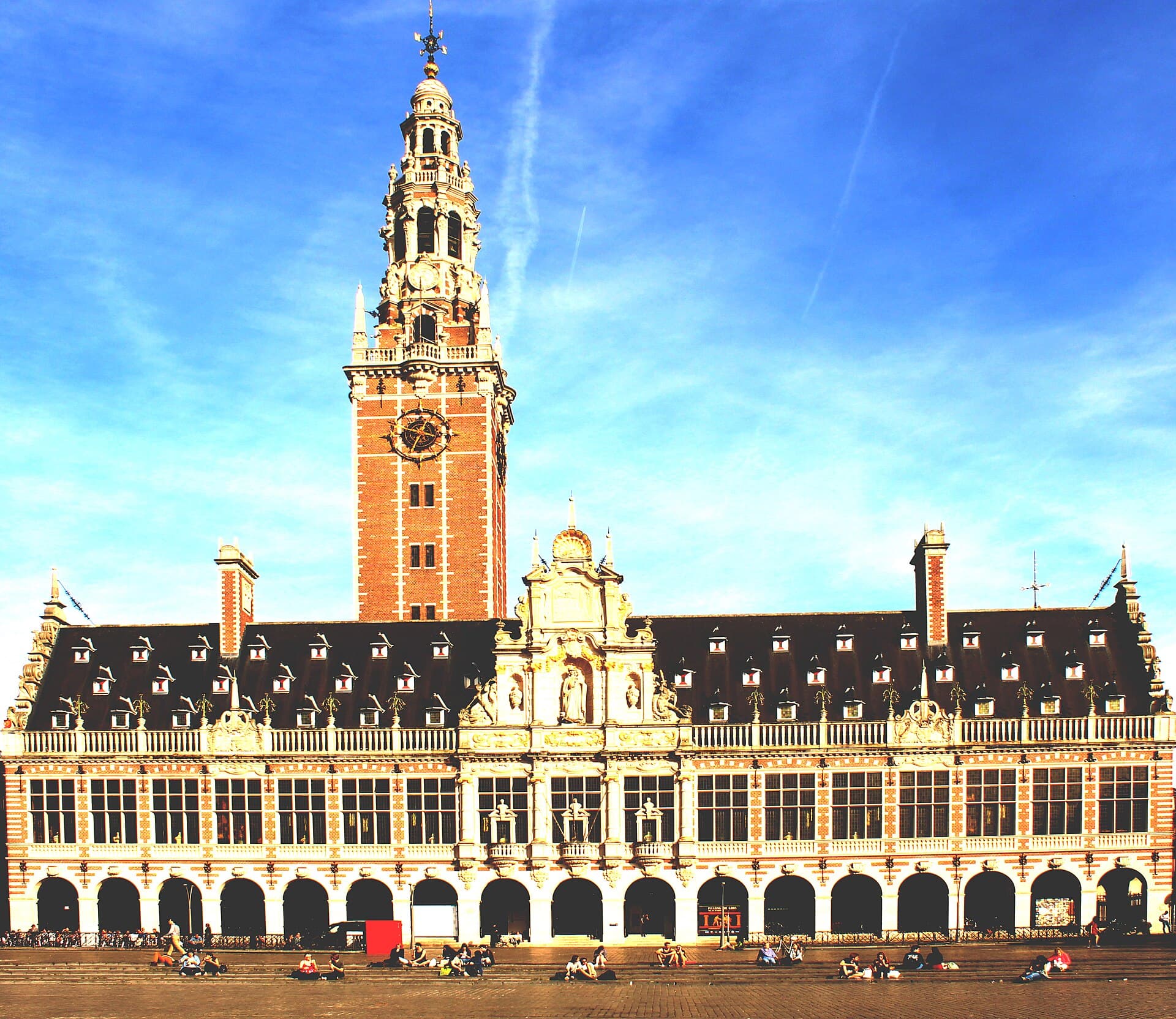
KU Leuven, the Catholic University of Leuven, is the oldest university in the Low Countries and the largest in Belgium. It was founded in 1425, when Pope Martin V issued a bull establishing a studium generale in the Brabantine market town of Leuven, and in 2025 it marked six hundred years of teaching. In that span it has counted Erasmus, Vesalius, Mercator and Justus Lipsius among its scholars, produced the priest-physicist who first proposed the expanding universe, and grown into one of Europe's leading research institutions.
It has also endured one of the most complete archival catastrophes ever inflicted on a place of learning. The university library was deliberately burned by an occupying army in 1914, rebuilt through an international campaign of donations, and burned again in 1940. That double loss, and the rebuilding that answered it, is the thread that runs through everything else on this page.
The university was created at the request of the town of Leuven and John IV, Duke of Brabant, and confirmed by Martin V's bull in December 1425. It taught the classic medieval faculties, with theology added in 1432, and by the early sixteenth century it stood among the great universities of Europe. Erasmus lived and worked in the town from 1517 to 1521, and in 1517 he helped establish the Collegium Trilingue, a college funded by the bequest of Hieronymus van Busleyden where Latin, Greek and Hebrew were taught side by side so that scripture and the classics could be read in their original tongues. The model spread across Europe and became a template for humanist education.
The old university did not survive the age of revolutions. French rule abolished it in 1797, and a Dutch state university occupied its buildings from 1817 to 1835. In 1834 the Belgian bishops founded a Catholic university at Mechelen, which moved to Leuven the following year and took up the inheritance, the buildings and the name. Historians have argued over the relationship between the medieval foundation and the modern one, but the continuity of place, purpose and collections is real, and the university counts its age from 1425.
The twentieth century brought a division from within. Belgium's linguistic conflict reached the university in the 1960s, when Flemish students and staff demanded a Dutch-speaking institution in a Flemish town. The crisis of 1968 brought down a national government, and the university split along language lines: the Dutch-speaking Katholieke Universiteit Leuven remained in the old town, while the francophone Université catholique de Louvain, now UCLouvain, moved to Louvain-la-Neuve, a new town built for it on farmland south of Brussels. The library was divided too. Roughly half the collection went to each successor, and the often repeated account holds that where no better criterion existed, works were assigned by odd and even shelf numbers. The story simplifies a more careful protocol that kept series and donations together where it could, but the arbitrary remainder was real, and the image of a library halved by number became shorthand for the whole painful separation.
KU Leuven has no walled campus. The university is woven through the streets of Leuven, its colleges, faculties and libraries scattered among the town's brick gables and Gothic landmarks, so that town and university are difficult to tell apart. The fifteenth-century Cloth Hall houses the rectorate; the Great Beguinage, a preserved medieval quarter and UNESCO World Heritage Site, serves as university housing. The best-known university building stands on Ladeuzeplein: the Central Library, a tall neo-Flemish-Renaissance block with a tower nearly 90 metres high, built in the 1920s to replace what was lost in 1914. Its carillon was installed with 48 bells, one for each American state at the time, in recognition of where so much of the rebuilding money had come from; restorations have since enlarged it to 63.
Academically the university spans theology, humanities, law, science, engineering, medicine, economics and the arts, taught in Leuven and at campuses across Flanders. Around 65,000 students are enrolled, a substantial share of them international, and the university is a founding member of the League of European Research Universities, whose secretariat sits in Leuven.
On the night of 25 August 1914, German troops occupying Leuven set fire to the town in reprisal for shooting they blamed on civilians. The university library burned with it. About 300,000 books were destroyed, along with roughly a thousand medieval manuscripts and hundreds of incunabula, the written memory of the oldest university in the Low Countries reduced to ash in a single night. The atrocity became one of the defining outrages of the war's opening weeks: newspapers across the neutral world carried the story, Allied propaganda made the burned library its leading exhibit, and "Remember Louvain" appeared on recruiting posters.
The response was as international as the outrage. After the war a campaign gathered books and money from across the world, with American universities, schools and institutions giving most, and the New York architect Whitney Warren designed a grand new library on Ladeuzeplein, completed in 1928. The names of American donor institutions are carved into its stones, so that the building itself reads as a ledger of gratitude. Warren wanted the balustrade to carry a Latin inscription declaring the library destroyed by German fury and restored by American generosity; the university, wary of building resentment into its walls, refused, and the quarrel over that single sentence became an incident of its own.
The restored collection stood for barely twelve years. In May 1940, as German forces invaded Belgium a second time, the new library burned amid the fighting for the town, and close to a million volumes were lost, more than the first fire had taken. The occupiers blamed British shelling, but the weight of evidence points to German artillery. Whatever the mechanism, the result was the same: the university's written past had been erased twice in twenty-six years. After the war the building was restored to Warren's design and the slow work of collecting began a third time. Today the Central Library holds millions of volumes again, and its tower carries the memory of both fires in its fabric. Few buildings anywhere state the case for safeguarding memory, and the cost of failing to, as plainly as this one.
The roll of Leuven scholars runs through the making of the modern mind. Andreas Vesalius began his studies at Leuven before moving on to Padua, where he wrote the anatomy that overturned Galen. Gerardus Mercator took his degree at Leuven in 1532 and learned instrument-making and engraving in the town; his 1569 projection, which lets a navigator steer a constant compass course as a straight line, still underlies the way the world is mapped. Justus Lipsius, the humanist editor of Tacitus and Seneca, taught at Leuven in the last years of his life, and his name now marks both a university college and a European Union building in Brussels.
The university's most consequential modern thinker was Georges Lemaître, a Catholic priest and professor of physics at Leuven. In 1927 he proposed that the universe is expanding and derived the relation between a galaxy's distance and its recession speed, two years before Edwin Hubble published the observations that made the idea famous. In 1931 he went further, arguing that the cosmos had grown from a "primeval atom," the proposal that became the Big Bang theory. Credit followed slowly, but it followed: in 2018 the International Astronomical Union voted to rename Hubble's law the Hubble-Lemaître law, restoring the Leuven priest's name to the discovery he made first. A generation later Christian de Duve, professor at Louvain, shared the 1974 Nobel Prize in Physiology or Medicine for revealing the internal organization of the cell, including the lysosome, which he discovered and named.
KU Leuven is consistently ranked the leading university in Belgium and among the strongest in continental Europe, and Reuters named it Europe's most innovative university for four consecutive years. Its research reach is anchored by imec, the nanoelectronics research centre founded in Leuven in 1984, now a global hub where the world's major chipmakers develop the processes behind future generations of chips. The university's spin-offs, teaching hospitals and science parks have made Leuven one of Europe's dense knowledge regions. In 2025 the university celebrated its six hundredth anniversary, a milestone reached by only a handful of institutions anywhere.
Leuven is about twenty five minutes from Brussels by train, and the university is best seen by walking the town: the Cloth Hall, the Gothic town hall on the Grote Markt, the Great Beguinage's lanes of brick houses, and the colleges threaded between them. The Central Library on Ladeuzeplein is the essential stop. Visitors can tour the reading room, climb the tower past exhibits on the two fires and the rebuildings, hear the carillon, and read the American donor names cut into the stone. The university works through term, so visitors are asked to keep reading rooms quiet and to check opening arrangements around examinations.