Heritage · University
University of the Witwatersrand: History and Overview
The University of the Witwatersrand grew from a school of mines founded in Kimberley in 1896 into Johannesburg's research university, chartered in 1922. It fought the segregation of South African higher education, taught Nelson Mandela law in the 1940s, and holds the fossil record that moved the story of human origins to Africa.Written to last.
By Confinity Heritage Editorial · 2026-08-24 · 8-minute readQuiet tools, kept out of the way.
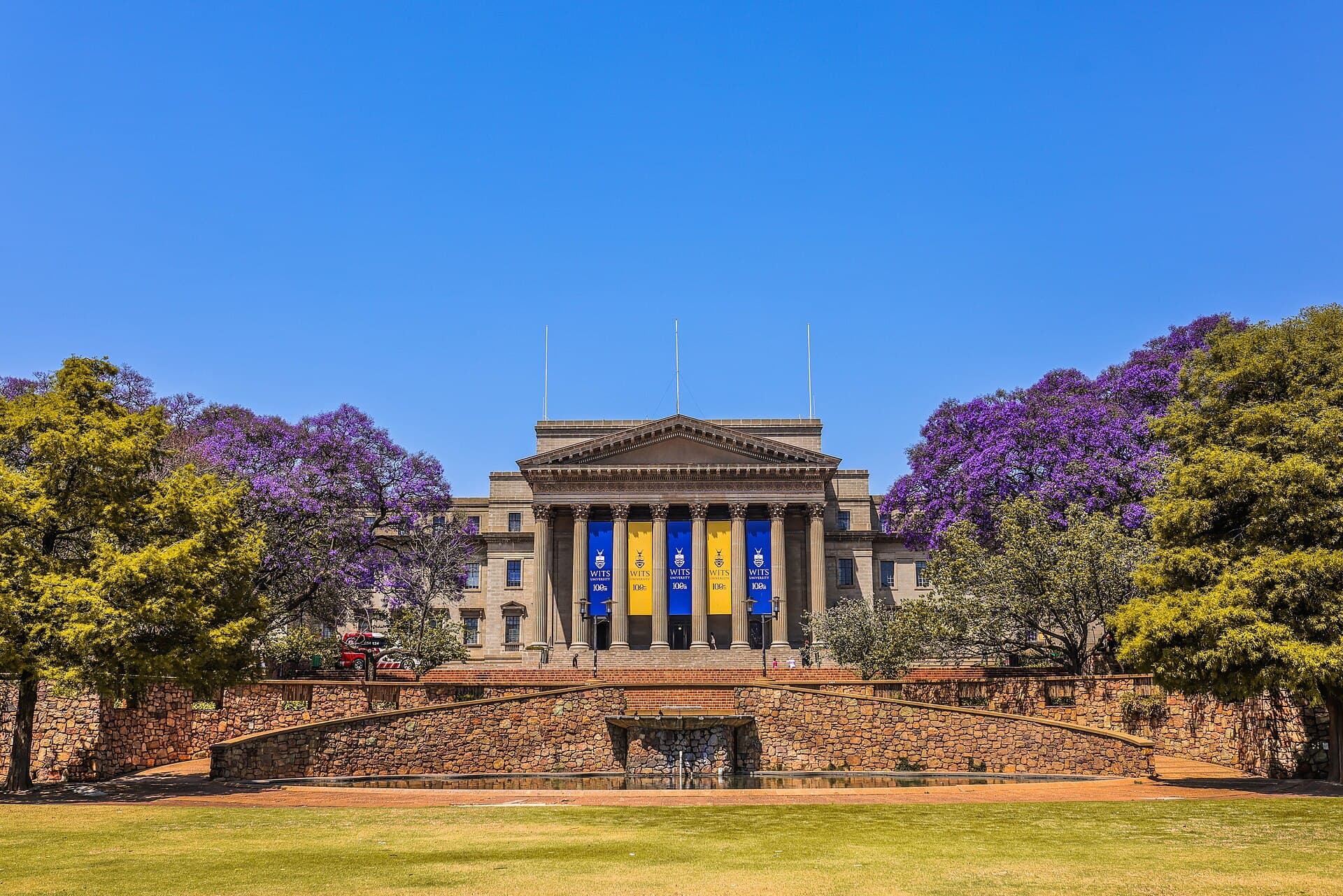
The University of the Witwatersrand, known to almost everyone as Wits, is the university that gold built. It takes its name from the low rocky ridge in South Africa's interior whose Afrikaans name means "ridge of white waters", beneath which, in 1886, prospectors found the richest goldfield ever discovered. Johannesburg grew on the reef with astonishing speed, the mines needed engineers faster than Europe could supply them, and the school founded to train them became, in time, one of Africa's leading research universities.
Wits keeps two histories that few institutions anywhere can match. It was one of the "open universities" that resisted the racial segregation of South African higher education, a resistance it lost in law and continued in argument, and it taught a young Nelson Mandela in the 1940s. And in its anatomy department in 1924 a fossil skull arrived from a lime quarry that redirected the study of human origins toward Africa. The university has kept that deepest layer of the human record ever since.
The institution began far from Johannesburg, as the South African School of Mines, founded in Kimberley in 1896 to serve the diamond fields. In 1904 it moved to Johannesburg, closer to the gold mines that now dominated the economy, and passed through a series of names, among them the South African School of Mines and Technology, as its teaching widened beyond engineering. On 1 March 1922 it received full university status as the University of the Witwatersrand, Johannesburg, and soon settled on its campus at Milner Park in Braamfontein, on a rise looking back toward the city the reef had made.
The university admitted students of all races in principle from early in its history, though never in equal numbers and never on equal terms. By the 1950s Wits and the University of Cape Town were known as the open universities, the two English-speaking institutions that kept academically integrated classes against the grain of the country's politics. When the apartheid government moved to end this, both protested formally, publishing a joint defence of the principle in 1957 as The Open Universities in South Africa. They lost. The Extension of University Education Act of 1959 barred Black, Coloured and Indian students from registering at the open universities without ministerial permission, and enrolment at Wits was largely segregated for the next three decades. The university marked the defeat by instituting an annual academic freedom lecture, a standing public reminder that its autonomy had been taken by statute.
The record deserves to be stated as the university's own historians state it: open in principle, unequal in practice. Black students at Wits before 1959 sat in the same lecture theatres but were excluded from residences, sports and much of student social life, and they were always few. The institution opposed segregation more consistently than most, and it did not escape the society it stood in.
Among those few students was Nelson Mandela, who enrolled for the LLB at Wits in 1943 while working as an articled clerk in the city. He was then the only African student in the law faculty, and he later wrote of meeting both open hostility and lifelong friendship there. At Wits and in the flats around it he came to know white and Indian contemporaries who became comrades in the struggle: Joe Slovo and Ruth First, both Wits students and later leaders of the movement, and Ismail Meer, in whose Kholvad House flat much of young activist Johannesburg gathered. Mandela left Wits in 1949 without the degree, after failing his final examinations in years consumed by politics, and completed the LLB through the University of South Africa in 1989, studying in prison near the end of the sentence that had taken him to Robben Island.
The heart of the university is the East Campus at Milner Park, and the heart of the East Campus is the Great Hall, the columned front of the original Central Block. Its classical portico, raised on a flight of steps above a broad piazza, is the image of Wits: the backdrop of graduations, protests and memorial services for a century. In October the jacarandas flower purple, and the sight of the Great Hall through their bloom is one of Johannesburg's fixed seasonal pleasures.
Beyond the Central Block the campus spreads through lawns and libraries to the science precincts, and across an enclosed motorway footbridge to the West Campus, home to commerce, law and engineering; a large health sciences campus sits in Parktown beside the teaching hospitals. Wits teaches across five faculties covering commerce, law and management; engineering and the built environment; health sciences; humanities; and science, with a student body of around 40,000. Its mining engineering school, the direct descendant of the Kimberley founding, remains among the most respected anywhere, formed by the deepest hard-rock mining on earth in the goldfields beneath and around the city.
In 1924 Raymond Dart, the young Australian-born professor of anatomy at Wits, received crates of fossil-bearing rock from a lime quarry at Taung. In one of them he found the face, jaw and natural brain cast of a young child that was not an ape and not yet human. In February 1925 he published the find in Nature, naming it Australopithecus africanus, the southern ape of Africa, and arguing that humanity's ancestors had arisen not in Asia or Europe, as most authorities then held, but in Africa. The scientific establishment resisted for decades; further discoveries proved Dart right. The Taung Child is kept at Wits still, one of the most consequential fossils ever described.
Dart's successor in anatomy, Phillip Tobias, carried the work through the second half of the century, and under him the university took over excavation of the Sterkfontein caves northwest of Johannesburg, the richest single source of early hominid fossils in the world. Sterkfontein produced "Mrs Ples", the Australopithecus africanus skull found by Robert Broom and John Robinson in 1947, and later "Little Foot", a near-complete Australopithecus skeleton that Wits palaeoanthropologist Ron Clarke traced from a handful of foot bones and spent some two decades freeing from the cave breccia. The caves lie within the Cradle of Humankind, a UNESCO World Heritage area where Wits remains the principal scientific presence.
The record is still growing. In 2013 cavers working with Wits professor Lee Berger found a chamber deep in the Rising Star cave system filled with hominid bones, and the expeditions of 2013-2015 recovered more than 1,500 fossil elements of a previously unknown species, announced in 2015 as Homo naledi. Berger's team had earlier described Australopithecus sediba from the nearby Malapa site. Between Taung, Sterkfontein, Malapa and Rising Star, the university keeps what amounts to the human family's earliest album: the oldest faces anyone can still look at. Its Origins Centre museum tells this story alongside the rock art of southern Africa, some of the oldest image-making in the world.
Wits counts four Nobel laureates among people who studied there. Sydney Brenner entered the medical school as a teenager in the 1940s and shared the 2002 Nobel Prize in Physiology or Medicine for work on the genetic regulation of development, done largely on a small worm he made one of biology's great model organisms. Aaron Klug took his undergraduate science degree at Wits and won the 1982 Nobel Prize in Chemistry for developing crystallographic electron microscopy. Nelson Mandela, the law student of the 1940s, shared the Nobel Peace Prize in 1993. The novelist Nadine Gordimer, who won the Literature prize in 1991, studied briefly at Wits and later received its honorary doctorate.
The wider roll call runs through South African public life: struggle lawyers and judges, writers, medical researchers, and generations of the mining engineers and geologists who mapped the deep reef. Wits research today spans the palaeosciences, deep mining, public health and particle physics, and the university regularly places among the top institutions on the continent.
Wits enters its second century as one of Africa's leading research universities, urban, argumentative and large, its historic campus embedded in the dense inner city of Braamfontein. In October 2015 it was the starting point of the Fees Must Fall protests over the cost of higher education, which spread to campuses across South Africa. The university marked its centenary in 2022, its founding trade still visible in its name and in the gold-bearing rock of its geology collections.
The East Campus in Braamfontein is the place to see: the Great Hall above its piazza, best in October when the jacarandas flower. The Origins Centre museum at the campus edge is open to the public and is the natural first stop for the human origins story, with the rock art collections alongside. The Sterkfontein caves and the Cradle of Humankind visitor centre at Maropeng, about an hour's drive northwest of the city, run guided tours into the caves themselves. Campus access arrangements change from term to term, so check the current entry requirements before setting out.