Heritage · University
University of Cambridge: History and Overview
Founded in 1209, the University of Cambridge is a collegiate research university in England and one of the oldest in continuous operation.Written to last.
By Confinity Heritage Editorial · Updated 2026-07-31 · 8-minute readQuiet tools, kept out of the way.
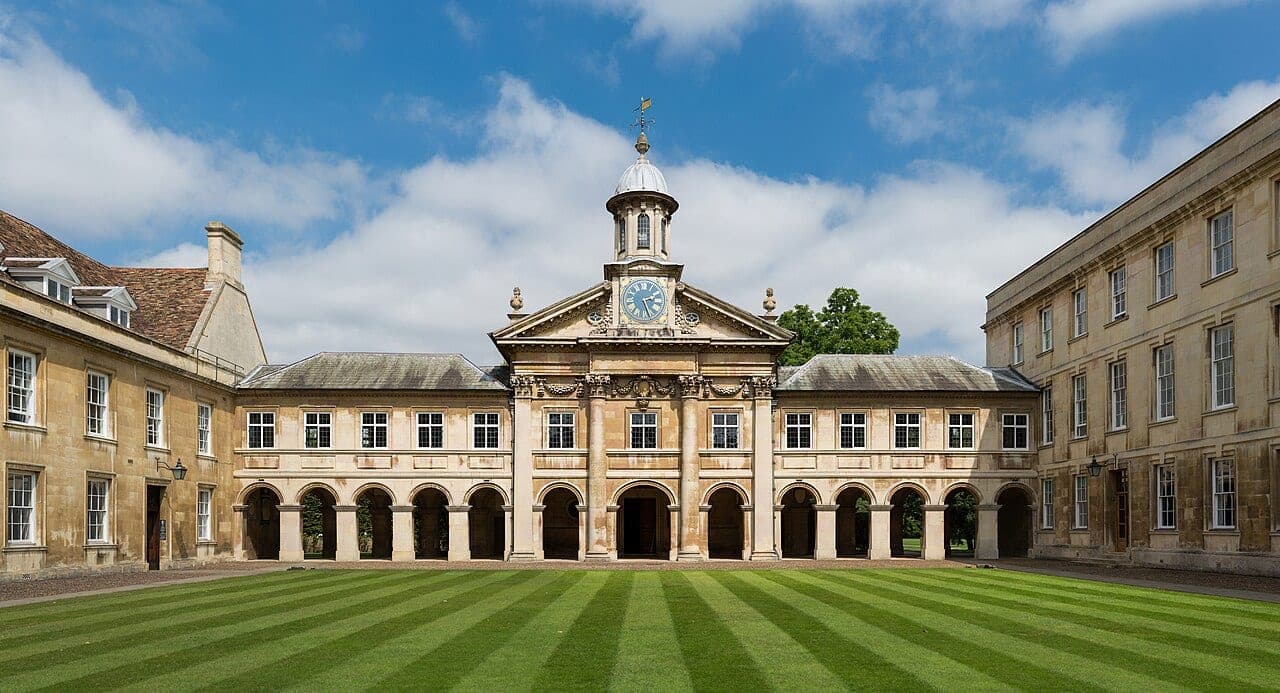
The University of Cambridge sits on the River Cam in the east of England, a collegiate research university whose origins reach back to 1209. It was founded by a group of scholars who left Oxford after a violent dispute with the local townspeople, which makes Cambridge a direct offshoot of the only English university then older than it (Britannica). It is usually described as the second-oldest university in the English-speaking world and among the oldest in continuous operation anywhere (Wikipedia). From that small community of clergy and students it grew into one of the most productive research institutions on earth.
Much of what Cambridge is known for was worked out within its walls: the law of universal gravitation, the theory of evolution by natural selection, the splitting of the atomic nucleus and the double-helix structure of DNA. The university remains a working place of teaching and research today, still organised around the semi-independent colleges that have shaped student life here for more than seven hundred years.
Cambridge began in 1209 when scholars fleeing Oxford settled in the market town on the Cam. The immediate cause was a killing: after two Oxford scholars were hanged by townspeople, others dispersed, and some established a new centre of study at Cambridge (Wikipedia). The community gained formal standing in 1231, when King Henry III granted it protections and a measure of self-government, with further recognition following from the papacy later that century (Britannica).
The defining institution of the university, the residential college, appeared in 1284 with the founding of Peterhouse. Colleges multiplied through the medieval and Tudor periods as bishops, monarchs and wealthy patrons endowed them, among them King's College in 1441 and Trinity College, established by Henry VIII in 1546. For centuries the curriculum centred on classics, theology and mathematics, the last examined through the demanding Mathematical Tripos. Reform came slowly. Religious tests for students were removed in the nineteenth century, the first women's colleges, Girton and Newnham, opened in 1869 and 1871, and women were finally admitted to full membership and degrees in 1948.
Cambridge is not a single body but a federation. It is made up of 31 semi-autonomous colleges alongside the central university and its academic departments (Wikipedia). The division of labour is old and precise. The colleges admit undergraduates, house and feed them, and provide the small-group teaching, known at Cambridge as supervision, in which one or two students discuss their work with a specialist each week. The university, for its part, organises lectures and laboratories, sets and marks the examinations that make up the Tripos, awards the degrees, and runs the libraries, museums and research facilities shared across the institution.
 The chapel took a century to build across the reigns of five kings, and the fan vault over it is the largest in the world. Photograph by Dmitry Tonkonog, CC BY-SA 3.0, via Wikimedia Commons.
Each college is a self-governing corporation with its own endowment, statutes and buildings, so they vary widely in age and wealth. Peterhouse remains the oldest, while Trinity is the largest and among the richest, its former members having included Isaac Newton and Francis Bacon.
The university's scientific reputation rests on a long line of individuals and, later, on one laboratory in particular. Isaac Newton entered Trinity College in 1661 and was elected Lucasian Professor of Mathematics in 1669; his Principia Mathematica, setting out the laws of motion and universal gravitation, appeared in 1687 (Britannica). Charles Darwin studied at Christ's College, graduating in 1831 shortly before he sailed on HMS Beagle, the voyage that led to On the Origin of Species.
Experimental physics was concentrated in 1874, when the Cavendish Laboratory opened under James Clerk Maxwell as its first professor (Cavendish Laboratory). What followed there reshaped modern science. J. J. Thomson identified the electron in 1897; in 1932 John Cockcroft and Ernest Walton split the atomic nucleus and James Chadwick discovered the neutron; and in 1953 Francis Crick and James Watson, building on the X-ray data of Rosalind Franklin and Maurice Wilkins, proposed the double-helix structure of DNA. In all, more than 120 Nobel laureates have been affiliated with Cambridge as students, staff or researchers (Wikipedia).
Cambridge is today one of the leading research universities in the world, teaching around 22,500 students and forming, with Oxford and London, the concentration of research strength often called the golden triangle (Wikipedia). Its Cambridge University Library is one of the United Kingdom's legal deposit libraries, entitled to a copy of every book published in the country, and Cambridge University Press, founded in 1534, is the oldest university press in the world. The city around it has grown into a dense cluster of science and technology companies, sometimes called Silicon Fen, so that the old relationship between town and gown now runs alongside close ties between the university and the businesses it has helped create.
Many of the historic colleges lie within a short walk of one another in the centre of Cambridge, and several open their courts, chapels and gardens to visitors, though some charge admission and most restrict access during the examination term. King's College Chapel, with its fan-vaulted ceiling and its Christmas Eve carol service, is the single best-known building. Behind the colleges that back onto the river lies the stretch of lawns and bridges known as the Backs, best seen from a flat-bottomed punt on the Cam. Opening hours and entry rules differ from college to college and change through the year, so it is worth checking the university's official website before a visit (University of Cambridge).
The chapel took a century to build across the reigns of five kings, and the fan vault over it is the largest in the world. Photograph by Dmitry Tonkonog, CC BY-SA 3.0, via Wikimedia Commons.
Each college is a self-governing corporation with its own endowment, statutes and buildings, so they vary widely in age and wealth. Peterhouse remains the oldest, while Trinity is the largest and among the richest, its former members having included Isaac Newton and Francis Bacon.
The university's scientific reputation rests on a long line of individuals and, later, on one laboratory in particular. Isaac Newton entered Trinity College in 1661 and was elected Lucasian Professor of Mathematics in 1669; his Principia Mathematica, setting out the laws of motion and universal gravitation, appeared in 1687 (Britannica). Charles Darwin studied at Christ's College, graduating in 1831 shortly before he sailed on HMS Beagle, the voyage that led to On the Origin of Species.
Experimental physics was concentrated in 1874, when the Cavendish Laboratory opened under James Clerk Maxwell as its first professor (Cavendish Laboratory). What followed there reshaped modern science. J. J. Thomson identified the electron in 1897; in 1932 John Cockcroft and Ernest Walton split the atomic nucleus and James Chadwick discovered the neutron; and in 1953 Francis Crick and James Watson, building on the X-ray data of Rosalind Franklin and Maurice Wilkins, proposed the double-helix structure of DNA. In all, more than 120 Nobel laureates have been affiliated with Cambridge as students, staff or researchers (Wikipedia).
Cambridge is today one of the leading research universities in the world, teaching around 22,500 students and forming, with Oxford and London, the concentration of research strength often called the golden triangle (Wikipedia). Its Cambridge University Library is one of the United Kingdom's legal deposit libraries, entitled to a copy of every book published in the country, and Cambridge University Press, founded in 1534, is the oldest university press in the world. The city around it has grown into a dense cluster of science and technology companies, sometimes called Silicon Fen, so that the old relationship between town and gown now runs alongside close ties between the university and the businesses it has helped create.
Many of the historic colleges lie within a short walk of one another in the centre of Cambridge, and several open their courts, chapels and gardens to visitors, though some charge admission and most restrict access during the examination term. King's College Chapel, with its fan-vaulted ceiling and its Christmas Eve carol service, is the single best-known building. Behind the colleges that back onto the river lies the stretch of lawns and bridges known as the Backs, best seen from a flat-bottomed punt on the Cam. Opening hours and entry rules differ from college to college and change through the year, so it is worth checking the university's official website before a visit (University of Cambridge).
History
The collegiate system
Scholarship and science
Cambridge today
Visiting
References and resources
- Encyclopaedia Britannica: University of Cambridge: founding, royal charter and long history.
- University of Cambridge, official site: colleges, visiting information and current figures.
- Wikipedia: University of Cambridge: collegiate structure, Nobel affiliations and modern scale.
- Cavendish Laboratory: our history (University of Cambridge): the founding of the laboratory in 1874 and its major discoveries.