Heritage · University
University of Cape Town: History and Overview
Founded in 1829 as the South African College, the University of Cape Town is South Africa's oldest university, set on the slopes of Devil's Peak above the city. Its history runs from an open university under apartheid to Rhodes Must Fall and the renaming of its great hall for Sarah Baartman, and its libraries carry one of the continent's deepest African Studies collections.Written to last.
By Confinity Heritage Editorial · 2026-08-23 · 8-minute readQuiet tools, kept out of the way.
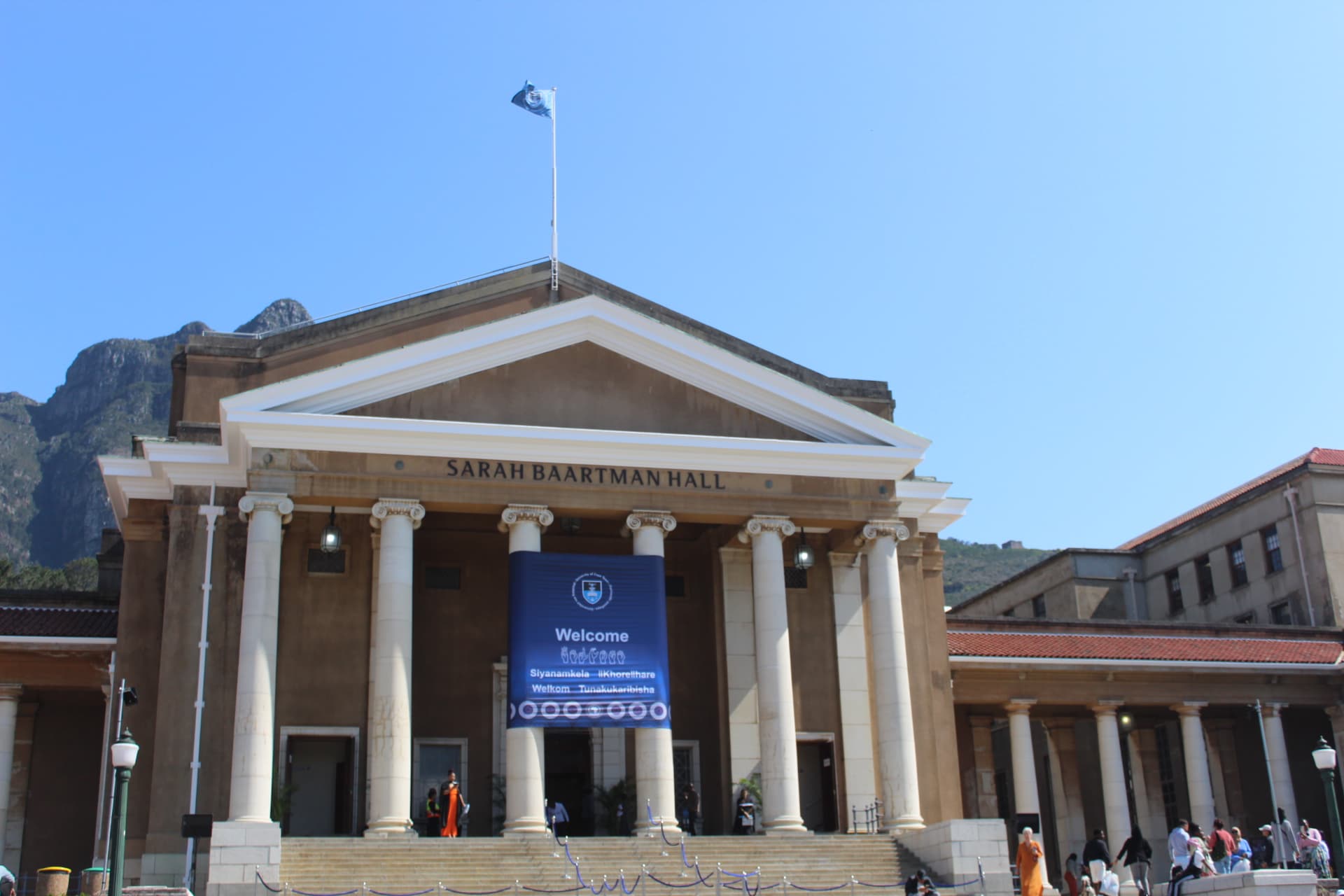
The University of Cape Town is South Africa's oldest university, and few institutions anywhere occupy a more dramatic piece of ground. Its upper campus climbs the lower slopes of Devil's Peak on land that once belonged to Cecil Rhodes's Groote Schuur estate, its stone terraces stacked against the mountainside with the Cape Flats spread out below. At the head of the central steps stands the ceremonial hall, its columned portico facing the city, a building that has carried two very different names in its lifetime.
That change of name is a fair summary of what this page has to record. UCT's history holds real distinction, including the continent's strongest research record and the hospital where the world's first heart transplant was performed, and it also holds the long shadow of segregation and protest. The university has become one of the places where South Africa argues most openly about what should be remembered and in whose honour.
The institution began on 1 October 1829 as the South African College, a school for boys in the young colonial town at the foot of Table Mountain. Through the nineteenth century the college slowly separated its school from its tertiary teaching and built up professorships in the sciences, law and the humanities. Full university status came on 2 April 1918, when the South African College became the University of Cape Town. In the 1920s the university moved from the Gardens district to a new campus on the mountainside estate that Rhodes had bequeathed to the nation at his death in 1902, laid out to a grand terraced plan by the architect J. M. Solomon.
For much of the twentieth century UCT described itself as an open university. From the 1920s it admitted students who were not white, in numbers that stayed small, and the openness had firm limits: teaching was shared, but residences, sports and social life remained segregated. Even that partial openness was ended by the state. The Extension of University Education Act of 1959 barred Black students from registering at the so-called white universities without a government permit, and steered them instead to separate ethnic colleges. UCT's leadership opposed the act publicly and then complied with it, a period of the country's history that The Apartheid Museum in Johannesburg documents in full.
The decades that followed were marked by recurring protest. The sharpest early episode was the Mafeje affair of 1968. The university council had appointed Archie Mafeje, a Black South African anthropologist, to a senior lectureship, then rescinded the appointment under pressure from the government. Students occupied the Bremner administration building for nine days in protest. Mafeje built his career abroad and never held the post; in 2008, after his death, the university issued a formal apology to his family. Through the 1970s and 1980s the campus saw marches, boycotts and police action as staff and students opposed apartheid with varying degrees of resolve. After 1994 the university turned to the slower work of transformation, widening access, diversifying its staff and rethinking what it taught.
The upper campus is the university's signature. Solomon's plan arranged the teaching buildings in symmetrical terraces up the mountainside, linked by a monumental flight of steps rising from the rugby fields to the portico of the great hall. The setting, with Devil's Peak behind and the city and False Bay in the distance, is regularly counted among the most striking campus landscapes anywhere. Below it, the middle and lower campuses hold residences, law and music, while the health sciences faculty sits at Observatory beside Groote Schuur Hospital, the teaching hospital where Christiaan Barnard, a UCT graduate and faculty member, performed the world's first human heart transplant on 3 December 1967.
UCT teaches around 29,000 students across six faculties covering commerce, engineering and the built environment, health sciences, the humanities, law and science. Among its scientific holdings is the Bolus Herbarium, built on the collection of the botanist Harry Bolus and one of the oldest herbaria in the country, a primary record of the Cape Floristic Region, the smallest and richest of the world's floral kingdoms.
For decades a bronze statue of Cecil Rhodes sat brooding partway up the campus steps, on land he had owned. On 9 March 2015 a student protest against the statue began, arguing that a memorial to the arch imperialist of southern Africa had no claim to the centre of a modern African university. The Rhodes Must Fall movement that formed around the demand occupied the administration building, forced a debate the institution had long deferred, and won quickly: the council voted for removal, and on 9 April 2015 the statue was lifted from its plinth before a huge crowd. The movement did not stop at the campus boundary. It carried to a parallel campaign at Oxford and fed the national student protests over fees and decolonisation later that year.
The university then turned to its own names. The great hall at the head of the steps had been called Jameson Hall, after Leander Starr Jameson, the colonial politician remembered for the raid that carries his name. In December 2018 the council renamed it Sarah Baartman Hall, for the Khoikhoi woman who was taken from the Cape to Europe in 1810 and exhibited as a curiosity in London and Paris until her death in 1815. Her remains were kept and at times displayed in a Paris museum for nearly two centuries, and were returned to South Africa in 2002, at the request of Nelson Mandela, for burial in the Eastern Cape. The renaming placed her name above the university's graduations and gatherings: a person once stripped of dignity in life given a standing place of honour in the country she was taken from.
The campus also carries a harder lesson about how fragile a kept record can be. On 18 April 2021 a wildfire running along the slopes of Table Mountain jumped into the university and gutted the reading room of the Jagger Library, home to UCT's Special Collections. Part of the printed African Studies collection and the African film collection was destroyed, losses no insurance can restore. Yet much survived: fire shutters protected the basement stores, and in the weeks that followed staff and volunteers carried out tens of thousands of manuscripts and archives, freeze-drying water-damaged material and triaging the rest. The fire accelerated a long-running digitisation programme, and the university is rebuilding the reading room around the collections that endured.
Five Nobel laureates are associated with the university. Max Theiler, who began his medical studies at UCT, won the 1951 prize for the yellow fever vaccine. Allan Cormack, a UCT physics graduate, shared the 1979 prize in medicine for the theoretical foundations of the CT scanner. Aaron Klug, who took his first degree at the university, won the 1982 chemistry prize for his work on the structures of biological molecules. J. M. Coetzee, who studied and later taught at UCT, received the Nobel Prize in Literature in 2003.
The university's graduates run through the public life of South Africa and the wider continent: judges of the Constitutional Court, among them the anti-apartheid lawyer Albie Sachs; ministers, central bankers and vice-chancellors; writers, filmmakers and generations of doctors and engineers. Archie Mafeje himself, denied his post in 1968, became one of Africa's most influential anthropologists in exile, and his critique of how the continent was studied is now taught in the department that could not hire him.
UCT is consistently ranked the leading university in Africa in the major international tables, and it remains the continent's strongest producer of highly cited research. Its Drug Discovery and Development Centre was the first of its kind in Africa, and its astronomers work with the Southern African Large Telescope and the Square Kilometre Array project. The work of transformation continues alongside the research: the student body is now majority Black, the professoriate is slowly changing, and the debates that Rhodes Must Fall opened, about curriculum, names and belonging, remain live in the institution's daily life.
The upper campus is best reached from the M3 highway below Devil's Peak, and visitors can walk the central steps to the portico of Sarah Baartman Hall for one of the finest views in Cape Town, out over the southern suburbs to the Cape Flats and the Hottentots Holland mountains. In the suburb of Rosebank the university runs the Irma Stern Museum, the former home of the painter, kept with her studio and her collection much as she left them. The upper campus steps and the view back over the Cape Flats are open ground; buildings and the Special Collections need arranging in advance.